451
Effect of Learning Strategy Based on
the Problem on the teaching and
improvement of Learning Processes
for the Students of Physical
Education Teaching Methods
Ismaeel Abid Zaid Ashoor, Muneeb Hassan
Nashmi, Muntadar Hussain Sabit
Faculty of basic Education- Department of Physical Education, University of Mustansiriya
Article Info
Received: March 31, 2014 Accepted: April 25, 2014
Published online: December 01, 2014
Abstract
The aim of present study is to know the effect of learning strategy based on the problem on the teaching and improvement of learning processes for the students of physical education teaching methods. Sixty two (62) students from faculty of basic education-University of Mustansiriya in Baghdad province were selected intentionally assigned into two groups (n=62), where each group consisted of 31 students. An experimental research design was used because it is suitable to the nature of the study. Research tool is a test of science processes that was made by Al-Saify (2002) which including 31 graphs. The study was conducted in 2012-2013 and data was analyzed by using SPSS. However, our conclusions confirmed that using learning strategy based on the problem has a positive effect on learning processes for the students of physical education teaching methods and improve mental capacities for students. In addition, it helps to improve discover processes.
Keywords: Learning strategy, learning processes, teaching methods, physical education.
1. Introduction
452
This kind of learning increasingly prevalent with time because it provides the student open learning positions which different of traditional teaching methods. The modern learning involves specific skills should be teaching to students such as problem-solving skills, communication skills, learning skills with meaning, and the skills of science operations, this is what we find available when apply the learning strategy based on the problem because this kind of learning works to provide scientific material for students in design of scientific problems lead to revitalize activity in the ration. Learning strategy based on problem different of problem solving strategy in a number of matters. The strategy of the problem solve can be used without requiring curriculum design (and teaching units) as required by learning based on the problem. Strategy of problem solving is mostly achieved during learn concepts and principles by strategies and methods differently, the role of strategy is to use concepts and educated principles and employed in solving the academic and life problems, so the importance of present study is to provide teaching strategic reduce the emphasis on conservation and develop other aspects among female students such as science operations in response to many of the recommendations and researches on a global and local level which calls attention to the need for the development of learning processes.
The reality of teaching in our schools still rely on the lecture and indoctrination which is a major drawback negative learner, the abolition of motivation, save the information, and repeated without understanding, this was confirmed by many studies (Gawth, 1987; Zaror 1987; Alsharqi, 1993). There is no doubt that the nature of teaching methods of physical education has a special importance for the other subjects because they allow to the learner the opportunity for discovery and innovation, and the development of the scientific method of thinking for the learner which qualifies him to address the surrounding environmental problems. Several studies focused on using different teaching strategies, trying to find out the impact of these strategies in the development of various aspects of learning such the collection, direction, and innovation, this studies varied in their results which leaves the door open for further studies. Present study is trying to investigate the effectiveness of the teaching strategy and help students in building their knowledge of themselves through provide different positions to them.
453
Moreover, identify the impact of the learning strategy based on the problem in the teaching and development skills of science operations for methods of physical education teaching.
2. Methodology
Researchers used experimental design method which consisted of (experiment and control groups) because it is suitable to the nature of present study.
2.1 Subject
Society of study included whole students of forth class of physical education department\ faculty of basic education Al-Mustansiriya University, years of 2012-2013 and study part was the seventh. Number of sample is 62 girl student assigned into two groups (experiment and control groups). Experiment group used teaching strategy which based on problem, whereas second group (control) used normal teaching. However, we achieved an equal between two groups in science operations before teaching our method, so we can see the results in table (1) as following:
Table (1)
Shows mean, stander deviation, and T test for both groups
Groups Mean SD T test Freedom degree Significant
Control 11.1 3.78 0.243 122 No
Experimental 11.2 4.33
No significant at the level less than 0.05 and freedom degree 122.
Table (1) showed that no significant differences between middle of both groups degrees, so the two groups are equal in science operations test.
2.2 Study materials
We divided study materials into:
2.2.1 Teacher guide: which including
1. Theoretical introduction about teaching strategy based on problem, such as what is it, it is benefits, philosophy of teaching which connect with it and how using them inside class. 2. Lessons depend on learning strategy based on the problem are vocabularies of physical
education teaching methods which including aims, activities and scientific issues, and methods of evaluation.
454
2.2.2 Student guide
It was prepared to help the student to study the unit by using a learning strategy based on the problem. Guiding is included a simple theoretical background and worksheets for each lesson of the unit lessons by using the strategic. However, worksheets included a scheme about students working plane by depending on learning based on problem.
2.3 Study tool
It is a science processes test which was made by Saify (2002) on a great sample similar to present study sample. This is one of the reasons to select this test, as has already been introduced on a large sample of arbitrators, in addition to knowledge of persistence which amounted to (0.80) using the stability of internal consistency. The test is consisted of 31 items, the choice is multiple and included number of science processes as shown in table (2).
Table (2)
Shows distribution of the test items on science operations
Science operations Numbers of items Account
Observe 11 ،9 ،1 3
Classification 27 ،18 ،14 ،13 4
Inference 23 ،17 2
Conclusion 29 ،25 ،19 ،4 ،3 5
Use numbers 21 ،16 ،12 ،8 ،2 5
Explain 26 ،7 2
Forecasting 30 ،20،22 3
Hypotheses impose 31 ،28 ،6 3
Adjust the variables 24 ،15 ،10 ،5 4
Total 31
Evidences has been showed after complete on the number of arbitrators from the professors of physical education department in the faculty of basic education Al-Mustansiriya, and a number of educational supervisors and teachers. However, arbitration is aimed primarily to review the evidence from the scientific and educational and directorial aspects.
2.4 Scientific research procedures
First: Identify the unit which will be applied in the study to be the first unit (physical exercise and divisions).
455
Third: Prepare a teacher guide which including lessons from the selected unit building on the learning strategy based on the problem designed for the use in the teaching process and shows it to the arbitrators to verify the truthfulness.
Fourth: Prepare the student handbook to be used while teaching by using learning strategy based on the problem and verify the truthfulness.
Fifth: Select two classes for the experimental group and two classes for the control group randomly.
Sixth: Science operations test was used by the study sample (experimental group and the control group). The aim is to ensure equality of the two groups in the science operations before the starting of the study.
Seventh: Chose work team for the teaching of experimental and control groups and training them on the teaching by using learning strategy based on the problem.
Eighth: The actual using of the proposed unit for a period of 8 weeks by (16) educational unit. Ninth: Using science operations test again by the study groups after completed of teaching
learning unit directly.
Tenth: Perform statistical analysis suitably to get good results and discos them.
2.5 Steps of experimental group teaching
1. Division the students into cooperative groups (each group consisting of 5-6 students) so as to adjust the impact of cooperative learning.
2. After introduction of the lesson, the teacher is given a simple introduction about the problem at hand that is related to the lesson.
3. We would distribute the working paper to the students which included the steps of problem solve, and diverse sources of magazines, books or references or from the international information network.
4. Teacher is determined the time to achieve the task and her role in this part is to make learning operation easy.
5. Students discuss the problem and solve it.
6. After completed the time of groups, teacher will discuss the groups about their solutions that got them and confirm the best solution then will give the information which not discussed. 7. Teacher will state the points which not showed by groups such as show slides or part of
movie.
8. Teacher can be evaluation work of groups.
2.6 Statistical analysis
456
3. Results and Discussion
Results for the first sub-question: What is the difference between the means in grades of two study groups in the test of science operations?
To answer this question, the means, standard deviations, and independent T test of the performance of the control group and the experimental group were calculated for each process of science operations and at the test as a whole (table 3).
Table (3)
Shows means, standard deviations, and independent T test of the performance of the control group and the experimental group in science operation test
Operation Groups Mean SD T test Freedom
degree
Significant
Observe N= 3 Control 1.37 0.84 1.216 122 No
Experiment 1.58 0.93
Classification N= 4 Control 1.91 0.73 0.590 122 No
Experiment 2.02 1.06
Forecasting N= 3 Control 1.24 0.86 0.099 122 No
Experiment 1.26 0.96
Explain N= 2 Control 0.68 0.67 3.098 122 S
Experiment 0.97 0.727
Inference N= 2 Control 0.89 0.68 2.166 122 S
Experiment 1.16 0.73
Conclusion N= 5 Control 1.92 1.08 2.202 122 S
Experiment 2.37 1.20
Use numbers N= 5 Control 2.26 1.04 2.722 122 S
Experiment 2.81 1.20
Adjust the variables N= 4
Control 2.32 1.13 0.297 122 No
Experiment 2.40 1.81
Hypotheses impose N= 3 Control 1.15 0.87 2.092 122 S
Experiment 1.48 0.94
Total performance Control 14.9 4.41 2.301 122 S
Experiment 16.7 4,84
N= number of items. Each item= one degree
457
reached 14.9 with a standard deviation of 4.41, and the difference between the means statistically significant at the level of α≤0.05. This results can be attributed that students of the experimental group (who studied by learning strategy based on the problem) gained science operations during the exercise of this type of learning, since the problems which approached to subjects of unit studied by the students did not gain only the content but they gained a set of mental and scientific skills such as analysis, interpretation, and the conclusion and the imposition of hypotheses.
Chun-Yen and Barufaldi, (1999) sees as stated by Ibrahim (2004) that learning based on problem is not based only on the knowledge and information (know what) but beyond that through focus on cognitive measures (ie. find out how), where (know what) enables learners to acquire only theoretical knowledge while (find out how) enables learners to use the knowledge and concepts in new situations. this application requires the use of a set of mental skills (science operations) such as observation, interpretation, and conclusion and others. Duch (1996) confirmed that students in the learning strategy based on the problem passing with experience is known as (Science exercise), which means using the skills of different science operations previously mentioned in the access to information.
Moreover, this type of learning is not provide ready information to students but the learner himself searched for and accessed through multiple sources for example scientific books, encyclopedias, and electronic sources (ie: Internet). To do this, the learner uses a set of skills such as observation, forecasting, conclusion, reasoning, and analysis, thus the student acquires the information and grow with him. However, the female students in the control group was not improved, Sonmez (2003) pointed out that the problems provided to students in learning based on problem method confirm and work to acquire and develop different thinking skills (science operations), and analysis skill. It is also concluded from table (3) that experimental group was better than control group in performance in five operations (ie: Explanation, inference, conclusion, number using, and hypotheses impose) where means amounted (0.97, 1.16, 2.37, 2.81, 1.48), while means of the same operations for the control group were (0.68, 0.89, 1.92, 2.26, and 1.15).
458
confirm that these operations are not needed a large effort by teacher to improve them and we can improve them by the prevalence method.
Results for the second sub-question: What is the difference between means of degrees of two groups in pre and post-studies for science operations test?
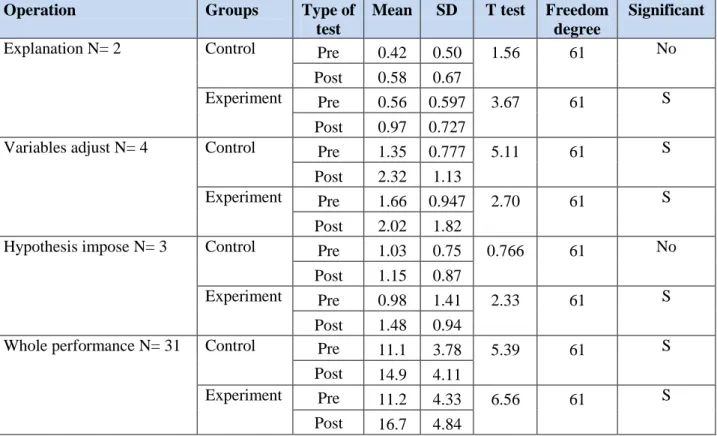
To answer this question, the means, standard deviations, and independent T test were used to know significant between means of pre and post-tests. So researchers divided results of question to two tables, table (4) concluded basic science operations (Observation, classification, forecasting, inference, conclusion, numbers using), and table (5) included integrative science operations (Explanation, variables adjust, hypothesis impose, and whole performance), the aim of the division is to make it easier to the reader.
Table (4)
Shows means, standard deviations, and independent T test of the performance of the control and the experimental groups in science operation of pre and post-test (Basic)
Operation Groups Type of
test
Mean SD T test Freedom
degree
Significant
Observe N= 3 Control Pre 1.08 0.89 1.82 61 No
Post 1.39 0.84
Experiment Pre 0.89 0.52 4.56 61 S
Post 1.58 0.93
Classification N= 4 Control Pre 1.62 0.95 1.96 61 No
Post 1.92 0.73
Experiment Pre 1.61 0.93 2.42 61 S
Post 2.02 1.06
Forecasting N= 3 Control Pre 0.72 0.81 3.61 61 S
Post 1.24 0.86
Experiment Pre 0.95 0.84 1.87 61 No
Post 1.23 0.96
Inference N= 2 Control Pre 0.42 0.50 0.127 61 No
Post 0.58 0.67
Experiment Pre 0.66 0.65 3.92 61 S
Post 1.16 0.73
Conclusion N= 5 Control Pre 1.50 0.90 2.32 61 S
Post 1.92 1.07
Experiment Pre 1.37 0.98 5.31 61 S
Post 2.37 1.24
Use numbers N= 5 Control Pre 1.90 1.05 1.96 61 No
Post 2.26 1.04
Experiment Pre 2.03 1.01 4.01 61 S
459
Table (4) showed improvement in science operations skills for experimental group which studied by using learning strategy based on problem in whole science operations have been previously mentioned in table (4) but no in forecasting, where means of science operations in pre-test were (0.89, 1.61, 0.66, 1.37, 2.03) while in post-pre-test (1.58, 2.02, 1.16, 2.37, 2.81) this differences are significant whereas no significant differences between pre and post- test in forecasting skill. No significant differences were showed for control group who used prevalence method in science operations such observation, classification, inference, and numbers using while was significant in forecasting and conclusion skills. However, table (5) showed integrative science operations.
Table (5)
Shows means, standard deviations, and independent T test of the performance of the control and the experimental groups in science operation of pre and post-test (integrative)
Operation Groups Type of
test
Mean SD T test Freedom
degree
Significant
Explanation N= 2 Control Pre 0.42 0.50 1.56 61 No
Post 0.58 0.67
Experiment Pre 0.56 0.597 3.67 61 S
Post 0.97 0.727
Variables adjust N= 4 Control Pre 1.35 0.777 5.11 61 S
Post 2.32 1.13
Experiment Pre 1.66 0.947 2.70 61 S
Post 2.02 1.82
Hypothesis impose N= 3 Control Pre 1.03 0.75 0.766 61 No
Post 1.15 0.87
Experiment Pre 0.98 1.41 2.33 61 S
Post 1.48 0.94
Whole performance N= 31 Control Pre 11.1 3.78 5.39 61 S
Post 14.9 4.11
Experiment Pre 11.2 4.33 6.56 61 S
Post 16.7 4.84
460
when the students of the experimental group. However, we can say that learning strategy based on problem helped students a lot in an improvement most of science operations which was tested in the present study because of using science operation through search about information in the different sources and find a solution for these problems. Gagne as stated in the Najdi and Rashid (1999) indicated that science operation is an acquire behavior which can be learned and trained and can be generalized and transferred to other aspects of life, since many of life's problems can be analyzed and propose appropriate solutions when achieve of science operations. Greenwald (2000) indicated that learning based on the problem helps students to acquire science operations because they practice it during their search for the sources of knowledge to solve problems given to them. Hassard (2005) see that there is a very strong relationship between the acquisition of the student for science operations and its ability to solve problems because solving problems require carrying out different thinking.
4. Conclusion
Our conclusions confirmed that using learning strategy based on the problem has a positive effect on learning processes for the students of physical education teaching methods and improve mental capacities for students. In addition, it helps to improve discover processes.
References
Duch, B. (1996). Problem based learning in physics: the power of students teaching students, Journal of College Science Teaching, March/April issue: 326-329.
Greenwald, N. (2000). Learning from problem, The Science Teacher, 67(4):28-32. Hassard, J. (2005). The Art of Teaching Science, New York, Oxford University Press.
Ibraheem Bassam (2004). Impact of the use learning based on problems in the teaching of physics to improve the ability to creative thinking and attitudes among students of ninth class, the teacher / student magazine, 1-2:4-22.
Najdi Ahmad and Abdul hadi (1999). Entrance in the teaching of science, Cairo, Dar Arab Thought, 25-37.
Saify, Saeed (2002). Measurement of science operations of general learning students in Amman, Master thesis, Qaboos University.