POTENTIAL RISKS OF LEGAL LIABILITY FOR COLLECTING INSTITUTIONS: AN EMPIRICAL STUDY OF LEGAL CLAIMS AND A COMPARISON WITH LEGAL ISSUES
INCLUDED IN LIS GRADUATE CURRICULA
Emily Elizabeth Roscoe
A dissertation submitted to the faculty at the University of North Carolina at Chapel Hill in partial fulfillment of the requirements for the degree of Doctor of Philosophy in the School of
Information and Library Science.
Chapel Hill 2020
Approved by:
Christopher (Cal) Lee Helen Tibbo
©2020
ABSTRACT
Emily Elizabeth Roscoe: Potential Risks of Legal Liability for Collecting Institutions: An Empirical Study of Legal Claims and a Comparison with Legal Issues Included in LIS Graduate
Curricula
(Under the direction of Dr. Christopher [Cal] Lee)
In this study I address legal liability risks for collecting institutions and the way graduate Library and Information Science (LIS) programs incorporate law and legal issues in their
classrooms. I study historical state and federal legal claims that involve collecting institutions as named parties to learn about the types of claims these institutions have faced. I do this by
retrieving and analyzing 6,597 relevant federal and state dockets, using the proprietary databases Bloomberg Law and Westlaw. I look to the federal Nature of Suit (NOS) and state Key Nature of Suit (KNOS) codes—which apply to each docket—to identify the various categories of legal claims involving these collecting institutions.
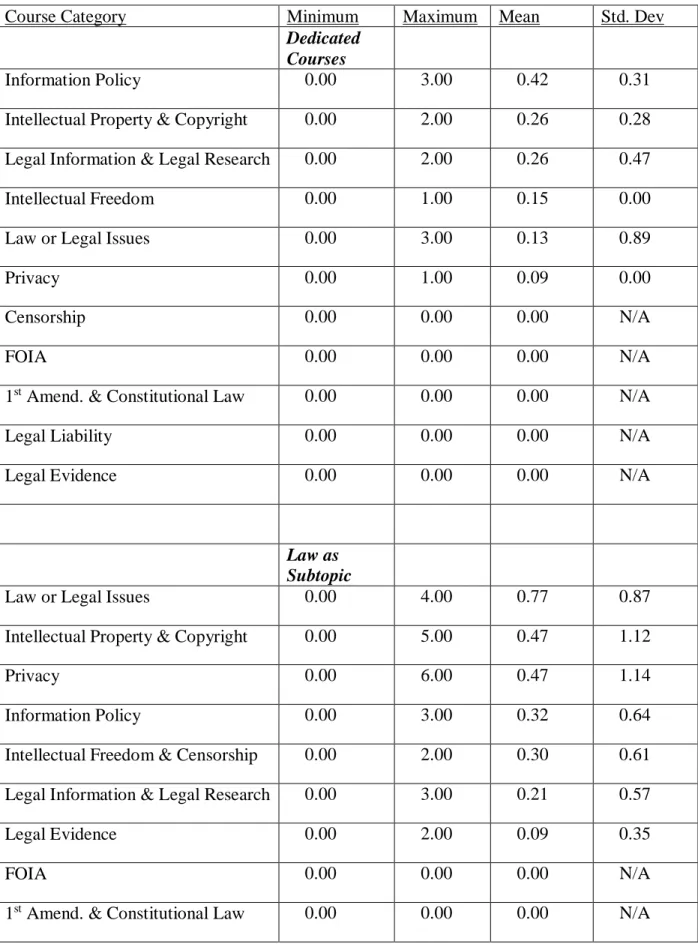
To understand how law is addressed in graduate LIS curricula, I examine courses offered in American ALA-accredited institutions, noting instances in which law and legal issues are included as the focus or part of a course. With these data, I compare the results to detect similarities and differences between the legal issues represented in docketed claims and those represented in the LIS curricula and literature. My findings indicate that graduate LIS curricula usually include at least one elective course concerning law or legal issues. However, many of the legal issues covered in graduate LIS curricula are not the same legal issues that collecting
in a much broader range of legal issues than the legal issues highlighted in “library law” literature. I suggest the LIS field take note of the full array of legal issues that may surface, including those that are not unique to collecting institutions.
I dedicate this dissertation to information professionals who know their mission to be providing access to knowledge. I studied this topic and wrote this text with thoughts of the professionals who must tackle difficult issues of legal liability risks for their institutions. I hope
the material within can help professionals avoid legal disputes and consequently dedicate their time to primary duties in their respective collecting institutions.
Disinterested intellectual curiosity is the life blood of real civilization.
ACKNOWLEDGMENTS
I very much appreciate UNC SILS for supporting me throughout my studies, especially since I have taken a non-traditional path. I am delighted to be an alum of this School. Thank you to my doctoral committee for your valuable feedback and backing in this process. I am honored to have each of you as an advisor. To my Chair, Dr. Cal Lee, you have been a constant
inspiration to keep learning and exploring in the records management and archival science field. I am lucky to have had the opportunity to study under your guidance. Thank you Dr. Helen Tibbo and Dr. Denise Anthony for keeping me focused on why we love this particular discipline. I value our many conversations about the LIS field. Thank you Professor Anne Klinefelter for providing insights about law library administration as well as being a great boss over these years. Thank you Mr. Brian Manning for your thoughtful participation in my project. Your practitioner-based input has been very valuable. I cannot imagine a better set of advisors for this dissertation study.
TABLE OF CONTENTS
LIST OF TABLES ...x
LIST OF FIGURES ... xi
LIST OF ABBREVIATIONS... xii
CHAPTER 1: INTRODUCTION ...1
1.1 Purpose of the Study ...4
1.2 Research Questions ...5
1.3 Significance of the Study ...6
CHAPTER 2: LITERATURE REVIEW ... 11
2.1 Law and LIS Curricula ... 11
2.1.1 Focused Curriculum Research ... 12
2.1.2 Curriculum Research for the Inclusion of Legal Issues Generally ... 16
2.1.3 Conclusion ... 23
2.2 Legal Issues for Information Professionals and Collecting Institutions ... 23
2.2.1 Sovereign Immunity ... 24
2.2.2 Legal Issues as Discussed in Academic and Professional Publications ... 32
2.2.3 Legal Issues Often Excluded or Not Emphasized ... 48
2.2.4 Conclusion ... 50
2.3 Government Mandates and Public Laws for Collecting Institutions ... 51
2.3.1 Custodial Duties ... 52
2.3.2 Public Information Law and Policy ... 57
2.3.4 Conclusion ... 66
2.4 Perceptions of Risks and Liability ... 67
2.4.1 Relationship to Behavior and Decision-Making Research ... 67
2.4.2 Attitudes and Perceptions of Risk ... 70
2.4.3 Risk Analysis ... 72
2.4.4 Misperception and Errors in Thinking ... 76
2.5 Conclusion ... 81
CHAPTER 3: RESEARCH DESIGN AND METHODOLOGY ... 82
3.1 Analysis of Legal Dockets and Natures of Suits ... 82
3.1.1 Federal Dockets ... 85
3.1.2 State Dockets ... 87
3.1.3 Docket Analysis ... 88
3.2 Analysis of ALA-Accredited Graduate LIS Curricula ... 88
3.2.1 Content Analysis and Coding ... 90
3.2.2 Special Coding and Analysis ... 93
3.3 Research Limitations ... 93
CHAPTER 4: FINDINGS ... 97
4.1 Results of Legal Dockets and Natures of Suits Analysis ... 97
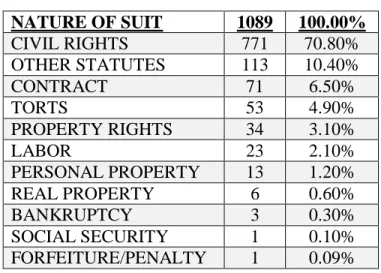
4.1.1 Federal Docket Nature of Suit (NOS) Counts ... 98
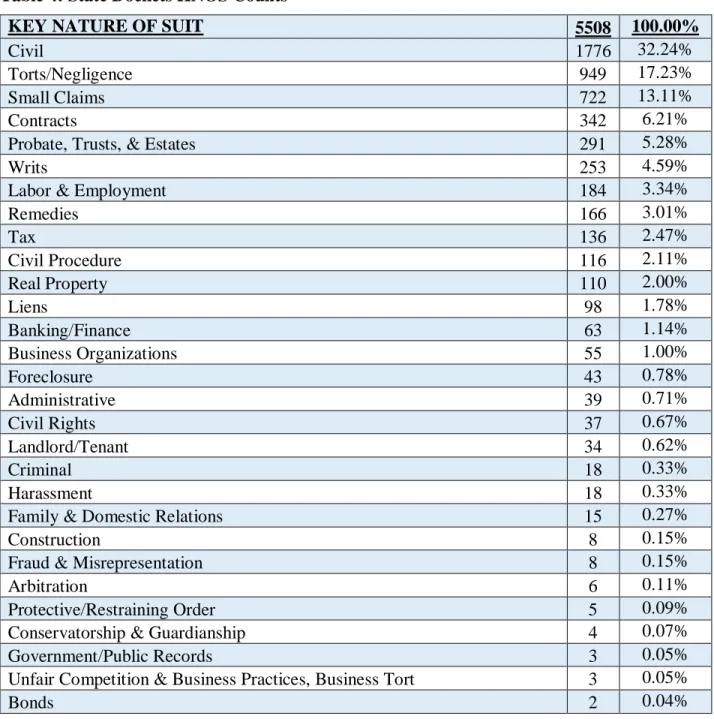
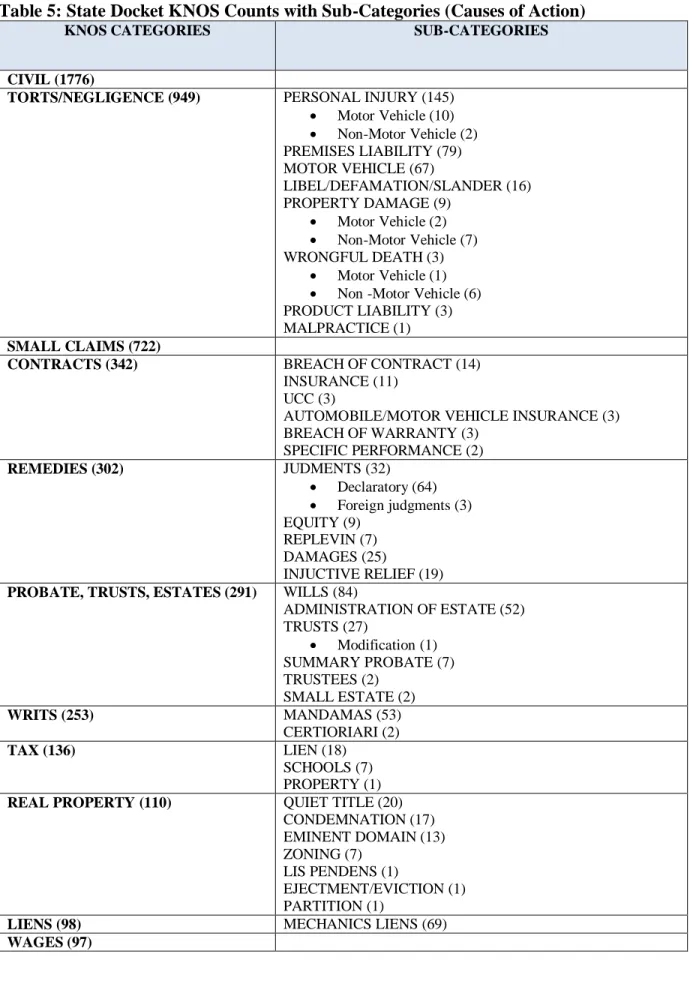
4.1.2 State Docket Key Nature of Suit (KNOS) Counts ... 98
4.1.3 Results Summary ... 108
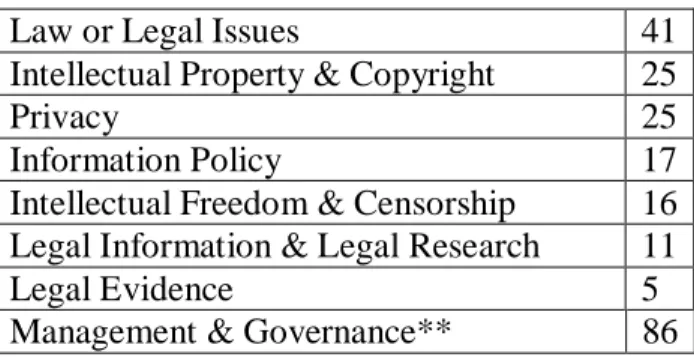
4.2 Results of ALA-Accredited Graduate LIS Curricula Analysis ... 115
4.2.1 Management and Governance ... 118
4.2.2 Information Policy ... 118
4.2.4 Legal Information and Legal Research ... 119
4.2.5 Legal Evidence ... 119
4.2.6 Other Legal Topics and Courses ... 120
CHAPTER 5: DISCUSSION ... 121
5.1 Results of Legal Dockets and Natures of Suits Analysis ... 121
5.2 Results of ALA-Accredited LIS Graduate Curriculum Analysis ... 122
5.3 Comparisons ... 123
5.4 Recommendations... 127
5.4.1 Course Proposal ... 127
5.4.2 Other Recommendations ... 131
5.5 Conclusion ... 132
APPENDIX A: LIST OF ALA-ACCREDITED GRADUATE LIS PROGRAMS ... 134
LIST OF TABLES
Table 1: Research About LIS Curricula Coverage of Specific Legal Issues ... 15
Table 2: Research About LIS Curricula Coverage of Legal Issues (Generally) ... 22
Table 3: Federal Docket NOS Counts ... 98
Table 4: State Dockets KNOS Counts ... 99
Table 6: Courses by Category: Dedicated Courses ... 116
Table 7: Courses by Category: Law as Subtopic ... 116
Table 8: Descriptive Statistics of Law Course Listings ... 117
Table 9: Federal Docket Categories Compared with LIS Courses and Corresponding Percentages ... 123
Table 10: State Docket Categories Compared with LIS Courses and Corresponding Percentages ... 124
Table 11: Proposed Topics for Graduate LIS Course on Law ... 128
LIST OF FIGURES
LIST OF ABBREVIATIONS
ADA Americans with Disabilities Act ALA American Library Association
ALISE Association for Library and Information Science Education
CIP Cataloging in Publication
CIPA Children’s Internet Protection Act CLE Continuing Legal Education COPA Child Online Protection Act
CPOEA Child Protection and Obscenity Enforcement Act E&O Errors and Omissions
FTCA Federal Tort Claims Act
IMLS Institute of Museum and Library Services
IP Intellectual Property
iSchool Information School
IUPUI Indiana University–Purdue University Indianapolis
JD Juris Doctorate
KNOS Key Nature of Suit
LIS Library and Information Science LSTA Library Services and Technology Act
NOS Nature of Suit
NSA National Security Agency OIF Office for Intellectual Freedom
SAA Society of American Archivists
SARF Social Amplification of Risk Framework
TPB Theory of Planned Behavior
CHAPTER 1: INTRODUCTION
Collecting institution administrators likely do not spend much time judging the probability of particular kinds of liability claims that could be made against their institutions. They must attend to a myriad of responsibilities to fulfill their fundamental mission of providing access to information. They know they can best serve their institutions by requiring staff to have advanced degrees in the library and information science field and incorporate continuing
education opportunities in relevant subject areas. They also likely appreciate that the law is a complex subject that in some respects requires specialized education to understand well. At the same time, they hear about legal claims receiving attention in the media and in professional circles, which may form their impression of the most important legal issues for their
organizations. A logically related question is: how prevalent are certain legal claims involving collecting institutions; does the literature acknowledge this frequency; do graduate library and information science programs address this frequency in the classroom when discussing law and legal issues?
Information professionals have generally agreed that law and legal issues are an important aspect of the work of collecting institutions. What remains to be determined is what legal issues are highlighted in scholarship and in LIS curricula and often arise for collecting institutions. The academic and professional library and information science (LIS) literature and LIS graduate curricula emphasize certain legal issues related to collecting institutions. For instance, in Library Law and Legislation in the United States, author Alex Ladenson (1982) includes a chapter titled “Special Legal Problems of Concern to Libraries.” He opens the chapter with the following:
Several bodies of law, though not limited to libraries, nonetheless have a direct impact on them. Most important are copyright, security of property, freedom of expression, and the right of privacy (p. 145).
When certain legal issues—like those listed by Ladenson—consistently appear in the literature about law and libraries, readers are likely to consider those issues to be the full range of legal issues important to libraries and other collecting institutions. While these more commonly discussed and taught legal issues may be very important to collecting institutions, much of it is now settled law that carries minimal risk for legal liability for libraries. What is missing from the LIS literature on legal issues is a systematic study of claims made against collecting institutions to surface those legal issues that frame historic and potentially future risks of liability for collecting institutions.
full trial (and even more rarely get appealed or reach the highest appellate court like the state or federal Supreme Court). Most of the legal claims in the American court system do not receive attention because the proceedings are not easily accessible in the same way as appellate opinions. Yet, legal issues that arise but do not get litigated or appealed are important because they give a holistic sense of legal liability. Looking into the claims from the lowest courts can help managers avoid serious lawsuits that could tie up an organization for many years as these claims pass through appellate courts. Information professionals should be concerned about these legal issues and not just the issues addressed in Supreme Court cases.
Furthermore, scholars cannot readily look up cases in which the court chooses not to issue an opinion; so, litigation involving collecting institutions that results in no opinion goes unexamined. Even litigation with an accompanying opinion could be missed if the opinion is not “published” or “reported.” Cases are reported or published when the court deems a point of law to be significant. Only these cases hold precedent in the respective jurisdiction. Unpublished or unreported cases are not citable. Even though the two main legal databases Lexis and Westlaw currently offer unreported/unpublished cases, these databases are not accessible by the average person. Law libraries sometimes provide access to these databases for free or for a minimal charge, but access typically requires a physical visit to the library; remote access is not available. Furthermore, many small law libraries like public law libraries, lower-tier or unaccredited academic law libraries, and court libraries may not collect the primary resources that include unreported or unpublished opinions.1
1 The primary resource for unreported federal cases is the Federal Appendix, a case law reporter published by
Because they represent only a small subset of legal disputes that have been reported and published,2 the handful of opinions discussed in the literature and covered in LIS graduate
education that directly relate to libraries and other collecting institutions could provide an unrepresentative look into “library law.” This is concerning because books and articles that discuss legal issues based upon landmark court cases can give the impression that those particular issues are the most common and form the biggest risk of legal liability for collecting institutions, when in fact the sample is quite small, and the majority of case law related to collecting institutions is effectively hidden. If administrators and LIS professionals consult the relevant literature to learn about legal liability risks and the legal issues affecting collecting institutions, it is not helpful if “library law” gives an inaccurate perception of common risks.
1.1 Purpose of the Study
The purpose of my study was to identify the most common legal claims involving collecting institutions and document how LIS graduate programs incorporate law and legal topics. In the first research phase, I examined docketed claims filed against libraries, archival institutions, and historical societies, noting the nature of suit for each claim. In the second research phase, I analyzed curriculum information from American Library Association (ALA)-accredited LIS graduate course descriptions and syllabi for relevant law-related courses. Through this examination, I identified the most common legal issues facing these institutions. Graduate LIS programs and information professionals can more properly address legal liability risks with empirical information—i.e. what types of claims occur most frequently.
2 In fiscal year 2016, 88.7% of all federal Courts of Appeals cases terminated on the merits after oral hearing or
submission on briefs (except for cases heard in the Federal Circuit) went unpublished. Table B-12, Annual Report of the Director: Judicial Business of the United States Courts,
1.2 Research Questions
This doctoral study covers the following research questions: 1. What lawsuits have collecting institutions faced?
2. How do ALA-accredited LIS graduate programs include law and legal issues in the classroom?
1.3 Significance of the Study
Never stir up litigation. A worse man can scarcely be found than one who does this. -Abraham Lincoln3
Litigation: A machine which you go into as a pig and come out of as a sausage. -Ambrose Bierce4
Because the cost is so high for being unprepared for legal actions, or being uninformed about law in general, information professionals need guidance with practical value, and this guidance should be based in evidence. Abraham Lincoln’s and Ambrose Bierce’s comments about litigation are more insightful than they could have known in their 18th-century lives. Some
of those who engage in litigation may, by default, trust the court system to apply the law
rigorously and resolve the dispute fairly. Litigants also naturally hope to prevail in their action or that they receive a favorable outcome. The reality often does not match these hopes. Even if the decision is to a party's advantage, the process is lengthy and the expense and cost in time will often significantly exceed the award or other advantage obtained in the decision.
Someone who believes himself to be aggrieved often finds justification to file a lawsuit against a perceived wrongdoer. The plaintiff begins by filing a complaint, which states the
actions that violate the law or other legal duty, or circumstances needing resolution, relevant law, and requested remedies (e.g. “stop what you are doing,” “do what you are supposed to do,” or “compensate me for my harm”). The defendant must answer this complaint by admitting or denying the various claims or raise other motions. If the plaintiff’s claim survives the
defendant’s answer or motion to dismiss, the case progresses into the discovery phase during
3 Basler, R. P., 1953, p. 82.
which both sides gather information about the claims at hand. Discovery can be very expensive and time-consuming. Parties must divert resources to respond to discovery requests, collecting evidence, and preparing for trial. Both sides must pay stenographers and experts in depositions, and travel is often necessary. If summary judgment motions (a regular exercise in court) are denied, the case proceeds to trial or the parties are ordered to engage in alternative dispute resolution such as mediation. Trials can last for months and usually require the involvement of multiple third parties who demand compensation.
Even the simplest litigation can become all-consuming in the short term. If a library, archive, or other collecting institution is served with notice of a lawsuit, routine responsibilities change, and staff must commit work hours to deal with the problem. These institutions must address the legal claims while also maintaining core functions. Librarians and archivists rarely have educational or practical backgrounds in law and, therefore, must rely heavily on their
formal LIS training, professional continuing education, and colleagues for guidance about how to handle legal issues and manage risks of legal liability. Relying on others with legal training is unavoidable and certainly valuable, but this leaves institutions vulnerable to a system in which legal professionals can profit from prolonging disputes. Good legal advisors would rather keep clients by establishing trusted relationships, rather than self-interestedly generate hourly fees by complicating matters, but libraries do not customarily generate enough legal business to form those relationships.
more than 15 million new civil actions were filed in state courts,5 and more than 277,000 new civil cases were filed in federal district courts.6
Being engaged in litigation is costly even when prevailing on the merits. Just dealing with the initial filing and early discovery can cost in excess of $20,000.7 The median litigation
costs for the types of cases in which a collecting institution is most likely to be involved are substantial: $91,000 for a contract matter, $88,000 for an employment matter, and $54,000 for a premises liability matter.8 The costs of a trial in attorney time and associated expenses are
readily apparent, but a trial takes only between one-third and one-half of the litigation time in a typical case.9 The next biggest use of litigation time is discovery, which takes between one-fifth
and one-quarter of total attorney hours.10 Accordingly, an institution may incur substantial expenses even with a lawsuit that can be settled or dismissed through actions other than a trial. The Northwestern University Center on Law, Business, and Economics, which studies the impact of laws and regulations on economic growth, concluded, based on empirical research of multi-national companies, that “Litigation transaction costs, independent of judgments awarded
5 National Center for State Courts. (2018). State Court Caseload Digest. Retrieved from
http://www.courtstatistics.org/~/media/Microsites/Files/CSP/National-Overview-2016/SCCD_2016.ashx.
6 Administrative Office of the U.S. Courts (2018). Federal Judicial Caseload Statistics. Retrieved from
https://www.uscourts.gov/statistics-reports/federal-judicial-caseload-statistics-2018.
7 National Center for State Courts. (2013). Estimating the Cost of Civil Litigation. Retrieved from
http://www.courtstatistics.org/~/media/Microsites/Files/CSP/DATA%20PDF/CSPH_online2.ashx.
8 Id.
9 Id.
in disputes or settlements reached between parties, constitute a significant cost of doing business in the United States,” far in excess of other industrialized nations.11
Litigation costs may not be as common for or weigh as heavily on most collecting institutions as they do on the kinds of multi-national companies that the Northwestern study researched. However, the findings described below show that a significant number of lawsuits are filed against collecting institutions and both their likelihood and financial impact are risks that should be considered. Also, unlike companies that are used to litigation as part of their business, collecting institutions are unlikely to be budgeting for substantial litigation expenses, which could have a significant impact on the institution’s ability to accomplish its mission. To operate in a manner that realistically accounts for legal risk, information professionals should have proper training in terms of required graduate-level education as well as continuing education opportunities.
More specifically, proper training can be construed as training that focuses not only on legal issues that are typically associated with the LIS discipline and collecting institutions, but also with legal issues that are apt to arise day-to-day (if there is a difference, of course). Much of the literature, as described in subsequent sections, does not consider claims brought against collecting institutions that have not resulted in landmark opinions. Without a systematic view of the legal disputes in which collecting institutions are involved, especially if such suits do not progress to full litigation and result in precedential court opinions, information professionals will remain ill-equipped to consider the array of potential legal liability risks for their institutions.
11 Lawyers for Civil Justice, Civil Justice Reform Group. (2010). U.S. Chamber Institute for Legal Reform,
“Litigation Cost Survey of Major Companies. pp. 5-15. Retrieved from
Understanding the realities of the lawsuits collecting institutions face–an object of this study–can result in a more careful consideration of the risks of potential litigation and better practices to avoid such risks. When collecting institutions are sued (and information
professionals are named as parties, as is often the case), diversion of monetary resources from other functions are not the only costs. When presented with formal legal complaints, library administrators gather information from employees about the alleged incidents, which may seem unimposing, but these types of diversions can, and inevitably do distract from employees’ daily work and focus on the institution’s mission. As described above, even claims that are ultimately dismissed in court require attention from administration and staff, and at times these distractions are time-consuming. Collecting institutions in small communities may be particularly
disadvantaged since these institutions employ fewer staff and have less access to legal experts in their organizations and locales. Across the board, collecting institutions could benefit from better insight into the various legal liability risks according to primary data.
My observations and thoughts described above informed my dissertation study. I
analyzed 1) types of legal claims involving collecting institutions and 2) the way legal issues are incorporated in LIS graduate education. My findings illustrate how current LIS graduate
CHAPTER 2: LITERATURE REVIEW
In this literature review I give an overview of the legal issues and policies commonly cited as related to collecting institutions as well as issues are often omitted. I also address the legal structure for public collecting institutions and the distinctive rules they must consider. Lastly, I describe the scholarship of risk perception and misperception.
2.1 Law and LIS Curricula
The oldest and largest professional associations for librarians and archivists acknowledge the importance of covering legal issues in graduate education for information professionals. The American Library Association (ALA) published a list of “Core Competencies for Librarianship” that identifies what knowledge and skills graduates of accredited master’s programs in library and information studies should know and be able to employ. Listed among the foundations of the profession is the “legal framework within which libraries and in information agencies operate,” and that this framework includes “laws relating to copyright, privacy, freedom of expression, equal rights (e.g., the Americans with Disabilities Act), and intellectual property” (American Library Association, 2009). Similarly, the Society of American Archivists (SAA) states in its Guidelines for a Graduate Program in Archival Studies that one goal is to communicate to students the “ethical and legal dimensions of their work” (Society of American Archivists, 2016). SAA also notes legal issues related to specific archival functions that must be covered to address core archival knowledge and contextual knowledge (e.g. the various laws and
must be a part of graduate curricula, very little has been studied and published about the way LIS graduate programs cover law and legal issues in their curricula.
2.1.1 Focused Curriculum Research
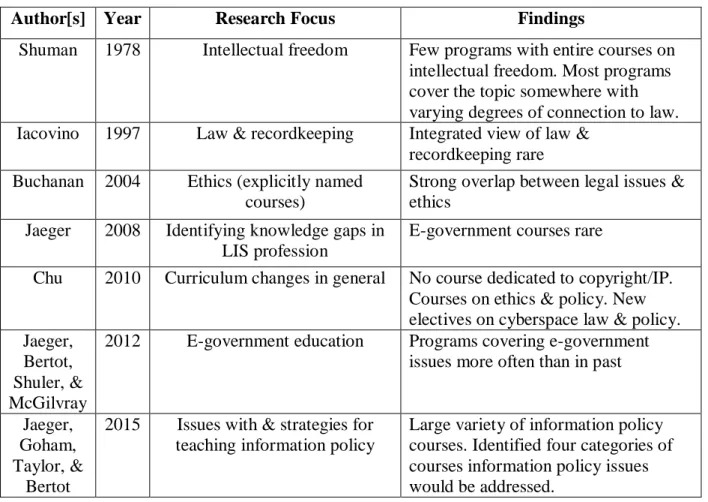
Several studies address specialized curricula or cover the content of LIS programs for how they include specific issues. These studies show how legal issues are incorporated in curricula; however, they are too selective for readers to make general conclusions about the way law is addressed in LIS education. For instance, in 1978 Bruce Shuman of the University of Oklahoma collaborated with the ALA’s Office for Intellectual Freedom (OIF) to study the inclusion and emphasis of intellectual freedom and censorship issues in graduate library science curricula. Shuman and the OIF used a questionnaire to elicit their data. Their findings indicate that comparatively few programs at the time—only about fifteen percent—offered entire courses dedicated to intellectual freedom, but that nearly all programs had the topic inserted somewhere in other graduate courses (p. 106). Questionnaire responses showed a wide variability in the content of the intellectual freedom classes, though, with some topics implying a stronger connection to law than others (e.g. recordkeeping and privacy legislation vs. analysis of ALA mission statements and positions).
Iacovino (1997) reported that an integrated view of law and recordkeeping was generally missing from archival education in Australia and how Monash University structured its
to graduate instruction was unclear and variable. Buchanan posed questions to inform such a discussion:
Should an ethics class be the place where students learn the principles of fair use and the four criteria used to evaluate fair use, or should we talk more theoretically about the importance of fair use in the support of the information commons, or both, for instance? Should an ethics class challenge legal arguments against moral arguments? What if an existing law, for example, the USA Patriot Act, stands in direct violation of principles of intellectual freedom and traditional LIS ethics? (2004, p. 58).
Chu (2010) analyzed LIS education in forty-five United States-based ALA-accredited programs to identify curriculum changes. Chu found no required course solely dedicated to copyright or intellectual property, but identified five required courses focused on information ethics and policy. Also, Chu noted newly-offered elective courses, and found eleven instances of cyberspace law and policy classes.
Jaeger, Goham, Taylor, and Bertot (2015) discussed issues with and strategies for teaching information policy in a digital age. Although their piece is more normative than empirical, the authors provided some insight into the current state of LIS education with regard to information policy. They explained that the LIS field is unique in its “regular attention to information policy as a broad topic area, rather than to the individual issues that fall within information policy” (p. 177).12 They noted that there is a large variety of information policy
courses and courses in which information policy may be discussed, observing that courses that do not immediately appear to be focused on information policy (i.e. those with words like “policy,” “law,” and “government” in the course title) may include important aspects of information policy (e.g. human rights, digital inclusion, and information literacy) (p. 181).
12 The authors pointed out that a problematic aspect of a broad coverage of information policy issues is that truly
Jaeger, et al. described information policy classes as fitting into four categories. Classes seemingly unrelated to information policy like Collection Development may include discussion of copyright, and these courses are meant to “familiarize students with existing laws and
policies,” not delve into the details. Formal information policy classes are aimed at addressing large, societal issues and helping students “understand how these issues intersect” (p. 182). In writing about information policy classes, the authors included classes about policy and program evaluation and classes on specific information policies. Finally, they identified classes on issues affected by policy. This category includes courses on, for example, human rights that require students to consider current laws and policies about information access and the “implications of policies that do not consider access” (p. 182).
Other literature indirectly addresses LIS education and the incorporation of legal issues by identifying service and knowledge gaps in the profession and recommending ways LIS programs could address such gaps. Jaeger (2008) explained that governments at all levels are increasingly providing services electronically, but for various reasons citizens have trouble using these “e-government” services (e.g. lack of digital information literacy, general lack of
knowledge about government structures, and lack of access to technology) (p. 168). Jaeger further explained that public libraries have stepped in to assist patrons with their use of e-government services, stating that “[m]any federal state, and local e-government agencies now direct residents to the nearest public library for access and help in filing taxes, welfare requests, immigration documents, and numerous other essential government forms” (p. 168). This new service role for librarians presents new opportunities for LIS curricula. He wrote that LIS
government information are common, courses about e-government are quite rare (p. 170). The author presented the e-Government master’s concentration available through the College of Information Studies at the University of Maryland and in partnership with the Center for Information Policy and Electronic Government (also at the University of Maryland) as a case study for addressing curriculum deficiencies. Jaeger, Bertot, Shuler, and McGilvray (2012) provided a follow-up to the 2008 article and reported that other LIS programs have made efforts to include e-government issues in their graduate programs. Table 1 summarizes the literature about LIS programs’ coverage of specific legal issues.
Table 1: Research About LIS Curricula Coverage of Specific Legal Issues
Author[s] Year Research Focus Findings
Shuman 1978 Intellectual freedom Few programs with entire courses on intellectual freedom. Most programs cover the topic somewhere with varying degrees of connection to law. Iacovino 1997 Law & recordkeeping Integrated view of law &
recordkeeping rare Buchanan 2004 Ethics (explicitly named
courses)
Strong overlap between legal issues & ethics
Jaeger 2008 Identifying knowledge gaps in LIS profession
E-government courses rare
Chu 2010 Curriculum changes in general No course dedicated to copyright/IP. Courses on ethics & policy. New electives on cyberspace law & policy. Jaeger,
Bertot, Shuler, & McGilvray
2012 E-government education Programs covering e-government issues more often than in past
Jaeger, Goham, Taylor, &
Bertot
2015 Issues with & strategies for teaching information policy
2.1.2 Curriculum Research for the Inclusion of Legal Issues Generally
Even in more detailed studies about the incorporation of legal issues in LIS education, a lack of standardization persists. For instance, authors use different categories to characterize the legal topics covered in LIS education. A few authors have attempted to address “legal issues” broadly when looking into graduate LIS programs, but their methods for analysis differ, causing inconsistencies. Direct comparisons are difficult because study methodologies differ so greatly. In this particular body of literature, how authors define legal issues and law-related courses or course content affects how these authors assess LIS programs for their coverage of law. I also found no mention in the literature about standard introductory textbooks about law and the LIS field. The readings assigned in courses addressing this topic include a wide array of formats— textbook chapters, scholarly journal articles, practitioner publications, etc. This part of the literature review focuses more on how law and legal issues are incorporated into LIS curricula overall, and not specifically what required class materials are being used.
ways. First, they examined responses from the ALISE Library and Information Science
Education Statistical Report. Second, they sent survey questionnaires to deans and directors of the various LIS programs. Finally, they analyzed available curriculum material on the
institutions’ websites. Their study is a valuable model, one that I use in this doctoral study. Gathegi and Burke found that courses fall into three categories: information law, legal information management and processing, and intellectual freedom/ethics. They looked into the relative frequencies of the various courses, reporting the least and most frequent course in each category. In the information law category, the authors identified courses such as Information Policy, Information Law/Legal Issues, Media Law, and Information Security/Privacy. They found that information policy courses were the most frequently listed while copyright and intellectual property courses were the least frequently listed. Gathegi and Burke explained that despite the surprisingly low number of copyright and intellectual property courses these issues may nonetheless be covered in information policy courses. In the legal information management and processing category, they identified courses related to the use and management of legal information such as Legal Research, Law Libraries, Government Information, and Legal Informatics. Their findings indicate that government information courses were the most frequently listed in the curricula at the time of their study. In the intellectual freedom/ethics category—which was found to be the least emphasized category in LIS curricula across the studied schools—the authors discovered material highlighting only tangential connections to the law. For example, they found courses including Intellectual Freedom and Censorship and Ethics.
and 32% of responding schools had on their faculty individuals with JDs. There was no further information given, however, about options for specialization in the dual degree curricula or details about who survey respondents considered to be members of their faculty (i.e. tenured, lecturers, adjuncts, etc.) when reporting if any of their faculty had JDs.
In 2011, Dryden conducted an update—although different and in some ways more limited in scope—to the Gathegi and Burke research by studying course descriptions, syllabi, and reading lists that included coverage of legal issues at nine Canadian graduate LIS programs. Dryden aimed to understand the overall depth of coverage as well as what topics are addressed most frequently. She based her 2011 study upon previous work in which she investigated the copyright practices of Canadian archivists; she had found uneven understanding of this area of law by professional archivists (Dryden, 2008; Dryden 2010). In this prior research, Dryden asked participants to share the sources of their copyright knowledge, and responses indicated a limited reliance on graduate education as a source of copyright training. Dryden explained in her 2011 work that it is important to understand how archivists and librarians are being educated in copyright and intellectual property law. Additionally, Dryden described why it is important to understand not only how copyright and intellectual property law are incorporated into graduate education, but also legal issues in general including privacy, freedom of information, records retention requirements, and freedom of speech (p. 184).
legal issues, but less-frequently. These topics are related to specific statutes, namely freedom of information legislation, record-keeping requirements, the legal authority for information
organizations, and labor law.
In Dryden’s discussion of these findings she implied that the inclusion of intellectual property law and copyright into LIS education is understandable. She wrote that the “role of libraries and archives in making copies of holdings for users has long been recognized in
copyright law” (p. 189), and because emerging digital technologies have provided opportunities for increased access, there is a constant need to ensure “an appropriate balance between the public interest in access to protected works, and the rights of copyright owners” (p. 189). What remains unclear, however, is the reason copyright makes its way to the forefront of LIS legal education over the three-year period between Dryden’s study and that of Gathegi and Burke. Dryden made no attempt to address the change or tackle causality. Dryden described the rationale for an inclusion of intellectual freedom issues, writing that “[l]ibraries play a
fundamental role in facilitating access to all expressions of knowledge and intellectual activity through their holdings, services, and programs.” She explained that it is unsurprising that privacy issues are frequently covered, especially in courses related to reference services in the digital world (p. 189).
analysis, issues, and practice” (p. 537),13 and coded for faculty members with formal legal
educations. Cross and Edwards found that out of the 57 ALA-accredited programs, 42 (73 percent) offer some course explicitly dealing with legal frameworks and practice (p. 538). The authors noted, however, the relative paucity of law in curricula. They reported that “more than half of all ALA-accredited master’s programs offer zero or one class, and fewer than 25 percent offer two or more classes” and found that no program requires a law-related course for master’s level students to graduate (p. 538).
Additionally, they discovered that less than half of the programs have faculty members with JDs, and the majority are adjunct or joint faculty (pp. 538-539). This lack of a full-time faculty member with a JD at most institutions is concerning for LIS students as the one faculty member who is knowledgeable about legal issues for collecting institutions may be “physically distant from the library school building because of a primary appointment elsewhere” (p. 540). Finally, Cross and Edwards discussed what they call “pedagogical shortcomings” in the way legal issues are taught in LIS programs, highlighting the inevitable “gradual, cumulative” process in learning law. They explained that “one class on copyright taught by an adjunct professor from the law school will not necessarily prepare [LIS] students to know and employ the legal
framework within which libraries and information agencies operate” (p. 540).
Schmidt and English (2015) argued that copyright and intellectual property issues are vital additions to LIS curricula. The authors studied emerging copyright and intellectual property demands on LIS professionals to gain insight into potential needs to alter LIS graduate
education. In their study the authors analyzed LIS programs during 2013-2014 in ways similar to
Gathegi and Burke and Dryden. They used simple keyword searches14 to identify courses with content relevant to copyright and intellectual property. They categorized these courses into:
(1) required courses dedicated to copyright/IP issues, (2) elective courses dedicated to copyright/IP issues, (3) required courses with a copyright/IP component, and (4) elective courses with a copyright/IP component
(Schmidt & English, 2015).
The authors’ analysis shows no required courses dedicated to copyright/IP within the fifty-one LIS programs in the study, but eleven programs offered elective courses dedicated to copyright (typically one course at the respective institution). They identified nine required as having some likely copyright/IP content,15 and they found thirty-five instances of elective
courses with some likely copyright/IP content. This breakdown between required and elective courses and between explicit and implied inclusion of copyright/IP is illuminating because it provides potential insight into the prior Gathegi and Burke findings (i.e. copyright and
intellectual property are strangely absent in LIS curricula). Gathegi and Burke did not account for broad courses titled “Legal Issues” as likely covering some copyright/IP material. The Schmidt and English study—though brief and only partially related to documenting the current LIS graduate education landscape16—sheds light on the difficulties in precisely studying
curricula. Bailey (2010) similarly found that many topics in a LIS program for academic
librarianship were not prominently mentioned in syllabi (including “copyright” and “intellectual
14 The authors used the keywords “copyright,” “intellectual property,” “legal,” and “ethic.” The authors explain that
they used “ethic” because there is often overlap between information ethics and intellectual property. If a retrieved information ethics course ultimately had little or no relevance to intellectual property, the authors disregarded the particular course.
15 The authors found only three elective courses dedicated explicitly to copyright/IP with the other six describing the
content as “legal or ethical issues.” However, copyright is likely included within that broad category, and thus the course was counted.
16 The core of the Schmidt and English study is an examination of the views of library professionals about perceived
property”), but likely “are touched on in many courses” (p. 38). These inconsistencies in course listings, lack of available syllabi, and outdated course descriptions are indeed problematic for content analysis. Table 2 summarizes the way LIS graduate programs have incorporated legal issues into their courses.
Table 2: Research About LIS Curricula Coverage of Legal Issues (Generally)
Author[s] Year Number of LIS Programs Studied
Findings
Gathegi & Burke
2008 63 (US & Canada) Three categories of law-related courses: (1) information law (2) legal information processing & management (3) intellectual freedom/ethics
Dryden 2011 9 (Canada) Copyright most frequently covered. Second and third most frequently covered are intellectual freedom & privacy.
Cross & Edwards
2011 57 (US & Canada) 73% of programs offer course
explicitly dealing with law. More than 50% offer zero or one course dealing with law. Fewer than 25% offer two or more courses dealing with law. No program requires law-related course for graduation.
Schmidt & English
2015 51 (US) No required course dedicated to
2.1.3 Conclusion
The Spring 2010 issue of Archivaria was dedicated to archives and the law. Guest editors Jean Dryden and Loryl MacDonald referred to Terry Cook’s editorial introduction from 1984 saying, “Twenty-five years have passed since Archivaria last devoted an entire issue to the theme of archives and the law. As the editor of Archivaria 18 stated in his introduction, ‘The
relationship between archivists and “the law” is intricate, varied, and largely unexplored.’ These words are no less true in the first decade of the twenty-first century” (p. 5). As seen in the literature reviewed above, the inconsistency in how LIS graduate programs explore and incorporate legal issues into their curricula has persisted through the 2010s. Future librarians, archivists, and other information professionals receive varying degrees of training in the law, with some programs including legal issues only within courses not explicitly dedicated to law, others having elective courses about legal issues for information professionals, and even more commonly including irregular “special” courses on specific legal topics like copyright and intellectual property. Additionally, the literature covering LIS graduate education and the law varies in depth, scope, and research question, and the methods used by the various authors significantly differ. No comprehensive study about how law is incorporated into LIS curricula, in general, has been undertaken since the Gathegi and Burke study in 2008.
2.2 Legal Issues for Information Professionals and Collecting Institutions
Libraries and archives are often public institutions, established by statute, and are therefore within the purview of many laws that direct and restrict government activity.17
Governments—federal, state, and local—and sometimes their public servant employees can be required to pay damages to someone harmed by actions of the collecting institution or individual
17 Some public libraries are partially privately-funded through endowments or other philanthropic means. These
employee. This section explores the legal issues discussed in the relevant literature for what issues are considered most important, most likely to arise, or most complex. Federal and state laws direct claims against governments limiting the legal liability of public institutions. Therefore, it is first necessary to briefly discuss sovereign and governmental immunity before addressing the literature about specific legal issues common in the information profession.
2.2.1 Sovereign Immunity
According to the concept of sovereign immunity, the government cannot be sued without its consent. As Alexander Hamilton explained, “It is inherent in the nature of sovereignty not to be amenable to the suit of an individual without its consent. This is the general sense and the general practice of mankind; and the exemption, as one of the attributes of sovereignty, is now enjoyed by the government of every State in the Union” (The Federalist No. 81, in The
Federalist, 1961, p. 487).
According to another rationale for sovereign immunity, known as the “public treasury rationale,” immunity protects the allocation of public funds from unanticipated burdens that would result from uncontrolled individual tort claims (Florey, 2008, pp. 787-793). As explained below, both federal and state government consent to suit, including with tort claims acts that authorize damage suits under certain parameters. This enables governments to make policy choices about when remedies from public funds will be afforded to individuals harmed from particular government activities, and when those individuals will be left to bear their own losses. The following sections describe the main aspects of the scope of immunity.
government enjoys immunity” (p. 2). A major shift in governmental immunity occurred in 1948 when Congress enacted the Federal Tort Claims Act (FTCA) (28 U.S.C. §§2671-2680 (2017)). The FTCA allows for government liability of a public employee’s negligent or wrongful acts and omissions if the employee was acting within the scope of his or her employment. Under the FTCA, the government can only be sued “under circumstances where the United States, if a private person, would be liable to the claimant in accordance with the law of the place where the act or omission occurred” (28 U.S.C. §1346(b)). With the FTCA Congress not only makes the general policy choice that individuals should have a right to sue for certain activities. Congress also sets the rules and limits for that liability, including the prerequisites for filing suit, the time limits for doing so, and the maximum amount of recovery.
Negligence Liability is based on someone doing something that a person using ordinary care would not do, or failing to do something that a person using ordinary care would do. For someone to recover damages based on alleged negligence, four elements must be proved: duty, proximate cause, breach of standard of care, and damages. The claimant must show that the government employee had a specific duty of care toward the claimant, that the public employee failed to conform his or her duty, that the claimant suffered harm, and that the public employee’s negligence was the reasonable, proximate cause of the harm (Restatement Second of Torts §§ 281, 328A). Along with negligent acts, some intentional torts are covered under the FTCA, which are civil wrongs committed by someone acting with general or specific intent (Black’s Law Dictionary, 2009, p. 1717). Examples of intentional torts include battery, false
imprisonment, and trespass to land.
to a governmental unit’s “conduct that is performed for the profit or benefit of the [governmental unit] rather than for the benefit of the general public” (Black’s Law Dictionary, 2009, p. 1339). The government is protected from liability for the tort of an employee “who harms someone while performing a governmental function; however, the government is liable if the employee commits a tort while engaged in a proprietary activity” (Bluestein, p. 100). It is not always clear if an activity qualifies under the “governmental function” rule; this has resulted in courts looking to certain factors of the activity to distinguish public and private. Some of the factors courts consider include whether a fee is charged for the service, who typically carries out the service, and if the chief beneficiaries are community members or the jurisdiction’s residents on the whole (Bluestein, pp. 101-103).
States followed suit after Congress enacted the FTCA, passing acts of limited waiver for governmental immunity.18 These statutes differ among states and apply to counties and
municipalities as well as public officials and employees to varying degrees (Minow and Lipinski, p. 4). Some of the common aspects of state statutes addressing immunity are addressed in the following sections. Parties believing to have suffered harm can initiate a suit for recovery from the government entity (e.g. state, county, or municipality) either by naming the government or by naming an official in an official capacity as an agent for the government. Often in lawsuits brought against governments multiple entities are listed as parties, including the government, a specific unit or department within, as well as individual employees in their official capacities. Government officials may be held responsible for actions of fellow public employees, but it is important to consider who qualifies as a public official as the standard for government officials
18 There is some overlap between the federal and state liability waiver statutes, and therefore, governments may be
and government employees often differs. The difference is based most often upon a “discretionary functions” exception (Minow and Lipinski, p. 4-5).
In many jurisdictions a “public official” is someone whose position requires the exercise of judgment and discretion. A government employee would be considered to be a public official with respect to discretionary actions. A public official is not liable for mistakes of judgment or for mere negligence in carrying out discretionary functions. The public official is protected by governmental immunity, on the theory that someone asked to serve the public in a discretionary position should not be held responsible for mere mistakes of judgment, which society must tolerate if it wants people to be willing to take such positions.A public official also cannot be held liable in connection with such functions on the ground that his or her employee acted negligently. But, as stated earlier, a public official is not shielded from liability for actions that are corrupt, malicious, outside of and beyond the scope of duties, in bad faith, or willful and deliberate.19
In contrast, ministerial duties involve the execution of a clearly defined and specific duty. There is no immunity for failure to comply with ministerial acts. Those who perform ministerial acts are often considered public employees rather than public officials. Public employees who are not public officials can also be held personally liable for their negligent acts.20 The
distinction here is most important when significant damages are involved as employees who are personally liable must pay from their personal resources, not the government’s. Finally, though, many institutions rely heavily on paraprofessionals (Oberg, Mentges, & McDermott, 1992). Although the legal standard regarding sovereign immunity is unaffected by this reality,
19 This immunity provides a shield from monetary suits, but not from requests for injunctive relief (Minow and
Lipinski, p. 6).
administrators in collecting institutions may have good reason to be alert that paraprofessionals may offer services that fall outside their scope of training. Managers will likely still be
concerned, even in light of sovereign immunity, about issues of oversight.
As described above, federal and state statutes have been enacted that extend limited waiver of governmental immunity. The government itself may waive immunity in several ways. Two of the most common—acquisition of insurance coverage and voluntary waiver—are discussed here.
A lawsuit is against a governmental unit if the party making the claim seeks to have the governmental unit pay the damages. The governmental unit is immune from liability for the negligence of its officers and employees in the exercise of governmental functions unless the immunity is waived. Sovereign immunity is waived to the extent that the governmental unit provides liability insurance for acts or omissions in connection with such functions.21 An
insurance policy is a contract, and its coverage is defined by the policy terms and conditions. The policy will define who is covered, the acts for which coverage exists and the maximum amount of coverage, the obligations of those covered by the insurance (the “insureds”) to give notice and to cooperate in defense of claims, and the parties’ other rights and obligations. The amounts of coverage and the identity of the insureds (such as whether all employees are covered) will be spelled out somewhere within the insurance contract (Goldsmith, p. 10-13). This insurance is sometimes called “professional liability” insurance or “errors and omissions” (“E&O”) insurance (Fisher, p. 18).
Policies have a coverage limit. In general, the insurance company does not have to pay any amount of a loss that exceeds the policy limits. The coverage can apply to public officials as
well as employees, but only for liability while acting within the course and scope of authority or duties. A typical insurance policy includes the duty to defend—the insurance company is
obligated to provide a defense to the insured against covered claims, including paying the fees for an attorney. When an attorney is required, the insurance company usually has right to select the attorney. Most policies give the insurance company the option of paying or settling a claim rather than defending against it. The insurer usually has the right to negotiate directly with someone suing the insured for a covered claim to determine the best route. The insured is usually prohibited from admitting liability or settling a claim without the insurance company’s prior agreement (doing so could be a basis for denying coverage). A typical policy also includes a duty for the insurance company to pay actual loss. The insurance policy will define the extent of the insurance company’s obligation to indemnify the insured against actual loss. In other words, if an insurance company defends the claim but is unsuccessful, the policy probably requires the
insurance company to pay the damages awarded, up to the policy limits.
The typical policy contains a number of conditions to, and exclusions from, coverage. As a condition, governmental units must give notice of an incident that may result in a liability claim to the insurance company, in writing, as soon as practicable. Typical exclusions are, for example, for fraudulent, dishonest, or criminal behavior; for intentional, willful, or malicious conduct; for breach of contract; for violating labor laws; for punitive damages; and for someone who personally inflicts sexual abuse. Finally, insurers are typically authorized to pursue
parties in the insured’s name. A subrogated insurance company has all of the insured’s rights, including relevant defenses, against a third party who was responsible for the loss.22
Courts in this country always have afforded federal, state, and local governments sovereign immunity against lawsuits for most of the common activities in which they face potential liability, including negligence. Federal and state legislators have understood this to involve a policy choice between freeing the government from the potential of liability and leaving those harmed by government actions to bear the loss. There is an inherent fairness question if two people suffering the same harms from the same act are treated differently: the victim of a private party’s action may sue to recover from the loss, while the victim of the same action involving a government official employee has no recourse. Therefore, governments may have good policy reasons to voluntarily waive their sovereign immunity.
In general, maintaining a strong public relations profile is an important goal of public administrators, and this includes creating a relationship with citizens based on the notion of public well-being and representative governance, not ruling in such a way that appears callous or unjust. Voluntary waiver can send a message of accountability and transparency and, in turn, promote public trust. As one observer noted a few years after Congress enacted the FTCA, the act is a “high point in the fight for responsible government” (Pugh, 1953, p. 476) (emphasis added). This notion that government should take some responsibility for the harms it causes has become increasingly persuasive since government has expanded its activities into the everyday activities of its citizens, including into many activities that formerly would not have been envisioned as involving essential government activities. For example, one of the chief reasons
22 The compiled materials from the continuing legal education (CLE) event titled “Suing the Sovereign” held on
May 2, 1997 on behalf of the North Carolina Academy of Trial Lawyers Education Foundation includes in
Congress enacted the FTCA was to provide recovery to those injured by U.S. Postal Service drivers (Dolan v. Postal Service, 546 U.S. 481 (2006)). There would be little rationale today for immunizing the post office from liability for the negligence of its drivers while Federal Express and United Parcel Service are exposed to full liability for the exact same actions—to the victim it does not matter which of these services caused the harm.
Finally, governments may choose to voluntarily waive immunity for basic economic reasons. Policy makers see that retaining sovereign or governmental immunity for some actions may distort the logic of engaging in these actions at all. Internalizing the costs of losses caused by an activity can result in a more sound and fair benefits-risks analysis. This notion that individuals incorporate liability costs in their decisions about whether to engage in an activity underlies all of tort law. The famous "Learned Hand Formula" weighs the costs of preventing harm against the likelihood that it will occur and the magnitude of harm (United States v. Carroll Towing Co., 159 F.2d 169 (2d Cir. 1947)23). Modern products liability law emerged in large part because of the economic rationale that a manufacturer is motivated not to make dangerous products by bearing the costs of the harm they cause.24 Governments, too, sometimes engage in risky and ill-advised activities; for example, it was popular in prior decades for governments to install recreational slides on public piers. Voluntarily waiving immunity for harms suffered on these slides allowed governments to reevaluate providing the slides. They assessed the relative advantages and threats. Most local governments no longer build slides on piers and have removed existing ones.
23 Carroll Towing is the landmark torts case in which Judge Learned Hand set forth the rule that is taught as the
basis for negligence liability.
24 See, for example, Escola v. Coca Cola Bottling Co., 24 Cal.2d 453, 150 P.2d 436, 441 (1944) which is a landmark
2.2.2 Legal Issues as Discussed in Academic and Professional Publications
Literature describing how legal issues have been and currently are incorporated into graduate LIS education typically include introductory sections describing the increasing interconnectedness of law and the LIS profession. In these descriptions, authors stress the importance of information professionals’ awareness of legal issues and continued education of emerging issues. Gathegi and Burke (2008) wrote that the impact of legal developments on the information professional is “becoming so central [to the field] that at times it appears the field is in danger of being swallowed by the law” (p. 1). They studied iSchools (Information Schools) and other ALISE (Association for Library and Information Science Education) schools for how they address legal issues in their respective curricula. As stated on the official website, “The iSchools organization was founded . . . to advance[e] the information field in the 21st Century. While each individual iSchool has its own strengths and specializations, together they share a fundamental interest in the relationships between information, people, and technology.”25 The ALISE website states their mission as serv[ing] as the intellectual home of faculty, staff, and students in library and information science, and allied disciplines. [ALISE] promotes innovation and excellence internationally through leadership, collaboration, advocacy, and dissemination of scholarship.”26
Gathegi and Burke explained that one can grasp the extent of the changing environment of LIS education with a few examples including “the increasing centrality of intellectual property rights, perhaps best symbolized by controversies in peer-to-peer file sharing, database licensing issues in libraries, privacy and censorship issues (e.g., the supreme court internet filters case),
25 The iSchools Organization, https://ischools.org/About.
legal impacts of information technologies, and information liability issues.” The footnote corresponding to the argument stated:
See, for example, the various cases in which the ALA has been a party to information law-related litigation: United States v. American Library Ass’n. (2005), CIPA Internet Filtering Case; American Library Ass’n v. Reno (1994), challenge on recording-keeping and disclosure requirements of CPOEA; American Library Ass’n v. F.C.C., (2005), Broadcast flag case; American Library Ass’n v. Barr (1992), constitutionality of provision of COPA; American Library Ass’n v. Odom (1987), challenge to the classification of documents by the NSA, etc. (p. 22).
Through their explanation of the importance of law in the information field and the examples they provided, the authors ultimately instructed readers to focus on these aspects of law as related to information. Presumably, readers are graduate LIS educators and professionals. Therefore, there is potentially an impact on how future and current professionals will consider legal issues related to their work.
The same is true for publications specifically about law and collecting institutions and about legal issues for information professionals. For instance, in Library Law and Legislation in the United States, author Alex Ladenson (1982) included a chapter titled “Special Legal
Problems of Concern to Libraries.” He opened the chapter with the following:
Several bodies of law, though not limited to libraries, nonetheless have a direct impact on them. Most important are copyright, security of property, freedom of expression, and the right of privacy.
Here, Ladenson explicitly identified the “most important” legal issues for libraries; other authors have been not quite as overt. However, when certain legal issues—like those listed by
court opinions relating to libraries.27 Hall (1971) nearly exclusively provided the text of the opinions, with little additional commentary. Libraries or library associations are sometimes parties to these cases, making it understandable that LIS authors would include analysis of such issues in their writing. The reality, though, is that lawsuits rarely go through to full trial and very rarely get appealed or reach the U.S. Supreme Court. The handful of opinions directly relating to libraries likely give an unrepresentative look into “library law.” Although not a certainty for all readers, the issues discussed in these books and articles based upon landmark court cases give the impression that those particular issues are the most common and form the biggest risk of legal liability for collecting institutions. I review the most common below.
2.2.2.1 Copyright and intellectual property
One of the most discussed legal issues in academic and professional publications is copyright and intellectual property in general. Each monograph focusing on “law and libraries” or the legal issues of which information professionals should be aware dedicates a large
proportion of pages to this topic (Nasri, 1987; Minow & Lipinski, 2003; Torrans, 2004). One book titled The Law of Libraries and Archives (Carson, 2007) explores copyright and intellectual property for nearly forty percent28 of the text. The substantial amount of attention given to
intellectual property issues is somewhat intuitive because the principal mission of collecting institutions is to acquire, preserve, and make available authored works, and many of these works are protected by copyright law. The authors of these monographs often echo such a sentiment in their introductory sections. For instance, Carson begins the copyright and intellectual property chapter with the following explanation: “Intellectual property is one of the most important areas
27 Thirty-one cases are included (dating prior to 1971).
where the law affects information professionals” (p. 43). Torrans opens her copyright section by writing, “The law of copyright and the purpose of libraries are intertwined and govern one of the most important functions of society—the transmission of knowledge. Copyright law attempts to balance the rights of society with the rights of the creator of the material, and the library must be aware of the role of copyright as it shares in the important function of the transmission of
knowledge” (p. 61). Obviously, there is an interwoven relationship between libraries and copyright law because the U.S. Copyright Office29 is housed within the Library of Congress.30
Authors typically address copyright law by describing the basic statutory rights and various exceptions. Some authors also cover more complex issues by looking into case law. Two of the most common topics covered in monographs about intellectual property issues in libraries and archives are collection and circulation of materials protected by copyright and the “fair use” doctrine that lays out criteria for situations in which copyright protection does not apply. Under Section 106 of the Copyright Act (1976), copyright owners have the exclusive right to do and authorize others to do the following: (1) reproduce the work in copies (2) prepare derivative works based upon the work (3) distribute copies of the work to the public by sale or other transfer of ownership, or by rental, lease, or lending (4) perform the work publicly,31 and (5)
display the work publicly.
29 The U.S. Copyright Office is responsible for “provid[ing] critical law and policy services, including domestic and
international policy analysis, legislative support for Congress, litigation support, assistance to courts and executive branch agencies, participation on U.S. delegations to international meetings, and public information and education programs” (https://www.copyright.gov/about/).
30 The Library of Congress is the largest library in the world (https://www.loc.gov/about/). The United States
Congress has considered moving the Copyright Office out of the Library of Congress as recent as 2017 (Register of Copyrights Selection and Accountability Act of 2017, H.R.1695, 115th Cong.), but the bill was ultimately not
enacted into law.
31 Performance rights apply to literary, musical, dramatic, and choreographic works, pantomimes, and motion
![Table 2: Research About LIS Curricula Coverage of Legal Issues (Generally) Author[s] Year Number of LIS Programs](https://thumb-us.123doks.com/thumbv2/123dok_us/8224969.2180481/35.918.109.819.312.850/research-curricula-coverage-issues-generally-author-number-programs.webp)