
An Overview of the Most Important Reference Architectures for Cloud
Computing
Răzvan ZOTA, Ionuț Alexandru PETRE The Bucharest University of Economic Studies
[email protected], [email protected]
In this paper we have presented the main characteristics of the most important reference ar-chitectures designed for the cloud computing environment. Specifically, we have introduced the proposed architectures of the worldwide cloud computing companies like Cisco, IBM and VMware and we also had a look at the National Institute of Standards and Technology (NIST) reference architecture which is the starting point for all proposed architectures in the field. As one would expect, the provider dependent reference architectures are written is such a way to suit the services and products of the company, while NIST’s architecture is a more general model with more comprehensive architectural details that we highlighted in this article. In the end of the article we draw out some conclusions regarding the existing reference architectures for cloud computing.
Keywords: Reference Architecture, Cloud Computing, Software as a Service (SaaS), Platform as a Service (PaaS), Infrastructure as a Service (IaaS).
Introduction
Cloud computing is the new term used for utility computing, with emphasis on offering IT resources over the Internet, in exchange of storing and operating resources locally. In the existing literature there are a plethora of dif-ferent reference architectures, models and frameworks for cloud computing. Usually, a reference framework for cloud computing tries to offer the baseline that stands on de-signing some interoperable cloud services and also their integration in the existing infrastruc-tures of the Internet and private corporations. On a regular basis, a reference framework should offer a draft or an architectural tem-plate that could be used by others that wish to adopt similar solutions. A reference model consists in explaining the concepts and rela-tionships which sustain reference architecture, while the term reference framework refers to both (architecture + model of reference) [1]. A cloud computing architecture of a cloud like solution represents the structure of such a sys-tem. The term also refers to conceiving proper documentation of the architectural system of a cloud computing solution, facilitating the communication between the investors, taking initial decisions and it also allows the reuse of the design components and templates for other similar projects [2].
A reference model of cloud architecture rep-resents the abstracting of the cloud computing concepts and relationships, which can be used to train organizations and to create standards and guidelines in the purpose of aiding these application concepts. Groups of organizations like DMTF (Distributed Management Task Force) – are the initiators of a wiki page www.cloud-standards.org [3]. Cloud Security Alliance or Open Security Architecture devel-ops reference models for cloud which can be used by different companies in the purpose of adopting new cloud technologies. Also, com-panies being active in the field (Cisco, IBM, VMware and others), also other federal agen-cies (GSA and others) are working on some reference models of their own which have specific characteristics. Next we will present four of the most important reference architec-tures in the field:
Reference architecture CISCO - Cisco Cloud Reference Architecture Frame-work [4]
Reference architecture IBM – IBM CCRA [5]
Reference architecture National Institute of Standards and Technology (NIST) [6]
Reference architecture VMware - Archi-tecting vCloud [7]
2 CISCO reference architecture
The CISCO reference architecture is based on the cloud definition provided by NIST, in which is stated, shortly, that a cloud represents IT services offered using a network. More pre-cisely, the cloud is a model in which the IT resources and services are abstracted from the infrastructure and are provided “on demand” and “at scale” in an environment for multiple “tenants”. “On demand” stands for resources which can be supplied and billed for only when they are used. “At scale” refers to the fact that the provided services offer an “infi-nite” pool of available resources which can provide for various demands. An environment with “multi-tenants” assumes that the re-sources are available for use for multiple con-sumers (for example, business units) in one implementation.
As a reference framework Cisco follows the NIST model for the cloud, with different ser-vices (IaaS, PaaS and SaaS) and the four de-ployment models in the cloud: private, public,
hybrid and community could. Cisco talks about some of the benefits of a cloud based solution, which include mainly an increased efficiency and agility in IT. It mentions some of the basic elements of developing in the cloud which include the general steps of vir-tualization, integration, automation and fi-nally cloud service offerings. After presenting these general steps Cisco shows the Cisco cloud strategy for Enterprises which contain 3 essential points:
It offers products, services and solutions for enterprises to build a secure cloud;
It allows enterprises to supply secure cloud solutions and services to internal cli-ents;
It contributes to the cloud marketplace by promoting innovative technologies, open source standards and ecosystems develop-ment.
Cisco Virtualized Multi-Tenant Data Center (VDMC) presents architecture and an end-to-end design for a complete solution for a pri-vate cloud with IaaS. VDMC consists of mul-tiple design components for the cloud begin-ning IT infrastructure and ending with man-agement and configuration components. The base construction blocks relies on stacks of in-tegrated infrastructure parts, which can be combined and scaled; in this direction there is mentioned Vblock™ Infrastructure Packages from VCE coalition (VMware, Cisco, EMC) and also Secure Multi-Tenancy stack (SMT) which is being developed in partnership with NetApp and VMware.
The solution is built on top of a framework for providing services which can be used for host-ing services outside IaaS on the basis of the same infrastructure: for example, virtual desk-top infrastructure – VDI. The VDI solution from Cisco provides a complete infrastructure for an enterprise leading to an increase of con-trol and security over data. Also it offers an easy migration to other new desktop operating systems and it assures control over operational expenses and capital. Cisco’s solutions for building a private cloud can be used also by service providers to build cloud infrastruc-tures so they can provide public, private and hybrid solutions for their clients. In communi-cation with service providers and companies Cisco is developing an ecosystem for cloud providers, developers and consumers. This ecosystem has the advantage of using com-mon approaches to cloud technology, admin-istration, interconnection and operation in the cloud.
3 IBM reference architecture
The proposed reference architecture from IBM is called IBM CCRA (Cloud Computing Reference Architecture). It was defined in 2009 and it is continuously being improved. This solution is based on clients experience in implementing cloud hosted solutions by IBM along the years, offering guidelines for build-ing IaaS, PaaS, and SaaS for usbuild-ing IBM’s products. IBM CCRA is reflected in the de-sign of IBM’s cloud, developing for clients, hosting services and in IBM’s products with a
focus for reducing costs and obtaining a high rate of security, reliability, scalability and control.
IBM CCRA [5] consists of multiple docu-ments, which presents the current state of knowledge in the field at the moment and it provides ideas for architecture and design for implementing cloud based solutions. Like Cisco’s reference architecture white paper, IBM’s presentation also starts with a brief summary of the benefits brought to the clients by using their cloud solutions. IBM CCRA saves time and money for clients by providing detailed documentation about the steps and the necessary components for building a cloud implementation for any type (public, private and hybrid). Clients can use IBM’s experience with building public, private and hybrid cloud systems which are based on a common archi-tecture with reusable entities and product rec-ommendations.
Clients benefit with a faster start for building a cloud system which contains predefined cases and documentation that refers to archi-tectural requirements or decisions that need to be made for security, service management, performance, scalability and virtualization. The increased flexibility of the business is an-other advantage of using common reference architecture for known models (public, pri-vate, and hybrid).
The last version, IBM CCRA 3.0, offers a se-ries of new benefits, these are:
Prescriptive guidance for designing IaaS, PaaS, SaaS solutions by using IBM’s products.
Consists of various architectural products which represent the best options in IT in-dustry in regard of designing, implement-ing and administration roles and permis-sions in the cloud for consumers, service providers and builders of cloud services.
Represents a modular framework which allows focusing on the most important field for cloud development (IaaS, PaaS, SaaS, and CSP).
It offers a comparative sketch with the scope of realizing an analysis of the cli-ents of the cloud with the goal of identi-fying integration points.
Fig. 2 A model for adopting IBM CCRA (Source: [5]) In Figure 2 we can see the proposed model for
adopting IBM CCRA 3.0, based on four mod-els which contain:
Business drivers
Actors and user stories
Non-functional requirements
System context
Architectural decisions
Overview of the architecture
Components model
Operation model
Steps to follow
Also within this IBM architecture there are also documents for:
General description of the architecture
Roles and user stories
Non-functional requirements
Architectural decisions
Security
Performance and scalability
Hybrid cloud
Used standards
4 NIST reference architecture 4.1 Introduction
National Institute of Standards and
Technol-ogy (NIST) - The national institute of stand-ards and technology of the department of commerce in USA provided a document called “NIST cloud computing standards roadmap” [6], which contains: NIST’s vision over the notion of cloud computing, a refer-ence architecture for the cloud, some case studies, cloud computing standards and map-ping them in contexts regarding security, in-teroperability and portability, as well as an analysis of the case studies for identifying gaps in standards elaboration.
NIST’s definition for the cloud is unani-mously accepted and it provides a clear under-standing about cloud technologies and ser-vices. The reference architecture which is given by NIST comes as a normal follow up of NIST’s cloud computing definition. NIST’s reference architecture is a high-level concep-tual generic model that represents a powerful tool when it comes to talking about require-ments, structures and operation in cloud com-puting. The model does not fold to character-istics or requirements of producers or devel-opers of the cloud and it does not define a pre-scriptive solution that inhibits innovation. This model defines a lot of actors, activities and functions which can be used in the process
of development in the cloud computing relat-ing with a taxonomy of the cloud computrelat-ing. It contains a series of opinions and descrip-tions which are the base of a talk regarding characteristics, usages and standards in the cloud computing field.
The NIST reference architecture focuses on the needs that the cloud services offer and not on a design that defines a solution and an im-plementation. This helps with understanding operational complications that can occur in the cloud computing. NIST reference archi-tecture does not represent system archiarchi-tecture of a system specific to cloud computing, it is rather a tool for describing, analyzing and de-velopment of a specific architecture using a common reference framework.
The design of the NIST reference architecture serves the following objectives:
Understanding and illustration of various services of the cloud in the context of a
generalized conceptual model for cloud computing.
Providing technical references to govern-mental agencies and to other consumers for understanding, analyzing, categoriz-ing and comparcategoriz-ing cloud services.
Security communication and analysis, possible standards for interoperability and portability and reference implemen-tations.
4.2 General overview
In the document that NIST published there are five involved main actors which are involved in the development of a new taxonomy devel-opment regarding cloud computing. In this di-rection NIST defines the actors as being: cloud consumer, cloud provider, cloud audi-tor, cloud broker and cloud carrier. See Figure 3.
Fig. 3 Actors involved in NIST reference architecture (Source: [6]) These actors have key roles in the cloud
com-puting process, each actor being an entity (person or enterprise) that assists in a transac-tion or process and executes a certain task. For example, a cloud consumer is an individual or an organization which purchases products and cloud services, while the person that offers
these products and services is the cloud pro-vider. Due to the diversity of the available products/services categories (Software, Plat-form or Infrastructure) there will be an altera-tion to the level of responsibilities for certain aspects regarding control, security and config-uration. The cloud broker acts as a middle man
between the consumer and the provider, nego-tiating their relationship, and it helps the con-sumers overcome the level of complexity of the cloud service, thus generating cloud ser-vices with added value. The cloud auditor of-fers a valuable function for the government by coordinating performance and monitoring cloud services security.
The cloud carrier represents the organization which has the responsibility of carrying data in a similar way as a power distributor for the electric grid.
4.3 Cloud consumer
The cloud consumer is the last one to which the cloud service offers support. A consumer represents a person or an organization which has a business relationship with a cloud pro-vider. Basically the cloud consumer choses some service from a catalog belonging to the cloud provider, it sets some contract condi-tions for those chosen services and starts using them. The cloud consumer can pay for the pro-visioned services and it can plan his payments
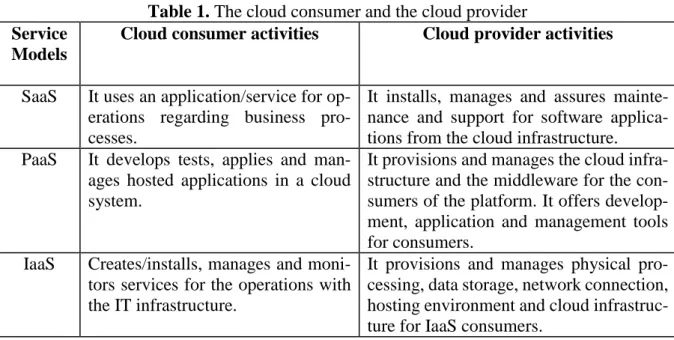
depending on the asked services. There are several scenarios and activities depending on the service that a consumer choses, these are listed in Table 1.
In Figure 4there are a couple of examples of services that can be provided to cloud con-sumers.
SaaS applications are implemented, usually, as hosted services which can be accessed through a network that connects the consum-ers with SaaS providconsum-ers. SaaS consumconsum-ers can be enterprises which offer its members access to software applications, they are the end users of the applications, or they can be administra-tors of software applications that configure the applications for final end users. SaaS consum-ers can access and use applications on demand and they can pay based on the number of con-sumers or based on the consumed services (these can be measured as: time usage, net-work bandwidth, amount of stored data or du-ration of stored data).
Table 1. The cloud consumer and the cloud provider
Service Models
Cloud consumer activities Cloud provider activities
SaaS It uses an application/service for op-erations regarding business pro-cesses.
It installs, manages and assures mainte-nance and support for software applica-tions from the cloud infrastructure. PaaS It develops tests, applies and
man-ages hosted applications in a cloud system.
It provisions and manages the cloud infra-structure and the middleware for the con-sumers of the platform. It offers develop-ment, application and management tools for consumers.
IaaS Creates/installs, manages and moni-tors services for the operations with the IT infrastructure.
It provisions and manages physical pro-cessing, data storage, network connection, hosting environment and cloud infrastruc-ture for IaaS consumers.
Fig. 4 Example of services for cloud consumers (Source: [6]) In the case of PaaS cloud consumers they use
execution tools and resources offered by cloud providers for developing, testing, implement-ing and managimplement-ing applications hosted in the cloud environment. PaaS cloud consumers can be application developers that design and implement applications, software testers that run and rest applications in different cloud en-vironments, application developers that pub-lish their applications in a cloud environment or application administrators that configure and monitor applications on a cloud platform. These types of cloud consumers can pay a tax based on the number of users, the type of con-sumed resources or duration of platform us-age.
4.4 Cloud providers
A cloud provider can be a person, enterprise or other entity responsible for making availa-ble a resource to a cloud consumer. A provider builds the infrastructure software/plat-form/services that manages the necessary technical infrastructure for providing these services, provisions services based on the ser-vice level agreements (SLA) and protects the
security and private characteristic of these ser-vices. For the SaaS case the cloud provider implements, configures and updates the oper-ating mode of the software applications on a cloud infrastructure in such a way that the pro-visioned services meet the corresponding level for the benefit of the consumer. The SaaS provider takes responsibility for manag-ing and controllmanag-ing applications as well as in-frastructure, while cloud consumers have a limited administrative control over the appli-cations.
For the PaaS case the provider manages cloud infrastructure for the platform and provisions execution tools and resources for the consum-ers of the platform for developing, testing, im-plementing and managing applications. The consumers control the behavior of the appli-cations and also they control the settings of the hosting environment, but they cannot access the infrastructure on which the platform is hosted (network, servers, operating system, storage capacity).
For the IaaS case the provider provides capa-bilities of physical processing, storage, con-nection to the network and other fundamental
calculation resources assuring and managing the hosting environment and the cloud infra-structure for the IaaS consumers. Cloud con-sumers implement and run applications, have a large control over the hosting environment of the cloud and the operating systems, but it does not manage or control the base infra-structure of the cloud (physical servers, net-work, storage capacity, hypervisors, etc.). The cloud provider activities can be analyzed in detail from the perspective of the following five characteristics: service implementation, service orchestration, service management, security and confidentiality.
Service implementation refers to implemen-tation models from the special paper called “NIST Special Publication 800-146, NIST
Cloud Computing Synopsis and Recommen-dations”, which defines public cloud models,
private, community and hybrid. A public cloud is a cloud system in which the infra-structure and the compute resources are made public through a public network. A public cloud is owned by an enterprise which sells cloud services and serves various categories of clients.
In the private cloud case, the infrastructure is
operated on entirely by a single enterprise which has access to computational resources and infrastructure in an exclusive way. The in-frastructure can be managed by the enterprise (case which holds the name on-site private cloud) or it ban managed by a 3rd-party (case which has the name outsourced private cloud). A cloud community can be managed by several organizations or 3rd-parties and it can be implemented on the location of the cli-ent or outsourced. A cloud community serves several enterprises that have a common goal, which can be regarding security, confidential-ity and conformconfidential-ity. A hybrid cloud is a bination of two or more models (private, com-munity and public) created by unique entities that are connected by standardized technolo-gies or property which assures data and appli-cations of portability.
Service orchestration refers to a way of or-ganizing, coordinating and managing of cloud infrastructure so as to offer the possibil-ity of optimizing cloud services with the scope or reducing costs. Figure 5shows an overview over the general requirements tied to each of the three service models.
Fig. 5 Service orchestration for cloud providers (Source: [6])
Cloud service management contains all func-tions regarding necessary services for manag-ing and operatmanag-ing offered services to cloud
consumers. As it is shown in Figure 6, cloud service management can be described from the following perspectives: business support,
provisioning and configuration, interopera-bility and portainteropera-bility requirements.
Fig. 6 Cloud service management (Source: [6])
Security is a vital function within all level of reference architectures (See Figure 7). At the Department of Defense of USA it was elabo-rated in July 2012 a Cloud Computing
Strat-egy which foresees taking specific actions re-garding “cyber-security, operation continuity, information insurance and resilience”.
Fig. 7 Characteristics regarding security and confidentiality from the whole cloud architecture view (Source: [6])
White Paper called “Challenging Security Re-quirements for U.S. Government Cloud Com-puting Adoption” which defines an overview
over priority problems regarding governmen-tal organizational security as obstacles in adopting cloud computing solutions.
In these documents there is an emphasis on the fact that security, compatibility and security policies requirements represent functions re-garding jurisdiction characteristics of the country in which the cloud services are being offered, these vary from country to country. Due to this aspect and independent auditor will check compatibility with the security pol-icies regulations.
Confidentiality and personal data protection is one of the key imperatives in the cloud field. Taking into consideration that cloud compu-ting solutions offer a flexible way of accessing shared resources, software and information it raises an issue regarding confidentiality. For example, the Federal Council in USA has written a document “Recommendations for Standardized Implementation of Digital Pri-vacy Controls” which takes in consideration
three basic ways for confidentiality control: Personal information inventory, Confidential-ity impact evaluation and Privacy Notice. The recommendations are that the governmental institutions can identify and take into consid-eration all personal information that can be collected or exposed through digital technol-ogy, analyze confidentiality risks through per-sonal data updates and offer notifications to individuals in regard to the way of collecting, storing, and processing and publishing per-sonal information.
4.5 Cloud auditor
A cloud auditor is a 3rd-party which can do an independent evaluation over:
Cloud services
Performance and operation modalities of informational systems
Cloud security implementations The cloud auditor can evaluate provided ser-vices by a cloud provider in relation to various parameters, which are: security control, im-pact over confidentiality, performance and
mapping to SLA characteristics. The audit ac-tion is extremely important to governmental institutions which need to assure security con-trols over the cloud providers including here actions over management, operation and tech-nical solutions for confidentiality insurance, integrity and availability of the system and also of the data stored through it. For security audit, a cloud auditor can elaborate methods of controlling security verifications, including a checking phase of system compatibilities with the security policies of the benefiting en-terprise.
4.6 Cloud broker
The cloud broker is an entity which manages usage, performance and provision of cloud services by negotiating the relationship be-tween cloud providers and consumers. With the evolution of cloud computing systems, in-tegration of cloud services can be a complex task which can be very difficult to manage for a cloud consumer. In both cases a cloud con-sumer asks for cloud services through a broker instead of contacting the cloud provider di-rectly. Cloud brokers offer a single entry point for managing several cloud services. The key characteristic that separates a cloud broker from a cloud provider is the fact that it can of-fer a consistent interface for multiple provid-ers indifferent if the interface is a technical or business one. In general there are three service categories for brokers:
Service Intermediation: enhances a given service by improving some specific capa-bility and providing value-added services to cloud consumers. The improvement can be managing access to cloud services, identity management, performance report-ing, enhanced security, etc.
Service Aggregation: combines and inte-grates multiple services into one or more new services. The broker provides data in-tegration and ensures the secure data movement between the cloud consumer and multiple cloud providers.
Service Arbitrage: service arbitrage is similar to service aggregation except that the services being aggregated are not fixed. Service arbitrage means a broker
has the flexibility to choose services from multiple agencies. The cloud broker, for example, can use a credit-scoring service to measure and select an agency with the best score.
4.7 Cloud carrier
A cloud carrier acts as an intermediary that provides connectivity and transport of cloud services between cloud consumers and cloud providers. Cloud carriers provide access to consumers through network, telecommunica-tion and other access devices. For example, cloud consumers can obtain cloud services through network access devices, such as com-puters, laptops, mobile phones, mobile Inter-net devices. The distribution of the cloud ser-vices is done usually by network and telecom-munication carriers or a transport agent where a transport agent refers to a business organiza-tion that provides physical transport of storage media such as high-capacity hard drives. Note that a cloud provider will set up SLAs with a cloud carrier to provide services consistent with the level of SLAs offered to cloud con-sumers, and may require the cloud carrier to provide dedicated and secure connections be-tween cloud consumers and cloud providers A document that gives details about establishing SLAs is “Creating Effective Cloud Compu-ting Contracts for the Federal Government – Best Practices for Acquiring IT as a Ser-vice”[8].
The NIST document [6] also presents some case studies from the cloud computing field regarding standards and interoperability, map-ping cloud standards with existing ones (for example: security, portability, accessibility, performance and interoperability) and also identifying the difference between existent standardization and what needs to be done. Cloud computing is the result of distributed systems evolution, also due to the advances in technology: better hardware, low price net-works, virtualization technologies and mature interactive technologies. The majority of rele-vant standards from the cloud field belong to technologies from the pre-cloud era. In the
1 vCloud from VMware is the cloud version built on
base VMware technologies and solutions.
same time, there are several challenges in the cloud computing zone which are being dis-covered by innovations brought by service and technology producers. The interaction of service models and the distributed nature of resource control and property in cloud compu-ting has raised some standard differences; to the existing ones we add the pre-cloud com-puting era ones as well.
5 VMware reference architecture
VMware, a worldwide leader in virtualization field, brought also an important document that is the reference architecture specification for their products in the cloud computing field. This document is called “VMware vCloud1
Architecting vCloud” [7] and it is an introduc-tion that describes what a vCloud, construc-tors, resource, vCloud capabilities, manage-ment, sizing and vCloud implementation is. The general vCloud architecture is presented in the form of a puzzle in Figure 8with these components:
vCloud Director – user interface and co-ordinator; abstracts VMware resources.
vCloud API – API interface used for in-teracting with vCloud.
VMware vSphere – it’s the base of
vir-tualized resources being an element that consists of a series of products like vCenter Server and vCenter database, host ESXi and management assistant.
VMware vShield – provides security ser-vices at network level.
VMware vCenter Chargeback – an op-tional component that offers portability of resource usage measurement and eases provisioning.
VMware vCenter Orchestrator – op-tional component that eases orchestration on vCloud API and vCloud vSphere lev-els.
VMware vCloud Request Manager –
optional component which overs provi-sioning demands and approving work-loads, tracking software licenses and cloud policy partitioning.
VMware vCloud Connector – optional component what eases the transfer of an
offline vApp application in OVF format from a local vCloud or vSphere to a re-mote vCloud.
Fig. 8 vCloud architecture from VMware (Source: [7]) From an infrastructure point of view vCloud
is build on a virtual infastructure that has its components splited into an administration cluster. In [7] there are presented the construc-tive details of the components from Figure 8 and also usage stories about those compo-nents. From those usage stories it stands out the importance of connection logs existence. As a result, tracking and monitoring is im-portant in order to prevent future attacks. An audit of a log allows an organization to verify compatibilities, detect violations of security and initialize restore points if it is necessary. A rule of thumb is to regularly examine the logs for identifying any suspicios activity. The laws and external rules can also require access to special levels of monitoring and checking. Rules are needed for restricting access, while log parsing can give some hints about system configuration errors or failures and applying any SLA rules. Thus we have identified some scopes for logs:
compatibility requirements – logs are needed for assisting audit control as well as checking security breaches, analysis and responses. For example, an authenti-cation log can check if an resource has been accesed only by authorized users.
client demands – end users (usally refered to as tenants) can obtain access to logs to correspond to their requirements.
operation integrity – operation alerts can
be defined for logs to trigger remediation notifications.
6 Conclusions
We have summarized here four important ref-erence architectures for cloud computing, re-spectively Cisco – Cisco Cloud Reference Ar-chitecture Framework, IBM CCRA, National Institute of Standards and Technology (NIST) and finally, VMware’s Architecting vCloud. Between all of them, the NIST’s architecture is provider independent, while the other three architectures belong to worldwide leaders of the cloud computing like Cisco, IBM and VMware. There are also proposed other refer-ence architectures for cloud computing from other vendors like Oracle, Microsoft, Ama-zon, Google or open source flavors like Open-Stack.
After going through the four architectures we can conclude that the independent platform ar-chitecture from NIST is the most comprehen-sive, containing also architectural details and talking about concrete case studies of usage. The other three platform dependent architec-tures basically follow NIST’s definition using their own technologies and solutions based on their own services or infrastructure elements. All the four architectures for cloud computing considered here are containing common base elements and rely on the same definition of a cloud and are following the same service
models described by NIST like: SaaS, PaaS and IaaS. Also, all the architectures are em-bracing the cloud consumers’ and providers’ interests with emphasis on the administration part, offered services and access to resources. Security of the data stored in the cloud envi-ronment is also a main concern of the cloud architectures [9].
As a final conclusion, no matter the reference architecture we discuss about, even it is inde-pendent (NIST) or company specific, it con-tains several common components and ser-vices. As an addition, ISO (the International Organization for Standardization) and IEC (the International Electrotechnical Commis-sion) have published in October 2014 under the auspices of ISO/IEC 17789:2014 specifies the cloud computing reference architecture (CCRA). The reference architecture “includes the cloud computing roles, cloud computing activities, and the cloud computing functional components and their relationships” [10], be-ing available only by buying from
www.iso.org. As for future research we will investigate this new ISO/IEC proposed stand-ard which could become in the future the de facto standard for cloud computing reference architecture.
References
[1] L.Wilkes, “Cloud computing reference ar-chitectures, models and frameworks”,
Everware CBDI, 2011, Available at http://everware-cbdi.com/ccrfam
[2] K. Gerald, “Cloud computing architec-ture”, Siemens AG, 2010, Available at
http://www.sei.cmu.edu/library/as- sets/presentations/Cloud%20compu- ting%20architecture%20-%20Ger-ald%20Kaefer.pdf
[3] Cloud standards wiki, Available at
http://cloud-standards.org/wiki/in-dex.php?title=Main_Page
[4] Cisco White Paper, “Cloud: What an En-terprise Must Know”, Available at
http://www.cisco.com/c/en/us/solu- tions/collateral/data-center-virtualiza- tion/cloud-computing/white_paper_c11-617239.html, 2011.
[5] IBM, “IBM Cloud Computing Reference
Architecture”, Available at https://www.ibm.com/devel- operworks/commu-nity/wikis/home?lang=en#!/wiki/Wf3cce 8ff09b3_49d2_8ee7_4e49c1ef5d22/page/ IBM%20Cloud%20Computing%20Ref-erence%20Architecture%203.0
[6] NIST – US Department of Commerce, “NIST Cloud Computing Standards
Roadmap”, Available at
http://www.nist.gov/itl/cloud/up- load/NIST_SP-500-291_Version-2_2013_June18_FINAL.pdf
[7] VMware, “VMware vCloud Architecting a vCloud, Technical White Paper”, 2010,
Available at
http://www.vmware.com/files/pdf/VMwa re-Architecting-vCloud-WP.pdf
[8] CIO Council, “Creating Effective Cloud Computing Contracts for the Federal Gov-ernment – Best Practices for Acquiring IT
as a Service”, Available at
https://cio.gov/wp-content/uploads/down-loads/2012/09/cloudbestpractices.pdf [9] C. Gurkok, “Securing Cloud Computing
Systems”, in Network and System Secu-rity (Second Edition), edited by John R. Vacca, Syngress, Boston, 2014, Pages 83-126, Available at http://www.sciencedi-
rect.com/science/arti-cle/pii/B9780124166899000046
[10] ISO/IEC 17789:2014 Standard,
Availa-ble at
https://www.iso.org/obp/ui/#iso:std:6054 5:en
Răzvan Daniel ZOTA has graduated the Faculty of Mathematics Informatics at the University of Bucharest in 1992. He holds a Ph.D. in Economic Informat-ics from 2000 and now is professor at the Department of Economic InformatInformat-ics and Cybernetics from the Bucharest University of Economic Studies. From 2010 he is Ph.D. supervisor in the field of Economic Informatics. His last published books in 2004 are “IT Basics” and “Computer Networks” in ASE Publishing House. His recent work focuses on business cloud computing, computer net-works and applications.
Ionuț Alexandru PETRE has graduated the University of Bucharest, Depart-ment of Technology, Information Technology in 2011. He continued his studies getting a Master’s degree from the Politehnica University of Bucharest, Faculty of Applied Sciences in the field of Models for decision, risk and forecasting. Ionuț is currently a Ph.D. candidate at Bucharest University of Economic Studies in the field of Economic Informatics. He is a software developer for an outsourc-ing IT company, workoutsourc-ing continuously since 2010.
![Fig. 1 Cisco’s cloud computing reference architecture (Source: [4])](https://thumb-us.123doks.com/thumbv2/123dok_us/8586644.2327107/2.892.144.794.622.1134/fig-cisco-s-cloud-computing-reference-architecture-source.webp)
![Fig. 2 A model for adopting IBM CCRA (Source: [5]) In Figure 2 we can see the proposed model for](https://thumb-us.123doks.com/thumbv2/123dok_us/8586644.2327107/4.892.134.804.148.544/fig-model-adopting-ccra-source-figure-proposed-model.webp)
![Fig. 3 Actors involved in NIST reference architecture (Source: [6]) These actors have key roles in the cloud](https://thumb-us.123doks.com/thumbv2/123dok_us/8586644.2327107/5.892.164.691.582.962/actors-involved-nist-reference-architecture-source-actors-roles.webp)
![Fig. 4 Example of services for cloud consumers (Source: [6]) In the case of PaaS cloud consumers they use](https://thumb-us.123doks.com/thumbv2/123dok_us/8586644.2327107/7.892.191.657.126.585/example-services-cloud-consumers-source-paas-cloud-consumers.webp)
![Fig. 5 Service orchestration for cloud providers (Source: [6])](https://thumb-us.123doks.com/thumbv2/123dok_us/8586644.2327107/8.892.144.791.715.1055/fig-service-orchestration-cloud-providers-source.webp)
![Fig. 7 Characteristics regarding security and confidentiality from the whole cloud architecture view (Source: [6])](https://thumb-us.123doks.com/thumbv2/123dok_us/8586644.2327107/9.892.132.726.745.1072/fig-characteristics-regarding-security-confidentiality-cloud-architecture-source.webp)
![Fig. 8 vCloud architecture from VMware (Source: [7]) From an infrastructure point of view vCloud](https://thumb-us.123doks.com/thumbv2/123dok_us/8586644.2327107/12.892.205.762.210.465/fig-vcloud-architecture-vmware-source-infrastructure-point-vcloud.webp)
