Enterprise Storage
Storage Economics: Hitachi
TagmaStore™ Universal
Storage Platform
Economic Justification for the Universal Storage
Platform
A White Paper
Executive Summary
The Hitachi TagmaStore™ Universal Storage Platform is a new class of storage hardware, and its proper deployment can help IT departments save substantial amounts of money. Supporting large-scale infrastructure consolidation, multitier configuration, multitenancy access, and single-pane-of-glass storage management, the Universal Storage Platform fundamentally changes the economics of large-scale storage ownership.
Total cost of ownership cannot be confused with purchase cost only. The true cost of owning enterprise storage capacity breaks down into a small number of well-known categories: labor, equipment, maintenance, and downtime. The Universal Storage Platform mounts a
sophisticated attack on each of these categories, cutting the overall cost of storage. The Universal Storage Platform significantly reduces labor costs by providing a single set of tools to manage all heterogeneous storage resources. This saves on training, improves productivity, and increases storage management efficiency and effectiveness. Equipment costs are dramatically reduced by use of virtualization and tiered storage capabilities. All existing assets are virtualized behind the Universal Storage Platform, providing a single pool of storage for all application resources to pull from. Multitenancy and virtual private machines offer the flexibility to customize each individual workload allocation. Virtualization allows existing assets to be reused, frees otherwise stranded capacity, supports greater consolidation, and provides a framework for implementing a tiered storage
architecture. Tiered storage alone can substantially reduce the cost of the entire storage infrastructure.
With less equipment to administer, and fewer tools needed to manage available capacity, maintenance costs for hardware and software decline dramatically. And with more terabytes per square meter, data center real estate and utility costs also drop.
Finally, the cost of downtime is permanently reduced. High-availability guarantees provide for 99.999% uptime, and in the event of local or regional failure, sophisticated disaster recovery features minimize recovery time and maximize recovery point.
The Universal Storage Platform architecture provides for enormous scalability and offers clear linear storage expense savings, by packing more terabytes into every square meter of hardware. However, the full economic impact of the Universal Storage Platform can be assessed only when virtualization capabilities are taken into account. And at that point, infrastructure savings become truly nonlinear.
Table of Contents
EXECUTIVE SUMMARY
2
INTRODUCTION
4
A PRIMER ON STORAGE ECONOMICS
4
ROI and TCO Analysis 4
Every 12TB of Useable Capacity Can Yield $1M in Savings 5
Real and Defendable Costs 5
Hardware 6 Software 6 Maintenance 7 Personnel 7 Data Protection 7 Downtime 7 Environmental 7 Regulatory Compliance 8
Performance and Scalability 8
HITACHI TAGMASTORE™ UNIVERSAL STORAGE PLATFORM 8
High-Performance and Massively Scalable Storage 8
Reducing Costs with a Tiered Architecture 9 Economies of Scale from Multiprotocol, Multihost Connectivity 10
Standards-Based Management Tools for Improved Productivity 11 Reducing the Risk of Downtime 11 The Path to Nonlinear Storage Operating Expense Savings 12
UNIVERSITY OF UTAH: 127 PERCENT ROI IN 14 MONTHS
13
Economic Impact of the Universal Storage Platform 14
Financial Investment Results 14
CONCLUSION
15
Nigel Hall! 4/24/07 4:47 PM Nigel Hall! 4/24/07 4:47 PM Nigel Hall! 4/24/07 4:47 PM Nigel Hall! 4/24/07 4:47 PM Deleted: 8 Deleted: 9 Deleted: 11 Deleted: 14Introduction
The Hitachi TagmaStore™ Universal Storage Platform is widely regarded as a generational leap in storage system sophistication. Capable of massive consolidation, controller-based virtualization, and supporting a multivendor range of management tools through an open standards interface, the Universal Storage Platform sets a new benchmark of technical achievement that competitors are scrambling to follow.
Not so widely discussed, but of equal relevance to enterprise IT buyers, is the way in which the Universal Storage Platform is redefining the economics of large-scale storage ownership. Previously considered financial norms of the enterprise storage infrastructure are being transformed by the groundbreaking capabilities of the Universal Storage Platform. In an economic environment that still rewards careful attention to each line item in the IT budget, the cost savings alone that accrue from implementing the Universal Storage Platform can provide sufficient justification for purchase, even when existing equipment has not yet been fully amortized.
With the capacity needs of even the most moribund organizations projected to double every 12 to 18 months, the price of storage weighs heavily on many IT budgets. Low-priced storage alternatives abound. But storage is one commodity where price does not equal cost. For every dollar in capital expenditure, an organization can expect to spend from five to seven dollars in ownership and operating expenses (OPEX) over the lifetime of the asset. Any effort to rein in long-term storage costs must focus on controlling these day-to-day outlays, not just on the pursuit of low-cost acquisition.
A Primer on Storage Economics
If capacity were the only economic factor1 under consideration, the solution to escalating demand for storage would be simple: buy more disk space. But the impact of continuous growth in storage capacity on the IT budget is more complex, involving the interplay of a diverse set of costs. If all elements in the storage economics equation are not taken into account, the real cost of a purchasing decision can be decidedly different than intended. Identifying cost categories that are important to the organization is the first step in assessing the impact of a proposed storage purchase. Once identified, costs must be quantified using concise, deterministic methods— time values of money saved, internal rates of return (IRR), payback or return on investment (ROI), and net present value (NPV) of future savings. These values allow differences between new and old storage infrastructures to be impartially assessed.
ROI and TCO Analysis
ROI and total cost of ownership (TCO) are two mechanisms used to determine the economic value of a proposed purchasing decision. Although the two are frequently treated as interchangeable in vendor marketing literature, ROI and TCO have very different purposes. ROI is effective when challenging the status quo with a proposition to replace an existing solution. Frequently IT planners will have an idea that long-term operating expense saving can be had from making an investment, and the ROI analysis provides the mechanism for fleshing out the financial pros and cons of the decision. The analysis illustrates how much is
1 For a more thorough discussion of storage economics, refer to David Merrill, “Storage Economics: Identifying and Reducing Operating Expenses” (Hitachi Data Systems, 2003) available at http://www.hds.com/tools/whitepapers.html
to be invested, how quickly the investment is to be recouped, and what net savings are to be expected.
TCO analysis is used when expansion is anticipated and the financial benefits of two or more proposed solutions must be assessed. The analysis places the total lifetime operating and purchasing costs of the assets side by side for comparison. IT purchasing best practices, documented by independent analysts, frequently cite the importance of including a TCO analysis in any competitive bid situation. The cost categories chosen for comparison are those that are deemed most significant, and these will frequently vary from one organization to the next.
Every 12TB of Useable Capacity Can Yield US$1M in Savings For several years, Hitachi Data Systems has conducted ROI and TCO exercises at hundreds of organizations around the world, assessing the economic impact of storage on the organization. This work has led to an astounding data point. On average, for every 12TB of useable disk capacity within the storage infrastructure, there is potential for a US$1M net operating expense savings.
This single data point, which is often sufficient to justify further investigation and economic analysis, is reached through savings in the following general categories:
• Reduced waste, 25 percent
• Reduced outages, 20 percent
• Reduction in labor and management, 15 percent
• Reduced maintenance fees, 25 percent
• Environmental savings, 10 percent
• Miscellaneous operating efficiency improvements, 5 percent Real and Defendable Costs
The first step in assessing the impact of a storage system on the IT budget is to determine what expense categories are real and defendable to the organization. Operating expenses fall into two primary categories: hard costs, the tangible and visible expenses that find their way into budgets and financial reports; and soft costs, those less tangible but equally important measures, such as performance and availability. Each organization will have its own idea of which costs are hard and which are soft.
Although hardware and software expenses are the most obvious of storage costs, organizations must consider less-tangible costs such as performance, maintenance, and compliance when calculating expected return on investment.
Hardware
Hardware is the most obvious of storage costs. Even though, as a one-time capital expense, it is dwarfed by ongoing operating expenses, the cost of hardware has a major psychological impact on purchasing decisions. Frequently measured and compared using dollar per gigabyte as a metric, in reality total hardware costs have several contributing factors that complicate measurement.
Asset Use
Asset use, calculated as a percentage of total useable disk space, provides a measure of how much enterprise storage capacity is wasted. It is also a key factor in determining storage hardware costs today and in the future. Distributed storage configurations typically have poor asset use. Direct-attached and decentralized SAN-attached storage environments invariably contain stranded capacity that cannot physically be reapportioned between applications. As demand continues to grow, over-purchasing further adds to the problem, leading to even more stranded capacity.
Raising the level of asset use reduces waste, exploits capacity that the organization already possesses, and maximizes the ROI of existing hardware resources. For many organizations, storage consolidation can boost asset use from 25 percent to 60 percent, significantly reducing current and future hardware costs.
Storage Infrastructure Hardware
In addition to storage systems, data centers contain an expansive infrastructure of hardware components dedicated to the deployment of today’s advanced IT architectures. Fabric switches, directors and gateways, Dense Wave Division Multiplexing (DWDM) and extender devices, virtualization appliances, tape subsystems, Network File System (NFS) filers, and host connection cards are all included in the calculation of total storage hardware expenditure. Software
Along with hardware, software costs are probably among the most visible expense in the storage infrastructure. However, the hidden cost of storage software is the effect it has on administrator productivity. With heterogeneous infrastructure configurations common in enterprise data centers, storage administrators frequently have to master a range of software products in order to manage capacity effectively. And because tools rarely communicate well
with each other, even when they are from the same vendor, the process of provisioning, optimizing, moving, and protecting data can involve products from many different sources. Supporting many different products has a negative impact on administrator productivity and increases training costs.
Maintenance
Hardware and software maintenance costs often correlate to the amount of storage capacity under management. But the relationship can be skewed when distributed architectures result in significantly under-used resources. Improving the efficiency of the hardware infrastructure will frequently have a ripple effect that cuts maintenance outlays for storage, network, server, and tape hardware, and for storage management and backup and recovery software. Personnel
Averaged over the life of a storage asset, labor costs account for 39 percent of operating and ownership expenses. With responsibility for such a large slice of the expenses pie, the cost of labor is always a prime candidate for potential savings.
With widely distributed, multivendor storage infrastructures the norm for many organizations, finding the path to greater storage administrator productivity can be difficult. Although many vendors advertise the productivity-enhancing aspects of their wares, it is often the sheer number of different solutions deployed, and their inability to communicate with one another, that causes the problem.
Data Protection
The costs associated with data protection cover a multitude of technologies and practices and frequently converge with the cost of downtime. RAID type selection, the hardware, software, and operational costs of the backup and recovery infrastructure, replication configurations, and the panoply of business continuity planning tasks all come under the banner of data protection. The diverse nature of data protection costs can make it difficult to assess specifically, but this same attribute also provides the category with broad scope for savings. Downtime
Although sometimes difficult to quantify, the cost of downtime should not be under-estimated. Analysts have conducted wide-ranging, multi-industry studies of the impact application outages have on different organizations and have determined that costs can range from several hundred thousand dollars per hour to multiple millions of dollars per hour. Increasingly sophisticated business continuity efforts often feature exceptionally granular classification of the recovery needs of individual applications and their storage. By breaking out the recovery time objectives (RTOs) and recovery point objectives (RPOs) of each business application, administrators are able to see clearly which have the most impact on the organization. This also provides a key to where efforts at cost containment can be focused. Any improvement in meeting RTO and RPO needs can have a significant financial impact on an organization.
Downtime is frequently considered in the context of disasters, but the category also covers the planned events, such as systems maintenance, that interrupt business application access to the storage infrastructure. With the push for ever-greater system availability to accommodate round-the-clock access to applications, scheduled downtime is increasingly costly. Vendors have also responded to this push for continuous availability with online upgradeable architectures that minimize planned downtime.
Environmental
Environmental costs rarely make up a significant portion of the overall storage infrastructure expense tally, but even in this category there are savings to be had. Newer-generation storage systems pack more gigabytes into a smaller footprint, requiring less floor space, and do not
run as hot—per terabyte or per square meter—demanding less of air conditioning systems and reducing electricity consumption. One of the most significant trends affecting storage infrastructure environmental costs is consolidation. By centralizing storage in a few large frames, companies can achieve significant savings.
Regulatory Compliance
Corporate compliance costs are a relatively recent expense category, and they are rapidly gaining awareness with IT financial planners. Government legislation, including Sarbanes-Oxley and the Health Insurance Portability and Accountability Act (HIPAA), and corporate regulatory requirements, such as Securities and Exchange Commission (SEC) Rule 17a-4 in the U.S. and Basel II in Europe, are imposing strict rules on the management, protection, and storage of corporate data.
The impact of regulatory compliance falls across a broad range of IT disciplines, but storage is often hardest hit because of the strict requirements for data retention periods, search and retrieval capabilities, and acceptable forms of long-term storage. Vendors can help manage the cost of compliance by providing integrated low-cost storage hardware and compliance-aware software specifically geared toward lessening the impact of the regulations. Performance and Scalability
Often considered soft costs of the storage infrastructure, performance and scalability have a tangential but measurable impact on expenses. Storage performance ties directly to end-user productivity and to deferring future hardware purchases: if more storage is available at the appropriate levels of performance needed by applications, storage managers need not buy further high-end storage resources to satisfy capacity growth.
Efficiently matching business applications performance demands and storage infrastructure capabilities is a key tenet of Application Optimized Storage™ solutions from Hitachi Data Systems and tiered storage infrastructures. The scalability of a storage system affects cost in the same way that performance does. If the storage systems invested in do not hold to their performance characteristics as capacity increases, it will be necessary to purchase more high-end capacity to satisfy the needs of applications. Scalable storage solutions also allow for greater storage consolidation.
Hitachi TagmaStore™ Universal Storage Platform
The Hitachi TagmaStore™ Universal Storage Platform is designed around a combination of revolutionary hardware and software advances that radically improve storage operations and management efficiency and deliver real financial benefits to the enterprise. The Universal Storage Platform supports multivendor storage virtualization and true logical partitioning, for massive aggregation and consolidation of existing storage resources. And with universal, vendor-agnostic data replication, and simplified “single-pane-of-glass” common storage management tools, the Universal Storage Platform is a vehicle for delivering economies of scale savings from the storage infrastructure.As a foundation for Application Optimized Storage solutions, the Universal Storage Platform provides a powerful enabler for aligning IT and business objectives. Application Optimized Storage solutions reduce the duplicated management effort and wasted capacity common to disparate, distributed islands of storage. The solution is built around a framework of hardware, software, and services, a tiered storage infrastructure, and a common management toolset. These combine to deliver huge cost savings from the storage infrastructure. High-Performance and Massively Scalable Storage
With twice the disk capacity and five times the internal bandwidth of its closest competitor, the Universal Storage Platform maintains high-performance data delivery characteristics in
even the largest-capacity configurations. Built around the third-generation Hitachi Hi-Star™ crossbar switch architecture, and supporting a total storage capacity of 32PB, up to 332TB of internal storage, 2 million I/Os per second, 81GB/sec aggregate internal bandwidth, and 256 concurrent memory operations, the Universal Storage Platform has scalability and
performance unmatched in the industry. The speed and size of the Universal Storage Platform makes it ideal for large-scale consolidation of existing storage infrastructures.
Consolidation has a significant impact on a wide range of storage-related costs, reducing the burden of administration, eliminating unnecessary hardware and software and their licensing and maintenance fees, and reducing the environmental demands of the infrastructure. By aggregating storage resources on a single high-performance monolithic architecture, the Universal Storage Platform is able to recover stranded infrastructure capacity, significantly improving asset use.
Despite the size and scale of the Universal Storage Platform, it is an exceptionally dynamic operating environment. Unlike competing solutions that restrict flexibility by hard-wiring logical unit (LUN) sizes across a storage system, the Universal Storage Platform sizes LUNs dynamically, according to the needs of each application. It is as easy to create a 1GB LUN as a 200GB LUN. This leads to greater use of the raw storage capacity, less opportunity for stranded LUNs, and less waste.
Reducing Costs with a Tiered Architecture
The Universal Storage Platform provides the hardware architecture necessary for implementing tiered storage. Tiered storage allows data to be hosted on the most cost-effective platform, based on the quality of service requirements of each business application. This ensures that high-value data is stored on high-value storage, and that these expensive resources are not wasted on data that does not warrant premium service levels.
A tiered architecture significantly reduces the unit cost of the storage infrastructure. For example, consider a storage infrastructure consisting of a single tier. All storage is provisioned to accommodate the needs of the most demanding data—RAID 1/0 on high-performance disk, with replication, and remote copies of specific volumes. If the cost of storage is US$100 per gigabyte, it is easy to see that this single tiered structure provides all data with the same unit cost. However, it is possible that only 20 percent of the organization’s data warrants being located on premium storage resources. Forty percent of corporate data has service level needs that can be satisfied by middle-tier storage, offering 146GB disk drives, with RAID 5 and no replication. And the remaining 40 percent of data can be hosted on a low-tier solution, offering 300GB Serial ATA (SATA) disk drives configured for RAID 5. If the unit cost of the middle tier is US$40 per gigabyte and the lower tier US$15 per gigabyte, the implementation of a multitiered architecture reduces the total acquisition and ownership costs of the storage infrastructure by more than 50 percent2.
The controller-based virtualization capabilities of the Universal Storage Platform allow many different back-end storage systems to be integrated and virtualized, giving storage users a single consistent interface. This is a key capability of a tiered-storage architecture and a feature that can extend the useful life of existing storage assets. The SATA Intermix Option leverages virtualization capabilities to allow low-cost SATA disks to be seamlessly integrated into the storage architecture. The SATA storage is accessed and managed through the same interface as other storage resources. Mainframe and open system application environments are
2 If x is the total storage capacity needed, the cost (p) of a single tiered solution is calculated by multiplying x by the unit cost of the storage:
p = x * 100 = 100x
In a multitiered solution, the cost equation changes to this:
supported. Hitachi Data Systems is the only vendor to provide low-cost SATA storage for mainframe environments.
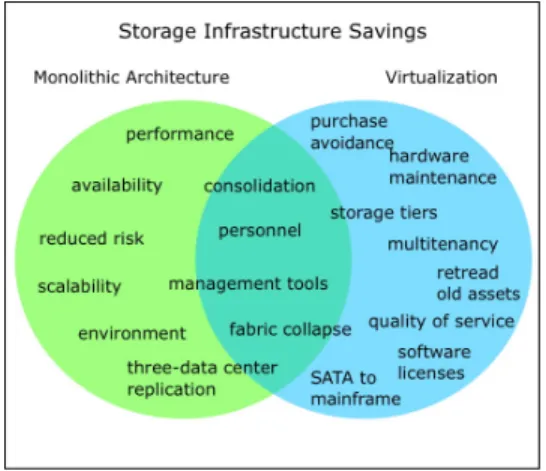
Figure 2. Storage Infrastructure Savings
Universal Storage Platform’s virtualization and tiered storage capabilities dramatically reduce equipment costs. All existing assets are virtualized behind the Universal Storage Platform, providing a single pool of storage for all application resources to pull from.
It is important to note that, unlike many other implementations of storage virtualization, the Universal Storage Platform does not change the native configuration of devices virtualized through the platform. At any time, the heterogeneous devices being virtualized can be detached from the Universal Storage Platform and attached natively to a server, with data preserved unchanged. This means that an organization is not locked in to a Hitachi Data Systems solution.
The Hitachi Universal Replicator for TagmaStore™ Universal Storage Platform leverages virtualization to provide any-to-any replication across all heterogeneous resources attached to the Universal Storage Platform. Using a single tool to provide all replication functionality lowers overhead costs—labor and software licensing and maintenance—and allows cross-platform replication tasks otherwise not supported.
Hitachi Data Retention Utility (formerly Open LDEV Guard) provides the Universal Storage Platform with a write-once-read-many (WORM) storage tier to support the compliance directives in government and industry regulations. The Data Retention Utility software delivers a virtual WORM layer, housed on a Hitachi Data Systems storage device. Data archived to the Data Retention Utility is locked down in a nonerasable and nonrewriteable format. Integration with the SATA Intermix Option and Hitachi Data Systems replication software allows for automated migration of data for immutable, tamperproof record retention on cost-effective online storage.
Economies of Scale from Multiprotocol, Multihost Connectivity Sophisticated storage partitioning, support for private virtual storage machines, and multitenancy allow the Universal Storage Platform to simultaneously provide dedicated storage resources to multiple mainframe and open systems application servers. The LUN 0 boot option provides faster restore time for servers after a catastrophic local disk loss,
reducing application downtime. This support for a common infrastructure allows storage overhead—labor, hardware, and maintenance costs—to be shared by all users, delivering massive economies of scale.
With the ability to create 32 distinct private virtual machines, each with its own cache, ports, and storage, the Universal Storage Platform can support a diverse range of environments without running the risk of applications stepping on each other’s resources. This further improves asset utilization by allowing administrators to size each storage environment to the exact needs to the application. Alternative architectures force the purchase of distinct storage frames, which are then underutilized, in order to ensure separation of data resources. The Universal Storage Platform contains 192 Fibre Channel, 64 ESCON, or 48 FICON ports. This wealth of connectivity allows many external directors and switches in the network infrastructure to be eliminated. In addition, blade technology allows iSCSI and NAS protocol support, for further consolidation of NAS devices behind the Universal Storage Platform. By reducing the number of infrastructure components being managed, immediate cost savings in administrator productivity and licensing and maintenance expenses can be achieved, and the number of points of failure in the infrastructure can be reduced, improving availability. Standards-based Management Tools for Improved Productivity Unlike competing products, where each family of storage has a different management toolset, the Universal Storage Platform delivers single-pane-of-glass management for all internally and externally attached heterogeneous storage. Having a single solution to storage management significantly reduces software licensing fees.
Based on the industry-standard SMI-S protocol, the Universal Storage Platform’s
management architecture supports tools from a range of vendors. This gives IT buyers greater choice and future-proofed investment protection for their purchases.
The Universal Storage Platform provides a single management point for heterogeneous storage infrastructure resources. This has far-reaching affects on the cost of storage administration personnel. With only a single toolset to master, storage administrators are able to concentrate their attention on building a broader and deeper understanding of the infrastructure. In effect, this consolidates storage administration expertise and allows fewer administrators to manage a larger number of storage resources. Training costs are also minimized, and administrators are able to provide backup for each other, eliminating the potential single point of failure that exists when each administrator manages a different set of storage resources.
Reducing the Risk of Downtime
The Universal Storage Platform helps organizations meet the challenge of providing cost-effective business continuity, by increasing disaster recovery service levels and reducing management complexity and operational risk. There is no single point of failure in the Universal Storage Platform, and Hitachi Data Systems has led the industry with the highest-availability storage for three product generations. The platform maximizes the efficient use of raw storage capacity through use of RAID 5, circumventing the risk of data loss from disk failures. And system cache is mirrored as well as backed by battery.
The Universal Replicator software is a powerful business continuity data movement solution that allows a consistent approach to replication—common procedures, tools, and skills— across diverse, heterogeneous storage environments. Replacing the complex combination of disjointed heterogeneous replication solutions that lack centralized and universal management tools with the Universal Replication software increases the chances of successfully
Universal Replicator software offers a new approach to asynchronous replication that improves application RPO and frees capacity on the primary storage system. Rather than push data from the primary site to the remote location, Universal Replicator software is controlled by the remote storage system, which pulls data from the primary site. This simple change in perspective has a huge impact on resource availability at the primary site. By shifting most of the replication workload off the primary storage system, Universal Replicator software is able to release critical resources that competing asynchronous replication approaches consume— disk storage, cache in storage-based replication solutions, and server memory in host-based software approaches.
The use of real-time local journaling allows Universal Replicator software to make the most efficient use of available network bandwidth and eliminate the risk of data loss during temporary communication outages between the primary and secondary replication sites. If the replication link fails, changes to the primary-site storage continue to be logged locally in the journal. When the communications link is reestablished, all changes in the journal are transmitted to the secondary storage site. Data consistency and application RPOs are preserved, without interruption to the protection process or the application.
The Universal Replicator software, in combination with synchronous Hitachi TrueCopy Remote Replication software, supports improved performance and reduced cost in multisite business continuity configurations. This option provides superior coverage and offers a technical solution to regulatory and legal compliance challenges that dictate forms of data protection and separation. The advanced replication architectures supported by the Universal Storage Platform provide higher availability and reduce the risk of outages from unscheduled downtime.
The Path to Nonlinear Storage Operating Expense Savings The massively scalable, monolithic architecture of the Universal Storage Platform offers clear linear storage expense savings, packing more terabytes into every square meter of hardware. The consolidation and centralization of storage capacity lead directly to better asset use and greater management productivity. However, the full economic impact of the Universal Storage Platform can be assessed only when virtualization capabilities are considered. And at that point, savings become truly nonlinear.
Universal Storage Platform virtualization reduces license costs—hardware and software, reduces SAN infrastructure costs, provides a single management interface for all virtualized storage hardware regardless of vendor, and extends the useful life of all assets. These hard costs are typically driven up when deploying traditional monolithic, SAN-based enterprise storage. The Universal Storage Platform not only reverses the trend but turns these hard costs into hard savings. And this is just the start.
Possibly the biggest opportunity for operating-expense savings comes from the Universal Storage Platform’s support for tiered storage. By virtualizing a range of storage solutions, each offering applications different service level properties, the Universal Storage Platform is able to locate business data on the most economically advantageous storage tier—with the SATA Intermix option providing mainframe environments with their first-ever opportunity to take advantage of tiered SATA storage. And, regardless of the server infrastructure— mainframe, open systems, or both—tiered resources are managed under a common framework with a single set of tools. Tiered storage support promises dramatic savings across the entire storage infrastructure, with the flexibility to start small and gradually move to a full-tiered model without ever affecting application access to data.
The Universal Storage Platform saves OPEX money. And it saves in areas that competing solutions are unable to touch: reducing labor costs; reducing hardware and software licensing and maintenance fees and corresponding infrastructure management costs; reducing wasted
capacity; reducing the cost of disaster recovery and the risk of outages; and, finally, reducing future procurement costs by reusing already depreciated assets.
University of Utah: 127 Percent ROI in 14 Months
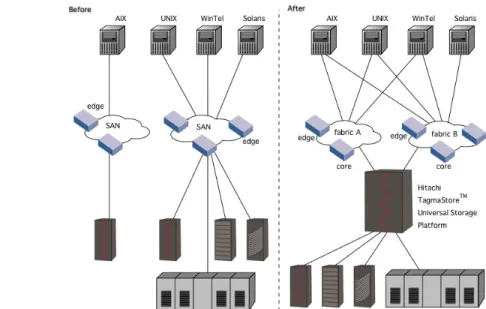
The Information Technology Services (ITS) group at the University of Utah Health Sciences Center (UUHSC), in Salt Lake City, Utah, provides technical resources in support of a wide variety of departmental, hospital, research group, and clinic-based facilities. Having implemented its first SAN in 1999, ITS noted a 200 percent per year increase in demand for storage capacity. With more UUHSC departments signing up to share the resource managed by the ITS group, it was clear that demand for capacity would accelerate. Other growth-related problems had also started to surface. Wastage from stranded disk space wasincreasing, affecting storage use rates. The existence of multiple SANs from different vendors meant many management points and different storage management practices. This also led to the risk of a single-point-of-failure in storage management personnel, because the fragmented management tools frustrated cross-training efforts and resulted in siloed management practices. In addition, backup windows had started to intrude on production work hours. Storage virtualization was identified as a technology that could address many UUHSC growth and management issues. But after ITS evaluated several appliance- and fabric-based storage virtualization products, it determined that the risk of managing another fabric element, the necessary increase in head count and training, and the single-point-of-failure that would be introduced into the system did not warrant further investigation. The ITS group then decided to evaluate the Universal Storage Platform.
Figure 3. the University of Utah Health Sciences Center Site Before and After Deploying the Universal Storage Platform
The storage controller–based virtualization of the Universal Storage Platform allowed UUHSC to implement a new storage architecture. All fabric elements were kept the same, older storage systems were virtualized behind the Universal Storage Platform, SAN management was collapsed into a single point of control, and a multitiered storage strategy was implemented.
Economic Impact of the Universal Storage Platform The implementation of the Universal Storage Platform resulted in a dramatic range of financial savings, which included:
:: Reduced the number of people needed to manage the storage infrastructure (two people, costing US$320K)
:: Improved utilization such that access to previously stranded data reduced the need for 18TB of new capacity (over three years)
:: Removed three storage frames with associated reduction in hardware, software, maintenance costs (US$200K) and floor space, electricity, and air-conditioning expenses (US$28K)
:: Extended the life of some older storage assets, reducing further capital procurement :: Removed older Fibre Channel switches from the SAN, further reducing hardware and
maintenance costs
:: Improved availability, with estimated risk cost avoidance for patient and billing systems conservatively put at US$118K, and for other systems US$138K
:: Improved performance, an estimated US$340K savings in faster access to data :: Improved access to tiered storage for all ITS customers
Financial Investment Results :: Capital investment of US$705K
:: Total savings of US$1,599,653 over three years :: Internal rate of return of 5.71 percent
:: Payback in 14 months
:: Return on investment of 127 percent
Figure 4. Payback Chart for Universal Storage Platform Initiative
For the University of Utah Health Sciences Center, payback came within 14 months and return on investment was 127 percent.Conclusion
As the University of Utah case study shows, proactive deployment of the Universal Storage Platform, considered as part of a long-term strategy to drive out operating expenses, delivers a positive and substantial ROI. And, whether tested under ROI conditions or compared side-by-side with competing solutions, for a TCO analysis that reviews all costs, not just purchase price, the Universal Storage Platform delivers peerless technical and economic performance. The overwhelming technical superiority of the Universal Storage Platform puts it in a class of its own. But, for many IT buyers, it is the economic impact of the solution that will prove truly revolutionary. As demand for storage capacity continues to grow and storage infrastructure costs receive increased scrutiny, the economic advantage to organizations that deploy the Universal Storage Platform will result in a long-term competitive edge.