http://www.heacademy.ac.uk/resources/detail/subjects/psychology/TQRMUL_Dataset_Teachi ng_Resources
The TQRMUL Dataset Teaching Resources: User Guide
The TQRMUL dataset consists of video and audio recordings, together with transcripts, of five interviews with undergraduate students on the subject of
friendship. The resources are intended to support the teaching of qualitative research methods, and are free to download and use. It is anticipated that the resources might be particularly useful for lecturers who teach qualitative methods – perhaps as part of general research methods modules – but who are not qualitative researchers
themselves, and as such may not have suitable data of their own on which to draw. This guide briefly introduces the resources, and provides some suggestions for
teaching and learning activities based around them. It is anticipated that lecturers will want to use the resources to support their own activities, and we would be keen to hear how the resources are being used. Please contact Stephen Gibson
([email protected]) with any such details, or if you have any queries regarding the resources.
The interviews
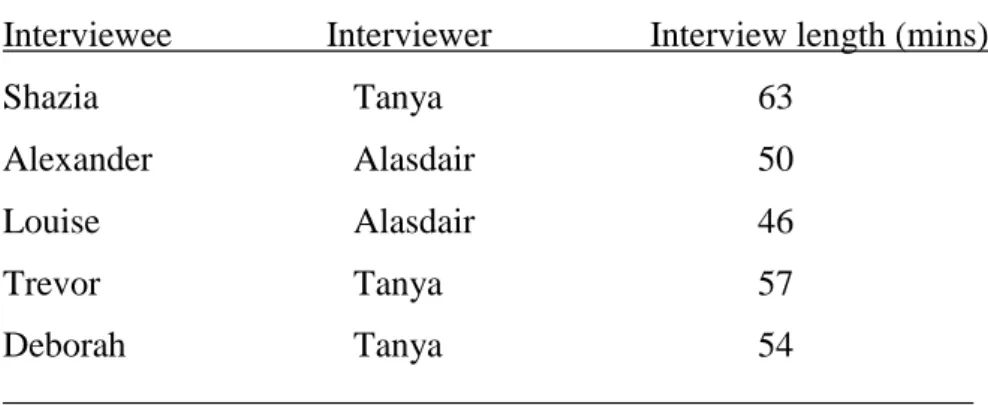
The interviews were conducted in Spring 2008 at Liverpool John Moores University by Tanya Corker and Alasdair Gordon-Finlayson, and were conducted specifically for the purpose of being made available online as a teaching resource. As a tutor on their course, Alasdair was known to his interviewees, whereas Tanya, a research assistant, was not. The aim of the interviews was to enable participants to talk at length about their experiences of friendships. The interviews lasted for between 46 and 63 minutes (Mean = 54 minutes). The interview schedule can be downloaded separately from the website. More details are presented in Table 1 below (pseudonyms are used for the interviewees).
Table 1: Interview details
Interviewee Interviewer Interview length (mins)
Shazia Tanya 63 Alexander Alasdair 50 Louise Alasdair 46 Trevor Tanya 57 Deborah Tanya 54
The files
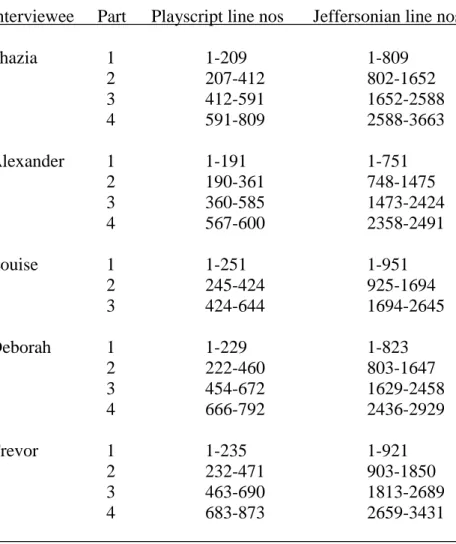
The files available for download consist of the video and audio recordings of the interviews, separated into segments of approximately 15 minutes in length each. The videos were recorded in split screen to provide a clear view of both interviewer and interviewee. Also provided are the interview schedule and two transcripts for each interview: one in standard ‘playscript’ orthography, and one in Jeffersonian transcription notation (see Forrester, 2002; Jefferson, 2004). Both versions of the transcripts feature line numbering, and Table 2 below maps the video and audio segments of each interview onto the line numbers on the transcripts.
Table 2: Line numbers covered by each audio/video file Interviewee Part Playscript line nos Jeffersonian line nos
Shazia 1 1-209 1-809 2 207-412 802-1652 3 412-591 1652-2588 4 591-809 2588-3663 Alexander 1 1-191 1-751 2 190-361 748-1475 3 360-585 1473-2424 4 567-600 2358-2491 Louise 1 1-251 1-951 2 245-424 925-1694 3 424-644 1694-2645 Deborah 1 1-229 1-823 2 222-460 803-1647 3 454-672 1629-2458 4 666-792 2436-2929 Trevor 1 1-235 1-921 2 232-471 903-1850 3 463-690 1813-2689 4 683-873 2659-3431
Ethics
Given that the resources are freely available on the internet, they raise some important ethical issues. Most notably, because the videos of the interviews are available for download, the participants are all identifiable. The standard requirement in
psychological research of maintaining participant confidentiality is therefore not possible. The British Psychological Society (n.d.) advises that ‘[i]n the event that confidentiality and/or anonymity cannot be guaranteed, the participant must be warned of this in advance of agreeing to participate.’ Participants were therefore advised from the outset that the data were being collected explicitly for the purpose of being made available online, and that as a result their anonymity and confidentiality
from the interview, and to withdraw their data from the project prior to it being made available online. In addition, we gave the participants the opportunity to review the materials prior to making them available online, and to edit or withdraw their contribution if they wished.
Despite the impossibility of maintaining participant confidentiality, we nevertheless took some measures to anonymise the interviewees, who were all given pseudonyms. In addition, the names of other people mentioned in the interviews were disguised (by blanking out the sound on the video and audio files, and inserting a pseudonym in the transcripts). On several occasions participants also mentioned other details – such as precise information about courses their friends were studying or local place names – and these were also disguised as appropriate. A section of one of the interviews (Louise’s) was also deleted for ethical reasons. The point at which the deleted section has been removed is clearly marked in all the relevant files.
These procedures were scrutinised by ethics committees at Liverpool John Moores University and York St John University, and are described in more detail in Forrester (forthcoming). It is not intended, however, that these procedures should necessarily assuage all concerns regarding the ethics of making these data available online. Indeed, one of the uses of these resources might be to encourage debate around the ethics of making such data available online – something that is likely to become increasingly common in future.
Teaching and learning activities
The following are examples of activities that the resources might be used to support. They are merely a taster of some of the ways in which the resources might be used, and as mentioned above, it is anticipated that they will be used in novel ways. Nevertheless, it is hopefully useful – especially for the novice lecturer, or someone new to qualitative methods – to provide these indicative examples here.
1. Video versus audio recording
Listen to the audio recording of a section of one of the interviews and jot down some notes about what you think are the important features of the interview. When you have done this, have a short break, and return to the interview, this time watching the video as well. What does the visual aspect of the recording add to your
interpretation? What do you miss by simply hearing the audio?
2. Varieties of transcription
The two types of transcript provided differ quite radically. Compare the same section of an interview transcribed in the two different formats. What advantages does each have over the other? What varieties of analysis might each be used to support? (n.b. the transcript excerpts used in no. 4 below are useful for this activity).
One of the key skills involved in open-ended or semi-structured interviewing is the ability to adapt and improvise one’s questions. Have a look at the interview schedule, and compare the way the questions are written to how they are asked in the interviews themselves. There are many sections across each of the interviews which are useful for exploring this, one example is from Shazia’s interview (at the very beginning of part 1 of the audio/video files; Playscript transcript lines 1-29). Compare the interviewer’s opening question to the suggested starting question on the interview schedule. Are there any similarities/differences between the two? How is this followed up? Are the follow-up questions identifiable as having been derived from the interview schedule, or are they improvised based on what Shazia says?
4. Identities in the interview
A great deal has been written on the importance of identities within the interview context (e.g. Cassell, 2005). To begin exploring this issue, consider Louise’s interview (Playscript lines 57-66; Jeffersonian lines 230-270; Video/audio part 1, 3.34-4.08). The interviewer here is Alasdair, who is a tutor on Louise’s course. How might these lecturer-student identities impact on this stretch of interaction? Focus specifically on Alasdair’s question on line 251 of the Jeffersonian transcript (‘d’you go out a lot?’), and the way in which Louise’s immediate response (‘Yeah’) is swiftly downgraded and qualified (lines 254-259). Why do you think she does this?
Students can be encouraged to explore the transcripts to see if they can find instances where other identities (e.g. gender, ethnicity, generational) become relevant.
5. The ethics of making data available on the internet
Despite the safeguards described in the section on ethics above, the resources nevertheless raise some important issues concerning the ethics of making these kind of data available on the internet. All of the participants discuss personally sensitive information. What are the implications of making these data available in such a way that the participants are identifiable? Do the potential educational benefits of having access to these data outweigh any ethical concerns? Should we have done anything differently?
6. Analysing data from multiple perspectives
How might different analytic methodologies (e.g. Grounded Theory, Interpretative Phenomenological Analysis, Conversation Analysis, Discourse Analysis) be used to analyse the data? What sorts of questions could each of these approaches be used to address? This exercise can, of course be adapted depending on the approaches covered in a particular course/module.
Further ideas for using the resources will be published in Forrester (forthcoming).
References
British Psychological Society. (n.d.). Ethical principles for conducting research with
human participants. Accessed 27th October 2008 from
< http://www.bps.org.uk/the-society/code-of-conduct/ethical-principles-for-conducting-research-with-human-participants.cfm#principles>
Cassell, C. (2005). Creating the interviewer: Identity work in the management research process. Qualitative Research, 5, 167-179.
Forrester, M. A. (2002). How to do conversation analysis: A brief guide. Accessed 14th November 2008 from <http://www.psychology.heacademy.ac.uk/
Webdocs_not_nof/CAP/Supplementary_Material/CAguide.doc>
Forrester, M. (Ed.) (forthcoming). Doing qualitative research in psychology: A practical guide. London: Sage.
Jefferson, G. (2004). Glossary of transcript symbols with an introduction. In G. Lerner (Ed.), Conversation analysis: Studies from the first generation (pp. 13-31). Amsterdam: John Benjamins.
TQRMUL group members: With thanks to:
Colm Crowley Leah Beestin
Mike Forrester Tanya Corker
Stephen Gibson Marina Crowe
Alasdair Gordon-Finlayson Richard Ribeiro
Siobhan Hugh-Jones Silvia Sbaraini
Nigel King Annie Trapp
Sarah Riley
Rachel Shaw and the technical staff in the Psychology
Cath Sullivan Departments at Liverpool John Moores
Sally Wiggins University and University of Kent.
The TQRMUL group would like to acknowledge the funding and support of the HEA Psychology Network.