THE DEVELOPMENT AND EVALUATION OF MULTIMEDIA MEDICAL
SIMULATION SOFTWARE FOR MEDICAL COMMUNICATION TRAINING
SAYOKO YAMASHITA Meikai University, Japan
NICHOLAS O. JUNGHEIM ATSUHIRO KINOSHITA
Waseda University, Japan Tokyo Medical and Dental University, Japan <[email protected]> <[email protected]>
ATSUSHI OKAWA CHIKAKO NAKAMURA
Tokyo Medical and Dental University, Japan Tokyo Medical and Dental University, Japan
<[email protected]> <[email protected]>
YOKO OKITA MATAZO IZUTANI
Tokyo Medical and Dental University, Japan Tokyo Medical and Dental University, Japan
<[email protected]> <[email protected]>
ABSTRACT
Since the Objective Structured Clinical Examination was introduced at medical schools, there has been a growing interest in medical communication training. Medical schools are using role plays with Simulated Patients (SP) to practice medical interviews. This has led to a new emphasis on evaluating medical students' ability to communicate with patients along with their ability to diagnose them. To deal with problems concerning limited budgets, our research group has developed multimedia medical simulation software using videos for medical communication training. This paper introduces these e-learning materials and reports on the results of a survey of medical students who have used them. Participants in the survey were administered three sets of training materials. Many of the participants felt some of the simulation material content was familiar, and most thought they had acquired substantial knowledge using the materials. All participants rated the materials as useful for their future, and felt that this practicum deepened their interest in other classes and training situations. INTRODUCTION
Japanese research in medical communication has a very short history, compared to the large number of studies conducted overseas (Ainsworth-Vaughn, 1992; Coulthard & Ashby, 1973; Mishler, 1984; Redford & Gift, 1997; Robinson, 1998; Tannen & Wallat, 1993; Todd & Fisher, 1993; West, 1990, 1993), and research into how medical practitioners and patients interact in clinical situations and how to apply this to the education of Japanese medical
students has only recently begun. As for foreign students involved in medical training, extensive studies have been conducted mostly overseas (Dudley-Evans, 1997; Dudley-Evans & St. John, 1998; Egly, 1998; Frank, 2000), except for Yamashita (2006). Japanese language education materials of this type have yet to be developed. The purpose of this research is to gather together medical, dental, counseling, Japanese language education, and communication specialists to jointly research the
development of an e-learning system for medical communication.
At present, foreign students studying medicine, dentistry, and nursing do not only carry out research but also are frequently involved in clinical training and in actual clinical practice. In the case of Tokyo Medical and Dental University (TMDU), the number of
undergraduates is not particularly large, but there are foreign students, and at the end of six years of study they must pass a national examination for medical and dental practitioners. To deal with this, fifth year students begin practical training prior to graduation. Of course, a large portion of this training is devoted to arriving at appropriate diagnoses based on a broad scope of knowledge spanning a variety of specialties. At the same time, however, the skillful management of medical communication with patients is a major point not to be forgotten, and of course, the nonverbal aspects that accompany such verbal interactions are also of great importance even in Japan (Ishikawa, Hashimoto, Kinoshita, Fujimori, Shimizu & Yano, 2006), especially for foreign medical students as part of their overall communicative competence
(Jungheim, 2001).
THE CURRENT STATE OF CLINICAL TRAINING Medical universities these days have introduced the Objective Structured Clinical Examination (OSCE) and the use of Simulated Patients (SP) in order to practice medical examinations and medical
interviews, as well as the use of role plays for tests. This not only includes practice listening to a
patients’ symptoms and medical histories, but also the requirement that medical students acquire appropriate methods of communication with patients, which can be subject to later evaluation.
Undergraduate students and foreign graduate students at medical universities tend to lack the appropriate language for clinical training and clinical
practice, and errors and misunderstandings resulting from insufficient communication are inexcusable. This means that simulated patient interactions using all possible communication scenarios should be required as part of clinical training.
Carrying out clinical conversation that includes language specialized to a particular field is difficult for foreign medical and dental students who lack
sufficient proficiency in Japanese, so it requires extra opportunities for study. Foreign students in Japan need to acquire a sufficient degree of competence in medical communication, but they must also handle a large number of assignments in a broad variety of specialized classes in a limited amount of time. This is where the need arises for an effective e-learning system that students can use anywhere and anytime.
AN E-LEARNING SYSTEM FOR MEDICAL EDUCATION
Tokyo Medical and Dental University is already receiving Good Practice project aid in the form of special grants from the Ministry of Education, Culture, Sports, Science and Technology (MEXT), and it is developing materials for use in e-learning that include cases (symptoms) and how to carry out diagnoses for medical and dental clinical training. This is the system that we are using to develop our own materials for medical communication.
Naturally, in medical and dental education it is very important for students in clinical training to have actual opportunities to examine patients. Recently, however, fewer patients are taking part in clinical training, and students are exposed to only a limited number of cases in the course of their studies. Reasons for this include a change in patients’ perceptions, safety issues, and debates over the legality of medical students’ direct involvement in medical activity. One can also cite the limited variety
of cases that medical students experience in the course of their studies.
In order to make up for students’ lack of clinical experience, we at the TMDU are promoting the development, use and dissemination of ‘diagnostic simulation learning materials’ that provide a simulated experience of doing actual medical examinations through interaction with a computer.
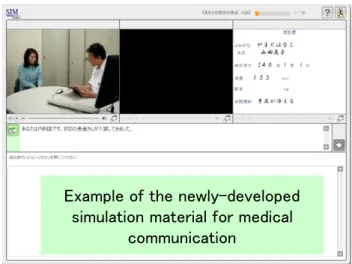
Figure 1. The First Visit.
This system is used in the following way. Three individual screens appear in the upper half of the monitor, and applicable information is displayed there. Figure 1 is an example of the newly-developed simulation material for medical communication — ‘the first visit’. In this example, from the left, there is a picture of a medical situation, patient details, and then details of the treatment.
The lower half of the screen includes instructions for the student. Students cannot learn with this system without a clear understanding of how to operate it, which raises the question of computer literacy. In order to familiarize themselves with the system students first go through an example of ‘How to fry an egg’.
Figure 2 shows the current simulation system screenshot of the tool for generating teaching
materials, illustrating how easy it is to create simulation materials if a clear scenario is created in advance.
!
Figure 2. Screenshot.
SIMULATION EDUCATION SYSTEM IN CLINICAL PRACTICUM 2
From 2006, TMDU began to use this simulation education system (hereafter referred to as Softsim) in Clinical Practicum 2 which is part of the curriculum for 4th year students in Dentistry Department of the TMDU School of Dentistry. A total of 50 sets of teaching materials were prepared for students in this practicum to experience over a period of five weeks. These materials include 34 sets for preservation, seven for oral prosthetics, eight for oral surgery, and one additional set. These teaching materials are patterned after actual clinical cases and chosen without regard to individual student’s academic situation.
EVALUATION OF THE SETUP
A set of three Softsim materials developed in this project for medical communication were tested in a second semester class in the College of Liberal Arts and Sciences: Issues in Medical Communication in the US — learning from video clips. The class consisted of 14 students. Materials presented in this class were:
1. A patient's first visit: Medical version 2. A 45-year-old male patient receiving an
intravenous drip the day before surgery to remove a tumor from his esophagus 3. 45-year-old female patient with high
blood pressure
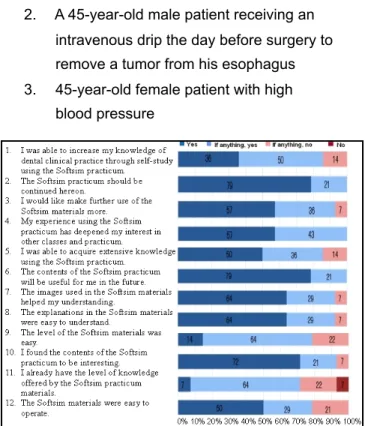
Figure 3. Overall evaluation results of the Softsim practicum 14 first and second year liberal arts students.
QUESTIONNAIRE RESULTS
Students were told to answer at their own pace. After finishing, students evaluated each of the materials and the simulation practicum as a whole.
Figure 3 shows the results of a questionnaire administered to the 14 first and second year liberal arts students who tried out the materials. The overall results of the evaluation were positive, and it was particularly notable that the materials were
completely fresh for some of the students as seen by item 11. Furthermore, all of the students felt that the Softsim practicum should be continued into the future (item 2), were motivated by the materials (item 4), and valued the materials for their future medical practice (item 6). We can conclude here that this Softsim administration was successful.
Answers to the open-ended evaluation also tended to be on the positive side. The following is a list of some of these comments:
• Individual situations are treated separately, and the questions make the communication skills that we need to learn clear.
• The differences among the options and the problems are clearly presented (Reasons why particular options are wrong are clearly presented).
• They are like short stories that make it easy to apply them to real situations.
• The addition of images made them easier to understand than text alone.
• I was able to learn how to communicate in a variety of situations.
• I could advance at my own pace.
Overall, participants seem to appreciate the basic concept of the Softsim and find it useful for there medical education.
Points that some participants felt could be improved were:
• Some explanations were difficult to understand. • Sometimes it was difficult to see a difference
between some of the answer choices.
• I wanted to learn more about what is needed in a clinical examination.
• Make it easier to operate. The buttons and letters could be made larger, for example. As with the questionnaire, favorable responses exceeded negative responses.
CONCLUSION AND FUTURE PERSPECTIVES Students’ positive and negative evaluations and comments help to improve the system. As this is a work in progress, additional materials involving a variety of new scenarios are currently be created, and the evaluations in this study will help shape the development of future simulations. As stated earlier,
both Japanese and foreign medical and dental students have a definite need for study materials based on e-learning because of its strength at showing an exhaustive variety of simulated doctor and patient communication cases using lively videos, as well as providing appropriate feedback.
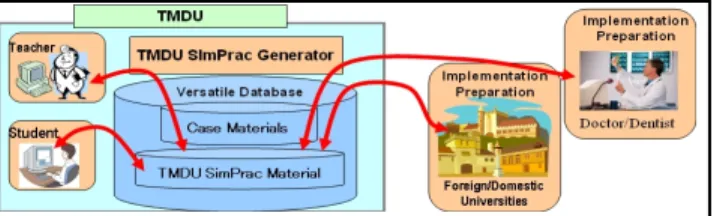
Figure 4. TMDU SimPrac Generator.
Use of the “TMDU SimPrac Generator” (see Figure 4) at other universities, hospitals, and related enterprise is also planned in future. The TMDU SimPrac Generator will be distributed to other universities and institutions through a contract allowing access to the TMDU server for the
generation of personalized teaching materials. With the TMDU’s permission, educators from other institutions can create teaching materials, download their files, and use them with their students.
Meanwhile, we will produce as many doctor and patient communication cases as possible to add to the library of e-learning materials.
ACKNOWLEGEMENTS
The teaching materials developed in this research are supported by a MEXT Grant in Aid for Scientific Research, Pioneering Research (B) (No.
19320074, 2007-2010, Sayoko Yamashita, representative) “Development of a Medical Communication Learning System for Medical Students Using e-Learning.”
The creation of the Computer Assisted Education System on Clinical Simulation for Medical and Dental Practice Training was undertaken under the
auspices of the MEXT Support Program for Distinctive University Education: “Establishment of a Computer Assisted Education System on Clinical Simulation for Medical and Dental Practice
Training” (Atsuhiro Kinoshita, coordinator).
REFERENCES
Ainsworth-Vaughn, N. (1992). Topic transitions in physician-patient interviews: Power, gender, and discourse change. Language in Society, 21, 409-426.
Coulthard, M., & Ashby, M. (1975). Talking with the doctor. Journal ofCommunication, 25(3), 140-148.
Dudley-Evans, T. (1997). An Overview of ESP in the 1990s. In T. Orr (Ed.), The Japan Conference on English for Specific Purposes (pp. 5-11). Aizu-Wakamatsu (Fukushima, Japan): University of Aizu.
Dudley-Evans, T., & St. John, M. J. (1998).
Developments in ESP: A multi-disciplinary approach. Cambridge: Cambridge University Press.
Egly, S. (1998). English for medical purposes: International medical graduates. The Language Teacher,22(11).
Frank, R.vA. (2000). Medical communication: Non-native English speaking patients and Non-native English speaking professionals. English for Specific Purposes, 19, 31-62.
Ishikawa, H., Hashimoto, H., Kinoshita, M., Fujimori, S., Shimizu, T., & Yano, E. (2006). Evaluating medical students' non-verbal communication during the objective structured clinical
examination. Medical Education, 40, 1180-1187. Jungheim, N. O. (2001). The unspoken element of
communicative competence: Evaluating
language learners' nonverbal behavior. In T. Hudson & J. D. Brown (Eds.), A focus on language test development: Expanding the language proficiency construct across a variety of tests (pp. 1-34). Honolulu: University of Hawai'i, Second Language Teaching and Curriculum Center.
Mishler, E. (1984). The discourse of medicine. Norwood, NJ: Ablex.
Redford, M., & Gift, H. C. (1997). Dentist–patient interactions in treatment decision-making: A qualitative study. Journal of Dental Education, 61(1), 16-21.
Robinson, J. D. (1998). Getting down to business: Talk, gaze, and body orientation during openings of doctor–patient consultations. Human
Communication Research 25(1), 97-123. Tannen, D., & Wallat, C. (1993). Doctor/mother/
child communication: Linguistic analysis of a pediatric interaction. In A. D. Todd & S. Fisher (Eds.), The social organization of doctor–patient communication (pp. 31-48). Norwood, NJ: Ablex. Todd, A. D., & Fisher, S. (Eds.). (1993). Social
organization of doctor–patient communication.
Norwood, NJ: Ablex.
West C. (1993). “Ask me no questions …” An analysis of queries and replies in physician– patient dialogues. In A. D. Todd & S. Fisher (Eds.), The social organization of doctor–Patient Communication (pp. 127-147). Norwood, NJ: Ablex.
Yamashita, S. (2006). Course designed for medical students on how to read journal articles on medical communication, Journal of Medical English Education, 6(1), 28-35.