157
PEDOLOGICAL STUDY OF LAND SUITABILITY IN THE AREA OF MAVRODIN TELEORMAN COUNTY, REGARDING THE ARRANGEMENT OF IRRIGATION WITH
WATER FROM ZOOTECHNICAL COMPLEXES
MUȘAT IULIAN BOGDAN1*, MIHALACHE MIRCEA1,
MUȘAT MARIAN1, NIȚUALINA1
1Soil Science Department, University of Agronomic Sciences and Veterinary Medicine of Bucharest, Bd. Marasti, No 59, Bucharest, Romania *Corresponding author:[email protected]
Key words: soil fertility, pretability, irrigation, zootechnical complexes
ABSTRACT
The studied area is located in the center of Teleorman County, belonging to the Mavrodin cadastral territory, currently used as an arable land. The pedological mapping was performed with the purpose of identifying the soil area, assessing its fertility as well as the suitability for irrigation with wastewater.
In this regard, a soil profile was opened and several surveys were collected from soil samples in natural and modified settlements, for morphological, physical and chemical analyzes. The soil type identified is red preluvosol.
Geomorphologically, the land is part of the Roman Plain, the subunit of Burnaz, between the Danube Lunca, the Vedea, Teleorman and Calniștei valleys, extended west to the Teleorman river and the eastern limit of the county. The ground level is maintained between 8-10 m, with small fluctuations depending on the terrain.
The type of soil identified, is classified in the luvisoluri class, having the following sequence of horizons: Ao-AB-Bt-C.
The criteria for classification into classes, subclasses and other subunits of land according to the suitability to irrigate with waste water are those mentioned in chap. 10 from MESP, vol II (ICPA, 1987) with some additions.
According to Annex 11.1 of the MESP, vol II (ICPA, 1987), the following additional criteria intervene in the selection of lands that can be irrigated with wastewater (soil type, soil texture, soil volume, soil thickness, erosion, soil unevenness, groundwater depth, excess surface moisture, other restrictions.
INTRODUCTION
This study, scientific research under contract no. 1187/09.11.2016 between SC Agrilemi SA, as beneficiary and the University of Science Agronomy and Veterinary Medicine in Bucharest - as a performer.
The object is to control the execution of a research entitled "Development of soil and agrochemical study to elaborate the plan of
fertilization on crop area of 400 ha. For this
study were carried out works on
morphological characterization, physical and
chemical, determining the production
potential of the soil cover, stating the measures to improve soil and crop
fertilization plan development, with
158 In addition to the conditions for the exclusion from irrigation with clean convention water, in the case of irrigation with waste water, there are added a number of restrictions, which extend the scope of the lands
completely excluded from irrigation (VI-class land), such as : soil type, soil texture, soil volume, soil thickness, risk of erosion, unevenness, ground level, excess humidity, etc..
MATERIALS AND METHODS
Soil sampling agrochemical middle of plowed horizon (0-20 cm) were composed of 15-20 individual samples from the surface sampling plots of ground. The
parceling of land, was considered
pedological complexity, uniformity of land utilization, crop structure so that each sample representing a plot as uniform. The results were analyzed and interpreted based on the standards contained in the catalog A.S.R.O. that are consistent with international standards.
Methods of analysis used to determine the chemical characteristics:
Organic matter (humus): determined by volumetric wet oxidation method after Walkley-Black, the change Doughnut - STAS 7184 / 21-82
Carbonates - gasometric method using calcimetrulScheibler after SR ISO 10693: 1998 (%)
Nitrogen content was determined indirectly (by calculation) based on the humus content and degree of saturation with bases.
IN = humus x V / 100
Accessible phosphorus (P mobile): after Egner-Riehm-Domingo and dosed with
molybdenum blue colorimetric after
Murphy-Riley method (reduction with
ascorbic acid).
Available potassium (K mobile):
extraction after Egner-Riehm-Domingo and determination by flame photometry. pH: determined potentiometrically with a combined glass and calomel electrode in an aqueous suspension to the Soil / Water 1/2.5 - SR 7184 / 13-2001
The acidity of the hydrolytic - extraction with sodium acetate to pH 8, 2
Amount bases - Kappen method
Schoffield Chirita by extraction with 0.05 normal hydrochloric acid
Methods of analysis used to determine the physical properties:
The apparent density (AD): the method of the metal cylinder of known volume (100 cm3) to the temporary humidity of the soil
(g/cm3)
The total porosity (PT) by calculating (% by volume -% v / v)
RESULTS AND DISCUSSIONS
The soil specific area mapped is
represented by chromic luvosoil mollic
subtype, with the following formula: Am-Bt1–
Bt2-Ck, whose morphologic and
159
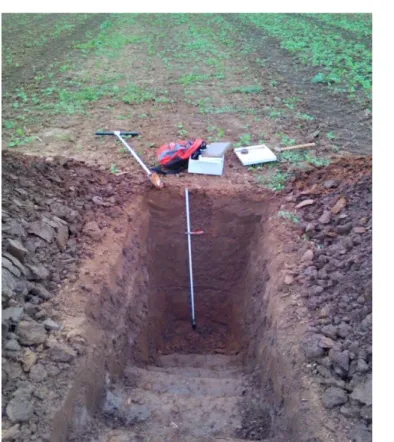
Figure 1. Chromic luvosoil, molic subtype (EL – rs.mo)
Am (0-36 )cm, 7,5YR color wet and dry material with well developed grainy structure in the upper horizon and medium developed at its base polyhedral aggregates
shatters hard. The texture is clayey loam horizon is poorly compacted, hard wet, rough dry, moderately plastic and sticky,
very compact and strongly cemented;
Bt1 (36-135) cm, uniform color in shades of 7,5YR 3/2 material 3/3 7,5YR wet
and dry material, columnoid-prismatic
structure is medium and high. The texture is clay.
The material is very strong in wet and dry very hard, very plastic and sticky, very compact and strongly cemented;
Bt2 (135-180) cm, uniform color in shades of 7,5YR 3/3 material 3/4 7,5YR wet and dry material. The texture is clay. The structure is prismatic medium and high frequencies fine cracks. The material is very
hard wet and very tough when uacată very plastic and sticky, very compact, there is waste in the form of films neoformaţii clay faces structural aggregates;
Ck (> 180) cm, uniform color in shades of 7,5YR 4/4 material 5/4 7,5YR wet and dry material. The texture is clay loam. The material is unstructured, friable wet,
moderately dry cohesive, presents rare grains of sand, rare spots of CaCO3, strong effervescence.
The physico-chemical characteristics of this type of soil, are consistent with the formation of physical and geographical conditions
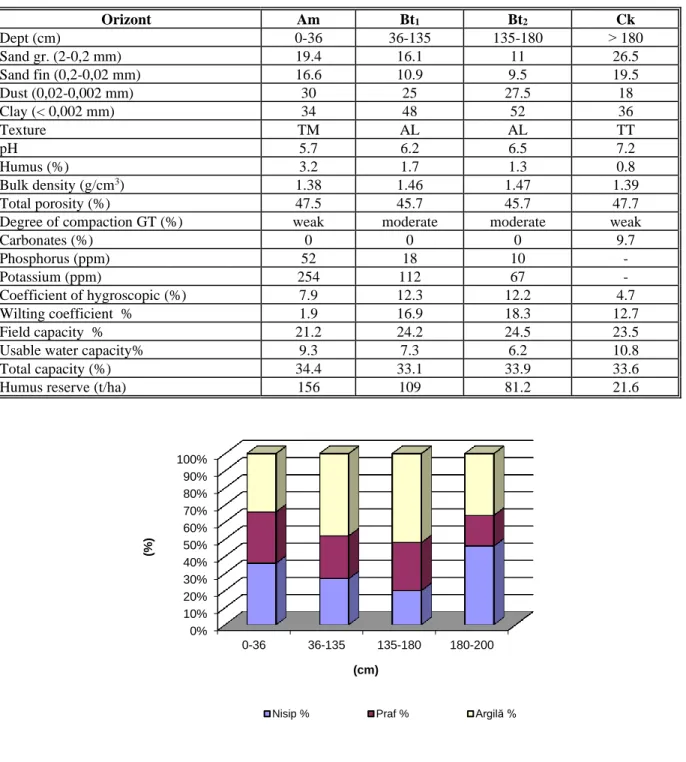
160 the texture is fine, differentiated profile, the amount of clay is greater in B horizons
(36-180 cm) compared to the value recorded the horizon surface (Figure 2).
Table1
Physico-chemical analysis at soil EL rs-mo, of territory studied
Orizont Am Bt1 Bt2 Ck
Dept (cm) 0-36 36-135 135-180 ˃ 180
Sand gr. (2-0,2 mm) 19.4 16.1 11 26.5
Sand fin (0,2-0,02 mm) 16.6 10.9 9.5 19.5
Dust (0,02-0,002 mm) 30 25 27.5 18
Clay (< 0,002 mm) 34 48 52 36
Texture TM AL AL TT
pH 5.7 6.2 6.5 7.2
Humus (%) 3.2 1.7 1.3 0.8
Bulk density (g/cm3) 1.38 1.46 1.47 1.39
Total porosity (%) 47.5 45.7 45.7 47.7
Degree of compaction GT (%) weak moderate moderate weak
Carbonates (%) 0 0 0 9.7
Phosphorus (ppm) 52 18 10 -
Potassium (ppm) 254 112 67 -
Coefficient of hygroscopic (%) 7.9 12.3 12.2 4.7
Wilting coefficient % 1.9 16.9 18.3 12.7
Field capacity % 21.2 24.2 24.5 23.5
Usable water capacity% 9.3 7.3 6.2 10.8
Total capacity (%) 34.4 33.1 33.9 33.6
Humus reserve (t/ha) 156 109 81.2 21.6
Figure 2. Granulometric composition 0%
10% 20% 30% 40% 50% 60% 70% 80% 90% 100%
0-36 36-135 135-180 180-200
(%
)
(cm)
161 The total porosity of the soil is between 45% and 47%. The degree of compaction of the soil is poor in the ranges of 0-36 cm deep
and 180-200 cm becomes moderate
between 36-180 cm depth profile in the Bt horizons and may be a factor limiting fertility to be corrected (figure 3) .
Figure 3. Variation porosity and degree of compaction the soil profile
The reaction is slightly acidic soil and soil fertility is a limitation. Also humus reserve in the upper horizon is medium and small drops to the underlying horizons. There is a
tendency of decrease in humus content and increase the profile of the reaction studied (Figure 4).
Figure 4. Variation reaction soil and humus content pe profilul de sol
0 10 20 30 40 50 60
0-36 36-135 135-180 180-200
PT Gt
0 1 2 3 4 5 6 7 8
0-36 36-135 135-180 180-200
162
CONCLUSIONS
The soil is in concordance with the physical and geographical conditions of the area being identified only one soil type with regional character is chromicluvosoil – mollic subtype.
The studied territory is very well suited to each criterion, so it can be irrigated with wastewater from zootechnical complexes, because the texture is muddy, very high volume edaphic, deeply deep, without danger of erosion, uniform territory, water level over 10 m and excess zero humidity.
REFERENCES
Canarache A., 1990. Agricultural soil
physics. Ed. Ceres, Bucharest;
Coteţ P., 1973. Geomorphology Romania.
Ed. Technical Bucharest;
Munteanu I., Florea N, 2009, Guide for field
description of soil profile and specific environmental condition, Ed. Sitech, Craiova;
Mușat M., Alexandra Radu, Mariana Burcea,
2013 – Pedoagrotehnică, Ed Ceres,
Bucharest;