Jagriti Kher and Savita Aggarwal Page 288 CLIMATE CHANGE AND WATER INSECURITIES: IMPACTS ON WOMEN
Jagriti Kher
Assistant Professor, Department of Development Communication & Extension, Institute of Home Economics, University of Delhi, (India)
Savita Aggarwal
Associate Professor, Department of Development Communication & Extension, Institute of Home Economics, University of Delhi, (India)
Abstract
Accession and management of natural resources especially water has traditionally been a prime responsibility of women. Climatic stresses and extremes coupled with non- climatic factors are reducing the per capita availability of water in several parts of the world including India. This is likely to enhance the vulnerability of women who are hitherto responsible for water accession and management. It is therefore important to monitor the availability and management of water across different regions. In order to quantify water related vulnerability a contextual water management tool called Water Insecurity Index (WII) was used as modification of Water Poverty Index developed by a group of hydrologists in 2000. WII was quantified for different states in India for two time slices 2000 and 2025.
The results showed that there is likely to be overall reduction in water related vulnerability in different states in India in 2025. However large majority of states will continue to be moderately or highly vulnerable to water accession and management. It was also seen that states with highest gender gaps in literacy and high poverty rates were the most vulnerable. Thus it is important to build adaptive capacity of women to face climatic stresses and extremes.
Key words: Climate Change, Water, Water Insecurity Index, Women, Vulnerability Emotional Intelligence Scale, Leadership
Introduction
Human activities since the beginning of the industrial revolution have led to unprecedented changes in the chemical composition of the earth‟s atmosphere, also leading to rising temperature. During the past century, mean world temperature has increased by 0.74oC and it is projected that by 2100 global mean temperature may rise by 0.3 to 4.8oC as per different climate change scenarios [1]. It is well documented that climate change is one of the greatest ecological and environmental challenge of the present times. This is supported by Climate Survey, 2017 of the Indian Meteorological Department (IMD), that extreme weather events, natural disasters and a failure of climate change adaptation are the three of the top ten environmental risks facing humankind.
Jagriti Kher and Savita Aggarwal Page 289 nations to climate change [3, 2]. Also as per
Climate Risk Index, 2017 India is ranked 6th among most vulnerable nations to changing extreme weather events. Studies have shown profound impacts of climate change on forests, water resources, health, agriculture, housing and industry. However observational records and climate projections provide evidence that fresh water resources are the most vulnerable. Thus, water is the primary medium through which climate change impacts will be recognized by humans and the environment [4, 5, 6]. However the impacts of climate change are not felt equally, with women often bearing the brunt of climate impacts.
Differential impacts of climate change on women
Women in the developing countries play multiple roles as providers, cultivators and care givers to the family members. They are often more vulnerable to disasters than men through their socially constructed roles and responsibilities, limited access to resources, restricted rights, limited mobility and muted voice in shaping decisions and because they are poorer [7, 8, 9]. Climate change brings with it droughts, floods, heat episodes, deforestation and scarcity of natural resources thus forcing women to spend additional time in collection of freshwater, fodder and fuel wood limiting their opportunities for education, training skill development and income generation. This will lead to reinforcement of traditional roles of women and will have inter-generational implications on them. There are both direct and indirect impacts of climate change on women. The direct impacts constitute increased extreme weather events such as droughts, floods, heat waves, cyclones, and hurricanes resulting in shortages of natural resources especially water, fuel wood. Since women are the prime mangers of water along with fuel wood [10, 11, 12, 13, 14, 15, 16, 17, 18, 19, 20, 21] Such shortages will further force women to spend increased time in meeting these resources for the family. These
Jagriti Kher and Savita Aggarwal Page 290 to growing population and affluence but on the
other hand the water availability is declining. It is thus expected that in the coming years, problems of climate change coupled with population pressures and developmental imperatives will put increased pressure on water as well as other resources. Since, women are responsible for procuring natural resources including water for the family, they are likely to bear the maximum burnt of climatic extremes and related environmental adversities.
Water Management tools to characterize water accession and management at household level Several assessments of water resources through physical sciences and hydrological modeling are available. However, these do not link the availability of water with human resources as well as the socio-economic drivers determining capacity of people to access water and manage resources. Thus a holistic approach is needed to address the questions of water availability, and its relationship to human and ecological needs. Water Poverty Index (WPI) later extended to Climate Vulnerability Index (CVI)) are such holistic tools assessing the vulnerability to water and climate related issues at the household level [51, 52]. There are six components of CVI namely Resources, Access, Capacity, Environment, Use and Geospatial characteristics. The „Resource’
component aims to capture the overall availability of water. „Access to water‟ includes the access of population to safe drinking water and sanitation as well as access to water for other purposes. The „Use‟ component focuses on the consumption of water at the domestic level, in industry and agriculture. „Capacity’ is the ability of people to lobby for and manage water and is interpreted in terms of education, investment in the health sector and income. The „Environment‟ component combines variables such as quality of water, sanitation facilities and environmental degradation.
Geospatial’ component which describes the
particular geographical characteristics of the location that make it vulnerable.
Thus the present study has been undertaken to quantify the vulnerability of women to climate and water related insecurities at the household level using an index „Water Insecurity Index‟ (WII). The Index was quantified for states and UTs in India for the present scenario (2000) as well as for the future (2025) scenario. Since research studies indicate a clear linkage between gender and water another objective of the study is to examine the relationship between different indices of human and gender development with climate and water related insecurity.
Methodology
In order to calculate WII scores for different states in India, six components (as stated above) were used. All these components have a number of subcomponents (in all 21 sub-components were used). These were selected on the basis of their suitability and feasibility of obtaining data. Normalization method was followed to compute the index values for each sub-component. (For detailed methodology, refer to [53]. In order to reflect the vulnerability, each index value was subtracted from one to arrive at the lack of resources, limited capacity and access to water, inadequate use of water, poor environment and climatic stresses. An average of all these six values provided water insecurity index, which (as well as its components) ranged from zero (most secure) to one (least secure).
The states were classified into four different levels of water and climate related insecurity:
Least vulnerable states
Moderately vulnerable states
Highly vulnerable states
Extremely vulnerable states
Jagriti Kher and Savita Aggarwal Page 291 computed based on the change rate of the
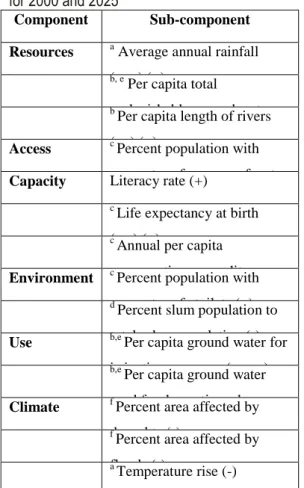
previous decade. As many as 14 sub-components (out of 21) were used for calculating projections of WII for the two time slices 2000 and 2025. The projected values for various indicators for the time slice 2025 were taken from a variety of sources as indicated (TABLE 1). The positive (+) or negative (-) signs after the sub-component indicate if it was considered as a positive or negative parameter.
Table 1: Selected sub-components of CVI-WH for 2000 and 2025
Component Sub-component
Resources a Average annual rainfall
(mm) (+)
b, e Per capita total
replenishable ground water
(cu.m.) (+)
b
Per capita length of rivers
(m.) (+)
Access c Percent population with
access to safe source of water
(+)
Capacity Literacy rate (+)
c Life expectancy at birth
(yrs) (+)
c Annual per capita
consumption expenditure
(Rs.) (+)
Environment c Percent population with
access to safe toilets (+)
d Percent slum population to
total urban population (-)
Use b,e Per capita ground water for
irrigation purposes (cu.m.)
b,e Per capita ground water
used for domestic and
industrial purposes (cu.m.)
Climate f Percent area affected by
droughts (-)
f
Percent area affected by
floods (-)
a Temperature rise (-)
a: values from IITM, Pune (2010), b:computed using
population figures from General of India 2006, c :
Computed using change rate from 1991-2001,d :
Registrar General of India 2006, e : Central Ground Water
Board, f : values are assumed to be same for 2000 and
2025
Results
WII scores were calculated for different states and Union Territories of India. There was found to be a huge variation as the WII values ranged from 0.36 in Goa and Pondicherry (least vulnerable) to 0.69 in Jharkhand (most vulnerable) indicating a wide variation in the level of vulnerability of regions and populations to water related stresses. On the whole, India was highly vulnerable to water related stresses with WII value at 0.54. Quantifying the vulnerability in terms of geographical area it was found that only 1.7 percent area was least vulnerable, 24.6 percent moderately vulnerable, 59 percent highly vulnerable and the rest 14.7 percent was extremely vulnerable. It was quite alarming to note that more than 98 percent of geographical area of India was moderately, highly or extremely vulnerable to water related stresses.
Figure 1: Level of vulnerability of states in India for time slices 2000 and 2025
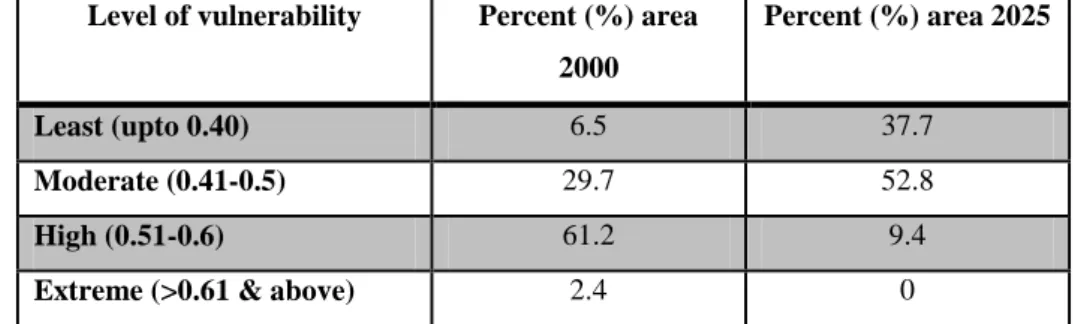
Jagriti Kher and Savita Aggarwal Page 292 Table: 2 Vulnerability levels in terms of percent geographical area for (2000 and 2025)
However, in 2025 for India, WII value is projected to decrease from 0.53 in the year 2000 to 0.40 in the year 2025, Overall it is alarming to note that in the future climate (2025), 62 percent geographical area in India will continue to be either moderately or highly vulnerable to climate and water related stresses, despite increased human capacity and infrastructure development. One of the major reasons for this would be climatic stresses as a result of higher temperatures. This will continue to have a negative impact on women and young girls who are responsible for water accession and management for the family.
3.2 Linkages of water insecurity with indices of development
In order to examine the linkages between gender, water and development, the relationships between WII and indices of human and gender development were computed.
3.2.1 Relation of WII with gender gap in literacy:
The relationship of WII and gender gap in literacy was examined since there is considerable regional variation in male to female literacy rate among the states in India (Fig 3). The analysis revealed that the states with high gender gaps in literacy, of the order of 25-30 percent, such as Bihar, Uttar Pradesh and Madhya Pradesh were among the most vulnerable states to climate and water related
stresses. By comparison, Kerala had the least gender differential in literacy of a little more than 6 percent and was among the least vulnerable states. In states with high incidence of climatic vulnerability and water stresses, the women including female children had to struggle very hard to procure natural resources required by their families for their lives and livelihoods. Women had to perform drudgerous tasks and in the process, there was neglect of literacy, education, participation of women in income generating roles or skill development opportunities. Thus it is apparent by the above analysis that reducing gender gaps in literacy is very important to reduce the vulnerability of families to environmental and climatic stresses.
Figure 2: Relationship between Gender gap in literacy with WII
3.2.2 Relation of WII with percent people living below poverty line
Level of vulnerability Percent (%) area
2000
Percent (%) area 2025
Least (upto 0.40) 6.5 37.7
Moderate (0.41-0.5) 29.7 52.8
High (0.51-0.6) 61.2 9.4
Jagriti Kher and Savita Aggarwal Page 293 There was a direct and linear relationship
between income poverty in different states/union territories and their vulnerability to climatic and water related stresses (Fig 3). Jharkhand, the most vulnerable state had more than 40 percent of its people living below poverty line. Orissa, a highly vulnerable state had more than 46 percent people living below the poverty line. Similar was the case with Bihar, Madhya Pradesh and Chhattisgarh. By contrast, the well to do states such as Kerala, Punjab and Goa with less people below poverty line (6-15 percent), exhibited the least vulnerability to climatic and water related stresses. This is because higher income levels of people enable them to avail better housing with water and sanitation facilities, undertake higher levels of education and enable them to voice their opinion for availing water as well as other rights thus reducing the vulnerability of families.
Figure 3: Relationship between percent population living below poverty line with WII
Conclusion
The analysis has shown that there is likely to be overall reduction in climate and water linked insecurity in different states in India in 2025 as compared to vulnerability in the year 2000. However, a large majority of states will still continue to be moderately or highly vulnerable to climatic and water related stresses. Since the women form a disproportionate share of poor in developing countries and communities
and are prime procurers and managers of natural resources they are more likely to be vulnerable to the effects of climate change in the future. The results of study revealed that tools such as WPI/WII can be used not only to gauge the level of development in the water sector at the household level but also can provide insights into the specific vulnerabilities of women and other socially differentiated groups across different regions and serve as a trigger for targeted action. It is very important to build adaptive capacity of people especially women in order to face climatic and water related vulnerabilities and improve their quality of life. This calls for more concentrated efforts and investments in water sector. Building up more artificial resources to tap and consume water, water recycling, judicious use of water as well as more efficient technologies to maximize water efficiency, simple technologies to access water and store water at the household level. Besides, it is also important to relook at gendered distribution of domestic tasks, which overburden women with drudgerous tasks. A change in mindset of people towards gender just workloads is required so that women have time freed up for education, skill development, economic empowerment and an enhanced status in society.
REFERENCES
[1[ Intergovernmental Panel on Climate change, IPCC. (2014). Climate change 2014. Impacts, Adaptation and Vulnerability Part A: Global and sectoral aspects. Working Group II contribution of the fifth assessment report of the Intergovernmental panel on climate change. Cambridge, New York
[2] Ministry of Environment and Forests, Government of India (MoEF). 2012). India Second National Communication to the United Nations Framework Convention on Climate Change. MoEF, Government of India.
Jagriti Kher and Savita Aggarwal Page 294 A sectorial and regional analysis for 2030‟s. Indian Network of
Climate change Assessment, MOEF, GOI, 2010.
[4] Bates, B. C., Kundzewicz, Z. W. Wu, S., & Palutikof, J. P. (Eds.). (2008). Climate change and water. Technical paper VI. Intergovernmental Panel on Climate Change. IPCC Secretariat, Geneva, 210 pp.
[5] UN/WWDR (United Nations/World Water Development Report). (2009). The United Nations World Water Development Report. Water in a changing world. UK, UNESCO
[6] UNICEF (2017). Thirsting for a Future: Water and children in a changing climate. Water and children in a changing climate. UNICEF, USA
[7] Mitchell, T., Tanner, T.M., and Lussier, K. (2007). We know what we need: South Asian women speak out on climate change adaptation. Action Aid International, Johannesburg/London [8] United Nations Development Programme. (2007/2008). Human development report 2007/2008 Fighting climate change: Human solidarity in a divided world. New York: Macmillan. [9] United Nations Development Programme. (2011). Human development report 2011: Sustainability and equity: A better future for all. United Nations Development Programme, New York. Macmillan.
[10] Crow, B. & Sultana, F. Gender class and access to water: Three cases in a poor and crowded Delta. Society and Natural Resources, 15, 2002, 709-724.
[11] United Nations Development Programme. (2006). Human development report, 2006. Beyond scarcity: power, poverty and the global water crisis. New York: Oxford University Press. [12] Ray, I. Women, water and development, Annual Review of Environment and Resources, 32, 2007, 421–49.
[13] Leduc, B., Shrestha, A., & Bhattarai, B. (2008). “Gender and climate change in the Hindu Kush Himalayas of Nepal.” International Centre for Integrated Mountain Development (ICIMOD) for WEDO.
[14] WHO/UNICEF Joint monitoring programme for water supply and sanitation. (2008). Progress on drinking water and sanitation: Special focus on sanitation. UNICEF, New York and WHO, Geneva.
[15] WHO/UNICEF Joint monitoring programme for water supply and sanitation. (2012). Progress on drinking water and sanitation 2012 update. New York , USA.
[16] Sorenson, B.S. Morssink, C. and Campos, A.P, Safe access to safe water in low income countries: Water fetching in current times. Social Science & Medicine, 72(9), 2011, 1522-1526 . [17] Sonalde B. Desai, Dubey, A., Joshi, L.B., Sen, M., Shariff, A., and Vanneman, R. (2010).
Human development in India. Challenges for a society in Transition. Oxford University.
[18] Karim, R.k.M., Emmelin, M., Resurreccion & Wamala. S. (2013). Water, women and marital violence in a Bangladesh village. Global water Forum. Retrieved from http://www.globalwaterforum.org/2013/03/25/water-women-and-marital-violence-in-a-bangladesh-village/?pdf=6365, accessed on July 28, 2016
[19] Arora-Johnson, S, Virtue and vulnerability. Discourses on women, gender and climate change. Global Environmental Change, 21, 2011, 744-751.
[20] Asaba, R.B. Fagan, G.H. Kabonesa, C. Mugumya, F., Beyond distance and time: Gender and the burden of water collection in rural Uganda. wH20 Journal, Vol 2 (1), 2013 .p.p 31-38 University of Pennsylvania.
[21] Graham, J.P. Hirai, M.n & Kim, S.S, An Analysis of Water Collection Labor among Women and Children in 24 Sub-Saharan African Countries. PLoS ONE11(6), 2016 : 0155981. doi:10.1371/journal. pone.0155981
[22] Skutsch, M. (1996). Gender and Energy Planning, Report-Sub Regional Training Course on Women in Wood Energy Development, FAO, Bangkok.
[23] James, A.J. Verhagen, J. Wikj, V.C. Nanavaty, R. Parikh, M. and Bhatt. M, Transforming time into money using water: A participatory study of economics and gender in rural India., Natural Resources Forum, 26 (3), 2002, 205–217, doi 10.1111/0165-020.
[24] Cecelski, E. (2004). Re-thinking Gender and Energy: Old and New directions, Energy, Environment and Development. ENERGIA/EASE Discussion Paper
[25] Crow, B. & McPike. J, How the drudgery of getting water shapes women‟s lives in low income communities. Gender Technology and Development, 13, 2009 43–68. doi: 10.1177/097185240901300103.
Jagriti Kher and Savita Aggarwal Page 295 [27] Parker, H., Oates, N., Mason, N., and Calow. R. (2016).
Gender agriculture and water insecurity. Overseas Development Institute , ODI, UK.
[28] United Nations Children‟s Emergency Fund (UNICEF). (1998). Accessed from Morna Lowe, C. (2000). Mainstreaming Gender in Water and sanitation: Literature Review for the SA Department of Water and sanitation, Johannesburg
[29] Moench. M., and Dixit, A. (2004). Adaptive capacity & livelihood resilience. Adaptive strategies for responding to the floods & droughts in South Asia. Institute for Social and Environmental Transition, Nepal. ISBN: 99946-30-05-9 [30] Lambrou and Nelson. (2010). Farmers in a changing climate. Does gender matter? Food security in Andhra Pradesh, India. Food & Agriculture Organization, USA.
[31] Preston, Katie M, Fuelwood collection and consumption: a case study in Lupeta Tanzania. Master's Thesis, Michigan Technological University, 2012.
[32] Imran, M., & Özçatalbaş. O. (2016). The Importance of Clean and Efficient Household Energy. 2nd Annual International
Conference on Social Sciences-AICSS 2016.Akdeniz University Department of Agricultural Economics Antalya, Turkey. [33] Oxfam International. (2005). The tsunami‟s impact on women. Retrieved from http://www.oxfam.org/en/files/ bn050326_tsunami_women , accessed December, 2 2017. [34] Nellemann, C., Verma, R., & Hislop, L. (2011). Women at the frontline of climate change: Gender risks and hopes. A rapid response assessment. United Nations Environment Programme, GRID-Adrendal.
[35] Willinger B, Knight J (2012) Setting the stage for disaster: Women in New Orleans before and after Katrina. The Women of Katrina: How Gender, Race, and Class Matter in an American Disaster, eds David E, Enarson EP (Vanderbilt University Press, Nashville, TN), pp 55–75.
[36] Madhuri, The Impact of Flooding in Bihar, India on Women. Asian Women, 32(1), 2016, pp- 31-52.
[37] Aguilar, L. (2004). Climate change and disaster mitigation. Gland: International Union for Conservation of Nature. Retrieved
from http.//www.gender and
environment.org/admin_admin.biblieoteca/documnetos/climate.p df, accessed on October 14, 2016.
[38] Röhr, U. (2007). Gender, climate change and adaptation. Introduction to the gender dimensions. Background paper
prepared for the both ends briefing paper adapting to climate change: How local experiences can shape the debate. [39] UN Women, Norwegian Embassy, BCAS. Assessment of women‟s livelihood needs in three eco-zones of Bangladesh. (2014).
[40] Global Gender and Climate Alliance (GGCA). Gender and Climate Change: A closer look. (2016). Global Gender and Climate Alliance
[41] Nelson, V. Meadows, K. Cannon, T. Morton, J. & Martin. A, Uncertain predictions, invisible impacts, and the need to mainstream gender in climate change adaptations, Gender & Development, 10, 2002, 51-59.
[42] Peterson, K. (2007). Reaching out to women when disaster strikes. Soroptimist White Paper, Philadelphia.
[43] Cotthem. W. V. (2009). Women and climate change: Issues of impact, equity and adaptation from http://desertification.wordpress.com/2009/01/18/women-and-climate-change, accessed on May 20, 2016.
[44] Neumayer, E. & Plumper. T, The gendered nature of natural disasters: The impact of catastrophic events on the gender gap in life expectancy, 1981-2002. Annals of the Association of American Geographers, 97(3), 2007, 551-566. [45] Women‟s Environment and Development Organization. (2008). Gender, climate change and human security lessons from Bangladesh, Ghana and Senegal (ELIAMEP). WEDO. [46] UNDP (2010) Gender, Climate Change and Community-Based Adaptation. New York: UNDP
[47] Quissumbing, A., MeizenDick., R, Bassett, L. (2008). Helping women respond to the global food price crisis. International Food Policy Research Institute. Policy Brief. [48] Goh, A.H.X. (2012). A Literature review of the gender differentiated impacts of climate change on women‟s and men‟s assets and well being in developing countries. International Food Policy Research Institute. Washington. D.C. CAPRi. Working paper No. 106
[49] Ministry of Water Resources, Government of India. (2011). Restructuring the central water commission. MOWR, Volume. I, Government of India.
[50] UNICEF, FAO, SaciWATERs, 2013. (2013). Water in India situation and prospects. United Nations resident coordinator, India.
Jagriti Kher and Savita Aggarwal Page 296 and Hydrology (CEH), Wallingford and the Department for
International Development, London.
[52] Sullivan, C. & Meigh. J, Targeting attention on local vulnerabilities using an integrated index approach: the example of climate vulnerability index, Water Science and Technology, 51(5), 2005, 69-78.