Akshima Sharma, Savita Aggarwal and Geeta Punhani Page 227 GENDER DIFFERENTIALS IN THE USE OF ICTS FOR DEVELOPMENT:
GLIMPSES FROM RURAL INDIA
Akshima Sharma
Ph. D. scholar, Institute of Home Economics, University of Delhi, New Delhi
Savita Aggarwal Geeta Punhani
Associate Professor, Institute of Home Economics, University of Delhi, New Delhi
Abstract
India has witnessed a phenomenal growth in the use of Information and Communication Technologies (ICTs) for development. The present study aims to examine the gender differentials in the awareness, access, exposure, experience and use of ICTs in rural areas of district Kangra of Himachal Pradesh, India. The study found extremely poor ownership of computers and broadband connectivity. Despite limited differentials in ownership of mobile phones, there were gender differentials in the mobile phone usage pattern as more men owned smart phones with internet connectivity (60 percent) whereas women owned ordinary phones with only 6 percent having internet connectivity. The study also indicated low awareness of ICT initiatives which was limited to only one or two programs and very poor use of the existing ICT initiatives especially by women as overall only 21 percent women and 57 percent men had used any of the ICT enabled initiatives. The study also has pointed out that the trickle down impact of modern technology is very limited due to poor digital literacy as well as gender-digital divide. All these constraints to the use of ICTs need to be addressed with special focus on women to bridge the gender gaps in ICT usage.
Keywords: Digital Literacy, Gender Differential, Information and Communication Technology (ICT), Rural, Women
Introduction
Akshima Sharma, Savita Aggarwal and Geeta Punhani Page 228 performance of India as well as several other
developing countries in gender related indices. The Human Development Index (HDI) value for females in India is 0.549, whereas by comparison it is 0.671 for males.[1] The reasons are poor performance of women in access to knowledge, poor health status and significantly lower ability to earn money. In terms of the Gender Inequality Index, which measures inequality between men and women in terms of reproductive health, empowerment (education and number of parliamentary seats) as well as participation in labor force, India ranks a dismal 125 out of 188 countries. [2] In the Gender Gap Index, which measures the performance gaps in different domains between men and women, India has secured a very low rank and is placed at 87th position out of a total of 144 countries.[3] As the nations across the globe are working to attain their own national development goals as well as the Sustainable Development Goals set forth by the United Nations to be achieved by 2030, it has become extremely important to fast-track multi-faceted development processes and ensures that the benefits reach the targeted population comprising of the most vulnerable sections of society. The use of Information and Communication Technologies (ICTs) offer significant promise in this regard and have been the focus of interest and experimentation especially for achieving socio-economic development
Growth of ICTs
The last two decades have seen a phenomenal growth in the use of ICTs due to rapid strides in the field of communication technology. Earlier presumed to be the forte of rich and developed countries, the use of ICTs holds considerable potential even for low and medium developed countries. The increased use and penetration of mobile telephony and internet enabled communication technologies across the globe presents several new opportunities for development. India too has a vast potential in exploiting ICTs for
development, as more than 940 million homes have access to television, 904 million people use mobile phones and almost 260 million people have access to the internet.[4] These figures are growing at an exponential rate. This is evident from the fact that the penetration of internet in India has increased from a mere 7.5 percent in 2010 to 38.5 percent in 2016 albeit through any device or type of connection and the numbers continue to grow at a fast pace.[5] At the same time, there are huge disparities across regions, states, rural vs. urban areas, socio-economic status and gender in the access to and use of new communication technologies. While on the one hand, ICTs offer immeasurable, new and remarkable opportunities for advancement and strengthening in diverse areas from education and governance to health services and business; on the other hand, the huge divides in societies can limit the access and use of ICTs.
Gender and ICTs
Akshima Sharma, Savita Aggarwal and Geeta Punhani Page 229 connectivity as cultural attitudes discriminate
against them.[7] To bridge the gender divide in the use of ICTs, special focus needs to be given on removing the socio-cultural constraints to the use of technology by women and build their digital capacity. Despite the revolution in the growth of mobile telephony and the rapid increase in access to internet connectivity, it is important to examine if both women and men are able to benefit from the use of ICTs over different temporal and spatial scales. If there are socio-economic-cultural barriers in the use of ICTS, has their nature and extent changed over a period of time? Is there adequate communication effort to promote the use of ICTs among the vulnerable groups including women. Hence, it is very important to focus on the social and gender dimension of use of ICTs and find solutions to overcoming obstacles to use of new communication technologies to enable and ensure speedy access to information and solutions.
The present study has therefore been conducted to examine the gender differentials in ways in which rural men and women access, use and experience ICTs. Another objective of this study is to assess the existing knowledge, digital skills, barriers and challenges faced by women in the access and use of ICTs as well as the causes underlying the same. The final objective of the study is to gauge the gender differentials in the awareness and use of ICT based programs operational in the selected location of the study. This will enable gender sensitive planning and delivery of services including training to facilitate and ensure women‟s participation in ICT based initiatives meant to benefit women as well as their families.
Methodology
The study has been conducted in rural areas of Kangra district of Himachal Pradesh. The state was chosen as it represents high level of human development being ranked among the top five out of 29 states in India with
presumably lesser constraints to the use of ICTs. The state was also ranked second in e-governance in the digital India week held in the year 2015.
A sample size of 60 respondents was selected representing equal number of males and females from different households in the rural areas of district Kangra. The villages selected were Bhadiyara, Dhugyairi and Sanora on the basis of their accessibility and contact with the local leaders. The selection of respondents was done in consultation with local leaders to be representative of different socio-economic groups residing in the villages. Effort was made to include younger participants below 50 years, as they were more likely to use digital technologies.
The data was collected with the help of both Qualitative and Quantitative tools. For quantitative data, an interview administered questionnaire was developed after an extensive review of literature, inputs from specialists in the field of ICTs, Women studies as well as Statistics. The tool was subjected to several rounds of revision after which it was field-tested. Some open ended questions were included in the questionnaire in order to get greater insights into reasons of attitudes and practices. The questionnaire comprised of three sections, the first one focusing on profiling the respondent and family in terms of type of family, education and assets. The second section focused on education, digital literacy and training opportunities, exposure to different media, ownership of ICT related devices including internet connectivity. The final section examined the awareness and use of ICT enabled programs functional in the region as well as the barriers to their use. The collected data was well supplemented with qualitative tool of Focus Group Discussion (FGD), which were conducted in order to assess the reasons, problems and awareness of people while using ICTs.
Akshima Sharma, Savita Aggarwal and Geeta Punhani Page 230 a comfortable environment so that they could
speak freely. This was especially important for women who had a tendency to depend on the male members for the responses.
Results
Profile of the sample: Information was obtained from the respondents regarding their age, education, occupation and family composition.
The sample selected for the study was to be aged between 20 to 50 years as they are likely to be the greater users of digital technology. More than 90% of the respondents were below 40 years of age. The educational level of respondents was fairly high as all the respondents were literate. 47 percent males and 57 percent females had studies upto senior secondary and half of the males and one- third of females were graduate and above. Majority of male respondents (57percent) were engaged in private jobs or were running their own businesses and a smaller number (13 percent) were working as government employees. By comparison, a large majority of females (60percent) were housewives, only 27 percent were engaged in jobs.
Media and ICT Usage
Television was the most popular source of entertainment, education and information for both male and female respondents and their families. While the men reported watching television for knowing the latest happenings from news telecasts, more females reported watching serials or films on television. It was surprising to note that radio was not a popular mode of communication as none of the females and as few as only three percent men reported listening to radio. With regard to print media, 40 percent males and as few as 6 percent females reported reading newspapers. Most families said they got all the news from television and did not purchase newspapers as they thought it was an extra expenditure, which they could easily avoid.
9 7
3 4 0
6 0 1 0 0 1 0 0
0
7 6
8 7
Ma le F e m a le
Figure 1: Gender differentiated Use and access of media and ICT
Access to and use of digital devices (Mobiles & Computers)
Ownership of ICT facilities in the form of computers (desktop/laptops/tablets) was extremely limited as hardly three percent males and none of the women respondents owned any of these. It was quite surprising to know that none of the families had a broadband connection. The access to and use of ICTs among the respondents was only possible through mobile phones either through mobile networks or internet connectivity. It was encouraging to find that all the men and 87 percent women owned a personal mobile phone, the remaining women reported using the common family phone to meet their need of being connected with family members. However there was a huge gender disparity in terms of access to internet connectivity. Almost 60 percent men had access to internet facility on their mobiles as against only six percent women. Even the women who had internet connectivity did not use it much as they did not feel the need to do so. However, it was encouraging to note that there were cases where women were keen to buy a phone for themselves or else upgrade their phone. One such case is presented below:
Akshima Sharma, Savita Aggarwal and Geeta Punhani Page 231 features such as video making, messaging and
internet surfing”.
Meenakshi, Aged 28 years, Occupation: Housewife: “I have an ordinary phone but want to purchase a smart phone similar to what my husband owns. As of now, I use mobile phone mostly for calling my family members and friends. I think phone is really a useful asset, when I buy a smart phone, I will also learn features such as video making, messaging and internet surfing”.
4 6
6 0
8 5
1 9
6 1 0
M E N W O M E N
Figure 2: Mobile phone usage pattern among men and women
Similar findings were highlighted in the recent report titled “State of the World‟s Children 2017: Children in Digital World” by UNICEF. It pointed out that the girls in rural areas often face restriction while using ICTs (mobile, Computer or cyber cafes) solely because of their gender. Also globally, 12% more men than women used internet in 2017. In India, less than one third of internet users are females.[10]
Cyber cafés
Since none of the respondents had a broadband connection, the use of public places with wi-fi connectivity such as cyber shops assume great significance. The respondents were asked about their awareness and use of cyber shops. About 96 percent of the male respondents knew about the cyber hubs in their vicinity and as many as 89 percent of them had used the facility some
time or the other. By comparison, hardly eight percent women were aware of the existence of cyber shops but did not use them ever by themselves. The women said that such cyber shops were not safe places for girls and women and the families did not permit young girls and women to go to such places. Moreover in case there was some urgent work such as checking examination result or filling up a form, which required the use of wi-fi connection, the males of the family went to the cyber outlets and did the needful. The women were happy to report that the men folk in their family had digital literacy; therefore it did not matter even if the women themselves lacked digital knowledge and skills. (Fig. 3)
A study conducted in Bangalore, India in 2005 examined the aspect of gender in cyber café usage showed that cyber cafes are slightly male-dominated, with 54.7 percent of users.[11] Also some other studies also highlight the gender and social norms as one of the major barriers in the use of Internet or cyberhubs. About 20% women in India and Egypt believed that women should not use the internet, as it was not „appropriate‟ for them due to their gender.[12]
96
89
8
0
M a le F e m a le
Figure 3: Gender Differentials in cyber café usage
Akshima Sharma, Savita Aggarwal and Geeta Punhani Page 232 cyber café and downloads whatever I need. As
these cyber cafes are crowded by boys, my parents don't consider them safe places for young girls like me”.
The male as well as female respondents also performed poorly in terms of digital literacy and participation in computer related training. Hardly six percent men had undertaken training in use of computers as compared to none of the women. Only a single woman respondent had digital literacy that too was acquired as part of college curriculum. Both male and female respondents said that when they were in school or college, computer literacy was not a part of the curriculum and there were no computer facilities for the students. The male as well as female respondents were not aware of availability of
computer training facilities in their
neighborhood which could cater to their digital literacy needs at their current age.
6
1
Figure 4: Digital training among men and women
Various research studies have shown that women with ICT skills have higher confidence, self-esteem, self-awareness and feeling of independence leading to their empowerment. In India training women in digital skills as part of the pilot project of National Digital Literacy Mission in three states, has shown that the training led to empowerment of women as many women found suitable jobs and their
prestige was enhanced within the family as well as community.[13]
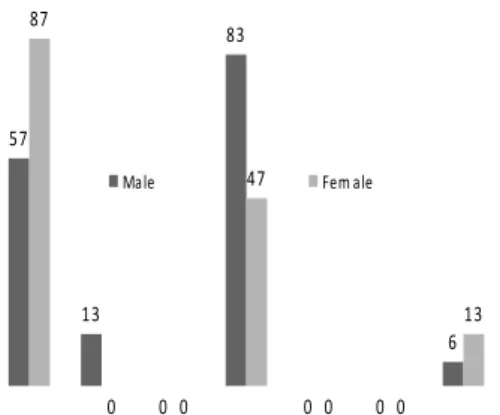
3.5 Awareness and use of various ICT enabled programs:
Akshima Sharma, Savita Aggarwal and Geeta Punhani Page 233 such as Telemedicine, Dimagi and e-health
point.
57
13
0 83
0 0
6 87
0 0
47
0 0
13
Male Fem ale
Figure 5: Gender differentiated awareness of ICT enabled programs
The ignorance of respondents about the names of programs is evident from the following case which was a common occurrence in the village:
Anju, Aged: 27 years, Village Dhugyari said, “ I do not know about any health or e-health program functional in this area. But I am aware that when I was pregnant, I got registered in Primary Health Center with the help of ASHA worker. I also got supplements and other services from ANM. My delivery was in a Government hospital”.
Awareness of ICT enabled programs did not mean their usage by the respondents or their family members as overall only 21% women and 57% men had used any of the ICT enabled initiatives. The study indicated low awareness about ICT enabled programs barring two programs and very poor use of the existing ICT enabled services especially by women.
86
57 47
21
ME N W O ME N
Figure 6: Awareness and usage of ICT enabled programs
When asked the reasons for non-usage of the programs, the male as well as female respondents cited lack of complete knowledge about services and usage, lack of time, pre-occupation with work, lack of faith in government services, lack of motivation and lack of digital skills as well as equipment and internet connectivity.
CONCLUSION
Akshima Sharma, Savita Aggarwal and Geeta Punhani Page 234 were not considered safe for women. The
study has also highlighted other barriers such as poor infrastructure for affordable internet connectivity, lower digital literacy among women, limited awareness and consequent usage of ICT initiatives. If this situation exists in one of the states with high level of human development and high raking in e -governance, then the situation in states with low development and ICT usage may be much worse.
The study also has pointed out that despite much rhetoric about the use of ICTs, the trickle down impact of modern technology is very limited due to poor digital literacy of people as well as affordable access to digital facilities. The gender specific barriers are additional obstacles. This study has shown imbalances between women's and men's access to and participation in ICT enabled programs and provides evidence that more needs to be done to ensure that women equally enjoy the benefits arising from global knowledge based economy at all levels of ICT policy and practice. Special efforts are needed in order to enhance the digital literacy for both men and women as education or literacy level of an individual does not ensure digital literacy. There is a need to integrate digital literacy in school curriculum to impart digital skills to every individual despite of their gender, caste or socio economic background. If ICTs have to be exploited for the purpose of development, there is an urgent need not only to enhance ICT related infrastructure and equipment but also enhance digital skills with special focus on women. At the same time, it is necessary to address the socio-cultural barriers, which hinder the participation of women in the use of ICTs. In order to bridge digital gap between men and women more programs are needed those address the needs of women and minimize their constraints in accessing ICTs. Effective communication campaigns using mass and alternative media are needed to create more awareness and use of ICT enabled programs and their benefits.
Therefore, for achieving national and international goals as per time frames, it is important for developing countries to work at a fast pace and train both men and women in the use new communication technologies. The constraints to the use of ICTs need to be addressed with special focus on women so that the gender gaps in ICT usage can be addressed. This can be done with enhanced awareness and knowledge about ICT enabled programs and their benefits, gender sensitized planning for training and finally imparting training in digital skills to women in their language, at their pace of understanding with content which is socially, economically, culturally relevant.
References
UNDP in India,. (2016). Human Development Reports. Retrieved
3 May 2017, from
http://www.in.undp.org/content/india/en/home/library/hdr/human- development-products/human-development-report-2016---human-development-for-everyone.html
Timeline: Gender Equality, 2015 Year in Review. (2015). Retrieved December 20, 2017, from
http://www.unwomen.org/en/digital-library/multimedia/2015/12/timeline-year-in-review
The Global Gender Gap Report 2016 | World Economic Forum,. (2016). The Global Gender Gap Report 2016. Retrieved 5 May 2016, from https://www.weforum.org/reports/the-global-gender-gap-report-2016
Telecom Regulatory Authority of India,. (2014). The Indian Telecom Services Performance Indicators. New Delhi, India.
Measuring the Information Society Report 2017(Vol. 1, Rep.). (2017). Geneva, Switzerland: International Telecommunication union. Retrieved July 28 , 2017, from https://www.itu.int/en/ITU-D/Statistics/Documents/publications/misr2017/MISR2017_Volum e1.pdf.
United Nations Conference on Trade and Development,. (2014). Measuring ICT and Gender: An Assessment. Geneva: UNITED NATIONS PUBLICATION.
Sulaiman, R., Kalaivani, N., Mittal, N., & Ramasundram, P. (2011). ICT and Empowerment of Indian Rural Women. Hyderabad, India: Centre for Research on Innovation and Science Policy (CRISP).
Mobile Internet in India 2015(Rep.). (2015). Retrieved February 24, 2018, from Internet and Mobile Association of India and
IMRB website:
Akshima Sharma, Savita Aggarwal and Geeta Punhani Page 235 Women and mobile in India: Realising the opportunity. (2016,
October 25). Retrieved February 24 , 2018, from https://www.gsma.com/mobilefordevelopment/programme/conne cted-women/women-and-mobile-in-india-realising-the-opportunity
The State of the World's Children 2017: Children in a Digital World. (2017, December 06). Retrieved February 24, 2018, from https://www.unicef.org/publications/index_101992.html
Haseloff, A. (2005). Cybercafés and their potential as Community Development Tools in India. The Journal Of
Community Informatics, 1(3). Retrieved
from http://cijournal.net/index.php/ciej/article/view/226/181
Intel & Dalberg Global Development Advisor. (2012). Women and the web. Intel Corporation. Retrieved from https://www.intel.com/content/www/us/en/technology-in-education/women-in-the-web.html