Reuse It Or Lose It: More Efficient Secure Computation
Through Reuse of Encrypted Values
Benjamin Mood
University of Florida
[email protected]
Debayan Gupta
Yale University
[email protected]
Kevin R. B. Butler
University of Florida
[email protected]
Joan Feigenbaum
Yale University
[email protected]
ABSTRACT
Two-party secure-function evaluation (SFE) has become sig-nificantly more feasible, even on resource-constrained de-vices, because of advances in server-aided computation sys-tems. However, there are still bottlenecks, particularly in the input-validation stage of a computation. Moreover, SFE re-search has not yet devoted sufficient attention to the impor-tant problem of retaining state after a computation has been performed so that expensive processing does not have to be repeated if a similar computation is done again. This paper presents PartialGC, an SFE system that allows the reuse of encrypted values generated during a garbled-circuit compu-tation. We show that using PartialGC can reduce computa-tion time by as much as 96% and bandwidth by as much as 98% in comparison with previous outsourcing schemes for secure computation. We demonstrate the feasibility of our approach with two sets of experiments, one in which the garbled circuit is evaluated on a mobile device and one in which it is evaluated on a server. We also use PartialGC to build a privacy-preserving “friend-finder” application for Android. The reuse of previous inputs to allow stateful eval-uation represents a new way of looking at SFE and further reduces computational barriers.
Categories and Subject Descriptors
D.4.6 [Operating Systems]: Security and Protection – Cryp-tographic Controls
Keywords
Garbled Circuits, Cut-and-Choose, Server-Aided Computa-tion
1.
INTRODUCTION
Secure function evaluation, orSFE, allows multiple parties to jointly compute a function while maintaining input and output privacy. The two-party variant, known as 2P-SFE, Permission to make digital or hard copies of all or part of this work for personal or classroom use is granted without fee provided that copies are not made or distributed for profit or commercial advantage and that copies bear this notice and the full citation on the first page. Copyrights for components of this work owned by others than ACM must be honored. Abstracting with credit is permitted. To copy otherwise, or republish, to post on servers or to redistribute to lists, requires prior specific permission and/or a fee. Request permissions from [email protected].
CCS’14,November 3–7, 2014, Scottsdale, Arizona, USA. Copyright 2014 ACM 978-1-4503-2957-6/14/11 ...$15.00. http://dx.doi.org/10.1145/2660267.2660285.
was first introduced by Yao in the 1980s [39] and was largely a theoretical curiosity. Developments in recent years have made 2P-SFE vastly more efficient [18, 27, 38]. However, computing a function using SFE is still usually much slower than doing so in a non-privacy-preserving manner.
As mobile devices become more powerful and ubiquitous, users expect more services to be accessible through them. When SFE is performed on mobile devices (where resource constraints are tight), it is extremely slow – if the com-putation can be run at all without exhausting the mem-ory, which can happen for non-trivial input sizes and algo-rithms [8]. One way to allow mobile devices to perform SFE is to use a server-aided computational model [8, 22], allow-ing the majority of an SFE computation to be “outsourced” to a more powerful device while still preserving privacy. Past approaches, however, have not considered the ways in which mobile computation differs from the desktop. Often, the mo-bile device is called upon to performincrementaloperations that are continuations of a previous computation.
Consider, for example, a “friend-finder” application where the location of users is updated periodically to determine whether a contact is in proximity. Traditional applications disclose location information to a central server. A privacy-preserving friend-finder could perform these operations in a mutually oblivious fashion. However, every incremental lo-cation update would require a full re-evaluation of the func-tion with fresh inputs in a standard SFE solufunc-tion. Our ex-amination of an outsourced SFE scheme for mobile devices by Carter et al. [8] (hereon CMTB), determined that the cryptographic consistency checks performed on the inputs to an SFE computationthemselvescan constitute the great-est bottleneck to performance.
Additionally, many other applications require the ability to save state, a feature that current garbled-circuit imple-mentations do not possess. The ability to save state and reuse an intermediate value from one garbled circuit execu-tion in another would be useful in many other ways,e.g., we could split a large computation into a number of smaller pieces. Combined with efficient input validation, this be-comes an extremely attractive proposition.
In this paper, we show that it is possible to reuse an en-crypted value in an outsourced SFE computation (we use a cut-and-choose garbled circuit protocol) even if one is re-stricted to primitives that are part of standard garbled cir-cuits. Our system, PartialGC, which is based on CMTB, provides a way to take encrypted output wire values from one SFE computation, save them, and then reuse them as
input wires in a new garbled circuit. Our method vastly re-duces the number of cryptographic operations compared to the trivial mechanism of simply XOR’ing the results with a one-time pad, which requires either generating inside the cir-cuit, or inputting, a very large one-time pad, both complex operations. Through the use of improved input validation mechanisms proposed by shelat and Shen [38] (hereon sS13) and new methods of partial input gate checks and evalu-ation, we improve on previous proposals. There are other approaches to the creation of reusable garbled circuits [13, 10, 5], and previous work on reusing encrypted values in the ORAM model [30, 11, 31], but these earlier schemes have not been implemented. By contrast, we have implemented our scheme and found it to be both practical and efficient; we provide a performance analysis and a sample application to illustrate its feasibility (Section 6), as well as a simplified example execution (Appendix C).
By breaking a large program into smaller pieces, our sys-tem allows interactive I/O throughout the garbled circuit computation. To the best of our knowledge this is the first practical protocol for performing interactive I/O in the mid-dle of a cut-and-choose garbled circuit computation.
Our system comprises three parties - a generator, an eval-uator, and a third party (“the cloud”), to which the evaluator outsources its part of the computation. Our protocol is se-cure against a malicious adversary, assuming that there is no collusion with the cloud. We also provide a semi-honest version of the protocol.
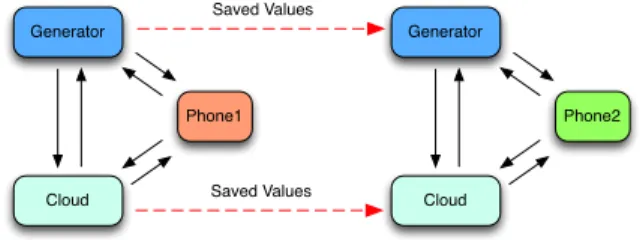
Figure 1 shows how PartialGC works at a high level: First, a standard SFE execution (blue) takes place, at the end of which we “save” some intermediate output values. All further executions use intermediate values from previous executions. In order to reuse these values, information from both parties – the generator and the evaluator – has to be saved. In our protocol, it is the cloud – rather than the evaluator – that saves information. This allows multiple distinct evaluators to participate in a large computation over time by saving state in the cloud between different garbled circuit execu-tions. For example, in a scenario where a mobile phone is outsourcing computation to a cloud, PartialGC can save the encrypted intermediate outputs to the cloud instead of the phone (Figure 2). This allows the phones to communicate with each other by storing encrypted intermediate values in the cloud, which is more efficient than requiring them to directly participate in the saving of values, as required by earlier 2P-SFE systems. Our friend finder application, built for an Android device, reflects this usage model and allows multiple friends to share their intermediate values in a cloud. Other friends use these saved values to check whether or not someone is in the same map cell as themselves without hav-ing to copy and send data.
By incorporating our optimizations, we give the following contributions:
1. Reusable Encrypted Values– We show how to reuse an encrypted value, using only garbled circuits, by mapping one garbled value into another.
2. Reduced Runtime and Bandwidth– We show how reusable encrypted values can be used in practice to reduce the ex-ecution time for a garbled-circuit computation; we get a 96% reduction in runtime and a 98% reduction in band-width over CMTB.
3. Outsourcing Stateful Applications– We show how our sys-tem increases the scope of SFE applications by allowing
Garbled( Circuit( Execu0on(1( E(
G(
Par0alGC(
Garbled( Circuit( Execu0on(2(
Par0alGC( Garbled(
Circuit( Execu0on(3( E(
G(
E( G(
Figure 1: PartialGC Overview. E is evaluator and G is gen-erator. The blue box is a standard execution that produces partial outputs (garbled values); yellow boxes represent exe-cutions that take partial inputs and produce partial outputs.
Generator
Phone1
Cloud
Generator
Phone2
Cloud
Outsourced SFE Computation 1 Outsourced SFE Computation 2 Saved Values
Saved Values
Figure 2: Our system has three parties. Only the cloud and generator have to save intermediate values - this means that we can have different phones in different computations.
multiple evaluating parties over a period of time to op-erate on the saved state of an SFE computation without the need for these parties to know about each other. The remainder of our paper is organized as follows: Section 2 provides some background on SFE. Section 3 introduces the concept of partial garbled circuits in detail. The PartialGC protocol and its implementation are described in Section 4, while its security is analyzed in Section 5. Section 6 evalu-ates PartialGC and introduces the friend finder application. Section 7 discusses related work and Section 8 concludes.
2.
BACKGROUND
Secure function evaluation (SFE) addresses scenarios where two or more mutually distrustful parties P1, . . . , Pn, with
private inputsx1, . . . , xn, want to compute a given function
yi =f(x1, . . . , xn) (yi is the output received by Pi), such
that noPilearns anything about anyxjoryj,i6=jthat is
not logically implied byxiandyi. Moreover, there exists no
trusted third party – if there was, thePis could simply send
their inputs to the trusted party, which would evaluate the function and return theyis.
SFE was first proposed in the 1980s in Yao’s seminal pa-per [39]. The area has been studied extensively by the cryp-tography community, leading to the creation of the first gen-eral purpose platform for SFE, Fairplay [32] in the early 2000s. Today, there exist many such platforms [6, 9, 16, 17, 26, 37, 40].
The classic platforms for 2P-SFE, including Fairplay, use garbled circuits. A garbled circuit is a Boolean circuit which is encrypted in such a way that it can be evaluated when the proper input wires are entered. The party that evaluates this circuit does not learn anything about what any partic-ular wire represents. In 2P-SFE, the two parties are: the generator, which creates the garbled circuit, and the evalua-tor, which evaluates the garbled circuit. Additional crypto-graphic techniques are used for input and output; we discuss these later.
A two-input Boolean gate has four truth table entries. A two-input garbled gate also has a truth table with four en-tries representing 1s and 0s, but these enen-tries are encrypted and can only be retrieved when the proper keys are used.
The values that represent the 1s and 0s are random strings of bits. The truth table entries are permuted such that the evaluator cannot determine which entry she is able to de-crypt, only that she is able to decrypt an entry. The entirety of a garbled gate is the four encrypted output values.
Each garbled gate is then encrypted in the following way: Each entry in the truth table is encrypted under the two input wires, which leads to the result,truthi=Enc(inputx||
inputy)⊕outputi, wheretruthiis a value in the truth table,
inputx is the value of input wire x,inputy is the value of
input wirey, andoutputiis the non-encrypted value, which
represents either 0 or 1.We use AES as theEnc function. If the evaluator hasinputx and inputy, then she can also
receiveoutputi, and the encrypted truth tables are sent to
her for evaluation.
For the evaluator’s input, 1-out-of-2 oblivious transfers (OTs) [1, 20, 34, 35] are used. In a 1-out-of-2 OT, one party offers up two possible values while the other party selects one of the two values without learning the other. The party that offers up the two values does not learn which value was selected. Using this technique, the evaluator gets the wire labels for her input without leaking information.
The only way for the evaluator to get a correct output value from a garbled gate is to know the correct decryption keys for a specific entry in the truth table, as well as the location of the value she has to decrypt.
During the permutation stage, rather than simply ran-domly permuting the values, the generator permutes values based on a specific bit ininputxandinputy, such that, given
inputxandinputythe evaluator knows that the location of
the entry to decrypt isbitx∗2 +bity. These bits are called
thepermutation bits, as they show the evaluator which en-try to select based on the permutation; this optimization, which does not leak any information, is known aspoint and permute[32].
2.1
Threat Models
Traditionally, there are two threat models discussed in SFE work, semi-honest and malicious. The above description of garbled circuits is the same in both threat models. In the semi-honest model users stay true to the protocol but may attempt to learn extra information from the system by looking at any message that is sent or received. In the malicious model, users may attempt to change anything with the goal of learning extra information or giving incorrect results without being detected; extra techniques must be added to achieve security against a malicious adversary.
There are several well-known attacks a malicious adver-sary could use against a garbled circuit protocol. A protocol secure against malicious adversaries must have solutions to all potential pitfalls, described in turn:
Generation of incorrect circuitsIf the generator does not create a correct garbled circuit, he could learn extra information by modifying truth table values to output the evaluator’s input; he is limited only by the external structure of the garbled circuit the evaluator expects.
Selective failure of inputIf the generator does not offer up correct input wires to the evaluator, and the evaluator selects the wire that was not created properly, the generator can learn up to a single bit of information based on whether the computation produced correct outputs.
Input consistencyIf either party’s input is not consis-tent across all circuits, then it might be possible for extra
information to be retrieved.
Output consistencyIn the two-party case, the output consistency check verifies that the evaluator did not modify the generator’s output before sending it.
2.1.1
Non-collusion
CMTB assumes non-collusion, as quoted below:
“The outsourced two-party SFE protocol securely computes a function f(a,b) in the following two corruption scenarios: (1)The cloud is malicious and non-cooperative with respect to the rest of the parties, while all other parties are semi-honest, (2)All but one party is malicious, while the cloud is semi-honest.”
This is the standard definition of non-collusion used in server-aided works such as Kamara et al. [22]. Non-collusion does not mean the parties are trusted; it only means the two parties are not working together (i.e. both malicious). In CMTB, any individual party that attempts to cheat to gain additional information will still be caught, but collu-sion between multiple parties could leak information. For instance, the generator could send the cloud the keys to de-crypt the circuit and see what the intermediate values are of the garbled function.
3.
PARTIAL GARBLED CIRCUITS
We introduce the concept ofpartial garbled circuits(PGCs), which allows the encrypted wire outputs from one SFE com-putation to be used as inputs to another. This can be ac-complished bymappingthe encrypted output wire values to valid input wire values in the next computation. In order to better demonstrate their structure and use, we first present PGCs in a semi-honest setting, before showing how they can aid us against malicious adversaries.
3.1
PGCs in the Semi-Honest Model
In the semi-honest model, for each wire value, the gen-erator can simply send two values to the evaluator, which transforms the wire label the evaluator owns to work in an-other garbled circuit. Depending on the point and permute bit of the wire label received by the evaluator, she can map the value from a previous garbled circuit computation to a valid wire label in the next computation.
Specifically, for a given wire pair, the generator has wires
wt0−1 andw
t−1
1 , and creates wiresw
t
0andw1t. Here,trefers
to a particular computation in a series, while 0 and 1 cor-respond to the values of the point and permute bits of the
t−1 values. The generator sends the valueswt0−1⊕w
t
0 and
wt−1
1 ⊕w
t
1 to the evaluator. Depending on the point and
permute bit of the wti−1 value she possesses, the evaluator selects the correct value and then XORs herwti−1 with the
(wt−1
i ⊕w t
i) value, thereby giving her wti, the valid partial
input wire.
3.2
PGCs in the Malicious Model
In the malicious model we must allow the evaluation of a circuit with partial inputs and verification of the mappings, while preventing a selective failure attack. The following fea-tures are necessary to accomplish these goals:
1. Verifiable Mapping
The generatorGis able to create a secure mapping from a saved garbled wire value into a new computation that can be checked by the evaluatorE, withoutEbeing able to re-verse the mapping. During the evaluation and check phase,
Input Garbled Circuit Input 0
Garbled Circuit Input N Input
Partial input Gate 0
Partial input
Gate N ...
...
Remainder of Garbled Circuit
AND
OR
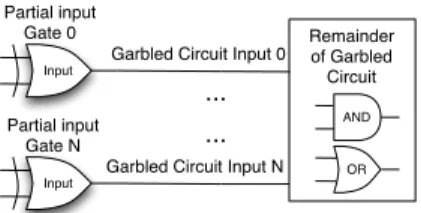
Figure 3: This figure shows how we create a single partial input gatefor each input bit for each circuit and then link thepartial input gates to the remainder of the circuit.
Emust be able to verify the mappingGsent.Gmust have either committed to the mappings before deciding the parti-tion of evaluaparti-tion and check circuits, or never learned which circuits are in the check versus the evaluation sets.
2. Partial Generation and Partial Evaluation
Gcreates the garbled gates necessary for E to enter the previously output intermediate encrypted values into the next garbled circuit. These garbled gates are calledpartial input gates. As shown in Figure 3 each garbled circuit is made up of two pieces: the partial input gates and the re-mainder of the garbled circuit.
3. Revealing Incorrect Transformations
Our last goal is to let E informGthat incorrect values have been detected. Without a way to limit leakage,Gcould gain information based on whether or notEinformsGthat she caught him cheating. This is a selective failure attack and is not present in our protocol.
4.
PARTIALGC PROTOCOL
We start with the CMTB protocol and add cut-and-choose operations from sS13 before introducing the mechanisms needed to save and reuse values. We defer to the original papers for full details of the outsourced oblivious trans-fer [8] and the generator’s input consistency check [38] sub-protocols that we use as primitives in our protocol.
Our system operates in the same threat model as CMTB (see Section 2.1.1): we are secure against a malicious adver-sary under the assumption of non-collusion. A description of the CMTB protocol is available in Appendix A.
4.1
Preliminaries
There are three participants in the protocol:
Generator – The generator is the party that generates the garbled circuit for the 2P-SFE.
Evaluator –The evaluator is the other party in the 2P-SFE, which is outsourcing computation to a third party, the cloud.
Cloud– The cloud is the party that executes the garbled circuit outsourced by the evaluator.
Notation
Ci- Theith circuit.
CKeyi- Circuit key used for the free XOR optimization [25].
The key is randomly generated and then used as the differ-ence between the 0 and 1 wire labels for a circuitCi.
CSeedi- This value is created by the generator’s PRNG and
is used to generate a particular circuitCi.
P Out#i,j- Thepartial outputvalues are the encrypted wire
values output from an SFE computation. These are encrypted garbled circuit values that can be reused in another garbled circuit computation. # is replaced in our protocol descrip-tion with either a 0, 1, or x, signifying whether it represents a
0, 1, or an unknown value (from the cloud’s point of view).i
denotes the circuit theP Outvalue came from andjdenotes the wire of theP Outicircuit.
P In#i,j - Thepartial inputvalues are the re-enteredPOut
values after they have been obfuscated to remove the circuit key from the previous computation. These values are input to thepartial input gates. #,i, andj, are the same as above.
GIn#i,j - The garbled circuit inputvalues are the results
of the partial input gates and are input into the remaining garbled circuit, as shown in Figure 3. #, i, andj, are the same as above.
Partial Input Gates - These are garbled gates that take in
P In values and output GIn values. Their purpose is to transform thePInvalues into values that are underCKeyi
for the current circuit.
4.2
Protocol
Each computation is self-contained; other than what is explicitly described as saved in the protocol, each value or property is only used for a single part of the computation (i.e.randomness is different across computations).
Algorithm 0:PartialComputation
Input : Circuit File, Bit Security, Number of Circuits, Inputs, Is First Execution
Output: Circuit File Output
Cut_and_Choose(is First Execution)
Eval Garbled Input←Evaluator_Input(Eval Select Bits, Possible Eval Input)
Generator_Input_Check(Gen Input)
Partial Garbled Input←Partial_Input(PartialOutputtime−1)
Garbled Output, Partial Output←
Circuit_Execution(Garbled Input (Gen, Eval, Partial)) Circuit_Output(Garbled Output)
Partial_Output(Partial Output)
Common Inputs: The program circuit file, the bit level security, the circuit level security (number of circuits) S, and encryption and commitment functions.
Private Inputs:The evaluator’s input evlInputand gen-erator’s inputgenInput.
Outputs:The evaluator and generator can both receive gar-bled circuit outputs.
Phase 1: Cut-and-choose
We modify the cut-and-choose mechanism described in sS13 as we have an extra party involved in the computation. In this cut-and-choose, the cloud selects which circuits are evaluation circuits and which circuits are check circuits,
circuitSelection=rand()
wherecircuitSelectionis a bit vector of sizeS;N evaluation circuits andS−Ncheck circuits are selected whereN= 2
5S.
The generator does not learn the circuit selection.
The generator generates garbled versions of his input and circuit seeds for each circuit. He encrypts these values using unique 1-time XOR pad keys. For 0≤i < S,
CSeedi=rand()
garbledGenInputi=garble(genInput, rand())
checkKeyi=rand()
evlKeyi=rand()
encSeedIni=CSeedi⊕evlKeyi
Algorithm 1:Cut and Choose
Input : is First Execution
ifis First Executionthen
circuitSelection←rand() // bit-vector of sizeS N←2
5S// Number of evaluation circuits
//Generator creates his garbled input and circuit seeds for each circuit
fori←0toSdo
CSeedi←rand()
garbledGenInputi←garble(genInput, rand()) //generator creates or loads keys
if is First Executionthen
checkKeyi←rand() evlKeyi←rand()
else
loadKeys();
checkKeyi←hash(loadedCheckKeyi) evlKeyi←hash(loadedEvlKeyi) // encrypts using unique 1-time XOR pads encSeedIni←CSeedi⊕evlKeyi
encGarbledIni←garbledGenInputi⊕checkKeyi
ifis First Executionthen
// generator offers input OR keys for each circuit seed selectedKeys←
OT(circuitSelection,{evlKey, checkKey})
else
loadSelectedKeys()
fori←0toSdo
genSendT oEval(hash(checkKeyi), hash(evaluationKeyi))
fori←0toSdo
cloudSendT oEval(hash(selectedKeyi), isCheckCircuiti) // If all values match, the evaluator learns split, else abort.
fori←0toSdo
j←isCheckCircuiti
correct←(recievedGeni,j==recievedEvli)
if !correctthen
abort()
The cloud and generator perform an oblivious transfer where the generator offers up decryption keys for his input and decryption keys for the circuit seed for each circuit. The cloud can select the key to decrypt the generator’s input or the key to decrypt the circuit seed for a circuit but not both. For each circuit, if the cloud selects the decryption key for the circuit seed in the oblivious transfer, then the circuit is used as a check circuit.
selectedKeys=OT(circuitSelection,{evlKey, checkKey}) If the cloud selects the key for the generator’s input then a given circuit is used as an evaluation circuit. Otherwise, the key for the circuit seed was selected and the circuit is a check circuit. The decryption keys are saved by both the generator and cloud in the event a computation uses saved values from this computation.
The generator sends the encrypted garbled inputs and check circuit information for all circuits to the cloud. The cloud decrypts the information he can decrypt using its keys. The evaluator must also learn the circuit split. The generator sends a hash of each possible encryption key the cloud could have selected to the evaluator for each circuit as an ordered pair. For 0≤i < S,
genSend(hash(checkKeyi), hash(evaluationKeyi))
The cloud sends a hash of the value received to the evaluator for each circuit. The cloud also sends bits to indicate which circuits were selected as check and evaluation circuits to the evaluator. For 0≤i < S,
cloudSend(hash(selectedKeyi), isCheckCircuiti)
The evaluator compares each hash the cloud sent to one of the hashes the generator sent, which is selected by the circuit selection sent by the cloud. For 0≤i < S,
j=isCheckCircuiti
correct= (receivedGeni,j==receivedEvli)
If all values match, the evaluator uses theisCheckCircuiti
to learn the split between check and evaluator circuits. Oth-erwise the evaluator safely aborts.
We only perform the cut-and-choose oblivious transfer for the initial computation. For any subsequent computations, the generator and evaluator hash the saved decryption keys and use those hashes as the new encryption and decryption keys. The circuit split selected by the cloud is saved and stays the same across computations.
Phase 2: Oblivious Transfer Algorithm 2:Evaluator Input
Input : Eval Select Bits, Possible Eval Input
Output: Eval Garbled Input
// cloud gets selected input wires // generator offers both possible input wire values for each input wire; evaluator selects its input
outSeeds=BaseOOT(bitsEvl, possibleInputs).
// the generator sends unique IKey values for each circuit to the evaluator
fori←0toSdo
genSendT oEval(IKeyi)
// the evaluator sends IKey values for all evaluation circuits to the cloud
fori←0toSdo
if!isCheckCircuit(i)then
EvalSendT oCloud(IKeyi)
// cloud uses this to learn appropriate inputs
fori←0toSdo
forj←0tolen(evlInputs)do if !isCheckCircuit(i)then
inputEvlij←hash(IKeysi, outSeedsj) return inputEvl
We use the base outsourced oblivious transfer (OOT) of CMTB. In this transfer the generator inputs both possible input wire values for each evaluator’s input wire while the evaluator inputs its own input. After the OOT is performed, the cloud has the selected input wire values, which represent the evaluator’s input.
As with CMTB, which uses the results from a single OOT as seeds to create the evaluator’s input for all circuits, the cloud in our system also uses seeds from a single base OT (called “BaseOOT” below) to generate the input for the eval-uation circuits. The cloud receives the seeds for each input bit selected by the evaluator.
outSeeds=BaseOOT(evlInputSeeds, evlInput).
The generator creates unique keys, IKey, for each circuit and sends each key to the evaluator. The evaluator sends the keys for the evaluation circuits to the cloud. The cloud then uses these values to attain the evaluator’s input. For 0≤i < S, for 0≤j < len(evlInputs) where !isCheckCircuit(i),
Phase 3: Generator’s Input Consistency Check Algorithm 3:Generator Input Check
Input : Generator Input
// The cloud takes a hash of the generator’s input or each evaluation circuitfori←0toSdo
if isCheckCircuit(i)then
ti←U HF(garbledGenInputi)
//If a single hash is different then the cloud knows the generator tried to cheat.
correct←((t0==t1)&(t0==t2)&. . .&(t0==tN−1))
if!correctthen
abort()
We use the input consistency check of sS13. In this check, a universal hash is used to prove consistency of the generator’s input across each evaluation circuit. Simply put, if the hash is different in any of the evaluation circuits, we know the generator did not enter consistent input. More formally, a hash of the generator’s input is taken for each circuit. For 0< i < S where !isCheckCircuit(i),
ti=U HF(garbledGenInputi, Ci)
The results of these universal hashes are compared. If a sin-gle hash is different then the cloud knows the generator tried to cheat and safely aborts.
correct= ((t0==t1)&(t0==t2)&. . .&(t0==tN−1))
Phase 4: Partial Input Gate Generation, Check, and Evaluation
Generation
For 0≤i < S, for 0≤j < len(savedW ires), the gener-ator creates apartial input gate, which transforms a wire’s saved values,P Out0i,j andP Out1i,j, into wire values that
can be used in the current garbled circuit execution,GIn0i,j
and GIn1i,j. For each circuit, Ci, the generator creates a
pseudorandom transformation valueRi, to assist with the
transformation.
For each set of P Out0i,j and P Out1i,j, the generator
XORs each value withRi. Both results are then hashed, and
put through a function to determine the new permutation bit, as hashing removes the old permutation bit.
t0 =hash(P Out0i,j⊕Ri)
t1 =hash(P Out1i,j⊕Ri)
P In0i,j, P In1i,j=setP P BitGen(t0, t1)
This function, setPPBitGen, pseudo-randomly finds a bit that is different between the two values of the wire and notes that bit to be the permutation bit.setPPBitGenis seeded fromCSeedi, allowing the cloud to regenerate these values
for the check circuits.
For eachP In0i,j, P In1i,jpair, a set of values,GIn0i,jand
GIn1i,j, are created under the master key ofCi,CKeyi, –
whereCKeyi is the difference between 0 and 1 wire labels
for the circuit. In classic garbled gate style, two truth table values,T T0i,jandT T1i,j, are created such that:
T T0i,j⊕P In0i,j=GIn0i,j
T T1i,j⊕P In1i,j=GIn1i,j
The truth table, T T0i,j and T T1i,j, is permuted so that
the permutation bits ofP In0i,j andP In1i,j tell the cloud
which entry to select. Eachpartial input gate, consisting of the permuted T T0i,j, T T1i,j values and the bit location
Algorithm 4:Partial Input
Input : Partial Output
Output: Partial Garbled Input
// Generation: the generator creates apartial input gate, which transforms a wire’s saved values,P Out0i,jandP Out1i,j, into values that can be used in the current garbled circuit execution, GIn0i,jandGIn1i,j.
fori←0toSdo
Ri←P RN G.random()
forj←0tolen(savedW ires)do
t0←hash(P Out0i,j⊕Ri) t1←hash(P Out1i,j⊕Ri)
P In0i,j, P In1i,j←setP P BitGen(t0, t1) GIn0i,j←T T0i,j⊕P In0i,j
GIn1i,j←T T1i,j⊕P In1i,j
GenSendToCloud( Permute([T T0i,j, T T1i,j]), permute bit locations )
GenSendToCloud(Ri)
// Check: The cloud checks the gates to make sure the generator didn’t cheat
fori←0toSdo
ifisCheckCircuit(i)then
forj←0tolen(savedW ires)do
// the cloud has received the truth table information,T T0i,j, T T1i,j, bit locations from setP P BitGen, andRi
correct←(generateGateF romInf o() == receivedGateF romGen())
// If any gate does not match, the cloud knows the generator tried to cheat.
if!correctthen
abort();
// Evaluation
fori←0toSdo
if!isCheckCircuit(i)then
forj←0tolen(savedW ires)do
//The cloud, using the previously savedP Outxi,j value, and the location (point and permute) bit sent by the generator, createsP Inxi,j
P Inxi,j←
setP P BitEval(hash(Ri⊕P Outxi,j), location) // UsingP Inxi,j, the cloud selects the proper truth table entryT T xi,jfrom eitherT T0i,jor T T1i,jto decrypt
// CreatesGInxi,jto enter into the garbled circuit GInxi,j←T T xi,j⊕P Outxi,j
return GIn;
fromsetP P BitGenis sent to the cloud. EachRiis also sent
to the cloud. Check
For 0 ≤ i < S where isCheckCircuit(i), for 0 ≤ j < len(savedW ires), the cloud receives the truth table informa-tion, T T0i,j, T T1i,j, and bit location from setP P BitGen,
and proceeds to regenerate the gates based on the check cir-cuit information. The cloud usesRi(sent by the generator),
P Out0i,j and P Out1i,j (saved during the previous
execu-tion), andCSeedi (recovered during the cut-and-choose) to
generate thepartial input gatesin the same manner as de-scribed previously. The cloud then compares these gates to those the generator sent. If any gate does not match, the cloud knows the generator tried to cheat and safely aborts. Evaluation
For 0 ≤ i < S where !isCheckCircuit(i), for 0 ≤ j < len(savedW ires) the cloud receives the truth table informa-tion,T T ai,j, T T bi,j and bit location fromsetP P BitGen.a
andbare used to denote the two permuted truth table val-ues. The cloud, using the previously savedP Outxi,j value,
creates theP Inxi,j value:
locationis the location of the point and permute bit sent by the generator. Using the point and permute bit ofP Inxi,j,
the cloud selects the proper truth table entryT T xi,j from
eitherT T ai,jorT T bi,jto decrypt, createsGInxi,jand then
entersGInxi,j into the garbled circuit.
GInxi,j=T T xi,j⊕P Outxi,j
Phase 5: Circuit Generation and Evaluation Algorithm 5:Circuit Execution
Input : Generator Input, Evaluator Input, Partial Input
Output: Partial Output, Garbled Output
// The generator generates each garbled gate and sends it to the cloud. Depending on whether the circuit is a check or evaluation circuit, the cloud verifies that the gate is correct or evaluates the gate.
fori←0toSdo
forj←0tolen(circuit)do
g←genGate(Ci, j) send(g)
// the cloud receives all gates for all circuits, and then checks OR evaluates each circuit
fori←0toSdo
forj←0tolen(circuit)do
g←recvGate()
ifisCheckCircuit(i)then if !verif yCorrect(g)then
abort()
else
eval(g)
return Partial Output, Garbled Output
Circuit Generation
The generator generates each garbled gate for each circuit and sends them to the cloud. Since the generator does not know the check and evaluation circuit split, nothing changes for the generation for check and evaluation circuits. For 0≤ i < S,For 0≤j < len(circuit),
g=genGate(Ci, j), send(g)
Circuit Evaluation and Check
The cloud receives each garbled gate for all circuits. For evaluation circuits the cloud evaluates those garbled gates. For check circuits the cloud generates the correct gate, based on the circuit seed, and is able to verify it is correct.
For 0≤i < S,For 0≤j < len(circuit),g=recvGate(),
if(isCheckCircuit(j))verif yCorrect(g)else eval(g) If a garbled gate is found not to be correct, the cloud informs the evaluator and generator of the incorrect gate and safely aborts.
Phase 6: Output and Output Consistency Check Algorithm 6:Circuit Output
Input : Garbled Output
// a MAC of the output is generated inside the garbled circuit, and both the resulting garbled circuit output and the MAC are encrypted under a one-time pad.
outEvlComplete=outEvl||M AC(outEvl) result= (outEvlM AC==M AC(outEvl))
if!result then
abort() // output check fail
As the final step of the garbled circuit execution, a MAC of the output is generated inside the garbled circuit, based on ak-bit secret key entered into the function.
outEvlComplete=outEvl||M AC(outEvl)
Both the resulting garbled circuit output and the MAC are encrypted under a one-time pad. The generator can also have output verified in the same manner. The cloud sends the corresponding encrypted output to each party.
The generator and evaluator then decrypt the received ciphertext, perform a MAC over real output, and verify the cloud did not modify the output by comparing the generated MAC with the MAC calculated within the garbled circuit.
result= (outEvlM AC==M AC(outEvl)) Phase 7: Partial Output
Algorithm 7:Partial Output
Input : Partial Output
fori←0toSdo
forj←0tolen(Partial Output)do
//The generator saves both possible wire values GenSave(P artial Output0i,j)
GenSave(P artial Output1i,j)
fori←0toSdo
forj←0tolen(Partial Output)do if isCheckCircuit(i)then
EvlSave(P artial Output0i,j) EvlSave(P artial Output1i,j)
else
// circuit is evaluation circuit EvlSave(P artial OutputXi,j)
The generator saves both possible wire values for each partial output wire. For each evaluation circuit the cloud saves the partial output wire value. For check circuits the cloud saves both possible output values.
4.3
Implementation
As with most garbled circuit systems there are two stages to our implementation. The first stage is a compiler for cre-ating garbled circuits, while the second stage is an execution system to evaluate the circuits.
We modified the KSS12 [27] compiler to allow for the sav-ing of intermediate wire labels and loadsav-ing wire labels from a different SFE computation. By using the KSS12 compiler, we have an added benefit of being able to compare circuits of almost identical size and functionality between our sys-tem and CMTB, whereas other protocols compare circuits of sometimes vastly different sizes.
For our execution system, we started with the CMTB sys-tem and modified it according to our protocol requirements. PartialGC automatically performs the output consistency check, and we implemented this check at the circuit level. We became aware and corrected issues with CMTB relat-ing to too many primitive OT operations performed in the outsourced oblivious transfer when using a high circuit pa-rameter and too low a general security papa-rameter in general. The fixes reduced the run-time of the OOT.
5.
SECURITY OF PARTIALGC
In this section, we provide a basic proof sketch of the PartialGC protocol, showing that our protocol preserves the standard security guarantees provided by traditional garbled circuits - that is, none of the parties learns anything about the private inputs of the other parties that is not logically implied by the output it receives. Since we borrow heavily from [8] and [38], we focus on our additions, and defer to the original papers for detailed proofs of those protocols. Due to
space constraints, we do not provide a formal proof here; a complete proof will be provided in the technical report.
We know that the protocol described in [8] allows us to garble individual circuits and securely outsource their eval-uation. In this paper, we modify certain portions of the pro-tocol to allow us to transform the output wire values from a previous circuit execution into input wire values in a new circuit execution. These transformed values, which can be checked by the evaluator, are created by the generator using circuit “seeds.”
We also use some aspects of [38], notably their novel cut-and-choose technique which ensures that the generator does not learn which circuits are used for evaluation and which are used for checking - this means that the generator must create the correct transformation values for all of the cut-and-choose circuits.
Because we assume that the CMTB garbled circuit scheme can securely garble any circuit, we can use it individually on the circuit used in the first execution and on the circuits used in subsequent executions. We focus on the changes made at the end of the first execution and the beginning of subse-quent executions which are introduced by PartialGC.
The only difference between the initial garbled circuit ex-ecution and any other garbled circuit in CMTB is that the output wires in an initial PartialGC circuit are stored by the cloud, and are not delivered to the generator or the evalua-tor. This prevents them from learning the output wire labels of the initial circuit, but cannot be less secure than CMTB, since no additional steps are taken here.
Subsequent circuits we wish to garble differ from ordinary CMTB garbled circuits only by the addition, before the first row of gates, of a set of partial input gates. These gates don’t change the output along a wire, but differ from normal gar-bled gates in that the two possible labels for each input wire are not chosen randomly by the generator, but are derived by using the two labels along each output wire of the initial garbled circuit.
This does not reduce security. In PartialGC, the input labels for partial input gates have the same property as the labels for ordinary garbled input gates: the generator knows both labels, but does not know which one corresponds to the evaluator’s input, and the evaluator knows only the label corresponding to its input, but not the other label. This is because the evaluator’s input is exactly the output of the initial garbled circuit, the output labels of which were saved by the evaluator. The evaluator does not learn the other output label for any of the output gates because the output of each garbled gate is encrypted. If the evaluator could learn any output labels other than those which result from an evaluation of the garbled circuit, the original garbled circuit scheme itself would not be secure.
The generator, which also generated the initial garbled circuit, knows both possible input labels for all partial eval-uation gates, because it has saved both potential output labels of the initial circuit’s output gates. Because of the outsourced oblivious transfer used in CMTB, the generator did not know which input labels to use for the initial garbled circuit, and therefore will not have been able to determine the output labels for that circuit. Therefore, the generator will likewise not know which input labels are being used for subsequent garbled circuits.
Generator’s Input Consistency Check
We use the generator’s input consistency check from sS13.
We note there is no problem with allowing the cloud to per-form this check; for the generator’s inconsistent input to pass the check, the cloud would have to see the malicious input and ignore it, which would violate the non-collusion assumption.
Correctness of Saved Values
Scenarios where either party enters incorrect values in the next computation reduce to previously solved problems in garbled circuits. If the generator does not use the correct values, then it reduces to the problem of creating an incor-rect garbled circuit. If the evaluator does not use the corincor-rect saved values then it reduces to the problem of the evaluator entering garbage values into the garbled circuit execution; this would be caught by the output consistency check. Abort on Check Failure
If any of the check circuits fail, the cloud reports the in-correct check circuit to both the generator and evaluator. At this point, the remaining computation and any saved values must be abandoned. However, as is standard in SFE, the cloud cannot abort on an incorrect evaluation circuit, even when she knows that it is incorrect.
Concatenation of Incorrect Circuits
If the generator produces a single incorrect circuit and the cloud does not abort, the generator learns that the circuit was used for evaluation, and not as a check circuit. This leaks no information about the input or output of the computa-tion; to do that, the generator must corrupt a majority of the evaluation circuits without modifying a check circuit. An incorrect circuit that goes undetected in one execution has no effect on subsequent executions as long the total amount of incorrect circuits is less than the majority of evaluation circuits.
Using Multiple Evaluators
One of the benefits of our outsourcing scheme is that the state is saved at the generator and cloud allowing the use of different evaluators in each computation. Previously, it was shown a group of users working with a single server using 2P-SFE was not secure against malicious adversaries, as a malicious server and lastkparties, also malicious, could re-play their portion of the computation with different inputs and gain more information than they can with a single com-putation [15]. However, this is not a problem in our system as at least one of our servers, either the generator or cloud, must be semi-honest due to non-collusion, which obviates the attack stated above.
Threat Model
As we have many computations involving the same gen-erator and cloud, we have to extend the threat model for how the parties can act in different computations. There can be no collusion in each singular computation. However, the malicious party can change between computations as long as there is no chain of malicious users that link the generator and cloud – this would break the non-collusion assumption.
6.
PERFORMANCE EVALUATION
We now demonstrate the efficacy of PartialGC through a comparison with the CMTB outsourcing system. Apart from the cut-and-choose from sS13, PartialGC provides other ben-efits through generating partial input values after the first execution of a program. On subsequent executions, the par-tial inputs act to amortize overall costs of execution and bandwidth.
mobile device outsourcing computation to a more powerful system. We also show that other devices, such as server-class machines, can act as evaluators, to show the generality of this system. Our testing environment includes a 64-core server containing 1 TB of RAM, which we use to model both the Generator and Outsourcing Proxy parties. We run separate programs for the Generator and Outsourcing Proxy, giving them each 32 threads. For the evaluator, we use a Samsung Galaxy Nexus phone with a 1.2 GHz dual-core ARM Cortex-A9 and 1 GB of RAM running Android 4.0, connected to the server through an 802.11 54 Mbps WiFi in an isolated environment. In our tests, which outsource the computation from a single server process we create that process on our 64-core server as well. We ran the CMTB implementation for comparison tests under the same setup.
6.1
Execution Time
The PartialGC system is particularly well suited to com-plex computations that require multiple stages and the sav-ing of intermediate state. Previous garbled circuit execution systems have focused on single-transaction evaluations, such as computing the “millionaires” problem (i.e., a joint evalua-tion of which party inputs a greater value without revealing the values of the inputs) or evaluating an AES circuit.
Our evaluation considers two comparisons: the improve-ment of our system compared with CMTB without reusing saved values, and comparing our protocol for saving and reusing values against CMTB if such reuse was implemented in that protocol. We also benchmark the overhead for sav-ing and loadsav-ing values on a per-bit basis for 256 circuits, a necessary number to achieve a security parameter of 2−80 in the malicious model. In all cases, we run 10 iterations of each test and give timing results with 95% confidence inter-vals. Other than varying the number of circuits our system parameters are set for 80-bit security.
The programs used for our evaluation are exemplars of differing input sizes and differing circuit complexities: Keyed Database:In this program, one party enters a data-base and keys to it while the other party enters a key that indexes into the database, receiving a database entry for that key. This is an example of a program expressed as a small circuit that has a very large amount of input.
Matrix Multiplication: Here, both parties enter 32-bit numbers to fill a matrix. Matrix multiplication is performed before the resulting matrix is output to both parties. This is an example of a program with a large amount of inputs with a large circuit.
Edit (Levenstein) Distance:This program finds the dis-tance between two strings of the same length and returns the difference. This is an example of a program with a small number of inputs and a medium sized circuit.
Millionaires:In this classic SFE program, both parties en-ter a value, and the result is a one-bit output to each party to let them know whether their value is greater or smaller than that of the other party. This is an example of a small circuit with a large amount of input.
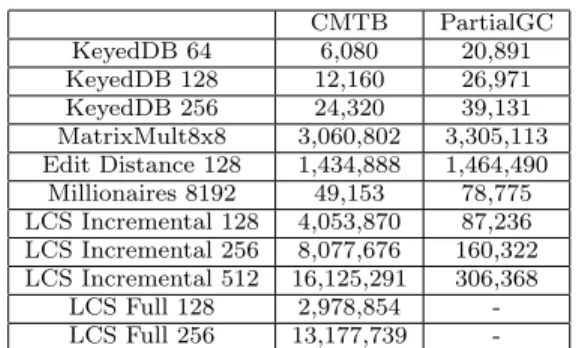
Gate counts for each of our programs can be found in Ta-ble 1. The only difference for the programs described above is the additional of a MAC function in PartialGC. We dis-cuss the reason for this check in Section 6.4.
Table 2 shows the results from our experimental tests. In the best case, execution time was reduced by a factor of 32 over CMTB, from 1200 seconds to 38 seconds, a 96%
CMTB PartialGC
KeyedDB 64 6,080 20,891
KeyedDB 128 12,160 26,971
KeyedDB 256 24,320 39,131
MatrixMult8x8 3,060,802 3,305,113
Edit Distance 128 1,434,888 1,464,490
Millionaires 8192 49,153 78,775
LCS Incremental 128 4,053,870 87,236
LCS Incremental 256 8,077,676 160,322
LCS Incremental 512 16,125,291 306,368
LCS Full 128 2,978,854
-LCS Full 256 13,177,739
-Table 1: Non-XOR gate counts for the various circuits. In the first 6 circuits, the difference between CMTB and PartialGC gate counts is in the consistency checks. The explanation for the difference in size between the incremental versions of longest common substring (LCS) is given inReusing Values. speedup over CMTB. Ultimately, our results show that our system outperforms CMTB when the input checks are the bottleneck. This run-time improvement is due to improve-ments we added from sS13 and occurs in the keyed database, millionaires, and matrix multiplications programs. In the other program, edit distance, the input checks are not the bottleneck and PartialGC does not outperform CMTB. The total run-time increase for the edit distance problem is due to overhead of using the new sS13 OT cut-and-choose tech-nique which requires sending each gate to the evaluator for check circuits and evaluation circuits. This is discussed fur-ther in Section 6.4. The typical use case we imagine for our system, however, is more like the keyed database program, which has a large amount of inputs and a very small circuit. We expand upon this use case later in this section.
Reusing Values
For a test of our system’s wire saving capabilities we tested a dynamic programming problem, longest common substring, in both PartialGC and CMTB. This program determines the length of the longest common substring between two strings. Rather than use a single computation for the solu-tion, our version incrementally adds a single bit of input to both strings each time the computation is run and outputs the results each time to the evaluator. We believe this is a realistic comparison to a real-world application that in-crementally adds data during each computation where it is faster to save the intermediate state and add to it after see-ing an intermediate result than rerun the entire computation many times after seeing the result.
For our testing, PartialGC uses our technique to reuse wire values. In CMTB, we save each desired internal bit under a one-time pad and re-enter them into the next com-putation, as well as the information needed to decrypt the ciphertext. We use a MAC (the AES circuit of KSS12) to verify that the party saving the output bits did not modify them. We also use AES to generate a one-time pad inside the garbled circuit. We use AES as this is the only cryp-tographically secure function used in CMTB. Both parties enter private keys to the MAC functions. This program is labeledCMTB-Inc, for CMTBincremental. The size of this program represents the size of the total strings. We also cre-ated a circuit that computes the complete longest common substring in one computation labeledCMTB-Full.
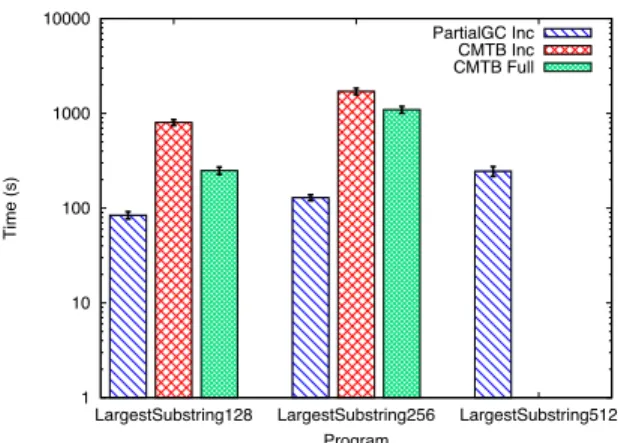
The resulting size of the PartialGC and CMTB circuits are shown in Table 1, and the results are shown in Figure 4. This result shows that saving and reusing values in Par-tialGC is more efficient than completely rerunning the
com-16 Circuits 64 Circuits 256 Circuits
CMTB PartialGC CMTB PartialGC CMTB PartialGC
KeyedDB 64 18±2% 3.5±3% 5.1x 72±2% 8.3±5% 8.7x 290±2% 26±2% 11x
KeyedDB 128 33±2% 4.4±8% 7.5x 140±2% 9.5±4% 15x 580±2% 31±3% 19x
KeyedDB 256 65±2% 4.6±2% 14x 270±1% 12±6% 23x 1200±3% 38±5% 32x
MatrixMult8x8 48±4% 46±4% 1.0x 110±8% 100±7% 1.1x 400±10% 370±5% 1.1x
Edit Distance 128 21±6% 22±3% 0.95x 47±7% 50±9% 0.94x 120±9% 180±6% 0.67x
Millionaires 8192 35±3% 7.3±6% 4.8x 140±2% 20±2% 7.0x 580±1% 70±2% 8.3x
Table 2: Timing results comparing PartialGC to CMTB without saving any values. All times in seconds.
1 10 100 1000 10000
LargestSubstring128 LargestSubstring256 LargestSubstring512
Time (s)
Program
PartialGC Inc CMTB Inc CMTB Full
Figure 4: Results from testing our largest common substring (LCS) programs for PartialGC and CMTB. This shows when changing a single input value is more efficient un-der PartialGC than either CMTB program. CMTB crashed on running LCS Incremental of size 512 due to memory re-quirements. We were unable to complete the compilation of CMTB Full of size 512.
putation. The input consistency check adds considerably to the memory use on the phone forCMTB-Incand in the case of input bit 512, theCMTB-Incprogram will not complete. In the case of the 512-bitCMTB-Full, the program would not complete compilation in over 42 hours. In our CMTB-Incprogram, we assume the cloud saves the output bits so that multiple phones can have a shared private key. We do not provide a full program due to space requirements.
Note that the growth of CMTB-Incand CMTB-Fullare different. CMTB-Full grows at a larger rate (4x for each 2x factor increase) thanCMTB-Inc (2x for each 2x factor increase), implying that although at first it seems more ef-ficient to rerun the program if small changes are desired in the input, eventually this will not be the case. Even with a more efficient AES function,CMTB-Incwould not be faster as the bottleneck is the input, not the size of the circuit.
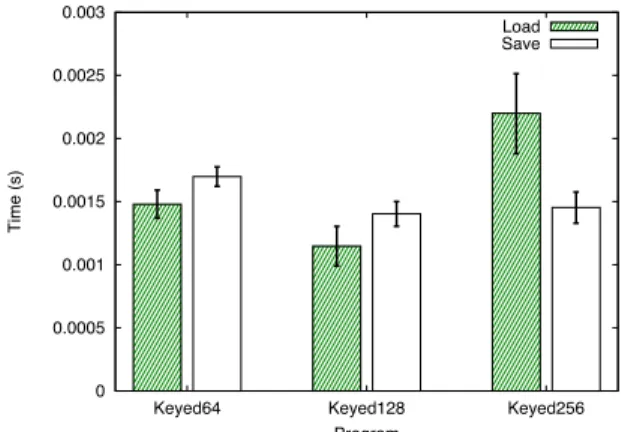
The overhead of saving and reusing values is discussed further in Appendix B.
Outsourcing to a Server Process
PartialGC can be used in other scenarios than just out-sourcing to a mobile device. It can outsource garbled circuit evaluation from a single server process and retain perfor-mance benefits over a single server process of CMTB. For this experiment the outsourcing party has a single thread. Table 4 displays these results and shows that in the KeyedDB 256 program, PartialGC has a 92% speedup over CMTB. As with the outsourced mobile case, keyed database prob-lems perform particularly well in PartialGC. Because the computationally-intensive input consistency check is a greater bottleneck on mobile devices than servers, these improve-ments for most programs are less dramatic. In particular,
256 Circuits
CMTB PartialGC
KeyedDB 64 64992308 3590416 18x
KeyedDB 128 129744948 3590416 36x
KeyedDB 256 259250228 3590416 72x
MatrixMult8x8 71238860 35027980 2.0x
Edit Distance 128 2615651 4108045 0.64x
Millionaires 8192 155377267 67071757 2.3x
Table 3: Bandwidth comparison of CMTB and PartialGC. Bandwidth counted by instrumenting PartialGC to count the bytes it was sending and receiving and then adding them together. Results in bytes.
both edit distance and matrix multiplication programs ben-efit from higher computational power and their bottlenecks on a server are no longer input consistency; as a result, they execute faster in CMTB than in PartialGC.
6.2
Bandwidth
Since the main reason for outsourcing a computation is to save on resources, we give results showing a decrease in the evaluator’s bandwidth. Bandwidth is counted by making the evaluator to count the number of bytes PartialGC sends and receives to either server. Our best result gives a 98% reduction in bandwidth (see Table 3). For the edit distance, the extra bandwidth used in the outsourced oblivious trans-fer for all circuits, instead of only the evaluation circuits, exceeds any benefit we would otherwise have received.
6.3
Secure Friend Finder
Many privacy-preserving applications can benefit from us-ing PartialGC to cache values for state. As a case study, we developed a privacy-preserving friend finder application, where users can locate nearby friends without any user di-vulging their exact location. In this application, many differ-ent mobile phone clidiffer-ents use a consistdiffer-ent generator (a server application) and outsource computation to a cloud. The gen-erator must be the same for all computations; the cloud must be the same for each computation. The cloud and generator are two different parties. After each computation, the map is updated when PartialGC saves the current state of the map as wire labels. Without PartialGC outsourcing values to the cloud, the wire labels would have to be transferred directly between mobile devices, making a multi-user appli-cation difficult or impossible.
We define three privacy-preserving operations that com-prise the application’s functionality:
MapStart- The three parties (generator, evaluator, cloud) create a “blank” map region, where all locations in the map are blank and remain that way until some mobile party sets a location to his or her ID.
MapSet - The mobile party sets a single map cell to a new value. This program takes in partial values from the generator and cloud and outputs a location selected by the
16 Circuits 64 Circuits 256 Circuits
CMTB PartialGC CMTB PartialGC CMTB PartialGC
KeyedDB 64 6.6±4% 1.4±1% 4.7x 27±4% 5.1±2% 5.3x 110±2% 24.9±0.3% 4.4x
KeyedDB 128 13±3% 1.8±2% 7.2x 54±4% 5.8±2% 9.3x 220±5% 27.9±0.5% 7.9x
KeyedDB 256 25±4% 2.5±1% 10x 110±7% 7.3±2% 15x 420±4% 33.5±0.6% 13x
MatrixMult8x8 42±3% 41±4% 1.0x 94±4% 79±3% 1.2x 300±10% 310±1% 0.97x
Edit Distance 128 18±3% 18±3% 1.0x 40±8% 40±6% 1.0x 120±9% 150±3% 0.8x
Millionaires 8192 13±4% 3.2±1% 4.1x 52±3% 8.5±2% 6.1x 220±5% 38.4±0.9% 5.7x
Table 4: Timing results from outsourcing the garbled circuit evaluation from a single server process. Results in seconds.
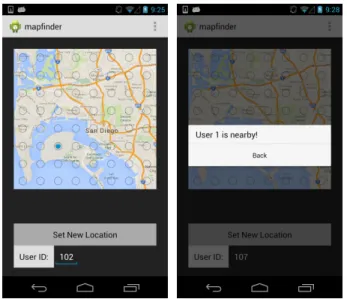
(a) Location selected. (b) After computation. Figure 5: Screenshots from our application. (a) shows the map with radio buttons a user can select to indicate position. (b) show the result after “set new position” is pressed when a user is present. The application is set to use 64 different map locations. Map image from Google Maps.
mobile party.
MapGet- The mobile party retrieves the contents of a sin-gle map cell. This program retrieves partial values from the generator and cloud and outputs any ID set for that cell to the mobile.
In the application, each user using theSecure Friend Finder has a unique ID that represents them on the map. We divide the map into ‘cells’, where each cell is a set amount of area. When the user presses “Set New Location’, the program will first look to determine if that cell is occupied. If the cell is occupied, the user is informed he is near a friend. Otherwise the cell is updated to contain his user ID and remove his ID from his previous location. We assume a maximum of 255 friends in our application since each cell in the map is 8 bits. Figure 6 shows the performance of these programs in the malicious model with a 2−80 security parameter (evaluated over 256 circuits). We consider map regions containing both 256 and 2048 cells. For maps of 256 cells, each operation takes about 30 seconds.1 As there are three operations for each “Set New Location” event, the total execution time is about 90 seconds, while execution time for 2048 cells is about 3 minutes. The bottleneck of the 64 and 256 cell maps is the outsourced oblivious transfer, which is not affected by the number of cells in the map. The vastly larger circuit
associ-1Our 64-cell map, as seen the application screenshots, also
takes about 30 seconds for each operation.
20 40 60 80 100
MapStart MapSet MapGet
Time (s)
Program
Map size 256 Map Size 2048
Figure 6: Run time comparison of our map programs with two different map sizes.
ated with the 2048-cell map makes getting and setting values slower operations, but these results show such an application is practical for many scenarios.
Example - As an example, two friends initiate a friend finder computation using Amazon as the cloud and Face-book as the generator. The first friend goes out for a coffee at a caf´e. The second friend, riding his bike, gets a message that his friend is nearby and looks for a few minutes and finds him in the caf´e. Using this application prevents either Amazon or Facebook from knowing either user’s location while they are able to learn whether they are nearby.
6.4
Discussion
Analysis of improvements
We analyzed our results and found the improvements came from three places: the improved sS13 consistency check, the saving and reusing of values, and the fixed oblivious trans-fer. In the case of the sS13 consistency check, there are two reasons for the improvement, first there is less network traf-fic and second it does not use exponentiations. In the case of saving and reusing values, we save time by the faster input consistency check and not requiring a user to recompute a circuit multiple times. Lastly, we reduced the runtime and bandwidth by fixing parts of the OOT. The previous out-sourced oblivious transfer performed the primitive OT S
times instead of a single time, which turn forced many ex-tra exponentiations. Each amount of improvement varies de-pending upon the circuit.
Output check
Although the garbled circuit is larger for our output check, this check performs less cryptographic operations for the outsourcing party, as the evaluator only has to perform a MAC on the output of the garbled circuit. We use this check to demonstrate using a MAC can be an efficient output check for a low power device when the computational power is not equivalent across all parties.
Commit Cut-and-Choose vs OT Cut-and-Choose Our results unexpectedly showed that the sS13 OT cut-and-choose used in PartialGC is actually slower than the KSS12 commit cut-and-choose used in CMTB in our ex-perimental setup. Theoretically, sS13, which requires fewer cryptographic operations, as it generates the garbled circuit only once, should be the faster protocol. The difference be-tween the two cut-and-choose protocols is the network usage – instead of 25 of the circuits (CMTB),allthe circuits must be transmitted in sS13. The sS13 cut-and-choose is required in our protocol so that the cloud can check that the gener-ator creates the correct gates.
7.
RELATED WORK
SFE was first described by Yao in his seminal paper [39] on the subject. The first general purpose platform for SFE, Fairplay [32], was created in 2004. Fairplay had both a com-piler for creating garbled circuits, and a run-time system for executing them. Computations involving three or more par-ties have also been examined; one of the earliest examples is FairplayMP [2]. There have been multiple other imple-mentations since, in both semi-honest [6, 9, 16, 17, 40] and malicious settings [26, 37].
Optimizations for garbled circuits include the free-XOR technique [25], garbled row reduction [36], rewriting compu-tations to minimize SFE [23], and pipelining [18]. Pipelining allows the evaluator to proceed with the computation while the generator is creating gates.
KSS12 [27] included both an optimizing compiler and an efficient run-time system using a parallelized implementa-tion of SFE in the malicious model from [37].
The creation of circuits for SFE in a fast and efficient man-ner is one of the central problems in the area. Previous com-pilers, from Fairplay to KSS12, were based on the concept of creating a complete circuit and then optimizing it. PAL [33] improved such systems by using a simple template circuit, reducing memory usage by orders of magnitude. PCF [26] built from this and used a more advanced representation to reduce the disk space used.
Other methods for performing MPC involve homomorphic encryption [3, 12], secret sharing [4], and ordered binary decision diagrams [28]. A general privacy-preserving com-putation protocol that uses homomorphic encryption and was designed specifically for mobile devices can be found in [7]. There are also custom protocols designed for partic-ular privacy-preserving computations; for example, Kamara et al. [21] showed how to scale server-aided Private Set In-tersection to billion-element sets with a custom protocol.
Previous reusable garbled-circuit schemes include that of Brand˜ao [5], which uses homomorphic encryption, Gentry et al.[10], which uses attribute-based functional encryption, and Goldwasseret al.[13], which introduces a succinct func-tional encryption scheme. These previous works are purely theoretical; none of them provides experimental performance analysis. There is also recent theoretical work on reusing encrypted garbled-circuit values [30, 11, 31] in the ORAM model; it uses a variety of techniques, including garbled cir-cuits and identity-based encryption, to execute the underly-ing low-level operations (program state, read/write queries, etc.). Our scheme for reusing encrypted values is based on completely different techniques; it enables us to do new kinds of computations, thus expanding the set of things that can be computed using garbled circuits.
The Quid-Pro-Quo-tocols system [19] allows fast execu-tion with a single bit of leakage. The garbled circuit is ex-ecuted twice, with the parties switching roles in the latter execution, then running a secure protocol to ensure that the output from both executions are equivalent; if this fails, a single bit may be leaked due to the selective failure attack.
8.
CONCLUSION
This paper presents PartialGC, a server-aided SFE scheme allowing the reuse of encrypted values to save the costs of in-put validation and to allow for the saving of state, such that the costs of multiple computations may be amortized. Com-pared to the server-aided outsourcing scheme by CMTB, we reduce costs of computation by up to 96% and bandwidth costs by up to 98%. Future work will consider the general-ity of the encryption re-use scheme to other SFE evaluation systems and large-scale systems problems that benefit from the addition of state, which can open up new and intriguing ways of bringing SFE into the practical realm.
Acknowledgements: This material is based on research sponsored by the Defense Advanced Research Projects Agency (DARPA) and the Air Force Research Laboratory under contracts FA8750-11-2-0211 and FA8750-13-2-0058. It is also supported in part by the U.S. National Science Founda-tion under grant numbers CNS-1118046 and CNS-1254198. The U.S. Government is authorized to reproduce and dis-tribute reprints for Governmental purposes notwithstanding any copyright notation thereon. The views and conclusions contained herein are those of the authors and should not be interpreted as necessarily representing the official policies or endorsements, either expressed or implied, of DARPA, NSF, or the U.S. Government.
9.
REFERENCES
[1] M. Bellare and S. Micali. Non-Interactive Oblivious Transfer and Applications. InProceedings of CRYPTO, 1990.
[2] A. Ben-David, N. Nisan, and B. Pinkas. FairplayMP: a system for secure multi-party computation. In Proceedings of the ACM conference on Computer and Communications Security, 2008.
[3] R. Bendlin, I. Damg˚ard, C. Orlandi, and S. Zakarias. Semi-Homomorphic Encryption and Multiparty Computation. InProceedings of EUROCRYPT, 2011. [4] D. Bogdanov, S. Laur, and J. Willemson. Sharemind:
A Framework for Fast Privacy-Preserving
Computations. InProceedings of the 13th European Symposium on Research in Computer Security -ESORICS’08, 2008.
[5] L. T. A. N. Brand˜ao. Secure Two-Party Computation with Reusable Bit-Commitments, via a
Cut-and-Choose with Forge-and-Lose Technique. Technical report, University of Lisbon, 2013. [6] M. Burkhart, M. Strasser, D. Many, and
X. Dimitropoulos. Sepia: Privacy-preserving aggregation of multi-domain network events and statistics. InProceedings of the 19th USENIX Conference on Security, USENIX Security’10, pages 15–15, Berkeley, CA, USA, 2010. USENIX
Association.
[7] H. Carter, C. Amrutkar, I. Dacosta, and P. Traynor. For your phone only: custom protocols for efficient