JORGE REZENDE
1. Introduction
Consider a polyhedron. For example, a platonic, an arquemidean, or a dual of an arquemidean polyhedron. Construct flat polygonal plates in the same number, shape and size as the faces of the referred polyhedron. Adjacent to each side of each plate draw a number like it is shown in figure 1. Some of the plates, or all, can have numbers on both faces. We call these plates, two-faced plates. In this case, they have the same number adjacent to the same side. In figure 1,c and d are the two faces of a pentagonal two-faced plate example.
Now the game is to put the plates over the polyhedron faces in such a way that the two numbers near each polyhedron edge are equal. If there is at least one solution for this puzzle one says that we have a polyhedron puzzle with numbers.
These puzzles are a tool in teaching and learning mathematics, and a source of examples and exercises. They may be used in various fields such as elementary group theory and computational geometry.
It is obvious that not all puzzles are interesting. But, amazingly or not, there are natural ways of constructing interesting puzzles.
From now on, assume that the numbers belong to the set{1,2, . . . , n}, and that all the numbers are used.
If we have plate faces which have the shape of a regular polygon with j sides, one can ask how many possible ways ν are there to draw the numbers 1,2, . . . , n, without repeating them on each plate face. The answer is
ν = (j−1)!
n j
= n!
(n−j)!j.
Forn = 3 andj = 3 (equilateral triangle), this givesν = 2.
The Mathematical Physics Group is supported by the Portuguese Ministry for Science and Technology.
2000Mathematics Subject Classification. 52B05, 52B15, 20B05, 20B30.
For n = 4 and j = 3, this gives ν = 8. Note that 8 is precisely the number of the octahedron faces. We naturally call the related puzzle, the octahedron puzzle.
d c
b a
Figure 1.
For n = 5 and j = 3, this gives ν = 20. Note that 20 is precisely the number of the icosahedron faces. We call the related puzzle, the icosahedron first puzzle (or icosahedron (1)).
For n = 6 and j = 3, this gives ν = 40. Note that 40 is the double of the number of the icosahedron faces. Construct different plates with the numbers written on both faces. This gives 20 plates. We call the related puzzle, the icosahedron second puzzle (or icosahedron (2)).
Consider again n = 6 and j = 3. Construct different plates with the numbers written only on one face, but in such a way that the numbers grow if we read them, beginning with the minimum, counter clock-wise. See an example in figure 1b. This gives 20 plates. We call the related puzzle, the icosahedron third puzzle (or icosahedron (3)).
Forn= 4 andj = 4 (square), this givesν = 6. Note that 6 is precisely the number of the cube faces. We naturally call the related puzzle, the cube puzzle.
For n = 5 and j = 5 (regular pentagon), this gives ν = 24. Note that 24 is precisely the double of the number of the dodecahedron faces. Construct different plates with the numbers written on both faces. This gives 12 plates. In figure 1, c and d show the two faces of a plate of this type. We call the related puzzle, the dodecahedron first puzzle (or dodecahedron (1)).
Let againn= 5 andj = 5. Construct different plates with the numbers written only on one face, but in such a way that the numbers read counter clock-wise, abcd5, are such that abcd form an even permutation. This gives 12 plates. In figure 1, c and d show two plates of this type. We call the related puzzle, the dodecahedron second puzzle (or dodecahedron (2)).
Consider n = 4. With j = 3, one has ν = 8. With j = 4, one has ν = 6. Note that 8 is precisely the number of the cuboctahedron triangular faces and 6 is precisely the number of its square faces. This is an example of an interesting puzzle using an arquemidean polyhedron.
Take now a deltoidal icositetrahedron. It has 24 deltoidal faces. If we have 24 plates which have the deltoidal shape the number of possible different ways to draw the numbers 1,2,3,4, without repeating them on each plate is precisely 24. This an example of an interesting puzzle using a dual of an arquemidean polyhedron.
These are simple examples of polyhedron puzzles with numbers, which are enough in order to understand the following sections. There are, obviously, others. For more examples see Reference [2], which is a de-velopment of Reference [1]. Reference [3] is a collection of some of these puzzles paper models.
2. Polyhedron symmetries and permutation groups
Consider a puzzle with numbers 1,2, . . . , n drawn on the plates. From now on P denotes the set of its plate faces which have numbers drawn, and call it the plate set. Sn denotes the group of all permutations
of {1,2, . . . , n}; σ ∈ Sn means that σ is a one-to-one function σ : {1,2, . . . , n} → {1,2, . . . , n}. The identity is σ0: σ0(1) = 1, σ0(2) = 2, . . . , σ0(n) = n. The alternating group, the Sn subgroup of the even
permutations, is denoted by An.
We shall use also the group {−1,1} ×Sn denoted by Sn±. If δ1, δ2 ∈
{−1,1} and σ1, σ2 ∈ Sn, then (δ1, σ1) (δ2, σ2) = (δ1δ2, σ1σ2). We denote Sn+ ={1} ×Sn≡Sn.
If Λ is a set, then |Λ| denotes its cardinal. Hence, if G is group, |G|
denotes its order.
From now onE denotes the set of the polyhedron edges andF denotes the set of the polyhedron faces. A solution of the puzzle defines a function ε :E → {1,2, . . . , n}. Denote E the set of these functions. One can say that E is the set of the puzzle solutions.
Denote Ω the group of the polyhedron symmetries. Every symmetry ω ∈ Ω induces two bijections, that we shall also denote ω, whenever there is no confusion possible: ω :E →E and ω : F →F. Denote also
Ω≡ {ω:E →E} ≡ {ω :F →F}, the two sets of these functions. One can say that each one of these two sets Ω is the set of the polyhedron symmetries. With the composition of functions each one of these two sets Ω forms a group that is isomorphic to the group of the polyhedron symmetries. If ω1, ω2 ∈Ω, we shall denote ω1ω2 ≡ω1◦ω2.
If Ω1 is a subgroup of Ω, then Ω1 acts naturally on the face set, F: for ω ∈Ω1 and ϕ ∈F, one defines the actionωϕ=ω(ϕ).
In the following Ω+ denotes the subgroup of Ω of the symmetries with determinant 1.
We shall also consider the groupSn×Ω. If (σ1, ω1),(σ2, ω2)∈Sn×Ω,
one defines the product (σ1, ω1) (σ2, ω2) = (σ1σ2, ω2ω1).
On group theory we follow essentially references [4] and [5].
2.1. The plate group. Some Sn subgroups act naturally on P. Let
π ∈P andσ ∈Sn. Assume thata, b, c, . . . are drawn onπ, by this order.
Then σπ is the plate face where the numbers σ(a), σ(b), σ(c), . . . are drawn replacing a, b, c, . . ..
Let s ∈ Sn± and π ∈ P. If s = (1, σ) ≡ σ, then sπ = σπ. If s = (−1, σ) ≡ σ−, then sπ is a reflection of σπ. In this last case, if the numbers a, b, c, . . . are drawn on π, by this order, then sπ is a plate face where the numbers . . . , σ(c), σ(b), σ(a) are drawn by this order.
The plate group, GP, is the greatest subgroup of Sn± that acts on P.
If s∈Sn± and sπ ∈P, for every π∈P, then s∈GP.
2.2. The solution group. Let ε : E → {1,2, . . . , n} be a solution of the puzzle. The group of this solution, Gε, is a subgroup of Sn ×Ω;
(σ, ω)∈Gε if and only if
σ◦ε◦ω=ε.
Denote Ωε the following subgroup of Ω: ω ∈ Ωε if and only if there
exists σ ∈ Sn such that (σ, ω) ∈ Gε. Note that if ω ∈ Ωε there exists
only one σ ∈ Sn such that (σ, ω) ∈ Gε. From this one concludes that
ω 7→ (σ, ω) defines an isomorphism between Ωε and Gε. On the other
hand (detω, σ) ∈ GP. This defines gε : Ωε → GP, gε(ω) = (detω, σ),
which is an homomorphism of groups.
If all the plates are different, as is the case in the given examples and as we shall assume from now on, (detω, σ) defines completely ω. Hence, gε establishes an isomorphism between Ωε and gε(Ωε) ⊂ GP. Denote
GP ε ≡ gε(Ωε). Finally, Gε and GP ε are isomorphic. We can identify
(σ, ω) with (detω, σ), and Gε with the subgroupGP ε of GP.
One can define a function uε : F → P, that associates to every face
|Pε|=|F| and that GP ε acts onPε. Then one has
(detω, σ) (uε◦ω(ϕ)) =uε(ϕ) ,
for every ϕ ∈F.
2.3. Equivalent solutions. Let ε1, ε2 : E → {1,2, . . . , n} be solutions of the puzzle. One says that these solutions are equivalent, ε1 ≈ ε2, if there are ω1 ∈Ω and σ1 ∈Sn, such that
σ1◦ε1◦ω1 =ε2. Note that (detω1, σ1)∈GP.
Then,
(σ, ω)7→ σ1σσ1−1, ω
−1 1 ωω1
= (σ1, ω1) (σ, ω) (σ1, ω1)
−1
defines an isomorphism between Gε1 and Gε2. As det ω −1 1 ωω1
= detω, one has that
s7→σ1sσ1−1
defines an isomorphism between GP ε1 and GP ε2.
If σ1 = σ0 and detω1 = 1, what distinguishes the solutions ε1 and ε2 is only a rotational symmetry. In this case ε1◦ω1 =ε2 expresses another equivalence relation,ε1 ∼ε2. When we make a puzzle, in practice, we do not recognize the difference between ε1 and ε2. We shall say that they represent the same natural solution, an equivalence class of the relation
∼.
Let ε, ε1, ε2 ∈ E. As ε1 ∼ ε2 and ε1 ≈ ε, implies ε2 ≈ ε, one can say that the natural solution represented byε1 is equivalent to ε. For ε∈ E, represent by [ε] the set of natural solutions equivalent to ε.
Choose now ω− ∈ Ω, such that detω− = −1. For ε ∈ E and s =
(δ, σ) ∈ GP, denote εs =σ◦ε◦ω, where ω is the identity if δ = 1 and
ω =ω− if δ =−1. The set {εs :s∈GP} includes representatives of all
natural solutions equivalent to ε. Then
|[ε]|= |GP|
|GP ε|
.
The cardinal of all the natural solutions is then given by
X
[ε]
|GP| |GP ε|
,
2.4. Equivalent actions. Consider two groups H1 and H2 that act on two sets K1 and K2. For ρj ∈ Hj and xj ∈ Kj, ρjxj(∈Kj) represents
the action ofρj onxj. One says that the action ofH1 onK1 is equivalent to the action of H2 on K2 if there exists an isomorphism ξ : H1 → H2 and a one-to-one function ζ :K1 →K2, such that for every ρ∈ H1 and every x∈K1 one has
ξ(ρ)ζ(x) =ζ(ρx) .
Note that if the action ofH1 onK1 is equivalent to the action ofH2 on K2, andH3 is a subgroup ofH1, then the action ofH3onK1 is equivalent to the action ofH4 =ξ(H2) on K2.
Assume that the action of H1 on K1 is equivalent to the action of H2 on K2. Let K1 and K2 be the sets of the equivalence classes of such actions. Then there exists a bijection Z : K1 → K2, such that for every ρ∈H1 and everyX ∈ K1 one has
ξ(ρ)Z(X) =Z(ρX) and
|X|=|Z(X)|.
These two conditions are necessary in order to have equivalent actions. Example 2.1. If ε1 and ε2 are equivalent solutions of the polyhedron
puzzle, the actions of GP ε1 and GP ε2 on P are equivalent. Let ξ(s) =
σ1sσ1−1 and ζ(π) = (detω1, σ1)π. Then
ξ(s)ζ(π) = σ1sσ1−1(detω1, σ1)π= (detω1, σ1)sπ =ζ(sπ). Example 2.2. If ε1 and ε2 are equivalent solutions of the polyhedron
puzzle, the actions of Ωε1 and Ωε2 on F are equivalent. Let ξ(ω) =
ω1ωω−11 and ζ(ϕ) =ω1ϕ. Then
ξ(ω)ζ(ϕ) =ω1ωω−11ω1ϕ =ω1ωϕ =ζ(ωϕ).
Example 2.3. If ε is a solution of the polyhedron puzzle, the actions of Ωε on F and of GP ε on Pε = uε(P) are equivalent. Let ξ(ω) =
gε(ω−1) = (detω, σ−1) and ζ(ϕ) =uε(ϕ). Then
ξ(ω)ζ(ϕ) = detω, σ−1uε(ϕ) = (uε◦ω(ϕ)) = ζ(ωϕ).
Denote F = {F1, F2, . . . , Fk} and P = {P1, P2, . . . , Pk} be the sets of the equivalence classes of such actions. Then uε induces a one-to-one function U :F → P, U(Fj) = Pj, |Fj|=|Pj|, and
detω, σ−1
U(Fj) =U(ωFj), for every j = 1,2, . . . , k, ω∈Ωε.
From now on we shall deal only with the action of a subgroup Ω1 of Ω on F, or the action of a subgroup G1 of GP on P. Hence, when we
say that two groupsH1 andH2 are equivalent (H1 ≈H2), we are talking about these actions.
3. Examples
Some of the examples we give in this section can easily be studied directly. It is the case of the cube, the octahedron and the dodecahedron (2) puzzles.
We give also results for the dodecahedron (1), icosahedron (1) and (3) puzzles. These results were obtained mostly with a computer. Similar results for the icosahedron (2) puzzle are left to the reader.
There are good reasons for presenting results for these two icosahedron puzzles. The icosahedron (1) puzzle is mathematically rich, has a lot of natural solutions (over one million!). On the other hand, the icosahedron (3) puzzle is also very instructive because it has few natural solutions (“only” 2322), which means that it is difficult to do it without the help of a computer.
3.1. The cube puzzle. In this case there is only one equivalence class. Gε ≈Ω+ ≈S4. |Gε|= 24. |GP|= 48.
If one puts a plate on a face then one has 2 different possibilities for the other plates (2 natural solutions): 48/24.
These two different possibilities and the equivalences Gε ≈ Ω+ ≈ S4 can be used to translate the cube symmetries into permutations, in the same way as we shall do later with the icosahedron (1) puzzle and its canonical solution.
3.2. The octahedron puzzle. There three equivalence classes. One can distinguish them in the following way. Take a solution. On every vertex of the octahedron, note the numbers that correspond to its four edges. There are two possibilities for a vertex: a) four distinct numbers; b) three distinct numbers, with one of them repeated. In the solution, count the number of vertices where the situation a) happens. They can be 6, 2 or 0, that distinguish the three equivalence classes.
The first class group is of order 24. The second class group is of order 8. The third class group is of order 6. As |GP|= 48, one has that if one
puts a plate on a face then one has 16 different possibilities for the other plates (16 natural solutions): 4824 +488 +486 .
Although the cube and the octahedron are dual polyhedra, puzzles are not. Solutions can be dual. The first class of the octahedron puzzle is dual of the cube puzzle class.
3.3. The dodecahedron (1) puzzle. This puzzle has three equivalence classes that we can distinguish in the following way. Consider a solution. On every dodecahedron vertex note the numbers that are on the edges around the vertex. There are 20 possibilities, but not all of them belong to the solution. There are some repetitions: 7 or 3. The solutions that have 7 repetitions on the vertices are equivalent. The solutions that have 3 repetitions on the vertices belong to 2 different equivalence classes. One of these classes has the repetitions on opposite vertices. The other has the repetitions on vertices that belong to the same edges.
The first class group is of order 8. The second class group is of order 24. The third class group is of order 12. As |GP|= 240, one has that if
one puts a plate on a face then one has 60 different possibilities for the other plates (120 natural solutions): 12 2408 +24024 + 24012
.
3.4. The dodecahedron (2) puzzle. This puzzle has 2 equivalence classes that can be distinguished in the following form. Consider two opposite dodecahedron edges. There are other four that are orthogonal to these two. The six edges are over the faces of a virtual cube where the dodecahedron is inscribed. There are five such cubes. The first equivalence class has the same number associated to the edges that belong to the faces of each cube. The second equivalence class has the same number associated to the edges that belong to the faces of one of the fives cubes.
The first class group is of order 120 and the second class group is of order 24. As |GP|= 120, one has that if one puts a plate on a face then
one has 6 different possibilities for the other plates (6 natural solutions): 120
120 + 120
24.
3.5. The icosahedron (1) puzzle. The icosahedron (1) puzzle has 5592 equivalence classes: 5366 have groups of order 1, 165 have groups of order 2, 36 have groups of order 3, 1 has a group of order 4, 4 have groups of order 5, 10 have groups of order 6, 1 has a group of order 8, 4 have groups of order 10, 2 have groups of order 12, 2 have groups of order 24, 1 has a group of order 120. As |GP| = 240, one has that once one
puts a plate over a face there are 1311360 different possibilities (1311360 natural solutions):
240
5366 + 165 2 +
36 3 +
1 4 +
4 5 +
10 6 +
1 8+
4 10+
2 12+
2 24 +
1 120
.
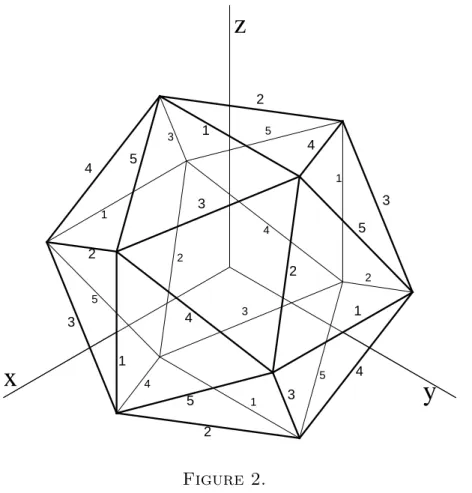
There are two possible natural solutions with a group of order 120. One of them, that we call canonical solution, is dual of the dodecahedron (2) solution with a group of order 120. The group of these two solutions
1
5
4
1
5 2 1
3 5
3 4
2
x
z
y
15
2 1
5
3
4
1
5 3
4
2 4
2
3
2
3
4
Figure 2.
is equivalent to the icosahedron group: Gε ≈ Ω ≈ {−1,1} ×A5. The canonical solution is represented in figure 2.
3.6. The icosahedron (3) puzzle. This puzzle has 197 equivalence classes: 190 have groups of order 1, and 7 have groups of order 2. As
|GP|= 12, one has that, once one puts a plate over a face there are 2322
different possibilities (2322 natural solutions): 190×12 + 7× 12 2.
Note that the actions of all these 7 groups of order 2 are equivalent. Figure 3 shows representatives of all these 7 equivalence classes.
4. More on icosahedron puzzles
As we have already seen there is a natural solution of the icosahedron (1) puzzle which is dual of the dodecahedron (2) natural solution with a group of order 120 (see figure 2). This group is equivalent to the icosahedron group Ω: Gε ≈ Ω ≈ {−1,1} × A5. As this solution is very easy to construct, one can use it in order to translate in terms of
4 2 6 5 4 3 2 1
6 4 5
3 2 1
5 4 3 2 1 6 4 3 2 1 6 5 4 3 2 1 1 6 5 4 3 2 1 6 5 4 3 2 1 6 5 4 3 2 1 6 5 4 3 2 1 6 5 4 3 2 1 6 5 4 3 2 1 6 5 4 3 2 1 6 5 3 2 1 6 5 4 3 2 1 6 5 3 2 1 6 5 4 3 2 1 6 5 4 3 2 1 1 4 3 2 1 6 5 4 3 2 1 6 5 3 2 1 6 5 4 3 2 1 1 1 1 Figure 3.
{−1,1} ×A5 everything that happens in Ω. For example, all subgroups of Ω are equivalent to the corresponding subgroups of {−1,1} ×A5.
4.1. Subgroups of the icosahedron group. The icosahedron group Ω has 22 different equivalence classes of subgroups: 1 of order 1 ({σ0}); 3 of order 2; 1 of order 3; 3 of order 4; 1 of order 5; 3 of order 6; 1 of order 8; 3 of order 10; 2 of order 12; 1 of order 20; 1 of order 24; 1 of order 60; 1 of order 120 (Ω ≈ {−1,1} ×A5). In the following a, b, c, d, e∈ {1,2,3,4,5}are different numbers, and in angle brackets we give the number of equivalence classes of solutions in the icosahedron (1) puzzle.
4.1.1. Groups of order 2. The 3 equivalence classes are generated by (ab) (cd) h148i, (−1,(ab) (cd)) h5i and (−1, σ0) h12i. Look at figure 2. The rotation around the z-axis by an angle of 180◦, corresponds to the permutation (23) (45). This rotation belongs to the first equivalence class. The reflection using the xy-plane (orthogonal to the z-axis) as a mirror, corresponds to (−1,(23) (45)). This reflection belongs to the second equivalence class. The third equivalence class corresponds to the central symmetry (x, y, z)7→ −(x, y, z).
4.1.2. Groups of order 3. The unique equivalence class is generated by (abc)h36i. In figure2, the rotations around the axis x=y=z by angles multiple of 120◦ correspond to group generated by (234).
4.1.3. Groups of order 4. Let σ1 = (ab) (cd) and σ2 = (ac) (bd). Note that σ1σ2 =σ2σ1 = (ad) (bc). The 3 equivalence classes are generated by σ1 and σ2 h0i, σ1 and (−1, σ0) h1i,σ1 and (−1, σ2) h0i, respectively.
4.1.4. Groups of order 5. The unique equivalence class is generated by (abcde)h4i. In figure2, the rotations around the axisx= 0,z =−1+√5
2 y (this is the z0-axis in figure 4), by angles multiple of 72◦, c orrespond to group generated by (12345).
4.1.5. Groups of order 6. Let σ1 = (ab) (cd) and σ2 = (ae) (cd). The 3 equivalence classes are generated by σ1 and σ2 (≡ S3) h3i, (−1, σ1) and (−1, σ2)h0i, (abc) and (−1, σ0) h7i, respectively.
4.1.6. Groups of order 8. Let σ1 = (ab) (cd) and σ2 = (ac) (bd). As before, note that σ1σ2 = σ2σ1 = (ad) (bc). The unique equivalence class is generated by σ1 and σ2 and (−1, σ0)h1i.
4.1.7. Groups of order 10. Let σ1 = (ab) (cd) and σ2 = (ac) (be). The 3 equivalence classes are generated by σ1 and σ2 (≡ D5, the dihedral group of order 10) h2i, (−1, σ1) and (−1, σ2) h0i, (abcde) and (−1, σ0)
h2i, respectively.
4.1.8. Groups of order 12. Let σ1 = (ab) (cd) and σ2 = (acd). The 2 equivalence classes are generated by σ1 and σ2 (≡ A4) h2i, S3 and (−1, σ0) (≡ {−1,1} ×S3) h0i, respectively.
4.1.9. Groups of order 20. The unique equivalence class is generated by D5 and (−1, σ0) (≡ {−1,1} ×D5)h0i.
4.1.10. Groups of order24. The unique equivalence class is generated by A4 and (−1, σ0) (≡ {−1,1} ×A4)h2i.
4.1.11. Groups of order 60. The unique equivalence class is A5 h0i.
4.1.12. Groups of order 120. The unique equivalence class is {−1,1} ×
4.2. Subgroups of plate groups. All the subgroups of the icosahedron group have cyclic groups of order 2, 3 or 5 as generators. Let us look at the actions on the faces of such cyclic groups.
The first equivalence class of the order 2 groups has 10 orbits with 2 elements and the determinant of the generator is 1: (1,10×2). The second equivalence class has 8 orbits with 2 elements, 4 orbits with 1 element and the determinant of the generator is−1: (−1,8×2 + 4×1). The third equivalence class has 10 orbits with 2 elements and the deter-minant of the generator is −1: (−1,10×2).
The equivalence class of the order 3 groups has 6 orbits with 3 ele-ments, 2 orbits with 1 element and the determinant of the generator is 1: (1,6×3 + 2×1).
The equivalence class of the order 5 groups has 4 orbits with 5 elements and the determinant of the generator is 1: (1,4×5).
4.2.1. The icosahedron (1) puzzle. The plate group isGP ={−1,1}×S5. The only cyclic groups of GP whose actions on the plates have orbits of
the type (1,10×2), (−1,8×2 + 4×1), (−1,10×2), (1,6×3 + 2×1) and (1,4×5) are those generated, precisely, by (1,(ab) (cd)), (−1,(ab) (cd)), (−1, σ0), (1,(abc)) and (1,(abcde)).
4.2.2. The icosahedron (3) puzzle. Letσ1 = (123456) andσ2 = (16) (25) (34). The plate group, GP, is generated by (1, σ1) and (−1, σ2). The only cyclic groups of GP whose actions on the plates have orbits of the type
(1,10×2), (−1,8×2 + 4×1), (−1,10×2) and (1,6×3 + 2×1) are generated by (1, σ3
1), −1, σ
j
1σ2
, −1, σk
1σ2
, (1, σ2
1), j = 1,3,5, k = 0,2,4. There are no subgroups of order 5. It is easy to see directly that there are no solutions corresponding to the subgroups of order 3. The solutions corresponding to subgroups of order 2, are only those related to the generators −1, σk
1σ2
, k = 0,2,4.
4.3. Finding solutions of a puzzle with a prescribed group. A way to find a solution for a puzzle is to use the group relations between the polyhedron and the plate groups. Take, for example, the icosahedron (1) puzzle and the third equivalence class for groups of order 10.
This class is generated by an element σ of order 5 and (−1, σ0). The numbers on the edges must respect the central symmetry and a rota-tional symmetry group of order 5. Let σ = (12345). In figure 4, that illustrates this example, a, b∈ {1,2,3,4,5}, and aj =σj(a), bj =σj(b),
j = 1,2,3,4. The numbers a and b must be chosen so that a 6= b, a 6= σ3(b) = b
3, b 6= σ2(a) = a2. These three conditions give 9 possibilities, but only 5 of them correspond to solutions of the puzzle: (a, b) = (2,1),(2,5),(3,4),(4,2),(4,3). The third one is the canonical
z’
a3 b1
b3 1
5
a
b b2
a2
3 a1
2 4
a4
b4
2
b4
4
Figure 4.
solution. The first and the fourth ones belong to the same equivalence class. The same happens with the second and the fifth ones. These last two classes are the ones already listed.
References
[1] Jorge Rezende: Puzzles num´ericos poli´edricos. Di´ario da Rep´ublica, III S´erie, no
300, p. 22647 (1988).
[2] Jorge Rezende: Jogos com poliedros e permuta¸c˜oes.Bol. Soc. Port. Mat.43, 105-124 (2000).http://gfm.cii.fc.ul.pt/Members/JR.pt PT.html
[3] Jorge Rezende: Puzzles com poliedros e n´umeros. SPM: Lisboa 2001. http://www.spm.pt/~spm/SPM/lojaSPM.html
[4] M. A. Armstrong: Groups and Symmetry. Berlin: Springer-Verlag 1988.
[5] R. A. Wilson, R. A. Parker and J. N. Bray: ATLAS of Finite Group Representa-tions.http://www.mat.bham.ac.uk/atlas
Grupo de F´ısica-Matem´atica da Universidade de Lisboa, Av. Prof. Gama Pinto 2, 1649-003 Lisboa, Portugal, e Departamento de Matem´atica, Faculdade de Ciˆencias da Universidade de Lisboa
E-mail address: [email protected]