AENSI Journals
Australian Journal of Basic and Applied Sciences
ISSN:1991-8178Journal home page: www.ajbasweb.com
Corresponding Author: Che Ku Nuraini Che Ku Mohd, University of Technical Malaysia Melaka, Department of Interactive Media, Faculty of Information and Communication Technology, Hang Tuah Jaya, 76100 Durian Tunggal, Melaka, Malaysia.
Ph: +60129082650. E-mail: [email protected]
Personalized Learning Environment (PLE): Classification of Dominant Learning Styles
Che Ku Nuraini Che Ku Mohd, Faaizah Shahbodin, Naim Che Pee
University of Technical Malaysia Melaka, Department of Interactive Media, Faculty of Information and Communication Technology, Hang Tuah Jaya, 76100 Durian Tunggal, Melaka, Malaysia.
A R T I C L E I N F O A B S T R A C T Article history:
Received 28 January 2015 Accepted 25 February 2015 Available online 6 March 2015
Keywords:
Auditory, Kinesthetic, Visual Learning Styles, Personalize Learning Environment
Background: Generally, many people recognize that each person prefers different learning styles and techniques. Learning styles group common ways that people learn. Everyone processes and learns new information in different ways. Some people may find that they have a dominant style of learning, with far less use of the other styles. Objective: The aim of the study was to classify the dominant learning styles among Form 2 student of secondary school in Malacca, Malaysia. There are three types’ of dominant learning styles which is Visual, Auditory and Kinesthetic. Results: The results revealed the classification of dominant students’ learning styles. The study also can provide useful information for improving the quality of the teaching and learning experiences of students. Conclusion: Therefore, the students' learning style preference is important for a high quality, effective teaching and learning process.
© 2015 AENSI Publisher All rights reserved. To Cite This Article: Che Ku Nuraini Che Ku Mohd, Faaizah Shahbodin & Naim Che Pee., Personalized Learning Environment (PLE): Classification of Dominant Learning Styles. Aust. J. Basic & Appl. Sci., 8(23): 366-371, 2015
INTRODUCTION
It is within this specific context that the concept of Personal Learning Environments (PLEs) appeared some years ago as a new way to understand how students learn as well as how educators teach (Attwell, 2007; Schaffert & Hilzwnsauer, 2008; Adell & Castañeda, 2010; Santamaría, 2010; Modritscher et al., 2011; Barroso, Cabero, & Vázquez, 2012; Cabero, 2012). PLEs are developed to incorporate a variety of approaches that take into account different ways of learning. These different approaches comprise a variety of techniques: knowledge representation; cognitive learning styles; adaptation to the learner needs; search; and retrieval techniques (Maria, 2013).
Learning styles are learners’ preferences in learning. There are many models of learning styles. Everyone has learning strengths and preferences even though people do not necessarily learn in the same ways. The various types of learning styles interact with one another. Thus, a learner can use various absorption and processing styles together to get the most learning potential. McRae (2010) states that personalized learning is often represented as a novel approach that can be used to broadly reorganize 21st century schooling and as a way to enhance the pedagogical practices of educators. He affirms that in order to achieve personalized learning, the individual strengths of students need to be assessed and addressed according to students’ specific needs and learning styles. The following sections analyze the following four learning styles model to be of most direct relevance to this study:
• Visual, Auditory and Kinesthetic (VAK) Model • Kolb Leaning Style Inventory Model
• Felder-Silverman Learning Style Model • Dunn & Dunn Model
A. Visual, Auditory and Kinesthetic (VAK) Model: •Visual:
•Auditory:
Auditory Learners are experts at listening and learn best from what they hear. They would rather not watch a PowerPoint, but prefer to record lectures and play them back to study. They may read notes out loud or have a friend quiz them on an upcoming test. They need diagrams to be explained to them, which does not mean they stupid at learning a diagram, rather hearing the explanation reinforces the visual data into their memory banks. They are also great at following verbal directions, whereas a visual learner, like myself, prefers to gets the instruction written down and in my hand so I can read it. Auditory learners would probably read this entire article out loud to themselves.
•Kinesthetic:
Kinesthetic or Tactile learners enjoy the hands-on experience. They will excel in labs and physical assessment. They learn best by doing, touching and manipulating. They enjoy working with equipment, need the write things down to remember them, may enjoy chewing gum or snacking while studying and may “finger spell” words rather than write it down. They rather demonstrate or act out a disease process rather than listen to a boring lecture. Tactile learners will probably skim through this article and may just skip to the last part in the references where they can actually do the learner inventory test.
B. Kolb Leaning Style Model:
Kolb has described four basic learning styles: accommodative, assimilative, divergent, and convergent. Incorporated within each learning style is a combination of two of the four learning modes: Concrete experiences, reflective observation, abstract conceptualization and active experimentation. Figure 2.1 shows Kolb’s Learning Styles.
Kolb and Fry (1975) also have described four different learning environments that are most conducive for accommodating the different learning styles and learning modes.
•Concrete Experiences: The concrete experiences mode is characteristic of learners who desire plenty of opportunities for direct human interpersonal interactions. These individuals also prefer to feel and experience rather than think. Kolb describes them as intuitive decision makers, who value circumstances involving people in real world situations.
•Reflective Observation: This mode focuses on the ability to understand the meaning of ideas. Individuals who are characterized by this mode value objective judgment, impartiality, and patience. They prefer abstract understanding over practical applications, prefer to reflect and observe rather than act on a situation.
•Abstract Conceptualization: Individuals oriented toward abstract conceptualization typically attend to tasks that involve logical investigation of ideas and concepts. Unlike concrete experiences, this learning mode is characterized by a preference to depend on cognitive rather than emotional skills. Commonly, individuals who prefer this mode involve themselves with and tackle academic problems that require the ability to build general theories in order to come up with a solution.
•Active Experimentation: The active experimentation learning mode focuses on actively influencing people and changing situations” (Kolb, 1984). In other words, individuals in this learning mode prefer to be involved in peer interactions that allow them to play an integral role in the decisions made in these interactions. This mode emphasizes practical applications or solutions rather than reflective understanding of a problem.
C. Felder-Silverman Learning Style Model:
One of the most widely used models of learning styles is the Index of Learning Styles developed by Richard Felder and Linda Silverman in the late 1980s. Felder stated that learners with a strong preference for a specific learning style may have difficulties in learning if the teaching style does not match with their learning style (Felder & Spurlin, 2005). According to this model which Felder revised in 2002, there are four dimensions of contrasting learning styles.
The first dimension distinguishes between an active and a reflective way of processing information. Active learners learn best by working actively with the learning material, by applying the material, and by trying things out. Furthermore, they tend to be more interested in communication with others and prefer to learn by working in groups where they can discuss about the learned material. In contrast, reflective learners prefer to think about and reflect on the material. Regarding communication, they prefer to work alone or maybe in a small group together with one good friend.
The third, visual-verbal dimension differentiates learners who remember best and therefore prefer to learn from what they have seen example such as pictures diagrams and flow-charts and learners who get more out of textual representations, regardless of whether they are written or spoken.
In the fourth dimension, the learners are characterized according to their understanding. Sequential learners learn in small incremental steps and therefore have a linear learning progress. They tend to follow logical stepwise paths in finding solutions. In contrast, global learners use a holistic thinking process and learn in large leaps. They tend to absorb learning material almost randomly without seeing connections but after they have learned enough material they suddenly get the whole picture. Then they are able to solve complex problems, find connections between different areas, and put things together in novel ways but they have difficulties in explaining how they did it. Because the whole picture is important for global learners, they tend to be more interested in overviews and in a broad knowledge whereas sequential learners are more interested in detail to work alone or maybe in a small group together with one good friend.
D. Dunn & Dunn Model:
The Dunn and Dunn model defines learning style as the way individuals begin to concentrate on, process, internalize, and retain new and difficult information (Dunn and Dunn 1993). The model utilizes Dunn and Dunn’s (1993) five learning style domains for the structural framework. The Dunn and Dunn Learning Style Model indicate a range of variables proven to influence the achievements of individual learners from kindergarten age to adulthood. Figure 2.3 shows Dunn and Dunn Learning Style Model.
Learners tend to demonstrate patterns in the way they prefer to deal with new and difficult information and ideas. The majority of us are more confident and successful when we approach difficult tasks using our strengths. The elements of Dunn and Dunn model is grouped according to 5 key stimuli:
• Environmental – where we learn best.
• Sociological – with whom we concentrate best.
• Emotional – what motivates us to learn and influence our feelings about learning. • Physiological – when and how we physically engage most in learning.
• Psychological – how we process and respond to information and ideas.
MATERIALS AND METHODS
An experimental study will be carried out to assess the learning preferences among the total 90 Form 2 students at Malacca secondary school for Science subject. The study will be carried out in different sessions. Explanation will be provided to assist participants in using the prototype and completing the questionnaire during the session. The questionnaires will be based on the VAK learning preferences. All the questions will be conducted in English.
Results:
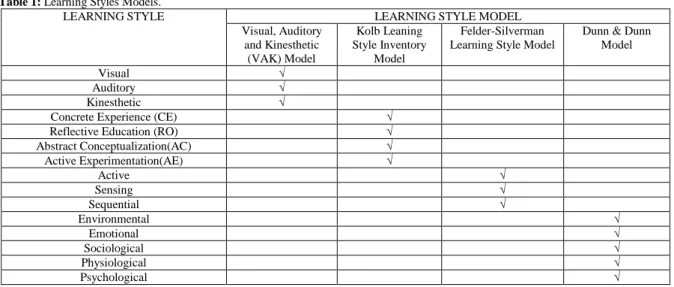
Table 1 shows Learning Styles Models. The following sections analyze the following four learning styles model which is (i) Visual, Auditory and Kinesthetic (VAK) Model, (ii) Kolb Leaning Style Inventory Model, (iii)Felder-Silverman Learning Style Model and (iv) Dunn & Dunn Model.
Table 1: Learning Styles Models.
LEARNING STYLE LEARNING STYLE MODEL
Visual, Auditory and Kinesthetic (VAK) Model
Kolb Leaning Style Inventory
Model
Felder-Silverman Learning Style Model
Dunn & Dunn Model
Visual √
Auditory √
Kinesthetic √
Concrete Experience (CE) √
Reflective Education (RO) √
Abstract Conceptualization(AC) √
Active Experimentation(AE) √
Active √
Sensing √
Sequential √
Environmental √
Emotional √
Sociological √
Physiological √
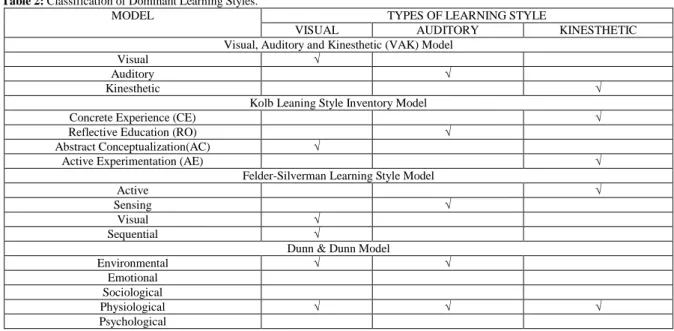
Table 2 shows Classification Dominant Learning Styles. The modes are classified into dominant types of learning styles which is Visual, Auditory and Kinesthetic. Students with a "V" preference learn best by seeing or observing, for example by using drawings, pictures, diagrams and demonstrations. Learners that prefer "A" are best suited to learn by listening to or recording lectures, discussing material and talking through material with themselves or others. "K" style learners perform best by using physical experiences such as touching; performing an activity, moving, lessons that emphasize doing and manipulation of objects (Mon AA et al., 2014). Student learners are capable of using all of these sensory modes of learning. However, each individual has a unique preference or set of preferences in which one mode is often dominant (Erica, 2007).
Teaching according to a variety of learning styles in a capstone or active learning course requires deliberate course organization. Again, the lack of a formal lecture requires scheduling opportunities for student learning in non-traditional ways. The typical mismatches between teaching and learning styles in active learning courses requires a unique need for deliberate course design that incorporates all learning styles. Small group activities may be necessary to engage students in coordinated learning opportunities that incorporate lessons taught with consideration of specific learning styles (Retherford & Amoah, 2014.
Table 2: Classification of Dominant Learning Styles.
MODEL TYPES OF LEARNING STYLE
VISUAL AUDITORY KINESTHETIC
Visual, Auditory and Kinesthetic (VAK) Model
Visual √
Auditory √
Kinesthetic √
Kolb Leaning Style Inventory Model
Concrete Experience (CE) √
Reflective Education (RO) √
Abstract Conceptualization(AC) √
Active Experimentation (AE) √
Felder-Silverman Learning Style Model
Active √
Sensing √
Visual √
Sequential √
Dunn & Dunn Model
Environmental √ √
Emotional Sociological
Physiological √ √ √
Psychological
Discussion:
According to Sarasin (2009), most learners can be categorized as Visual, Auditory or Kinesthetic learners depending on how they prefer to receive and process information. Visual learners can learn effectively when they see the materials, Auditory learners like to hear the material, while Kinesthetic learners are those who learn best by doing (Herman, 2011). These three categorizes are known as VAK learning styles. The VAK learning styles refer to human observation channels: vision, hearing and feeling. It suggests that learners can be divided into one of three preferred learning styles example Visual, Auditory or Kinesthetic.
Auditory: These learners prefer to absorb information by listening. They learn best from listening to lectures, participating in discussions and talking things out. When they recall information, they will remember the way they heard it.
Visual: These learners learn best when information is presented in pictures, tables, charts, maps or diagrams. Seeing and reading are important activities for visual learners.
Kinesthetic: These learners learn best through feeling and doing. They prefer lab activities or field trips over classroom lectures. They like to be involved with physical experiences; touching, feeling, holding, doing, and practical hands-on experiences.
Numerous studies have investigated the impact of learning styles in community college courses (Jones, Reichard, & Mokhtari, 2003; Terry, 2001), for educators in public schools (Lemire, 2002), and pre-service student teachers (Raschick, Maypole, & Day, 1998). Very little research, however, has focused on the relevance of learning styles to internet-based courses in higher education. Simpson and Du (2004) recently investigated the relationship of learning styles to self-reported enjoyment in students enrolled in online classes. Learning style influences the effectiveness of training, whether that training is provided on-line or in more traditional ways (Benham, 2002).
This study also demonstrated the potential of using VAK for identifying learning styles preferences to help the design of teaching format. It is also can be suggested the usefulness of identifying students' learning styles preferences at the beginning of the subject to help teaches to make adjustments in the teaching methods in order to facilitate the learning of the students (Mon AA et al., 2014). In order to develop a learning environment, individual differences need to be taken into consideration to ensure the impact on students’ achievements and satisfactions. While research in this area continues to grow, teachers should make concentrated efforts to teach in a multi-style fashion that both reaches the greatest extent of students in a given class and challenges all students to grow as learners (Gilakjani, 2012). Therefore, the learning environment must be suitable for their differences, to include their learning styles, learning orientations, preferences and needs in learning. In addition, there is need for instructional design to provide external conditions of learning, such as: new information, contexts for learning and practice, feedback, transfer, organizers and attention devices. For this reason, the integration of interactivity functions in the learning environment could ensure that those external conditions of learning are provided to students.
ACKNOWLEDGEMENT
The authors would like to thank University Technical Malaysia Melaka (UTeM) for providing the research grant. The author also gratefully acknowledge to the Ministry of Higher Education Malaysia for giving permission to conduct this study.
REFERENCES
Adell, J., L. Castañeda, 2010. Los Entornos Personales de Aprendizaje (PLEs): una nueva manera de entender el aprendizaje. In R. Roig Vila & M. Fiorucci (Eds.). Claves para la investigación en innovación y calidad educativas. Alcoy-Roma: Marfil - Università degli Studi Roma Tre.
Attwell, G., 2007. The personal learning environments- the future of elearning? eLearning Papers,2(1). Available at: http://www.elearningeuropa.info/files/media/media11561.pdf. [Accessed on 25 November 2013].
Barroso, J., J. Cabero, A. Vázquez, 2012. Formación desde la perspectiva de los entornos personales de
aprendizaje. Apertura, 16. Retrieved
fromhttp://www.udgvirtual.udg.mx/apertura/index.php/apertura3/article/view/209/224.
Benham, H.C., 2002. Training effectiveness, online delivery and the influence of learning style. Paper presented at the 2002 ACMSIGCPR Conference on Computing Personal Research,Kristiansand, Norway.
Cabero, J., 2012. Tendencias para el aprendizaje digital: de los contenidos cerrados al diseño de materiales centrado en las actividades. El proyecto Dipro 2.0. Red. Revista de Educación a Distancia, 32. Retrieved from http://www.um.es/ead/red/32.
Dun, R., K. Dunn, 1993. Teaching secondary students through their individual learning styles: Pratical approaches for grades 7-12.Boston, MA: Allyn & Bacon.
Erica, A.W., L.L. Heidi, E.D. Stephen, 2007. Gender differences in learning style preferences among undergraduate physiology students. Advan in Physio Edu., 31: 153-157.
Felder, R.M., B.A. Solomon, 2007. Learning styles and strategies. Retrieved on January 6, 2007, from http://www.ncsu.edu/felder-public/ILSdir/styles.htm.
Felder, R.M., J. Spurlin, 2005. Applications, reliability, and validity of the Index of Learning Styles. International Journal ofEngineering Education, 21(1): 103-112.
Gilakjani, A.P., 2012. Visual, Auditory, Kinaesthetic Learning Styles and Their Impacts on English Language Teaching. Journal of Studies in Education, 2(1): 104-113.
Herman Dwi Surjono, 2011. The Design of Adaptive E-Learning System basedon Student’s Learning Styles. International Journal of Computer Science and Information Technologies, 2(5), 2011, ISSN 2350-2353.
Kolb, D.A., R.E. Fry, 1975. Toward an applied theory of experiential learning, In C. Cooper, (Ed), Theories of group processes. London: Wiley Press.
Jones, C., C. Reichard, K. Mokhtar, 2003. Are students’ learning styles discipline specific? Community College Journal of Research and Practice, 27(5): 363-375.
Kolb, D.A., 1984. Experiential learning: Experience as the source of learning and development, Upper Saddle River, New Jersey: Prentice Hall.
Lemire, D., 2002. Brief report: What developmental educators should know about learning styles and cognitive styles. Journal of College Reading and Learning, 32(2): 177-182.
McRae, P., 2010. The politics of personalization in the 21st century. ATA Magazine, 91(1). Retrieved from http://www.teachers.ab.ca/Publications/ATA%20Magazine/Volume-91/Number-1/Pages/The-Politics-of-Personalization-in-te-21st-Century.aspx.
Modritscher, F., et al., 2011. May I suggest? Comparign three PLE recommender strategies. Digital Education Review, 20: 1-13.
Raschick, M., D.E. Maypole, P.A. Day, 1998. Improving field education through Kolb’s learning theory. Journal of Social Work Education, 34(1): 31-42.
Santamaría, F., 2010. Evolución y desarrollo de un entorno personal de aprendizaje en la Universidad de León. Digital Education Review, 18: 48-60.
Retherford, J.Q., J.K. Amoah, 2014. Incorporating ASCE's ExCEEd Principles in Capstone Project and Other Active Learning Courses. 2014. ASEE Southeast Section Conference.
Sarasin, Lynne Celli, 1999. Learning Style Perspectives, Impact inthe Classroom. Madison, WI: Atwood Publishing.
Schaffert, S., W. Hilzwnsauer, 2008. On the way towards Personal Learning Environments: Seven crucial aspects. eLearning Papers, 9.
Simpson, C., Y. Du, 2004. Effects of learning styles and class participation on students' enjoyment level in distributed learning environments. Journal of Education for Library and Information Science, 45(2): 123-136.