5
IV
April 2017
Technology (IJRASET)
To Study Strength Characteristic of Aggregate in
Concrete by Replacing with Recycled Aggregate
Yoginder1, Parveen Berwal2
1
M. Tech scholar, 2Assistant Professor , Indus Institute of Engineering and Technology, Jind -126102
Abstract: Concrete is the composite mix of cement, aggregates, sand and water. Aggregate, the main constituent of concrete, constitutes 60 to 80% of the total volume of concrete. Proper selection of the type and particle size distribution of the aggregates affects the workability and the hardened properties of the concrete. The present study is replacing the concrete aggregate with recycled aggregate in different proportion.
Keywords: Recycled aggregate, workability, concrete aggregate
I. INTRODUCTION
Concrete structures are designed in a proper manner so to have a long life. The rate of demolition has increased day by day and there is a shortage in dumping space. Instead of dumping this demolished concrete, use of demolished as recycled concrete would not only reduce the cost but also will conserve the non-renewable energy sources. The use of demolished concrete will further result in reduction in use of natural aggregates. The usage of natural aggregates is causing damage to natural resources resulting in imbalance in environment. Recycled aggregates consist of crushed aggregate obtained from the materials that have been used in constructions. Recycled aggregates are generally obtained from buildings, roads and bridges which are demolished due to completion of life, wars and earthquake.
The study on use of recycled aggregate in pavement construction consists of laboratory investigations to find various properties. The main objectives of study are
A. To prepare mix design for M40 concrete with varying proportions of recycled aggregates.
B. To determine the compressive strength of the samples at the end of 7, 28, 56 and 90 days.
C. To determine sulphate resistance for different percentage of concrete mix.
The purpose of this research was to study the behavior of recycled coarse aggregates when it was included in Plain Cement Concrete.
II. LITERATURE REVIEW
Shayan (2003) found that the use of RCA in the concrete mix decreases compressive strength compared to natural aggregate. But it
is also found that, at 28 days, all mix designs usually exceed 50MPa compressive strength.
Lin (2004) fined that the compressive strength is most affected by the w/c ratio and other parameters include fine recycled aggregate
content, cleanness of aggregate, interaction between fine recycled aggregate content and crushed brick content, and interaction between w/c ratio and coarse RCA content.
Tavakoli (1996) fined in a study that there is a strong interaction between maximum aggregate size and water-cement ratio when
compared with compressive strength development. Due to a lower w/c ratio Compressive strength may increase for RCA, 14% and 34% respectively in comparison of natural aggregates.
Buyle-bodin, F.et. al. (2002) showed a comparison between the behavior of RAC and natural aggregates. The effect of both the
composition and the curing conditions was discussed. It was observed that durability of RAC is controlled by flow properties of high total W/C ratio and air permeability.
Technology (IJRASET)
kept 35 MPa. The investigations were made on effect of recycled aggregates on slump value and bleeding. The effects of delaying the bleeding tests and using fly ash on the bleeding of concrete have been examined. From this study it was found that the use of recycled aggregates caused higher rate of bleeding. The slump of concrete mixes or without recycled aggregates was increased due to replacement of cement by 25% fly ash. It reduced bleeding rate and bleeding capacity with only minor negative effects on concrete strength at or before 28 days, but it gave positive effects on strength at age of 90 days.
Rao, Aakash,et.al. (2006) investigated the effect of recycled aggregates concrete that can be used in lower end application of concrete. It was found that RCA can be used for making normal structural concrete with the addition of fly ash, condensed silica fume etc.
Zhang, Xue-bing et.al. (2007) generated a formula for additional water requirement in recycled aggregate concrete. They found that the specific absorption of coarse aggregates increases as the time of water absorbing goes on. The speed of water absorption was greatest in first 10 minutes. Then it decreased and changed very little. The specific absorption and water absorption speed of RCA are greater than those of crushed stones and pebble, within the same time.
Tabsh,Sami W.et.al (2008) investigated the strength concrete with use of recycled aggregates. The main objectives of study were the sources of recycled aggregates and the strength of recycled concrete. Test results showed that the losses as 50% for toughness and 12% for soundness test which are within acceptable limits. From this study it was found that recycled aggregates concrete required more water than the virgin concrete to maintain the same slump without use of admixture. It was also found that the strength was reduced to 10-25% with the use of recycled aggregates.
III. EXPERIMENTAL PROGRAMME
A. General
Mix design is done to select the mix material and their required proportions. There are a lot of methods to determine the mix design. The methods used in India are in compliance with Bureau of Indian Standards (BIS). The motive of mix design is to determine the proportion in which concrete ingredients like cement, water, fine aggregates and coarse aggregates should be mixed to provide specified strength, workability, durability and other specified requirements as listed in standards such as IS: 456-2000. Concrete mix design guidelines are given in IS: 10262-1982. In present study different mixes were prepared of varying percentage. These mixes were designated as M0, M10, M20, M30 and M40. Mix M0 stand for concrete mix of 0% recycled aggregate and M10, M20, M30 and M40 stand for mix with varying percentage of recycled aggregate. The natural coarse aggregate was replaced by recycled aggregate in proportion of 0%, 10%, 20 %, 30% and 40% in M0, M10, M20, M30, and M40 respectively as given in table 1. Content of sand, cement and water were kept constant in every mix. In the present study properties of concrete such as compressive strength, and sulphate resistance of concrete were determined.
B. Testing Procedure
1) Compressive Strength: The dried cubes were tested at the age of 7, 28, 56 and 90 days. The cubes were tested on compression
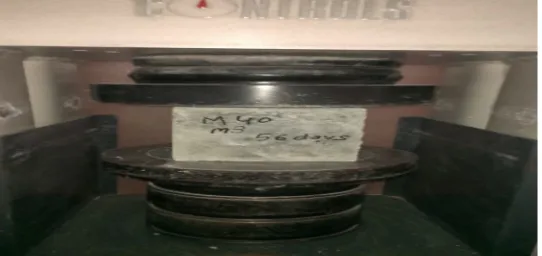
[image:3.612.172.443.574.702.2]testing machine (CTM) after drying at room temperature as per IS: 516-1959 as shown in Figure 1. The load was applied at rate of 350MPa/minute in a uniform and continuous manner. Impacts were prevented during the application of load. Application of load was kept continued until the sample failed and maximum load carried by the sample was recorded. Three samples for each test reading were tested. Final value of test is taken as an average of three samples.
Technology (IJRASET)
2) Sulphate Resistance: Test cubes were cured in water for 28 days before submerging to sulphate solution (MgSO4). Cubes were
tested in CTM machine after 7,28 and 56 days for checking the compressive strength after sulphate solution.
IV. RESULTS AND DISCUSSION OF REULTS
A. General
Testing of sample was done at 7, 28, 56 and 90 days for compressive strength. Sulphate resistance was also check for various percentage of mix In this chapter, results of these tests are discussed.
B. Variation of Compressive Strength with Age
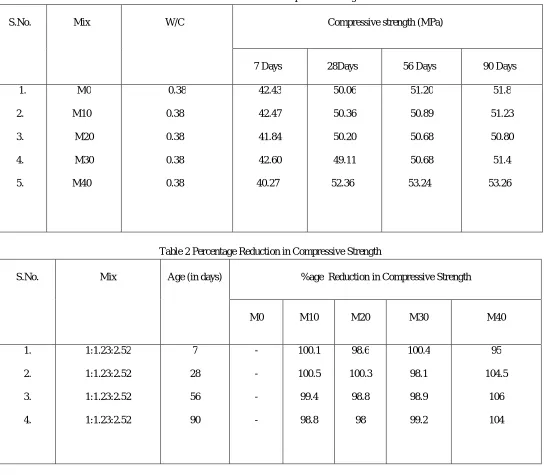
[image:4.612.36.582.253.728.2]Table 2 gives the test results of compressive strength at 7, 28, 56 and 90 days. Water cement ratio was kept as 0.38 for all mixes. Super plasticizer used was 0.6% of cement. Table 1.2 gives the percentage reduction in compressive strength for all mixes at different number of days.
Table 1 Test Results for Compressive Strength
S.No. Mix W/C Compressive strength (MPa)
7 Days 28Days 56 Days 90 Days
1. 2. 3. 4. 5. M0 M10 M20 M30 M40 0.38 0.38 0.38 0.38 0.38 42.43 42.47 41.84 42.60 40.27 50.06 50.36 50.20 49.11 52.36 51.20 50.89 50.68 50.68 53.24 51.8 51.23 50.80 51.4 53.26
Table 2 Percentage Reduction in Compressive Strength
S.No. Mix Age (in days) %age Reduction in Compressive Strength
M0 M10 M20 M30 M40
Technology (IJRASET)
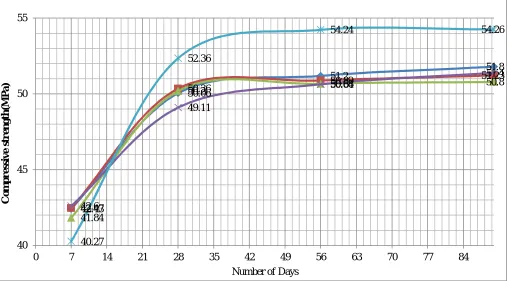
Figure 2 Comparison of Compressive Strength of all Five Mixes with Age of 7, 28, 56 and 90 Days
From above figure and tables it was observed that the compressive strength does not followed a uniform pattern of increment or reduction when RCA is used instead of natural aggregate. All of the mixes reached to target strength of 48.26 in 28 days..
C. Sulphate Resistance of RCA Concrete
In this section of study, effect of sulphate solution on compressive strength of RCA concrete was investigated. Concrete cubes were
kept in MgSO4 (magnesium sulfate) solution for 7, 28 and 56 days after normal curing for 28- days. Compressive strength of cubes
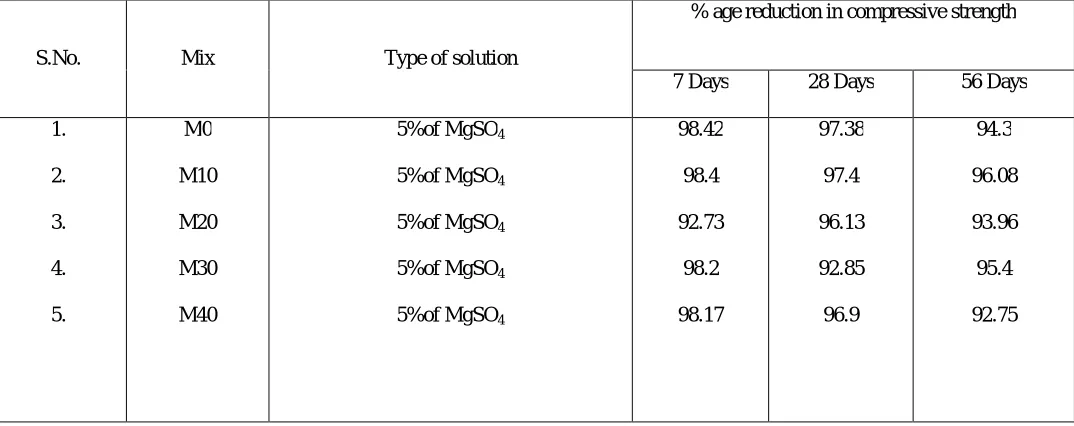
[image:5.612.39.578.510.716.2]was checked by using CTM. Table 3 gives the test results at age of specified number of days. Table 4 gives the details of percentage reduction in compressive strength at the age of specified number of days.
Table 3 Test Results for Sulphate Resistance
S.No. Mix Type Of Solution Compressive Strength(MPa)
7 Days 28 Days 56 Days
1. 2. 3. 4. 5. M0 M10 M20 M30 M40
5%of MgSO4
5%of MgSO4
5%of MgSO4
5%of MgSO4
5%of MgSO4
41.75 41.79 38.8 41.8 39.53 48.74 49.05 48.26 45.6 50.73 48.3 49.23 47.62 49.03 49.38 42.43 50.06
51.2 51.8
42.47
50.36 50.89
51.23
41.84
50.2 50.68 50.8
42.6 49.11 50.64 51.4 40.27 52.36
54.24 54.26
40 45 50 55
0 7 14 21 28 35 42 49 56 63 70 77 84
C o m p r e ss iv e s tr e n gth (M P a)
Technology (IJRASET)
Table 4 Percentage Reduction of Compressive Strength Due To Sulphate Attack
S.No. Mix Type of solution
% age reduction in compressive strength
7 Days 28 Days 56 Days
1. 2. 3. 4. 5. M0 M10 M20 M30 M40
5%of MgSO4
5%of MgSO4
5%of MgSO4
5%of MgSO4
5%of MgSO4
[image:6.612.40.577.90.303.2]98.42 98.4 92.73 98.2 98.17 97.38 97.4 96.13 92.85 96.9 94.3 96.08 93.96 95.4 92.75
Figure 3 gives the comparison of compressive strength of all mixes kept in MgSO4 solution at the age of 7,28 and 56 days. It show
the variation of compressive strength of mixes kept in magnesium sulfate solution for 7 days,28 days and 56 days respectively.
Figure 3 Comparison of Compressive Strength of all Mixes Kept in Mgso4 Solution at the Age of 7, 28 And 56 Days
V. CONCLUSIONS AND RECOMMENDATIONS
A. Conclusions
The research on usage of RCA in construction of pavement is very important because material waste is gradually increasing with the increase in urban development and increase in population. Recycled aggregates are easily available while natural aggregates need mining and their cost is much higher than the cost of natural aggregates. Recycled aggregates are cheaper than the virgin aggregates, so builders can easily afford these for construction purpose if their strength is equal or comparable to natural aggregates. Compressive strength and sulfate resistance of RCA concrete is examined, where it was observed that mixing of RCA cause increased water absorption. To avoid this, super plasticizer is used to reduce the cement consumption. Concrete mix of M40 was designed as per properties of aggregates. The results of this study showed that RCA concrete gave comparable strength to conventional concrete. This indicated that RCA concrete can be viable source for construction of pavements. From the results, it is also found that workability of concrete is decreased due to higher water absorption.
Following conclusions can be drawn from results and discussion of results from the study
1) The compressive strength of all mixes exceeded at the age of 28 days. Compressive strength of mix M0 is 50.05 MPa which is
greater than the target strength of 48.25 for M40 concrete. Compressive strength of M10 is slightly increased to 50.36. So the compressive strength increases by 0.5%. For M20, compressive strength is increased to 50.20 MPa, it also showed an increase in compressive strength by 0.3%. Compressive strength of M30 is decreased to 49.11 MPa that showed a decrease in compressive strength by 1.9%. But in case of M40, there is sudden increase in compressive strength that raises the compressive
41.75
48.74 48.3
41.79
49.05 49.23
38.8 48.26 45.6 41.8 45.6 49.03 39.53
50.73 49.38
35 40 45 50 55
0 10 20 30 40 50 60
Co m pr es si v e S tr en gt h(M P a )
[image:6.612.39.572.342.469.2]Technology (IJRASET)
strength to 52.36 MPa. Compressive strength is increased by 4.5%. So the results of test show that compressive strength does not follow a regular trend from M0 to M40. But from the results it is also concluded that compressive strength never went below the target strength for 28 days. This indicates that RCA can be used as replacement aggregates for compressive strength.
2) Use of 5% of MgSO4 solution caused the reduction in compressive strength. The compressive strength of RCA mixed concrete
reduced upto 7%. Effect of sulphate solution increased when quantity of demolished concrete aggregate increased. This study showed that the strength of m4 at 56 days was most affected. So with increase in sulphate caused reduction in compressive strength of concrete.
3) It was found that the RCA concrete have relatively lower bulk density, specific gravity and high water absorption as compared
to natural concrete. This was due to the presence of mortar in present on recycled coarse aggregates.
4) From this study it was observed that the demolished concrete was viable source for construction of concrete pavements.
Economical and environmental pressures justify suitability of RCA concrete as alternative to the natural concrete. Where there is non-availability of natural aggregate from new rocks RCA can be a good or viable replacement option for natural coarse aggregate in pavement construction.
B. Recommendations
Some modification can be made for RCA to become widely used material for construction of concrete pavements. Consistent and predictable results need to be obtained when using RCA as a replacement for natural aggregate in concrete. To achieve this further investigation is required in the areas of properties of aggregates, mix design and proportioning, performance, testing, and modeling.
REFERENCES
[1] Abou-Zeid, M.N., Shenouda, M.N., McCabe, S.L., and El-Tawil, F.A. (2005). “Reincarnation of Concrete,” Concrete International, V. 27, No.2, February 2005, pp. 53-59.
[2] Ajdukiewicz, A., and Kliszczewica, A. (2002). “Influence of Recycled Aggregates on Mechanical Properties of HS/HPS,” Cement and Concrete Composites, V. 24, No. 2, 2002, pp. 269-279.
[3] Bairagi, N. K., Vidyadhara, H. S., and Ravande, K. (1990). “Mix Design Procedure for Recycled Aggregate Concrete,” Construction and Building Materials, V. 4, No. 4, December 1990, pp. 188-193.
[4] Buyle-Bodin, F., “Influence of industrially produced recycled aggregates on flow of properties of concrete.” Materials and structures/ Mate’riaux et. Construction, Vol. no. 35, September-October 2002,pp 504-509.
[5] Chen, H.J., Yen, T., and Chen, K.H. (2003). “Use of Building Rubbles as Recycled Aggregate,”Cement and Concrete Research, V.33, No.1, pp. 125-132. [6] FHWA. (2004). “Transportation Applications Of Recycled Concrete Aggregate: FHWA State of the Practice National Review September 2004,” U.S.
Department of Transportation, Federal Highways Administration, Washington, DC.
[7] GTAA. (2007). “Reducing, Reusing and Recycling Terminal 2,” Toronto Pearson Today: Terminal 2, Terminal 2 Commemorative Issue, Greater Toronto Airports Authority, Toronto, ON.
[8] Hansen, T.C., and Hedegard, S.E. (1984). “Properties of Recycled Aggregate Concretes as Affected by Admixtures in Original Concretes,” ACI Journal, January-February 1984, pp. 21-26.
[9] Harrington, J. (2004). “States Achieve Recycling Success,” Roads and Bridges, V.42, No.7.
[10] Hendricks, Ch. F., “Use of Recycled materials in constructions”, Materials and structures/ Mate’riaux et. Construction, Vol. no. 36, November 2003,pp 604-608.
[11] IS: 456-2000, “Indian Standard Code of practice for plain and reinforced concrete”, (second revision), Bureau of Indian Standard, New Delhi.
[12] IS: 383-1963, “Indian Standard Specifications for Coarse and Fine Aggregate from Natural Sources for Concrete”, Bureau of Indian Standard, New Delhi. [13] IS: 516-1959, “Methods of Tests for Strength of Concrete”, Bureau of Indian Standard, New Delhi.
[14] IS: 10262-1982, “Recommended Guidelines for Concrete Mix design”, Bureau of Indian Standard, New Delhi.
[15] IS: 2386(Part-1)-1963, “Methods of Test for Aggregate for Concrete (Part-1 Particle Size and Shape)”, Bureau of Indian Standard, New Delhi. [16] IS: 8112-1989, “Specification for 43 Grade Ordinary Portland Cement”, Bureau of Indian Standard, New Delhi.
[17] IS: 4031-1968, “Indian Standard Definitions And Terminology Relating To Hydraulic Cement”, Bureau of Indian Standard, New Delhi.
[18] Katz, A. (2003). “Properties of Concrete Made with Recycled Aggregate from Partially Hydrated Old Concrete,” Cement and Concrete Research, V. 343 No. 5, pp. 703-711.
[19] Katz A. (2004). “Treatments for the Improvement of Recycled Aggregate,” Journal of Materials in Civil Engineering, V. 16 No. 6, November/December 2004 pp. 597-603.