arXiv:1
80
5.
048
14
v
6
Ju
ly
11
, 2018
What Current Flows through a Resistor?
July 11, 2018Bob Eisenberg
1,2Nathan Gold
3Zilong Song
3Huaxiong Huang
1,31 Fields Institute for Research in Mathematical Sciences,
222 College St, Toronto, ON M5T 3J1, Canada
2 Department of Applied Mathematics, Illinois Institute of Technology,
10 West 35th Street, Chicago, IL 60616, USA and
Department of Physiology and Biophysics, Rush University, 1653 West Congress Parkway, Chicago, IL 60612, USA
3 Department of Mathematics and Statistics, York University, Toronto, Ontario, M3J 1P3, Canada
Abstract of Paper
Our digital technology depends on mathematics to compute current flow and design the devices we use so much everyday. The mathematics of digital devices describes current flow as the flux of electrons and idealizes its flow by Kirchoff’s law: ‘all the electrons that flow into a node flow out’, crudely speaking. Circuit/network theory makes these ideas precise and generalizes them to branched one dimensional circuits, and beyond that. However, the idealizations of ‘current as flux’ and Kirchoff’s law describe measurements from actual circuits only when stray capacitances are included in the circuit, as is well documented in engineering practice and literature. Motivated by Maxwell’s equations, we propose that current in Kirchoff’s law be re-defined as 𝐉𝑡𝑜𝑡𝑎𝑙 = 𝐉̃ + 𝜀0 𝜕𝐄 𝜕𝑡⁄ . 𝐉𝑡𝑜𝑡𝑎𝑙combines the flux 𝐉̃ of charge that has mass with Maxwell’s (vacuum) displacement current 𝜀0 𝜕𝐄 𝜕𝑡.⁄ 𝐉̃ includes the polarization of dielectrics as well as the flux of electrons. Stray capacitances add (𝜀𝑟− 1)𝜀0 𝜕𝐄 𝜕𝑡⁄ to the vacuum displacement current 𝜀0 𝜕𝐄 𝜕𝑡,⁄ when the strays behave
Our digital technology depends on mathematics to compute current flow and design its devices. Mathematics describes current flow by an idealization, Kirchoff’s current law: all the electrons that flow into a node flow out is a crude statement of that law. Engineering practice and textbooks make clear that this idealization needs to be supplemented with the reality of ‘stray capacitance’.[14,16,23] Kirchoff’s law, in which current is the flux of ions, describes the observed
properties of real circuits only when stray capacitances are included in the circuit.
Motivated by Maxwell’s equations, we propose that current in Kirchoff’s law be defined as 𝐉𝑡𝑜𝑡𝑎𝑙 = 𝐉̃ + 𝜀0 𝜕𝐄 𝜕𝑡,⁄ where 𝐉̃ describes all the movement of charge with mass, for example, the
polarization of dielectrics as well as the movement of electrons. This definition has been used previously, for example, ref. [19] p. 276, eq.16-148. Kirchoff’s law is not an approximation when
current is defined this way, as we shall see. Kirchoff’s current law in circuits is then as exact as Maxwell’s equations themselves.
Current flow through a resistor. It seems best to approach this question with a simple example, the definition of current flow through a resistor, that can then be easily generalized using the powerful techniques of circuit[6] and network[26] theory.
Kirchoff’s current law applied to a resistor seems straightforward. Electrons carry charge (and mass) as they enter or leave the resistor. All the electrons that enter an ideal resistor, leave it.
This view has difficulties dealing with the accumulation of charge that is needed to produce an electric field. All the electrons that flow in, flow out. Only electrons carry charge. So all the charge that flows in, flows out. Then, how can charge accumulate to produce the potential? [Note: this verbal discussion can be replaced by a precise mathematical formulation with time integrals of current, etc., but there seems no point to do so.]
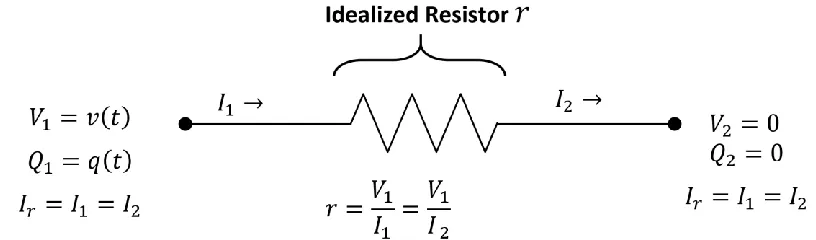
Conflicting idealizations. The difficulties arise from two conflicting idealizations. (1) The first idealization is “the use of Kirchoff’s current law with current equal to flux of electrons.” (2) The second idealization is the “ideal resistor 𝑟”. The conflict is traditionally resolved by changing the model of a resistor—from Fig.1 to Fig.2. An additional circuit element is added, the idealized capacitor 𝑐.
Organization of the paper. Here we show how to resolve the conflict of idealizations another way, by changing the definition of current in Fig. 1, retaining the definition of the idealized resistor 𝑟. We then point out that this revised definition can be used in Kirchoff’s law in general. And in fact we recognize that the revised definition has a natural place in Maxwell’s equations, as well, so a single
𝐼1→ 𝐼2→
[image:3.612.112.520.380.500.2]Idealized Resistor
𝑟
Fig. 2revised definition of ‘current’ can be used in both Kirchoff’s law and Maxwell’s equations. Kirchoff’s law for circuits then becomes as exact as Maxwell’s equations themselves.
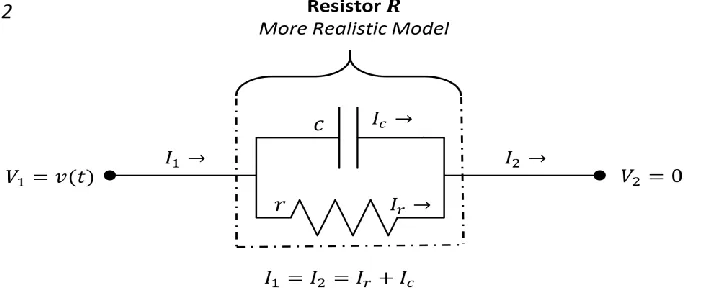
Conflict resolved by stray capacitance. The conflict of idealizations can be resolved without changing the definition of current if we add circuit elements to the idealization of Fig. 1. We can follow engineering practice and replace the idealized resistor 𝑟 of Fig. 1 with a more realistic resistor 𝑹 that includes stray capacitance[14,16,23] as a separate circuit element.
The circuit in Fig. 2 is described by the circuit equations
𝐼𝑟 = 𝑣(𝑡)
𝑟 (1)
𝐼𝑐 = 𝑐𝜕𝑣(𝑡)
𝜕𝑡 (2)
(3)
𝐼1 = 𝑣(𝑡)
𝑟 + 𝑐 𝜕𝑣(𝑡)
𝜕𝑡 (4)
Now, we introduce a physical description of an idealized parallel plate capacitor with area 𝐴, spacing 𝐿, filled with a vacuum with dielectric coefficient 𝜀𝑟 = 1 and permittivity of free space 𝜀0 (units: farads∙meter-1). This is a one dimensional representation of the field equations for a
capacitor, as shown in most textbooks.
𝑐 =
𝐴𝐿
𝜀
0 (5)Then, we can replace the circuit equations (2)-(4) with field equations
𝐼
𝑐=
𝐴𝐿
𝜀
0 𝜕𝑣(𝑡)𝜕𝑡 (6)
[image:4.612.111.466.186.335.2]The total current through the circuit of Fig. 2 is
𝐼
1=
𝑣(𝑡)𝑟
+
𝐴 𝐿𝜀
0𝜕𝑣(𝑡)
𝜕𝑡 (8)
In words: the more realistic resistor 𝑹 of Fig. 2 has two parallel components instead of just one component 𝑟 found in the idealized circuit of Fig. 1. The more realistic resistor 𝑹 has an idealized resistor 𝑟 and an idealized capacitor 𝑐 = 𝜀0(𝐴 𝐿⁄ ) in parallel.
The total current through the more realistic resistor 𝑹 has two components. One flows through the idealized resistor 𝑟 defined in Fig. 1. The other component 𝑐 𝜕𝑣(𝑡) 𝜕𝑡⁄ flows through a capacitance 𝑐 added in parallel to 𝑟 in Fig. 2, often called a stray or parasitic capacitance.[14,16,23] The
new component—the capacitor labelled 𝑐—allows the circuit of Fig. 2 to describe many of the properties of real resistors, as measured in the laboratory.
In the more realistic model of a resistor (Fig. 2), there is no conflict of idealizations, because of the charge on the capacitor. All the electrons and all the charge that enters the idealized resistor 𝑟 leaves the resistor. But additional charge 𝑄1 flows onto the capacitor. That charge creates the electrical field. That is the charge not present in the idealized resistor 𝑟 defined in Fig. 1.
Fig. 2 is of course not enough to describe all the properties of a real resistor. Real resistors are embedded in circuits in most cases, and then a complete description (useful on the 10 −9sec
time scale of modern digital circuits) requires analysis reaching to Maxwell’s equations in general, including effects of the magnetic field, and even radiation. In practical circuits, matter is present between the plates of the capacitor, and the capacitance of Fig. 2 is only a component of the total capacitance.
The total capacitance 𝑐𝑡𝑜𝑡𝑎𝑙 in practical circuits has two terms, the ideal component 𝑐 = 𝜀0(𝐴 𝐿⁄ ) of Fig. 2 and another component dependent on the properties of matter. If the matter is an ideal dielectric, then the total capacitance is
𝑐𝑡𝑜𝑡𝑎𝑙 = 𝐴
𝐿𝜀0
⏟
𝑐0
+ 𝐴
𝐿 (𝜀𝑟 − 1)𝜀0
⏟
𝑀𝑎𝑡𝑡𝑒𝑟
(9)
If the matter is not an ideal dielectric, its nonideal properties are include in the flux 𝐉̃ of charge with mass, discussed at length in the next pages.
We define an ideal dielectric as one with a dielectric constant that is a positive real number, a constant independent of time, electric field, and other variables that change as the circuit is used. Few materials[2] or ionic solutions[3] (e.g., electrolytes) have such characteristics. None that we know
of have that characteristic on the time scale of ionic solutions (~10−7sec), electronics (~10−9sec) or the time scale of atomic motion (~10−15sec) that accompanies the atomic scale of distance
Another definition of current, motivated by Maxwell. The charge stored in the stray capacitor of Fig. 2 can be described in another way if we use Maxwell’s version[5,19] of Ampere’s law to define
current as the source of (the curl of) the magnetic field, as suggested previously (see ref. [19] p. 276,
eq.16-148). Note that 𝐉̃ includes all movements of charge, including the dielectric properties of matter. Movements of charge in dielectrics are traditionally described by separate terms like (𝜀𝑟− 1)𝜀0 𝜕𝐄 𝜕𝑡⁄ , where 𝜀𝑟 is the dimensionless dielectric constant, approximately 80 for water at room temperature. Those dielectric terms, along with nonideal properties of dielectrics and matter, are included in 𝐉̃ in our formulation, details in [9,11,19].
Maxwell’s Equation: 𝟏
𝝁𝒐 𝐜𝐮𝐫𝐥 𝐁 = 𝐉̃ + 𝜀0
𝜕𝐄(𝑥, 𝑡)
𝜕𝑡 (10)
The term 𝜀0 𝜕𝐄 𝜕𝑡 ⁄ is sometimes called (vacuum) displacement current; it exists in a vacuum and
allows light to propagate as waves in the space between stars, even though that space is a vacuum that contains (almost) zero mass[5,19] and cannot conduct current 𝐉̃ associated with mass. In a
vacuum like outer space, electric and magnetic fields are components of an electromagnetic wave supported by the displacement term 𝜀0 𝜕𝐄 𝜕𝑡⁄ . The displacement current term arises from a Lorentz transformation of Gauss’s law (see[19] p. 275), using the fact that charge is relativistically
invariant, i.e., charge does not change with velocity (see [13]. p. 13-8 and [19] Section 5.20, starting on
p. 228), unlike mass, distance, or time.
The 𝜀0 𝜕𝐄 𝜕𝑡⁄ term is a source of the (curl of the) magnetic field 𝐁, as is 𝐉̃. It seems natural then to define current as the entire right hand side of eq. (10).
Definition: Current ≜𝐉̃total ≜ 𝐉̃ + 𝜀0 𝜕𝐄(𝑥,𝑡)
𝜕𝑡 (11)
The divergence of the curl is always zero, so eq. (1) implies conservation of current:[11]
𝐝𝐢𝐯 (𝐉̃ + 𝜀0 𝜕𝐄(𝑥,𝑡)
𝜕𝑡 ) = 0 (12)
Most of our technology depends on one dimensional branched circuits. The essential features of such circuits is illustrated by a simple unbranched series arrangement of components, so we consider that next. The generalization to branched circuits is a straightforward application of the well known, powerful theory of linear networks and circuits.[6,26]
Conservation of current in a one dimensional series circuit implies equality of current in all parts of the series circuit at all times under all conditions. The total current 𝐉̃total = 𝐉̃ + 𝜀0 𝜕𝐄(x, t) 𝜕𝑡⁄ is equal in every component (everywhere at every time) even though the physical mechanisms producing the current differ profoundly in each component. The mechanisms can be as different as the current flow in a wire, in a semiconductor, current flow in vacuum capacitor, or current flow in a (imperfect) insulator (Details are found in and near Fig. 2 of reference[12]).
(with charge) 𝐉̃ can be very different indeed in components as different as a wire, capacitor, or (imperfect) insulator.
Changing the definition of current. We now rewrite the more realistic model of a resistor 𝑅 by recognizing that eq. (11) is itself the analog of eq. (4). We abandon the definition of current as the flux of electrons (that had been used in Fig.1 and in many traditional treatments of Kirchoff’s law) but we retain the definition of the ideal resistor 𝑟.
In the language of equations, 𝐉̃𝑡𝑜𝑡𝑎𝑙 is defined by eq. (11) and 𝑟 is defined by
𝐉̃𝑟 =𝒗(𝒙,𝒕)
𝒓 (13)
The Maxwell-motivated definition of current eq. (11) (also used by Lorrain and Corson [19],
p.276, and probably many others we do not know of) gives the same results as the conventional circuit description Fig. 2:
𝐉̃𝑐𝑎𝑝 = 𝜀0 𝜕𝐄(𝑥,𝑡)
𝜕𝑡 =
𝐴 𝐿𝜀0
𝜕𝑣(𝑥,𝑡)
𝜕𝑡
;
𝑐0 = 𝐴𝐿𝜀0 (14)
Note: The electric field 𝐄𝒄𝒂𝒑(𝑥, 𝑡) implied by eq. (14) is that of a parallel plate capacitor
𝐄𝒄𝒂𝒑(𝑥, 𝑡) = 𝐴
𝐿(𝑣(𝐿, 𝑡) − 𝑣(0, 𝑡)) (15)
Then the total current 𝐉̃𝑡𝑜𝑡𝑎𝑙 through the more realistic resistor of Fig. 2 becomes
𝐉̃𝑡𝑜𝑡𝑎𝑙 = 𝐉̃𝑟+ 𝐉̃𝑐𝑎𝑝 =𝑣(𝑥,𝑡)
𝑟 + 𝜀0
𝜕𝐄(𝑥,𝑡)
𝜕𝑡 =
𝑣(𝑥,𝑡)
𝑟 + 𝜀0
𝐴 𝐿 ⏟ 𝑐0 𝜕𝑣(𝑥,𝑡) 𝜕𝑡 (16)
which we recognize as eq. (4). The 𝜀0 𝜕𝐄 𝜕𝑡 ⁄ term of the Maxwell defined current 𝐉̃𝑡𝑜𝑡𝑎𝑙 of eq. (11) provides the current 𝜀0(𝐴 𝐿⁄ )(𝜕𝑣(𝑥, 𝑡) 𝜕𝑡⁄ ) that flows through the stray capacitance𝑐 in Fig. 2. Comparing circuit and Maxwell formulations. The more realistic resistor described by Fig. 2 stores charge in different ways in the circuit representation and the Maxwell formulation. In the circuit representation (of Fig. 2; eq. (1)-(8)), charge is stored in a physical element, the capacitor 𝑐. In the Maxwell formulation (of eq. (10)-(16)) charge is stored in the electric field itself, by the 𝜀0 𝜕𝐄 𝜕𝑡⁄
term that helps create the magnetic field (see [13]. p. 13-8 and [19] Section 5.20, starting on p. 228).
No physical capacitor is needed to store charge.1 The charge is stored as a result of the relativistic
invariance of charge, i.e., of the Lorentz transformation of Gauss’ law (see[19] p. 275).
Conflict of idealizations resolved, with revised definition of current. The same definition of current can be used in Maxwell’s equations and Kirchoff’s law 𝐉̃𝑡𝑜𝑡𝑎𝑙 = 𝐉̃ + 𝜀0 𝜕𝐄 𝜕𝑡,⁄ where 𝐉̃ is the flux of
all charge with mass. 𝐉̃𝑡𝑜𝑡𝑎𝑙 is the source of the (curl of the) magnetic field. It is also the current that flows through the ideal resistor.
Conclusion: derivation of Kirchoff’s Current Law. Kirchoff’s current law is not approximate. It is as exact in circuits as Maxwell’s equations are in general, when 𝐉̃𝑡𝑜𝑡𝑎𝑙 is the current.
1 The additional charge storage found in capacitors filled with an ideal dielectric can be included in eq. (16) as it was in
eq.(9). Add an additional term (𝜀𝑟− 1)𝜀0 (𝐴 𝐿⁄ )that describes an ideal dielectric to the right hand side of eq. (16). This
Supplementary Material
Scope of paper. This paper is meant to motivate a more general definition of current flow—a definition used previously by Lorrain and Corson (see[19] p. 276)—that removes an apparent paradox
and unites Kirchoff’s and Maxwell’s representations of current.
This paper is not a general analysis of real resistors. That would require a full solution of Maxwell’s equations and would depend sensitively on the details of the fabrication of the resistor and how it is embedded in surroundings.[15,16,23]
Redefinition of 𝐉̃. All movements of charge carried by or associated with mass are included in 𝐉̃. In many important applications, 𝐉̃ can contain movements of charge driven by fields and forces not present in the Maxwell equations, like diffusion or convection. Nearly all of biology, and most of chemistry, occurs in electrolyte (i.e., ionic) solutions in which diffusion and convection drive significant electrical currents. As mentioned previously, the movements of charge include those usually described as the polarization of dielectrics, as well as more complex nonlinear polarization and other charge movements, details in [9,11,19].
The other equations of Maxwell (e.g., the ‘first’ equation, more or less the Poisson equation) has an analogous reformulation, in which the 𝐃 field is discarded, and the total charge (of every sort whatsoever) on the right hand side is written as explicit function(al)s of appropriate variables. Classical dielectric polarization charge would be one component; ‘permanent’ charge, independent of the electric field would be another; other components might include convective, diffusive, or heat driven currents that are not part of classical electrodynamics at all.
The crucial point is that an explicit functional or experimental dependence needs to be specified for all the components of ‘charge’, and for all the components of 𝐉̃. Of course, the components of charge must spread and move in a way that produces 𝐉̃ with its spatial spread and time dependence. 𝐉̃ and the components of charge must be consistent, and consistent with conservation of mass and its flow, as well. Together, the charge and flux of charged matter satisfy a continuity equation for 𝐉̃.
Stray Capacitance.[14,16,23] The capacitor 𝑐 of Fig. 2 allows a circuit model including an idealized
resistor 𝑟 to store charge 𝑄1 as it must in any more realistic model of a resistor 𝑹. The capacitor is required if current is defined as the flux of electrons (or other charge carriers with mass, like ions in sea water).
The capacitor is often called parasitic or stray. It deserves to be called parasitic because the charge needed to change the potential is unavailable to flow or fan out of the (right hand terminal of) the circuit to the inputs of other devices. The capacitor is indeed a parasite because the stored charge is unavailable for other useful use. The capacitor 𝑐 does not deserve the name ‘stray’, in our opinion, because 𝑐 includes a component 𝑐0 = 𝜀0 𝜕𝐄 𝜕𝑡⁄ that cannot wander off, as strays often do.
The unstray component 𝑐0 is the displacement current 𝜀0 𝜕𝐄 𝜕𝑡⁄ that is the universal
‘polarization of the vacuum’,2 arising from the Lorentz transformation of Gauss’ law, also
responsible for the propagation of light. The vacuum displacement current may be a parasite, but the parasite cannot stray.
Chemical Kinetic Models: Stray Capacitance and Born Energy. Chemical kinetic models are found throughout the literature of chemistry, physical and biochemistry. They use rate constants and the ‘law of mass action’ to define the arrows that connect different states of chemical reactants, and are derived to satisfy conservation of mass, whether or not the mass carries charge. They, however, do not satisfy conservation of current, either in the steady-state[7,8], or transiently,[11,12] as they are
usually written. (Of course, an additional constraint or restructuring of the equations may be possible that generalizes chemical kinetics and allows it to satisfy conservation of current 𝐉̃total . See
below paragraph for one possibility.)
Chemical kinetic models are branched one dimensional systems reminiscent of the branched one dimensional circuits we have considered here. In particular, each reaction in chemical kinetics is reminiscent of the simple representation of an idealized resistor used in Fig. 1. As we have seen, adding an unstray component of capacitance into Fig. 1 creates the more realistic circuit of Fig.2 that satisfies conservation of current 𝐉̃total.
It seems possible that modifying the rate models of kinetic theory might be as productive as modifying idealized models of circuits. Perhaps adding an unstray capacitor, or equivalently redefining current in the chemical kinetic models, would allow these rate models to satisfy conservation of current 𝐉̃total.
The unstray capacitor, storing charge 𝑄1 (see Fig. 2), is something like the capacitance of the Born energy terms found in many treatments of ions in solution, but connecting nodes of the rate models to each other, not to ‘infinity’. The dependence of rate (and flow) on concentration of reactants is often nonlinear in chemical kinetic models, so the analogy with linear resistors and capacitors of circuits is not precise. It seems worthwhile, nonetheless, to investigate explicitly what happens to the equations of chemical kinetics if a vacuum capacitance is included linking the nodes of the kinetic scheme. It seems worthwhile to investigate explicitly what happens if the definition of flux in the rate equations of the kinetic scheme is not the flux of mass, but the generalized flux 𝐉̃total of the Maxwell equation (10) that includes the universal displacement current 𝜀0 𝜕𝐄 𝜕𝑡.⁄ Special nature of the electric field. The conservation laws of electrodynamics are exact and universal because of a special property of electrodynamics not shared by other fields, like heat flow, convection, or diffusion. The vacuum polarization term 𝜀0 𝜕𝐄 𝜕𝑡⁄ of the Maxwell equations
allows the electric field to take on whatever value is necessary so the current 𝐉̃total (of eq.(11):
that includes 𝜀0 𝜕𝐄 𝜕𝑡⁄ ) is exactly equal everywhere in a series circuit (see eq. (12) and eq. (4),
Section 3, of ref [10]). No matter how mass carries charge, the vacuum displacement current
𝜀0 𝜕𝐄 𝜕𝑡⁄ changes so the total current 𝐉̃total— that includes the vacuum displacement current 𝜀0 𝜕𝐄 𝜕𝑡⁄ — is exactly the same everywhere in the series circuit at any time whatsoever. These issues are discussed in detail in references [11,12].
A field like magnetism and a term like 𝜀0 𝜕𝐄 𝜕𝑡⁄ are not found in field equations for convection, heat flow, and diffusion. Magnetism and the displacement current arise from the special relativistically invariant properties of charge (see [13]. p. 13-8 and [19] Section 5.20, starting
transformation of a charge—with the magnitude of the charge itself independent of velocity— produces the magnetic field.
Convection, heat flow, and diffusion flows 𝐉̃ do not follow an equation like eq. (10) because those fields do not include an analog to displacement current. Matter cannot flow or polarize in a vacuum where it does not exist. 𝐉̃ does not exist in a vacuum. Electrical current𝐉̃𝑡𝑜𝑡𝑎𝑙
does exist in a vacuum; indeed, the electric field ‘polarizes the vacuum’, creates 𝐜𝐮𝐫𝐥 𝐁 through eq. (10),and thereby propagates electromagnetic waves.
Properties of flux𝐉̃. The flux 𝐉̃ involves all flows of matter. The flux𝐉̃ can involve all the complex flows of fluid dynamics and all the flows, shock waves, and perhaps turbulence of the Navier-Stokes equations. The flux 𝐉̃ —and its component the dielectric polarization—includes the intricate movements of charge that occur within molecules and between atoms, of molecules as large and complex as proteins—with their surface layers that move at slow speeds (~1 sec) and ionic atmospheres that move much faster (~10−8sec)—and as small as organic molecules that move quickly (~10−17sec) and even inorganic atoms with their electrons that move even faster. The flux occurs over time scales ranging from seconds (proteins) to say 10−17sec of ultraviolet light (to pick one possible cut off).
The polarization components of 𝐉̃ are known in great detail thanks to measurements of dielectric properties, refractive indices, and other estimators of these induced charges. Various kinds of spectroscopy reveal the properties of 𝐉̃ in real materials. Spectroscopy at each time scale has a different name and technology: impedance[2-4,17]; molecular, (i.e., microwave)[1,22,24]; optical
(light);, infrared; and ultraviolet spectroscopy are examples. All describe remarkably varied properties of 𝐉̃ of materials with great accuracy. It is worthwhile looking at a spectrum of an organic molecule to be impressed with just how diverse and complex can be the frequency dependence of polarization charge in real materials and how inadequate is the description of polarization by a single real dielectric constant.
The properties of polarization charge of matter 𝐉̃ are in fact so diverse that general principles are hard to discern and so are not very useful. Matter is conserved but how does that change spectra? General properties of 𝐉̃ —or implications of mass conservation— are not easy to see in the infrared spectra of say the heme group of myoglobin or of organic molecules in general.[25] The spectra are of immense practical use as fingerprints to identify compounds, but
their use is (nearly) as empirical as the use of fingerprints. General theoretical properties like conservation of mass are hard to exploit.
General properties of the ‘current’ 𝐉̃𝑡𝑜𝑡𝑎𝑙 are much more useful as electrical engineers
have shown us. They use Kirchoff’s current law to design high speed (~10−9 sec) circuits embedded in composites of materials with complex dielectric properties.
Mathematical idealizations assuming an ideal dielectric with a single real dielectric constant are of great historical importance because of their wide use in the 1800’s by Faraday, Maxwell, Hertz, and Heaviside (et al.), whose experimental systems were measured on time scales of seconds. Technological systems today work on a time scale of 10−9 sec where dielectric
properties cannot be described by a single real constant. But the idealization of a single real dielectric constant is useful today in understanding the qualitative properties of complex material systems, and in theories and simulations of molecular dynamics, particularly the spatial dependence of properties. In those idealized systems, either (1) conservation of current or (2) continuity and Gauss’ law can be used: The choice depends on which is more helpful in computation and understanding.
However, in real, not ideal systems the complex properties of 𝐉̃ have a profound consequence. They prevent the practical or general computation of the forces on charges. No more can be said about the forces in general in real matter than can be said about its dielectric polarization. Complete theories of the movement of matter and charge in electric (and sometimes other) fields are needed before the forces that move matter can be computed. Every force depends on the diverse and complex properties of polarization and one despairs of computing those in a general way. The combination of the continuity equation for 𝐉̃ and Gauss law for the electric field 𝐄 is not useful because it does not allow the computation of forces on charges in real materials.
But conservation of current 𝐉̃𝑡𝑜𝑡𝑎𝑙 can be used for practical purposes because it is true generally and is valid in real materials, under any condition. Nothing needs to be known about matter to use Kirchoff’s law in the actual circuits of our computers, whereas everything needs to be known about the polarization of matter to compute forces using the continuity equation-Gauss law. For example, current 𝐉̃𝑡𝑜𝑡𝑎𝑙 measured in any component in a series system, is the
current in every component, no matter what the physics or structure of each component.
Conservation of current 𝐉̃𝑡𝑜𝑡𝑎𝑙and the continuity equation-Gauss law are not equivalent
when applied to real materials. Only conservation of current is useful in general when dealing with real materials with unknown polarization.
Current in one dimensional systems has no spatial dependence. We are used to seeing the enormous variation in the position and motion of atoms in the wonderful movies of molecular dynamics. Such images have been in the minds eye of physicists for a very long time. And this enormous variation is certainly illustrated by the temporal variation of current in one dimensional systems. Thermal motions produce Brownian like motion in time in one dimensional systems.
But there is no spatial variation of 𝐉̃𝑡𝑜𝑡𝑎𝑙 in one dimensional systems, thermal, Brownian or otherwise.Conservation of current is equality of current in one dimensional systems on all time scales. This was an unexpected finding for us, but it is an inescapable consequence of conservation of 𝐉̃𝑡𝑜𝑡𝑎𝑙, see eq. (12).
Theories of one dimensional systems need not work hard to include details of spatial dependence of electric current 𝐉̃𝑡𝑜𝑡𝑎𝑙because there is no spatial dependence in one dimensional systems. Models of electric current 𝐉̃𝑡𝑜𝑡𝑎𝑙 should be dramatically simpler than models of other
space and time. But how to take advantage of this simplification is not so obvious: the simplification is only in one dependent variable, the output electric current 𝐉̃𝑡𝑜𝑡𝑎𝑙. It is the only
variable that has no variation in space. Other quantities fluctuate wildly in space, (nearly) as wildly as they do in time.
The challenge to mathematics is how to construct approximations that exploit the unique spatial independence of electric current 𝐉̃𝑡𝑜𝑡𝑎𝑙in one dimensional systems. The image of spatially
smooth current is so different from the image of Brownian fluctuating flux that one can hope for dramatic advances in mathematically defined approximations. These might conceivably justify the highly reduced models of one dimensional systems that are so useful in biophysics and technology.
One dimensional systems are important. One dimensional systems are not just mathematical idealizations. Ion channels of biological membranes are nearly one dimensional systems that control an enormous range of biological function and so are of considerable personal importance to most of us, in health and disease. Semiconductor diodes are one dimensional systems of technological importance. Current is the main output of these systems and so its lack of spatial dependence should help construct approximate but useful input/output models.
Branched Circuits: FETs and Transporters. Conservation of electric current 𝐉̃𝑡𝑜𝑡𝑎𝑙 plays a more subtle role in circuits with three terminals (like the FET Field Effect Transistors that make up such a large part of our integrated circuits and computers). Kirchoff’s law guarantees very strong correlation between flows. Currents between say the source and drain, and gate and drain of FETs, should show coherence functions far from zero, with large effects, one imagines, on the qualitative performance and noise of these devices. Certainly, it would be unwise to assume independent properties for source-drain, and gate-drain noise in FETs, if this thinking is correct.
Similar correlations may be found in those ionic channels that have three terminal Y
structure, like those in many transporters.[18] Transporters can move one ionic species uphill,
against the gradient of its own electrochemical potential, taking the energy from the coupled downhill movement of another ionic species, each perhaps moving in different parts (strokes) in the upper part of the Y structure.
Correlations are likely to be important in a Y structure and have an important effect on the coupling of fluxes that makes active transport possible. Indeed, the coupling may arise from conservation of current, with the Maxwell equations changing the microscopic potential within the atomic machinery of the transporter to guarantee that the sum of currents through the transporter and membrane satisfy Kirchoff’s law, as described in Section 3 and eq. (4) of ref [10].
The work of Mathias[20], et al, (p. 9) points in that direction. They show that the circulation of the
Summary
The Maxwell-Ampere equation (10) itself shows that conservation of current is as universal and exact as the Maxwell equations themselves. Conservation of electric current
𝐉̃𝑡𝑜𝑡𝑎𝑙depends on the mathematical identity 𝐝𝐢𝐯 𝐜𝐮𝐫𝐥( 𝐉̃ + 𝜀0 𝜕𝐄 𝜕𝑡⁄ ) = 0, which remains true,
whatever the fluxes and properties of matter.
Amazingly, conservation of electric current 𝐉̃𝑡𝑜𝑡𝑎𝑙 is true and useful over the entire range of existence of the electric/magnetic field. Perhaps, that is why our digital technology—that is so fast (10−9 sec) and yet requires near perfect reliability[21] in tiny devices made of handfuls of
atoms—is built using Kirchoff’s law, namely, conservation of current in circuits.
References
1 Banwell, C. N. & McCash, E. M. Fundamentals of molecular spectroscopy. Vol. 851 (McGraw-Hill New York, 1994).
2 Barsoukov, E. & Macdonald, J. R. Impedance Spectroscopy: Theory, Experiment, and Applications. 2nd Edition edn, (Wiley-Interscience, 2005).
3 Barthel, J., Buchner, R. & Münsterer, M. Electrolyte Data Collection Vol. 12, Part 2: Dielectric Properties of Water and Aqueous Electrolyte Solutions. (DECHEMA, 1995).
4 Buchner, R. & Barthel, J. Dielectric Relaxation in Solutions Annual Reports on the Progress of Chemistry, Section C: Physical Chemistry 97, 349-382 (2001).
5 Darrigol, O. Electrodynamics from ampere to Einstein. (Oxford University Press, 2003).
6 Desoer, C. A. & Kuh, E. S. Basic Circuit Theory. 876 (McGraw Hill, 1969).
7 Eisenberg, B. Can we make biochemistry an exact science? Available on arXiv as
https://arxiv.org/abs/1409.0243 (2014).
8 Eisenberg, B. Shouldn’t we make biochemistry an exact science? ASBMB Today 13, 36-38 (2014).
9 Eisenberg, B. Conservation of Current and Conservation of Charge. Available on arXiv as
https://arxiv.org/abs/1609.09175 (2016).
10 Eisenberg, B. Maxwell Matters. Available on arXiv as https://arxiv.org/pdf/1607.06691 (2016).
11 Eisenberg, B., Oriols, X. & Ferry, D. Dynamics of Current, Charge, and Mass. Molecular Based Mathematical Biology 5, 78-115 and arXiv preprint https://arxiv.org/abs/1708.07400, doi:10.1515/mlbmb-2017-0006 (2017).
12 Eisenberg, R. S. Mass Action and Conservation of Current. Hungarian Journal of Industry and Chemistry Posted on arXiv.org with paper ID arXiv:1502.07251 44, 1-28, doi:10.1515/hjic-2016-0001 (2016).
13 Feynman, R. P., Leighton, R. B. & Sands, M. The Feynman: Lectures on Physics, Mainly Electromagnetism and Matter. Vol. 2 (Addison-Wesley Publishing Co., also at
http://www.feynmanlectures.caltech.edu/II_toc.html, 1963).
14 Horowitz, P. & Hill, W. The Art of Electronics. Third Edition edn, (Cambridge University Press, 2015).
15 Joffe, E. B. & Lock, K.-S. Grounds for Grounding. ( Wiley-IEEE Press, 2010).
16 Johnson, H. W. & Graham, M. High-speed signal propagation: advanced black magic. (Prentice Hall Professional, 2003).
17 Kremer, F. & Schönhals, A. Broadband Dielectric Spectroscopy. (Springer 2003).
18 Liu, J.-L., Hsieh, H.-j. & Eisenberg, B. Poisson–Fermi Modeling of the Ion Exchange Mechanism of the Sodium/Calcium Exchanger. The Journal of Physical Chemistry B 120, 2658-2669 (2016).
19 Lorrain, P. & Corson, D. Electromagnetic fields and waves, Second Edition. (1970).
21 Mukherjee, S. Architecture design for soft errors. (Morgan Kaufmann, 2011).
22 Rao, K. N. Molecular spectroscopy: modern research. (Elsevier, 2012).
23 Scherz, P. & Monk, S. Practical electronics for inventors. (McGraw-Hill, Inc., 2006).
24 Steinfeld, J. I. Molecules and radiation: An introduction to modern molecular spectroscopy. (Courier Corporation, 2012).
25 Stuart, B. Infrared spectroscopy. (Wiley Online Library, 2005).