5
IV
April 2017
Technology (IJRASET)
Effect of Latex Modified Self-Compacting Concrete
(M-25) by Partial Replacement of Cement with
Glass Powder
Juned Ahmad1, Abdul Muqtadir2
1
Assistant Professor, 2M. Tech (Research Scholar), Department of Civil Engineering Integral University, Lucknow(UP), India
Abstract: Self-compacting concrete (SCC) is defined as a flowing concrete mixture that is able to consolidate under its own weight. The highly fluid nature of SCC makes it suitable for placing in difficult conditions and in sections with congested reinforcement. To improve the performance of SCC, polymers are mixed with SCC. It has been observed that polymer-modified self-compacting concrete (PMSCC) is more durable than conventional self-compacting concrete due to superior strength and high durability. There is a current trend in all over the world to utilize the treated and untreated industrial by- products, domestic wastes etc. as raw materials in concrete. These not only help in the reuse of the waste materials but also create a cleaner and greener environment. This study aims to focus on the possibility of using waste material in a preparation of innovative concrete. One kind of waste was identified: Glass Powder (GP). The use of this waste (GP) was proposed in different percentage as an instead of cement for production of latex modified self-compacting concrete.
Keywords: Self-Compacting Concrete, Glass Powder, SBR latex, Compressive Strength
I. INTRODUCTION
Conventional concrete generally constitutes cement, fine aggregates, coarse aggregates and water. As times change, there is a need to provide better concrete, in terms of its strength, durability, etc. Special concretes need to be designed which are task specific. Self-compacting concrete (SCC) as the name suggest is the concrete which get compacted without vibration. The self-compacting concrete was developed in Japan in late 1980’s. By the early 1990’s Japan has developed and used SCC that does not required vibration to achieve full compaction. Because of its wide advantages by the year 2000, the SCC has become popular in Japan for prefabricated products and ready mixed concrete. Several European countries recognized the significance and potentials of SCC developed in Japan. During 1989, they founded European federation of natural trade associations representing producers and applicators of specialist building products (EFNARC). To call a SCC successful it must possess following properties:
Have a fluidity that allows self-compaction without external energy. Remain homogeneous in a form during and after the placing process and Flow easily through reinforcement
A. SBR Latex
SBR latex is a carboxylated styrene butadiene copolymer latex admixture that is designed as an integral adhesive for cement bond coats, mortars and concrete to improve bond strength and chemical resistance. SBR latex is sometimes used as part of cement based sub structural (basement) Waterproofing systems where as a liquid it is mixed with water to form the Gauging solution for mixing the powdered tanking material to a slurry. SBR aids the bond strength, reduces the potential for shrinkage and adds an element of flexibility, its offers better durability, reduced shrinkage and increased flexibility, as well as being resistant to emulsification in damp conditions.
B. Latex Modified Self Compacting Concrete
Technology (IJRASET)
In this dissertation work, latex modified self-compacting concrete compositions containing 5% SBR latex by weight of cement were prepared. Concrete cubes, cylinders and beams were cast using these latex modified self-compacting concrete to perform compressive strength, split tensile strength and flexural strength tests
C. Glass Powder
Glass is an amorphous solid that has been found in various forms for thousands of year and has been manufactured for human use since 1200 BC. Glass is one the most versatile substance on earth, used in many applications and in a wide variety of forms, from plain clear glass to tempered and tinted varieties, and so forth. After its usage it is usually dumped in landfills. Since glass is a non-biodegradable material, landfills do not provide a friendly environment.
II. EXPERIMENTAL WORK
A. Material used and their Properties
1) Cement: Ordinary Portland Cement of 43 grades manufactured by Shree Ultratech Cement was used throughout the Experimental investigation. The quality of the cement was confirmed as per IS 4031-1988 and all the quality tests were conducted conforming to the specifications of 12269-1987.Results of the various test are Tabulated in Table 1
Table 1:Physical Properties of Ordinary Portland cement:
Characteristics Observed Value
Normal Consistency 32%
Initial Setting Time 48 minutes
Final Setting Time 625 minutes
Specific Gravity 3.15
Compressive Strength at 28 days 43.3 Mpa
2) Fine Aggregate: The Fine Aggregate used was locally available coarse Sand. The test procedure as per IS 383: 1970 was carried out to determine the properties of Fine aggregate. The Results of the various test are tabulated in Table 2
Table 2: Physical Properties of Fine Aggregate:
Characteristics Observed Value Grade Zone III Fineness Modulus 2.3 Specific Gravity 2.60 Silt Content 1.7%
3) Coarse Aggregate: The Coarse Aggregate used was locally available. The test procedure as per IS 383: 1970 was carried out to determine the properties of Coarse aggregate. The Results of the various test are tabulated in Table 3
Table 3: Physical Properties of Coarse Aggregate Characteristics Observed Value Fineness modulus 6.92 Specific Gravity 2.64 Water Absorption 0.40%
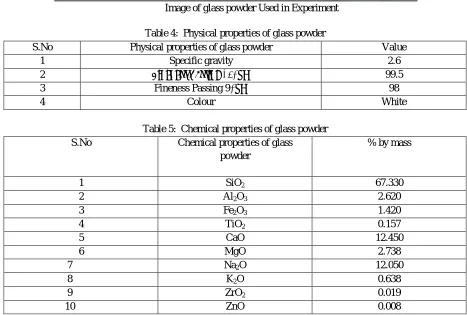
4) Glass Powder: Waste glass available locally in Lucknow shops is been collected and made into glass powder. Glass waste is very hard material. Before adding glass powder in the concrete it has to be powdered to desired size. In this studies glass
powder ground in ball/ pulveriser for a period of 30 to 60 minutes resulted in particle sizes less than size 150 μm and sieved in
Technology (IJRASET)
[image:4.612.71.538.192.507.2]Image of glass powder Used in Experiment
Table 4: Physical properties of glass powder
S.No Physical properties of glass powder Value
1 Specific gravity 2.6
2 Fineness Passing 150μm 99.5
3 Fineness Passing 90μm 98
4 Colour White
Table 5: Chemical properties of glass powder S.No Chemical properties of glass
powder
% by mass
1 SiO2 67.330
2 Al2O3 2.620
3 Fe2O3 1.420
4 TiO2 0.157
5 CaO 12.450
6 MgO 2.738
7 Na2O 12.050
8 K2O 0.638
9 ZrO2 0.019
10 ZnO 0.008
5) Super Plasticizer (SP): Super plasticizer is essential for the creation of SCC. The job of SP is to impart a high degree of flow ability and deformability, however the high dosages generally associate with SCC can lead to a high degree of segregation. CICO PLAST SUPER-HS is utilized in this project, which is a product of CICO Company having a specific gravity of 1.14. Super plasticizer is a chemical compound used to increase the workability without adding more water. It was used to provide necessary workability. Properties of CICO PLAST SUPER-HS are tabulated in Table 6
Table 6: Properties of admixture
Characteristics CICO PLAST SUPER-HS Specific Gravity 1.14
Role in Concrete Improves workability & flow properties, Produces concrete of very high strength
B. Mix Proportioning
[image:4.612.51.538.618.690.2]Technology (IJRASET)
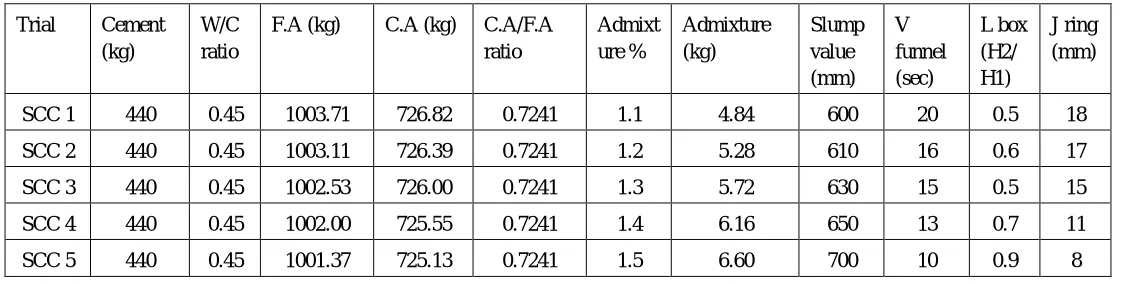
[image:5.612.27.588.241.383.2]mix design was done for M25 grade mix and the amount of materials was calculated. Table 8 gives the quantities required for M25 grade of concrete Mix. The mix was checked for self-compact ability by flow test, J ring test, V funnel test and L-Box test. Flow test and V-funnel tests for checking the filling ability and L-box test, J ring test for the passing ability. The mixes were checked for the SCC acceptance criteria given in Table 7
Table 7: SCC - Acceptance Criteria
Method Properties Range of values Flow value Filling ability 650-800mm V-funnel Viscosity 8-12 sec L-box Passing ability 0.8-1.0 J ring Passing ability 0-10
Mix Design Trial of Self-Compacting Concrete for 1 m3 of Concrete: Trial Cement
(kg)
W/C ratio
F.A (kg) C.A (kg) C.A/F.A ratio Admixt ure % Admixture (kg) Slump value (mm) V funnel (sec) L box (H2/ H1) J ring (mm)
SCC 1 440 0.45 1003.71 726.82 0.7241 1.1 4.84 600 20 0.5 18 SCC 2 440 0.45 1003.11 726.39 0.7241 1.2 5.28 610 16 0.6 17 SCC 3 440 0.45 1002.53 726.00 0.7241 1.3 5.72 630 15 0.5 15 SCC 4 440 0.45 1002.00 725.55 0.7241 1.4 6.16 650 13 0.7 11 SCC 5 440 0.45 1001.37 725.13 0.7241 1.5 6.60 700 10 0.9 8
Mix design trial of latex modified self-compacting concrete for 1 m3 of concrete
Slump Test for SCC Trial SBR
Latex % Cement (kg) W/C ratio F.A (kg) C.A (kg) Admixt ure % Admixt ure (kg) Slump value (mm) V funnel (sec) L box (H2/ H1) J ring (mm) Remark
LMSCC 1 5 440 0.45 1001.3 7
725.13 1.5 6.60 Not measur
able
7 0.8 16 Bleeding
LMSCC 2 5 440 0.45 1002.0 0
725.55 1.4 6.16 Not measur
able
7 0.6 18 Segregatio n LMSCC 3 5 440 0.45 1002.5
3
726.00 1.3 5.72 850 8 0.5 11 Flow is more LMSCC 4 5 440 0.45 1003.1
1
Technology (IJRASET)
J- Ring Test of SCC
V-funnel test for SCC
L-box test for SCC
C. Mixes
Technology (IJRASET)
Types of mix % replacement of glass powder SBR latex % Cement (kg) Fine aggregate (kg) Coarse aggregate (kg) Glass powder (kg) Water (w/c = 0.45) (kg) Admixtu re (kg)M1 0 0 440 1003.11 726.39 0 198 5.28
M2 0 5 440 1003.11 726.39 0 198 5.28
M3 2.5 5 429 1003.11 726.39 11 198 5.28
M4 5 5 418 1003.11 726.39 22 198 5.28
M5 7.5 5 407 1003.11 726.39 33 198 5.28
M6 10 5 396 1003.11 726.39 44 198 5.28
III. DISCUSSION OF RESULT
A. Compressive Strength
Compressive strength test was performed according to IS 516: 1959.Cubes of specimen of size 150 mm x 150 mm x 150 mm were prepared for each mix. Result table for compressive strength of cube at 28 days is given below and plotted graphically.
Compressive Strength of concrete at 28 days
Mix Grade
M25
Types of mix % of SBR latex % of glass powder Compressive strength in MPa
M1 0 0 31.64
M2 5 0 32.98
M3 5 2.5 34.91
M4 5 5.0 35.01
M5 5 7.5 35.45
M6 5 10 33.70
29 30 31 32 33 34 35 36
0% + 0% 0% + 5% 2.5% + 5% 5% + 5% 7.5% + 5% 10% + 5%
28
d
ays
c
om
p
re
ss
ive
s
tr
en
gt
h
(
M
P
a)
% of glass powder and SBR latex
variation of compressive strength for
different percentage of glass powder
Technology (IJRASET)
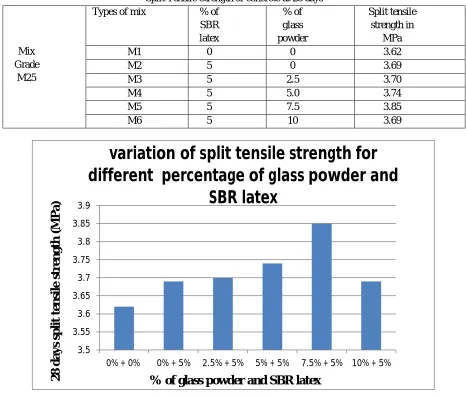
B. Split Tensile StrengthThe test were performed according to the procedure adopted in IS 5816: 1999. Cylinder of size 150 mm x 300 mm were prepared for each mixes. Result table for Split Tensile strength of cylinder at 28 days is given below and plotted graphically
Split Tensile Strength of concrete at 28 days
Mix Grade
M25
Types of mix % of SBR latex % of glass powder Split tensile strength in MPa
M1 0 0 3.62
M2 5 0 3.69
M3 5 2.5 3.70
M4 5 5.0 3.74
M5 5 7.5 3.85
M6 5 10 3.69
C. Flexural Strength
[image:8.612.72.538.134.532.2]Flexural strength test was performed according to IS 9399:1979. Beams of specimen of size 500 mm x 100 mm x 100 mm were prepared for each mix. Result table for flexural strength of beam at 28 days is given below and plotted graphically.
Table Flexural Strength of concrete at 28 days
Mix Grade
M25
Types of mix % of SBR latex % of glass powder Flexural strength in MPa
M1 0 0 5.00
M2 5 0 5.09
M3 5 2.5 5.17
M4 5 5.0 5.27
M5 5 7.5 5.52
M6 5 10 5.14
3.5 3.55 3.6 3.65 3.7 3.75 3.8 3.85 3.9
0% + 0% 0% + 5% 2.5% + 5% 5% + 5% 7.5% + 5% 10% + 5%
28
d
ays
s
p
li
t
te
n
si
le
s
tr
en
gt
h
(
M
P
a)
% of glass powder and SBR latex
variation of split tensile strength for
different percentage of glass powder and
Technology (IJRASET)
IV. CONCLUSION
Based on the experimental study on concrete mixes, the following conclusions could be made:
A. It has been found that compressive strength, split tensile strength & flexural strength have their maximum values for 5% SBR latex dosage. The compressive strength is increased by 4.2%, split tensile strength by 2.0% & flexural strength by 1.8% when compared to their nominal strength.
B. When 5% SBR latex is added along with 7.5% Glass powder dosage, maximum strengths are obtained. The compressive strength is increased by 12%, split tensile strength by 6.35%, & flexural strength by 10.4% when compared to their nominal strength.
C. The maximum strength was achieved for 7.5% replacement of cement with glass powder in latex modified self-compacting concrete. Further addition of glass powder reduces the strength.
REFERENCES
[1] Mayur B. Vanjare, Shriram H. Mahure. “Experimental Investigation On Self Compacting Concrete Using Glass Powder.”, International Journal of Engineering Research and Applications (IJERA) ISSN: 2248-9622 www.ijera.com Vol. 2, Issue 3, May-Jun 2012, pp.1488-149
[2] Vijayakumar, G., Vishaliny, H. and Govindarajulu, D. “Studies on Glass Powder as Partial Replacement of Cement in Concrete Production.", International Journal of Emerging Technology and Advanced Engineering, 3(2), 153-157 (2013)
[3] A Rajathi and G Portchejian. “Experimental Study on Self Compacting Concrete Using Glass Powder.”, International Journal of structural and civil Engineering Research ISSN: 2319 – 6009 www.ijscer.com Vol. 3, No. 3, August 2014.
[4] Shilpa raju and Dr. P.R.kumar “Effect of Using Glass Powder in Concrete”, International journal of innovative research in science, Engineering and Technology.[IC – IASET 2014].
[5] Ismail ansari and Sheetal sahare. “Utilization of Glass Powder as a Partial Replacement of Cement and its Effect on Concrete Strength.”, Proceedings of 45th IRF International Conference, 13th December 2015.
[6] Gunalaan Vasudevan, Seri Ganis Kanapathy pillay, “Performance of Using Waste Glass Powder in Concrete as Replacement of Cement.” American Journal of Engineering Research (AJER) e-ISSN: 2320-0847 p-ISSN: 2320-0936 Volume-02, Issue-12, pp-175-181, 2013.
[7] Ravi Shanker Yadav and Juned Ahmad. “To Study the Properties of Self-Compacting Concrete Using Recycled Aggregate and Glass Fiber.”, International Journal of Recent Research in Civil and Mechanical Engineering (IJRRCME) Vol. 2, Issue 1, pp: (187-191), 2015.
[8] Aniket S. Aphale and Sheetal. A.Sahare. “Effect of Particle Size of Recycled Glass on Concrete Properties.” Proceedings of 60th IRF International Conference, 24th July, 2016.
[9] Rakesh Sakale, Sourabh Jain, Seema Singh. “Experimental Investigation on Strength of Glass Powder Replacement by Cement in Concrete with Different Dosages.”,International Journal of Advanced Research in Computer Science and Software Engineering Volume 5, Issue 12, December 2015 .
[10] Hongjian Du and Kiang Hwee Tan. “Waste Glass Powder as Cement Replacement in Concrete.” Journal of Advanced Concrete Technology, Volume 12 (2014), pp. 468-477.
[11] Sameer Shaikh, S.S.Bachhav, D.Y. Kshirsagar. “Effective Utilisation of Waste Glass in Concrete.” Sameer Shaikh et al. Int. Journal of Engineering Research and Applicationswww.ijera.com ISSN: 2248-9622, Vol. 5, Issue 12, (Part - 4) December 2015, pp.01-04
4.7 4.8 4.9 5 5.1 5.2 5.3 5.4 5.5 5.6
0% + 0% 0% + 5% 2.5% + 5% 5% + 5% 7.5% + 5% 10% + 5%
28
d
ays
f
le
x
u
ral
s
tr
en
gt
h
(
M
P
a)
% of glass powder and SBR latex
Technology (IJRASET)
production” IOSR Journal of Mechanical and Civil Engineering (IOSR-JMCE) e-ISSN: 2278-1684, p-ISSN: 2320-334X [International Conference on Advances in Engineering and Technology –(ICAET-2014)]
[14] Shivacharan Singh, Vikas Srivastava, V.C. Agarwal. “Glass Waste in Concrete: Effect on Workability and Compressive Strength.” International Journal of Innovative Research in Science, Engineering and Technology Vol. 4, Issue 9, September 2015.
[15] Swarna Dubey S. S. Goliya O.S.Dhakre3. “Feasibility of study on effect of waste glass Powder as a partial replacement of cement on compressive strength of concrete.”, IJSRD - International Journal for Scientific Research & Development| Vol. 4, Issue 05, 2016 | ISSN (online): 2321-0613 . [16] Soumendra Mitra, Alipta Srimany, Braja Gopal Dey. “A practical study on Effective Utilisation of Waste Glass in Concrete.”, International Journal
of Science, Engineering and Technology Research (IJSETR), Volume 5, Issue 3, March 2016.
[17] Dhanraj Mohan patil and Dr.Sangle Keshav K (2013) “Experimental Investigation of Waste Glass Powder as Partial Replacement of Cement in Concrete”. International Journal of Advanced Technology in Civil Engineering, ISSN: 2231 –5721, Volume-2, Issue-1, 2013.
[18] Bhupendra Singh Shekhawat, Dr. Vanita Aggarwal, “Investigation of Strength and Durability Parameters of Glass Powder Based Concrete”, International Journal of Engineering Research & Technology (IJERT), ISSN: 2278-0181,Vol. 3 Issue 7, 2014.
[19] Mohammad Shoeb Sayeeduddin, Mr. F.I. Chavan. “Use of Waste Glass Powder As A Partial Replacement of Cement In Fibre Reinforced Concrete.” IOSR Journal of Mechanical and Civil Engineering (IOSR-JMCE) e-ISSN: 2278-1684, p-ISSN: 2320-334X, Volume 13, Issue 4 Ver. IV (Jul. - Aug. 2016), PP 16-21.
[20] Veena V. Bhat and N. Bhavanishankar Rao. “Influence of Glass Powder on the Properties of Concrete.” International Journal of Engineering Trends and Technology (IJETT) – Volume 16 Number 5 – Oct 2014.
[21] Ms. Karthika Kishore Koka, Mr. Shashi Kumara S R, Dr. D L Ven katesh Babu. “Steel Fibre Reinforced Latex Modified Concrete.”, International Journal of Engineering Research & Technology (IJERT) ISSN: 2278-0181, Vol. 3 Issue 9, September- 2014
[22] ] KapilSoni, YP Joshi, “Performance analysis of SBR Latex on cement concrete mixes” International Journal of Engineering Research and Applications, ISSN: 2248-9622, Vol. 4, Issue 3(Version 1), pp. 838-844, March 2014, Sati Govt. Engineering College, Vidisha.
[23] R.J Folic, and V.S Radonjanin, “Experiment Research on Polymer Modified Concrete” , ACI Material Journal, Vol. 95, No.44, pp. 463 -469,July– August, 1998 IS 9103 (1999): Specifications for concrete for admixtures - [ CED 2: Cement and Concrete][29] IS 456 (2000): Plain and Reinforced Concrete – Code of practice [ CED 2: Cement and Concrete