5
VIII
August 2017
Non Autoclaved Aerated Concrete (NAAC) Blocks:
An Alternative Building Construction Material
Anshul Shrivastava1, Prof. Archana Tiwari2
1,2Civil Engineering Department, Madhav Institute Of Technology & Science, Gwalior, M.P
Abstract: NAAC is the concrete which is light in weight that is used as an alternative construction material in modern world. The purpose of this investigation is to construct NAAC blocks to replace clay bricks in masonry. NAAC is a lighter concrete in weight which is formed by using fly ash, cement, lime, gypsum, aluminum powder and water. Fly ash is a waste material that collects from the coal used thermal power industries that can be utilized in NAAC. Different dosages of aluminium powder (0%,0.04%,0.08%,0.12% and 0.16%) taken by using weight of dry material to design aerated concrete blocks of 70.6mm×70.6mm×70.6mm. Based on in advance investigations and understanding, water to dry substances ratio is taken as 0.65. The dry density, water inclusion and compressive strength of blocks are acquired at various fractions of aluminum powder. Mixing of aluminium powder lessen the weight, density and the compressive force of the blocks. From this research it is determined that, the blocks made with aerated concrete are higher than the conventional clay bricks used in brick masonry as they are lighter in weight and saves natural clay.
Keywords: Aluminium powder, NAAC, Density, Water absorption, Compressive Strength.
I. INTRODUCTION
Now-a-days aerated concrete is an innovative construction material employ in a construction industry 60% to 80% of its volume contains pore space. The properties like strength, durability, toughness, heat transfer and wetness convey are get affected by the pore dimension and micro structure [3,9]. This porous material will provide high acoustic insulation and thermal insulation functions [5]. However, due to increased pores the compressive strength of cubes reduces. It is low weight than the conventional clay bricks with a dry density ranging between 600 kg/m3 to 1600 kg/m3. On the basis of method of curing, aerated concrete can be of two types which
are autoclaved aerated concrete (AAC) and non autoclaved aerated concrete (NAAC). In this research, focus has been through on non autoclaved concrete (NAAC) in which water curing of blocks has been done. Non autoclaved aerated concrete can be created either by using foaming agent or by with air entraining mediator. In this research, aluminium powder has been used as an air entraining agent. Aerated concrete is obtained by a chemical reaction that takes place in a fresh mortar. The effect of aluminum powder with the hydroxide of calcium and alkali from cement and lime releases hydrogen, which causes bubbles in the mixture. The bubbles enlarge the mixture and concrete augments. The hardened concrete contains voids left by the reaction. Several investigators have studied the compressive strength and density of Autoclaved Aerated Concrete but there is fewer investigations are done on Non Autoclaved Aerated concrete. S O Rathi, Khandve P. V., have examined the density and compressive strength of aerated concrete blocks. From the experimental results, they have found that the density of AAC blocks ranges from 250 kg/m3 to 1800
kg/m3 as compared to 2500 kg/m3 for conventional concrete and the compressive strength of 2.86 MPa has been achieved on 650
kg/m3 density. Radhika Shukla, have compared the burnt clay bricks with aerated concrete blocks. The results shows that
compressive strength of aerated blocks is 3-4 MPa, dry density of blocks ranging between 600 kg/m3 to 800 kg/m3, and fire
resistance for blocks are 7 hours ,which are better than burnt clay bricks. Desani Parth, Soni Mansi Et al., have examined the mechanical functions of aerated autoclaved concrete cubes and they have concluded that compressive strength of Aerated Autoclaved Concrete is between 3-4 MPa and dry density ranges between 600 kg/m3 to 800 kg/m3. Begum Razia, Habib Ehsaan Et
al., studied the effect of rice husk on Non Autoclaved Aerated concrete. At 30% RHA and 70% OPC, the compressive strength is found 3.87 MPa at 21 days, density is about 570kg/m3 and water absorption is 39 %.
II. NEED
Further, these light weight aerated concrete blocks helps in easy transport and faster construction and reduction in dead load. NAAC is a green building material, possess excellent thermal insulating properties, good sound absorber and can also be used as a decorative material [6].
III.MATERIALS USED
The following raw materials are used in the manufacturing of NAAC blocks-
A. Cement
Cement is used as a binding material in NAAC blocks. Ordinary Portland Cement (Ultratech) of 43 grade is used in the production process. Cement of this grade is available in local market.
Table 1. Properties of cement
|S. No. Physical property Results
1. Specific gravity 3.11
2. Initial setting time 90 minutes
3. Final setting time 150 minutes
4. Fineness 2 %
B. Fly Ash
Fly ash used in this experiment is taken from the Parichha thermal power plant, Jhansi, U.P. Table 2. Properties of Fly ash
S. No. Physical property Results
1. Specific gravity 2.34
2. Bulk density 1.12 gm/cc
C. Quicklim
Quick lime are obtained by calcining limestone at temperatures above 900°C.Quicklime taken for this research is taken from INDUS MINERAL PRODUCTS OF INDIA, KATNI, M.P.
D. Gypsum
Gypsum (CaSO4.2H2O) is easily available in market and used in powder form.
Table 3. Properties of Gypsum S No. Physical property Results
1. Specific Gravity 2.32
E. Aluminium Powder
A fine grey colour, uniform, smooth metallic powder available in market is used in this experimental process, having a molecular weight 26.98.
F. Water
Water is an important constituent that helps in chemical reaction. Potable water is used in this process.
IV. METHODOLOGY
A. Quantities of Materials
Table 4. Quantities of materials in percentage
Sample Designation Cement Fly Ash Quicklime Gypsum Al. powder Water/dry
material
SC 40 50 7 3 0 65
S1 40 50 7 3 0.04 65
S2 40 50 7 3 0.08 65
S3 40 50 7 3 0.12 65
S4 40 50 7 3 0.16 65
B. Mixing
All materials are weighed properly as per the requirement of mix design. Water is heated upto 70⁰c to make the end temperature of mixing upto 40⁰c for the chemical reaction of aluminium powder with other materials. Quantity of water is taken as 0.65 times of weight of dry material. First, The slurry is formed by mixing fly ash with water for 3-4 minutes in a container. On the other hand , remaining dry materials i.e Cement, Lime, Gypsum and Aluminium powder is properly mixed in dry form. Dry material is then mixed with slurry and keeps on stirring for 2-3 minutes.
C. Moulding
Oil is applied in 70.6mm*70.6mm*70.6mm cube moulds and the mixture is poured in the moulds. Mould is filled upto two third of the total height. It was observed that the concrete expanded and filled the completely.
D. Curing
Cubes are demoulded after 24 hours. Cubes are kept in air for two hours at room temperature for drying. Curing was done by immersing the cubes in water at room temperature for 7 days, 14 days and 21 days.
V. RESULTS
After completing the curing , the density, Water absorption and Compressive Strength of cubes are obtained at different stages of curing.
A. Water Absorption Analysis
[image:4.612.38.578.89.191.2]The cubes are placed in water for 24 hours. After that, Remove the cube from water and wipe out the traces of water with cloth and weigh the cube. Then, dry the cube in oven for 24 hours and weigh it. Max. Permissible Water absorption is 40%. .Water absorption test of NAAC blocks are shown in following table 5.
Table 5. Water absorption test Samples Water Absorption (%) Result
SC 6.12 Satisfied
S1 30.64 Satisfied
S2 36.84 Satisfied
S3 43.13 Unsatisfied
S4 44.68 Unsatisfied
B. Expansion in volume
Expansion in volume of cubes with respect to SC sample.
Table 6. Expansion in volume
Sample Volume increase
S1 36.80 %
S2 41.82 %
S3 48.00 %
C. Variation of Density
[image:5.612.166.501.132.323.2]The density of the NAAC blocks varied with aluminium powder content. It decreased significantly from 1392.45 kg/m3 at 0% to 667.81 kg/m3 at 0.16% and these results are shown in Fig1. With increasing aluminium powder content, the density of the non autoclaved aerated concrete gradually decreases due to increase in pores formed.
Figure 1. Density variation of blocks D. Compressive Strength Test
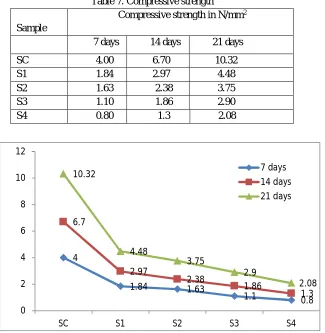
This test is performed by compressive testing machine. The compressive strength of NAAC blocks was obtained at the age of 7 days, 14 days and 21 days. The results of the tests are shown below:
Table 7. Compressive strength
Sample
Compressive strength in N/mm2
7 days 14 days 21 days
SC 4.00 6.70 10.32 S1 1.84 2.97 4.48 S2 1.63 2.38 3.75 S3 1.10 1.86 2.90 S4 0.80 1.3 2.08
Figure 2. Compressive strength of NAAC blocks
1392.45 880 810 724 667.81 0 200 400 600 800 1000 1200 1400 1600
SC S1 S2 S3 S4
Density (kg/m3)
% of Al powder
4 1.84 1.63 1.1 0.8 6.7 2.97 2.38 1.86 1.3 10.32 4.48 3.75 2.9 2.08 0 2 4 6 8 10 12
SC S1 S2 S3 S4
[image:5.612.154.479.375.708.2]E. Cost Analysis
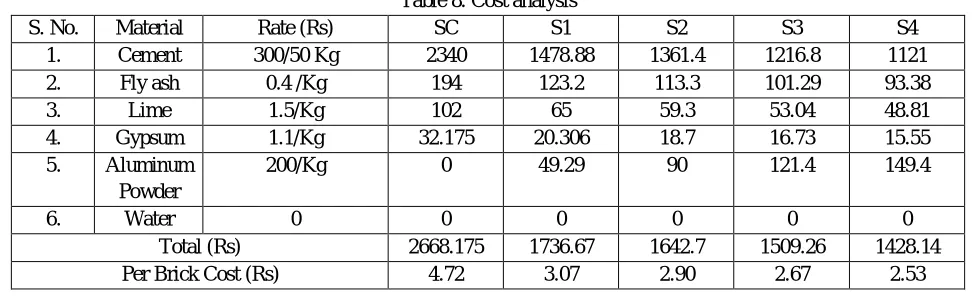
[image:6.612.62.548.132.286.2]Cost analysis is done by considering the cost of materials only. NAAC blocks gives equal and better results than conventional clay bricks. The cost of NAAC blocks are shown in following table:
Table 8. Cost analysis
S. No. Material Rate (Rs) SC S1 S2 S3 S4
1. Cement 300/50 Kg 2340 1478.88 1361.4 1216.8 1121
2. Fly ash 0.4 /Kg 194 123.2 113.3 101.29 93.38
3. Lime 1.5/Kg 102 65 59.3 53.04 48.81
4. Gypsum 1.1/Kg 32.175 20.306 18.7 16.73 15.55
5. Aluminum Powder
200/Kg 0 49.29 90 121.4 149.4
6. Water 0 0 0 0 0 0
Total (Rs) 2668.175 1736.67 1642.7 1509.26 1428.14
Per Brick Cost (Rs) 4.72 3.07 2.90 2.67 2.53
VI.CONCLUSIONS
The following conclusions are drawn from this experimental work
A. Water absorption of NAAC blocks increases with the increase in aluminium powder from 0.04% to 0.16% respectively. B. Samples S1 and S2gives water absorption less than 40%, which is acceptable for light weight concrete.
C. NAAC blocks are lighter than conventional clay bricks.
D. The density of material decreases with increase in quantity of aluminium powder. Density decreases between the range of 512 Kg/m3 to 725 Kg/m3 from sample S1 to S4.
E. S1 and S2 samples of NAAC blocks have a compressive strength 4.48 N/mm2 and 3.75 N/mm2 respectively, which is more than
the strength of third class bricks.
REFERENCES
[1] Aruova Lyazat , “Process Parameters of Production of Non-Autoclaved Aerated Concrete on the Basis of Complex Use of Ash and Gypsum-Containing Wastes”, Mediterranean Journal of Social Sciences MCSER Publishing, Vol 5 No 23 November 2014.
[2] Gautam Prashant, Saxena Navdeep, “Comparison of Autoclaved Aerated Concrete Blocks with Red Bricks”, International Journal of Engineering Research & Technology (IJERT) Vol. 2 Issue 10, October 2013.
[3] Guglielmi P. O. , W. R. L. Silva, et al, “ Porosity and Mechanical Strength of an Autoclaved Clayey Cellular Concrete”, Advances in Civil Engineering
Volume 2010, Article ID 194102, 6 pages,2010.
[4] Hamad Ali J. “Materials, Production, Properties and Application of Aerated Lightweight Concrete: Review” International Journal of Materials Science and Engineering Vol. 2, No. 2 December 2014.
[5] Jani Sohani n., Shah Darshan s., Analysis of microstructure and properties of aac block with its manufacturing process, Journal Of International Academic Research For Multidisciplinary, Volume 2, Issue 7, August 2014.
[6] Khandve P.V., Applications of AAC in Construction Industry,2016.
[7] Kumar Nitin , Dr. Netula Om Prakash, “application of aac blocks in residential buildings”, International Journal of Engineering Sciences & Research Technology, March, 2017.
[8] Moon Ashish S, Dr. Valsson Varghese, Mr. Waghmare S. S., “Foam Concrete Can Be used for Sustainable Construction as a Building Material”, IJSRD - International Journal for Scientific Research & Development Vol. 3, Issue 02, 2015 .
[9] Narayanan N., Ramamurthy K., Structure and properties of aerated concrete: a review, Cement & Concrete Composites 22 , 321±329,2000.
[10] Poznyak Oksana , Melnyk Andryy , “ Non-autoclaved aerated concrete made of modified binding composition containing supplementary cementitious materials”, Budownictwo i Architektura 13(2),2014
[11] Rathi Shweta O, Khandve P. V , “AAC Block - A New Eco-friendly Material for Construction”, International Journal of Advance Engineering and Research Development Volume 2,Issue 4, April -2015.