Technology(IJRASET)
Implement Adaptive Modulation Technique in
Wireless Sensor Network to Reduce Bit Error Rate
Krishna Devi
Yamuna Institute of Engineering & Technology, Gadholi, Kurukshetra University, Kurukshetra
Abstract: A wireless sensor networks a collection of nodes are organized in cooperative network. These nodes are the sensor nodes which is communicate over the wireless medium. The wireless medium may either of radio frequencies, infrared or any other medium, of course, having no wired connection. These nodes are deployed in a random fashion and they can communicate among themselves to make an ad-hoc network. There are several issues in wireless sensor networks like battery degradation, scalability. When data transfer from source to sink their signal strength become weak due to network interferences. To regain their strength a modulation should be needed which increase its strength. So to overcome this problem a novel technique will be proposed which is based upon adaptive modulation. Adaptive modulation helps to increase signal strength and improves bit error rate.
Keywords: Wireless sensor networks, Clustering, Adaptive Modulation, Noise levels.
I. INTRODUCTION
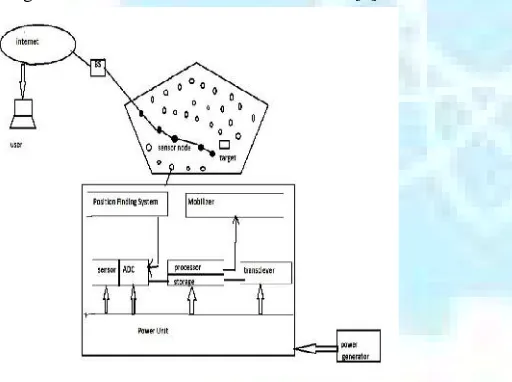
A wireless sensor networks a collection of nodes are organized in cooperative network. These nodes are the sensor nodes which is communicate over the wireless medium. The wireless medium may either of radio frequencies, infrared or any other medium, of course, having no wired connection. These nodes are deployed in a random fashion and they can communicate among themselves to make an ad-hoc network [5].
F i g . 1 . 1 C o mp o n e n t s o f S e n s o r n o d e s
In wireless sensor network the sensor nodes monitor different conditions at different locations, such as temperature, humidity, vehicular movement, lightning condition, pressure, soil makeup, noise levels, the presence or absence of certain kinds of objects, Mechanical stress levels on attached objects, the current characteristics such as speed, direction and size of an object [6]. Sensors are used in heating, ventilation and air conditioning or
other systems. Hundreds of sensors are used in these systems by using wires [8]. The cost of wiring can be a few hundred of dollars. The installation of these wires more difficult in access conditions and their re-configurability [9]. To reduce cost and provide easy reconfiguration, replacing the wired sensors with wireless sensors [8]. Wireless sensor nodes can improve the quality and coverage of sensor networks. To enhance the system capability, add more sensor nodes with multiple modalities. Adaptation Modulation technique is used to remove the error and increase the frequency strength [10]. In 2nd section we will do literature survey. In section 3rd we will discuss about Adaptation Modulation. After that we will discuss about proposed methodology and conclusion respectively.
II. LITERATURE SURVEY
[image:2.612.51.307.416.607.2]large number of sensor nodes and multiple sink nodes deployed for increase the manageability of the network and reduce the energy consumption. In this paper they mainly focus on the multiple sink location problems in large scale wireless sensor networks. Different problems are depends upon the design criteria. They consider locating sink nodes to the sensor environment, where we are given a time constraint that states the minimum required operational time for the sensor network. In this paper .Katayoun Sohrabi, they presented [3] algorithms for wireless sensor networks, which is self-organized networks, in this larger number of static nodes with highly constrained energy resources. In wireless sensor networks some protocols which supported the slow mobility by a subset of the nodes, energy efficient routing, and formation of sensor networks for carrying out cooperative signal processing functions among a set of the nodes. Wireless sensor networks used for such applications as surveillance, widespread environmental sampling, security and health monitoring. In this paper ,Yu Cheng et al. [4] ,they presented a theoretical analysis of the maximum throughput of a wireless mesh backhaul network that is achievable over a practical carrier sense multiple access with collision avoidance (CSMA/CA) medium access control (MAC) protocol. They resort to the multi commodity flow (MCF) formulation augmented with the conflict-graph constraints, a novel approach to take into account the collision overhead in the distributed CSMA/CAMAC. Such overhead due to random access has been ignored by existing MCF-based capacity studies, which assume impractical centralized scheduling and result in aggressive capacity planning, which is unachievable over the CSMA/CA MAC. This paper makes the following three main contributions: 1) They developed a generic method of integrating the CSMA/CA MAC analysis with the MCF formulation for optimal network capacity analysis, which readily generates an upper bound of the network throughput; 2) Authors define a new concept of CSMA/CA clique and theoretically study its relationship to a CSMA/CA area in terms of throughput; and 3) using the CSMA/CA clique as a tool, they derive a lower bound of the network throughput achievable over the CSMA/CA MAC by clique-based MCF formulation. NS-2 simulation results are presented to demonstrate the tightness of the upper and lower bounds that are newly developed, compared to those based on the MCF formulation assuming a slotted system and centralized scheduling. In this paper Ossama Younis and Sonia Fahmy they discussed [5] that topology control in a sensor network balances load on sensor nodes, and increases network scalability and lifetime. In sensor network clustering of sensor nodes is an effective topology. In this paper, they proposed a distributed clustering approach for
long-lived ad-hoc sensor networks. Proposed approach does not make any assumptions about the presence of infrastructure or about node capabilities, other than the availability of multiple power levels in sensor nodes. They presented a protocol, HEED (Hybrid Energy-Efficient Distributed clustering), that periodically selects cluster heads according to a hybrid of the node residual energy and a secondary parameter, such as node proximity to its neighbors or node degree. HEED terminate sinO(1) iterations, incurs low message overhead, and achieves fairly uniform cluster head distribution across the network. In this paper [6] Shashidhar Rao Gandham they have proposed four metrics and evaluate our solution using these metrics. Based on the simulation results they find that employing multiple mobile base stations in the solution given by their technique would significantly increase the lifetime period of the sensor network. In this paper they have proposed an energy efficient usage of multiple mobile base stations to increase the lifetime of wireless sensor networks. Their approach uses an integer linear program to determine the locations of the base stations and a flow-based routing protocol. They conclude that using a rigorous approach to optimize energy utilization leads to a significant increase in network lifetime. Moreover, the trade off solution quality and computing time allows us to compute near-optimal solutions within a reasonable time for the network sizes considered.
III. ADAPTIVE MODULATION TECHNIQUE
dynamic but protocol parameters and signal depends on the radio link circumstances [11]. If circumstances convert signals and protocol parameters change. The channel information is frequently required by the adaptive modulation system at the transmitter. This can be assumed in time division duplex systems that the channel from the transmitter to receiver and receiver to transmitter are more or less be same. On the other side the channel information may also be computed deliberately at the receiver and slowly pass back to the transmitter. On the transmitter the adaptive modulation optimizes the Bit Error Rate (BER) [13].
IV. PROPOSED METHODOLOGY
We have analyzed various energy efficient hierarchical routing algorithms. As per their simulation results most of these have enhanced the network lifetime and the throughput of wireless sensor network while utilizing less power. All these protocols while considering the same energy (power) of every sensor node at the time of initial deployment. In this work we are considering presently the most energy efficient protocol which is actually based on static clustering as one of the hierarchical routing technique. Most of the battery power in wireless sensor networks is consumed in determining the optimal path between the event-driven sensor node and the base station. The adaptive modulation scheme is been used in this thesis to enhance the efficiency of the network. The adaptive modulation is the scheme which is based on the neural network and will used for the signal modulation. The data signal which is transmitted between the source and sink is of less frequency and it more vulnerable to network interferences. To reduce the network inferences, the scheme of adaptive modulation is been used which will modulate the signal according to the network conditions using the neural network scheme. The neural network scheme which is going to use in this thesis is the knowledge based learning. The adaptive modulation can increase the network reliability and performance. It is used to reduce the bit rate error. The signal which became weak due to network interference can be modulated using adaptive modulation technique. With the help of adaptive modulation signal strength can be improved and bit error rate reduce.
V. EXPERIMENTAL RESULTS AND SIMULATION TABLE
Parameter Value
Sink Node 1 node in the middle
Network Size 1000 nodes
Communication Radius 18 meter
Loss Probability 0%
Simulation Duration 100 rounds
Network Area 100*100
Nodes Density 7 nodes/m^2
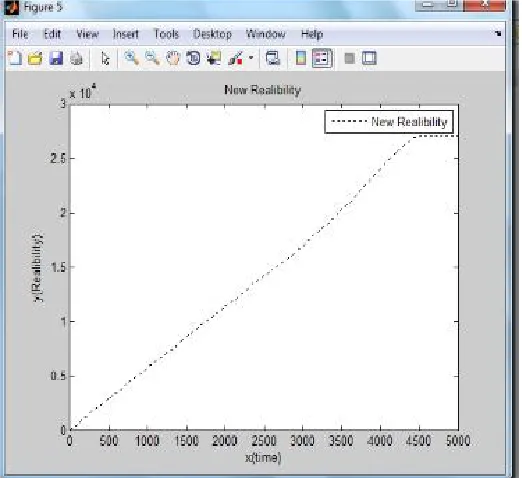
[image:4.612.312.573.436.675.2]In fig 1.2, shows that bit error rate deuce by using adaptive modulation technique and it increase reliability of the network.
Fig. 1.3 Comparison graph of all parameters
Above graph illustrate that second figure shows that it is better in all the parameters. In second figure adaptive modulation is used which shows that it much better than old scenario. Using adaptive modulation reliability of the network increases. It reduces delay and packet overhead respectively.
VI. CONCLUSION
Wireless sensor network is application depended network. These are placed in those areas where human being can’t go forcheck the status of network issues. In the WSN the physical length of the nodes is the biggest issue. As, the two nodes which are far from each other communicate very smoothly whereas the nodes which are very close to each other is not able to communicate due to the physical interference. The deployment of the sensor network also leads to the problem of congestion and battery consumption. When data is send from source to sink the strength of the signal became weak due to network interferences. If the signal is weak than it effect the performance and reliability of the network. To increase the signal strength of the system or network modulation technique will be used. In this proposed work we will use adaptive modulation technique which wills helps to increase the signal strength and reduce bit error rate. Experimental results shows that it reduce delay, energy consumption and increase reliability of the network.
REFERENCES
[1] Lucas D. P. Mendes, Joel J. P. C. Rodrigues∗ , Athanasios V. Vasilakos , and Liang Zhou “Lifetime Analysis of a Slotted
ALOHA-based Wireless Sensor Network using a Cross-layer
Frame Rate Adaptation Scheme”, IEEE, 2010
[2] E. Ilker Oyman and Cem Ersoy “Multiple Sink Network
Design Problem in Large Scale Wireless Sensor Networks”
IJCA, 2011
[3] Katayoun Sohrabi, Jay Gao, Vishal Ailawadhi and Gregory J
Pottie “Protocols for Self-Organization of a Wireless Sensor
Network” ACM, 2011
[4] Yu Cheng, Hongkun Li, Peng-jun Wan, Xinbing Wang
“Wireless Mesh Network Capacity Achievable Over the
CSMA/CA MAC” in IEEE Transaction on Vehicular
Technology, September 2012.
[5]Ossama Younisand Sonia Fahmy, “Hex-MASCLE –
Hexagon based Clustering withSelfHealing Abilities”, IEEE, 2012
[6] Shashidhar Rao Gandham “Energy Efficient Schemes for
Wireless Sensor Networks with Multiple Mobile Base Stations”
IJCA, 2010
[7] Jakob Salzmann, Ralf Behnke, Dirk Timmermann “ Hex-MASCLE – Hexagon based Clustering withSelfHealing Abilities”WirelessCommunicationsandNetworking Conference (WCNC), pp. 528-533,2011IEEE.
[8] Ewa Hansen, Jonas Neander, Mikael Nolin and Mats
Bjorkman “Efficient Cluster Formation for Sensor Networks”
IJERT, 2012
[9] Ying Miao “Seminar Wireless Self-Organization Networks
Application of sensor network” 2005
[10] Sudhanshu Pant, Naveen Chauhan“Effective Cache based Policies in Wireless Sensor Networks: A Survey”
International Journal of Computer Applications (0975 – 8887) Volume 11–No.10, December 2010
[11] Basilis Mamalis, Damianos Gavalas, Charalampos Konstantopoulos and Grammati Pantziou “Clustering in Wireless Sensor Networks” 2009
[12] LEWIS ADAMS“CAPITALIZING ON 802.11 FOR
SENSOR NETWORKS Low-Power Wireless Sensor Networks”
IJSER, 2011