Technology (IJRASET)
Application of Taguchi method for design of
experiments in turning Al 6063
Sandeep R.Jadhav1, Arun B. Degaonkar2
1
M.E.(Mechanical-Production)Student, 2Professor, Department of Mechanical Engineering,
Karmaveer Bhaurao Patil College of Engineering Satara, Maharashtra, India
Abstract - In order to produce any product with desired quality by machining, proper selection of process parameter is essential. Taguchi’s parameter design is an important tool for robust design, which offers a simple and systematic approach to optimize a design for performance, quality and cost. The Taguchi method is off line quality control encompasses all stages of product/process development. However, the key element for achieving high quality at low cost is design of experiment.
This paper describes use and steps of Taguchi design of experiment and orthogonal array to find specific range and combinations of turning parameter like cutting speed, feed, depth of cut and rake angle
Keywords- Turning, process parameter, orthogonal array, Taguchi method
I. INTRODUCTION
To achieving a desired level of surface finishing for turned parts requires practical knowledge and skill to properly set up this type of operation with the given specification and condition. In order to obtain optimal cutting parameters to achieve the best possible surface finish, manufacturing industries have resorted to the use of handbook based information and operators’ experience. This traditional practice leads to improper surface finish and decrease in the productivity due to sub-optimal use of machining capability. This causes high manufacturing cost and low product quality. Therefore, in this past experience to select parameter which will likely yield a surface roughness below that of specified level, and perhaps make some parameter adjustments as time allows or quality control requires. Engineers and technicians establish such an operation would ideally consider other implications of setup parameter such as production schedules, processing time and noise factors. A more methodical or experimental, approach to setting parameter should be used to ensure that the operation meets the desired level of quality with given noise conditions and without sacrificing production time. Unfortunately, in most scenarios, time is limited and design of experiment methods tend to be lengthy and cumbersome when considering the complex factors and noise that affect such an operation.
In order to optimize such an operation with such restrictions, a more efficient experimental method is needed. An excellence solution to this issue is an approach known as Taguchi Parameter Design.
II. PRESENTTHEORIESANDPRACTICES
Metal cutting is one of the most extensively used manufacturing processes, and its technology continues to advance in parallel with the developments in material science. The productivity and accuracy of the metal removal operations depend on machining process parameters, cutting conditions and cutting tool geometry as well as the work piece material and material of the tool [2]. An important aspect in manufacturing and machining process is to obtain the desired final dimensions and surface finish quality.
Zeelan Basha N[3] has prediction of machining parameters i.e. cutting speed, feed, depth of cut that improve the quality of surface finish in machining of Al 6063 using coated carbide tool. Effective optimization techniques approach response surface methodology was used to develop mathematical model and genetic algorithm was utilized for finding the optimal cutting conditions for best surface finish and also to develop the second order mathematical model for process parameters and analysis of variance measured for process parameters to ensure the significant effects. Minimum predicted surface roughness value for the optimal solution of the cutting conditions was 80 m/min, 0.18 mm/rev, 0.3mm.
Technology (IJRASET)
maximization of material removal rate in CNC turning of Aluminium alloy(Al 6063-T6) using carbon insert tool in dry condition. Taguchi design of experiment with L9 orthogonal array was used for experiment and minitab17 statistical software used to analysis the experimental data. The ANOVA was used to investigate which design factor and their interaction affects the response significantly. The result show that significant factor for surface roughness are feed rate and spindle speed while for MRR depth of cut and spindle speed are most significant factor.
H.M. Samashekara [6] has developed regression model during machining of Al 6351-T6 Aluminium alloy using uncoated carbide insert to analyze the combination of machining parameter(speed, feed, depth of cut) for better performance within selected range of machining parameter. A full factorial design of experiment with orthogonal L9 array was used to develop the surface regression model. Developed model shows that surface roughness on machining parameter are significant; hence it could be used for making prediction for surface roughness. Analysis of variance is also used to analysis the influence of cutting parameter during machining and it was found that speed has greater influence on surface roughness followed by feed.
K. Krishanamurthy et al. [7] has performed experiment to investigate the effect of machining parameter on surface roughness and material remove rate of TiB2 particles reinforced aluminum (Al6063) metal. Four parameter namely cutting speed, feed, depth of cut and material are varied to study their effect on surface roughness and material remove rate. Experiment were conducted based on Taguchi L27 orthogonal array and then followed by optimization of the result using Analysis of variance to find out maximum material remove rate and minimum surface roughness. The optimum MRR was obtained when setting the cutting speed and feed rate at high values but low surface roughness obtained at high cutting speed and low feed rate.
Mihir T. Patel et al. [8] performing the experiment to investigate the effect of process parameter like spindle speed, feed, depth of cut, nose radius on material removal rate and surface roughness. They developed a surface roughness and material removal rate prediction model for machining of Al6068 Aluminium alloy. The experiments have been conducted using L8 orthogonal array with mixed level design on conventional lath machine. To test the quality of fit data, the ANOVA analysis was undertaken. The result shows that material removal directly influenced by cutting speed and depth of cut while the nose radius and cutting speed have significance on surface roughness.
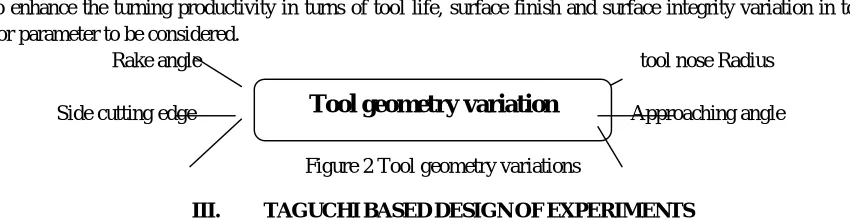
M. Dorga [9]has investigated that surface roughness also depends on cutting tool geometry and condition of cutting tool. New cutting tool with optimum cutting condition can produce better surface finish. Due to tool wear that occurs during cutting process, it influences the quality of product surface finish. Also tool geometry has significant influences on chip formation, heat generation, tool wear, surface finish and surface integrity during turning. The tool geometry effect on turning performance parameter shows in Figure 1, 2
Surface finish tool wear Residual stress White/dark layer Chip formation heat generation
Cutting forces micro hardness variation
Figure 1 Effect of tool geometry on performance parameter in turning
In order to enhance the turning productivity in turns of tool life, surface finish and surface integrity variation in tool geometry is one of major parameter to be considered.
Rake angle tool nose Radius
[image:3.612.165.462.457.556.2]Side cutting edge Approaching angle
Figure 2 Tool geometry variations
III. TAGUCHIBASEDDESIGNOFEXPERIMENTS
Taguchi’s parameter design is an important tool for stable design. It provides simple, efficient and systematic approach to optimize
Effect of tool geometry
[image:3.612.85.510.593.703.2]Technology (IJRASET)
designs for performance, quality and cost. Taguchi method is efficient method as compare to other methods available for designing process that operates consistently and optimally over a variety of conditions it gives high efficiency with less experiment runs also it offers a simple and systematic approach to optimize design for performance, quality and cost. Two major tools used in stable design are signal to noise ratio; which measures quality with emphasis on variation, and orthogonal array; which accommodates many design factors simultaneously. Taguchi’s design is a fractional factorial matrix that ensures a balanced comparison of levels of any factor. In this design analysis each factor is evaluated independent of all other factors. When a critical quality characteristic deviates from the target value, it causes a loss. Continuously pursuing variability reduction from the target value in critical quality characteristics is the key to achieve high quality and reduce cost. By applying this technique one can significantly reduce the time required for experimental investigation, as it is effective in investigating the effects of multiple factors on performance as well as to study the influence of individual factors to determine which factor has more influence and which has less on responses.
Taguchi defines three quality characteristics in terms of signal to noise (S/N) ratio which can be formulated for different categories which are follows
Nominal is the best: S/NT= 10 log10 (Ybar2/s2) ………. (1)
Where,
Ybar = Σyi/n
s2= Σ (yi – ybar) 2/ (n – 1) =1
a. Larger is the better (maximum); S/NL= - 10 log10[Σ (1/yi2)/n]………… (2)
b. Smaller is the better (minimize): S/NS= - 10 log10[Σ yi2/n] ……… (3)
Where, y is value of response variables and n is the number of observations in the experiments. Taguchi method- based design of experiments involved following steps [10]
Definition of the problem Identification of noise factors Selection of response variables
Selection of control parameter and their levels Identification of control factor interactions Selection of orthogonal array
Conducting the matrix experiment
Analysis of the data and prediction of optimum level
A. Definition of problem
A brief statement of problem under investigation is “To obtain optimum levels of speed, feed, depth of cut and rake angle for desired dimensional accuracy, surface roughness and machining time of Al 6063 by using carbide insert”
B. Identification of noise factor
The environment in which experiments are performed is main external source of variation of performance of turning process. Examples of noise factor temperature, vibrations human error in operating the process
.
C. Selection of response variables
In any process, the response variables need to be chosen so that they provide useful information about the performance of turning process. By considering all parameters and by taking literature reviews as technical based surface roughness (Ra), machining time and dimensional accuracy were are chosen as response variables.
D. Selection of control parameter and their levels
In process, parameters affecting the characteristic of turned part are: cutting parameter – cutting speed, feed, and depth of cut, dry cutting and wet cutting; Tool geometry- rake angle and tool material; work piece related parameters- metallographic.
E. Selection of cutting speed
Technology (IJRASET)
speed increases. Machine constraint is another reason for selection of cutting speed.
F. Selection of feed
From the fundamentals of metal cutting that feed rate influences the chip cross sectional area, machining force, pitch of machined surface profile and machined surface roughness. As feed rate increases roughness value goes on increases also increases in cracks, pits on machined surface due to reinforcement pull-out and fracture. Also, effect of change in tool geometry in conjunction with feed rate on surface quality is not adequately clear too.
G. Selection of depth of cut
The surface roughness deteriorates with increases in depth of cut, which attributed to formation of unstable BUE at lower feed rate and high depth of cut. However, most of investigations have reported that surface roughness has little or not depend on depth of cut. Further, it is envisaged that a change in depth of cut may vary the rate of plastic deformation. This in turn influences the mechanical and thermal stresses on the machining surface. Also, as depth of cut is smaller rate of production goes on decreases, as depth of cut increases, due to high cutting force and vibration roughness value goes on increases.
Considering the literature review and the available machine setting following process parameter were selected for present work The ranges of the selected process parameter were ascertained by conducting some preliminary experiments using one variable at a time approach. The selected parameters were kept fixed during the entire experimentation.
H. Selection of orthogonal array
In Taguchi method-based design of experiment, to select an appropriate orthogonal array for experimentation, the degrees of freedom (DOF) needs to be computed. The DOF is defined as the number of comparisons between machining parameters that need to be made to determine, which level is better a specifically how much better it is. In present study, interactions between parameter not consider. Therefore there are 8 DOF owing to three level independent parameter.
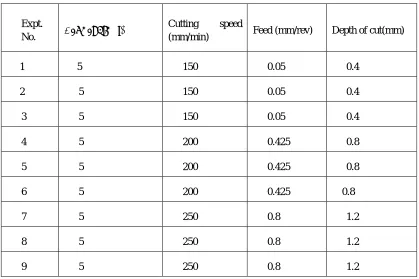
[image:5.612.97.516.439.718.2]In this study a L27 orthogonal array as shown in table, has been used because it has 26 DOF which is higher than 8 and for four cutting parameter it give better result compare to L9 orthogonal array.
Table I Experimental plan -Taguchi Array (L27)
Expt.
No. Rake angle ( ̊ )
Cutting speed
(mm/min) Feed (mm/rev) Depth of cut(mm)
1 5 150 0.05 0.4
2 5 150 0.05 0.4
3 5 150 0.05 0.4
4 5 200 0.425 0.8
5 5 200 0.425 0.8
6 5 200 0.425 0.8
7 5 250 0.8 1.2
8 5 250 0.8 1.2
Technology (IJRASET)
IV. SELECTION OF WORK MATERIAL AND TOOL
Work material used as the test specimen was Al 6063. A cylindrical bar of Aluminium alloy (320 mm long and 35 mm diameter) was used for test.
The chemical analysis was carried out and the composition obtained is as given in Table II Table II Chemical Composition of Al 6063
Element Si (%) Fe (%) Cu (%) Mn (%) Mg (%) Zn (%) Ti (%) Cr (%) Aluminium
Weights 0.2-0.6 0.0-0.35 0.0-0.10 0.0-0.10 0.45-0.9 0.0-0.1 0.0-0.1 0.1max balance
10 10 150 0.425 1.2
11 10 150 0.425 1.2
12 10 150 0.425 1.2
13 10 200 0.8 0.4
14 10 200 0.8 0.4
15 10 200 0.8 0.4
16 10 250 0.05 0.8
17 10 250 0.05 0.8
18 10 250 0.05 0.8
19 15 150 0.8 0.8
20 15 150 0.8 0.8
21 15 150 0.8 0.8
22 15 200 0.05 1.2
23 15 200 0.05 1.2
24 15 200 0.05 1.2
25 15 250 0.425 0.4
26 15 250 0.425 0.4
Technology (IJRASET)
The physical properties is given in Table III Table III Physical properties of Al 6063
Properties Density Melting Point
Modulus of elasticity
Electrical resistivity
Thermal conductivity
Thermal expansion
Value 2.70kg/
m3 600
0
c 69.5Gpa 0.035 * 10-6Ωm 200W/mk 23.5 *10-6/k
The Cutting tool used for experimentation with all the standard specification is carbide insert. Specification – CCMG 12 06 12
C- 80° (Shape Turning Insert)
C- Turning Insert with 7° clearance angle M- Insert tolerance
G- Turning insert with cylindrical hole 12- 12mm (Cutting edge length of insert) 06- 6mm (width of insert),
12- 1.2 mm (nose radius of insert)
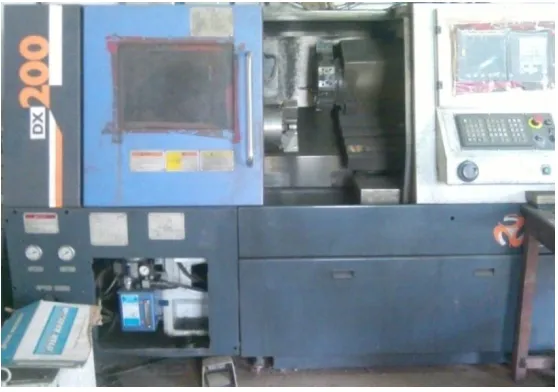
[image:7.612.167.446.336.532.2]The machine used for turning is CNC lathe DX-200(Fanuc series) manufactured by Jyoti CNC Automation Pvt. Ltd. The actual photograph of CNC workstation used during experimentation is as shown in Figure 3
Figure 3 Photographic view of CNC machine
V. OVERALL DISCUSSION
This paper has discussed the application of Taguchi method for find a specific range and combination of turning parameter like cutting speed, feed, depth of cut and rake angle to achieve optimal values of response variable like surface roughness, machining time and dimensional accuracy in turning of Al 6063 Aluminium alloy. It is effective methodology to find out the effective performance and machining condition. Taguchi parameter design offers a simple, systematic approach and can reduce number of experiment to optimize design for performance, quality and manufacturing cost. It is a scientifically disciplined mechanism for evaluating and implementing improvement in product, processes, material, equipment and facilities
VI. ACKNOWLEDGMENT
I would like to acknowledgment and extend my sincere gratitude to Prof. A.B. Degaonkar for his constant assistance and much needed motivation to publish this paper.
REFERENCES
Technology (IJRASET)
[2] Dr. C. J. Rao, Dr. D. Nageswara Rao, P Srihari, “Influence of Cutting Parameter on Cutting Force and Surface Finish in Turning Operation” Elsevier Procedia Engineering 64(2013) 1405-1415.
[3] Zeelan Basha.N, “Determining the Effect of Cutting Parameters on Surface Roughness Using Genetic Algorithm” Science, Technology and Arts Research Journal, Oct-Dec 2013, 2(4): 98-101.
[4] P. Jayaramana, L. Mahesh kumar, “Multi-response Optimization of Machining Parameters of Turning AA6063 T6 Aluminium Alloy using Grey Relational Analysis in Taguchi Method”, Procedia Engineering 97(2014) 197 – 204.
[5] M.D. Tayab Ali, Dr. Thuleswar Nath, “Cutting Parameters Optimization for Turning AA6063-T6 Alloy by Using Taguchi Method” IJRMET Vol. 4, Issue 2, May - October 2014, ISSN: 2249-5762.
[6] H. M. Somashekara, “Optimizing Surface Roughness in Turning Operation Using Taguchi Technique and ANOVA”, International Journal of Engineering Science and Technology (IJEST), Vol. 4 No.05, May 2012 ISSN: 0975-5462.
[7] K. Krishnamurthy, J. Venkatesh, “Assessment of Surface Roughness and Material Removal Rate on Machining of TIB 2 Reinforced Aluminum 6063 Composites: A Taguchi’s Approach” International Journal of Scientific and Research Publications, Volume 3, Issue 1, January 2013,PP:1-6.
[8] Mihir T. Patel, Vivek A. Deshpande , “Experimental Investigation of Effect of Process Parameters on MRR and Surface Roughness In Turning Operation on Conventional Lathe Machine for Aluminum 6082 Grade Material Using Taguchi Method”, Int. Journal of Engineering Research and Applications, ISSN : 2248-9622, Vol. 4, Issue 1( Version 3), January 2014, pp.177-185.
[9] M.dorga, V.S. Sharma, J. Dureja, “Effect of Tool Geometry Variation on Finish Turning- A Review” Engineering Science and Technology Review, 4(1) (2011), 1-13.