E c s t a si p r oj e c t : U si n g
t e c h n olo gy t o e n c o u r a g e
c r e a tivi ty in t h e a s s e s s m e n t
p r o c e s s
Ku t ar, M S , G riffit h s , M a n d Woo d , J
T i t l e E c s t a s i p r oj e c t : U si n g t e c h n olo g y t o e n c o u r a g e c r e a t ivi ty in t h e a s s e s s m e n t p r o c e s s
A u t h o r s Ku t ar, M S , G riffit h s , M a n d Woo d , J
Typ e C o nf e r e n c e o r Wo r k s h o p I t e m
U RL T hi s v e r si o n is a v ail a bl e a t :
h t t p :// u sir. s alfo r d . a c . u k /i d/ e p ri n t/ 3 5 3 8 5 /
P u b l i s h e d D a t e 2 0 1 5
U S IR is a d i gi t al c oll e c ti o n of t h e r e s e a r c h o u t p u t of t h e U n iv e r si ty of S alfo r d . W h e r e c o p y ri g h t p e r m i t s , f ull t e x t m a t e r i al h el d i n t h e r e p o si t o r y is m a d e f r e ely a v ail a bl e o nli n e a n d c a n b e r e a d , d o w nl o a d e d a n d c o pi e d fo r n o
n-c o m m e r n-ci al p r iv a t e s t u d y o r r e s e a r n-c h p u r p o s e s . Pl e a s e n-c h e n-c k t h e m a n u s n-c ri p t fo r a n y f u r t h e r c o p y ri g h t r e s t r i c ti o n s .
Ecstasi Project: Using Technology to
Encourage Creativity in the Assessment
Process
Maria Kutar1, Marie Griffiths1, Jamie Wood2
1Salford Business School, University of Salford. 2School of History & Heritage,
University of Lincoln
Email: [email protected], [email protected], [email protected]
Abstract
The notion of creativity has attracted increasing attention in Higher Education in recent years, and is seen to be of importance in a variety of disciplines, not just those which are closely associated with the creative industries. This provides a challenge to educators to understand how the concept can be incorporated into student learning and assessment. This paper introduces the Ecstasi project, which is studying the creative learning journey of students in two different disciplines and institutions, on modules which use an inquiry-based pedagogy. The students are encouraged to creatively utilise information technology to develop artefacts for their assessed work.. A key challenge is the assessment of creativity, which we consider this using the dimensions of person, process and product. The paper discusses creativity and its assessment in HE, presents preliminary results from the on-going longitudinal study, and considers the role of technology in this process.
Keywords: IT, Technology, Creativity, Education, HE, Assessment
1 Introduction
Rapid advancements in digital technology and applications have led to a generation of higher education (HE) students who may be described as digital natives (Prensky 2009), comfortable with the permeation of technology across their personal and educational lives. Whilst the true extent of their digital skills may be more mixed than the digital natives narratives suggests (Jones and Shao 2011), the changing technological landscape is leading the increasing digitalisation of HE. This offers opportunities and challenges to educators to develop teaching, learning and assessment approaches which exploit both the benefits of the technologies themselves and students’ increasing skills in utilising them. In this paper we report on a study which investigates the use of technology to encourage creativity in student learning.
technology group. The students are encouraged to use a range of technological tools in their assessed work, and to share their perceptions of creativity. We examine the extent to which these perceptions change as a result of their experience on the modules, and investigate the creativity of the work produced. In this paper we provide an overview of this study, which is now in the final stages of two years of data collection.
About the Project
The Ecstasi project (Encouraging Creativity in Students Through Applying Student
Inquiry) is investigating whether Inquiry-based pedagogies can help to foster student creativity, in areas which are not viewed as being inherently creative (specifically, Business Information Technology and History). Inquiry Based Learning (IBL) can be defined as approaches to learning that are based on a process of self-directed inquiry or research where the lecturers are facilitators in the process of knowledge whilst the students discover the knowledge for themselves (Khan and O’Rourke 2005). The project draws data from two modules at two different HE institutions - one in the North West of England and one in the East of England. Running for two years this gives data from four discrete groups of students.
information technology students were given free choice regarding the technology they used.
Data has been collected through four areas. Students were informed about the project at the start of the module, and invited to take part. (The project has received ethical approval from both institutions and it was emphasised that participation in the study itself was voluntary and would in no way affect students’ grades or studies). Those that agreed to take part completed a questionnaire at the start of the module, which examined their perceptions of creativity at the same time as asking them to make a self-assessment of their own creativity. Students participated in the module in the usual way, with one assessment component - the information artefact - being designed to encourage creativity in student work. Following completion of this assessment component a second questionnaire was administered which again assessed the students’ perceptions and self assessment of creativity, and also the extent to which students felt their creativity had changed as a result of their experience on the module. Once the module was completed (and students had received their results), we assessed a sample of the information artefacts for their creativity, using a rubric adapted from Brookhart (2013). Finally in the second year of the project, two student focus groups have discussed creativity and their experiences in developing their information artefacts.
This paper explores the challenges faced by researchers and academics in defining the notion of creativity. This is followed by a review of how creativity is positioned with higher education, which is then extended with a discussion of how creativity is embedded in the assessment process. Creativity and technology is also explored to understand any perspectives that might contribute towards this discussion. Preliminary findings of what we can learn from the use of technology in the HE environment, and the extent to which this encourages creativity, are discussed to conclude the paper.
Creativity and Learning
educators have attempted unfurling the word ‘creativity’. These have ranged from “Creativity is a bit like pornography; it is hard to define, but we think we know it when we see it” (Mitchell et al, 2003:7), to “Creativity is considered as the ability to provide novel answers to a proposal or problem given, or to discover new relations and give them new mental structures, respectively” (Piedra et al 2010: 1511). Brookhart (2013) defines creativity as: ‘Creativity is a simple concept that can be difficult to get your head around. In its most basic sense, creative means "original and of high quality" (Perkins, 1981: 6).’ ‘Probably the foremost characteristic of creative students is that they put things together in new ways (Brookhart, 2010). Fasko (2000) conducts a historical review of past and current literature on the relation of education to creativity in students. What is pertinent in this paper is that researchers continue to probe similar complex issues regarding creativity and learning with Guildford (1975: 120) suggesting, ‘the student be taught about the nature of his own intellectual resources, so that s/he may gain more control over them’. Furthermore in 1991, Davies argues that it is important to help students understand what creativity actually is and this understanding should increase creative consciousness, demystify creativity and increase creative ideas and products (Davies 1991). Interestingly Fasko (2001) also reports on Treffinger’s (1980) suggestion that the creative processes of fluency, originality, and flexibility be incorporated in an inquiry- discovery approach not unlike the IBL approach adopted for our study. The issue of creativity is not a recent concern for academia.
Creativity in HE
courses and degree programmes (HEA 2011). The challenge to educators, when creativity is often perceived as the panacea - the new “must be good” discourse in education (Livingstone 2010) - is how can we foster this and educate students to re-imagine their own creativity. Sinclair (2006) makes the pertinent point that HE, in its very structural procedures actively discourages the notion of creativity, whilst Jackson (2006) identifies that there is a ‘problem’ with the notion of creativity in HE and he argues for a process to develop and encourage students to be creative and become critical enquirers. There is not necessarily a need to teach creativity per se, but, as Jackson (2006) argues, to develop students awareness and understanding of their own creativities as they develop their self-awareness. A major role of universities is guiding students in processes which encourage this; Livingstone (2010) adds that HE institutions are about learning not teaching, a distinction which is particularly appropriate in the context of developing creativity.
Creativity and Inquiry-Based Approaches
Technology and Creativity
The extent to which technology may encourage creativity has been widely discussed. Shneiderman (2000) proposed a research agenda to support evolutionary creativity but cautioned that creativity support tools ‘may restrict imagination to only what is possible with these tools’. Within the computing science community, research has addressed the design of tools and interfaces which may be used too support or encourage creativity (Resnick 2005; Shneiderman et al 2006; Greenberg 2007). Other research has examined the process and social aspects of creativity (Warr and O’Neill 2005; Pepplar and Solomu 2011) and its relationship with technology, which are increasingly relevant given the rise of social technologies. We agree that the use of technological tools may influence student creativity and are not concerned in this paper with tools designed to support creativity per se. Rather we draw on students’ increasing technological literacy, and for the technology students in our study, encourage students to use a range of technologies for their work, something which arguably enhances the creative possibilities of their technology use.
Discussion: Preliminary Findings
Creativity has frequently been presented as a desirable attribute of graduates of tertiary education, irrespective of discipline. It is no longer seen to be the sole preserve of students who have graduated from what might traditionally have been considered as ‘creative disciplines’ (Allen and Coleman, 2011; Sternberg, 2010; Tan and Grigorenko, 2010; Charyton et al., 2009). One of the problems facing those who want to assess creativity is definitional: what is creativity? The challenges facing any educator who wants to try to assess ‘creativity’ can be illustrated by the series of questions below (Charyton et al., 2009).
• Person – is the student a creative person and have their learning experiences made them more creative?
• Process – is the process through which the person learnt or the product was made creative?
• Product – is the essay or other piece of work creative?
analysis process has used the strands identified by Charyton (2009) to provide additional insight from our findings:
Questions asked to students (within questionnaires)
History student responses BIT student responses
Person:
Do you think Creativity can be taught?
Student 5: ‘No, you’re either a creative person or not, more ‘born with it’
Student 10: ‘Reaching your creativity can be helped and encouraged.
Student 12: ‘To a certain extent, the person must have a knack, and confidence previously.’
Student 4: ‘It can be improved taking other people's views’ Student 5: ‘no’ Student 8: ‘Not sure maybe’
Process:
Do you think your creativity has changed as a result of developing the artefact?
Student 6: ‘It has allowed me to think in other formats than just an essay and made me think more about presentation.’
Student 12: ‘Not really, I think the program was just complicated and wasn't fair that it was new and part of the assessment. Don't think that it was just me that felt this.’ Student 20: ‘Thinking outside the
Student 1: ‘yes, I now think of more creative ways of displaying various types of work’ Student 2: ‘Yes maybe, I could do a lot more than I expected’
Table 1: Escasti Questionnaire Findings (adapted from Charyton et al 2009)
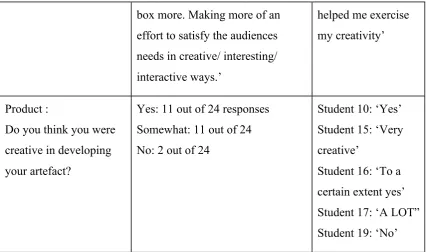
The Ecstasi project addresses each of these strands in turn (see Table 1: Escasti Questionnaire Finding). The survey of students focuses on person, examining students’ perceptions of their own creativity, and is intended to track how this changes as a result of their learning experiences on the module. Questionnaire responses for the person strand presents a mixed response to this question, not everyone believed that creativity could be taught but it could be encouraged echoing Jacksons (2006) that there should be a process in place to develop and encourage students to be creative and become critical enquirers. This links closely to the following strand of
process. The use of an inquiry-based pedagogy and an innovative assessment approach provided an opportunity within the process for students to be creative. The use of technology-based tools for development, presentation and assessment of learning needed to develop the information artefacts provides students with the scaffolding that is necessary for successful engagement with IBL (Levy et al., 2010). The assessments were designed to harness the flexibility offered by technology that might better facilitate, with appropriate scaffolding, student creativity in both the process and product of their work, unlike more traditional modes of assessment in these subject areas (e.g. essays, reports). The process responses were favourable, with the majority of students believing their creativity was altered positively as a result of developing the artefact. Finally this links closely to the third strand of product. The
box more. Making more of an effort to satisfy the audiences needs in creative/ interesting/ interactive ways.’
helped me exercise my creativity’
Product :
Do you think you were creative in developing your artefact?
Yes: 11 out of 24 responses Somewhat: 11 out of 24 No: 2 out of 24
Student 10: ‘Yes’ Student 15: ‘Very creative’
information artefacts produced were the products, the creativeness of which were assessed, and finally the majority of students believed that by developing the artefact they were being creative (although we acknowledge the small number who did not agree with this view). A more extensive analysis, together with demonstrations of student work from this ongoing project will be presented at the conference, to encourage an extended discussion on the complex nature of embedding, facilitating, empowering and assessing creativity in Higher Education.
References
Allen, B. and Coleman, K. (2011): The creative graduate: cultivating and assessing creativity with eportfolios, Changing Demands, Changing Directions. Proceedings ascilite Hobart 2011, G. Williams, P. Statham, N. Brown and B. Cleland, eds., 59-69. Retrieved January 24, 2015, from
http://www.ascilite.org/conferences/hobart11/downloads/papers/Allen-full.pdf
Baxter-Magolda, M. B. (2009): Educating Students for Self-Authorship: Learning Partnerships to Achieve Complex Outcomes. In The University and Its Disciplines: Teaching and Learning Within and Beyond Disciplinary Boundaries, C. Kreber, ed., New York-London: Routledge, pp. 143-156.
Baxter-Magolda, M. B., King, P. M. (2012): Assessing Meaning Making and Self-Authorship: Theory, Research, and Application. ASHE Higher Education Report 38.3. San Francisco, Jossey-Bass.
Brookhart, S. (2013) How to Create and Use Rubrics for Formative Assessment and Grading, Alexandria, VA: ASCD. Copyright 2013 by ASCD.
Charyton, C., Ivcevic, Z., Plucker, J. A., Kaufman, J. C. (2009): Creativity Assessment in Higher Education, Handbook of Research on Assessment Technologies, Methods, and Applications in Higher Education, C. S. Schreiner, ed., Hershey: IGI Global, 78-96.
Davis, G. A. (1991). Teaching creativity thinking. In N. Colangelo & G. A. Davis (Eds.), Handbook of gifted education (pp.236–244). Boston: Allyn & Bacon.
Driver, M. (2001): Fostering Creativity in Business Education: Developing Creative Classroom Environments to Provide Students With Critical Workplace Competencies, Journal of Education for Business, 77:1, 28-33.
Fasko, D. (2001): Education and Creativity. Creativity Research Journal, 13:3-4, 317-327.
Guilford, J. P. (1975). Varieties of creative giftedness, their measurement and development. Gifted Child Quarterly, 19, 107–121
Jackson, N. (2006) Creativity in Higher Education ‘Creating tipping points for cultural change’, SCEPTrE Scholarly Paper 3: March
Jackson, L. A., Witt, E. A., Games, A. I., Fitzgerald, H. E., von Eye, A., & Zhao, Y. (2012). Information technology use and creativity: Findings from the Children and Technology Project. Computers in Human Behavior, 28(2), 370-376.
Jones, C. and Shao, B. (2011). The net generation and digital natives: implications for higher education. Higher Education Academy, York. accessed on 14/01/2015 via http://www.heacademy.ac.uk/resources/detail/evidencenet/net-generation-and-digital-natives
Kleiman, P. (2008) Towards Transformation: concepts of creativity in higher
education, Innovations in Education and Teaching International, Vol. 45, No. 3, August 2008, 209–217
Leong, S., Burnard, P., Jeanneret, N., Wah Leung, B., Waugh, C. (2012): Assessing Creativity, in Music: International Perspectives and Practices, The Oxford Handbook of Music Education, Volume 2, Gary E. McPherson and Graham F. Welch, eds., Oxford, Oxford University Press, 389-407.
Levy, P., Little, S, McKinney, P., Nibbs, A. and Wood, J. (2010). The Sheffield Companion to Inquiry-based Learning. Sheffield: Centre for Inquiry-based Learning in the Arts and Social Sciences, University of Sheffield. Retrieved January 24, 2015, from
http://www.sheffield.ac.uk/ibl/resources/sheffieldcompanion
Mitchell, W.J., Inouye, A.S., & Blumenthal, M.S. (Eds.). (2003). Beyond
productivity: Information technology, innovation and creativity. Washington, DC: The National Academies Press.
Oliver, R. (2007): Exploring an inquiry-based learning approach with first-year students in a large undergraduate class, Innovations in Education and Teaching International, 44:1, 3-15
Peppler, K. A., & Solomou, M. (2011). Building creativity: Collaborative learning and creativity in social media environments. On the Horizon, 19(1), 13-23.
Pizzolato, J. E. (2007): Assessing self-authorship, New Directions for Teaching and Learning, 109, 31-42.
Piedra, N., Chicaiza, J., López, J., Romero, A. and Tovar, J. (2010), Measuring collaboration and creativity skills through rubrics: Experience from UTPL Collaborative Social Networks Course, IEEE Educon (copy downloaded)
Resnick, M., Myers, B., Nakakoji, K., Shneiderman, B., Pausch, R., Selker, T., & Eisenberg, M. (2005). Design principles for tools to support creative thinking. Retreived 24 January 2015 from
http://repository.cmu.edu/cgi/viewcontent.cgi?article=1822&context=isr
Shneiderman, Ben. "Creating creativity: user interfaces for supporting innovation." (2000) ACM Transactions on Computer-Human Interaction (TOCHI) 7.1 114-138.
Shneiderman, B., Fischer, G., Czerwinski, M., Resnick, M., Myers, B., Candy, L., ... & Terry, M. (2006). Creativity support tools: Report from a US National Science Foundation sponsored workshop. International Journal of Human-Computer Interaction, 20(2), 61-77.
Sternberg, R. J. (2010): Teach Creativity, Not Memorization, The Chronicle of Higher Education, October 10. Retrieved January 24, 2015, from
http://chronicle.com/article/Teach-Creativity-Not/124879/
Tan, M. and Grigorenko, E. L. (2010): Where Creativity and the Curriculum Meet, New Horizons for Learning, Fall 2010. Retrieved 24 January, 2015, from http://education.jhu.edu/PD/newhorizons/Journals/Fall2010/Grigorenko-Tan
Treffinger, D. J. (1980). Encouraging creative learning for the gifted and talented. Ventura, CA: Ventura County Schools/LTI.
Warr, A., & O'Neill, E. (2005). Understanding design as a social creative process. In Proceedings of the 5th conference on Creativity & cognition (pp. 118-127). ACM.