The Points Based System (PBS) and
migrant cap on nonEEA workers : An
accessible guide
Pemberton, S and Scullion, LC
Title The Points Based System (PBS) and migrant cap on nonEEA workers : An accessible guide
Authors Pemberton, S and Scullion, LC
Type Monograph
URL This version is available at: http://usir.salford.ac.uk/35825/ Published Date 2011
USIR is a digital collection of the research output of the University of Salford. Where copyright permits, full text material held in the repository is made freely available online and can be read, downloaded and copied for noncommercial private study or research purposes. Please check the manuscript for any further copyright restrictions.
The Points Based System (PBS) and migrant cap on
non-EEA workers: an accessible guide
Simon Pemberton
University of Birmingham
And
Lisa Scullion
Salford Housing & Urban Studies Unit
University of Salford
About the authors
Dr Simon Pemberton is Senior Lecturer in Urban Geography and Planning at the University of Birmingham. He has wide-ranging interests in the politics and policies of ‘managed migration’ and has published extensively on this topic.
School of Geography, Earth and Environmental Sciences University of Birmingham
Edgbaston
Birmingham, B15 2TT http:///www.bham.ac.uk/
Dr Lisa Scullion is a Research Fellow in the Salford Housing & Urban Studies Unit (SHUSU) at the University of Salford. The Salford Housing & Urban Studies Unit is a dedicated multi-disciplinary research and consultancy unit providing a range of services relating to housing, regeneration and urban and community policy to public and private sector clients.
Salford Housing & Urban Studies Unit (SHUSU) The University of Salford
Business House University Road Salford, M5 4WT
Contents
Glossary 4
1. Introduction 5
2. What is the Points Based System (PBS)? 6
2.1 The Points Based System 6
2.2 Tools of relevance to the imposition of the
Points Based System 9
2.3 The Points Based System and the migrant cap on non-EEA
workers allowed into the UK 10
2.4 Concerns over the new system of ‘managed migration’ 12 2.5 Summary of key elements of sponsoring migrants from
non-EEA countries under the Points Based System 13
2.6 Further help and support 14
3. What has been the impact of the (UK’s) managed migration system? 15
3.1 Concerns over the Points Based System (PBS) 15 3.2 Concerns over the recent cap on non-EEA migrants 17
4. Conclusions: Moving forward and potential future impacts 21
Glossary
A2 Accession 2 – the countries which joined the European Union inJanuary 2007 (Bulgaria and Romania) A8 Accession 8 – the countries which joined the European Union inMay 2004 (Czech Republic, Estonia, Hungary, Latvia, Lithuania,
Poland, Slovakia and Slovenia)
A & E Accident and Emergency
CBI Confederation of British Industry
CEE Central and Eastern Europe
EEA European Economic Area – European Union, plus Iceland,Liechtenstein and Norway ENT Ear, Nose and Throat
EU
European Union – Austria, Belgium, Bulgaria, Cyprus, Czech Republic, Denmark, Estonia, Finland, France, Germany, Greece, Hungary, Ireland, Italy, Latvia, Lithuania, Luxembourg, Malta,
Netherlands, Poland, Portugal, Romania, Slovakia, Slovenia, Spain, Sweden and the United Kingdom
FE Further Education
GLA Greater London Authority
HEBRG Higher Education Better Regulation Group
HEIs Higher Education Institutions
HR / HRM Human Resources / Human Resources Management
IPPR Institute for Public Policy Research
ICT Information and Communications Technology
LFS Labour Force Survey
MAC Migration Advisory Committee
NMDS-SC National Minimum Data Set for Social Care
NHS National Health Service
PBS Points Based System
1.
Introduction
According to Anderson and Ruhs (2009, p. 2) ‘the regulation of labour immigration is one of the most important and controversial public policy issues in high income countries’. Indeed, as migration has increased over the past few decades, public demands for ‘managed migration’ have risen (Chappell and Mulley, 2010).
Within this context, governments across the world have increasingly grappled with key questions concerning how many migrants could or should be admitted to a particular country, and on what basis migrants should be selected. In many instances the economic benefits vis a vis costs of immigration have dominated policy-making processes, although attempts to derive an optimal balance are notoriously difficult to define given conflicting evidence and the extent to which ‘on the ground’ impacts can be effectively captured.
Consequently, the introduction of the Points Based System (PBS) by the former Labour Government in 2008 and the more recent imposition of a cap (from April 2011) by the current Coalition Government on the numbers of non-European Economic Area (EAA) workers allowed entry into the UK demands our attention. In essence, there is a need for clarity on the key elements and characteristics of such a system of ‘managed migration’, the impact it has had to date, and potential future implications. These issues are pertinent given the evolving nature of international migration - for example, the ‘transitional’ restrictions on EEA migrants now being lifted across the European Union - the impact of restricting new arrivals set against foreign investment and patterns of global trade, and the rationale for maintaining such an approach in the UK in the medium to longer term.
2.
What is the Points Based System (PBS)?
2.1 The Points Based System
In the UK, the arrival of increasing numbers of Central and Eastern European (CEE) migrants since 2004 has led to the phasing out by the Government of a number of (traditional) low skill immigration schemes for individuals from other parts of the world (Home Office, 2006). Within this context, a new Points Based System (PBS) was introduced in February 2008 to manage migration from outside of the European Economic Area (EEA – i.e. the European Union (EU) plus the countries of Iceland, Norway and Lichtenstein).
In summary, the PBS consists of five tiers:
The five tiers of the UK Points Based System for managing
migration from non-EEA countries
Tier 1: Highly skilled individuals to contribute to growth and
productivity
Tier 2: Skilled workers with a job offer to fill gaps in the UK labour
force
Tier 3: Limited numbers of low-skilled workers needed to fill
specific temporary labour shortages
(this is currently suspended as
EEA workers have been identified as being able to fill such vacancies)
Tier 4: Students
Tier 5: Youth mobility and temporary workers
(the Youth mobility
scheme applies to those travelling from Australia, Canada, Japan,
Monaco and New Zealand)
More detailed breakdown of Tiers 1 and 2 of the UK Points Based
System (PBS)
Tier 1: Visas for highly skilled migrants, entrepreneurs,
investors and foreign graduates of UK educational
institutions
Tier 2:
General
:
for people coming to the United Kingdom with a job
offer to fill a gap that cannot be filled by a settled worker
which may or may not be on the Shortage Occupation List.
Intra-Company Transfers:
for employees of multi-national
companies who are being transferred by an overseas
employer to a skilled job in a UK-based branch of the
organisation.
Sports People
:
for elite sportspeople and coaches whose
employment will make a significant contribution to the
development of their sport at the highest level; and
Ministers of Religion:
for those people coming to fill a
vacancy as a Minister of Religion, Missionary or Member of a
Religious Order.
Tier 2
In relation to the Tier 2 ‘General’ category, current legislation now defines that such jobs must now be at graduate level or above. Non-EEA migrants falling into this category must also earn the appropriate salary for that job in the UK.
For the ‘Intra-Company Transfer’ category, multinational companies can transfer their employees to the UK under four different routes:
i. Long-term staff and short-term staff – allows the transfer of skilled employees to the UK branch of their organisation to fill a graduate level post (see below and following section) that cannot be filled by a ‘settled’ worker. Long term staff can come for up to 5 years and short-term staff for up to 12 months.
ii. Graduate trainees – allows the transfer of graduate recruits for training purposes.
iii. Skills transfer – allows the transfer of recruits to a UK branch of the organisation to acquire skills and knowledge or to impart their own skills and knowledge to the UK workforce.
In relation to the ‘Sports People’ category, these individuals must have an international reputation and who will be based within the UK.
A migrant under Tier 2 will need to score at least 70 points in total before a ‘Certificate of Sponsorship’ can be assigned by an employer (see the UK Border Agency website for a more detailed breakdown of how points are assigned).
It must be reiterated that in early April 2011, the skills threshold for non-EEA migrants applying through the Tier 2 ‘General’ category was changed and occupations below this level have now been removed from the UK Shortage Occupation List that the Migration Advisory Committee (MAC) had drawn up as part of implementing the PBS. In essence, they no longer qualify under Tier 2 of the PBS, although those non-EEA migrants who had approval to extend their employment in non-graduate occupations are exempt. In addition, the new graduate skills threshold does also not apply to work permit applications to employ Bulgarian or Romanian nationals.
Tier 4
For Tier 4 (Students), in general this covers students aged 16-17 who want to come to the UK for their post-16 education. It also includes those coming to the UK to study for an English language qualification. In addition, it covers those aged 4-15 who come to the UK to be educated at an independent fee paying school.
Students aged 16 or above were allowed to work for up to 20 hours a week in term time and could undertake full-time work during vacation periods if they were studying foundation degree courses or courses at National Qualifications Framework level 6 or above. This reduced to 10 hours a week if they are studying below this level.
A student under Tier 4 will need to score at least 40 points.
However, from April 2011 new rules were introduced in the light of the Government claiming that 26 per cent of a sample of Tier 4 students studying at private institutions could not be accounted for (see http://www.ukba.gov.uk). Therefore the coalition government is now attempting to ensure that student immigration from non-EEA countries is temporary and targeted at the highest achieving individuals. The key changes proposed are set out in the box below:
From April 2012 all sponsors of students will need to apply for and achieve ‘Highly Trusted’ sponsor status and will need accreditation from a statutory education inspection body by the end of 2012.
Students coming to study for a degree in the UK will need improved English language attainment.
Students who do not attend either a university of a publicly funded further education college will have no right to work.
Only postgraduate students at universities and government-sponsored students will be able to bring their dependants.
Student visas will be limited to three (lower level) and five years (higher level) respectively.
The Tier 1 Post-study work route which allows students to seek work for up to 2 years after their course ends will be closed – only graduates who have an offer of a skilled job will be able to stay to work.
Finally, it is proposed that the above changes will be implemented alongside reforms to family and settlement routes for non-EEA workers, and which are scheduled to be published by the coalition government later in 2011.
Tier 5
In relation to Tier 5 (Youth mobility and temporary workers), youth mobility refers to young people from the currently participating countries of Australia, Canada, Japan, Monaco and New Zealand who can come to the UK for up to two years to do whatever work they wish apart from setting up their own business, playing a professional sport or working as a doctor. The scheme works on a reciprocal basis. The temporary worker category includes a ‘creative and sporting’ category, charity workers, religious workers, government authorised workers (for up to 24 months), and an ‘international agreement’ category (e.g. employees of overseas governments).
A temporary worker under Tier 5 will need to score a total of 40 points before a certificate of sponsorship can be assigned by an employer.
2.2 Tools of relevance to the imposition of the Points Based
System
A number of ‘tools’ are of relevance to the imposition of the PBS. These are as follows:
1. The Resident Labour Market test – this requires employers to demonstrate that they have filled vacancies from within the UK and the EEA before they are able to recruit from outside Europe. As part of this process, all vacancies must be advertised to settled workers for at least 28 days in order to try and recruit initially from within these areas. The only ways that employers can be exempt from the Resident Labour Market Test would be if:
a) The migrant will be doing a job on the Shortage Occupation List (see below); b) The migrant is an existing employee in the same job and currently has
permission to stay in the UK;
c) The migrant is a postgraduate doctor or dentist who has been in further speciality training; and
d) The migrant will be undertaking a job with a gross salary of £150,000 or more.
a) A genuine organisation operating legally in the UK;
b) No threat to immigration control (history is important here);
c) Able to send all necessary supporting documents when applying for the relevant sponsorship licence relating to Tiers 2, 4 and 5 detailed above (registration and application is on-line through the UKBA website and under the sponsorship management system); and
d) Compliant with sponsor duties, such as having an appropriate Human Resources (HR) system in order to carry out specific duties (both compliance and HR are seen as crucial). They must also have designated an ‘authorising officer’ who is responsible for the staff using the sponsorship management system, a ‘level 1’ user (who sets up accounts for all additional sponsorship management system users), a ‘level 2’ user (who can assign certificates of sponsorship to migrants) and a ‘key contact’ within their organisation. These roles can be filled by the same person or by different persons.
3. Certificates of Sponsorship – This is a ‘virtual’ document’ (it is not a paper certificate) assigned by an employer (who must also be a licensed sponsor) to a migrant. The migrant must quote the certificate’s reference number when applying for permission to work in the UK under Tier 2 or Tier 5 of the PBS. Different types of certificates exist, including those for the creative sector, group certificates (for example, those in the migrant’s entourage – i.e. sportspersons under Tier 5) and multiple entry certificates of sponsorship to allow migrants from overseas to enter the UK on a regular basis to work for the same sponsor.
The current application fees for sponsorship licences under the PBS in the UK and current fees for assigning certificates of sponsorship from employers to migrants vary depending upon the status of the employer. For example, charity or small sponsors generally pay between £310 and £410 for a sponsor licence fee whilst medium or large sponsors pay between £410 and £1025 according to the tier in question. However, if they have already registered the fees are reduced considerably.
Fees for assigning certificates of sponsorship are £175 for Tier 2 migrants (May 2011) and £10 for Tier 5 migrants (those from Croatia, Macedonia and Turkey).
2.3. The Points Based System and the migrant cap on non-EEA
workers allowed into the UK
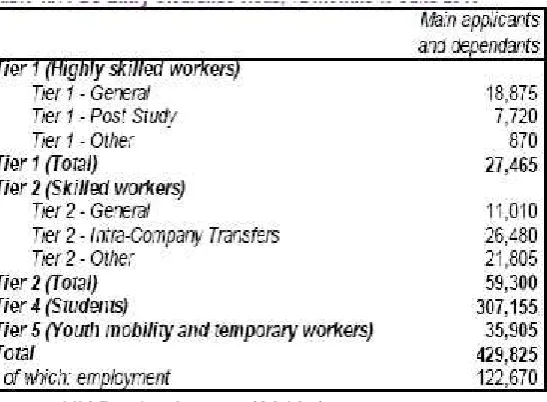
Currently, there is no annual limit on Tier 5 migrants but those in Tier 4 (Students) – as we have already noted – will have increasing restrictions placed on them from April 2012. This is an important point, given the recent figures available for non-EEA migration to the UK for the 12 months up to and including June 2010 (see Table 1). Indeed, the Table suggests that the bulk of non-EEA immigration arises from students. This is an important point which we will return to later.
Table 1: Number of non-EEA migrant arriving in the UK for the 12 months up to and including June 2010
Source: UK Border Agency (2010a)
Subsequently, the Government has taken advice from the Migration Advisory Committee (MAC) – through a consultation – on where the permanent annual cap should be set, taking into account both the potential economic impact on employers (and particularly those in ‘migrant dense’ sectors) as well as social impacts; for example, pressures on schools, hospitals, social housing and other public services (Home Office, 2010; Migration Advisory Committee, 2010).
This led to a decision in November 2010 that that the migrant cap from 1st April 2011
would be set at 21,700 skilled non-EEA migrants per annum. Within this figure, 1,000 non-EEA migrants are allowed into the UK under a revamped Tier 1 – ‘the exceptionally talented route’. However, this now only applies to entrepreneurs, investors and ‘exceptionally talented individuals’ (in the fields of science, engineering and the arts) (UKBA, 2010b). This is a considerable reduction on the figure of 27,465 for Tier 1 workers in 2009/10 – see Table 1 above).
Under the new visa rules for investors, those who invest £5 million will be allowed to settle in the UK after 3 years, and those investing £10 million+ will be allowed to settle after 2 years, as opposed to the minimum 5-year requirement that was in place.
In practice, the changes now mean that from April 2011, non-EEA migrants will be competing against other applicants for a visa to enter the UK and, in months when the limit is oversubscribed, only those with the most points will qualify for one of the certificates of sponsorship available each month (UKBA, 2010b). Notwithstanding this, only 1,028 of the 4,200 certificates of sponsorship available in April 2011 were taken up. It has been reported that this ‘is not indicative of a lack of demand…rather it is a sign of confusion over the government’s new system’ (Migrants’ Rights Network, 2011).
However, it must be noted that Intra-Company transfers are not part of the annual limit (an unlimited amount of transfers are allowed), although the regulations since April 2011 have changed in three main ways: first, the job has to be an occupation on the graduate occupation list; second, only those paid more than £40,000 per annum will be able to stay for more than a year (up to five years in total) and third, those paid between £24,000 and £40,000 will be allowed to come to the UK for no longer than 12 months, at which point they must leave and will not be able to re-apply for a further 12 months (again see UKBA website for more detail).
Furthermore, there is no restriction on the number of Tier 2 (General) certificates of sponsorship that can be assigned to non-EEA migrants earning over £150,000, or who are already in the UK and either have permission to extend their stay or who are eligible to switch into this category from another.
2.4 Concerns over the new system of ‘managed migration’
Despite the Government arguing that the permanent cap would be imposed in a ‘flexible’ way to aid the economic recovery, employers have raised concerns about the detrimental impact this will have on their competitiveness. Indeed, a recent MAC report (2010, p.10) highlights widespread concern amongst employers, who have argued that ‘the restrictions could affect businesses’ ability to be competitive, stunt economic recovery, and lead to reduced investment’. Scepticism has also been raised in relation to the ability to train indigenous British workers to fill vacancies that become available. Furthermore, the MAC report highlights gaps in the existing evidence base, particularly in relation to the social and public service impacts of migration (2010, p.17).
Consequently, although there appears to be a degree of acceptance of the need to reduce net migration to the UK (Sachrajda, 2010), it has been highlighted that the cap will have little overall impact. Indeed, the MAC report (2010, p.13) suggested that closing all non-EEA work-relatedmigration routes would not bring net migration down on its own (this would only contribute 20% of the Government’s target to reducing immigration from 196,000 in 2010 to ‘tens of thousands’ by 2015). Consequently, it is proposed that achieving the other 80 per cent will come from reducing student immigration (it is envisaged that there will be a 40 per cent reduction of the 325,000 who arrive in the UK each year) and through restricting family reunification and long-term rights to settlement. Nevertheless, the latter actions will clearly take time to filter through the system.
2.5 Summary of key elements of sponsoring migrants from
non-EEA countries under the Points Based System
The following diagram attempts to summarise key elements of the sponsoring process for non-EEA migrants that employers now need to be aware of in relation to the current operation of the PBS / migrant cap:
PBS Context
Tier 1 – Highly skilled / exceptionally talented non-EEA migrants – 1,000 allocations 2011/12.
Tier 2 – Skilled non-EEA migrant workers – General – 20,700 restricted certificates of sponsorship available 2011/12 (4,200 up to April 6; 1,500 month thereafter available).
Tier 2 – Skilled non-EEA migrant workers – Intra-Company Transfers – unlimited numbers allowed subject to a number of caveats (see text).
Tier 2 – Skilled non-EEA migrant workers – Other – unlimited subject to caveats – see text (e.g. those earning £150k+ per annum; those who are postgraduate doctors / dentists who have been in further speciality training; those already with ‘leave to remain’; those who are eligible to switch into this category from another).
Tier 3 – Low skilled workers to fill temporary labour shortages – currently suspended (to be met from settled workers / EEA migrant workers).
Tier 4 – Students – can work up to 20 hours per week dependant upon eligibility criteria (highly talented / proficient in English and need a skilled job to stay on – see text.
Tier 5 – Youth mobility and temporary workers – unlimited (up to 2 years in general – see text).
Code of Practice
Check ‘Code of Practice’ for the job to be offered under Tier 2 or Tier 5 (as applicable) through use of the Standard Occupational Classification (SOC) – i.e. link job to SOC code and then download SOC code for the relevant code of practice to ensure that the job meets the necessary conditions of the relevant code of practice (skills level and salary).
Employer vacancy
Is job on the Shortage Occupation List?
Resident Labour Market Test
Job needs to be advertised for at least 28 days to illustrate that cannot be
filled from settled workers / EEA migrants.
Employer registration as a Licensed Sponsor through Sponsorship Management System
Employer needs to register (if not done so already) as a licensed sponsor (but some exceptions available for those employing migrants for less than 6 months). Key criteria to meet eligibility include: i) operating formally in UK; ii) established history of having no threat to immigration; iii) can supply necessary supporting documentation; iv) compliant with sponsor duties (Human Resources system; authorising officer; ‘Level 1’ and ‘Level 2’ officers etc).
Employer applies for a Certificate of Sponsorship through the Sponsorship Management System
Employer is provided with a unique reference number that is issued to non-EEA migrants so that they can obtain entry clearance to the UK or secure ‘leave to remain in the UK’. Fees vary (April 2011) from £310-£410 for charities / small sponsors to £410-£1025 for larger sponsors.
Yes No
Employer assigns a Certificate of Sponsorship through the Sponsorship Management System
2.6 Further help and support
For further help and support on the PBS, the following details are of relevance:
UK Border agency website
http://www.ukba.homeoffice.gov.uk/employers/points/sponsoringmigrants/eligibility/
UK Border agency sponsorship and employers helpline
0300 123 4699
UK Border agency email support
3.
What has been the impact of the (UK’s) managed
migration system?
Chapter 2 has highlighted the policy backdrop in relation to the ‘managed migration’ system in the UK and the introduction – from February 2008 – of the Points Based System (PBS) for migration from outside of the European Economic Area (EEA). It has also provided a comprehensive overview of the different Tiers of the PBS and the changes to these Tiers as a result of the government’s cap on non-EEA migrants. While the main purpose of this guide is to provide an understanding of the Points Based System and recent changes, it is also useful to explore some of the reported and potential impacts of the system. This chapter therefore draws on a range of secondary sources, including research reports, briefing papers, and press releases to provide an overview of some of the concerns that have been raised in relation to the PBS and cap on migration.
The first section focuses on issues raised in relation to the implementation of the Points Based System more generally, while the second section explores more recent debates around the new migrant cap.
3.1 Concerns over the Points Based System (PBS)
Length of the process, increased administration and associated costs
Recent research has highlighted an increase in the length of time it takes to get someone ‘in post’ under the Points Based System (PBS). The Greater London Authority (GLA) (2011), for example, commissioned an online survey to find out how arts and culture organisations and higher education institutions felt about the PBS and to explore the impact of the PBS on their organisation. This survey – which was based on 122 responses – highlighted that while organisations had an expectation
that it should take 14 days to process the visa application, respondents reported that
in reality it was taking up to 6 weeks.
The survey carried out by the GLA highlighted that organisations had been affected by increased administration tasks and costs as a result of the PBS. Of the 122 organisations they surveyed, for example, 82% had experienced increased administration tasks and 77% had experienced increased administration costs. The increases in administration and costs were due to processing certificates of sponsorship, sponsor licences and delays with visa processing and checks (as highlighted above). Indeed, 63% of the organisations who were surveyed indicated that at some point they had had to cancel or change an event at the last minute due to artists not being granted visas in time incurred. In these situations a number of the organisations had incurred a financial cost.
interim. An example given by a number of NHS Trusts was the onerous cost of paying agency locums to cover the role during the application process.
Concerns over interpreting the rules correctly
As highlighted in Chapter 2, the system has created confusion for some employers (Migrants Rights’ Network, 2011). Research on the health and social care sector, referred to above, found that employers were experiencing uncertainty in terms of whether they were interpreting immigration legislation correctly. Indeed, it was suggested that since the introduction of the PBS, employers – and especially those in the private sector – had become much more cautious about recruiting non-EEA migrant workers, even where fundamental skills gaps existed. Moreover, it was suggested that there had been a number of examples where employers had ‘shedded’ non-EEA workers for no reason apart from uncertainty over their rules of employment. In this particular study, while most of the HR and Equality and Diversity representatives felt that they had a general understanding of the PBS, there appeared to be conflicting perspectives on how such legislation was being interpreted and implemented both across and within different sectors, which was leading to a great deal of uncertainly on recruitment decisions. Consequently, it was felt that clear and informative guidance, but also a greater level of communication from the UKBA was vital for employers.
Lack of flexibility for certain sectors
A key concern around the ‘managed migration’ system raised by employers in recent research relates to the perceived lack of consideration of the PBS to the needs of particular employment sectors. Looking at the findings of the GLA survey, referred to above, while a large proportion of respondents were positive about the PBS overall, it was felt that it could be improved to better meet the needs of the arts and culture sector. The example given in the report related to artists / academics falling into ‘borderline’ categories in the PBS, thus making them difficult to allocate under the Tier system. Consequently, it was felt that the current system was ‘impacting on London’s position as a world city for arts and culture’ (GLA, 2011, p.1).
Similarly, research carried out with health and social care representatives highlighted concerns that the Shortage Occupation List was outdated, and needed to be much sharper in identifying speciality areas where labour shortages exist (Pemberton and Scullion, 2010). Moreover it was felt that definitions of occupations on the list needed to be more reflective of the diversity and specificity of roles within the health and social care sector, and that there should be a further system of review for ‘one-off’ situations, with greater flexibilities being granted for certain professions over others. Indeed, it has been noted in a recent Home Affairs Committee Report (2010) on migration that the social care and education sectors are most likely (in the medium term) to be adversely affected.
Equality impacts
out in terms of progress / attendance of students or the attendance of staff. With regards to staff, for example, the HEI would have a duty to report to the UKBA if a member of staff with a Tier 2 visa fails to start work at that HEI, or is absent for a period of 10 working days without prior granted permission. The Equality Challenge Unit (2008) felt that this could lead to ‘clocking in and out’ procedures targeted at particular staff members. Concerns were also raised over the increased likelihood of educational institutions facing ‘unannounced’ visits from the UKBA (Gilhooley, 2009).
3.2 Concerns over the recent cap on non-EEA migrants
As highlighted in Chapter 2, in June 2010 the coalition government in the UK announced the introduction of a temporary cap on the number of workers from outside the European Economic Area (EEA) allowed entry into the UK, followed by a
permanent cap from April 2011. The introduction of the temporary and permanent cap on non-EEA migrant workers is perceived as simply adding to a ‘tightening up’ of the use of such labour that had already become apparent since the introduction of the PBS in 2008 (Pemberton and Scullion, 2010). As such, it exacerbates the concerns highlighted above in relation to the PBS.
While the restrictions on Tier 1 and Tier 2 are seen to have little impact on reducing overall migration figures the impact on employers reliant on these workers is causing concern. As highlighted in Chapter 2, despite the government arguing that the permanent cap would be imposed in a ‘flexible’ way to aid the economic recovery, employers have raised concerns about the detrimental impact the cap will have on their competitiveness. The Migration Advisory Committee report (2010, p. 10) highlighted widespread concern amongst employers, who argued that ‘the restrictions could affect businesses’ ability to be competitive, stunt economic recovery and lead to reduced investment’. Given how recently the changes have been implemented there is currently little research focusing on the impact of the cap; however, this section provides an overview of some the key issues raised in recent publications in this area, including the research carried out by the authors in relation to the health and social care sector.
Concerns over continuing skills shortages
King’s College London’s HRM Learning Board published its third annual report on
The concerns over skills shortages have been noted in particular by those sectors historically reliant on migrant labour. Taking the example of the health and social care sector, recent figures from the National Minimum Data Set for Social Care (NMDS-SC) show that more than a third of adult social care workers in England (35%) recruited in the 12 months to June 2010 were from outside the EEA (Lombard, 2010). Furthermore, Labour Force Survey (LFS) analysis suggests that almost one third of medical practitioners and approximately one fifth of nurses, dental practitioners and pharmacists currently working in the UK were born outside the EEA – a large proportion of which were from India (MAC, 2010).
While efforts are being made to increase the domestic supply of skilled labour in the medical profession, there are concerns about the length of time it takes to train people to the required skills levels. Indeed, a Skills for Health representative who took part in the MAC consultation on the migrant cap stated that:
‘It is possible for the health sector to reduce its overall dependence on Tier 1 and Tier 2 migrants. However, to train and develop a health care professional can take years – and for those in consultant roles, sometimes decades’ (MAC, 2010: 172).
Recent research carried out by Pemberton and Scullion (2010) in the health and social care sector highlighted ongoing skills shortages in the NHS, particularly in relation to medical specialisms such as Ear, Nose and Throat (ENT) consultants, cardiac nurses and middle grade doctors to work in Accident and Emergency (A&E) departments. The respondents in this study stated that non-EEA workers were vital to filling these skills gaps.
From a social care perspective, the sector is reliant on non-EEA labour to fill senior care worker shortages. Pemberton and Scullion (2010) highlighted shortages of skilled nurses / care workers, with the situation being compounded by the fact that the latter had now been omitted from the Shortage Occupation List due to it being primarily a non-graduate role. Furthermore, evidence from Skills for Care & Development in the MAC consultation suggested that a number of employers would not be able to continue to provide care services safely and legally without the continued recruitment of migrant workers.
The Association of Directors of Children’s Services urged ministers to rethink the migration cap, with concerns that they will be unable to recruit experienced practitioners (such as social workers) – particularly in London and other metropolitan areas. This highlights the need to take ‘regional variance’ into account when considering the need for migrant workers and the roles they are required for (see section below for more discussion on concerns over geographical variation).
Concerns over geographical variation
In addition to key concerns around ongoing skills shortages, recent research has also highlighted geographical variations in relation to the impact of the migrant cap. Pemberton and Scullion (2010) found that some of the more remote NHS Trusts, for example, felt that they were less likely to be able to entice skilled workers. This was seen to be an inevitable outcome of the further immigration restrictions being imposed as health and social care employers competed with each other to fill vacancies, with claims that intra and inter-regional disparities in the recruitment and retention of such individuals were becoming evident between more remote (rural) areas and more accessible (urban) areas. A number of NHS representatives argued that the PBS needed amending to respond to geographical variations in labour market conditions and the supply and demand of both (skilled) domestic and migrant labour. On the flip-side of the ‘urban-rural’ debate, due to the size and volume of caseloads that social workers frequently face in urban areas, a number of metropolitan local authorities had strongly argued for a relaxation in the number of permits / certificates of sponsorship they can secure in order to ensure that they have enough skilled social workers / care workers to meet existing demands (Lombard, 2010).
The geographical variation, however, can also been noted in relation to widening North-South divide. For example, after intense lobbying from many companies within the City of London, as well as umbrella-organisations such as the Confederation of British Industry (CBI), as decision was made to exclude non-EEA employees transferred by UK-based companies from abroad from Tier 2 of the PBS (MAC, 2010). Such individuals can now stay for up to 5 years in the UK if their salary exceeds £40,000 per annum. Furthermore, firms are also allowed to bring members of staff to work in the UK for up to a year if their job is in Information and Communications Technology (ICT) and their salary exceeds £24,000 per annum (MAC, 2010). Interestingly, an earlier commentary on managed migration by Amicus (2006) questioned the increasing number of intra-company transfers for ICT professionals, stating that ‘it is not obvious why many of these skills are not available in the UK from the resident labour force’, particularly when there were ‘around 10,000 redundancies per quarter amongst [UK] IT professionals’.
To summarise, it appeared that concessions on the implementation of the PBS were privileging certain territories and actors (businesses) operating in particular sectors over others, with London and the South East of England most likely to benefit from the above changes compared to other parts of the UK.
Concerns over the system acting as a deterrent
In a similar vein, UK universities have also expressed their concerns about the impact of the cap on their ability to compete for international staff. Currently around 10% of their academic workforce is comprised of non-EEA nationals, particularly in science, technology, engineering and mathematics subject areas, with the top five nationalities being American, Chinese, Indian, Australian and Canadian (Home Affairs Committee Report, 2010). It was therefore felt that consideration was needed in relation to the attractiveness of the UK compared to other countries – particularly as it becomes more difficult to enter the UK.
These concerns, however, were not just raised in relation to employment but also in relation to student migration. Cunnane (2011), for example, writing before implementation of the student cap highlights that the chief executive of the Australian international student recruitment agency – IDP Education – had reported that students had already been discouraged from applying to the UK and were looking at alternatives as UK was perceived to be ‘toughening up’. Given how recently the changes to the student immigration system have been implemented there are very few publications on the impact. However, the All-Party Parliamentary Group on Migration (2011) have called for ‘full and frank’ economic assessment of international student reforms, while the Higher Education Better Regulation Group (HEBRG) are undertaking a project to explore the impact on UK higher education institutions of complying with the PBS and Tier 4 (General Students) in particular. This project seeks to identify any areas where HEIs’ workload is perceived to have increased as a result of the changes.
Changes in recruitment patterns
4.
Conclusions: Moving forward and potential future
impacts
From this brief analysis it is apparent that the current system for managing migration to the UK is by no means straightforward – both in respect of understanding issues concerning eligibility to work and in terms of the actual impact of current immigration policy in geographical terms and in relation to specific sectors. Indeed, some have already commented that the revised guidance issued as part of the imposition of the recent cap on non-EEA workers is privileging wealthy investors and entrepreneurs from overseas whilst tightening entry / ‘leave to remain’ requirements for others (Home Affairs Committee, 2010).
It is therefore likely that the migrant cap will come under increased scrutiny over the next 12 months and against a number of different criteria, including the extent to which the needs of UK businesses are being met; the extent to which settled workers’ skills can be enhanced in the short-term to meet any gaps that are currently evident; and the impact on the UK’s global trade and investment as a consequence of the imposition of additional barriers to entry.
Equally, given that intra-company transfers accounted for 60% of all Tier 2 visas in 2009 and 40% of all Tier 1 and Tier 2 combined (Home Affairs Committee, 2010), the fact that many such transfers are exempt under the current arrangements means that the cap (as it stands) is likely to have only a minimal impact on reducing net immigration (by one or two per cent on average; MAC, 2010).
There is also a need to consider how the removal (on 1 May 2011) of the transitional arrangements for nationals of the A8 countries which joined the EU in 2004 will affect their access to labour markets and state support systems, and how this will impinge on the UK. In essence, such individuals are now no longer required to register under the Worker Registration Scheme (WRS) if they want to work in the UK, and in general terms, if they lose their job, they are likely to be entitled to housing and welfare benefits. A key question, therefore, is whether this will lead to an increase in A8 migrants seeking to access the UK’s welfare system and whether those already in the UK become more welfare dependent. If this does occur, it may become more difficult for employers to recruit workers for lower-skilled positions and lead to demands to open up Tier 3 of the PBS which is currently suspended.
In addition, given that Germany and Austria have now opened up their labour markets consideration is needed as to whether or not this will lead to the UK becoming an increasingly less attractive place to migrate for A8 nationals. Again, this may necessitate a re-assessment of the PBS and the migrant cap currently in place as there could be a risk of a general decline in both the quantity and quality of applicants from both non-EEA and EEA countries seeking to work in the UK. In this respect, there is already a degree of scepticism that EEA migrants offer a suitable alternative to non-EEA migrants due to their differing skills sets and experiences, their linguistic capabilities and their propensity to seek work in particular sectors (see Bach 2010; Crisp, 2007; Pemberton and Scullion, 2010).
government perspective, there is a need to prepare for a potential increase in undocumented working or unofficial employment. Whilst this is widely acknowledged to be taking place throughout the EEA (Markova and McKay, 2008), the PBS and imposition of the migrant cap in the UK may considerably exacerbate such issues and increase vulnerable or exploitative labour situations (for example trafficking and forced labour; see Kalayaan, 2008).
The tightening of Tier 4 legislation on numbers of non-EU students allowed to study in the UK will also have financial impacts, and these again will be geographically uneven. For example, Kyte and Muchenje (2011) have calculated that in London, fees for Higher Education Institutions (HEIs) may have to rise between £300 and £900 per annum. They suggest the impact would be greater in London than elsewhere given high proportions of non-EU students attending some London universities.
Furthermore, a briefing paper published by the Institute for Public Policy Research (IPPR) (see Mulley and Sachrajda, 2011) suggests that drastic reductions in student immigration to the UK will only deliver small reductions in net migration, given that very few stay long-term or permanently. Conversely, they suggest that there is a risk that the proposed changes will impose substantial costs on the education sector and wider economy (for example, they note that international student expenditure on and off-campus accounts for about £5 billion, and if further education (FE) and private sector colleges are included, this figure rises to £8-10 billion).
References
All-Party Parliamentary Group on Migration (2011) ‘Economic assessment of foreign student reforms is urgently needed’, All-Party Parliamentary Group on
Migration Press Release, online at:
http://www.appgmigration.org.uk/sites/default/files/APPG_press_release_stud ents-17_March_2011.pdf [accessed 17 May 2011].
Amicus (2006) The Impact of the Work Permit Scheme on IT professionals in the UK, online at: http://www.unitetheunion.org/PDF/Work%20Permits%20Amicus.pdf [accessed 17 May 2011].
Anderson, B. and Ruhs, M. (2009)Who needs migrant workers? Introduction to the analysis of staff shortages, immigration and public policy, Centre on Migration, Policy and Society (COMPAS), Oxford: University of Oxford; online at:
http://www.compas.ox.ac.uk/research/labourmarket/a-need-for-migrant-labour/#c228 [accessed 16 May 2011].
Bach, S. (2010) ‘Managed migration? Nurse recruitment and the consequences of state policy’,Industrial Relations Journal, 41, 3: 249-66.
Chappell, L. and Mulley, S (2010) Development: Do points Mean prizes? How the UK’s migration policies could benefit the world’s poor, London: Global Development Network and Institute of Public Policy Research.
Clinton, M. and Woollard, S. (2011) Austerity or prosperity? The state of HR in this challenging economic environment: The State of Human Resources Survey 2011, London: King’s College London, online at:
http://www.thestateofhr.com/downloads/The-State-of-HR-Survey-Report-2011.pdf [accessed 17 May 2011].
Crisp, N. (2007) Global Health Partnerships: The UK contribution to Health in Developing Countries, London, Department of Health.
Cunnane, S. (2011) ‘UK doesn’t want us, let’s go elsewhere’, Times Higher Education, 3 March 2011.
Eborall, C. and Griffiths, D. (2008) The State of the Social Care Workforce, Leeds: Skills for Care.
Equality Challenge Unit (2008) Points-based immigration system for international students and staff: equality implications, online at:
http://www.ecu.ac.uk/publications/files/points-based-immigration.pdf/view [accessed 17 May 2011].
Gilhooley, D. (2009) ‘Unannounced UK Border Agency inspections’, Times Higher Education, 21 September 2009, online at:
Greater London Authority (GLA) (2011) Points-based visa system and the culture sector, London: Greater London Authority, online at:
http://www.london.gov.uk/sites/default/files/arts-visa-survey-results.pdf [accessed 17 May 2011].
Higher Education Better Regulation Group (HEBRG) (2011) Analysis of the impact on UK higher education institutions of complying with the UKBA Points Based System (PBS) for Immigration (Tier 4) , online at:
http://www.hebetterregulation.ac.uk/OurWork/Documents/HEBRG%20PBS%2 0(Tier4)%20review.pdf [accessed 19 May 2011].
Home Affairs Committee Report (2010) Immigration Cap - Home Affairs Committee Report; online at:
http://www.publications.parliament.uk/pa/cm201011/cmselect/cmhaff/361/361 07.htm [accessed 17 May 2011].
Home Office (2006) A Points Based System – Making Migration Work for Britain, London: Home Office.
Kyte, S. and Muchenje, Y. (2011) The potential impact of a Tier 4 immigration cap on UK and EU-domiciled students’ fees, GLA Economics Current Issues Note 28, London: Greater London Authority, online at:
http://www.london.gov.uk/sites/default/files/Current%20Issues%20Note%2028 .pdf [accessed 17 May 2011].
Kalayaan (2008) The New Bonded Labour?: The impact of proposed changes to the UK immigration system on migrant domestic workers, online at:
http://www.kalayaan.org.uk/documents/Kalayaan%20Oxfam%20report.pdf [accessed 17 May 2011].
Lombard, D. (2010) ‘Councils warn Home Secretary over migrant cap impact on care’, communitycare.co.uk, online at:
http://www.communitycare.co.uk/Articles/2010/09/02/115228/councils-warn-home-secretary-over-migrant-cap-impact.htm [accessed 2 September 2010].
Markova, E. and McKay, S. (2008) Commission on Vulnerable Employment: Agency and Migrant Workers – Literature Review, London: Working Lives Research Institute, London Metropolitan University.
Migration Advisory Committee (2010) Limits on Migration: Limits on Tier 1 and Tier 2 for 2011/12 and supporting policies, Croydon: Migration Advisory Committee. Migrants’ Rights Network (2011) ‘Signs of confusion among businesses over
immigration cap’, online at http://www.migrantsrights.org.uk/news/2011/ [accessed 14 May 2011].
McNeill, R. (2011) Imposing caps, filling gaps or charging tax? How should we control labour immigration; online at:
http://www.migrationobservatory.ox.ac.uk/commentary/imposing-caps-filling-gaps-or-charging-tax-how-should-we-control-labour-immigration [accessed 14 May 2011].
Pemberton, S. and Scullion, L. (2010) The implications in North West England of the migrant cap on non-EU workers: A case study of the health and social care sector, Salford: Migrant Workers North West.
Poolia (2011) ‘Is business preempting migrant cap by switching from temp to perm?’, Poolia press release, online at:
http://www.poolia.co.uk/files/IS_BUSINESS_PRE-EMPTING_MIGRANT_CAP_BY_SWITCHING_FROM_TEMP_TO_PERM_.pd f [accessed 17 May 2011].
Sachrajda, A. (2010) ‘Coalition should abandon immigration cap or redefine target’, IPPR Articles, 3 November 2010, online at:
http://www.ippr.org/articles/?id=4196 [accessed 8 November 2010]. UK Border Agency (UKBA) (2010a) Limits on Non-EU Economic Migration: A
Consultation, online at:
http://www.ukba.homeoffice.gov.uk/sitecontent/documents/aboutus/consultatio ns/limits-on-non-eu-migration/limits-on-non-eu-migration.pdf?view=Binary [accessed 3 August 2010]