A data-based power transformation for
compositional data
T. Tsagris, Michail and Preston, Simon and T.A. Wood,
Andrew
Division of Statistics, School of Mathematical Sciences, University of
Nottingham„ Division of Statistics, School of Mathematical
Sciences, University of Nottingham„ Division of Statistics, School of
Mathematical Sciences, University of Nottingham,
May 2011
Online at
https://mpra.ub.uni-muenchen.de/53068/
A data-based power transformation for compositional data
Michail T. Tsagris, Simon Preston and Andrew T.A. Wood
Division of Statistics, School of Mathematical Sciences, University of Nottingham, UK;[email protected]
1
Introduction
A compositional data vector is a special type of multivariate observation in which the elements of the vector are non-negative and sum to a constant, usually taken to be unity. Data of this type arise in many fields including geology, archaeology, biology and economics. In mathematical terms, the relevant sample space is the standard simplex, defined by
Sd=
(
(x1, ..., xD)
xi≥0,
D
X
i=1
xi= 1
)
where d=D−1. (1)
The following two approaches have been widely used for compositional data analysis. The first is to neglect the compositional constraint and apply standard multivariate data analysis techniques to the raw data, an approach we will call raw data analysis (RDA). For discussion and examples of RDA see for example Baxter (1995, 2001); Baxter et al. (2005); Baxter and Freestone (2006). RDA is also adopted by (Srivastava et al., 2007) in biological settings. The second approach, introduced by Aitchison (1982, 1983, 1986), is based upon transforming the data using log-ratios, an approach we will call log-ratio analysis (LRA). The motivation behind LRA is that compositional data carry only relative information about the components and hence working with logs of ratios is appropriate for analysing this information. A popular log-ratio transformation, suggested by Aitchison (1983, 1986), is the centred log-ratio transformation defined by
y={yi}i=1,...,D=
log xi
g(x)
i=1,...,D
(2)
where g(x) = QD
j=1xj
1/D
is the geometric mean of the D components of the composition. This transformation maps the standard simplex (1) onto ad-dimensional subspace ofRD, given by
Qd=
(
(x1, ..., xD)
D
X
i=1
xi = 0
)
The so called isometric log-ratio transformation (Egozcue et al., 2003) is then given byz=Hy, where
His ad×Dorthonormal matrix whose rows are orthogonal to1D, theD-vector of ones. A standard
choice of H is the Helmert sub-matrix obtained by removing the first row from the Helmert matrix (Lancaster, 1965).
Over the years there has been a debate over whether it is preferable to use RDA or LRA (Barcel´o et al., 1996; Aitchison, 1999; Aitchison et al., 2000; Beardah et al., 2003; Sharp, 2006). In this paper we take the view that the choice between RDA, LRA and other possibilities should depend at least in part on the data, and should not be purely a matter of a priori considerations. For this purpose we consider a framework in which RDA and LRA relate to two special cases of a one-parameter family of transformations of the simplex (1). The idea is that we should explore this family of transformations when deciding which approach to use for a given compositional dataset because, for different datasets, different transformations may be preferable. For a more extensive discussion of this framework we refer to Tsagris et al. (2011).
2
An informal comparison of RDA and LRA
2.1 Simplicial distance
Aitchison (1992) argues that a simplicial metric should satisfy certain properties. These properties include
1. Scale invariance. The requirement here is that the measure used to define the distance between two compositional data vectors should be scale invariant, in the sense that it makes no difference whether, for example, the compositions are represented by proportions or percentages.
2. Subcompositional dominance. To explain this we consider two compositional data vectors, and select subvectors from each consisting of the same components. Then subcompositional domi-nance means that the distance between the subvectors is always less than or equal to the distance between the original compositional vectors.
3. Perturbation invariance. The perturbation of one compositional data vector by another is defined by (6) below. The requirement here is that the distance between compositional vectors x and
wshould be the same as distance betweenx⊕0pand w⊕0p, where the operator⊕0 is defined
in (6) andp is any vector with positive components.
RDA amounts to using the Euclidean distance as a metric in the simplex. In RDA the distance between two vectors xand w∈Sdis
∆RDA(x,w) =
" D X
i=1
(xi−wi)2
#1/2
. (3)
In LRA the relevant metric is the Euclidean distance applied to the log-ratio transformed data (Aitchison, 1983, 1986). In mathematical terms the expression is:
∆LRA(x,w) =
" D X
i=1
log xi
g(x) −log
wi
g(w)
2#1/2
. (4)
Aitchison (1986) has shown that ∆LRA satisfies the three properties above. It is straightforward
to see that, in contrast to ∆LRA, ∆RDA does not satisfy any of these properties (although ∆RDA is
equivariant with respect to a scale change, in an obvious sense). On this basis, Aitchison argued that the metric ∆LRA is preferable to ∆RDA. However, although at first glance properties 1-3 seem to be
reasonable requirements, there will sometimes be a price to be paid for using ∆LRA. In particular,
this choice and similarly the choice of ∆RDA, ties us to a specific geometry on the simplex which may
or may not be appropriate for a given dataset. Our thinking here is that, ideally, one should work with a geometry on the simplex in which the structure of the data is ”as nice as possible”. In the data examples considered in section 3, niceness means linear structure and a measure of central tendency which lies in the main body of the sample, though of course different definitions of niceness could be adopted. The main point, however, is that one does not know in advance what the most appropriate geometry on the simplex is, because it will depend on the data.
2.2 Measures of central tendency and simplicial addition
The two approaches lead to different definitions of measures of central tendency. The means specified in (5) and (7) below are Fr´echet means with respect to ∆RDA and ∆LRA, respectively. The Fr´echet
mean on a metric space (M,dist), with the distance between p, q∈ M given by dist (p, q), is defined by argminhEX
h
dist (X, h)2iand argminhPn
i=1dist (xi, h)2 in the population and finite sample cases,
x⊕1w=C
n
{xi+wi}i=1,...,D
o
where C is the closure operation C(x) =x/(x1+. . .+xD). The mean in this case is defined as the
simple arithmetic mean of the components:
µ(1) =
1 n n X j=1 xij
i=1,...,D
. (5)
In the geometry defined by LRA, the analogue of addition of two compositional vectors x and
w, known as perturbation of x and w which we denote by x⊕0w, is given by the component-wise
product followed by the closure operation:
x⊕0w=C
n
{xiwi}i=1,...,D
o
. (6)
In the LRA case, the Fr´echet mean is given by the vector consisting of the sample geometric mean of each component followed by the closure operation (Aitchison, 1989):
µ(0)=C
n Y j=1
x1ij/n
i=1,...,D
. (7)
2.3 Further discussion
LRA works very well when the data follow the logistic normal distribution; see for instance Hongite, Kongite and Boxite data analysed by Aitchison (1986). However it is not necessarily clear whether for data with different distributions that the LRA is still the best approach. Baxter and Freestone (2006) performed principal component analysis on both simulated and real data. The conclusion they reached was, in the examples considered, the RDA produced more archaeologically interpretable results than LRA. In a previous paper Beardah et al. (2003) mention that the use of PCA on standardized data may be regarded as incorrect by proponents of LRA but did recover interpretable structure whereas the use of the log-ratio transformation failed to detect it. The standardization of the data after the centred log-ratio transformation worked well but the produced results are similar to the standardized data analysis for the most part.
RDA has another potential advantage: in contrast to the LRA mean in (7), the RDA mean (5) is well-defined even when the data have some components equal to zero.
A general transformation applied to compositional data is the Box-Cox transformation applied to ratios of components
v={vi}i=1,...,D =
xi xD λ −1 λ
i=1,...,D
. (8)
The xD stands for the last component but with relabelling any component can play the role of the
common divisor. As λ → 0, the above expression tends to the ”additive log-ratio transformation” which was defined by Aitchison (1986) as an alternative transformation to the centred log-ratio trans-formation in (2)
v={vi}i=1,...,D =
log xi
xD
i=1,...,D
. (9)
In Barcel´o et al. (1996) the Box-Cox transformation defined in (8) is examined and the conclusion was that some samples cannot be adequately modelled using the additive log-ratio transformation defined in (9), in the sense that the value of λshould not be restricted to zero.
3
Some examples
We now present some examples with real and artificial data. In the first example the use of LRA is to be preferred whereas RDA seems to work better in the second example.
3.1 Example 1: Hongite data
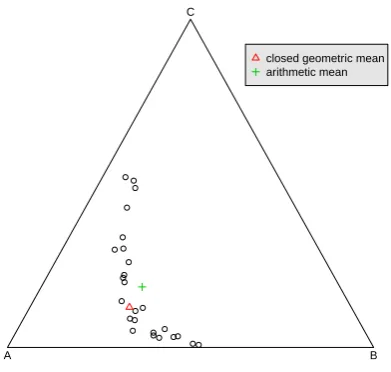
We created a subcomposition taking the first 3 components of Hongite data Aitchison (1986) and plotted it in Figure 1. The closed geometric mean in (7) clearly lies within the body of the data, whereas the arithmetic mean in (5) has failed in this example as it lies outside the body. The assumption of logistic normality based upon the battery of tests suggested by Aitchison (1986) is not rejected for this composition.
C
A B
[image:5.595.209.405.249.435.2]closed geometric mean arithmetic mean
3.2 Example 2: Artificial data
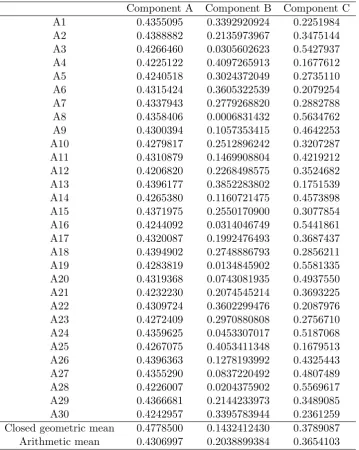
Here, we created a dataset in which is concentrated on a straight line when plotted in a ternary diagram; see Figure 2. In this case, the data do not follow the logistic normal distribution based upon the battery of tests suggested by Aitchison (1986). The arithmetic mean (5) is a good measure of central tendency, whereas the closed geometric mean (7) has failed because it lies off the line around which the data are concentrated.
C
A B
[image:6.595.209.405.179.363.2]closed geometric mean arithmetic mean
Figure 2: Ternary diagram of artificial data showing an example where the geometric mean appears to be an unsuitable measure of central tendency.
Our conclusions from the examples considered above are that in the first case, the approach based on LRA and the closed geometric mean seems more appropriate, while in the second case RDA and the arithmetic mean seems better. In general, the question of interest is to decide whether to use LRA, RDA or perhaps another possibility. We believe that this decision should depend on the nature of the data at hand.
4
A family of power transformations on the simplex
We now consider a Box-Cox type transformation in terms of which the RDA and LRA can be consid-ered as special cases. Consider the power transformation introduced by Aitchison (1986)
u={ui}i=1,...,D =
(
xαi
PD
j=1xαj
)
i=1,...,D
, (10)
and in terms of this define:
z= 1
α(Du−1)H
T, (11)
where we take Hto be the d×D Helmert sub-matrix mentioned in the Introduction. Note that the
α-transformed vectoru in (10) remains in the simplexSd, whereasz is mapped onto a subset ofRd. Note that (11) is simply a linear transformation of (10). Moreover as α → 0, (11) converges to the isometric log-ratio transformation. For a givenα we can define a simplicial distance:
∆α(x,w) =
D α
D
X xαi PD
xα −
wα i
PD
wα
!2
1/2
Associated with this one-parameter family of distances is the family of Fr´echet means
µ(α)=C
1
n
n
X
j=1
xαij
PD
k=1xαkj
1/α
i=1,...,D
. (13)
This agrees with (5) when α = 1 and it agrees with (7) when α = 0. Specifically, as α → 0, the
α-distance (12) and Fr´echet mean (13) converge to Aitchison’s distance (4) and the closed geometric mean (7), respectively. When α = 1, the Fr´echet mean is equal to the arithmetic mean of the components (5) and theα-distance is equal to the Euclidean distance in the simplex (3) multiplied by
D.
The choice of the parameter α should depend on the type of analysis, we wish to perform. In dis-criminant analysis, for instance, the percentage of correct classification (estimated via cross-validation) could be used as a criterion to maximize with respect to the value ofα. Similarly in linear regression the pseudo-R2 (Aitchison, 1986) could serve as a criterion.
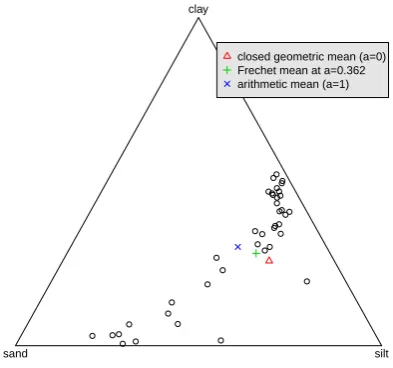
Alternatively, if we are prepared to assume that the data follow a parametric model after an (unknown) α-transformation, we could use the profile log-likelihood to choose α. As in the Box-Cox transformation, the value of the parameter is selected by maximizing the profile log-likelihood of the transformed data. One possibility, which we adopted with the Arctic lake data (Aitchison, 1986) in Figure 3, was to treat the data as being from a (singular) multivariate normal after a suitable α-transformation. This approach has the obvious drawback that it ignores the fact that any multivariate normal will assign positive probability outside the simplex, which may or not be of practical importance, depending on how concentrated the normal distribution is. The profile log-likelihood of α applied to (11) is the same as the log-likelihood applied to (10) plus a constant equal to n2 logD, wherenand D denote the sample size and the number of components of the composition respectively. Figure 3 shows the ternary diagram of the Arctic lake data (Aitchison, 1986). The profile log-likelihood of α for this data was maximized when α = 0.362. Thus the three Fr´echet means for
α= 0,0.362 and 1 were calculated and plotted as well.
clay
sand silt
[image:7.595.205.402.486.670.2]closed geometric mean (a=0) Frechet mean at a=0.362 arithmetic mean (a=1)
5
Conclusions
Two standard approaches to compositional data analysis, referred to in the paper as RDA and LRA, were discussed and compared. On the basis of simple numerical examples and further considerations we concluded that which approach, if either, is to be preferred should depend on the data under study. We then considered a framework involving a one-parameter family of Box-Cox type power transformations which includes the RDA and LRA approaches as special cases. Depending on the purposes of the analysis, we may then choose an optimal value ofαby optimizing a suitable criterion, and/or explore the practical implications of different choices of α. This framework offers greater flexibility than simply adopting one method or another.
[image:8.595.120.480.266.717.2]Appendix
Table 1: Artificial data used in example 2
References
Aitchison, J. (1982). The statistical analysis of compositional data. Journal of the Royal Statistical Society. Series B 44(2), 139–177.
Aitchison, J. (1983). Principal component analysis of compositional data. Biometrika 70(1), 57–65.
Aitchison, J. (1986). The Statistical Analysis of Compositional Data. Monographs on Statistics and Applied Probability. Chapman & Hall Ltd., London (UK). (Reprinted in 2003 with additional material by The Blackburn Press). 416 p.
Aitchison J. (1989). Measures of location of compositional data sets. Mathematical Geology 21(7), 787–790.
Aitchison J. (1999). Logratios and Natural Laws in Compositional Data Analysis. Mathematical Geology 31(5), 563–580.
Aitchison J. (1992). On criteria for measure of compositional difference. Mathematical Geology 24(4), 365–379.
Aitchison, J., Barcel´o-Vidal, C., Mart´ın-Fern´andez, J.A. and Pawlowsky-Glahn, V. (2000). Logratio Analysis and Compositional Distance. Mathematical Geology 32(3), 271–275.
Barcel´o-Vidal, C., Pawlowsky, V. and Grunsky, E. (1996). Some aspects of transformations of com-positional data and the identification of outliers. Mathematical geology 28(4), 501–518.
Baxter, M.J. (1995). Standardization and transformation in principal component analysis, with ap-plications to archaeometry. Applied Statistics 44(4), 513–527.
Baxter, M.J. (2001). Statistical modelling of artefact compositional data. Archaeometry 43(1), 131–147.
Baxter, M.J., Beardah, C.C., Cool, H.E.M. and Jackson C.M. (2005). Compositional data analysis of some alkaline glasses. Mathematical Geology 37(2), 183–196.
Baxter, M.J. and Freestone, I.C. (2006). Log-ratio compositional data analysis in archaeometry.
Archaeometry 48(3), 511–531.
Beardah, C.C., Baxter, M.J., Cool, H.E.M. and Jackson, C.M. (2003). Compositional data analysis of archaeological glass: problems and possible solutions. Proceedings of the Compositional Data Analysis Workshop, CODAWORK 2003 .
Egozcue, J.J., Pawlowsky-Glahn, V., Mateu-Figueras, G. and Barcel´o-Vidal, C. (2003). Isometric logratio transformations for compositional data analysis. Mathematical Geology 35(3), 279–300.
Lancaster H.O. (1965). The Helmert matrices. American Mathematical Monthly 72(1), 4–12.
Sharp W.E. (2006). The graph median–A stable alternative measure of central tendency for compo-sitional data sets. Mathematical Geology 38(2), 221–229.
Srivastava, D.K., Boyett, J.M., Jackson, C.W., Tong, X. and Rai, S.N (2007). A comparison of permutation Hotelling’sT2test and log-ratio test for analyzing compositional data.Communications in Statistics-Theory and Methods 36(2), 415–431.