Burn-Up Measurements on Dissolver Solution of Mixed
Oxide Fuel Using HPLC-Mass Spectrometric Method
S. Bera, R. Balasubramanian, Arpita Datta, R. Sajimol, S. Nalini, T. S. Lakshmi Narasimhan, M. P. Antony, N. Sivaraman*, K. Nagarajan, P. R. Vasudeva Rao
Chemistry Group, Indira Gandhi Centre for Atomic Research, Kalpakkam, India Email: *[email protected]
Received July 20, 2013; revised August 23, 2013; accepted September 23, 2013
Copyright © 2013 S. Bera et al. This is an open access article distributed under the Creative Commons Attribution License, which permits unrestricted use, distribution, and reproduction in any medium, provided the original work is properly cited.
ABSTRACT
Burn-up measurement on an irradiated mixed oxide (MOX) test fuel pellet was carried out through measurements on the dissolver solution by HPLC-Thermal Ionization Mass Spectrometric (TIMS) technique. The studies carried out us- ing HPLC as well as TIMS for quantification of burn-up value are described. While in one case, both the separation and determination of elements of interest (U, Pu and Nd) were carried out by HPLC; in another case, TIMS technique was used to quantify them from the HPLC separated fractions.The rapid separation procedures developed in our laboratory earlier were employed to isolate pure fractions of the desired elements. The individual lanthanide fission products (La to Eu) were separated from each other using dynamic ion-exchange chromatographic technique whereas uranium and plu- tonium were separated from each other using reversed phase chromatographic technique. The pure fractions of U, Pu and Nd obtained after HPLC separation procedure for “spiked” and “unspiked” dissolver solutions were used in TIMS measurements for the first time in our laboratory. In TIMS analysis, isotopic abundances of uranium, plutonium and neodymium fractions obtained from HPLC separation procedure on an “unspiked” fuel sample were measured. For the determination of U, Pu and Nd by isotopic dilution mass spectrometric technique (IDMS), known quantities of tracers enriched in 238U, 240Pu and 142Nd were added to the pre-weighed dissolver solution and subjected to HPLC separation
procedures. The isotope ratios viz. 142 Nd/(145Nd +146Nd), 238U/233U and 240Pu/239Pu in the pertinent “spiked” fractions
were subsequently measured by TIMS. The spikes were pre-standardized in our laboratory employing reverse isotopic dilution technique against the standard solutions available in our laboratory (for 238U, 239Pu and 142Nd, standard solu-
tions of 233U, 239Pu (of higher abundance than in the sample) and 150Nd were employed as spikes). The burn-up values
from duplicate spiking experiments were computed based on the summation of 145Nd + 146Nd. The concentrations of
neodymium, uranium and plutonium were also measured using HPLC with post-column derivatisation technique using aresenazo(III) as the post-column reagent. The atom % burn-up computed from HPLC and TIMS techniques were in good agreement.
Keywords: MOX; Dissolver Solution; HPLC; TIMS; Uranium; Plutonium; Neodymium
1. Introduction
The burn-up of a fuel is a measure of the number of fis- sions undergone by the fuel [1]. The atom percent burn- up expression is essentially ratio of the number of fis- sions that have occurred to the total heavy atoms initially present. Determination of burn-up is thus an important parameter for the study of fuel performance, an indica- tion of energy production from unit mass of fuel. The measurement of burn-up on dissolver solution of fuel subjected to high burn-up is challenging due to the high levels of radioactivity associated with the fuel. Various
methods have been developed to measure the burn-up of spent nuclear fuels [1-8]. Among these, isotope dilution mass spectrometric technique (IDMS) is recognized as an established technique [2]. The HPLC based techniques have also been developed in our laboratory for rapid and accurate determination of burn-up of nuclear reactor fu- els [5,7].
The mass spectrometric method uses the isotopic dilu- tion technique to measure the concentrations of the burn- up monitor and the residual heavy elements present in the spent fuel to deduce the burn-up. The criteria for choos- ing a particular fission product monitor stems from the desired nuclear properties such as fission yield, neutron
absorption cross section, decay constant and its migration into the fuel matrix to give reliable burn-up value [1]. By far the most widely used burn-up monitor for mass spec- trometric measurements is 148Nd based on the above con-
siderations [1,2,6].
The burn-up (BU) is obtained from the relation: BU (in at% fissions) = 100 (N(MNd)/y(MNd))/[N(U) +
N(Pu) + (N(MNd)/y(MNd))].
where “N” represents the concentration (number of at- oms/g of the dissolver solution) of the nuclide or element given in the parentheses; and “y” represents the frac- tional fast-fission yield for MNd. In this study, “M” refers
to mass numbers of Nd: 148, 145, and 146 wherever ap- plicable and the rationale behind considering these iso- topes for computing the burn-up is discussed later.
In the present study, results on the determination of burn-up on dissolver solution of nuclear reactor fuel, namely uranium-plutonium mixed oxide (MOX) spent fuel by mass spectrometric method are discussed. The HPLC based techniques using dynamic ion-exchange (individual lanthanide separation) and reversed phase chromatography (uranium and plutonium) were employ- ed for the determination of lanthanides and actinides [3- 5,7].
The pure fractions of neodymium, uranium and pluto- nium required for mass spectrometric studies are conven- tionally obtained using time consuming traditional ion- exchange chromatographic procedure using gravity flow. However, in the present study, these metal ion fractions were rapidly isolated employing HPLC technique, i.e. the
dissolver solution was directly injected into the HPLC system after appropriate dilutions for the isolation of desired fractions of fission products and actinides. The neodymium fraction required for TIMS measurements was obtained by its isolation from other lanthanide fis- sion products using dynamic ion exchange chromatogra- phic method, whereas pure fractions of uranium and plu- tonium were obtained using reversed phase chroma- tographic technique. The fractional fission and the atom percent fission were computed based on these measure- ments and the results were discussed.
2. Experimental
Mass spectrometric and HPLC determination of burn-up of MOX fuel pellets were carried out on a test irradiated fuel, discharged from Fast Breeder Test Reactor (FBTR) at Kalpakkam. The U-Pu mixed oxide fuel with 29% ± 1% PuO2 (76% 239Pu in total plutonium) and rest UO2 en-
riched in 233U (53.5% 233U in total uranium) was used.
One of the irradiated fuel pellets was dissolved in 11 M HNO3 mediumin the hotcells. An aliquot of the dissolver
solution containing uranium, plutonium, lanthanides and other fission products in HNO3 medium (with permissi-
ble external dose) was taken inside a fume hood, evapo-
rated to near dryness under a heat lamp and re-dissolved in 8 M HNO3 medium. Subsequently, the solution was
diluted witha solution ofα-HIBA and directly injected into the HPLC system with appropriate dilutions for the determination of lanthanide fission products, uranium and plutonium. The pure fraction of Nd was collected at an appropriate retention time and was analyzed for iso- topic analysis by TIMS. Similarly, the pure U and Pu fractions for TIMS were collected from reversed phase chromatographic technique. Identical separation proce- dures were followed after the addition of spikes viz. 238U, 239Pu and 142Nd. The samples (about 2 µg in the case of
uranium and plutonium and 1 µg in the case of neodym- ium) were loaded onto a side filament of the triple fila- ment assembly with Ta-Re-Ta configuration.
2.1. HPLC Analysis
The HPLC system (M/S JASCO, Japan) was set-up in fumehood for separation of fission product monitors and actinides. High pressure pumps used for the delivery of mobile phase and post-column reagent were placed out- side the fumehood; Rheodyne sample injector, chroma- tographic column and detector were kept inside the fumehood. Reverse phase monolithic column (Merck) with dimensions, surface area, macroporous and meso- porous structure of 100 mm × 4.6 mm, 300 m2g−1, 2 μm,
and 13 nm respectively was used. The eluate from the chromatographic experiment was collected inside the fumehood. The data acquisition from the UV-Vis detec- tor was connected to a computer through a Borwin soft- ware interface, which was kept outside the fumehood. Post-column derivatisation technique was employed for the detection of lanthanides and actinides. In this method, the effluent from the column was mixed with the color- ing reagent, arsenazo (III) after the column using a “T” connector and the complex was passed on to a UV-Vis detector. The lanthanide and actinide (U, and Pu) com- plexes were detected at 655 nm. For the preparation of calibration plots, lanthanide samples (La-Sm) over the concentration range of 2 - 50 g/mL (injected amount, 20
L) were injected into the HPLC system. In the reversed phase chromatographic study, uranium i.e. UO2+2 (10 -
100 ppm) and plutonium i.e. Pu (IV) (10 - 75 ppm) ni-
trate solutions were injected into the HPLC system for the calibration studies. Sodium nitrite was added to an aliquot of dissolver solution to ensure plutonium in its Pu(IV) oxidation state
.
2.2. Separation of Lanthanide Fission Products Using HPLC with Dynamic Ion-Exchange Column
ifier, e.g., ion-pairing reagent, camphor-10-sulfonic acid (CSA) [9-11]. The lanthanides were separated and eluted using alpha hydroxy isobutyric acid (α-HIBA). The mo- bile phase (0.02 M CSA + 0.1 M α-HIBA, pH adjusted to 3.1 with dil. NH3) was passed through the monolithic
reversed phase column to establish a dynamic ion-ex- change surface. About 30 mL of mobile phase was pass- ed through the column to establish a dynamic ion-ex- change surface.
2.3. Separation and Determination of Uranium and Plutonium with HPLC Using Reversed Phase Chromatography
Uranium and plutonium present in the dissolver solution were separated and determined by both dynamic ion- exchange and reversed phase chromatographic techni- ques. Uranium as well as plutonium were not determined in the same run along with lanthanides since the U and Pu peaks showed near saturation during the assay of the lanthanide fraction in the dynamic ion-exchange experi- ments. The dissolver solution was directly injected after appropriate dilution for thedetermination of uranium or plutonium.
The reversed phase HPLC technique using monolith support was also employed in the present work for the separation and determination of uranium (UO2+2) and
plutonium Pu (IV).
2.4. Mass Spectrometric Analysis
The isotopic ratios were measured using a multi collector thermal ionization mass spectrometer (ISOPROBE-T, M/S ISOTOPX, UK). It is equipped with 20 sample tur- ret with 9 Faraday cups and an axial SEM. The instru- ment uses a 90˚ sector magnet designed with a 26.5˚
oblique incidence to provide a better mass dispersion compared to old generation instruments. The samples were loaded on to a triple filament assembly.
2.5. Experimental Conditions for TIMS
The pure neodymium, uranium and plutonium fractions obtained from chromatographic separations were evapo- rated to near dryness and were re-dissolved in 8 M HNO3
medium. This procedure i.e. dissolution of fractions in
HNO3 medium was repeated three times to minimize the
organics (CSA and HIBA) during the loading of Nd, U and Pu fractions on the tantalum filament.
Prior to running an isotopic ratio measurement pro- gram, collector gain calibration was done, since the meas- urements were done in static multicollection mode. The samples were first heated using an in-built program to ramp up the filament current slowly to 4.0 A and 1.0 A for central (ionization) and side (vaporization) filaments respectively. At this stage, Re+ signal (usually about 60 -
70 mV) was measured and the focus conditions opti- mized with the controls provided for various focus plates. Subsequently, the side filament currents were slowly increased to get minimum ion intensity for the peaks of interest. Once the “flat topped” isotopic peaks were ob- tained by proper focusing, all the peaks were checked for “coincidence” which signifies the exact placement of collectors for the dispersed beams. Subsequently, the sample filament current was slowly ramped to obtain the ion intensity around 1 - 2 V for major peak. In general, central filament and side filaments were heated at 5.4 A and 2.3 A respectively for a satisfactory analysis. The isotope ratios were obtained by comparing the ion inten- sities of all the beams acquired by the software. During the experiments, vacuum of around 3 × 10⁻⁸ mbar at ion
source and 4 × 10⁻⁹ mbar atanalyzer was maintained us-
ing turbo molecular pump and ion pumps respectively, backed up by liquid nitrogen trap placed above the source chamber.
3. Results and Discussion
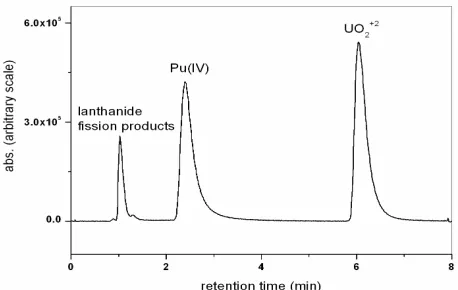
Figure 1 represents the chromatogram showing the lanthanides present in the dissolver solution separated from each other as well as resolved from uranium and plutonium under dynamic ion-exchange conditions. The fission product monitors, neodymium/lanthanum present in dissolver solution were well separated from uranium (UO2+2) and Pu(IV) under the experimental condition
with a mobile phase composition as follows: 0.02 M CSA + 0.1 M HIBA, pH: 3.1, flow rate: 2 mL/min. The concentrations of La, Ce, Pr, and Nd were determined in the dissolver solution using a calibration plot. The concentrations of lanthanides (La, Ce, Pr, Nd and Sm) and actinides (U and Pu) in the dissolver solution of MOX fuel were estimated and the results are shown in
Table 1. Uranium and plutonium were also separated and determined by reversed phase chromatographic technique (Figure 2).
3.1. Computation of Burn-Up Using HPLC Technique
The HPLC technique can provide only an elemental rather than an isotopic yield. When sum of concentra- tions of all isotopes of a fission product monitor element is used (total elemental yield) for determination of “A”, the fractional fission yield, “y” is obtained by summing up the fractional fission yield of all isotopes of the fission monitor and dividing by 100 [1]. In the present study, for computing burn-up, we have examined the possibility of using three different lanthanides as fission product monitors, namely, Nd, La and Pr. The Nd isotopes pro- duced in the fission are 143Nd, 144Nd, 145Nd, 146Nd, 148Nd
Figure 1. Direct injection of MOX dissolver solution into HPLC for separation and determination of lanthanide fis- sion products. Mobile phase: 0.02 M CSA + 0.1 M HIBA, pH: 3.1, Flow rate: 2 mL/min; post-column reagent: Arse- nazo(III) (10−4M); flow rate: 1 mL/min; detection of lantha-
nide-arsenazo(III) complexes: 655 nm. Sample: aliquot of MOX fuel ~110 GWd/t dissolved in mobile phase and in- jected into HPLC.
Table 1. Estimation of lanthanides, uranium and plutonium in the dissolver solution.
Lanthanide fission products/
actinides Amount per gram of dissolver solution Atom % burn-up
Lanthanum (La-139) 204.9 µg 10.8
Cerium (Ce-140, 142) 401.1 µg
Praseodymium (Pr-141) 201.6 µg
Neodymium (Nd-143, 144,
145, 146, 148, 150) 573.2 µg
10.5*
11$
10.7+
Samarium 123.1 µg
Europium 8.5 µg
Uranium 32.85 mg
Plutonium 13.28 mg
HPLC experimental conditions: mobile phase: 0.02 M CSA; 0.1 M HIBA; pH: 3.1 (lanthanide fission products separation); 0.1 M HIBA; pH: 3.75 (U-Pu separation). *‘y’ value used was 0.1743, where ‘y’ was cumulative
yield of all Nd isotopes exclusively from 233U fast fissions. $ ‘y’ value used
was 0.1641, where ‘y’ was cumulative yield of all Nd isotopes exclusively from 239Pu fast fissions. + ‘y’ value used was 0.1696, where ‘y’ was com-
puted based on 54.2 % fast fissions from 233U and 45.8 % fast fissions from 239Pu. Fractional fissions were computed using TIMS. Burn-up computed
(HPLC technique) as follows: Atom percent fission = {[A/y]}/{H+ [A/y]} x 100; where “A”is the number of atoms of fission product monitor (Nd or La ), ‘y’ is the effective fractional fission yield for “A”[12] and “H”is the residual heavy element (U+Pu) atoms in the dissolver solution.
yield is 16.41% and 17.43% for 239Pu and 233U respec-
tively, differing by about 6% [12]. The fission product La is mainly formed as mono isotopic (139La) and allows the
use of chemical technique for its assay. However, the La yields for 239Pu and 233U fissions are 5.83% and 6.55%
respectively, differing by ~11% [12]. Similarly, use of praseodymium (produced as 141Pr) also results in a dif-
ference in the “y” between 239Pu (5.62 %) and 233U fis-
[image:4.595.309.538.85.230.2]sions (7.00 %) by about 20 % [12]. Thus use of total
Figure 2. Separation and determination of uranium and plutonium present in dissolver solution of MOX fuel by reversed phase chromatography. Mobile phase: 0.1 M HIBA, pH: 3.75, Flow rate: 2 mL/min; PCR with arsenazo(III) at 655 nm. Sample: dissolver solution of MOX. (U and Pu fractions from these studies taken for IDMS). Concentra- tions of U and Pu were 33 µg/mL and 13 μg/mL respec- tively.
Nd as fission product monitor can be regarded as better option than use of Pr or La. Further, the difference in “y” gets minimized by employing fractional fission contribu tions from 233U and 239Pu for computing atom % burn-up.
The atom % fission deduced from the HPLC measure- ments are summarized in Table 1.
3.2. Isotopic Ratio Measurements and Atom % Burn-Up
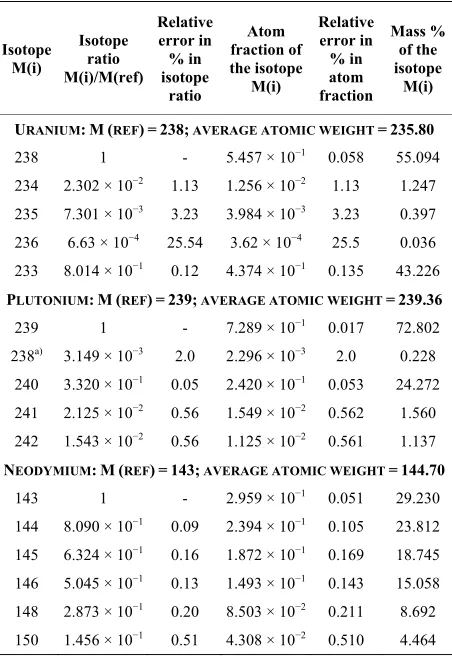
The isotopic composition of uranium in the dissolver solution was found to be: 238U: 55.09%; 233U: 43.23%; 234U: 1.25%; 235U: 0.397%; and 236U: 0.036%; for Pluto-
nium, the values were: 239Pu: 72.80%; 240Pu: 24.27%; 241Pu: 1.56%; 242Pu: 1.14%; and 238Pu: 0.23%. The iso-
topic composition of fission product neodymium was:
143Nd: 29.23%; 144Nd: 23.81; 145Nd: 18.75%; 146Nd:
15.06%; 148Nd: 8.69%; and 150Nd: 4.46%. The isotopic
composition data are given in Table 2. Since the test fuel is a combination of Pu recycled from thermal reactor and uranium enriched in 233U to provide more fissile content,
the fissions would be mainly contributed by 239Pu and 233U. Since one of the criteria for choosing a burn-up
monitor is uniform fission yield from various sources of fission [1], different isotopes of neodymium were exam- ined for deducing burn-up for this type of test fuel and the pair 145Nd + 146Nd having closely similar fast fission
yields from 233U (5.65 %) and 239Pu (5.59 %) was chosen
[12]. The ratios of neodymium isotopes i.e. [145Nd + 146Nd]/[150Nd] are widely different for these two sources
of fission (12.12 for 233U and 5.48 for 239Pu). Hence the
[image:4.595.59.287.354.512.2]our earlier studies using HPLC [5]. The fractional fis- sion contribution of 233U and 239Pu towards total fission is
54.2 % and 45.8 % respectively. The atom % burn-up deduced from the concentrations of U, Pu and Nd was 10.8 (total Nd as monitor), 10.9 (Nd148 as monitor) and
10.9 (Nd145 + 146 as monitors) and are given in Table 3.
[image:5.595.60.286.245.573.2]The possible source of errors contributing to the com- puted burn-up are those arising from 1) assay of fission product monitor, uranium and plutonium, 2) data on the fission yield of the fission product monitor and 3) com- putation of fractional fissions from 233U and 239Pu from
Table 2. Isotope ratios and abundances.
Isotope M(i)
Isotope ratio M(i)/M(ref)
Relative error in
% in isotope
ratio
Atom fraction of the isotope
M(i)
Relative error in % in atom fraction
Mass % of the isotope
M(i)
URANIUM:M(REF)=238; AVERAGE ATOMIC WEIGHT =235.80
238 1 - 5.457 × 10⁻¹ 0.058 55.094
234 2.302 × 10⁻² 1.13 1.256 × 10⁻² 1.13 1.247
235 7.301 × 10⁻³ 3.23 3.984 × 10⁻³ 3.23 0.397
236 6.63 × 10⁻⁴ 25.54 3.62 × 10⁻⁴ 25.5 0.036
233 8.014 × 10⁻¹ 0.12 4.374 × 10⁻¹ 0.135 43.226
PLUTONIUM:M(REF)=239; AVERAGE ATOMIC WEIGHT =239.36
239 1 - 7.289 × 10⁻¹ 0.017 72.802
238a) 3.149 × 10⁻³ 2.0 2.296 × 10⁻³ 2.0 0.228
240 3.320 × 10⁻¹ 0.05 2.420 × 10⁻¹ 0.053 24.272
241 2.125 × 10⁻² 0.56 1.549 × 10⁻² 0.562 1.560
242 1.543 × 10⁻² 0.56 1.125 × 10⁻² 0.561 1.137
NEODYMIUM:M(REF)=143; AVERAGE ATOMIC WEIGHT =144.70
143 1 - 2.959 × 10⁻¹ 0.051 29.230
144 8.090 × 10⁻¹ 0.09 2.394 × 10⁻¹ 0.105 23.812
145 6.324 × 10⁻¹ 0.16 1.872 × 10⁻¹ 0.169 18.745
146 5.045 × 10⁻¹ 0.13 1.493 × 10⁻¹ 0.143 15.058
148 2.873 × 10⁻¹ 0.20 8.503 × 10⁻² 0.211 8.692
150 1.456 × 10⁻¹ 0.51 4.308 × 10⁻² 0.510 4.464
a) Deduced by combining mass spectrometric and alpha spectrometric results;
error estimated to be 2 %.
Table 3. Computation of burn-up using different isotopes of Nd determined by IDMS technique.
Fission product monitors
Total number of atoms determined per gram of
dissolver solution
Atom % burn-up*
Total Nd 2.28 × 10²² 10.8
148Nd 1.94 × 10²¹ 10.9
(145 + 146)Nd 7.68 × 10²¹ 10.9 *Total residual heavy element atoms (U + Pu) determined per gram of
dis-solver solution: 11.1 × 10²³.
isotopic measurements. The uncertainties in the assay of fission monitor, and heavy elements are minimized by the use of certified standards to <1%. The uncertainty in the yields of fission monitors (e.g. Nd) obtained from literature is ~1% - 2%. The overall uncertainty arising from the individual contributions to the atom percent fission could extend to a maximum of 3% - 5%.
4. Conclusion
The rapid separation technique using dynamic ion ex- change chromatographic technique was demonstrated for the separation of pure fractions of uranium, plutonium, and lanthanide fission products present in the dissolver solution of a mixed oxide fuel. Reversed phase chroma- tographic technique was employed for isolation of pure fractions of uranium and plutonium as well as for their assay in the dissolver solution. The pure fractions of neo- dymium, uranium and plutonium required for TIMS were isolated from the dissolver solutions using HPLC techni- que. Isotope dilution mass spectrometric method was employed to estimate different isotopes of neodymium, uranium and plutonium present in the dissolver solution. Fractional fissions from 233U and 239Pu were determined
from these measurements. The atom percent fission (burn- up) was computed from these data.
5. Acknowledgements
Authors thank Dr. K. Devan and Mr. C.R. Venkatasubra- mani for discussions on the reactor physics data.
REFERENCES
[1] J. E. Rein and B. F. Rider, “TID-17385, Burn-Up Deter- mination of Nuclear Fuels,” Progress Report, AEC Re- search and Development Report, 1962.
[2] ASTM Standards E, “Standard Test Method for Atom Percent Fission in Uranium and Plutonium Fuel (Neo-dymium-148 Method),” ASTM Standards E321-96, 2005. [3] C. H. Knight, R. M. Cassidy, B. M. Recoskie and L. W.
Green, “Dynamic Ion Exchange Chromatography for De- termination of Number of Fissions in Thorium-Uranium Dioxide Fuels,” Analytical Chemistry, Vol. 56, No. 3, 1984, pp. 474-478. doi:10.1021/ac00267a041
[4] R. M. Cassidy, S. Elchuk, N. L. Elliot, L. W. Green, C. H. Knight and B. M. Recoskie, “Dynamic Ion Exchange Chromatography for the Determination of Number of Fis- sions in Uranium Dioxide Fuels,” Analytical Chemistry, Vol. 58, No. 6, 1986, pp. 1181-1186.
doi:10.1021/ac00297a045
[5] N. Sivaraman, S. Subramaniam, T. G. Srinivasan and P. R. Vasudeva Rao, “Burn-Up Measurements on Nuclear Reactor Fuels Using High Performance Liquid Chroma- tography,” Journal of Radioanalytical and Nuclear Che- mistry, Vol. 253, No. 1, 2002, pp. 35-40.
[6] R. Balasubramanian, D. Darwin Albert Raj, S. Nalini and M. Sai Baba, “Mass Spectrometric Studies on Irradiated (U, Pu) Mixed Carbide Fuel of FBTR,” International Journal of Nuclear Energy Science and Technology, Vol. 1, No. 2-3, 2005, pp. 197-203.
[7] A. Datta, N. Sivaraman, T. G. Srinivasan and P. R. Va- sudeva Rao, “Single Stage Dual Column HPLC Techni- que for Separation and Determination of Lanthanides in Uranium Matrix-Application to Burn-Up Measurement on Nuclear Reactor Fuel,” Nuclear Technology, Vol. 182, 2013, pp. 84-97.
[8] P. G. Jaison, N. M. Raut and S. K. Aggarwal, “Direct Determination of Lanthanides in Simulated Irradiated Thoria Fuels Using Reversed-Phase High-Performance Liquid Chromatography,” Journal of Chromatography A, Vol. 1122, No. 1-2, 2006, pp. 47-53.
doi:10.1016/j.chroma.2006.04.037
[9] P. R. Vasudeva Rao, N. Sivaraman and T. G. Srinivasan, “Studies of Lanthanide Separation with HPLC,” In: Ency- clopedia of Chromatography, Taylor & Francis, 2005. [10] A. Datta, N. Sivaraman, T. G. Srinivasan and P. R. Vasu-
deva Rao, “Rapid Separation of Lanthanides and Acti- nides on Small Particle Based Reverse Phase Supports,” Radiochimica Acta, Vol. 98, 2010, pp. 277-285. doi:10.1524/ract.2010.1715
[11] A. Datta, N. Sivaraman, T. G. Srinivasan and P. R. Vasu- deva Rao, “Liquid Chromatographic Behaviour of Lan- thanide and Actinides on Monolith Supports,” Radio- chimica Acta, Vol. 99, 2011, pp. 275-283.
doi:10.1524/ract.2011.1816