Data Flow Communication without Interference in
Wireless Sensor Networks
S.Jeevitha
Department of Computer Science and Engineering Mount Zion College of Engineering and Technology
Pudukkottai, Tamilnadu, India
ABSTRACT
Wireless Sensor Networks (WSNs) performs by collecting the sensed data from various sensor nodes and store them for future processing. The performance of sensor network application is based on energy efficiency which is maintained wholesome by processing the queries at MAC layer. In this paper it is decided to propose data flow without a little interference using Interference- less Data Flow (IDF), an eminent transmission scheduling technique for real time communication supporting network dynamics and variable workload in wireless sensor networks. The flow scheduling algorithm is used to achieve reduced interference in real time data flow communication. The performance is evaluated using network capacity, average latency , miss ration and drop ratio.
Keywords:
Data flow, Flow scheduling, Generic interference model, Interference, Reliability, Real time data flow, Wireless Sensor Networks
1.
INTRODUCTION
Recent research developments in miniaturization and low-power design have led to active research area in large-scale, highly distributed systems of small-size, wireless attended and unattended sensors [1][2][3]. WSN consists of battery powered devices that are capable of probing the sensed environment and reporting the collected data, typically using a radio, to the data logging command center which is usually called by term base station. The deployment of such networks is usually done in an ad-hoc manner which implies that sensor-network nodes need to self-organize without any standard infrastructure into a multi-hop wireless network [4]. The ability to communicate across the network of nodes not only allows information and control to be communicated, but also allows nodes to cooperate in performing more complex tasks, like statistical sampling, data aggregation, and system health and status monitoring [2,5]. Since wireless sensor networks (WSNs) operate in a broadcast medium, these networks require a medium access control (MAC) layer to resolve contention in a random and multi access.
Medium Access Control (MAC) is used to avoid collisions by keeping away two or more nodes causing interference from accessing the medium at the same time, which is good for the successful operation of shared-medium networks. The unique characteristics of WSNs require MAC data communication with improved performance that is quite different from traditional ones developed for wireless voice and data communication networks.
1.1 Factors influencing MAC Protocol in
WSN
The design of a MAC protocol for WSNs takes the following factors for performing best:
1.1.1 Energy Consumption.
Sensors usually have a limited energy use and are usually deployed in a hostile environment. Recharging is impossible during the operation in wireless environment. Hence long-term applications such as high as well as low data rate applications require energy-efficient solutions.
1.1.2 Idle or Sleep listening.
Sleep listening occurs when a device listens to a medium when there is no data to sense. Contention-based WSN protocols attempt to synchronize traffic so that transmissions begin only in predetermined time slots. Once all network transmissions are complete for a particular cycle or time frame, the protocols allow nodes return to sleep until the next transmission period arises. In contrast, various Contention-free MAC protocols reduce idle listening by scheduling transmission slots and allowing nodes not active exchanging messages to sleep.
1.1.3. Scalability.
WSNs usually consist of tens of thousands of sensor nodes in minimum two orders of magnitude with more sensors per router than conventional wireless networks. Highly localized and distributed solutions are required for managing the immigrants of network to keep the scalable networks.
1.1.4. Collision of Frames.
A frame collision occurs when a node sends a data which collides or overlaps in time with another. The frame has to be discarded and the retransmission may increase the energy consumption. Protocol designers reduce frame collisions by employing contention-free scheduling protocols or contention based backoff algorithms to minimize the probability of collisions.
1.1.5.
Autonomous Network Operation.
Sensors are often deployed and arranged in environments that are not easily accessible to humans (e.g., dropped from an airplane into remote mountainous regions). The topology of a WSN changes frequently or when new node enters the network due to failures of the sensor nodes. The protocols and algorithms to be used should possess a self organizing ability.
1.1.6
Frame Overhearing.
increase throughput and decrease latency. Message overhearing is costly in WSNs since all of the nodes expend energy receiving a message intended for just one node.
Sensor Networks serve many diverse applications starting from the research on Great Duck Island (GDI) [4] for monitoring the maine to high data rate real time structural health monitoring, the data services requires the improvement of performance in terms of throughput and latency. Packets pertaining to the same flow are transmitted periodically at known rates and deadlines, potentially over multiple hops. TDMA protocols address the demands of randomized workloads by constructing fixed schedules that are difficult to adapt in response to workload changes. Differently Interference-less Data Flow (IDF) is pliable model for communication in which real-time data flows may be established between arbitrary sources and destinations which may optimize flows by taking advantage of their temporal properties and hop-by-hop forwarding. IDF separates the construction of transmission schedules from flow of data. IDF is proposed to have following the salient features such as: 1) Supporting real-time communication for enriched workloads 2) Keeping aware of Interference 3) Retransmissions with fine reliability are incorporated to increase the performance 4) Ensuring dynamic performance in scalable environment.
2.
RELATED WORKS
Contention-based protocols usually support real time communication by manipulating the parameters of CSMA/CA such as the initial back-off, contention window, or sleep schedule ([6]–[10]). A common Medium Access Control (MAC) paradigm used in wireless network is Carrier Sense Multiple Access (CSMA). Any CSMA based medium access scheme has two important components, the listening mechanism and the backoff scheme. But it doesn’t work beyond one hop causing problem called hidden terminal problem which may leads to degradation of throughput especially in high data rate sensor application.
Time division multiple access (TDMA) is most attractive for high data rate sensor networks because it is energy-efficient and may provide higher throughput than CSMA/CA protocols under heavy load. Though it is efficient than CSMA, it has many disadvantages making less suitable for use of sensor network [11]. First, finding an efficient time schedule in a scalable fashion is not trivial. Second TDMA needs clock synchronization which may incur high energy overhead because it requires frequent message exchanges. In addition it is not suitable for real time applications with variable workloads as it maintains an explicit schedule for transmission. Thus the MAC scheme for sensor network should include a variant of TDMA [3].
Various prior results simplified workloads such as converge-cast [12]–[14] or query services where data is routed from sensors to a single base station provided for data logging. Even though when the centralized architectures is employed in which all communication survives one or a few gateways, to achieve higher scalability, the next generation of industrial process monitoring and control will require multiple control loops to be established between arbitrary sensors and actuators using real-time flows.
WirelessHART is a standard for sensor-actuator networks which prohibits simultaneous packet transmissions within the same channel [15][16]. The scale of existing WirelessHART networks is limited for adopting the unrealistic interference models or ignores interference.
Several TDMA protocols that provide bounded communication latencies have been proposed. These protocols incorporate effective heuristics for reducing latencies and improving real- time performance; however, a majority of existing protocols do not support prioritization. Distributed Randomized TDMA Scheduling (DRAND) is fully distributed, efficient scalable channel scheduling algorithm [17]. It is the first scalable implementation of RAND which is a famous centralized channel scheduling scheme. DRAND calculates a TDMA schedule in time linear to the maximum node degree in form of time slot. After the slot assignment, each node reuses its assigned slot periodically in every predetermined period, called frame. A node assigned to a time slot acts as an owner of that slot and the others be the non-owners of that slot. It gives a chance of being more than one owner per slot. It is useful in scheduling protocols such as Z-MAC, FDMA, CDMA etc.,
TRaffic-Adaptive Medium Access (TRAMA) protocol provides energy-efficient conflict free channel access in wireless sensor networks [18]. Energy efficiency is attained by using the transmission schedules that avoid collisions of data packets at the receivers having nodes switch to low power radio mode when there is no data packets intended for those nodes. It supports for unicast, broadcast and multicast traffic and more adaptive for sensor network and monitoring applications. But it is not suited for delay sensitive transmission.
Several protocols aim at supporting real-time communication in multi-hop networks by proposing real-time transmission scheduling for robots [19]. Both protocols may assume that at least one robot has complete knowledge of the robots’ positions and network topology. Though these protocols are suited for small teams of robots, they are not suitable for queries in multi-hop WSNs.
In prior work, RTDCQS adopts a variant of node/link scheduling called query scheduling in contrast to earlier TDMA protocols [20]. In query scheduling, the time slots are assigned to transmission on specific communication. It requires data to be routed from sensors to a single base station over a shared routing tree.
The proposed system IDF supports more general workloads resulting from concurrent real-time flows with added flexibility. In contrast with CSMA, IDF works beyond the hidden terminal problem. TDMA supports only the uniform workloads while IDF supports variable and non uniform workloads. There is no need to assign time slots for packet at time of deployment. Node stealing is not possible in IDF as compared to DRAND. Energy efficiency is maintained for all the transmission including delay probing one in contrast to TRAMA.
3.
SYSTEM ARCHITECTURE
The objective of the system is to develop new transmission scheduling techniques and time schedule analysis for real-time data flows. Also IDF adopts a generic interference model which is sufficient to enable spatial reuse and features a novel technique for ensuring reliable packet retransmissions and supports real-time flows in large networks through the novel application of Release Guard.
3.1. Components
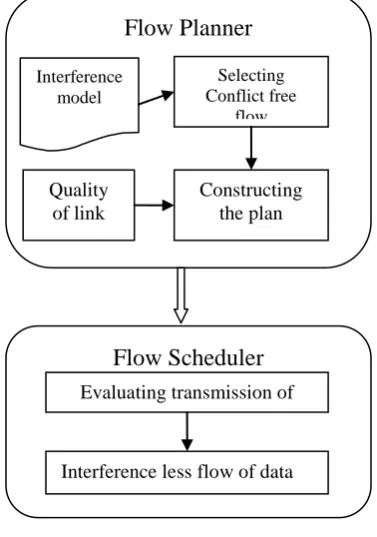
decides the transmissions for each flow and scheduler for scheduling the corresponding plans.
3.1.1.
Flow Planner
[image:3.595.72.261.131.400.2]The flow planner is responsible for constructing the plans which
Figure.1 Components of IDF
is the sequential order of transmission steps for executing a flow instance.Each step should consist of set of transmissions which should be free from both the primary and secondary conflict which is shown in Figure.2. Primary conflict is said to occur when one node transmits and receives at the same time slot or receives more than one transmission destined to it at same time slot. Secondary conflict occurs when an intended receiver of particular transmission is also within the transmission range of another transmission intended for other nodes. Conflict free path can be determined by planning the transmission with help of Interference model namely Interference Communication (IC) graph.
A Flow Plan refers a single transmission is assigned in each step with the order of transmissions respects the constraints of hop-by-hop forwarding. When links are good and perfect, a plan is the routing path between the flow’s source and destination. Plans are usually stable over time or if there exists an unreliable links are usually handled through Automatic Repeat reQuest (ARQ).
The ARQ mechanism automatically retransmits a packet that is unacknowledged up to a maximum number of retransmissions. It is important to detect the quality of a link before stepping the plan. A number of link estimators evaluate the quality of a link using Expected Transmission Count (ETX) [21]. It is temptingto use ETX as an estimate of MNT. However, the ETX provided by the link layer estimates the average MNT.
When it is possible to use reuse existing plans, plan reuse is encouraged. Consider the case when a node A wants to establish a flow to B but there already is a flow that routes data from an arbitrary source through A to B. In this case, rather
than constructing a new plan, A disseminates the part of the plan involving transmissions from A to B. Reusing plans will effectively reduce of times new flows are constructed.
Figure. 2. Types of Conflicts
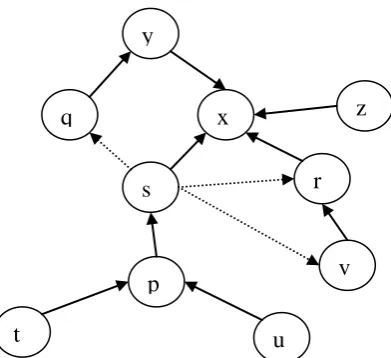
Let G (V,E) be the IC graph where V are the set of vertices representing sensor nodes and E are the set of edges represents the communication edges and interference edges. The link between the nodes for packet transmission is termed as the Communication edges and the link which interrupts the any communication in time is Interference edge. For example, PQ and RS are said to be conflict free (PQ ∥ RS) if PS and RS are not the edges and P, Q, R, S are distinct. The realistic method for constructing the IC graph is Radio Interference Detection (RID) based on Receiver Signal Strength (RSS)[22]. An example IC graph is shown in Figure.3
The conflict matrix is shown for the example IC graph in Figure.3 is shown in Figure.4. In each step the transmissions assigned are conflict free. For example, in step 2 the nodes v and p may transmit simultaneously as their transmission vr and
ps
are conflict free i.e, they do not conflict with each other (vr ∥ ps ). It provides the transmission to satisfy the precedence constraints such that t and u transmits efore its parent p. sr and
up
are conflict with each other producing exposed problem. The minimized transmission plan may results in reduced latency.
Flow Planner
Selecting Conflict free
flow
Quality of link
Constructing the plan Interference
model
Flow Scheduler
Evaluating transmission of flow
Interference less flow of data
Hidden Terminal
[image:3.595.322.526.131.322.2]Figure.3 Example IC Graph. The solid line shows the communication links and dotted line shows the
intereference links.
Receivers
x Y r z s q p v
s
u
t
v
p
s
s Q
z
s
r
y
Figure. 4 Conflict Matrix for IC graph in Fig.3. The shaded box denotes the sender causing conflict
and normal box shows the plan without conflict. The capitalized letters shows the communication
link while others are interference links
3.1.2.
Flow Scheduler.
Flow scheduling is used to avoid the wastage of time when the nodes or links are idle for a period of time. Instead of assigning the time slot for
node or links, slot should be assigned for the flow. The slot is a period of time allotted for workload on demand. Scheduling should ensure that all the steps executed are conflict free with the relative order being preserved
.
The algorithm flow scheduling is used when the two instances of a flow is executed concurrently. The scheduler uses two different queues called wait and execute queue. The instance of flow waiting to be executed are stored in wait queue but are not being executed and those instance to be executed is placed in execute queue. When an instance starts, it is moved from wait queue to execute queue. Being simple and efficient, it is feasible on resource constraint devices. The operation of determining the starting time of flow instance takes time of O (1). The algorithm for data flow without interference is shown in Algorithm1.
Flow Scheduling considers all released instances in order of their priority and determines the instances that will be executed (execute set) and the instances that will be suspended (the suspend set). An instance i whose execute step will be added to the exec set if three conditions are satisfied: (1) The
transmission1 will not conflict with any of the transmissions of the instances previously added to the execute set (2) IDF avoids the greedy choice that leads to increased worst-case interference i.e., no instance i in the suspend set interferes (3) The number of transmissions per slot does not exceed N.The time complexity of the operations performed per slot is O(wait X suspend). The time complexity is to significantly lower since the size of the execute set is constrained by N.
begin
new instance i is released wait = wait ∪ i
execute = null; suspend = null;
begin
start a new slot s
for each i in wait
if (interefere (i) ∪ transmission (execute) = true) then continue (i) = False
else
continue (i) = True
for each i ∪ suspend
if (interefere (i), conflict matrix) = N – 2 then continue (i) = False; break;
if continue(i) then execute = execute ∪ i; else
suspend = suspend ∪ i; if length(execute) = N then break;
end end
continue (i):
execute = execute ∪ i;
wait = wait – i add instances to all occurConflict
Algorithm1. Flow Scheduling Algorithm
4.
PERFORMANCE EVALUATION.
The performance of RTDCQS is compared with the performance of the proposed IDF system in terms of drop ratio, miss ratio, average flow latency, and maximum flow latency.
4.1 Performance Metric
The flow throughput and flow latency of the proposed system is compared with that of RTDCQS which are defined as follows:4.1.1.
Network Capacity
The real time capacity of a protocol is the maximum throughput that a protocol supports without missing deadlines
y
x
q
z
s
r
p
t
v
[image:4.595.109.244.296.422.2]Figure. 5 Performance comparison using Network capacity for RTDCQS and IDF
Figure. 6 Performance comparison using latency for RTDCQS and IDF
4.1.2.
Flow Latency
It is the response time for every flow instance after sending the flow request. It is represented by seconds (s).
4.1.3
Drop Ratio
The drop ratio is the number of packets received at the destination out of the transmitted packets.
4.1.4
Miss Ratio
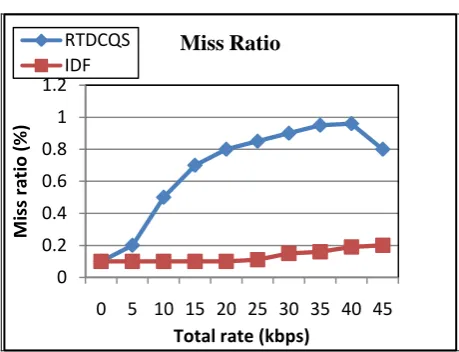
The miss ratio is the number of packets which were either dropped or missed the deadline out of the transmitted packet
.
4.2
Results
[image:5.595.54.286.77.454.2]The performance comparison of RTDCQS and IDF in terms of throughput is shown in Figure 5. Clearly shown, IDF achieves the maximum throughput of 5.4Hz which is about 63% higher than RTDCQS. From this it is concluded that fair allocation of slots not only suitable for WSN. The performance comparison of RTDCQS and IDF in terms of latency is depicted in Figure 6.
Figure. 7 Performance comparison using drop ratio for RTDCQS and IDF
Figure. 8 Performance comparison using Miss ratio for RTDCQS and IDF
Even though the flow rate is low, the IDF performs significantly better latency on comparing RTDCQS. For example, when flow rate is 3.4, IDF has the latency of 1.8 in contrast to RTDCQS with latency of 6.8 which is about 77% lower than RTDCQS. The long latency period for RTDCQS is due to increased waiting duration a node to transmit entire frame to its parent
Figure 7 shows the drop ratio with the increased flow rate. All curves follow a similar pattern: they start at zero, remain at zero until the network capacity of the protocol is exceeded, and then they increase sharply. These results highlight the importance of allocating slots proportionally to the bandwidth requirements of a node. When the total rate was 13.46 kbps, IDF did not drop packets until the total rate became 31.78 kbps, a 2.36 times increase in network capacity.
Figure 8 shows the miss packets when the total rate is relatively low. A packet waits for half the frame before it is forwarded to the next hop, since the TDMA schedule was constructed without accounting precedence constraints introduced by hop-by-hop forwarding. In contrast, IFD uses this information, effectively aligning the transmission of packets across multiple hops, leading to latencies below 0.4 s
0 1 2 3 4 5 6
2.5 3.4 4.3 5.2 6.1 7
Fl
o
w
Th
ro
u
gh
p
u
t
(H
z)
Flow Rate (Hz)
Throughput
RTDCQS IDF
0 2 4 6 8 10
2.5 3.4 4.3 5.2 6.1 7
Fl
o
w
late
n
cy
(s)
Flow rate (Hz)
Average Latency
RTDCQS IDF
0 0.5 1 1.5 2 2.5 3
0 5 10 15 20 25 30 40
D
rop
Rati
o
(%
)
Total rate (kbps)
Drop Ratio
RTDCQS IDF
0 0.2 0.4 0.6 0.8 1 1.2
0 5 10 15 20 25 30 35 40 45
M
iss r
atio
(%
)
Total rate (kbps)
Miss Ratio
[image:5.595.310.540.294.470.2]5.
CONCLUSION
The scheduling technique IDF is specifically designed for real time flow services in wireless sensor networks. It address various demerits of existing solutions such as unrealistic interference models, simplified workload models, link quality and limited scalability. With the flow planner, flow latency is reduced by constructing conflict free transmission plans based on the precedence constraints. By the flow scheduler throughput is improved by over-lapping the transmissions of multiple flow instances concurrently. Scheduler makes use of interfere set to determine the interference happened. In future work it is decided to use the various models for detecting interference and transport layer protocols for detecting the congestion, mitigating the congestion and thereby increasing the throughput at base station in varying sensor environment.
6.
ACKNOWLEDGMENT
Author express thanks to their friends and colleagues for encouraging them in good manner for completing this work.
7.
REFERENCES
[1] I. F. Akyildiz , W. Su, Y. Sankarasubramaniam, and E.Cayirci. March 2002. Wireless sensor networks: a survey, Computer Networks, Vol. 38, pp. 393-422
[2] D. Estrin, R. Govindan, J. S. Heidemann, and S. Kumar. 1999. Next century challenges: Scalable coordination in sensor networks. In Mobile Computing and Networking, pages 263–270
[3] K.Sohrabi, et al. October 2000. Protocols for self-organization of a wireless sensor network, IEEE Personal Communications, Vol. 7, No. 5, pp. 16-27
[4] A.Mainwaring, D. Culler, J. Polastre, R. Szewczyk, and J.Anderson, 2002. Wireless Sensor Networks for Habitat Monitoring,”Proc. First ACM Int’l Workshop Wireless Sensor Networks and Applications (WSNA)
[5] A. Woo, D. Culler, July 2001. A transmission control scheme for media access in sensor networks, Proceedings of ACM MobiCom’01, Rome, Italy, pp. 221–235
[6] Y. Ge, J. C. Hou, and S. Choi, 2007. An analytic study of tuning systems parameters in IEEE 802.11e enhanced distributed channel access, Computer Networks, vol. 51, no. 8, pp. 1955–1980
[7] V. Kanodia, C. Li, A. Sabharwal, B. Sadeghi, and E. Knightly, 2001. “Distributed multi-hop scheduling and medium access with delay and throughput constraints,” in MobiCom
[8] G.-S. Ahn, A. T. Campbell, A. Veres, and L.-H. Sun, 2002. Swan: service differentiation in stateless wireless ad hoc networks, in INFOCOM ’02
[9] B. D. Bui, R. Pellizzoni, M. Caccamo, C. F. Cheah, and A. Tzakis, 2007. Soft real-time chains for multi-hop wireless ad-hoc networks, in RTAS
[10]Y. Gu, T. He, M. Lin, and J. Xu., 2009. “Spatiotemporal delay control for low duty-cycle sensor networks.” in RTSS
[11]W. Ye, J. Heidemann, and D. Estrin , 2004. Medium access control with coordinated adaptive sleeping for wireless sensor networks. IEEE/ACM Trans. Netw., 12(3):493-506
[12]A. Saifullah, Y. Xu, C. Lu, and Y. Chen, 2010. End-to-end delay analysis for fixed priority scheduling in wirelesshart networks, in RTAS
[13]P. Jurcik, A. Koubˆaa, R. Severino, M. Alves, and E. Tovar, 2010. Dimensioning and worst-case analysis of cluster-tree sensor networks, ACM Transaction on Sensor Networks, vol. 7, no. 2, pp. 1–47
[14]P. Suriyachai, J. Brown, and U. Roedig, 2010. Time-critical data delivery in wireless sensor networks, in Distributed Computing in Sensor Systems.
[15]H. Zhang, P. Soldati, and M. Johansson, 2009. Optimal link scheduling and channel assignment for convergecast in linear WirelessHART networks,in WiOPT,
[16]A. Saifullah, Y. Xu, C. Lu, and Y. Chen, 2010. Real-time scheduling for wirelesshart networks in RTSS,
[17]I. Rhee, A. Warrior, J. Min, and L. Xu, 2006. DRAND: Distributed Randomized TDMA Scheduling for Wireless Ad Hoc Networks, Proc. ACM MobiHoc
[18]V. Rajendran, K. Obraczka, and J.J. Garcia-Luna-Aceves, 2003. Energy- Efficient Collision-Free Medium Access Control for Wireless Sensor Networks, Proc. First Int’l Conf. Embedded Networked Sensor Systems (SenSys)
[19]A. Koubaa, M. Alves, and E. Tovar, 2006. i-GAME: an implicit GTS allocation mechanism in IEEE 802.15.4 for time-sensitive wireless sensor networks, in Euromicro Conference on Real-Time Systems
[20]S.Jeevitha and S.Kaleeswari, 2013. Optimizing the performance of queries using Real Time Conflict Free Query Scheduling in WSN, Proc. First IEEE Int’l Conf. Research and Development Prospectus on Engineering and Technology
[21]O. Gnawali, R. Fonseca, K. Jamieson, D. Moss, and P. Levis, 2009. Collection tree protocol, in SenSys, pp. 1–14