Munich Personal RePEc Archive
China’s Regional Convergence in Panels
with Multiple Structural Breaks
Matsuki, Takashi and Usami, Ryoichi
17 March 2007
China’s Regional Convergence in Panels with Multiple Structural Breaks
(Running Title: China’s Regional Convergence in Panels with Multiple Breaks)
Takashi Matsuki * and Ryoichi Usami
Department of Economics, Osaka Gakuin University,
2-36-1 Kishibeminami, Suita- City, Osaka, 564-8511, Japan
Abstract
This study investigates the existence of regional convergence of per capita outputs in
China from 1952–2004, particularly focusing on considering the presence of multiple
structural breaks in the provincial-level panel data. First, the panel-based unit root test
that allows for occurrence of multiple breaks at various break dates across provinces is
developed; this test is based on the p-value combination approach suggested by Fisher
(1932). Next, the test is applied to China’s provincial real per capita outputs to examine
the regional convergence in China. To obtain the p-values of unit root tests for each
province, which are combined to construct the panel unit root test, this study assumes
three data generating processes: a driftless random walk process, an ARMA process,
and an AR process with cross-sectionally dependent errors in Monte Carlo simulation.
The results obtained from this study reveal that the convergence of the provincial per
capita outputs exists in each of the three geographically classified regions—the Eastern,
Central, and Western regions—of China.
*
1. Introduction
One of the important issues in China, which has achieved high economic growth rates
since the end of 1978, is the existence of large differentials in output per capita between
provinces. Reducing these gaps is one of the main objectives set in the Eleventh
Five-Year-Plan (2006–2010). Therefore, from the perspective of policy making by the
Chinese government, it is extremely important to understand the behaviour of provincial
per capita outputs, particularly observing whether these per capita outputs can converge.
Lots of studies, including Mankiw, Romer and Weil (1992), Bernard and Durlauf
(1995, 1996), and Quah (1993a, b, 1996), have been conducted on the convergence of
per capita outputs since Barro (1991) and Barro and Sala-i-Martin (1992). Among these,
some empirical studies have utilized nonstationary time series techniques such as unit
root tests and cointegration tests.1 On the other hand, Evans and Karras (1996), Lee,
Pesaran and Smith (1997), Evans (1998), Flessig and Strauss (2001), and McCoskey
(2002) have used unit root tests extended for panel data sets to investigate convergence
across countries and the states of US; some of these tests have been proposed by Im,
Pesaran and Shin (2003) (hereafter, IPS) and Maddala and Wu (1999) (hereafter, MW).
With regard to the convergence hypothesis of provincial per capita outputs in
China, there are several contributions to the literature, such as Zhang, Liu and Yao
(2001) and Pedroni and Yao (2006), that use unit root testing methods for a single time
1
Bernard and Durlauf (1995), Oxley and Greasley (1995), Hobijn and Franses (2000),
series and panel data sets.2 Zhang et al. (2001) aggregated the real per capita GDP of
30 Chinese provinces from 1952–1997 into three regions (the Eastern, Central, and
Western regions) in accordance with the official classification and then applied the
Augmented Dickey–Fuller t-test and the unit root test with a break suggested by Perron
(1994) to the relative regional and national per capita GDPs of each of the three regions.
Then, they concluded that two of the three regions (the Eastern and Western regions)
are converging to their own specific steady states. Pedroni and Yao (2006) utilized the
panel-based unit root tests, the IPS and MW tests, to investigate convergence of the
annual real per capita GDP across all the provinces of China. They split each provincial
series into the pre-reform sample (1952–1977) and the post-reform sample (1978–1997)
to consider the impacts of the economic reforms since 1978. The results revealed
convergence in the pre-reform sample, but not in the post-reform sample.
While testing unit roots or cointegrating relationships using a single time series, the
sample size used in the analysis needs to be sufficiently large to obtain higher power of
the test. Similarly, the time series dimension of panel sets for each cross-sectional unit
should be large in panel unit root tests, especially in the tests based on combinations of
separate unit root tests such as the IPS and MW tests. However, panels with longer time
spans have a higher possibility of including structural changes caused by wars, supply
shocks, significant policy changes, and so on. Perron (1989), Leybourne, Mills and
2
The studies on regional growth in China which have not adopted the nonstationary
time series or panel techniques are Chen and Fleisher (1996), Jian, Sachs and Warner
Newbold (1998), and Im, Lee and Tieslau (2005) have shown that ignoring the existing
structural breaks in time series or panel data sets may lead to a substantial loss of power
or serious size distortions in commonly used unit root tests such as the Dickey–Fuller
test and the IPS test. Taking such evidence into account, it is desirable to employ tests
that allow for structural changes in data.3
Smyth and Inder (2004) ascribe the logic behind the inclusion of multiple
structural breaks in the official output of China to the occurrence of significant political
and economic events: the Great Leap Forward from 1958–1960; the sudden suspension
of the economic assistance from the Soviet Union in 1960; the crop failures from
1959–1961; the Cultural Revolution from 1966–1976; economic reforms from
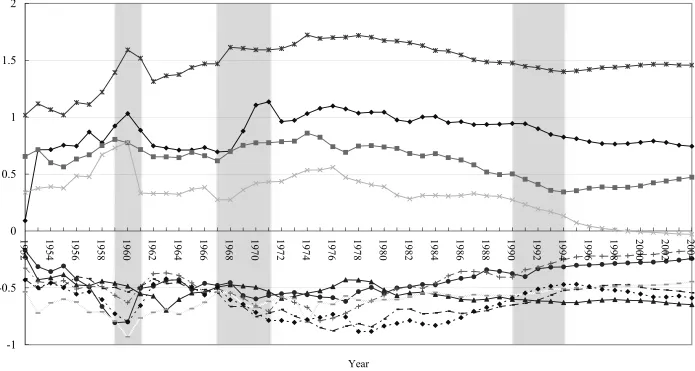
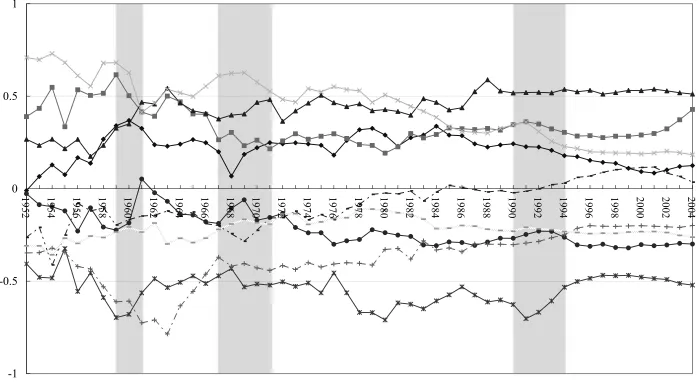
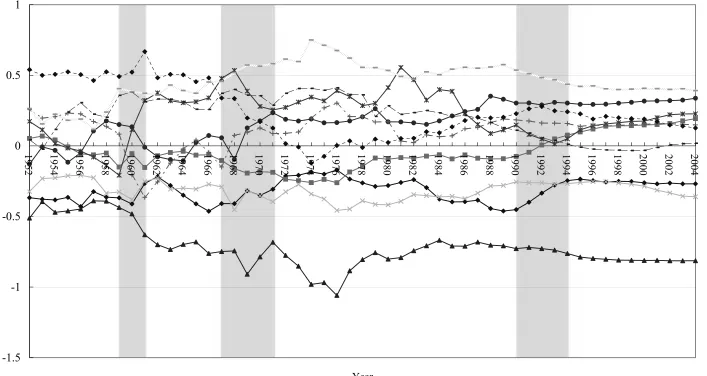
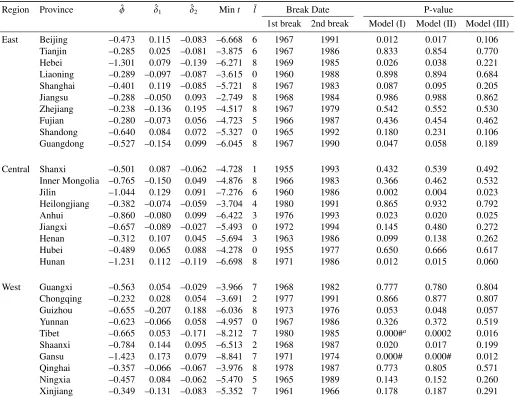
1978–1979; and Deng Xiaoping’s southern tour in 1992. Figures 1 to 3 show the
fluctuations of log of real per capita outputs of the provinces, wherein each series is
subtracted from the mean value of each of three regions, with twenty-nine provinces.4 5
In all the figures, we observe apparent shifts in the level of the series corresponding to
3
Carlino and Mills (1993), Greasley and Oxley (1997), and Li and Papell (1999) have
examined convergence using unit root tests which can deal with a breaking time series.
4
This classification of provinces is nearly identical to that of Zhang et al. (2001), but
the aggregation of provincial series is not conducted in this paper. The details will be
described in Section 4.1.
5
Studies on multi-country convergence often use the deviation from the cross-sectional
mean and look into its nonstationarity (Evans and Karras, 1996; Lee et al., 1997; and
each province for the following time periods: 1959–61, 1967–71, and the early 1990s
(shown as grey areas in the figures). These shifts coincide with the occurrences of the
events mentioned above. Based on these findings, some studies have focused on the
presence of structural changes in the annual series in China (Li, 2000; Zhang et al.,
2001; and Smyth and Inder, 2004); these studies have adopted unit root testing methods
permitting one or two breaks in a single time series for the analysis of the
nonstationarity of the macroeconomic or provincial time series.
However, with regard to the convergence hypothesis in regional panel data in
China, published papers which explicitly deal with the existence of multiple structural
breaks occurring at different break dates in the panels have been few in number.6
6
In general, existing panel-based unit root tests which allow for breaks may be too
restrictive for empirical applications based on the convergence hypothesis. Specifically,
these tests are based on two major assumptions: the presence of a linear time trend in a
series and the absence of cross-sectional dependence between error terms in the data
generating process (DGP). In the case of the former assumption, the tests defined under
the DGP with a time trend are not directly applicable to investigations on convergence.
In these investigations, the difference between two series or the deviation from the
mean value of all cross-sectional units is usually used, and the difference or the mean
deviation is often assumed to be zero mean stationary when absolute convergence exists,
or level stationary when conditional convergence exists (Bernard and Durlauf, 1995;
Evans and Karras, 1996). Thus, these analyses require tests which are defined under
Therefore, while examining convergence across provinces in China, this study focuses
on the presence of multiple structural breaks in the panels. Based on the combining
p-values method of Fisher (1932), we first develop a unit root test which allows for
multiple breaks in the panels. We then investigate the existence of regional convergence
in China by applying the test to China’s provincial per capita outputs. The p-values of
the t-type unit root tests for each province, which are combined by the panel unit root
tests based on Fisher’s p-values combination approach, are calculated by Monte Carlo
simulation under three data generating models—the driftless random walk model, the
ARMA model, and the AR model with cross-sectionally dependent errors. In particular,
in the case of cross-sectional dependence between error terms, the bootstrap method
proposed by Maddala and Wu (1999) and Wu and Wu (2001) is employed in order to
correct the biases of the panel-based unit root tests.7
The remaining sections of this paper are organized as follows: Section 2 defines
convergence; Section 3 describes the econometric methodology; Section 4 briefly
mentions the data and discusses the empirical results; and Section 5 presents the
conclusions.
assumption, cross-sectional correlation between error terms is a major issue in dynamic
panel estimation because neglecting this correlation may lead to a bias of an estimated
parameter and increase its variance (O’connell, 1998; Phillips and Sul, 2003).
7
Banerjee and Carrion-i-Silvestre (2006) have dealt with several issues on structural
2. Definition of Convergence
At first, we consider convergence as proposed by Evans (1998). Suppose that yit is a
log per capita output for province (cross-sectional unit) i at time t (i=1,K,N ,
T
t =1,K, ). Next, consider the difference between yit and the mean value of yit
over i=1,K,N , which is denoted as y%it≡ yit−yt, where 1
1
N it
t N i y
y ≡ −
∑
= . As provedby Evans (1998), since 1
1( )
N
it t j it jt
y −y =N−
∑
= y −y , if yit −yjt is stationary for allpairs of i and j, yit−yt is stationary for all i. A converse proof is also available:
since yit −yjt =(yit −yt) (− yjt−yt), if yit−yt is stationary for all i, yit −yjt is
stationary for all pairs (i, j). These results equate bivariate convergence within all
pairs of provinces, reflected by the stationarity of yit−yjt for all pairs of i and j, to
the stationarity of yit−yt for all i. This equivalence enables us to focus on
investigating the stochastic properties of y%it= yit−yt for all i instead of yit−yjt
for all pairs of i and j.
In the next section, we will specify structural changes at some time periods in a
series as multiple shifts in the level of the series. Accordingly, convergence is defined
as follows:
For all i , if y%it is stationary with shifts in its level at some t , then convergence exists
across all the provinces.8
8
Evans and Karras (1996) have postulated that convergence is absolute if y%it has a
zero mean for all i, or conditional if y%it has a non-zero mean for some i. According
to Evans and Karras, when all the series of y%it are stationary and have some structural
This study does not allow the trend stationarity of y%it for each i because the
presence of a linear time trend implies that some of the differences between yit and
jt
y for fixed i and all j will diverge as time approaches infinity unless the time
trends are the same for all the pairs (Bernard and Durlauf, 1995). Further, with the
exceptions of Liaoning in Figure 1 and Heilongjiang and Hubei in Figure 2, none of the
figures show a distinct upward or downward tendency for any series during the entire
sample period. Therefore, we consider y%it as a series without a time trend in the later
sections.
3. Econometric Methodology
3.1. Models and Test Statistics for a Single Time Series
We assume y%it for each province to be nonstationary without breaks under the null
hypothesis, and stationary with breaks under the alternative hypothesis. As discussed in
Section 2, although each series exhibits no linear time trend, it contains some shifts in
the level. Therefore, this study assumes that y%it is generated by the following data
generating process (DGP).
Under Null ~yit = ~yit−1 +εit (1) Under Alternative ~yit =ρi~yit−1+δ1iDU1it +δ2iDU2it +εit, ρi <1 (2)
N
i=1,K, , t =1,K,T
i after the last break date, or conditional if y%it has a non-zero mean for some i after
where εit is independently and identically distributed across i and t with a zero
mean and a finite variance; δhi denotes the size of the hth break (h=1, 2); DUhit
denotes the hth break in the level of a series (h=1, 2), where DUhit =1 for t >τhiT,
and zero otherwise; and τhi is the fraction of the h th break ( h=1, 2) in
1
0<τ1i <τ2i < , which is defined as TBhi /T for all T, where TBhi is the date of the
hth break (h=1, 2). In this DGP, the series is a driftless random walk process under
the null hypothesis, whereas it is a stationary process and has up to two-time level shifts
under the alternative hypothesis. Next, the regression model nests Models (1) and (2).
error DU
DU y
d
yit = mi m+ i it + i it + i it +
∆~ αˆ φˆ~ −1 δˆ1 1 δˆ2 2 m=1, 2 (3)
where ∆~yit =~yit −~yit−1, φˆi = ρˆi −1, and dm denotes the deterministic term, where
{ } m
d = ∅ for m=1 and {1} for m=2. Let tim be the t-statistic testing the null
hypothesis φˆi =0 and δˆ1i =δˆ2i =0 against the alternative hypothesis φˆi ≠0 and
0 ˆ
1i ≠
δ , δˆ2i ≠0 in each regression model m (m=1, 2) for each i. As carried out in
Zivot and Andrews (1992) and Lumsdane and Papell (1997), the break dates
} ,
{TB1i TB2i are endogenously determined to be where the one-sided tim-statistic is
minimized in sequential estimations over all possible break dates within the range of
1
0<τ1i <τ2i < . For fixed i, when Model (1) has a constant and Model (3) has both a
constant and linear time trend, the tim-statistic is the counterpart of the one proposed by
Zivot and Andrews (1992) for a single break (δ2i =0 and δˆ2i =0) and of that
proposed by Lumsdane and Papell (1997) for double breaks, where the asymptotic
behaviour of the statistic as T →∞ can be found. On the other hand, no literature
provides the exact asymptotic behaviour of the test considered here. Therefore, as
∞ →
breaks in the following theorems in which the subscript i is omitted for simplicity.
Theorem 1.For Models (1) and (3), with δ2 =0 and δˆ2 =0, as T →∞, the limiting distribution of the minimum t -statistic is given as follows: m
(
)
{
}
+
⇒
∫
−∫
10 1 2 / 1 1 0 2 1 2
1) inf 1 ( , ) ( , )
(
1 m m m m
m dW r W dr r W b
t τ τ τ
τ m=1, 2 (4)
where ⇒ denotes weak convergence in distribution; Wm(r,τ1) denotes the residuals
from the projection of a standard Wiener process W(r) onto the subspace generated
by the functions
{
du1(r,τ1)}
for m=1 and{
1,du1(r,τ1)}
for m=2 , where1 ) , ( 1 1 r τ =
du for r >τ1, and zero otherwise. b is given bym
{
W r dr}
b = − −1
∫
1 1 1 1 ) ( ) 1 ( τ τ{
W r dr}
b2 = 1−1 − 1 −1∫
11 ) ( ) 1 ( τ µ τ τ
where Wµ(r) is a demeaned standard Wiener process defined as
) ( )
(r W r
Wµ ≡ −
∫
1W r dr 0 ( ) .The proof of Theorem 1 is analogous to the following theorem and is, therefore,
omitted.9
Theorem 2. For Models (1) and (3), as T →∞, the limiting distribution of the minimum t -statistic is given as follows: im
(
)
{
}
+ +
⇒ m m
∫
m −∫
m mm dW r W dr r W c b t 1
0 1 2
2 / 1 1 0 2 2 1 2 2 , 2
1, ) inf 1 ( , , ) ( , , )
( 2 1 τ τ τ τ τ τ τ
τ m=1, 2 (5)
9
where Wm(r,τ1,τ2) denotes the residuals from the projection of W(r) onto the
subspace generated by the functions
{
du1(r,τ1),du2(r,τ2)}
for m=1 and{
1,du1(r,τ1),du2(r,τ2)}
for m=2 , where duh(r,τh)=1 for r >τh , and zerootherwise (h=1, 2). b and m c are given bym
{
W r dr W r dr}
b1 = 2 − 1 −1∫
1 −∫
12 1 ) ( ) ( ) ( τ τ τ τ
{
W r dr W r dr}
c1 = 2 − 1 −1 −
∫
1 + − 1 − 2 −1∫
1 2 1 ) ( ) 1 )( 1 ( ) ( ) ( ττ τ τ
τ τ
{
W r dr W r dr}
b = − − − −
∫
1 +∫
20 0 2 1 1 1 1 2
2 ( ) ( ) ( )
τ µ τ µ τ τ τ τ
{
W r dr W r dr}
c = − −
∫
1 − − − −∫
20 1 2 1 0 1 1 2
2 ( ) ( ) (1 )(1 ) ( )
τ µ τ µ τ τ τ τ .
The proof of Theorem 2 is given in Appendix.
3.2. Construction of Panel Unit Root Test with Breaks
In this subsection, we construct a panel unit root test with breaks by combining the
individual minimum tim-test; this test is based on Fisher’s (1932) sum of log p-value
approach, which has been introduced and used by Maddala and Wu (1999).
Suppose that pi is the p-value from the ith test statistic among N continuous
test statistics. Therefore, since each pi is an independent uniform (0, 1) variable,
i
p
log 2
− has the chi-square distribution with two degrees of freedom. Further, the
summation of −2logpi from i=1 to N also has the chi-square distribution with
N
2 degrees of freedom. Fisher (1932) utilized this fact to develop the test (hereafter,
Fisher test). By applying Fisher’s p-value combination method to N augmented
Dickey–Fuller t-tests, Maddala and Wu (1999) has built a panel-based unit root test
which does not allow breaks. In this study, we use Fisher’s approach to construct panel
individual minimum tim-test. Therefore, the sum of logpim is defined as follows:
∑
=−
= N
i
m i
p B
Fisher
1
log 2
_ m=1,2 (6)
The Fisher_B test (the Fisher test with breaks) also has the chi-square distribution with
N
2 degrees of freedom. In the present case, however, the degree of freedom of the
chi-square distribution is 2(N −1) due to the restriction of ~ 0
1 =
∑
=N
i yit . The null and
alternative hypotheses of the test are specified as H0: 0φi = and δ1i =δ2i =0 for
all i and H1: 0φi < and δ1i ≠0, 0δ2i ≠ for some i respectively.
There are two noteworthy features of the tests based on Fisher’s p-value
combination approach: (1) Since the tests have an exact (chi-square) distribution, they
do not require a large cross-sectional dimension of panel data. Hence, they are expected
to perform well in the analyses using panels with a relatively large time dimension and a
small cross-sectional dimension such as country-level, state-level, or provincial-level
panels.10 (2) Even if some of the N unit root tests give larger p-values than
conventional significance levels, e.g. 5 or 10 per cent, which implies the non-rejection
of the unit root null in each test, if these p-values indicate a slight tendency to reject the
unit root null (e.g. 0.15 or 0.2), the tests based on Fisher’s p-value combination
approach can capture it.
To calculate the Fisher_B test statistic, we need to compute the p-value of the
10
Although Becker (1997) compared the performance of 16 p-value combination tests,
including the Fisher test, he concluded that there was no test that was the most accurate
minimum tim-test for all (i, m) by Monte Carlo simulation because the minimum
m i
t -test has non-standard limiting distributions for each m shown in Theorems 1 and 2.
Under the unit root null hypothesis, this study considers the following three DGPs:
Model (I) ~yit = ~yit−1 +εit
Model (II) θˆi(L)∆~yit =ψˆi(L)σˆiεit
Model (III) *
1 *
* ˆ ~
~ it k k k it ik it i y
y = γ ∆ +ε
∆
∑
= −
where εit is an i.i.d. N(0, 1) error across i and t ;
= ) ( ˆ L
i
θ − − 2 −
2 1 ˆ ˆ
1 θ iL θ iL i i p i p L θˆ −
L and ψˆi(L)=1−ψˆ1iL−ψˆ2iL2 − i
i q i q L ψˆ −
L , where
p
θ θˆ, , ˆ
1 L and ψˆ1,L,ψˆq are estimated parameters; and L is the lag operator such as
1 −
= t
t y
Ly . For Model (I), ~ is generated for each yit i by a driftless random walk
model. For Model (II), for each i, ∆y~it is generated by the optimal autoregressive
moving average (ARMA) (pi, qi) model with estimated parameters and N(0, σˆi2)
innovations, where σˆi2 is the estimated innovation variance of the ARMA model. The
selection of the optimal ARMA model follows the Zivot and Andrews (1992) procedure,
which fits ARMA(p, q) model to ∆~yt over the possible combinations of p and q
with 5p, q≤ , then finds the best fitted model according to the Akaike information
criterion and the Schwartz information criterion. When the two criteria choose different
models, the most parsimonious model is selected.
For Model (III), ∆~yit* is the bootstrap sample for ∆~yit, which is obtained by the
bootstrap method employed by Maddala and Wu (1999) and Wu and Wu (2001). The
procedure followed herein is elaborated below. Firstly, we estimate the equation
0 1 ~ ˆ ~ it k
k ik it k
it
i
y
y = γ ∆ +ε
residuals εt0 =[ε10t,ε20t,L,εNt0 ] (t =1,K,T ). Next, we resample εit0 from the obtained
residuals by preserving their cross-sectional correlation structure based on the bootstrap
method of Maddala and Wu (1999), wherein the vector εt0 =[ε10t,L,εNt0 ] is resampled
instead of individual εit0. In addition, we generate a random number g which takes
integer values on [1, T] with probability 1/T, by using a uniform random number.
We then draw a row of residuals 0 =
g
ε [ 0 0
1g, ,εNg
ε L ] according to the realizations of g.
The bootstrap sample εt* (t =1,K,T ) is obtained by T-time withdrawals from the
residuals. The bootstrap sample ~yit* is generated by Model (III) with estimated
parameters γˆ (ik k =1,K,ki) in the previous OLS estimation. However, *
1 *
1
~ , , ~
+ i
k i
i y
y L
are replaced by the sample obtained by the block resampling method of Berkowitz and
Kilian (1996). Their method divides the actual sample y~ into it T −ki overlapping
subsampling blocks with size ki +1 and randomly draws a block from T −ki blocks.
Then, *
1 *
1
~ , , ~
+ i
k i
i y
y L are replaced with this block.
In fact, in the case where the cross-sectionally dependent errors are present in the
data generating model, the Fisher_B test does not belong to the chi-square distribution
under the null hypothesis because the minimum m
i
t -tests are correlated across i.
Accordingly, the test may be biased towards over- or under-rejections of the null.
In order to correct these biases of the test, we first capture the cross-sectional
correlation structure in the panels according to the above resampling scheme.11 Then,
with the generated bootstrap sample ~yit* (t =1,K,T ), we obtain the empirical
11
To remove cross-sectional dependence in the panels with structural breaks, the
distribution function of the Fisher_B test through simulation, which provides the
appropriate small-sample critical values for the test. These values are listed in Table 2.
Based on these simulated critical values, we can conduct unit root testing in an
appropriate manner.
A Monte Carlo simulation is performed using 5,000 replications under each DGP.
The summary of the simulation is as follows:
(1) For each i, the empirical distribution function of the minimum tim-statistic is
obtained through replications. In particular, in Model (III), 5,000 bootstrap samples
are generated and used in the simulation.
(2) For each i, the p-value ( m
i
p ) of the actual minimum m
i
t -test, obtained from the
original data set, is evaluated based on the empirical distribution function obtained
in (1). Then, the Fisher_B statistic is calculated.
(3) In each replication in Model (III), pim of the simulated minimum tim-test, which
is computed from each bootstrap sample, is evaluated for each i based on the
empirical distribution function obtained in (1). Then, using p1m,K,pNm, the value
of −
∑
N=i
m i p
1log
2 is calculated. The empirical distribution function of the
Fisher_B test can be obtained from the calculated values of −
∑
mi p
log
2 .
4. Empirical Analysis
4.1. Data
Provincial data have been sourced from China Compendium of Statistics 1949–2004.
these outputs have been generated by the chain index of the per capita gross regional
product (GRP) with 1952 as the reference year.12 Hainan and Sichuan provinces have
been excluded due to the lack of data. All the series used in this paper have been taken
in natural logarithms.13
As in Zhang et al. (2001), we divide the 29 provinces according to their
geographical locations into the following three regions: the Eastern, Central and
Western regions.14 However, we have included the Guangxi Zhuang autonomous
12
The chain index of the per capita GRP is computed as
) 100 / ( ) 100 / ( ) 100 / (
100 52 53
*
t
t Y Y Y
Y = ⋅ ⋅ L , where Yt* is the chain index of the per
capita GRP. Further, Yt is the index of the per capita GRP (preceding year = 100), and
52
Y is set to 100.
13
The quality of official Chinese statistics has been argued by many researchers (e.g.
Chow, 1986; Rawski, 2001; and Holz, 2006). Currently, it is widely recognized that
official Chinese data at the national and provincial levels have certain inconsistencies
and miscalculations due to factors such as the lack of technical personnel for the
collection of statistics and political pressure to exaggerate statistics at the lower levels.
However, our results, which will be presented in Section 4.3, remain valid as long as the
stochastic properties of the series used in this paper do not change even if there are
certain inaccuracies in them.
14
The Eastern region has the following ten provinces: Beijing, Tianjin, Hebei,
Liaoning, Shanghai, Jiangsu, Zhejiang, Shandong, Fujian, and Guangdong. The Central
region in the Western region, instead of the Eastern region, because since 1978, its log
of real per capita output has shown considerable deviation from those of the other
Eastern provinces. In fact, the differences between the recent data of Guangxi and other
Western provinces are considerably less compared to the differences between Guangxi
and other Eastern provinces. Therefore, it is reasonable to include Guangxi in the
Western region.15
The panel for each region used in this study is composed of the deviations of a log
of real per capita output from the mean value across all the provinces in the
corresponding region, which is denoted by N it t
i it it
it y y y y
y = −
∑
=' = −1
~ , where '
N is
the number of provinces in the region.
4.2. Test Procedure
Model (3) shown in Section 3.1 is regressed for each m , including lagged
augmentation terms of the first difference of ~ , in order to eliminate the yit
Heilongjiang, Anhui, Jiangxi, Henan, Hubei, and Hunan. The Western region consists
of the following ten provinces: Guangxi, Chongqing, Guizhou, Yunnan, Tibet, Shaanxi,
Gansu, Qinghai, Ningxia, and Xinjiang.
15
For example, for the series (in logarithms) in 2004, the difference between the series
of Guangxi and Hebei (the closest series among other Eastern provinces) is 0.87. In
contrast, the difference between the series of Guangxi and Yunnan (the closest among
the Western provinces) is 0.09. In addition, the series of some other provinces in the
autocorrelation of the error term.
it l
l
l it il it
i it i it i m mi
it d y DU DU a y u
y
i
+ ∆ +
+ +
+ =
∆
∑
= −
−
1 2 2 1 1 1
~ ˆ ˆ
ˆ ~ ˆ ˆ
~ α φ δ δ (7)
where li is a lag order parameter and uit is a serially uncorrelated error. We
determine the number of lagged augmentation terms by following the
‘general-to-specific’ procedure described in Perron (1989) and suggested in Ng and
Perron (1995). The maximum lag order is set at 8. Next, the procedure first estimates
the regression model with li =8. If the last lag is significant at 10 per cent, where the
critical value is an asymptotic normal value of 1.645 on the t-statistic, the procedure
selects 8 as the optimal lag order; otherwise, it is eliminated from the regression model.
The steps mentioned above are repeated until the last lag becomes significant. In the
event of a single insignificant lag, the optimal lag order is set at 0.
For each i, the minimum tim-test statistic is obtained by sequentially regressing
Model m ( m=1, 2 ) over the possible break dates {TB1i, TB2i} within
53
1+li <TB1i <TB2i < for two-time breaks and {TB1i} within 1+li <TB1i <53 for
a one-time break. Then, for each of the three regions, the Fisher_B test is constructed
for each m (m=1, 2) by combining the p-value of the individual test ( pim), which is
obtained via simulation.
4.3. Test Results and Discussion
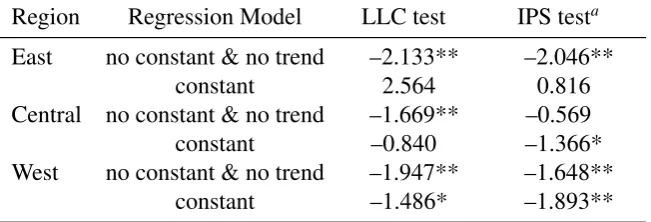
We first employ the commonly used panel unit root tests without a break—the Levin,
Lin and Chu (2002) test and the Im et al. (2003) test. The results are shown in Table 1.
regression model at the 10 per cent or better significance level. From this test result, the
convergence hypothesis of the provincial outputs appears to be supported for each
region. However, the IPS and LLC tests may possibly suffer from biases towards under-
or over-rejections of the unit root null because they do not treat the presence of both
structural breaks and cross-sectional dependence among error terms in the panels.16
Next, we apply the tests based on Fisher’s p-value combination approach—the
MW test and the Fisher_B test—on series with breaks (The estimation results for each
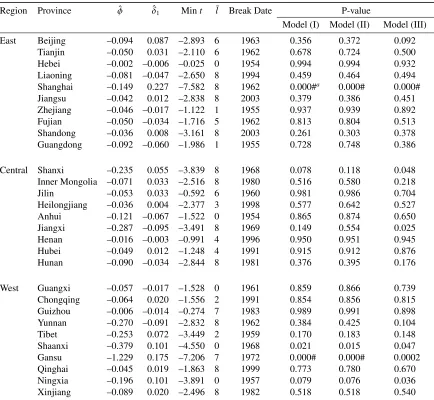
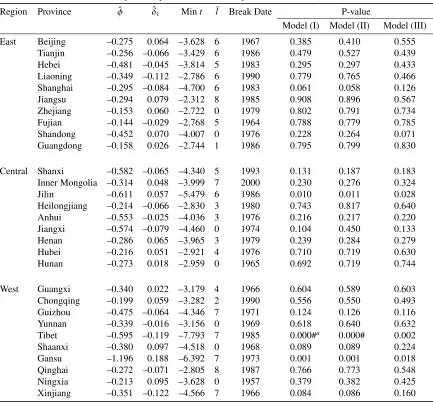
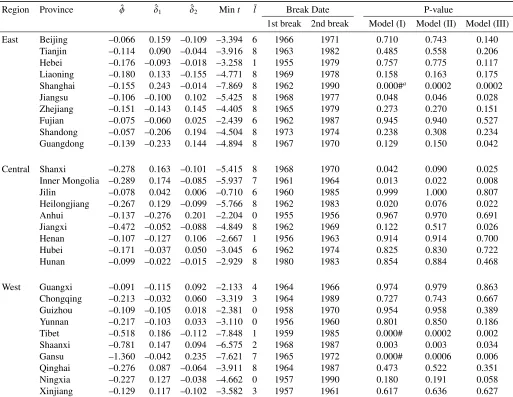
province in the presence of breaks are presented in Tables 1A–4A in Appendix.).17
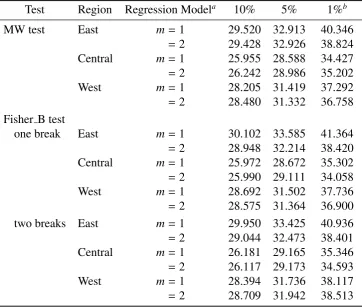
Table 2 provides the small-sample critical values at the 10, 5, and 1 per cent levels of
the MW and Fisher_B tests under Model (III), which are obtained by using the
procedure described in Section 3.2.
Table 3 reports the test results obtained under the three DGPs. In the case of tests
on series without a break (the MW test), there are ten significant tests of regional
16
With regard to these issues, Perron (1989), Leybourne et al. (1998), and Im et al.
(2005) have revealed that ignoring breaks in a single time series or panel data can lead
to an erroneous inference in a test, while O’connell (1998) and Phillips and Sul (2003)
have argued that estimated parameters tend to be biased by the presence of
cross-sectionally correlated errors.
17
We have also obtained test results for cases in which the mean deviations of log per
capita outputs display a linear time trend for Liaoning in the Eastern region and
Heilongjiang and Hubei in the Central region. Since these results are quite similar to
convergence of real per capita outputs. In these tests, however, due to the omission of
breaks, the test results might be inaccurate and, therefore, misleading.
We then consider the possibility of structural breaks occurring at various break
dates across provinces. The fourth column of Table 3 shows the results of the Fisher_B
test in the case of a one-time break. When Models (I) and (II) are used as DGPs, for the
Western region, the Fisher_B test rejects the unit root null hypothesis for both the
regression models (m=1, 2) at the 1 per cent significance level. In addition, under both
the DGPs, significant rejections of the null are observed at the 10 per cent level for the
Eastern region (m=1) and at the 10 or 5 per cent level for the Central region (m=2).
In the case of Model (III), wherein there is the cross-sectional correlation between error
terms, the test statistics for both the regression models for the Western region are still
higher than the corresponding critical values at the 1 per cent significance level. Further,
the statistic of the regression model for the Eastern region where m=1 is also
significant at the 10 per cent level. In the case of Central provinces, the Fisher_B test
cannot support the stationarity alternative. In Model (III), the finding that convergence
occurs within all provinces in the Eastern and Western regions appears to be consistent
with that of Zhang et al. (2001).
The last column of Table 3 presents the results for cases with two-time breaks. In
Models (I) and (II), with one exception in the Central region, all the test results for all
the regions exhibit significant rejections of the unit root null hypothesis at the 5 per cent
or better levels. Moreover, when the correlation of error terms among provinces in each
region is considered in Model (III), the Fisher_B test also strongly supports the
the regression models). As compared to the case of a series that includes a single
structural break, under any DGP, this case indicates the existence of regional
convergence within all the three regions. Therefore, it should be concluded that dealing
with multiple structural breaks occurring at different break dates for each province
provides stronger evidence of the existence of convergence within regions in China.
This fact may also account for the discrepancies in the results compared with those of
Zhang et al. (2001), where one endogenous break point is assumed in their estimation.
The comparison of the three tests results shown in Table 3 reveals that they greatly
depend on the number of breaks allowed in the tests. As discussed in Section 1, due to
the impact of certain significant political and economic events, the provincial real per
capita outputs in China are suspected to have some structural breaks; therefore, in the
analysis on regional convergence in China, we consider it appropriate to examine the
possibility of multiple structural changes in the studied time periods. Consequently,
when the provincial log per capita outputs are allowed to have two-time level shifts at
various break dates across the provinces, we observe convergence of the series in all the
three regions.
4.4. Test Results Based on Other Regional Classifications 18
As illustrated in Figure 1, the mean deviation of the real per capita output for
Shanghai is much larger than those for other Eastern provinces. Since this may be
indicative of the heterogeneity of Shanghai, the series for nine Eastern provinces,
18
excluding Shanghai, have been tested. Consequently, convergence is also observed in
the Eastern region.
Further investigations have been conducted based on other data classifications
where the Eastern region (with or without Shanghai) includes the neighboring provinces,
which are Guangxi, Jilin, and Heilongjiang. The cases where one, two, or all of the
provinces are classified as belonging to the Eastern region are analyzed. As a result, in
the case of two structural breaks, the evidence of convergence has been found in all the
classifications. This fact seems to imply that the neighboring provinces are on the same
path of convergence as that of other Eastern provinces; however, this is not
conclusive.19
To make the discussion more concrete, in classifying provinces into certain regions,
the use of classification methods such as cluster analysis would be desirable. The work
of Hobijn and Franses (2000) is one such application. However, this is beyond the scope
of this paper. Meanwhile, as discussed in Section 4.1, there appear to be substantial
grounds for our classification of Chinese provinces. Therefore, our findings obtained
from Table 3 are meaningful.
19
In addition, the sample consisting of whole provinces has been tested; moreover, a
significant rejection of the unit root null hypothesis has been obtained. However, we
believe that further information (e.g. the homogeneity of provinces classified into
5. Conclusion
In this study, we investigated the regional convergence hypothesis of the provincial per
capita outputs in China while considering up to two-time structural breaks in the panels.
According to the p-value combination approach of Fisher (1932), the panel-based unit
root test has been developed by combining the p-value of the individual unit root test
which allows for breaks in a single time series. This approach allowed us to consider
multiple breaks at various break dates across the provinces. We used three data
generating models in the Monte Carlo simulation—the driftless random walk model, the
ARMA model, and the AR model with cross-sectionally dependent errors—to calculate
the p-value of the individual minimum t-type unit root test from its empirical
distribution. In particular, in the case of the AR model with cross-sectionally dependent
errors, the empirical distribution of the test for each province was generated on the
bootstrap samples, which were obtained by the resampling procedure proposed by
Maddala and Wu (1999) and Wu and Wu (2001). On the basis of their geographical
locations, the provinces were grouped into the following three regions: the Eastern,
Central, and Western regions. Subsequently, the existence of convergence within each
region was tested by the panel unit root test with breaks, which was developed in this
paper. As a result, when the presence of two-time breaks was considered in the test, we
found significant evidence to suggest that the convergence of the provincial per capita
outputs exists within each region.
Acknowledgement
participants at Yokohama Symposia in 2007 for their helpful comments.
References
Banerjee, A. and Carrion-i-Silvestre, J. L. (2006) Cointegration in panel data with
breaks and cross-section dependence, EUI Working Papers, ECO No. 2006/5, 1-47.
Barro, R. J. (1991) Economic growth in a cross section of countries, The Quarterly
Journal of Economics, 106, 407-443.
Barro, R. J. and Sala-i-Martin, X. (1992) Convergence, Journal of Political Economy,
100, 223-251.
Becker, B. J. (1997) P-values, combination of, in Encyclopedia of Statistical Sciences:
Update vol.1 (Ed.) S. Kotz and N. L. Johnson, Wiley, New York, pp.448-453.
Berkowitz, J. and Kilian, L. (1996) Recent developments in bootstrapping time series,
Discussion paper 96/54, Board of Governors of the Federal Reserve System.
Bernard, A. B. and Durlauf, S. N. (1995) Convergence in international output, Journal
of Applied Econometrics, 10, 97-108.
Bernard, A. B. and Durlauf, S. N. (1996) Interpreting tests of the convergence
hypothesis, Journal of Econometrics, 71, 161-173.
Carlino, G. A. and Mills, L. O. (1993) Are U.S. regional incomes converging? A time
series analysis, Journal of Monetary Economics, 32, 335-346.
Chen, J. and Fleisher, B. M. (1996) Regional income inequality and economic growth in
China, Journal of Comparative Economics, 22, 141-164.
Chow, G. C. (1986) Chinese statistics, The American Statistician, 40, 191-196.
Review, 39, 295-306.
Evans, P. and Karras, G. (1996) Convergence revisited, Journal of Monetary Economics,
37, 249-265.
Fisher, R. A. (1932) Statistical Methods for Research Workers, Oliver & Boyd,
Edinburgh, 4th Edition.
Fleissig, A. and Strauss, J. (2001) Panel unit-root tests of OECD stochastic convergence,
Review of International Economics, 9, 153-162.
Greasley, D. and Oxley, L. (1997) Time-series based tests of the convergence
hypothesis: some positive results, Economics Letters, 56, 143-147.
Gundlach, E. (1997) Regional convergence of output per worker in China: a
neoclassical interpretation, Asian Economic Journal, 11, 423-442.
Hobijn, B. and Franses, P. H. (2000) Asymptotically perfect and relative convergence of
productivity, Journal of Applied Econometrics, 15, 59-81.
Holz, C. A. (2006) Why China’s new GDP data matters, Far Eastern Economic Review,
169, 54-57.
Im, K.-S., Lee, J. and Tieslau, M. (2005) Panel LM unit-root tests with level shifts,
Oxford Bulletin of Economics and Statistics, 67, 393-419.
Im, K.-S., Pesaran, H. and Shin, Y. (2003) Testing for unit roots in heterogeneous
panels, Journal of Econometrics, 115, 53-74.
Jian, T., Sachs, J. D. and Warner, A. M. (1996) Trends in regional inequality in China,
China Economic Review, 7, 1-21.
Lee, K., Pesaran, M. H. and Smith, R. (1997) Growth and convergence in a
12, 357-392.
Levin, A., Lin, C.-F. and Chu, C. (2002) Unit root test in panel data: Asymptotic and
finite sample results, Journal of Econometrics, 108, 1-24.
Leybourne, S. J., Mills, T. C. and Newbold, P. (1998) Spurious rejection by
Dickey–Fuller tests in the presence of a break under the null, Journal of
Econometrics, 87, 191-203.
Li, Q. and Papell, D. (1999) Convergence of international output: Time series evidence
for 16 OECD countries, International Review of Economics and Finance, 8, 267-280.
Li, X.-M. (2000) The Great Leap Forward, economic reforms, and the unit root
hypothesis: testing for breaking trend functions in China’s GDP data, Journal of
Comparative Economics, 28, 814-827.
Lim, L. K. and McAleer, M. (2004) Convergence and catching up in ASEAN: a
comparative analysis, Applied Economics, 36, 137-153.
Lumsdaine, R. L. and Papell, D. H. (1997) Multiple trend breaks and the unit-root
hypothesis, The Review of Economics and Statistics, 79, 212-218.
Maddala, G. S. and Wu, S. (1999) A comparative study of unit root tests with panel data
and a new simple test, Oxford Bulletin of Economics and Statistics, 61, 631-652.
Mankiw, N. G., Romer, D. and Weil, D. N. (1992) A contribution to the empirics of
economic growth, The Quarterly Journal of Economics, 107, 407-437.
McCoskey, S. K. (2002) Convergence in Sub-Saharan Africa: a nonstationary panel
data approach, Applied Economics, 34, 819-829.
National Bureau of Statistics (2005) China Compendium of Statistics 1949–2004, China
Ng, S. and Perron, P. (1995) Unit root tests in ARMA models with data-dependent
methods for the selection of the truncation lag, Journal of American Statistical
Association, 90, 268-281.
O’connell, P. G. J. (1998) The overvaluation of purchasing power parity, Journal of
International Economics, 44, 1-19.
Oxley, L. and Greasley, D. (1995) A time-series perspective on convergence: Australia,
UK and USA since 1870, The Economic Record, 71, 259-270.
Pedroni, P. and Yao, J. Y. (2006) Regional income divergence in China, Journal of
Asian Economics, 17, 294-315.
Perron, P. (1989) The great crash, the oil price shock, and the unit root hypothesis,
Econometrica, 57, 1361-1401.
Perron, P. (1994) Trend, unit root and structural change in macroeconomic time series,
in Cointegration for the applied economists, (Ed.) B. B. Rao, Macmillan, Basingstoke
pp.113-146.
Pesaran, M. H. (2004) A pair-wise approach to testing for output and growth
convergence, Mimeo, University of Cambridge.
Phillips, P. C. B. and Sul, D. (2003) Dynamic panel estimation and homogeneity testing
under cross section dependence, Econometrics Journal, 6, 217-259.
Quah, D. (1993a) Empirical cross-section dynamics in economic growth, European
Economic Review, 37, 426-434.
Quah, D. (1993b) Galton’s fallacy and tests of the convergence hypothesis, The
Scandinavian Journal of Economics, 95, 427-443.
Review, 40, 1353-1375.
Raiser, M. (1998) Subsidising inequality: Economic reforms, fiscal transfers and
convergence across Chinese provinces, Journal of Development Studies, 34, 1-26.
Rawski, T. G. (2001) What is happening to China’s GDP statistics? China Economic
Review, 12, 347-354.
Smyth, R. and Inder, B. (2004) Is Chinese provincial real GDP per capita
nonstationary? Evidence from multiple trend break unit, China Economic Review, 15,
1-24.
Weeks, M. and Yao, J. Y. (2003) Provincial conditional income convergence in China,
1953-1997: a panel data approach, Econometric Reviews, 22, 59-77.
Wu, J.-L. and Wu, S. (2001) Is purchasing power parity overvalued? Journal of Money,
Credit, and Banking, 33, 804-812.
Zhang, Z., Liu, A. and Yao, S. (2001) Convergence of China’s regional incomes
1952-1997, China Economic Review, 12, 243-258.
Zivot, E. and Andrews, D. W. K. (1992) Further evidence on the great crash, the
oil-price shock, and the unit-root hypothesis Journal of Business & Economic
Figure 1. Mean deviations of log of provincial real per capita outputs for the Eastern provinces
-1 -0.5 0 0.5 1 1.5 2
1952 1954 1956 1958 1960 1962 1964 1966 1968 1970 1972 1974 1976 1978 1980 1982 1984 1986 1988 1990 1992 1994 1996 1998 2000 2002 2004
Year
Beijing Tianjin Hebei Liaoning Shanghai Jiangsu
Figure 2. Mean deviations of log of provincial real per capita outputs for the Central provinces
-1 -0.5 0 0.5 1
1952 1954 1956 1958 1960 1962 1964 1966 1968 1970 1972 1974 1976 1978 1980 1982 1984 1986 1988 1990 1992 1994 1996 1998 2000 2002 2004
Year
Figure 3. Mean deviations of log of provincial real per capita outputs for the Western provinces
-1.5 -1 -0.5 0 0.5 1
1952 1954 1956 1958 1960 1962 1964 1966 1968 1970 1972 1974 1976 1978 1980 1982 1984 1986 1988 1990 1992 1994 1996 1998 2000 2002 2004
Year
Guangxi Chongqing Guizhou Yunnan Tibet Shaanxi Gansu
Table 1. The results for the Levin et al. (2002) (LLC) test and the Im et al. (2003) (IPS) test
Region Regression Model LLC test IPS testa East no constant & no trend –2.133** –2.046**
constant 2.564 0.816
Central no constant & no trend –1.669** –0.569 constant –0.840 –1.366* West no constant & no trend –1.947** –1.648**
constant –1.486* –1.893**
***, **, and * denote statistical significance at the 1%, 5%, and 10% levels, respectively.
aFor both regression models, the means and the variances of the individual
augmented Dickey–Fuller t-test forT =53−pi−1 were computed with 500,000
replications, wherepiis the number of lagged augmentation terms of the first
difference of a series added in the individual ADF equation.
Table 2. The critical values of the Maddala and Wu (1999) test and the Fisher B test in the case of cross-sectionally dependent errors
Test Region Regression Modela 10% 5% 1%b MW test East m= 1 29.520 32.913 40.346
= 2 29.428 32.926 38.824 Central m= 1 25.955 28.588 34.427
= 2 26.242 28.986 35.202 West m= 1 28.205 31.419 37.292
= 2 28.480 31.332 36.758 Fisher B test
one break East m= 1 30.102 33.585 41.364
= 2 28.948 32.214 38.420 Central m= 1 25.972 28.672 35.302
= 2 25.990 29.111 34.058 West m= 1 28.692 31.502 37.736
= 2 28.575 31.364 36.900 two breaks East m= 1 29.950 33.425 40.936
= 2 29.044 32.473 38.401 Central m= 1 26.181 29.165 35.346
= 2 26.117 29.173 34.593 West m= 1 28.394 31.736 38.117
= 2 28.709 31.942 38.513
a
The regression model is∆y˜it=αˆmidm+φˆiy˜it−1+δˆ1iDU1it+δˆ2iDU2it+P
¯
li
l=1aˆil∆y˜it−l+uit,
i = 1, . . . ,N′,t = 2, . . . ,53, whereN′ = 10 for the Eastern and Western regions and
N′=9 for the Central region, anddm={∅}form=1 anddm={1}form=2; in addition,
ˆ
δ1i=δˆ2i=0 for allifor the MW test and ˆδ2i=0 for allifor the Fisher B test for the one
break case.
bThe values are 10, 5, and 1 per cent points on the right tail of the empirical distributions
of the MW and Fisher B tests. These distributions are obtained as follows. For eachiand
m, under Model (III), the empirical distribution of the minimum tm
i-statistic is obtained
by a Monte Carlo simulation with 5,000 replications. Next, the percentage point (pm i)
of the minimumtm
i-statistic computed for each replication is evaluated on the empirical
distribution obtained in the first step. After this, the value of−2PiN=1logpm
i is calculated
for each replication. The empirical distributions of the tests can thus be obtained from the calculated values of−2Plogpm
i.
Table 3. The results for the Maddala and Wu (1999) test and the Fisher B test in the cases of one-time and two-time breaks
Region Regression Modela MW testb Fisher B testb
(no break) one break two breaks
DGP Model (I): ˜yit =y˜it−1+ǫit
East m= 1 37.511*** 27.251#c* 39.156#***
= 2 12.125 16.436 33.962**
Central m= 1 19.276 13.907 28.053**
= 2 25.340* 28.723** 41.961***
West m= 1 26.270* 37.805*** 52.676#***
= 2 26.751* 50.076#*** 58.674#***
DGP Model (II): ˆθi(L)∆y˜it =ψˆi(L) ˆσiǫit
East m= 1 35.940*** 26.638#* 37.975***
= 2 12.250 16.024 31.379**
Central m= 1 17.185 9.875 19.740
= 2 23.236 23.881* 36.547***
West m= 1 26.214* 38.109#*** 49.923***
= 2 27.492* 49.960#*** 58.591#***
DGP Model (III):∆y˜∗it =P¯ki
k=1γˆik∆y˜
∗
it−k+ǫ
∗
it
East m= 1 19.601 31.744#* 53.414***
= 2 15.104 18.074 22.887
Central m= 1 17.042 23.211 36.035***
= 2 27.109* 24.817 29.930**
West m= 1 28.991* 41.450*** 45.013***
= 2 28.882* 37.688*** 34.546**
***, **, and * denote statistical significance at the 1%, 5%, and 10% levels, respectively.
aThe regression model is∆y˜
it = αˆmidm+φˆiy˜it−1+δˆ1iDU1it+δˆ2iDU2it+P
¯
li
l=1aˆil∆y˜it−l+uit,i =
1, . . . ,N′,t = 2, . . . ,53, whereN′ = 10 for the Eastern and Western regions and N′ = 9 for the Central region, anddm={∅}form=1 anddm={1}form=2; in addition, ˆδ1i=δˆ2i=0 for allifor
the MW test and ˆδ2i=0 for allifor the Fisher B test for the one break case. b
Under Models (I) and (II), because of the restriction ofPNi=1y˜it=0, the degree of freedom of the
chi-square distribution of the test is 2(N−1).
cThe sign # indicates that the p-values for some provinces were estimated to be zero due to the
fact that for each of these provinces, the realization of the minimumtm
i -statistic lay far left from its
empirical distribution which was generated by a Monte Carlo simulation with 5,000 replications. Therefore, in order to calculate the Fisher B statistic, the obtained p-values for these provinces were assigned a value of 0.0002 (1/5000). This implies that we assume that the minimumtm
i -statistic for
each of these provinces took a value within the estimated empirical distribution only once in the 5,000 replications.
Appendix
Proof of Theorem
For simplicity, we omit the subscript i of a variable and denote a time series as merely
t
y instead of ~ used in the main text. Therefore, yt yt is assumed to be subject to
Models (1) and (2) with an i.i.d. innovation εt with a zero mean and a finite variance
2
σ . In this proof, we show the derivation only for the case of m=2 because that for
the case of m=1 is obtained along the same lines.
Let et be the OLS residual obtained by regressing yt on an intercept and two
dummy variables (DU1t and DU2t) for t =1,K,T . Then, the residual is expressed as
(
1 1) (
2 2 2)
1 ˆ
ˆ DU DU DU DU
S
et = tµ −δ t − −δ t − (1A)
where Stµ is the demeaned random walk process such as ≡ − −
∑
T=t t t
t S T S
S
1 1
µ
,
where =
∑
t=s s t
S
1ε , and h
T
t ht h DU
DU =
∑
= =1−τ1 ( h=1,2 ). Now, we write
µ 1 S X' X) (X'
δˆ = −
, where δˆ =(δˆ1,δˆ2)' ; X=
(
DU1 −DU1,DU2 −DU2)
, where(
)
'1 h hT h
h DU , ,DU DU
DU − −
=
− h L
h DU
DU ; µ =
(
S1µ,L,STµ)
'S . Then, we have
(
)
− − − + + − + − − =∑
∑
∑
∑
=∑
∑
= = − = = = − − T t T t T t t t t T t t T t T t t t S S S S S S T T 1 2 1 21 1 2 1 1
1 2 1 1 1 1 2 1 1 2 / 3 1 2 2 / 1 ) 1 ( ) 1 ( ) ( 1 ˆ
τ µ µ τ µ
µ
τ µ τ µ
τ τ τ τ τ τ τ τ δ . Thus, = − − − + − − ⇒
∫
∫
∫
∫
− − − B A dr r W dr r W dr r W dr r W T σ τ τ τ τ τ τ σ δ δ τ µ τ µ τ µ τ µ 2 1 2 1 0 1 1 2 0 0 0 2 1 1 1 2 2 1 2 / 1 ) ( ) 1 ( ) 1 ( ) ( ) ( ) ( ˆ ˆwhere ⇒ denotes weak convergence in distribution. Therefore,
(
)
2(
2 2)
2 / 1 1 1 1 2 / 1 2 / 1 2 /
1 ˆ ˆ
DU DU T DU DU T S T e
T− t = − tµ − − δ t − − − δ t −
=σ
[
Wµ(r)−A{
du1(r,τ1)−(1−τ1)} {
−B du2(r,τ2)−(1−τ2)}
]
where W2(r,τ1,τ2) denotes the residual from the projection of W(r) onto the
subspace generated by the function
{
1,du1(r,τ1),du2(r,τ2)}
, where duh(r,τh)=1 forh
r>τ , and zero otherwise (h=1,2).
From the regression of et on et−1, we can obtain the t-test statistic as
(
)
1/22 2 1 2 2 1 1
∑
∑
= − − = − − ∆ = T t t Tt t t
e T s e e T
t (3A)
where = −
∑
T= − −t et et
T s 2 2 1 1 2 ) ˆ
( ρ , where ρˆ is the estimated coefficient of et−1 in the
regression of et on et−1. Now, we show the probability limits of −
∑
T= −∆t et et
T 2 1 1 ,
∑
= − − Tt et
T
2 2
1
2 and s2.
T−1
∑
et−1∆et is expressed as{
1 1 1 1 1 1}
1 1 2 1 1 2 1 1 ˆ ) 1 ( ) 1 ( ˆ 1
1 τ τ τ δ
δ µ τ
τ µ
µ ∆ − + − + − + −
= ∆ − + = − − = − −
∑
∑
y y y S T S S T e eT T T T
T t t t T t t t
{
}
1 21 2 1 2 2 1 2 1 2 2
1 ˆ ˆ
) 1 ( ˆ ) 1 ( ) 1 ( ˆ 2
2 τ τ τ δ τ τ δδ
δ µ τ
τ + −
− + − + − + − + + −
−T S T yT y T y T .
Hence, we have the following limiting distribution.
{
}
− − + + − ⇒ ∆∫
∫
∑
= − − A W dr r W A r dW r W e e T T t tt ( ) ( ) ( ) 1 (1) (1 1) 1 0 1 0 2 2 1
1 σ µ µ τ τ
−B
{
−∫
1W(r)dr+ 2W(1)+(1− 2)B}
+( 1 + 2 −1)AB0 τ τ τ τ .
In the derivation above, we used the following facts that
∫
∑
∆ ⇒ = − − 1 0 2 2 1 1 ) ( )(r dW r
W S S T T t t t µ µ µ µ σ
, T 1/2S T W ( h)
h σ τ
µ µ τ ⇒ − ) 1 ( 2 /
1 y W
T− T ⇒σ , 1/2 1 ( )
h T W
y T
h σ τ
τ + ⇒
−