14195
RESPONSE SURFACE METHODOLOGY OPTIMIZATION OF PALM
RUBBER SEED COMBINED OIL BASED BIODIESEL AND IDI DIESEL
ENGINE PERFORMANCE AND EMISSION
Ibrahim Khalil Adam1, A. Rashid A. Aziz1 and Suzana Yusuf2
1Centre for Automotive Research and Electric Mobility, Mechanical Engineering Department Universiti Teknologi Petronas, Seri Iskandar, Perak, Malaysia
2Center of Biofuel and Biochemical Research, Biomass Processing Laboratory, Chemical Engineering Department, Universiti Teknologi Petronas, Seri Iskandar, Perak, Malaysia
E-Mail: [email protected]
ABSTRACT
Emission from diesel engine has been considered as major air pollution sources. The blending of feedstocks is motivated by property enhancement and cost reduction. In this study rubber seed/palm oil mixture at equal blend ratio was used to produce biodiesel. Parametric effect on trans esterification were studied using response surface methodology (RSM). Maximum yield was determined. Methyl ester at optimized condition was produced. Thermo physical properties were studied. Methyl ester effect on the emissions and performance of unmodified indirect injection diesel engine (IDI) at full load was examined. The results show that blends torque and brake mean effective pressure (BMEP) were 1.1% and 1% lower. Compared to diesel fuel, power and brake thermal efficiency (BTE) were 1.1% and 1.3 % lower, but brake specific fuel consumption (BSFC) was 1.4% higher. The CO was reduced 2% while CO2, NOx and exhaust temperature increased on averages of 1%, 1.2% and 1.1% respectively.
Keywords: rubber seed oil, palm oil, response surface methodology, performance and emissions.
INTRODUCTION
The use of clean fuel such as biodiesel has both environmental and economic advantages. The environmental advantage is reduced emissions, whereas economic benefit stems from locally availability of raw material and improve energy security. Currently most of biodiesel production comes from edible sources such as soybean, palm and sunflower oils. However due to price fluctuation, land limitation, contrary to the current social movement and energy policies, it’s industrial expansion has been limited [1]. Although the biodiesel production from these sources inevitable for their availability and large production levels, reducing their amounts using no edible sources will relieve them for other uses. Blending edible/non-edible oils is a solution that will give big contribution towards the advancement of the industry. In addition, Jatropha-palm oil, Jatropha- soapnut and Mahua-simarouba oil blends had been investigated [2-6] and observed to be a good potential sources for biodiesel production. In Malaysia there are 1,229,940 hectares of rubber plantation according to association of Natural Rubber Producing Countries and the projected annual production estimated to be 1.2 million metric ton per year [7]. The trees yield in an average of 800 seed (1.3kg) twice a year depending on crop density and soil fertility. The kernel has an average oil of 30-40 wt. % and can be used for biodiesel synthesis. The detailed literature of rubber seed oil based biodiesel production process is available in [8-12]. Usta et al. [13] tested oil blend of
waste sunflower/hazelnut soapstock in indirect injection diesel engine. It is reported that compared to diesel fuel blends torque and power were higher. Optimum blend was 17.5% methyl ester addition to diesel. Emissions of CO, CO2 and exhaust temperature were higher. NOx was
higher at full load and reduced at partial loads. Raheman
et al. [5] investigated biodiesel effect obtained from
mahua-simarouba oil mixture on a single cylinder diesel engine emissions and performance. They reported higher BSFC and NOx. BTE, CO and total hydrocarbon (THC) were lower compared to diesel fuel. Haas et al. [14]
investigated soybean soap stock biodiesel in a diesel engine. It is observed that CO, THC and particle matter (PM) were reduced. From a literature view, there is a major lack exists regarding the production optimization, engine emissions and performance of oil blends based biodiesel such as rubber seed/palm oil. Therefore, in this paper, rubber seed/palm oil mixture at equal blend ratio was studied. The response surface methodology (RSM), in Design Expert 8.0 software was utilized to investigate parametric effect on the transesterification process. The experimental design used was Central Composition Design (CCD). Methyl ester at optimized condition was produced using two-step (acid esterification and transesterification) process in hydrodynamic cavitation reaction. Thermo physical properties and IDI diesel engine emissions and performance at full load was investigated. To the authors knowledge this paper is pioneering the testing of unmodified indirect diesel engine using biodiesel based oil blend of rubber seed/palm at full load.
MATERIALS AND METHODS
Rubber seed/ palm oils analysis
Rubber seed/Palm oil mixture at equal blend ratio (vol. %) was characterized. The parameters such as acid value, iodine value, free fatty acid percentage, density, viscosity, calorific value, nitrogen and sulphur content were investigated following AOCS method [15]. The results of oil analysis are presented in Table-1.
Table-1. Rubber seed/ palm oil blend analysis.
Based transesterification study
Transesterification is a chemical conversion in which the triglycerides is converted to fatty acid alkyl ester. Rubber seed/palm oil blend acid value of 33.4 mg KOH/g oil was reduced to 1.42 mg KOH/g oil in acid esterification process. Oil after acid esterification process was used for transesterification process. Three-neck round bottom flask of 250 ml attached with condenser to avoid
alcohol losses was used. Input factors and theirs ranges were, (-1) low level, (+1) high level and on the axial direction were (-2) low level and (+2) high level as presented in Table-2. The required temperature, mixing time (mechanical stirrer) and amount of methanol and catalyst (potassium hydroxide) followed the experimental plan as shown in Table-3. After the specified time the reaction process was stopped and the product was left for separation gravitationally. Two layers such as methyl ester upper and glycerol lower were formed after 12 h. The deionized warm water was used to wash the methyl ester to remove impurities. Finally, the produced biodiesel was stored for properties study. Transesterification optimized condition of 97% conversion yield, were reaction temperature and time of 64 °C and 2.5 h, catalyst amount of 1.3 and methanol to oil ratio of 6:1.
Table-2. Process parameter for transesterification.
14197
Test fuel and properties study
The preparation of fuels and properties study were carried out at Universiti Teknologi Petronas. Three samples such as fossil diesel fuel, B10 (10% biodiesel and 90% diesel, and B20 (20% biodiesel and 80% diesel) vol. % were investigated. The blends were mechanically stirred for 15 minutes at 2500 rpm. The properties of the fuels were studied following ASTM and EN standard method. Anton Paar (model DMA 4500M) was used to measure the density following ASTM D 5002 standard method. Anton Paar, Lovis (model 2000 M/ME) was used to study the viscosity. Cloud point and pour point temperature were obtained by CPP 5G’s analyzer based ASTM D 2500 and ASTM D 97 test methods respectively. FPP 5G’s and 873-CH-9101 Metrohm analyzer were used to measure the cold filter plugging point and oxidation stability following ASTM D 6371 and EN 14112 standard. Octane number was analyzed using SHATOX SX-100K) with RS-232 interface connector following ASTM D-613 standard method. The surface tension was measured using rame hart model 260. The properties of the methyl ester and blends are presented in Table-4.
Table-4. Methyl ester and blends properties.
Engine testing
Unmodified multi cylinder indirect injection diesel engine, model XLD 418D was used for presence investigation. The experimental setup and engine specification are shown in Figure-1 and Table-5. The engine and the dynamometer were controlled using control panel (ECU) equipped with sensors, logging and data acquisition device. The experiments were started with engine warm up for about 30 minutes using diesel fuel and the test was conducted in a full and partial loads at variable speed of 1000 to 4500 rpm. The engine was flushed with fossil diesel after every fuel change and running for 20 minutes to insure full exhaustion of pervious sample. The experiments were repeated two time to insure stable reading of torque, engine oil and cooling water inlet and outlet temperatures and fuel mass flow. The emissions such as NOx, CO, O2, exhaust gas temperature and CO2 were measured using Mur Vario Plus Industrial exhaust gas analyser 944008 model. Exhaust gas analyser was calibrated at each fuel changed. The repeated measured data for each blend were averaged prior used for analysis and discussions.
Table-5. Engine specification.
RESULTS AND DISCUSSION
Effect of catalyst, oil to alcohol ratio, reaction time and temperature on FAME yield
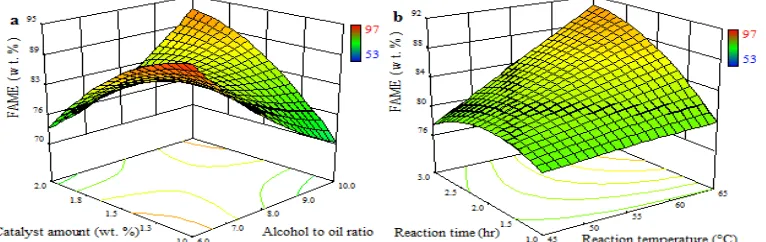
The parametric effect such as reaction temperature, time, catalyst and oil to alcohol ratio on FAME conversion based transesterification is presented in Figure-2. (a) and (b). It is observed that by increasing alcohol to oil ratio and catalyst the FAME yield decreased.
[image:4.612.118.501.208.329.2]The reason behind is due to saponification reaction resulting in poor product separation and higher glycerol formation. It was observed that the first 25-30 minutes of reaction time was enough to achieve the maximum amount of FAME yield, whereas FAME conversion rate increased as temperature increased and promoted reaction towards product side as presented in Figure-2b.
Figure-2. Effect of oil to alcohol ratio and catalyst (a) and reaction temperature and time (b).
ANOVA (Analysis of variance) study based transesterification process
The transesterification output response significance was statistically studied using ANOVA test and presented in Table-6. The model assumed to be significant if P-value is less than 0.05 at 95% confidence level. Data fitting goodness was expressed in terms of determination coefficient (R2) and goodness of prediction (adjusted-R2). The influence of oil molar ratio to alcohol, reaction temperature, time and catalyst ratio on FAME conversion was measured using F-value. The higher the F value of the variable, the high its influence as shown in Table 6. In this study B (catalyst) and D (reaction time) are
most influencing variables compared to alcohol to oil ratio and reaction temperature as in Figure-3a. Thus the steepest factor is the most influencing compared to others. The trend between the model predicted values versus actual confer the software prediction compared to the experimental, thus the model positively fitted well with the experimental as in Figure-3b. The points are close towards the center linear line. From the regression analysis the response equation was produced in terms of actual and coded terms. The second order coded polynomial equation in terms of most influencing variables on yield is presented in Equation. (1).
2 2
[image:4.612.79.536.541.739.2]FAME yiled =+88.86- 6.18*B+ 5.05*D- 4.61*B -4.93*D +9.66*AB- 5.59*AC
(1)
14199
Figure-3. Based transesterification perturbation plot (a) and prediction vs. actual FAME (b).
Engine performance and emissions at full load
The variations of engine emissions and performance and averages of performance and emissions over speed at full load are presented in Figure-4. Compared to diesel fuel, blends torque, power and BMEP were almost similar at 1000 -3000 rpm, whereas the difference was more dominant as speed increased beyond 3000 rpm. The reason behind this is additional lubricity provided by biodiesel blends and oxygen resulted in complete combustion [16]. The reduction at higher speed is because of engine inability to ingest fuel charge of air and increased frication loses. CO emission of the blends compared to diesel fuel was 2% lower. The CO reduction was because of biodiesel chemically bound oxygen that results in increasing the oxidation rate of CO to CO2. The increases of CO2 were observed to be 1% compared to diesel fuel. NOx and exhaust temperature of the blends
Figure-4. Variation of engine performance and emissions vs. speed at full load.
CONCLUSIONS
In this study parametric effect on rubber seed/palm oil biodiesel synthesis were studied using response surface methodology method. Optimum condition of higher yield was determined and biodiesel at optimized condition was produced. Methyl ester was characterized and found to be in good agreement with ASTM and EN standard. In addition, the effect of obtained methyl ester blended diesel on the emissions and performance of IDI engine were investigated. The following conclusions are obtained.
The catalyst (B) and reaction time (D) were found to be the most influencing variables compared to alcohol to oil ratio (A) and reaction temperature(C).
On an averages blends BSFC was 1.4% higher, while brake thermal efficiency was either similar or less than diesel fuel. CO emission of the blends was up to 1.5% lower but CO2 was 1% higher compared to diesel fuel. Exhaust temperature and NOx of the blends compared to diesel fuel was 1.1% and 1% higher compared to diesel fuel.
ACKNOWLEDGEMENTS
14201
REFERENCES
[1] Wendy, N, Pei Qin, Hon Loong, L, Yusup, S 2013.Supply network synthesis on rubber seed oil utilisation as potential biofuel feedstock. Energy 55: 82-88.
[2] Sarin, R, Sharma, M, Sinharay, S, Malhotra, RK 2007.Jatropha – Palm biodiesel blends : An optimum mix for Asia. Fuel 86: 1365-1371.
[3] Amit, S, Arora, R, Singh, NP, Sarin, R, Malhotra, RK, Kundu, K 2009.Effect of blends of Palm-Jatropha-Pongamia biodiesels on cloud point and pour point. Energy 34: 2016-2021.
[4] Amit, S, Arora, R, Singh, NP, Sarin, R, Malhotra, RK 2010.Blends of biodiesels synthesized from non-edible and non-edible oils: Influence on the OS (oxidation stability). Energy 35(8): 3449-3453.
[5] Jena, RH, Jadav, PC, Snehal, S 2013.Performance of a diesel engine with blends of biodiesel ( from a mixture of oils ) and high-speed diesel. International Journal of Energy and Environmental Engineering 4(1): 1-1.
[6] Yi, CH, Han, CT, Hong, CJ 2012.An optimum biodiesel combination: Jatropha and soapnut oil biodiesel blends. Fuel 92(1): 377-380.
[7] Eka, HD, Tajul, AY, Wan, N, W. A. 2010.Potential use of Malaysian rubber (Hevea brasiliensis) seed as food, feed and biofue. International Food Research Journal 17: 527-534.
[8] Ramadhas, AS, Jayaraj, S, Muraleedharan, C 2005.Biodiesel production from high FFA rubber seed oil. Fuel 84: 335-340.
[9] Yang, R, Su, M, Zhang, J, Jin, F, Zha, C,Li, M et al.
2011.Biodiesel production from rubber seed oil using poly ( sodium acrylate ) supporting NaOH as a water-resistant catalyst. Bioresource Technology 102: 2665-2671.
[10]Ahmad, J, Yusup, S,Bokhari, A, Mohammad Kamil, R 2014.Study of fuel properties of rubber seed oil based biodiesel. Energy Conversion and Management 78: 266–275.
[11]Morshed, M, Ferdous, K, Khan R., M, Mazumder, MSI, Islam, MA, Uddin, MT 2011.Rubber seed oil as a potential source for biodiesel production in Bangladesh. Fuel 90: 2981–2986.
[12]Ramadhas, AS, Jayaraj, S, Muraleedharan, C 2005.Characterization and effect of using rubber seed
oil as fuel in the compression ignition engines. Renewable Energy 30: 795-803.
[13]Usta, N, Ozturk, E, Can, O, Conkur, ES, Nas, S, Con,
AH et al. 2005.Combustion of biodiesel fuel produced
from hazelnut soapstock/waste sunflower oil mixture in a Diesel engine. Energy Conversion and Management 46(5): 741-755.
[14]Haas, MJ, Scott, KM, Alleman, T, L., McCormick, RL 2001.Engine Performance of Biodiesel Fuel Prepared from Soybean Soapstock: A High Quality Renewable Fuel Produced from a Waste Feedstock. Energy & Fuels 15: 1207-1212.
[15]Firestone, D 1998.Offical methods and recommended practices of the AOCS. American Oil Chemists Society
[16]M.A. Kalam, M. Husnawan, Masjuki, HH 2003.Exhaust emission and combustion evaluation of coconut oil-powered indirect injection diesel engine. Renewable Energy 28: 2405–2415.
[17]Muralidharan, K, Vasudevan, D 2011.Performance , emission and combustion characteristics of a variable compression ratio engine using methyl esters of waste cooking oil and diesel blends. Applied Energy 88(11): 3959-3968.