Georgia State University Georgia State University
ScholarWorks @ Georgia State University
ScholarWorks @ Georgia State University
Respiratory Therapy Theses Department of Respiratory Therapy
Summer 8-11-2011
Cost-Benefit Analysis of a Dosimetric Nebulizer Using Circulaire
Cost-Benefit Analysis of a Dosimetric Nebulizer Using Circulaire
and aTraditional Vixone Nebulizer
and aTraditional Vixone Nebulizer
Nwakaego C. Okere Ms Georgia State University
Follow this and additional works at: https://scholarworks.gsu.edu/rt_theses Part of the Medicine and Health Sciences Commons
Recommended Citation Recommended Citation
Okere, Nwakaego C. Ms, "Cost-Benefit Analysis of a Dosimetric Nebulizer Using Circulaire and aTraditional Vixone Nebulizer." Thesis, Georgia State University, 2011.
https://scholarworks.gsu.edu/rt_theses/8
This Thesis is brought to you for free and open access by the Department of Respiratory Therapy at ScholarWorks @ Georgia State University. It has been accepted for inclusion in Respiratory Therapy Theses by an authorized administrator of ScholarWorks @ Georgia State University. For more information, please contact
ACCEPTANCE
This thesis, COST-BENEFIT ANALYSIS OF A DOSIMETRIC NEBULIZER USING CIRCULAIRE AND A TRADITIONAL VIXONE NEBULIZER, by Nwakaego C. Okere, RRT, was prepared under the direction of the Master‟s Thesis Advisory Committee. It is accepted by the committee members in partial fulfillment of the requirements for the degree of Master of Science in the College of Health and Human Sciences, Georgia State University.
The Master‟s Thesis Advisory Committee, as representatives of the faculty, certifies that this thesis has met all standards of excellence and scholarship as determined by the faculty.
____________________________________ Douglas S. Gardenhire, Ed.D, RRT-NPS Committee Chair
____________________________________ Chip Zimmerman, M.S., RRT-NPS
Committee Member
AUTHOR‟S STATEMENT
In presenting this thesis as a partial fulfillment of the requirements for the advanced degree from Georgia State University, I agree that the library of Georgia State University shall make it available for inspection and circulation in accordance with its regulations governing materials of this type. I agree that permission to quote, to copy from, or to publish this thesis may be granted by the professor under whose direction it was written, by the College of Health and Human Sciences director of graduate studies and research, or by me. Such quoting, copying, or publishing must be solely for scholarly purposes and will not involve potential financial gain. It is understood that any copying from or
publication of this thesis which involves potential financial gain will not be allowed without my written permission.
NOTICE TO BORROWERS
All theses deposited in the Georgia State University Library must be used in accordance with the stipulations prescribed by the author in the preceding statement. The author of this thesis is:
Nwakaego C. Okere, RRT 6603 Church Street, Apt # I-3
Riverdale, Georgia 30274
The director of this thesis is:
Douglas S. Gardenhire, Ed.D, RRT-NPS Director of Clinical Education Division of Respiratory Therapy
School of Health Professions Georgia State University
P.O. Box 4019 Atlanta, Georgia 30302
Users of this thesis not regularly enrolled as students of Georgia State University are required to attest acceptance of the preceding stipulation by signing below. Libraries borrowing this thesis for use of their patrons are required to see that each user records here the information requested:
Curriculum Vitae
Nwakaego C. Okere, RRT 6603 Church Street, Apt # I-3
Riverdale, Georgia 30274
EDUCATION
Georgia State University – Atlanta, Georgia
College of Health and Human Sciences Division of Respiratory Therapy
Masters of Science, Health Science, Candidate
University of Calabar – Nigeria, West Africa
Faculty of Arts and Humanities Department of Foreign Languages
Bachelors of Arts (Hons.) French, June 2004
CERTIFICATIONS
Registered Respiratory Therapist # 121117, February 2011 Respiratory Care Professional, State of Georgia, # 8485
PROFESSIONAL SOCIETIES
American Association for Respiratory Care National Board for Respiratory Care
ADMINISTRATIVE RESPONSIBILITIES/APPOINTMENTS Piedmont Fayette Hospital - Fayetteville, Georgia
Respiratory Care Practitioner, May 2011 – Present
SPECIAL RECOGNITION
ACKNOWLEDGMENTS
I would like to thank God Almighty for His Grace and Mercies during the course of this thesis work. I would not have made it this far without His benevolence.
To Douglas S. Gardenhire, Ed.D, RRT-NPS, thank you for all your assistance, guidance, support, and encouragement during this journey. You have been such a great inspiration, and I will always be appreciative of all your encouraging words.
To Ralph “Chip” Zimmerman, MS, RRT-NPS, thanks for all your feedback and words of encouragement throughout the writing of my thesis. Your motivation has helped me attain great heights. I sincerely appreciate all your hard work.
To all the faculty members of the Division of Respiratory Therapy, Georgia State University, thanks for being such a great resource. I have really appreciated it.
To my parents Mr. & Mrs. B. Chidi Okere, my siblings Iyke, Nkechi, and Ugo, I will always remain eternally grateful for all your love, prayers and support. You have encouraged me and supported me in every decision, not relenting in your prayers for me. May God continue to bless you abundantly, and may I always be a source of joy and inspiration to you.
COST-BENEFIT ANALYSIS OF A DOSIMETRIC NEBULIZER USING CIRCULAIRE AND A TRADITIONAL VIXONE NEBULIZER
By
NWAKAEGO CHIOMA OKERE, RRT
A Thesis
Presented in Partial Fulfillment of Requirements for the
Degree of Master of Science
in Health Science
in
the Division of Respiratory Therapy in
the College of Health and Human Sciences Georgia State University
ABSTRACT
COST-BENEFIT ANALYSIS OF A DOSIMETRIC NEBULIZER USING CIRCULAIRE AND A TRADITIONAL VIXONE NEBULIZER
By
Nwakaego C. Okere, RRT
Aerosol administration via small-volume nebulizers are still being used by selected patient-population. In the economic market, several nebulizer designs have become available, with each incorporating unique features that will potentially establish it as the preferred choice in aerosol delivery. With the continuous rising cost of health care services, clinicians are faced with the task of identifying opportunities for cost reduction in respiratory care. PURPOSE: The purpose of this study was to conduct a cost-benefit analysis of dosimetric nebulization using the Circulaire system and the traditional
VixOne nebulizer. The desired outcome was to elevate awareness of the potential impact of the Circulaire, and how its adoption might reduce costs and enhance productivity in respiratory care. METHODS: A retrospective study using existing data collected from an urban tertiary adult hospital with a Level II Trauma Center was completed. DATA
ANALYSIS: Descriptive statistics were run for each variable. The total cost of a full-time Registered Respiratory Therapist (RRT) with benefits per hour was calculated. The average number of RRTs per 12-hour shift, average number of nebulizer treatments by an RRT per 12-hour shift, average costs of traditional VixOne nebulizer and the Circulaire system were also calculated. RESULTS: Descriptive statistics indicated the annual cost of delivering aerosol therapy using the traditional VixOne nebulizer at 9-minutes
treatment time to be $114,263.25 per year. The Circulaire was compared at two different treatment times of 5-minutes and 3-minutes, and the annual costs were $137,422.50 per year and $116,982.50 respectively. A sensitivity analysis was also conducted, and the treatment load was increased by 30%, with a reduction to 5 RRTs per shift. Data indicated an annual savings of 8% with the Circulaire at 5-minutes treatment time, and 21% with the Circulaire at 3-minutes treatment time. CONCLUSION: The use of the Circulaire system at 5-minutes or 3-minutes treatment time can reduce department expenditure by reducing labor costs.
TABLE OF CONTENTS
Chapter Page
I. INTRODUCTION………...1
Purpose of Study……….9
Research Questions………...10
Significance of Study………11
Definition of Words and Terms………11
Delimitations……….11
Assumptions……….12
II. REVIEW OF LITERATURE………13
III. METHODOLOGY……….….…..23
IV. RESULTS………..26
V. DISCUSSION………...30
Recommendation for Future Research……….…34
Conclusion………....34
REFERENCES……….…36
CHAPTER I
Introduction
The rising costs of health care in the United States have become a critical issue
that can no longer be ignored anymore. It was among the forefront of issues raised during
the debate for reforms in the health care system. What is not widely recognized, however,
is that this rising costs at a disturbingly rapid rate is true throughout the world, most
especially in all developed nations (Malach and Baumol, 2010).
With the new millennium, consumers of health care services have felt the need to
cut down on their coverage as a result of the rising cost of health care. However, the
reality remains that as the demand for health care services increases, additional funding in
this area becomes highly unlikely, and all efforts should be geared towards finding
possible avenues for cost reduction of health care services.
In this era of limited health care resources, the adoption of the least expensive
treatment modalities and the development of cost-saving medical technology will go a
long way in minimizing the burden of health care costs. Most health care administrators,
chief executive officers, directors, and clinicians are now veering towards several cost
saving alternatives as means of combating the economic aspect of health care. There is a
new focus on the economic efficiency of a strategy versus its clinical impact by weighing
the costs against the benefits that it might bring over a number of years in the future. If
budget gatekeepers and other key decision-makers are to be won over, proponents of the
new product need a strategic plan to gather and present empirical evidence that
2
To facilitate the adoption of any new product, reliable and valid data are needed
to support both the cost of the product and the benefits that are likely to arise from using
the product. Cost-benefit analysis attempts to translate into dollar terms the improved
clinical outcomes from a new care or treatment intervention (Dunne, 2002). The
difference between cost-benefit analysis and cost-effectiveness analysis is that unlike
cost-benefit analysis, cost-effectiveness analysis does not necessarily translate into a
dollar amount. However, it compares the effectiveness of an intervention by measuring
one or more outcomes and comparing it with the costs.
Just like any other sector in health care, there is also need to save costs in
respiratory care. Most respiratory care establishments are adopting cost-effective
modalities, aimed at saving resources for the department, improving productivity, and
saving manpower/labor, most especially in facilities where the demand for respiratory
therapists exceed their availability.
The administration of aerosol therapy via small-volume nebulizer accounts for a
large proportion of the in-patient respiratory therapy workload in large health-care
organizations (Hoisington, Chatburn, and Stoller, 2009). It is not uncommon to see that in
most hospitals, the purchasing department rather than the respiratory care department
oversee the selection of nebulizers, and the nebulizer brand selected is usually based on
price. According to the study done by Hoisington et al. (2009), time spent delivering
small volume nebulizer treatments accounted for approximately 40% of the clinical
3
Reducing the time spent on aerosol administration can be achieved by
modification of the nebulizer equipment to deliver aerosol more rapidly, thus shortening
the length of treatment time. For example, if a novel nebulizer is shown to result in 35%
fewer treatments during hospitalization, the incremental increase in the cost of the device
should be evaluated in the context of the overall savings realized (Dunne, 2002). The
rationale being that fewer treatments given can indirectly save cost through fewer missed
treatments, reduced length of hospital stay, greater satisfaction by patients, and decreased
workload on respiratory therapists ensuring that more time is spent on other important
respiratory patient-care activities.
The term “nebulizer” derives from the Latin “nebula,” meaning “mist,” and
reportedly was first used in 1872, followed by an 1874 definition as “an instrument for
converting a liquid into fine spray, especially for medical purposes” (Rau, 2002). One of
the oldest forms of delivering aerosol therapy is through the nebulizers. They are
predominantly used to deliver bronchodilators to the lower respiratory tract. The liquid
particles are converted into aerosol particles, and are deposited into the lower respiratory
tract through inhalation.
Most aerosol devices do not generate a single particle size. Instead, they usually
produce heterodisperse particle sizes. A measure used to determine a heterodisperse
aerosol particle is the mass median diameter (MMD). The mass median diameter or mass
median aerodynamic diameter (MMAD) indicates where the mass of drug is centered in a
distribution of particle sizes (Gardenhire, 2008). When nebulizers are used to deliver
medications like bronchodilators to the lungs, it is important to have the particle sizes
4
sizes that are too small or too large end up being ineffective, and have no clinical benefits
when administered. This is because particle sizes that are too small tend to be blown
away during exhalation, thereby failing to deposit in the lung periphery, while the aerosol
particles that are too large end up being deposited in the nose, mouth, and oropharynx.
Aerosol particle sizes that are between 1 – 5µm usually deposit in the lower respiratory
tract, particle sizes between 5 – 10µm mostly deposit in the upper airways, and particle
sizes > 10µm are usually found in the nose, mouth, and oropharynx.
Several literatures (Dolovich et al., 2005; Hess, 2002; Rau, 2002, 2004) have
supported the use of small-volume nebulizers because some drugs are only available for
inhalation in liquid solutions, and also some patients who are unable to either coordinate
their breathing, or generate a high inspiratory flow unlike with the metered-dose inhalers
and dry powder inhalers respectively are much more comfortable using the small-volume
nebulizers.
There are two main types of nebulizers. These include pneumatic nebulizers, also
called jet nebulizers, and ultrasonic nebulizers. These nebulizers differ based on their
principles of operation, aerosol particle size generated, and time of nebulization. The
operation of a pneumatic nebulizer requires a pressurized gas supply as the driving force
for liquid atomization (Hess, 2000). The solution to be aerosolized is entrained into the
gas stream as compressed gas is delivered through a jet. The solution is then sheared into
a liquid film which separates into droplets as a result of surface tension. A more stable
particle size is produced by placing a baffle in the aerosol stream. The baffle acts as a
sieve by allowing the smaller particles to pass through, preventing larger particles from
5
The ultrasonic nebulizer uses a piezoelectric transducer to produce ultrasonic
waves that pass through the solution and aerosolize it at the surface of the solution (Hess,
2000). The piezoelectric effect is defined as the ability of some materials to convert
electrical energy into mechanical energy which vibrates and causes the solution to be
aerosolized. Ultrasonic nebulizers have been shown to produce particle sizes of smaller
MMAD when compared with pneumatic nebulizers.
There are numerous advantages and disadvantages of using the small-volume jet
nebulizers. Perhaps one of the greatest advantages similar with both small-volume jet
nebulizers and ultrasonic nebulizers is the tidal breathing pattern. This is very simple and
less complex, being the most convenient for patients who are unable to coordinate their
breathing. Patients who are unable to generate high inspiratory flows and large volumes
find this more effective. Another factor is also the ability to aerosolize more than one
drug solution at a time. Jet nebulizers have the ability of modifying drug concentrations,
allowing the delivery of higher doses.
In the United States, health care reimbursements are often determined by a
number of issues. In most cases, patients tend not to use devices that they cannot afford.
Medicare reimbursements do not cover the use of pressurized metered-dose inhalers
(MDI) and dry powder inhalers (DPI) in non-hospitalized patients, but does for patients
who use nebulizers in home therapy.
Some of the disadvantages of small-volume jet nebulizers include the length of
time required to aerosolize, the need for an external power source, the size of the
6
jet nebulizers is that it increases the risk of infections. There is an increased risk of
patient contamination when the nebulizers are not properly cleaned after use, and are
constantly stored in wet or moist conditions. This allows for the growth of bacteria and
other unhealthy organisms.
There are various factors that affect the deposition of aerosol when using the
small-volume jet nebulizers. Some of the factors are patient-related, while others can be
due to technical issues. Some of the patient-related factors include the breathing pattern.
Patients are encouraged to maintain normal tidal breathing with occasional deep breaths
for better aerosol deposition in the lung periphery. Also, with the nose acting as a filter,
some of the aerosolized drugs are lost on patients who breathe through the nose versus
patients who breathe through the mouth. Other patient-related factors include the degree
of airway obstruction, artificial airway, and mechanical ventilation.
Several studies (Hess, 2000, 2002; Rau, 2002, 2004) have attributed the
differences in design and nebulizer models from various manufacturers as one of the
major technical factors affecting the deposition of aerosol when using small-volume jet
nebulizers. Other technical factors include the density of the gas used to deliver the
aerosol; humidity and temperature; the solution of the liquid nebulized; and the device
interface used to deliver the aerosol. Better aerosol deposition is obtained with patients
who are encouraged to use the mouthpiece instead of the mask. Masks that do not
properly fit cause aerosol particles to be deposited in the face or eyes instead of their
intended location. The amount of gas flow and pressure also affect the size of aerosol
particle generated. Lower gas flows and pressures tend to increase particle size, while
7
affect the overall performance of the nebulizers. Several studies have also reported
greater output from pneumatic nebulizers when the fill volume is increased (Hess, 2000,
2002; Rau, 2002, 2004). This can be explained by the fact that a greater fill volume
increases the total output of aerosol generated, while the percentage of dead volume
within the nebulizer increases with a small fill volume. The dead volume is the amount of
the aerosol medication that is not delivered at the end of treatment. A fill volume of 4 – 5
mL has been recommended.
With the advancements in bio-medical technology come newer and more efficient
nebulizer designs. Jet nebulizers are predominantly classified under three major
categories. They include constant-output nebulizers, breath-enhanced nebulizers, and
dosimetric or breath-actuated nebulizers. Constant-output nebulizer is the type of
nebulizer that delivers aerosol at a constant rate, without taking into account if a patient is
inhaling or exhaling. Constant-output nebulizers are theoretically inefficient, as they (at
least without accessory modification) result in making available for patient inhalation a
maximum of only about one third of the total aerosol released, with the remaining two
thirds of total aerosol output being released either during the patient exhalation or
breath-hold phase (Dennis, 1998). The traditional nebulizer cup such as the Misty-Neb with a
mouthpiece that is connected to a T-piece is an example of the constant-output nebulizer.
Breath-enhanced nebulizers have designed characteristics that allow them to
release more aerosols during patient inhalation while dropping back to residual output
capacity during non-inspiratory phases (breath-hold and exhalation phases) (Dennis,
1998). These devices are more superior to the constant-output nebulizers because fewer
8
aerosol is still generated and lost to the atmosphere during the breath-hold and exhalation
phases. Pari LC Plus and Ventstream are examples of breath-enhanced nebulizers.
Dosimetric nebulizers are designed to release aerosol only during the inspiratory
phase. This can be achieved by generating aerosol only during inspiration, using a
manual interrupter for the power-gas (as in the Pari LL) or a spring-loaded valve (as in
the AeroEclipse) or by containing all aerosol in the device, with no release during
expiration (as with the Circulaire) (Rau, 2002). This type of jet nebulizer design is the
most efficient in the delivery of aerosol medications and has been shown to reduce
treatment time and improve patient compliance (Dennis, 1998; Rau et al., 2004).
Specifically designed nebulizers have also been manufactured for aerosolizing
specific medications. This is because the physical composition, efficiency, and efficacy
of these drugs may be affected when used with regular nebulizers. Examples of such
special nebulizer devices include the Respirgard II for the delivery of aerosolized
pentamidine (NebuPent), Small-Particle Aerosol Generator for aerosolization of ribavirin
(Virazole), and Pari LC which is used to aerosolize tobramycin (TOBI). Some of these
drugs require special scavenging systems as they have also been shown to contaminate
the environment, thereby posing a health hazard to the health care professionals.
In the late 1980s and early 1990s, there were reports of increased aerosol delivery
to the lower respiratory tract when a plastic chamber was used with the nebulizer to
capture aerosol during the expiratory phase, and provide that to the patient during
subsequent inspiration (Hess, 2000). This concept was incorporated into the design
9
reservoir bag of 750mL that is used to store aerosol during exhalation. On subsequent
inhalation, stored aerosol from the bag is delivered to the patient with a one-way valve
preventing the patient from rebreathing exhaled carbon dioxide. The Circulaire uses a
one-way flapper valve so that gas can travel only from the direction of the aerosol storage
bag toward the patient, thus ensuring that exhaled gas goes directly from the patient to the
ambient environment (Piper, 2000).
Mason, Miller, and Small (1994) compared aerosol delivery via Circulaire system
versus conventional small volume nebulizer. They reported an MMAD of 0.51µm, and
concluded that the Circulaire system improved aerosol delivery to the lungs, less
deposition in the non-targeted parts of the body, and less loss in the environment. In a
similar study done on COPD patients, Mason and Miller (1996) also concluded that the
Circulaire provided equal therapeutic effect with relative freedom from side effects and
less exposure for caregivers. Hoffman and Smithline (1997) also compared Circulaire to
conventional small volume nebulizers for the treatment of bronchospasm in the
emergency department, and concluded that Circulaire showed greater improvement in
bronchospasm as measured by peak flow meter. However, questions have been raised
over the design performance of the conventional small-volume nebulizer used, as the
Circulaire design has been shown to be of a much superior quality (Hess, 2000).
Purpose of the Study
The purpose of this study was to perform a cost-benefit analysis of dosimetric
nebulization with Circulaire and the traditional VixOne nebulizer using data
10
be well informed about the various nebulizer designs available and purchasing decisions
should be based on a thorough selection process. Often, the assessment of needs becomes
the driving force for the design of the selection and evaluation process. The goal in
purchasing a new nebulizer design is to select the nebulizer with the best performance at
the lowest relative cost. The desired outcome of this study is to elevate awareness of the
potential impact of this nebulizer design, and how its adoption might reduce costs and
enhance clinical efficiency most especially in respiratory care.
The following research questions were addressed to guide the acquisition of data
required to justify the purpose of this study.
1. What was the total cost of a full-time RRT per hour?
2. What was the average number of respiratory therapists per 12-hour shift?
3. What was the average number of nebulizer treatments given by a respiratory
therapist per 12- hour shift?
4. What was the average cost of traditional VixOne nebulizer?
5. What was the average cost of the Circulaire system?
6. What is the average yearly cost of utilizing the VixOne nebulizer?
7. What is the average yearly cost of utilizing the Circulaire system at a treatment
time of 5 minutes?
8. What is the average yearly cost of utilizing the Circulaire system at a treatment
time of 3 minutes?
9. Does the Circulaire system at 5 minutes reduce cost when compared to the
11
10.Does the Circulaire system at 3 minutes reduce cost when compared to the
VixOne nebulizer?
Significance of Study
The study is significant in that it might present an alternative treatment modality
that could be least expensive and easily adopted, thereby helping to reduce the rising cost
of health care. This study may also identify certain areas where revenue can be generated
for the health care establishment.
Definition of Words and Terms
Total cost: Average cost per hour of a full-time RRT plus benefits.
Cost-benefit analysis (CBA): Costs versus overall savings.
Cost-effectiveness Analysis: Cost per number of cures or lives saved.
Mass Median Aerodynamic Diameter (MMAD): The particle size above and below
which 50% of the mass of the particles is found.
Heterodisperse: Aerosol particles comprised of different sizes.
Delimitations
This study involves retrospective data collected from an urban tertiary adult
not-for-profit hospital with a Level II Trauma Center for the year 2010. The results of this
study can only be generalized to this health care facility. The limitation factors noted in
this study are beyond the control of the researcher, as information gathered was done
12
Assumptions
The intention of this study is to prove that aerosol administration using the
Circulaire system will save costs in a tertiary care institution, when compared to aerosol
administration using the traditional VixOne nebulizer. This assumption is based on the
fact that with the additional aerosol bag attached to the Circulaire system, and the
one-way expiratory valve, aerosol is effectively administered to the targeted area, and fewer
drugs are lost to the environment at 3 and 5 minute treatment times. This will indirectly
affect patient outcomes by reducing the length of hospital stay, thereby saving costs for
13
CHAPTER II
Review of Literature
Methods of evaluating the costs and benefits of healthcare have become
increasingly important due to the rising costs of healthcare, and the number of economic
evaluations of healthcare has increased dramatically (Phillips, Veenstra, VanBebber, and
Sakowski, 2003). With ongoing inflation in the healthcare system, there is need to ensure
that proper economic evaluation is done on all costs and benefits resulting from an
intervention.
Furthermore, with the limited funds available for healthcare, as well as
competition from other areas like education and housing, it becomes imperative that total
funds available are allocated appropriately. Economic evaluation is defined as „the
comparative analysis of alternative courses of action in terms of their costs and
consequences‟ (Drummond et al., 1987; Kumar et al., 2006). However, this term is
collectively used to describe a range of techniques that can be used to make comparison
showing the costs, benefits, and consequences of each intervention.
There are several methods of economic evaluation in healthcare, and they include:
utility analysis, minimization analysis, effectiveness analysis, and
cost-benefit analysis. Although these methods all share some similarities, they also vary in the
way they compare different interventions. Cost-utility analysis tends to measure benefits
in terms of quality adjusted life years (QALY), allowing different techniques to be
compared by standardizing the denominator. In cost-minimization analysis, interventions
14
Cost-effectiveness analysis is used for comparison when the expected outcomes
may vary, but can be expressed as common units. While cost-benefit analysis estimates
the total monetary value of costs and benefits of two interventions to determine which of
them is worth the time or effort spent. Cost-effectiveness analysis and cost-benefit
analysis in particular provide decision-makers with a framework whereby they can make
decisions regarding healthcare provision, insurance reimbursement, and drug
development given a fixed budget and competing choices (Phillips et al., 2003).
A thorough cost-benefit analysis should incorporate most of its founding
principles. A common unit of measurement is one of the important principles of
cost-benefit analysis. In order to arrive at a conclusion as to why an intervention is best suited,
all aspects of the intervention should be evaluated and expressed in terms of their
equivalent monetary value; in this case, the dollar amount. However, the most
challenging aspect of cost-benefit analysis remains the fact that certain cost estimates are
arbitrary by nature and as such, it becomes more difficult to obtain a true estimate of such
costs.
In the course of this literature review, a systematic analysis on aerosol delivery
and cost-saving modalities in respiratory care will be extensively discussed. It will also
focus on cost-effectiveness and cost-benefit analysis of different nebulizer designs,
comparing dosimetric nebulization using different nebulizer brands, and evaluating
factors that can affect optimum aerosol delivery.
Resources for this review of literature were retrieved from databases such as
15
Science (WOS), PUBMED, Cochrane Library, and nursing and allied health
(PROQUEST). The search terms used were “cost-benefit analysis”, “cost-benefit analysis
in respiratory care”, and “cost-benefit analysis of dosimetric nebulization”. The articles
reviewed spanned the last two decades, and were limited to research studies done in
English language. These were all peer-reviewed articles, with references that are
pertinent to the subject matter. The only setback in the course of this review was the use
of peer-reviewed articles with greater than 10 years of publication. This can be attributed
to the paucity of data to support this topic.
Cost-Benefit Analysis in Respiratory Care
Kollef et al. (2000) carried out a single center, quasi-randomized, clinical study to
compare the effects of respiratory care practitioner (RCP)-directed treatment protocols
versus physician-directed orders on patient outcomes and resource utilization. The need
for this research arose from the fact that needless respiratory therapy treatments are often
prescribed to patients who do not derive any benefit from its administration, thereby
wasting resources for the department. The study involved 694 consecutive hospitalized
non-ICU patients ordered to receive respiratory treatments. The main outcomes measured
were respiratory care charges, discordant respiratory care orders, hospital length of stay,
and patient-specific complications. The results of the study led to the conclusion that
RCP-directed treatment protocols were significantly cost-effective when compared to
physician-directed orders by improving patient outcomes, and reducing the cost of
16
The results of Kollef et al. (2000) were consistent with a previous study
conducted by Stoller et al. (1998). In this randomized control trial, RCP-directed
treatment protocols were compared to physician-directed orders, and the results
associated RCP-directed treatment protocols with lower costs of medical care.
Hoisington et al. (2009) compared the respiratory care workload requirement in a
hospital facility with a common small-volume nebulizer to that with a newer nebulizer
design than can deliver a standard dose of bronchodilator in less time. The researchers
hypothesized that the time saved on aerosol workload could be directed for use on other
valued respiratory therapy patient-care activities. The respiratory care day-shift workload
distribution in a post-thoracic-surgery ward during two consecutive 30-day periods was
compared. For the baseline period, a standard nebulizer (VixOne, Westmed, Tucson,
Arizona) was used, while a newer nebulizer with a higher aerosol output (NebuTech
HDN, Salter Labs, Arvin, California) was used during the intervention period. The
number of respiratory care procedures which have been assigned standard treatment
times were compared during the baseline and intervention periods. The researchers
concluded that aerosol administration time was significantly reduced with NebuTech
HDN, and time saved was used for value-added patient-care activities. They also
suggested that shorter treatment times may play a role in dealing with the nationwide
shortage of respiratory therapists.
In 1994, LeBouef‟s study of one respiratory care department‟s contribution to the
„bottom line‟ analyzed the financial statements of a 240-bed, not-for-profit hospital to
determine the respiratory care department‟s actual contribution to the hospital‟s revenue
17
respiratory care department‟s financial statement, and the financial statements for all 54
hospital departments. His analysis revealed that the respiratory care department was the
hospital‟s largest revenue contributor, with it generating 42.8% of the hospital‟s revenue
above expenditures. He further suggested the need for pursuing therapist-driven protocols
and critical pathways to become even more efficient and cost-effective in providing
services.
Aerosol Delivery
Due to costs consideration, the expense and risk associated with utilizing reusable
devices that needs to be sterilized between patients, disposable single-patient
use-nebulizers have become the mainstay in today‟s economy. There are mass productions of
low-cost single-patient use-nebulizers, and various factors affect the characteristics of
these nebulizer performances. The time required for nebulization, the drug output, the
ease of use, the costs of purchasing these nebulizers are all contributing factors that may
affect the performances of these nebulizers.
Dolovich et al. (2005) conducted a systematic review of randomized controlled
clinical trials taken from MEDLINE, EmBase, and the Cochrane Library databases to
determine the efficacy and adverse effects of treatment using nebulizer versus pressurized
metered-dose inhalers (MDIs) with or without a spacer/holding chamber versus dry
powder inhalers (DPIs), as delivery systems for beta-agonists, anticholinergic agents, and
corticosteroids. This was done to provide recommendations for clinicians when choosing
an aerosol delivery device. A total of 394 trials assessing inhaled corticosteroid, beta2
18
chamber, a nebulizer, or a DPI were identified for the years 1982 to 2001. A total of 254
outcomes were tabulated. Of the 131 studies that met the eligibility criteria, only 59
(primarily those that tested beta2-agonists) proved to have useable data. The result of the
studies did not show any significant difference between devices in any efficacy outcome
and in any patient group. In conclusion, the authors surmised that the basis for selecting
an aerosol delivery device for respiratory care patients should be based on the patient‟s
age and the ability to use the selected device correctly among other things.
Hess, Fisher, Williams, Pooler, and Kacmarek (1996) conducted a study to
evaluate the effects of diluent volume, nebulizer flow, and nebulizer brand on medication
nebulizer performance. A total of 17 nebulizers were evaluated using three different fill
volumes, and three different oxygen flow rates. With each trial, the amount of aerosol left
in the nebulizer and the amount deposited in the airway was measured using
spectrophotometry. The researchers concluded that medication nebulizer function is
affected by diluent volume, flow, and nebulizer brand and recommended that nebulizers
should be evaluated in a setting similar to its clinical use.
Camargo and Kenney (2000) compiled a literature review assessing costs of
aerosol therapy. The article introduced basic economic concepts, compared outcomes of
beta-agonist delivery via nebulizer and MDI/spacer, and finally evaluated selected
economic analyses of nebulizer and MDI/spacer treatment. They suggested that a useful
way to evaluate two different interventions was to assess their cost-effectiveness, stating
that an intervention was only cost-effective in relation to another course of action. Their
19
importance of critically evaluating cost analysis, and identified potential areas of
improvement in aerosol delivery.
Dosimetric Nebulization
Rau, Ari, and Restrepo (2004) performed an in vitro study to evaluate the total
drug deposition of constant-output, breath-enhanced, and dosimetric nebulizers, using
simulated normal adult breathing. The five nebulizer brands tested include Misty-Neb
and SideStream (constant-output nebulizers); Pari LCD (breath-enhanced nebulizers);
Circulaire and AeroEclipse (dosimetric nebulizers). Three of each of the five nebulizer
brands were tested, and each device nebulized 2.5-mg unit-dose of albuterol sulfate
solution, with a 3 mL total fill volume, powered by oxygen at 8 L/min. The outcomes
measured were the total inhaled drug mass, exhaled/ambient drug loss, drug lost in the
device, and drug remaining in the unit-dose bottle. Their results showed a significant
difference in the percentage of total inhaled drug mass among all nebulizer brands tested.
The Circulaire was approximately half that of the constant-output and breath-enhanced
nebulizers, while the total inhaled drug mass of AeroEclipse was about 2.5 times greater.
However, the AeroEclipse average time to sputter was over 20 minutes. The dosimetric
nebulizers also had the least exhaled/ambient drug loss. A significant limitation to this
study was the use of the United States Pharmacopenia (USP) throat as a simple model of
the upper respiratory tract, instead of obtaining a measurement of particle size
distribution and fine particle fraction.
A study conducted by Mason et al. (1994), suggested that the Circulaire system
improved aerosol delivery to the lungs, reduced aerosol deposition in the body outside of
20
volume nebulizer. Based on the outcomes of their study, they suggested the replacement
of conventional nebulizers with the Circulaire system so as to reduce the risk of
environmental drug exposure to respiratory therapists and caregivers.
A follow-up study carried out by Mason et al. (1996) also supported their
previous study. They compared aerosol delivery via Circulaire system versus a disposable
nebulizer in chronic obstructive pulmonary disease (COPD) patients. The inclusion of
patients having this disease process introduced abnormal physiology and the opportunity
to evaluate therapeutic response and side effects. The study was a prospective
randomized, crossover-controlled study comprised of 10 COPD out-patients. Their
results showed that the Circulaire and conventional nebulizer appeared to deliver about
the same amount of aerosol in the lungs. However, extrapulmonary deposition in the
body and environmental contamination were significantly higher with the conventional
nebulizers.
A similar study was performed by Hoffman and Smithline (1997) for the
treatment of bronchospasm in the emergency department. The results obtained from their
study supported previous studies on the superiority of the Circulaire system over
conventional small-volume nebulizers. The researchers reported a greater improvement
of bronchospasm in the Circulaire group as measured by peak flow meter.
Piper (2000) compared AeroTee and Circulaire, two nebulizer designs that
incorporate the use of reservoir bags during patient exhalation with the conventional
nebulizer T-piece with corrugated tubing. Three of each of the three nebulizer designs
21
calculated using the ratio of the inspiratory flow to the sampling flow and the total
amount of mass collected. The result of this in vitro study was contradictory to the
previously performed studies. The researcher found out that the AeroTee delivered
superior performance when compared to a nebulizer T-piece with corrugated tubing.
While the Circulaire system delivered less medication when compared to the nebulizer
T-piece with corrugated tubing.
Conclusion
Regardless of the fact that MDIs and DPIs have attained much popularity as the
preferred choice of aerosol delivery due its portability and convenience, nebulizers are
still being used on selected patient-population. The assessment of need becomes the
driving force for the design of the selection and evaluation process. When considering the
purchasing of new nebulizers, focus should be on the selection of the nebulizer with the
best performance at the lowest relative cost.
Research has established the need for the adoption of RCP-directed treatment
protocols as an avenue for reducing the rising cost of medical care. It has shown that this
treatment option is cost-effective, and improves patient outcomes. With the
advancements in technology, techniques for aerosol delivery have not been left out. The
introduction of dosimetric nebulization has been shown to work on selected
patient-population unable to coordinate the use of MDIs and DPIs. Direct comparisons of
selected nebulizer brands by researchers have also established the efficiency and
cost-effectiveness of these newer nebulizer designs. Research has shown the superiority of the
22
made for its adoption in hospital facilities as it reduces the risk of environmental drug
23
CHAPTER III
Methodology
The study performed is a retrospective study using existing data collected from an
urban tertiary adult hospital with a Level II Trauma Center. The objective of this study
was to perform a cost-benefit analysis of dosimetric nebulization with the Circulaire
system and the traditional VixOne nebulizer using data retrospectively collected .The
data collected will be used to answer the preset research questions.
The analytical process involves identifying if there are monetary benefits
associated with the use of the Circulaire system as a device for aerosol delivery, and if its
adoption has been able to generate revenue for the respiratory care department. The
desired outcome of this study is to elevate awareness of the potential impact of this
nebulizer design, and how its adoption might reduce costs and enhance clinical efficiency
most especially in respiratory care.
Population
The data used for this cost-benefit analysis was retrospectively collected from the
respiratory care department of an urban tertiary adult medical center serving Northwest
Georgia and Northeast Alabama. The hospital is a 304-bed, not-for-profit teaching
hospital with a full range of ancillary services and a state-designated Level II Trauma
Center.
In an effort to save costs and possibly enhance the delivery of more efficient and
24
use of a new aerosol device for dosimetric nebulization. This new device is the Circulaire
system. A cost-benefit analysis of changing aerosol devices was conducted to determine
if the Circulaire would save resources for the respiratory care department and the hospital
in general. Data collected for the research study was for the year 2010.
Data Analysis
The data collection for this project was performed by the researcher. The
researcher requested information from the respiratory care director of the hospital facility.
The director supplied the data from the existing records of the respiratory care
department for the year 2010. The researcher met with the major professor and discussed
the key steps in conducting a cost-benefit analysis. The models that will be used to
assess costs, benefits/effects, and outcomes were determined. All possible variables were
discussed and estimates for costs were developed.
Descriptive statistics were calculated to answer the preset research questions. For
the purpose of this study, the Circulaire system was compared with the traditional
VixOne nebulizer at two treatment times of 5-minutes and 3-minutes. Hoisington et al.
(2009) in their bench observation established the standard small-volume nebulizer
treatment time with the VixOne to be 9 minutes. Research studies on comparison of
dosimetric nebulizers have also shown the Circulaire system to deliver the same, if not a
greater percentage of aerosol to the airways using a lesser treatment time when compared
to the traditional VixOne nebulizer (Gardenhire, 2011).
Sensitivity analysis was also performed, and certain variables where altered, with
25
Sensitivity analysis can be conducted by varying the assumptions about one variable and
assessing the effect on the evaluation of the decision (one-way analysis) or by
simultaneously allowing assumptions about multiple variables to vary and reanalyzing
26
CHAPTER IV
Results
The purpose of this study was perform a cost-benefit analysis of dosimetric
nebulization with the Circulaire and the traditional VixOne nebulizer using existing data
retrospectively collected from an urban tertiary adult hospital with a Level II Trauma
Center for the year 2010. This research study explored the overall costs associated with
the use of each nebulizer design, benefits/effects, and outcomes.
Descriptive Data
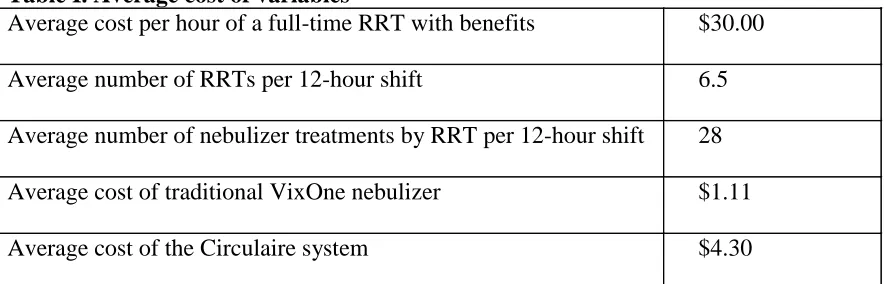
The total cost of a full-time Registered Respiratory Therapist (RRT) with benefits
per hour, average number of RRTs per 12-hour shift, average number of nebulizer
treatments by an RRT per 12-hour shift, average costs of traditional VixOne nebulizer
[image:35.612.110.552.463.605.2]and the Circulaire system was presented in Table I.
Table I. Average cost of variables
Average cost per hour of a full-time RRT with benefits $30.00
Average number of RRTs per 12-hour shift 6.5
Average number of nebulizer treatments by RRT per 12-hour shift 28
Average cost of traditional VixOne nebulizer $1.11
Average cost of the Circulaire system $4.30
The average cost per hour of a full-time RRT was calculated to be $24.00/hr plus
28% for benefits making a total cost of $30.00/hr. In a 12-hour shift, an average number
27
treatments per 12-hour shift. The average cost of a traditional VixOne nebulizer was
$1.11, while the Circulaire was priced at $4.30.
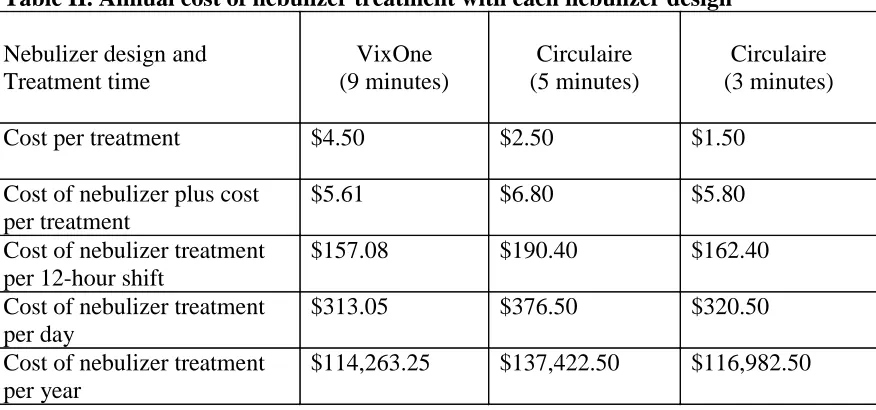
Based on the information in Table I, the following calculations were made in
Table II to estimate the annual costs of nebulizer treatment using each of the nebulizer
designs at different treatment times. With a standard treatment time of 9 minutes for the
traditional VixOne nebulizer, and an average cost per hour of a full-time RRT with
benefits of $30.00, it would cost $4.50 to give a treatment. When the cost of a nebulizer
is added to that, it amounts to $5.61 per treatment. To calculate the labor and cost of
nebulizer treatments per RRT for a 12-hour shift, multiply $5.61 by 28 treatments to get
$157.08. For a day (24-hour period), $157.08 is multiplied by 2 to get $314.16. Data
collected suggests that the nebulizers where only changed as needed, thus calculations
will be made using one nebulizer per day. The cost of the VixOne nebulizer is subtracted
from $314.16, resulting in a total cost and labor of $313.05 per day. Therefore, the annual
cost of delivering aerosol treatment using the traditional VixOne nebulizer would be
$114,263.25 a year.
When the Circulaire is used with a treatment time of 5 minutes and an average
cost per hour of a full-time RRT with benefits of $30.00, it would cost $2.50 to give a
treatment. When the cost of a nebulizer is added to that, it amounts to $6.80 per
treatment. To calculate the labor and cost of nebulizer treatments per RRT for a 12-hour
shift, multiply $6.80 by 28 treatments to get $190.40. For a day (24-hour period), $190.40
is multiplied by 2, and the cost of the nebulizer is subtracted to get $376.50. Therefore,
the annual cost of delivering aerosol treatment with the Circulaire system using a
28
However, when the Circulaire is used with a treatment time of 3 minutes and an
average cost per hour of a full-time RRT with benefits of $30.00, it would cost $1.50 to
deliver a treatment. When the cost of a nebulizer is added to that, it amounts to $5.80 per
treatment. To calculate the labor and cost of nebulizer treatments per RRT for a 12-hour
shift, multiply $5.80 by 28 treatments to get $162.40. For a day (24-hour period), $162.40
is multiplied by 2 and the cost of the nebulizer is subtracted to get $320.50. Therefore,
the annual cost of delivering aerosol treatment with the Circulaire system using a
[image:37.612.112.550.311.516.2]treatment time of 3 minutes would amount to $116,982.50 a year.
Table II. Annual cost of nebulizer treatment with each nebulizer design
Nebulizer design and Treatment time VixOne (9 minutes) Circulaire (5 minutes) Circulaire (3 minutes)
Cost per treatment $4.50 $2.50 $1.50
Cost of nebulizer plus cost per treatment
$5.61 $6.80 $5.80
Cost of nebulizer treatment per 12-hour shift
$157.08 $190.40 $162.40
Cost of nebulizer treatment per day
$313.05 $376.50 $320.50
Cost of nebulizer treatment per year
$114,263.25 $137,422.50 $116,982.50
Sensitivity Analysis
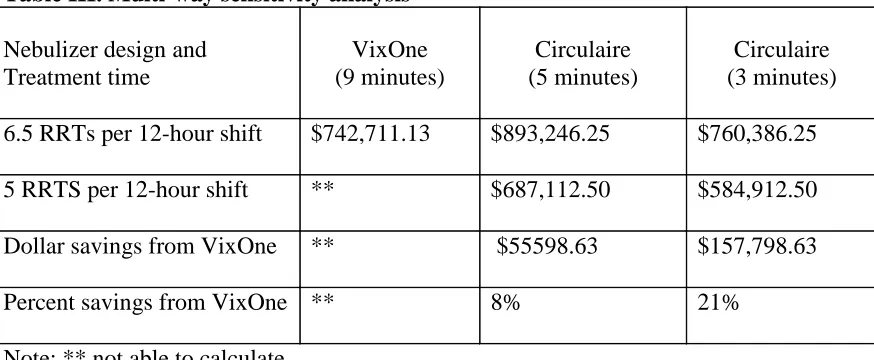
I assumed an increase in treatment load by 30%, allowing a reduction to an
average of 5 full-time RRTs per 12-hour shift. The VixOne nebulizer with 6.5 RRTs per
12-hour shift will result in $742,711.13 annually. However, calculations cannot be made
for 5 RRTs per 12-hour shift. Using the Circulaire at 5 minutes treatment time, an annual
29
RRTs per 12-hour shift an annual cost of $687,112.50 is estimated, thus resulting in 8%
savings. When the Circulaire is used with a treatment time of 3 minutes, and 6.5 RRTs
per 12-hour shift, the annual cost will be $760,386.25 a year. When the number of RRTs
per 12-hour shift is reduced to 5, an annual cost of $584,912.50 is estimated,
consequently resulting in 21% savings. This multi-way sensitivity analysis is represented
[image:38.612.112.549.258.438.2]below in Table III.
Table III. Multi-way sensitivity analysis
Nebulizer design and Treatment time
VixOne (9 minutes)
Circulaire (5 minutes)
Circulaire (3 minutes)
6.5 RRTs per 12-hour shift $742,711.13 $893,246.25 $760,386.25
5 RRTS per 12-hour shift ** $687,112.50 $584,912.50
Dollar savings from VixOne ** $55598.63 $157,798.63
Percent savings from VixOne ** 8% 21%
Note: ** not able to calculate.
30
CHAPTER V
Discussion
Aerosol administration through liquid nebulization accounts for a greater
percentage of the respiratory care workload. The administration of aerosol therapy using
small-volume nebulizers has evolved over the years. In the economic market, different
nebulizer designs are being manufactured, with each incorporating unique features that
will potentially establish it as the preferred choice in aerosol delivery. There is a need to
identify further opportunities for cost reduction in respiratory care. Most health care
administrators, chief executive officers, directors, and clinicians are now faced with the
tasks of deciding which of these several nebulizer designs can be used as an alternative to
combat the rising cost of health care now at a disturbingly rapid rate.
The focus of this study was to perform a cost-benefit analysis of dosimetric
nebulization with Circulaire and traditional VixOne nebulizers using data retrospectively
collected from an urban tertiary adult hospital with a Level II Trauma Center. A
cost-benefit analysis appraises and adds up the equivalent money value of the cost-benefits and
costs of an intervention to determine whether it is worthwhile. However, one major
challenge in cost-benefit analysis is that certain cost estimates, most especially indirect
costs are, by nature, arbitrary making them more difficult to quantify.
As clinicians in respiratory care, we ought to be well informed about the various
nebulizer designs available and purchasing decisions should be based on a thorough
31
potential impact of the Circulaire system, and how its adoption might reduce costs and
enhance clinical efficiency most especially in respiratory care.
In this study, data was retrospectively collected from the respiratory care
department of an urban tertiary adult hospital with a Level II Trauma Center. The
hospital‟s respiratory care department had recently adopted the use of the Circulaire
system as its modality for liquid aerosol delivery, and sought to perform a cost-benefit
analysis to determine if the Circulaire would save resources for the respiratory care
department and the hospital in general. The costs attached to the adoption of the
Circulaire system was compared to the traditional VixOne nebulizer being the device
previously used by the department. The respiratory care director of the hospital facility
supplied the data from the existing records of the respiratory care department for the year
2010.
The results of the study further addressed some of the research questions that
were previously raised. The total cost of a full-time RRT with benefits per hour, average
number of RRTs per 12-hour shift, average number of nebulizer treatments by an RRT
per 12-hour shift, average costs of traditional VixOne nebulizer and the Circulaire system
were calculated and used to determine the costs, benefits, and outcomes associated with
the use of the Circulaire and traditional VixOne nebulizer. The Circulaire was compared
at two different treatment times of 5-minutes and 3-minutes. Research from several
studies have shown that aerosol treatment time using dosimetric nebulizers are often
shorter when compared to traditional constant-output nebulizers, and the dosimetric
nebulizers have also been known to generate a higher percentage of drug deposition in
32
growing concerns of the Joint Commission on Accreditation of Health Care
Organizations (JCAHO) on concurrent therapy in respiratory care, the adoption of a
nebulizer design that allows for a shorter treatment time will potentially eliminate the
problem of “treatment stacking” and indirectly improve the quality of patient care. In
areas where the demand is high for RRTs, dosimetric nebulization using the Circulaire at
3-minutes treatment time will be cost-effective and decrease the workload of the
respiratory therapists.
Overall, the annual cost of delivering aerosol treatment using the Circulaire with a
5-minute treatment time was considerably higher than the traditional VixOne nebulizer at
a treatment time of 9-minutes. Nevertheless, it is important to note that given the length
of treatment time, the inhaled drug mass is greater with the Circulaire at 5-minutes versus
the VixOne at 9-minutes. Dosimetric nebulization using the Circulaire at 5-minutes and
3-minutes treatment time can reduce department expenditure by reducing labor costs.
This was clearly stated in the calculations made for the cost of nebulizer treatments per
year using the different nebulizer designs at different treatment times. The time saved
reduces labor costs, ensures fewer missed therapy, and enhances effective and skilled
patient care.
When the treatment load was increased by 30%, with a reduction to an average of
five respiratory therapists, calculations could not be made for the VixOne nebulizer. This
is primarily because with a treatment time of 9-minutes, a reduction in the number of
respiratory therapists per 12-hour shift will rather give room for concurrent therapy,
33
care. With the Circulaire at 5-minutes and 3-minutes treatment time, annual savings of
8% and 21% were recorded.
Previous studies conducted on cost-benefit analysis in respiratory care were
centered on respiratory care protocols (RCP) versus physician directed treatments as a
means of saving costs for the respiratory care department. Kollef et al. (2000) surmised
that RCP-directed treatment protocols were significantly cost-effective when compared to
physician-directed orders. This conclusion was in line with a similar study carried out by
Stoller et al. (1998) associating RCP-directed treatment protocols with lower costs of
medical care. When Hoisington et al. (2009) compared the respiratory care workload
requirement in a hospital facility with different nebulizer designs at different treatment
times; they also arrived at the conclusion that shorter treatment times may play a role in
dealing with the nationwide shortage of respiratory therapists with time saved being used
for value-added patient-care activities.
The efficiency of the Circulaire system as a device for aerosol administration was
the purpose of the study conducted by Mason et al. (1994, 1996) and it acknowledged
better lung deposition of aerosols, with lesser amount lost in the ambient environment. In
addition, Hoffman et al. (1997) supported the superiority of the Circulaire system over
conventional small-volume nebulizers in the treatment of bronchospasm.
Significant limitations were considered in this study. Data collected suggests that
the nebulizers where only changed as needed. This can be when the nebulizers are visibly
soiled, or can no longer function properly. Although calculations where made with the
34
how often these nebulizers where changed. This may have an effect on the overall
savings realized. The fewer times we use a new nebulizer for each daily treatment, the
greater the percent savings. In reality, there will be additional savings and revenues
generated for the respiratory care department. There was no mention if additional costs
were incurred with training the respiratory therapists on the use of the Circulaire system.
Lastly, another limitation to this study was that the researcher only factored in the costs
of treatment and labor costs to arrive at an annual cost for each nebulizer design. The
researcher was unable to calculate productivity.
Recommendations for future research
Future research in the area of cost-benefit analysis using dosimetric nebulization
should be conducted. A similar study should be conducted using existing data from more
hospital facilities. Additional variables that will possibly address productivity and quality
of care should be included in future research studies. Furthermore, the economic aspect
of introducing new nebulizer designs should be thoroughly explored in a clinical setting.
Cost-effectiveness analysis, cost-minimization analysis, and cost-utility analysis
comparing dosimetric nebulization of aerosols are useful areas that can be delved into
with future research studies.
Conclusion
Current studies on cost-benefit analysis of dosimetric nebulization are limited and
this study along with others should aim at saving resources for the respiratory care
department, improving productivity, and saving manpower/labor in areas where there are
35
impact of the Circulaire, and how its adoption might reduce costs and enhance
productivity in respiratory care. According to this study, the use of the Circulaire system
at 5-minutes or 3-minutes treatment time can reduce department expenditure by reducing
labor costs. It is hoped that future research will be carried out to strengthen the need to
36
REFERENCES
Arzu, A., Hess, D., Myers, T., Rau, J. (2009). A Guide to Aerosol Delivery Devices for
Respiratory Therapists (2nd ed.). American Association of Respiratory Care.
Barry, P. (2002). The Future of Nebulization. Respiratory Care, 47(12), 1459-1470.
Camargo, C., Kenney, P. (2000). Assessing Costs of Aerosol Therapy. Respir Care,
45(6), 756-763
Cunningham, S. (2001). An Introduction to Economic Evaluation of Health Care. J
Orthod, 28(3), 246-250
Dalal, A., St-Charles, M., Petersen, H., Roberts, M., Blanchette, C., & et al. (2010).
Cost-Effectiveness of Combination Fluticasone Propionate–Salmeterol 250/50 μg
Versus Salmeterol in Severe COPD Patients. International Journal of Chronic
Obstructive Pulmonary Disease, 5: 179-187
Dennis, J. (2002). Standardization Issues: In Vitro Assessment of Nebulizer Performance.
Respir Care, 47(12), 1445-1458
Dennis, J. (1998). A Review of Issues Relating to Nebulizer Standards. J Aerosol Med,
11(Suppl 1):S73
Dolovich, M., Ahrens, R., Hess, D., Anderson, P., Dhand, R., Rau, J., Smaldone, G.,
Guyatt, G. (2005). Device Selection and Outcomes of Aerosol Therapy:
Evidence-Based Guidelines: American College of Chest Physicians/American
37
Drummond, M., Stoddart, G., Torrance, G. (1987). Methods for the Economic Evaluation
of Health Care Programmes. Oxford University Press, Oxford.
Dunne, P. (2002). Economic Aspects of Introducing New Nebulizer Technology. Respire
Care, 47(11), 1321-1331
Gardenhire, D., Parkman, S., Ari, A., Zimmerman, R., Gardenhire, R. (2007). An In Vitro
Comparison of Dosimetric and Constant Output Nebulizers. [Abstract] Respir
Care, 52(11):1580
Gardenhire, D. (2008). Rau’s Respiratory Care Pharmacology (7th ed.). Mosby, Inc., St.
Louis, MO.
Gardenhire, D. (2011). An In Vitro Comparison of Dosimetric Nebulizers. [Abstract] Am
J Respir Crit Care Med, 183:A4430
Hampp, C., Kauf, T., Saidi, A., Winterstein, A. (2011). Cost-Effectiveness of Respiratory
Syncytial Virus Prophylaxis in Various Indications. Arch Pediatr Adolesc Med,
Published online February 7, 2011.doi:10.1001/archpediatrics.2010.298
Hess, D. (2002). Liquid Nebulization: Emerging Technologies Conference Summary.
Respiratory Care, 47(12), 1471-1476.
Hess, D. (2000). Nebulizers: Principles and Performance. Respir Care, 45(6), 609-622
Hess, D., Fisher, D., Williams, P., Pooler, S., Kacmarek, R. (1996). Medication Nebulizer
Performance. Effects of Diluent Volume, Nebulizer Flow, and Nebulizer Brand.
38
Hoffman, L., Smithline, H. (1997). Comparison of Circulaire to Conventional Small
Volume Nebulizer for the Treatment of Bronchospasm in the Emergency
Department. Respiratory Care, 42(12), 1170-1174
Hoisington, E., Chatburn, R., Stoller, J. (2009). A Comparison of Respiratory Care
Workload with 2 Different Nebulizers. Respiratory Care, 54(4), 495-499
Kollef, M., Shapiro, S., Clinkscale, D., Cracchiolo, L., Clayton, D., Wilner, R., Hossin,
L. (2000). The Effect of Respiratory Therapist-Initiated Treatment Protocols on
Patient Outcomes and Resource Utilization. Chest, 117(2), 467-475
Kumar, S., Williams, A., Sandy, J. (2006). How do we Evaluate the Economics of Health
Care? European Journal of Orthodontics, 28, 513-519
LeBouef, L. (1994). One Respiratory Care Department‟s Contribution to the „Bottom
Line‟. Respir Care, 39(7), 740-745
Malach, M., Baumol, W. (2010). Further Opportunities for Cost Reduction of Medical
Care. J Community Health, 35, 561-571
Mason, J., Miller, W. (1996). Comparison of Aerosol Delivery via Circulaire System vs
Conventional Small Volume Nebulizer in COPD patients. Respir Care, 41(11),
1006-1008
Mason, J., Miller, W., Small, S. (1994). Comparison of Aerosol Delivery via Circulaire
System vs Conventional Small Volume Nebulizer. Respiratory Care, 39(12),
39
McCarthy, M. (2003). US Health-Care System Faces Cost and Insurance Crises. Lancet,
362: 375
Meyer, R. (2002). Bringing New Nebulizer Technologies to Market: Regulatory Issues.
Respir Care, 47(11), 1334-1336
Piper, S. (2000). In Vitro Comparison of the Circulaire and AeroTee to a Traditional
Nebulizer T-Piece with Corrugated Tubing. Respir Care, 45(3), 313-319
Phillips, K., Veenstra, D., VanBebber, S., Sakowski, J. (2003). An Introduction to
Cost-Effectiveness and Cost-Benefit Analysis of Pharmacogenomics.
Pharmacogenomics, 4(3), 231-239
Rau, J., Ari, A., Restrepo, R. (2004). Performance Comparison of Nebulizer Designs:
Constant-Output, Breath-Enhanced, and Dosimetric. Respir Care, 49(2), 174-179
Rau, J. (2002). Design Principles of Liquid Nebulization Devices Currently in Use.
Respir Care, 47(11), 1257-1258
Stoller, J., Mascha, E., Kester, L., & et al. (1998). Randomized Control Trial of
Physician-Directed versus Respiratory Therapy Consult Service-Directed
Respiratory Care to Adult non-ICU Inpatients. Am J Respir Crit Care Med, 158,