ScholarWorks @ Georgia State University
ScholarWorks @ Georgia State University
Psychology Dissertations Department of Psychology
Spring 4-11-2011
The Impact of Psychological Acceptance and Sibling Relationship
The Impact of Psychological Acceptance and Sibling Relationship
Quality on Depression and Perceived Stigma for Youth Living with
Quality on Depression and Perceived Stigma for Youth Living with
HIV
HIV
Kara E. Snead
Georgia State University
Follow this and additional works at: https://scholarworks.gsu.edu/psych_diss
Part of the Psychology Commons
Recommended Citation Recommended Citation
Snead, Kara E., "The Impact of Psychological Acceptance and Sibling Relationship Quality on Depression and Perceived Stigma for Youth Living with HIV." Dissertation, Georgia State University, 2011.
https://scholarworks.gsu.edu/psych_diss/86
This Dissertation is brought to you for free and open access by the Department of Psychology at ScholarWorks @ Georgia State University. It has been accepted for inclusion in Psychology Dissertations by an authorized
THE IMPACT OF PSYCHOLOGICAL ACCEPTANCE AND SIBLING RELATIONSHIP
QUALITY ON DEPRESSION AND PERCEIVED STIGMA FOR YOUTH LIVING WITH
HIV
by
KARA E. SNEAD
Under the Direction of Frank Floyd
ABSTRACT
Compared to their uninfected peers, youth living with HIV experience greater distress
related to a multitude of stressors they face. In order to enhance the lives of youth who are living
with HIV, it is important to identify the personal and social resources that these individuals
might bring to coping with their disease. Using the compensatory hypothesis and resiliency
theory as conceptual frameworks, the present study examined the function of both psychological
acceptance and sibling relationships for youths in managing depression and HIV-related stigma.
In addition, the current study investigated the interactive effects of psychological acceptance and
sibling relationship quality on these outcomes for youths living with HIV. The participants for
the current study included 68 youth who were recruited as part of another study examining
adolescents infected with HIV and their caregivers. The racial composition of the final sample
consisted of 94% African Americans and 6 % who identified as another racial minority. The
12 and 23 (M= 17.9, SD= 2.8). In the sample, 56% of youth were perinatally infected and 44%
were behaviorally infected. Regression analyses indicated no support for the complex
associations among resources posited in the resiliency model and the compensatory hypothesis.
Greater psychological acceptance was associated with both less depression and less stigma. Both
the positive and negative aspects of sibling relationships demonstrated importance for youth’s
psychological well-being, such that supportive sibling relationships were associated with lower
depression and negative sibling relationships were associated with greater perceived stigma.
Exploratory analyses demonstrated interactions with gender, age, and route of transmission not
explained by the proposed models, which suggests that further research is needed to understand
their impact. Future research endeavors should examine the efficacy of intervention programs in
individual and group settings to determine if the predicted benefit of both personal and social
resources are compounding factors in the psychosocial well-being for youth living with HIV.
THE IMPACT OF PSYCHOLOGICAL ACCEPTANCE AND SIBLING RELATIONSHIP
QUALITY ON DEPRESSION AND PERCEIVED STIGMA FOR YOUTH LIVING WITH
HIV
by
KARA E. SNEAD
A Dissertation Submitted in Partial Fulfillment of the Requirements for the Degree of
Doctor of Philosophy
in the College of Arts and Sciences
Georgia State University
Copyright by Kara E. Snead
THE IMPACT OF PSYCHOLOGICAL ACCEPTANCE AND SIBLING RELATIONSHIP
QUALITY ON DEPRESSION AND PERCEIVED STIGMA FOR YOUTH LIVING WITH
HIV
by
KARA E. SNEAD
Committee Chair: Frank J. Floyd
Committee: Lisa Armistead
Aki Masuda
Michelle Robbins-Broth
Electronic Version Approved:
Office of Graduate Studies
College of Arts and Sciences
Georgia State University
DEDICATION
I would like to dedicate this document to my family and friends for all of their support. Each and
every one of you has impacted my life in numerous ways. Without your influences, love, and
enthusiasm, I certainly would not be in the position I am in today. I am deeply grateful for each
ACKNOWLEDGMENTS
I would like to especially thank Mike Barker and Katie Edwards for their help with statistical
analyses and Ashlyn Smith for her support in preparing this document. I would also like to
extend many thanks to Frank Floyd for all of his guidance and encouragement during my
graduate school career. He has been an amazing mentor and I would not be where I am today
TABLE OF CONTENTS
ACKNOWLEDGMENTS ... v
LIST OF TABLES ... viii
LIST OF FIGURES ... ix
Introduction ... 1
Stigma ... 4
Psychological Acceptance as a Personal Resource... 6
Social Support ... 10
Sibling Relationships in the Context of a Systemic Framework ... 12
Compensatory Theory: Siblings as a Social Resource ... 15
Sibling Relationship Characteristics that may Contribute to or Inhibit Resilience ... 17
Purpose ... 19
Hypothesis 1: Personal Resources: Psychological Acceptance ... 19
Hypothesis 2: Social Resources:Siblings ... 20
Hypothesis 3: Compensatory Mechanism ... 20
Hypothesis 4: Interactive Effects of Personal and Social Resources ... 21
Methods... 21
Participants ... 21
Procedures ... 22
Demographic... 23
Sibling relationship quality ... 23
Stigma ... 25
Depression ... 26
Psychological Acceptance ... 26
Results ... 27
Psychological acceptance as a predictor of depression and perceived stigma ... 28
Sibling relationship quality as a predictor of depression and perceived stigma ... 30
The Compensatory Hypothesis: Total other support as a moderator of sibling relationship quality and youth outcomes ... 33
The relationship between youth outcomes and sibling relationship quality as moderated by psychological acceptance ... 38
Follow-up Analyses ... 42
Gender... 42
Age ... 47
Route of Transmission... 50
Discussion ... 54
Study Limitations and Future Directions ... 54
LIST OF TABLES
Table 1 ... 29
Table 2 ... 30
Table 3: ... 32
Table 4 ... 35
Table 5 ... 37
Table 6 ... 39
LIST OF FIGURES
Figure 1 ... 45
Figure 2 ... 52
Figure 3 ... 53
Figure 4 ... 53
Figure 5 ... 55
Figure 6 ... 55
Figure 7 ... 57
Figure 8 ... 57
Figure 9 ... 59
Figure 10 ... 60
Figure 11 ... 60
Figure 12 ... 62
Introduction
Over the last decade, prevalence rates of HIV infection in African American youths
between the ages of 13-25 have risen (Kang et. al, 2008, Hosek, 2000). Recent reports from the
Centers for Disease Control (2008) indicated that at the end of 2007, 6,559 adolescents 13 to 19
years of age were living with HIV/AIDS in the 34 states with confidential name-based HIV
infection reporting, representing about 14% of the persons diagnosed that year. Although only
15% of the adolescent population at that time was African American, 68% of reported AIDS
cases among 13 to 19 year olds were African American. Paired with this increase in infection
rates are advances in medical treatments for HIV infection which have improved survival rates
for infected individuals. Thus, an interest in the psychosocial issues and quality of life of young
people who are living with the disease has also grown.
Compared to their uninfected peers, youths infected with HIV experience greater distress
related to a multitude of stressors they face. Stressors include concern over disclosure of HIV
status because of the stigma associated with the disease. As result, these youths are often socially
isolated, depressed, and lack normative peer supports. Furthermore, these problems occur in the
context of many other stressors, including concerns about sexual health, feelings of hopelessness,
fears of death, and family conflict (Fielden et al., 2006). Because HIV infection is more common
among youths from low SES groups (Brown et. al, 2000) numerous youths with HIV endure
exposure to substance abuse, and community violence. Moreover, youths not only face the
possibility of the losing their own life, many are also dealing with the repeated loss of family
members (Battles & Wiener, 2002).
Despite the numerous risks factors they face, many youths with HIV seem to be thriving
personal resources in conjunction with a complex social process. Specifically, he posits that
resiliency results from an interactive process of protective factors, a combination of internal
characteristics and environmental influences. Further, Rutter (2000) maintains that an
individual’s ability to take active steps to deal with the environmental challenges combined with
the availability of an external support system contribute to long-term well-being. Notably, his
research has consistently shown that a positive self image together with the presence of a healthy
parent-child relationship and/or other close, confiding relationships help to reduce the impact of
adverse risks experienced by adolescents during stressful periods, such as divorce and marital
conflict. Thus, successful coping with HIV infection likely requires a combination of personal
resources and social supports from close family members or friends.
In terms of personal sources, Rutter (2000; 2006) posits that it is protective for people to
accept the reality of their negative experiences rather than deny or ignore it. He further explains
that acknowledging the reality of any experience includes recognizing the positive aspects while
not denying the negative. The ability to cognitively process an adverse event in such a way that
promotes adjustment is a personal resource. In his review of resiliency literature, Rutter (2000)
cited a study (Main et al., 1985) which indicated that adults who recalled their negative
childhood experiences with a sense of acceptance evidenced healthier relationships compared to
adults who distorted those early experiences. Other investigators identified personal resources
such as emotional control (Stattin et al., 1997), a sense of control over one’s life (Connell et al.,
1994; Luthar, 1991) and a determination to influence one’s own fate (Werner, 1996) as key
components of resiliency. In Steinhauer’s (2001) review of interventions designed to diminish
individuals. Specifically, resilient individuals were those who evidenced a sense of meaning in
their lives, a will to overcome difficulties, and hope.
In conjunction with personal resources, social resources contribute to well-being in the
face of adversity. Steinhaur (2001) demonstrated that individuals who had strong, supportive
relationships with family members evidenced resiliency during interventions designed to address
the effects of poverty. Similarly, the results from a prospective longitudinal study that followed
children from birth to age thirty-two indicated that of the “high risk” individuals, those who had
a close bond within a supportive relationship with a caregiver, such as a parent, grandparent, or
sibling evidenced healthy relationships and stable employment over time (Werner, 1996).
Another study involving children who were raised in residential care indicated that the children
who received a high level of support from their social network engaged in fewer deviant
behaviors compared to children who did not have a strong support network(Losel & Bliesener,
1994).
To date, research has not adequately examined factors, like support, that might affect the
adjustment of HIV infected youths. Instead, many of the studies involving children and
adolescents and HIV have examined the impact of maternal HIV infection disclosure on their
children, usually who are not infected themselves. Research has also looked at the mental health
and behavioral outcomes of youths with infected parents (Havens et al., 1996). The research that
has examined youths who are themselves infected has mostly focused on medication adherence
(Murphy et al., 2001), psychological distress related to youths’ disclosure, and prevention of risk
behaviors in youths (Donenberg and Pao, 2005; Rotheram-Borus et al., 2001), with little
attention to other aspects of adjustment. In addition, the literature that has explored the impacts
studies that do examine social support from specific sources mostly explore the support provided
by peers or adults, such as parents and teachers, and ignore siblings.
To gain a better understanding of the sources of strength for these youths in facing both
stigma and social isolation, the current study will examine their personal and social resources. In
particular, the focus will be on psychological flexibility in the form of psychological acceptance
as a personal resource and siblings as a potentially important social resource. These two
resources might act in combination with one another and/or independently from each other to
protect youths from dysfunction. Thus, the present study will aim first, to understand the nature
of psychological acceptance as a personal resource for adapting to the stigma of HIV infection
and will explore the role of psychological acceptance on youths’ psychological distress. In
addition, the study will seek to describe the nature and quality of sibling relationships in the
context of other interpersonal resources available to these adolescents, then to demonstrate how
the quality of sibling relationships may impact depression and perceived stigma around HIV.
Stigma
Stigma is a significant stressor for individuals infected with HIV. Seminal work by
Goffman (1963) defined stigma as an undesirable or discrediting attribute that an individual
possesses which subsequently reduces that individual’s status in society. In an effort to further
understand health-related stigma, Berger and colleagues (2001) generated a conceptual model of
feelings and experiences around stigma related to HIV. Perceived stigma is conceptualized as the
person’s awareness of actual or potential rejection and change in social identity related to HIV
status. Much of what makes some interactions distressful for the individual with HIV is the
inability to predict reliably how he/she will be treated by others (Kinsler, et al., 2007; Brown et
psychological well-being of an individual who experiences it (Vanable et al., 2006; Swendeman
et al., 2006). For example, individuals who have HIV often internalize the negative stereotypes
others have about HIV, which in turn may lead them to feel stigmatized and ashamed.
Subsequently, they might engage in behaviors that negatively influence their well-being, such as
avoiding disclosure of their infection to medical professionals, failure to follow medication
regimens consistently, or failure to seek social support. Ultimately, perceived stigma leads
people to alter their behaviors to avoid additional experiences of stigma and in doing so may also
limit opportunities for support and treatment.
Because HIV infection has historically been associated with those who have been
marginalized in society, including gay men, minorities, and injection drug users, it involves
prejudice and poor treatment that often contributes to perceived stigma. As such, youths infected
with HIV are vulnerable to negative experiences and often perceive stigma as a result. In a study
by Flicker and colleagues (2004), youths with HIV reported that they felt lonely and stigmatized,
and that their feelings of sadness and depression negatively impacted their ability to connect to
others. For individuals whose status is not known outside the family, often the “burden of
secrecy” may further exacerbate feelings of isolation (Brown et al., 2000). In another study of
youths living with HIV, participants reported that many of their peers made derogatory
comments about HIV-positive individuals (Rao et al., 2007). Subsequently, youths described
feeling as though they had to hide their own status from peers and in some cases,
parents/guardians. Similarly, in a sample of 17-21 year-old youths living with HIV, self-isolation
and distancing from friends and peers tended to occur following diagnosis (Hosek et al., 2000).
Given the social isolation that perceived stigma perpetuates, it is might be especially important
for youth living with HIV to rely on close relationships for support.
Psychological Acceptance as a Personal Resource
The effects of stigma on psychological distress and dysfunction can be conceptualized
from the framework of psychological acceptance theory. A premise of the acceptance and
commitment therapy (ACT) formulation is that a problem with trying to directly control internal
experiences such as negative emotions, thoughts, and physical sensations is that these attempts
sometimes make a problem more pronounced and aversive, or cause additional problems. The
inflexible tendency to negatively evaluate internal events, like thoughts about stigma, and to
make persistent attempts to alter and avoid those experiences, lessens contact with present
moments (Kashdan et al., 2006). In contrast, psychological acceptance, or flexibility, refers to a
willingness to experience thoughts, feelings, and physiological sensations without avoiding them
or letting them determine one’s actions in life (Hayes, 1987; Hayes, Strosahl & Wilson, 1999).
By not controlling internal behavior, one can better control actions and thus, promote mental
health and lessen the impact of negative events (Hayes et al., 1996). Subsequently, people make
choices based on their own values, not based on the emotions or thoughts they may be
experiencing and, thus, become better able to define and accomplish meaningful goals in the
future.
From the perspective of ACT, the negative impact of stigmatizing beliefs and attitudes
comes not from the existence of such thoughts, but from the function of the thoughts (Luoma,
2008). Stigmatizing thoughts can be rigid (Kurzban & Leary, 2001) and therefore difficult to
eliminate or alter. As such, when acted on, feelings and thoughts related to stigma often lead
stigmatizing. For example, it seems likely that if a person infected with HIV holds beliefs about
him/herself that are stigmatizing such as “others think a person with HIV is disgusting”, those
beliefs would lead the person to avoid thinking about being someone who is disgusting to others
and feelings related to the sense that other people find him/her disgusting. However, doing so
would include avoiding situations and activities where the possibility of thinking these thoughts
and experiencing these feelings would exist such as avoiding contact with other people, or at
least avoiding disclosure of HIV status. Therefore, the very situations that would facilitate
supportive interaction and connection with family and friends are likely to perpetuate this
thought and related fears. This situation might also lead one to deny the seriousness of the
condition in order to reduce the internalized sense of stigma, which might then lead to poor
medication adherence. In contrast, psychological acceptance enables individuals to feel their
emotions and notice their thoughts related to stigma, rather than try to act on, change, or avoid
them. Current research indicates a strong relationship between perceived stigma and limited
psychological acceptance. Masuda and colleagues (2007) examined stigma that college students
felt towards individuals with psychological disorders, and self-stigma they experienced in
regards to their own psychological struggles. Results showed that psychologically inflexible
individuals also tended to have more stigmatizing and shame-based thoughts and beliefs about
themselves and others compared to participants who were more psychologically flexible. A study
by Luoma and colleagues (2008) examined the impact of psychological acceptance on
self-stigma in a group of adult substance users. Findings demonstrated that after some individuals
learned how to use acceptance among other ACT-based techniques, internalized stigma and
shame decreased and were negatively correlated with post-treatment levels of psychological
Research on psychological acceptance has consistently demonstrated its relationship with
psychological functioning (Hayes, Stosahl et al., 2004; Karekla et al., 2004). In particular, the impact of psychological acceptance on reducing depression has been well established. In a
prospective study with undergraduates, Plumb and colleagues (2004) demonstrated that using
avoidance as a coping mechanism, which presumably implies low levels of flexibility or
acceptance, following a stressful event was associated with depression. Several other studies
have indicated that low acceptance, thus high avoidance, was also associated with depression
(Tull et al., 2004; Forsyth et al., 2003; Roemer et al., 2005). Similarly, a meta-analysis indicated
that higher levels of psychological flexibility, were associated with lower levels of depression,
and better mental health overall as captured by measures of psychopathology (Hayes et. al,
2006).
Although there is little research to date that associates psychological acceptance with
interpersonal functioning, there are some findings that have begun to establish a link. A set of
studies involving undergraduates examined the relationship between psychological acceptance
and psychological outcomes and behaviors. Results indicated that high levels of psychological
acceptance were associated with relatively frequent positive social interactions on a daily basis,
and inversely related to feelings of social anxiety (Kashdan et al., 2006). In other studies, high
levels of acceptance were associated with high levels of support from friends (Luoma et al.,
2008) and a positive quality of life including relationship satisfaction (Hayes, et. al, 2006).
Although these studies indicate some relationship between psychological acceptance and
interpersonal engagement, the exact nature of the relationship remains unclear. Though not yet
examined in the literature, it might be that psychological acceptance enhances the effects of
negative thoughts and feelings, and instead participate more fully and actively in relationships,
such as the sibling relationship.Increased cognitive flexibility not only makes individuals less
susceptible to the influences of their own negative thoughts and feelings, but also makes
individuals less susceptible to the negativity from others (Hayes, et al., 2006). Thus, in the
context of high levels of psychological acceptance, the negative effects of a hostile or
antagonistic relationship on well-being likely dampen.
Other research has examined the role of psychological acceptance as a strengthening
effect on behaviors that reduce stress. Several particularly relevant studies evaluated this process
in the workplace. Previous research by Bond & Bunce (2000) established links amongst
acceptance, employees’ general mental health, and their ability make productive changes in the
workplace. Subsequently, Bond & Bunce (2003) conducted a study that examined whether the
benefits of job control were greater when acceptance was higher than when it was lower. Job
control is an individual’s perceived ability to assert control over the work environment so that it
is more rewarding. Low job control has been shown to diminish job satisfaction, performance,
and mental health. Specifically, it was predicted that at low acceptance levels, individuals would
engage in avoidance of negative thoughts and feelings related to their job. In comparison,
individuals who had high levels of acceptance would be able to use their attentional resources to
notice the control they had in a given situation and subsequently, obtain goals such as positive
work performance, mental health, and job satisfaction. The findings supported the expectations
that psychological acceptance interacted with job control such that the benefits of job control on
productivity and mental health were greater when acceptance was higher. Additionally, as
expected, results indicated that there was a main effect of acceptance and a main effect of job
Another relevant line of research has examined psychological acceptance with
individuals who suffer from chronic pain (Donaldson-Feilder & Bond, 2004; Vowles &
McCracken, 2008). Findings from one study by McCracken (1998) indicated that acceptance of
chronic pain was associated with less depression and pain-related anxiety. In the study,
acceptance did not mean resigning oneself to all experiences of suffering, but rather acceptance
involved facing suffering so that a healthy course of action could be followed. Further,
acceptance of pain involved acknowledging the pain, relinquishing useless attempts to control it,
and committing to live a satisfying life in spite of the pain. In doing so, patients reported better
psychological and behavioral adjustment outcomes. These studies establish a link between
acceptance and disease adjustment that will likely be salient for individuals who are infected
with HIV and who might face similar struggles related to their illness.
To date, psychological acceptance has not been studied in individuals infected with HIV,
but may be particularly useful considering the challenging nature of the disease. Given the
positive effects that psychological acceptance has evidenced on reducing depression and stigma
in samples of individuals who struggle with substance abuse and chronic pain, it seems likely
that individuals with HIV might also use psychological acceptance as a personal resource to cope
with distress.
Social Support
Research has firmly established that social support has a significant impact on adjustment
to disease for individuals who suffer from chronic illnesses (LaGreca et al., 1995; Varni &
Setoguchi, 1993; Pennix et al., 1996). Support from family, friends, and medical professionals
often helps to reduce the risks from emotional and behavior difficulties for children with chronic
(Wallander & Varni, 1998; Kyngas et al., 2004). Social support also impacts psychological
well-being by lessening feelings of loneliness, depression, and anxiety that are commonly associated
with chronic illness (Graetz, 2000).
Like individuals with other chronic illnesses, individuals with HIV likely benefit from
social support to help manage psychological distress. Research literature on adults with HIV is
fairly extensive and serves as a foundation for understanding how social support might operate
for youths living with HIV, given that these youths can experience similar struggles to adults
with the same condition. Several studies have demonstrated that among HIV-infected adults,
greater social support was associated with lower levels of HIV symptomatology, depression, and
loneliness (Hays et al., 1992; McDowell & Serovich, 2007). For youths living with HIV, there is
a strong link between an effective support network and positive psychological functioning
(Murphy et al., 2000). Compared to non-infected peers and youth with other chronic illnesses,
HIV-positive youth are vulnerable because they experience higher levels of anxiety, depression,
and loneliness (Bachanas et.al, 2001; Brown et al, 2000), and thus need support to cope with
these problems. Furthermore, adolescents living with HIV may also require significant levels of
support to maintain complicated adherence regimens, manage disclosure of HIV status, and to
develop intimate relationships (Brown et al., 2000). Social support has also been shown to correlate with feeling confident in one’s abilities to provide self-care such as adherence to
medication in HIV-positive youths (Naar-King, et al., 2006). Another study of youths infected
with HIV indicated that high levels of social support were associated with relatively few
experiences of personalized stigma (Wright et al., 2007).
The literature on adults with HIV has also shown that social support tends to come from
with HIV/AIDS, the women reported that their families were the central providers of affective,
concrete, and informational support (Owens, 2003). Kalichman and colleagues (2003)
demonstrated that HIV-positive adults who disclosed their HIV status to family members
perceived the greatest amounts of support from those relationships compared to relationships
with non-family members. Findings from another study involving women living with HIV
indicated that the quality of support from family members was more predictive of lower levels of
depression, loneliness, and anxiety than was support from friends (Serovich et al., 2001).
Similar to adults, family support might be particularly important for youths with HIV as
well. Although research is limited, some findings suggest that this is the case. In a study of HIV
positive youths (ages 16-25), Lam and colleagues (2007) demonstrated that higher social support
from family was related to less anxiety and depression. Further, the study indicated that youths
were more likely to disclose their status to family members rather than friends. It may be that
siblings are a particularly important component of family support for youth.
Sibling Relationships in the Context of a Systemic Framework
Individuals exist within a context of a family system that involves interacting parts that help
to shape the development of the individual. Systems theory holds that changes in each of the
subsystems in a family (parent-child, child-child) mutually influence one another.Similarly,
changes in the behaviors of individuals exert an influence on and are influenced by the subsystems (Bronfenbrenner, 1992; Pike, Coldwell & Dunn, 2005). Sibling dyads represent
independent subsystems within the family that uniquely affect the psychosocial functioning of
the developing individual (Howe & Ross, 1990; Hanson et al., 1992). Although much of the
extant research on families focuses on the parent-child dyad and its influence on individual
individual development (Dunn, 1992; Brody, 1992; Stocker, Burwell &Briggs, 2002, Dunn,
2002).
Sibling relationships are distinctive due to their life-long duration, shared genetic
components, and common cultural and family experiences for the two individuals. Sibling
relationships can be characterized by friendship and trust as well as hostility and disengagement
(Stoneman & Brody, 1992). Although sibling relationships share components similar to those of
a close peer relationship (e.g., companionship, support), the sibling dyad remains unique.
Specifically, sibling relationships are not chosen or fostered in the same intentional manner as
peer relationships (East & Rook, 1992). Further, sibling relationships provide easy access to
companionship, intimacy, and support, and they have potential for high conflict. Thus, sibling
dyads are characterized by emotional salience and a combination of closeness and conflict that is
unlike any other interpersonal relationship (Furman & Buhrmester, 1985).
In normative circumstances, family roles and relationships shift during adolescence.
Throughout the course of childhood and adolescence, individuals spend more time with siblings
than with their parents (McHale & Crouter, 1996; Stocker, Burwell & Briggs, 2002).
Adolescence is a developmental time when autonomy and personal independence from parents
and family typically become foci. During this period, youths begin to spend even less time with
their parents and place more importance on peer relationships. Although adolescent siblings may
spend less time together as well, the relationships do endure and remain important over time
(Furman & Burhmester, 1992).
For youths who have experienced disruptions in typical development due to stressful life
events such as chronic illness, the sibling relationship may serve an important interpersonal
personal independence for youths with HIV may deviate from typical patterns. In particular, they
may remain more strongly reliant on family members, with fewer strong connections to peers.
For example, the complex and/or unpleasant medical regimens often lead to non-adherence
issues for the youth. In turn, parents or other parent-like caregivers become heavily involved in
managing the youth’s anti-retroviral medications (Battles & Weiner, 2002). Given that youths
living with HIV tend to face interpersonal difficulties and are socially isolated due to the
stigmatizing perceptions of HIV and social isolation, sibling relationships might be an important
source of social support during this developmental stage when individuation is vital. Like the
literature on typically-developing youths, research on the interpersonal relationships of youths
with HIV has mainly focused on how parents/caregivers or peer networks impact both
psychological adjustment and risk factors associated with HIV infection. To date, however,
research has failed to attend to the function of sibling relationship quality, especially as it relates
to youths’ psychological well-being and disease adjustment.
Given that siblings have not been a large focus of the research conducted on youths with
HIV, the theories and empirical findings related to typical siblings will be used as a foundation
for the current study. Much of the literature on typical siblings has used samples of majority
culture siblings from two-parent families (McHale et al., 2007). The few studies that have
examined African American families are restricted to two-parent, middle-class families (McHale
et al., 2007). Therefore, the current study will likely fill some of the gaps regarding sibling
relationships for minority youth, many whose families are low-income and led by a
single-parent. Sibling literature has also tended to emphasize the impact of structural characteristics
such as gender, age gap, and birth order on outcomes. However, in a seminal article, Brody
than on the structural components in order to understand the impact of the relationship on
adjustment and psychosocial functioning. Thus, the present study will focus on the quality of
sibling relationships and its impact on adjustment for youths living with HIV.
Compensatory Theory: Siblings as a Social Resource
Siblings might be especially important when other sources of support are not available.
In their review of the effects of multiple types of interpersonal relationships on individual well
being, Furman and Burhmester (1985) argued that it would be adaptive for an individual who
lacks a specific relationship type to be able to compensate for the missing support by turning to a
functionally similar type of relationship. For youth who struggle with significant family-related
stress, such as a disruption in the parent-child relationship due to loss or illness, the impact of a
supportive, close sibling relationship may be even greater. Previous research shows that overtly
distressed or emotionally or physically absent parents have children who take care of each other
to compensate for the lack of parental involvement (Hetherington, 1988, 1989; Brody, 1998). In
a study by Bryant (1992), children whose parents were more rejecting and/or invalidating during
a discussion about stressful events, reported that they usually prefer to talk to a close sibling
about those experiences. Alternatively, children whose parents demonstrated emotional support
during the discussion reported that they typically looked to their parents for support. Similarly,
Jenkins and colleagues (1990; 1989) demonstrated that sibling dyads growing up in
disharmonious homes characterized by high marital distress benefited from offering comfort to,
and from receiving comfort from each other such that they evidenced fewer emotional and
behavioral problems compared to sibling dyads without a supportive sibling relationship. Close
sibling relationships might also compensate for a lack of peer relationships. A study by East &
support from their sibling relationships. Additionally, isolated adolescents who had high sibling
support also endorsed fewer adjustment problems such as anxiety compared to isolated
adolescents who had low sibling support.
Although some research supports a compensatory process between siblings, these results
have only been found in sibling dyads who were under adverse conditions, such as social
isolation from peers, maternal illness, or when one sibling suffered from chronic illness (Dunn et
al., 1994).Thus, it might be that sibling relationships serve a compensatory function only when
the families experience significantly stressful conditions (East & Khoo, 2005). Other studies
conducted with families who were relatively low in parental distress such as marital conflict
indicated a different pattern from the compensatory relationship. Under these low adverse
conditions, healthy parent-child relationships were associated with prosocial behaviors between
siblings and relatively negative or hostile parent-child relationships were associated with
quarrelsome and antagonistic sibling relationships (Boer et. al, 1992; Seginer, 1998). Thus, for
some families, positive versus negative sibling relationships emerge from positive versus
negative relationships among other family members. For other families, the stress of adversity
influences sibling relationship quality such that siblings actually become closer.
Given that HIV is associated with significant stress within the family like maternal loss,
and stress from outside the family like social isolation, siblings might overcome and compensate
for the stress. In particular, siblings might compensate for distressful or absent relationships for
these youths.Thus, it will be especially useful to explore the role of siblings within the context
of all support sources to further understand how youths adjust to HIV infection and related
Sibling Relationship Characteristics that may Contribute to or Inhibit Resilience
There are both positive and negative aspects of sibling relationship quality that
potentially promote or weaken resilience. Positive support qualities include nurturance, warmth,
intimacy, and companionship. Negative qualities include conflict and antagonism. One relevant
support component is nurturance or emotional support. Although most children and adolescents
receive the bulk of their emotional support from parents (Bryant, 1992), siblings can also provide
emotional support in such a way that impacts psychosocial adjustment.Branje and colleagues
(2004) found that for a sample of adolescents, high levels of emotional support from a sibling
were uniquely related to lower levels of externalizing and internalizing behavior problems over
time after controlling for the effects of support from father, mother, and friends. Warmth
between siblings is another important support component and has been positively associated with
self-esteem (Stocker, 1994). Intimacy and companionship within a sibling relationship are also
important components of support that might contribute to resilience. Both have been associated
with less loneliness and fewer internalizing issues for developing children and adolescents
(Brody, 1998; Dunn, 2005).
In contrast to being a source of support, highly conflictual sibling relationships can create
or exacerbate distress for individuals. Further, the negative effects of sibling conflict on youths’
psychological functioning can be extensive and damaging. For example, in a 6-year longitudinal
study of sibling dyads, Kim and colleagues (2007) showed that increases in sibling conflict were
associated with increases over time in depressive symptoms, and this association remained after
controlling for parent-child relationship quality and the psychological adjustment of other family
members. Additionally, findings from a longitudinal study conducted by Stocker, Burwell &
depressed mood, and delinquent behavior two years later, beyond the effects of parental hostility
and marital conflict.
The positive and negative aspects of sibling relationship quality may have a particularly
strong impact for children and adolescents who suffer from chronic illness. In a sample of youths
with insulin dependent diabetes, Hanson and colleagues (1992) showed that high sibling conflict
was significantly related to low self-esteem, low acceptance of the illness, and high levels of
externalizing behaviors for the youths with illness. Also, these effects occurred above and
beyond the effects of marital distress and family cohesion. Conversely, high sibling
warmth/closeness was positively associated with self-esteem above and beyond the effects of the
family factors. Although there is a significant amount of research on sibling relationships with
children who have chronic illnesses, the majority of studies are descriptive and comparative with
normative samples, without focusing on the impact of the relationship for the individual with
illness (Williams, 1997; Faux, 1991). Thus, the impact of sibling relationship quality on disease
adjustment and psychosocial functioning of the child with the illness remains unclear. It may be
that sibling relationship quality varies based on the severity of the illness, such that for youths
who have significantly severe illnesses (e.g., require extensive care-taking, complex medication
regimens, hospitalizations), effects of sibling relationship quality are even more intense
compared to sibling relationships of youth whose illnesses are easier to manage and less
stigmatizing (Weiss, 2001).
Given the significant role siblings play in other populations of individuals with chronic
illness, and youths infected with HIV experience a multitude of interpersonal struggles, siblings
may be an important support for these youths. However, to date, studies have not adequately
from parents and teachers was associated with relatively lower levels of psychological distress
compared to support from peers over a five year period (Battles & Wiener, 2002). Although the
study examined the support provided by important individuals for the youths, it failed to include
siblings as potential support agents.
Purpose
In order to enhance the lives of youths who are living with HIV it is important to identify
the personal and social resources that individuals might bring to coping with their disease. The
present study will examine the function of both psychological acceptance and sibling
relationships for youths who have HIV. Specifically, first, the study will explore the effects of
psychological acceptance on depression and perceived stigma for these youths.Second, the study
will examine the impact of sibling relationship quality on these same adjustment and well-being
outcomes. Third, in order to understand the uniqueness of sibling relationships and what they add
to existing relationships, the study will compare the nature and impact of sibling relationships
with other close relationships such as parent/caregiver, close peers, and partners for youths living
with HIV. Finally, the study will examine the interactive effects of psychological acceptance and
sibling relationship quality on depression and perceived stigma of these youths.
Hypothesis 1: Personal Resources: Psychological Acceptance
Given the impact of personal or psychological resources on the adjustment of individuals
who suffer from significant distress,it is hypothesized that personal resources will have a
significant impact on youths’ adjustment. There will be a main effect of acceptance on
well-being such that higher levels of acceptance will be associated with lower levels of depression. It
Hypothesis 2: Social Resources:Siblings
Due to the nature of HIV and associated risks such as loss of a parent and social
ostracism, the quality of sibling relationships will have a significant impact on the well being of
HIV positive youths. It is hypothesized that youths who have a sibling relationship characterized
by high levels of support in the form of warmth, companionship, instrumental support, intimacy,
nurturance, affection, and admiration will endorse lower levels of depression. Negative, hostile
or distant sibling relationships will be predictive of higher levels of depression for the youths.
Sibling relationship quality will also impact how youths with HIV perceive HIV-related stigma.
Specifically, it is hypothesized that youths who have a close, supportive relationship with a
sibling will endorse less perceived stigma. Hostile or distant sibling relationships with be
predictive of higher levels of perceived stigma.
Hypothesis 3: Compensatory Mechanism
Given the importance of other supportive social relationships such as parents, relatives,
peers, and partners, it will be necessary to consider their influence on youths’ depression and
perceived stigma. Based on the notion that siblings might play a compensatory role when other
forms of support are lacking, it is hypothesized that the impact of sibling relationship quality on
depression will be moderated by support from others, such that at low levels of other supportive
relationships, sibling relationship quality will have a larger impact on depression than at high
levels of other support. At higher levels of other support, the impact of sibling relationship
quality on depression will still be significant, but weaker. In addition, it is hypothesized that the
impact if sibling relationship quality on perceived stigma will be moderated by support from
others, such that at low levels of other supportive relationships, sibling relationship quality will
Hypothesis 4: Interactive Effects of Personal and Social Resources
In light of the interactive effects of personal and social resources on adjustment to
adversity that Rutter (1987) discussed, it is hypothesized that youths with HIV will also utilize a
combination of personal and social resources to overcome depression and disease related stigma.
It is hypothesized that the impact of sibling relationship quality on depression and perceived
stigma will be moderated by the psychological acceptance level of individual. At high levels of
psychological acceptance, sibling support will have a stronger impact on depression and
perceived stigma than at lower levels of psychological acceptance. At high levels of acceptance,
the impact of a sibling relationship that is negative, hostile or distant will be weaker than at low
levels of acceptance.
Methods
Participants
The participants for the current study included 68 youth who were recruited as part of a
larger study examining adolescents infected with HIV and their caregivers. There were 75 youth
who participated in the larger research study; however, given that the focus of the present study
was on sibling relationships of minority youth, a total of 7 participants were excluded from the
data analysis because they did not have a sibling and of the 7, 2 participants were excluded
because they were Caucasian. The larger study served two purposes. First, it examined caregiver
reports of their own attachments, experiences of trauma, psychological functioning, social
support, and involvement in their child’s medication adherence. Second, it investigated the same
variables in youths and examined additional issues for youth, including body image, perceived
stigma, self-esteem, and coping strategies. The racial composition of the final sample consisted
consisted of 28 males, 38 females, and 2 transgendered youth between the ages of 12 and 23 (M=
17.9, SD= 2.8). In the sample, 56% of youth were perinatally infected and 44% were
behaviorally infected. The youth in the current study reported having experienced significantly
stressful life circumstances, including multiple deaths of close relatives (M= 3, SD=3.4) and a
substantial frequency of having moved (M=5.5, SD=5.5). In addition, 53% of the participants
reported living with at least one other family and 29% of the youth reported that they were
currently in or had been in the custody of the Department of Family and Children Services
during their lifetime. For exploratory analyses involving gender, the 2 transgendered participants
were excluded. The age group was selected in order to understand the issues that face
HIV-positive adolescents as they mature to adulthood. Youths were eligible for the study if they were
aware of their HIV diagnosis and spoke and understood English fluently. In some cases, the legal
guardians of youth in state custody (i.e., DFCS caseworkers) were contacted to provide consent
for the youth.
Procedures
Recruitment occurred at the Infectious Disease Clinic at the Ponce Center in Atlanta, GA,
a specialty medical center associated with Grady Health System which serves a predominantly
low-income, minority population. Data collection was conducted by advanced graduate students.
Adolescents and their caregivers who presented for appointments and who were eligible for
participation were approached by a staff person who provided information about the study.
Approximately 15 people who were approached for the study chose not to participate based on
reasons such as not having the time to complete the protocol or feeling ill. No further
information is available on the individuals who did not participate. Families interested in the
questions together. Upon understanding of and agreement to participate, the families were then
asked to sign the consent and assent forms and given their own copies to keep. After signing the
forms, the researcher met with the youth individually, read all questionnaires to the participant
and recorded the responses. The measures were read to the participants to better ensure
comprehension regardless of their reading level. The participants were given response cards
which indicated the rating scales for each measure. The youth assessment was conducted
separate from caregiver assessments to ensure privacy for the youths and increase the probability
that their responses would be candid. The youth assessment took approximately 2 hours to
complete, which included a ten-minute break. All participants completed the full protocol. After
completion of study protocol, the adolescents were compensated $40 for their time.
Measures
Demographic. Information was collected during the initial portion of the interview with
the parents/caregivers and the youths on the participant’s gender, age, ethnicity, race, yearly
household income, and route of HIV transmission (e.g., perinatal or behavioral). If youths were
living independently from their family, the yearly household income was based on their personal
income. In addition, a medical chart review was conducted to verify date of diagnosis and route
of transmission. There were no discrepancies in reports pertaining to diagnosis except in cases
where someone did not have the information.
Sibling relationship quality. The Network of Relationships Inventory (NRI; Furman & Buhrmester, 1985a) was used to assess the quality of the youth’s relationship with a close sibling
in the context of other close relationships. If subjects had more than one sibling, they were asked
to identify their favorite sibling or the sibling with whom they felt closest. The participants were
partner, and best friends of the same and opposite sex. The NRI is comprised of 30 items, three
items for each of 10 subscales, and all 30 items are repeated for each relationship examined.
Participants were asked to rate each of the 10 relationship qualities for each relationship. For
example, participants were asked “How much free time do you spend with this person?”
Participants then answered based on a 5-point Likert scale ranging from, “1”, indicating little or
none, to “5”, indicating the most. The NRI produces scores for two broad scales, Social Support
and Negative Interaction, which were derived through a factor analysis of the 10 subscales
(Furman, 1996). The social support score consists of the average of scores from seven subscales,
including companionship, e.g., “How much do you have fun with this person”, instrumental aid,
e.g., “How much does this person help you figure out or fix things”, intimacy, e.g., “How much
do you share your secrets and private feelings with this person”, nurturance e.g., “How much do
you protect and look out for this person”, affection, e.g., “How much does this person really care
about you”, admiration, e.g., “How much does this person treat you like you are good at many
things”, and reliable alliance, e.g., “How sure are you that this relationship will last no matter
what”. The negative interaction factor is the average of two scales, conflict, e.g., “How much do
you and this person disagree and quarrel”, and antagonism, e.g., “How much do you and this
person get annoyed with each other’s behavior”. One additional subscale, relative power, forms a
separate factor. This factor is not a focus of the current study because it is unrelated to support or
non-support behaviors of individuals within the interpersonal network. Thus, the score range for
the social support and the negative interaction factors is 1-5 and with higher scores reflecting
more support or more negativity. Furman and Buhrmester (1985a, 1992) reported internal
consistency of the larger factors with a mean Cronbach alpha of .81. Further, findings indicated
independent of one another. For the current study, internal consistency of the sibling support and
sibling negative interaction factors was strong with Cronbach alphas of .88 and .91 respectively.
The NRI has been used in samples of youths across cultures (van Horn & Cunegatto Marques,
2000; DeRosier & Kupersmidt, J., 1991). In other studies involving youth participants, ratings on
the NRI demonstrated stability across time (Connolly et al., 2000), and were correlated in
expected directions with depressed mood (Williams, et al., 2001), family cohesion and family
conflict (Creasey & Jarvis, 2001).
Stigma. The Stigma Regarding HIV scale (Wright, Naar-King, Lam, Templin, & Frey,
2007) was chosen to assess perceived stigma. The Stigma Regarding HIV is a modified, shorter
version of the HIV Stigma scale (Berger, 2001). It is a 10-item self-report measure and was
developed as a brief, psychometrically sound measure of HIV-related stigma, validated on a
sample of predominantly African American, HIV-positive youth. To create this version, the
authors chose the items that loaded the highest in each of 4 factor scales of Berger’s original
factor analysis, using two to three items per subscale. Each item is rated on a five-point scale
from “Strongly Disagree” to “Strongly Agree,” resulting in a Total Stigma score that ranges from
0-40, with higher scores reflecting greater perceived stigma. Additionally, there are four subscale
scores examining (1) Personalized Stigma (3 items), which addresses personal experiences or
fears of rejection for having HIV, e.g., “I have been hurt by how people reacted to learning I
have HIV”, (2) Disclosure Concerns (2 items), which relates to keeping one’s HIV status secret,
e.g., “I worry that people who know I have HIV will tell others”, (3) Negative Self-Image (3
items), which concerns feeling not as good as others, shame, and guilt, e.g., “Having HIV makes
me feel unclean”, and (4) Concern with Public Attitudes (2 items), which are what people think
stigma score have been correlated with the Brief Symptom Inventory (BSI, Derogatis, 1982),
measures of social support, and substance use (Wright, Naar-King, Lam, Templin, & Frey,
2007). The subscales and total stigma scale demonstrated adequate reliability with Cronbach
alphas ranging from .72-.84 (Wright, Naar-King, Lam, Templin, & Frey, 2007). In the current
study, the internal consistency of the total stigma scale indicated a Cronbach alpha of .83.
Depression. The Center for Epidemiological Studies-Depression Scale (CES-D; Radloff,
1977) was administered to assess youths’ current depressive symptoms. The reliability and
validity of the scale with adults has been assessed in both community and clinic populations.
Fewer studies of adolescents have been conducted; however, the data available suggest that
characteristics of the scale are similar for both adult and adolescent samples (Murphy et al.,
2000). Overall, the CES-D has evidenced strong psychometric properties with internal
consistency ranging from .80-.90 in recent studies (Murphy et al., 2000; Rotheram-Borus et al.,
2001). Consistent with existing studies, the reliability of the CES-D in the current study was
strong with a Cronbach alpha of .91. In this study, participants responded on a 4 point scale
ranging from 0-3, “0”, indicating rarely or none of the time or less than 1 day of the last week, to
“3”, indicating most or all of the time or 5-7 days of the last week, yielding total scores of
between 0 and 60. Higher scores indicate greater depression. The CES-D has been used for
self-ratings of depression in clinical populations, including youth with HIV and AIDS (Berger et al.,
2001). Specific findings demonstrated that higher scores on the CES-D were associated with
higher scores on the life event distress scale and poorer overall psychosocial functioning for
minority youth infected with HIV (Murphy et al., 2000).
AAQ-R uses a 7-point Likert scale, with “1” indicating never true to “7” indicating always true.
The current version of the measure was created based on a factor analysis conducted by Hayes
and colleagues (2004). The questions inquire about avoidance of emotions and inability to act
while experiencing difficult or negative thoughts and feelings. The 16-item version is a
self-report measure and yields dual factors, which are action, e.g., “I’m able to take action on a
problem even if I am uncertain what is the right thing to do” and willingness, e.g., “It’s okay to
feel depressed or anxious”.Higher scores correspond with high acceptance and psychological
flexibility. The AAQ-R shows expected correlations with depression (Hayes et al., 2004),
general mental health (Bond & Bunce, 2000), and the Quality of Life Inventory (Frisch et al.,
1992). The AAQ-R has demonstrated adequate reliability, with Cronbach alphas of .72-.79
(Bond & Bunce, 2003). In the current study, the AAQ-R evidenced low reliability with a
Cronbach alpha of .4. The AAQ-R has been largely used in samples of Caucasian adults, ages 18
and older. Although the measure has not been widely used in samples of ethnic minority youth,
this study presents an initial step towards understanding these constructs in minority youth
populations.Using a child version of the AAQ-R, Greco and colleagues (2008) recently
measured psychological acceptance in a fairly ethnically diverse sample of children ages 8-14
years old.The findings demonstrated that psychological flexibility was correlated with measures
of behavioral health, anxiety and overall quality of life, which supports the notion that
psychological acceptance is salient and measurable in youth.
Results
Descriptive statistics are presented in Table 1. Examination of the skewness and kurtosis
statistics and histograms revealed that the distributions for all variables were relatively normal.
mean. The data for the disclosure variable revealed an outlier that was 3 SD’s below the mean,
which was reassigned to the next lowest value of 3. After this transformation, all variables met
the assumptions of normality according to the guidelines provided by Tabachnick and Fidell
(2001).
Psychological acceptance as a predictor of depression and perceived stigma
The bivariate correlations largely supported the hypothesis that psychological acceptance
would be significantly associated with levels of depression, total perceived stigma, and the four
stigma subscales (Table 1). Of the six hypothesized relationships, three of the correlations were
significant in the expected direction. Specifically, higher levels of psychological acceptance were
significantly associated with lower levels of depression, total stigma, and negative self-image.
There was also a nonsignificant trend for the association between higher levels of acceptance and
lower levels of personalized stigma. Psychological acceptance was not significantly associated
Table 1
Descriptives and correlations
1 2 3 4 5 6 7 8 9 10 11 12 13
1 Acceptance - .31* -.23^ .26* -.39** -.26* -.22^ -.09 -.25* -.16 -.11 .26* .21^
2 Sibling Support - -.09 .63** -.42** -.17 -.06 -.10 -.21 -.15 .16 -.15 -.19
3 Sibling Negative - -.22^ .13 .32** .10 .10 .34** .39** .14 -.10 -.12
4 Total Other Support - -.41** -.33** -.20 -.19 -.37** -.20 .21 -.10 -.09
5 Depression - .51** .45** .23* .48** .24 -.17 .20 .37**
6 Total Stigma - .81** .53** .83** .66** .05 .16 .18
7 Personalized Stigma - .31** .48** .36** .12 .24* .11
8 Disclosure - .33** .16 .10 .02 .11
9 Negative Self-Image - .47** -.08 .12 .20
10 Public Attitudes - .07 .03 .12
11 Gender - -.22 -.31*
12 Age - .65**
13 Route of Transmission -
Mean 70.3 3.7 2.3 3.6 14.1 18.4 3.7 5.9 3.3 5.5 .55 .53 .43 SD 9.4 0.64 1.0 0.64 11.6 8.3 3.7 1.7 3.4 2.3 .50 .50 .50 Std. Skew 0.30 -0.31 0.78 -0.08 1.5 0.39 0.75 -0.05 0.77 -0.82 -.31 -.12 .28 Std. Kurtosis 0.16 -0.16 -0.05 -0.98 1.4 -0.48 -0.49 -1.5 -0.33 0.04 -2.0 -2.0 -2.0
Sibling relationship quality as a predictor of depression and perceived stigma
Multiple regression analyses tested the hypothesized relationship between sibling
relationship quality and depression and stigma. It was expected that sibling support would be
negatively associated with depression, total stigma, and with each the four stigma subscales. In
addition, sibling negative was hypothesized to be positively associated with depression, total
stigma, and with each of the stigma subscales.
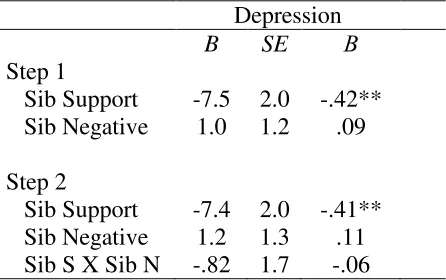
First, the dependent variable, depression, was regressed onto both of the variables
measuring sibling relationship quality. This model was significant, F (2, 65) = 7.4, p<.001, R2=
0.18. Beta weights for the individual predictors indicated that greater sibling support predicted
lower levels of depression, as expected, but sibling negativity was not a significant predictor (see
[image:42.612.69.292.437.577.2]Table 2).
Table 2
Multiple Regression Predicting Depression from Sibling Relationship Quality (N=68)
Depression
B SE Β
Step 1
Sib Support -7.5 2.0 -.42** Sib Negative 1.0 1.2 .09
Step 2
Sib Support -7.4 2.0 -.41** Sib Negative 1.2 1.3 .11 Sib S X Sib N -.82 1.7 -.06
Note. Sib Supp= Sibling Support. Sib Negative =
Sibling Negative. Sib S X Sib N= Sibling Support X Sibling Negative.
**= p<.01.
To examine the association between sibling relationship quality and perceived stigma, the
support and sibling negative scale scores in five separate regressions. The model for predicting
total stigma was significant, F (2, 65) = 4.3, p<.01, R2= 0.12. Beta weights indicated that sibling
support did not significantly predict total stigma. However, greater sibling negativity predicted
higher total perceived stigma, as expected (see Table 3).
For predicting personalized stigma, the overall model was not significant, F (2, 65) = .43,
p >.05, R2= 0.01.The beta weights in Table 3 indicated that there were no significant effects of
sibling relationship quality on this outcome.
Predicting disclosure, the overall model was not significant, F (2, 65) = .59, p >.05, R2=
0.02. The beta weights in Table 3 indicated that there were no significant effects of sibling
relationship quality on this outcome.
For predicting negative self-image, the overall model was significant, F (2, 65) = 5.6,
p<.01, R2= 0.15. Similar to total stigma, the beta weights in Table 3 indicated that there was a
significant main effect of sibling negative, such that more negative sibling relationships
predicted higher negative self-image for the youth, and there was no significant effect of sibling
support.
Predicting public attitudes, the overall model was significant, F (2, 65) = 6.5, p<.01, R2=
0.17. Similar to total stigma and negative self-image, the beta weights in Table 3 indicated that
there was a significant main effect of sibling negative, such that more negative sibling
relationships predicted higher concerns about public attitudes, and there was no significant
Table 3:
Multiple Regression Predicting Stigma from Sibling Relationship Quality
Total Stigma
Personalized
Stigma
Disclosure Negative Self-Image Public Attitudes
b SE β b SE β b SE β b SE β b SE β
Step 1
Sib S -1.8 1.5 -.14 -.26 .71 -.05 -.23 .33 -.09 -.99 .62 -.18 -.40 .40 -.11
Sib N 2.4 .93 .30** .35 .44 .10 .15 .20 .09 1.05 .38 .32** .84 .25 .38**
Step 2
Sib S -1.8 1.5 -.14 -.25 .72 -.04 -.21 .33 -.08 -1.1 .62 -.19 -.41 .40 -.11
Sib N 2.4 .97 .30** .37 .46 .11 .20 .21 .12 .98 .39 .30* .82 .26 .38**
SS X SN .17 1.3 .02 -.09 .59 -.02 -.23 .27 -.11 .40 .51 .09 .08 .33 .03
In sum, overall, sibling support was predictive of youths’ depression and sibling negative
was predictive of youths’ perceived stigma. It was further hypothesized that the value of sibling
support and sibling negative might be important within the context of each other. Specifically, it
was hypothesized that sibling conflict would be less detrimental in the context of a supportive
sibling relationship, and that sibling support would be less effective in the context of a highly
negative (i.e., conflictual) relationship. To test this hypothesis, the Sibling Support X Sibling
Negative interaction terms were entered in the second step of all regressions. The results
indicated that there was not a significant interaction predicting depression F (1, 64) = .24, p> .05,
R2change = .00 or total stigma, F (1, 64) = .02, p> .05, R2change = .00 or any of the stigma subscales
(see Tables 2 and 3).
The Compensatory Hypothesis: Total other support as a moderator of sibling relationship
quality and youth outcomes
The next analyses tested the hypothesis that the impact of sibling relationship quality on
depression and perceived stigma would vary depending on support from others, such that in the
context of low other support, the relationship between sibling relationship quality and outcomes
would be especially strong. Two indices of the amount and quality of other support were
calculated. Total other support was calculated by taking the total sum of each support score
(mother, father, relative, etc.) excluding sibling support and then dividing that total by the
number of people who were supports, which resulted in an averaged total support score. Highest
other support was calculated by taking the highest support score out of all the support scores,
excluding sibling support. However, the latter variable was subsequently discarded because it
was not correlated with any outcomes and, thus, did not appear to be capturing an aspect of