2018 International Conference on Modeling, Simulation and Analysis (ICMSA 2018) ISBN: 978-1-60595-544-5
A Simulation Method to Evaluate Manufacturing Service
in Cloud Manufacturing
Yao-ping YU, Jian-feng LU
*and Zhi-hui JIANG
CIMS Research Center of Tongji University, 4800 Cao’an Road, Shanghai, China
*Corresponding author
Keywords: Simulation, Manufacturing service evaluation, Cloud Manufacturing.
Abstract. Since the globalization of manufacturing, the manufacturing has been a rapid development
and emerges many new developed manufacturing modes such as Cloud Manufacturing (CM), while meets more complex manufacturing problems at the same time. For example, evaluation of service is a key for the transaction process of CM service. Thus, this paper introduces a simulation method to evaluate manufacturing service. Firstly, the research status of CM service evaluation was discussed. Then, the mapping relationship between manufacturing service and simulation model was given out. After that, by modeling, unique evaluation indices for service consumers and providers were provided to make decisions. Lastly, an implementation case was given to verify the feasibility of the method.
Introduction
With the globalization of manufacturing, manufacturing must meet more complex production and management problems and necessarily implement larger scale of co-manufacturing. Although some developed manufacturing modes, such as agile manufacturing and networked manufacturing, have achieved certain development, it still exists some unavoidable disadvantages [1]. Fortunately, a new manufacturing mode, Cloud Manufacturing, was born. In all, it enriches and expends the content of resource sharing and service mode [2], aiming at achieving agile, service-oriented, green and intelligent manufacturing [3].
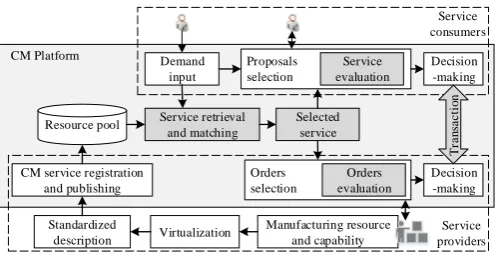
Cloud manufacturing system is an open and complex giant system, which is committed to providing a way to gather and use the global distributed manufacturing resources and serve users on their needs. Generally, the process of cloud manufacturing service transaction is shown as Figure 1. It involves three main parts: service providers, service consumers and cloud manufacturing platform. The cloud service starts from the virtualization and publication of manufacturing resources and capabilities firstly, after which the resource pool will be formed in the cloud platform. Then service consumers can search, composite and match cloud service resources from resource pool according to their demand. After that, several service proposals and orders will be respectively sent to service consumer and providers. Finally, considering evaluation indices of service proposals and orders, service consumers and providers can decide whether to reach a transaction.
Demand input Proposals selection Service evaluation Decision -making Service retrieval and matching Selected service Resource pool Orders selection Orders evaluation Decision -making CM service registration
[image:1.595.171.420.630.759.2]and publishing Standardized description Virtualization Manufacturing resource and capability CM Platform Service consumers Service providers T ra n sa c ti o n
In the whole process of cloud manufacturing, a key point should be studied. That is, service consumers need select service from many service proposals in the light of necessary evaluation index, while service providers also need select appropriate orders from different consumers according to service evaluation index. Thus, both service consumers and providers need unique service evaluation indices. Naturally, how to construct the evaluation system of manufacturing services based on overall QoS (Quality of Service) to help both sides make decisions has become an urgent problem.
Research Status
Firstly, a sound evaluation index system is the premise for evaluating cloud manufacturing services reasonably and correctly. Wang [4] proposed the evaluation index from the perspective of hard-manufacturing source, soft-manufacturing source, manufacturing ability and network ability. Huang [5] and Ma [6] proposed evaluation index, such as service performance, response time and service price, from the perspective of QoS. Secondly, high accuracy of evaluation result is an important prerequisite and basis for selection. The situation that service consumers get inaccurate or wrong QoS data from the service provider may lead to credibility problems [7]. So some studies [8-10] paid more attention to achieve the creditability of service and modified the QoS according to the creditability. Thirdly, when it comes to the methods to get credible and complete evaluation index, some scholars have studied the analytic hierarchy process (AHP) [11] and the fuzzy mathematics method [12-13] to improve the evaluation of cloud service. Those methods are mature and have been the focus of current research. What’s more, several researchers use statistical analysis method, such as principle component analysis (PCA) [14] and probability density function (PDF) [15] to achieve evaluation index, which is suitable for classifying evaluation object.
To conclude, the above mentioned methods all need mathematical analysis method to realize. But it is usually difficult to describe a complex system with analytic method. The execution of CM service composition is highly a complex process, and there exists much difficulty to achieve correct evaluation index by the methods mentioned above. Thus, this paper focus on the evaluation method of cloud manufacturing service, and try to use the simulation method to evaluate the cloud manufacturing service for evaluating the processing of manufacturing services more accurately, reliably and easily.
General Framework of the Evaluation System Based on Simulation
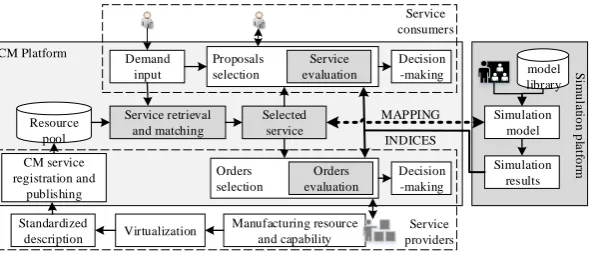
Based on the transaction process of CM service, the general framework of the evaluation system for CM service in this paper is shown as Figure 2. The brief process of evaluation: firstly, map the selected CM service to simulation model after forming one or more service proposals. Then, based on simulation unit model library, the simulation stuff can construct complete simulation models corresponding to service proposals and run it. When simulation finishes, the simulation platform will deal with the simulation data according to service consumers’ and providers’ unique focus point and send results to both sides as a feedback for making decisions.
[image:2.595.153.448.643.770.2]Demand input Proposals selection Service evaluation Decision -making Service retrieval and matching Selected service Resource pool Orders selection Orders evaluation Decision -making CM service registration and publishing Standardized description Virtualization Manufacturing resource and capability CM Platform Service consumers Service providers model library Simulation model Simulation results S im u la tio n p la tf o rm MAPPING INDICES
Based on the above framework, this paper finishes two main tasks: Firstly, analyze the mapping relationships between CM service and simulation model. Secondly, provide cloud service evaluation index for service providers and consumers, propose the mapping relationships between the results of simulation and service evaluation index through analyzing, and construct the CM service evaluation index system eventually.
Related Work
CM Service Modeling and Simulating
[image:3.595.160.440.357.465.2]The key point of the evaluation system for CM service lies in the construction of simulation model. This paper mainly aims at manufacturing service evaluation. Based on simulation platform, such as Tecnomatix Plant Simulation, this paper proposes a mapping method between simulation model and manufacturing service (that is, virtualized entity resource), namely constructs simulation unit model library. Taking the use of model library, different levels of processing tasks can correspond to different simulation resources. For example, products corresponding to enterprises, component corresponding to workshop. According to the requirement of simulation granularity, manufacturing services can be mapped to not only the processing station, but also workshop, which is a set of stations and expressed by “Frame” module in Plant Simulation, which is shown in Table1.
Table 1. The mapping relationship.
Service Station Simulation Object
Product service Enterprise Component service Work shop
Processing service station
Logistics service Logistics object
Evaluation Index System of CM Service
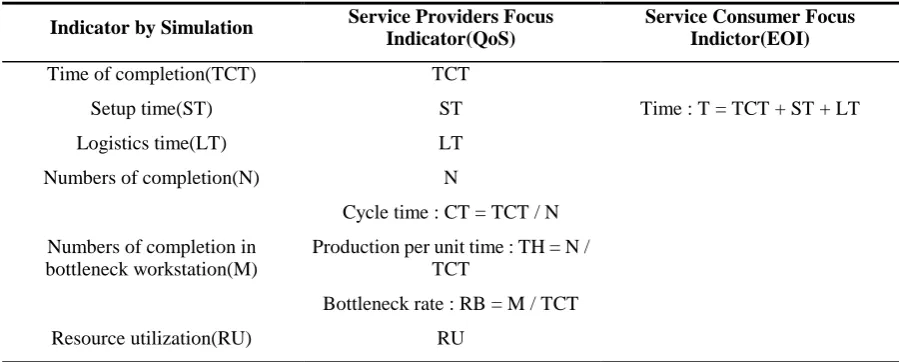
For service providers and consumers, they need different indicators for the corresponding evaluation. Service consumers need the QoS indicators such as reliability, time, cost, while service providers need resource capacity, turnaround time, transport time and so on. In this paper, the evaluation indices are divided into two categories: one for service consumers, another for service providers. By building the correspondence between evaluation indices of cloud services and simulation indices, the QoS will be fed to service consumers and the Enterprise Operation Index (EOI) to service providers. The corresponding relationship is shown in Table 2.
Table 2. Index transition relation.
Indicator by Simulation Service Providers Focus
Indicator(QoS)
Service Consumer Focus Indictor(EOI)
Time of completion(TCT) TCT
Time : T = TCT + ST + LT
Setup time(ST) ST
Logistics time(LT) LT
Numbers of completion(N) N
Numbers of completion in bottleneck workstation(M)
Cycle time : CT = TCT / N Production per unit time : TH = N /
TCT
[image:3.595.72.522.614.795.2]Energy consumption status(ECS) ECS Energy efficiency(EE) EE
TCT ST
Production Cost : PC = TCT * PCU
Cost : C = PC + LC + AC Logistics Cost : LC = ST * LCU
Management Cost : AC = TCT * ACU
Quality Quality
Service Reliability Service Availability
Service Reputation
Application
In this section, a case would be given to show the construction of simulation model and simulation indices analysis.
Case Background
A manufacturer needs a kind of parts processing service. That machining part can be produced with four steps: blank process, rough machining, finish machining, inspection and marking. Two factories, factory A and factory B, can do these works. They both provide corresponding CM service of these four steps. In other words, each processing step can be published as a cloud manufacturing atomic service into resource pool and be selected.
[image:4.595.77.520.72.254.2]Then service consumer can select suitable service from service pool. For example, service consumer can select two kinds of service composition proposals shown in Table 3.
Table 3. Service composition list.
Proposal Blank
process
Rough machining
Finish machining
Inspection and marking
AAAA A A A A
BABA B A B A
Simulation Mapping
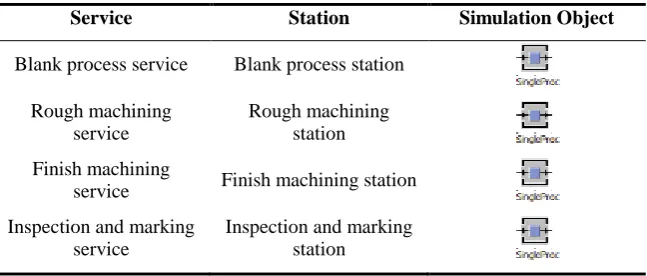
[image:4.595.138.462.637.775.2]Each atomic service can be mapped to a simulation model. Based on the simulation unit model library, the mapping relationship between the four CM services and simulation models is shown in Table 4.
Table 4. The mapping relationship
Service Station Simulation Object
Blank process service Blank process station
Rough machining service
Rough machining station Finish machining
service Finish machining station Inspection and marking
service
Construction of Simulation Model
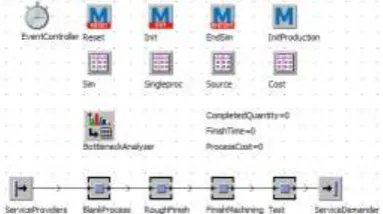
Based on the simulation unit model library and the selected service, stuff can construct the complete model in Plant Simulation, which is shown in Figure 3. During the running time, the simulation data will be saved in tables such as “sim”, “singleproc”, “source”, “cost”. The table named “sim” is used for storing connection information among simulation components. Table “singleproc” is used for storing processing time of station. Table “source” is for storing production plan. And Table “cost” is for objects’ cost. These tables will be read by method object named “InitProductLine”. By programming language, the objects of simulation model can be generated.
Simulation Indices Analysis
The paper regards the bottleneck station, completed quantity as enterprise operation indices, while finish time and processing cost as QoS indices.
Bottleneck Analysis
Using “Bottleneck Analyzer” module in Plant Simulation, sorting according to “work” column. The results of combination scheme AAAA and combination scheme BABA are shown in Figure 4 and 5, from which we can know the bottleneck stations of two schemes are both “Finish machining”.
Completed Quantity, Finish Time, Processing Cost and Production Analysis
[image:5.595.137.457.399.724.2]When the simulation model is finished running, using programming language to display the simulation indices, including completed quantity, completion time and processing cost and that scheme BABA does better in the same completed quantity. Then, according to the service composition scheme BABA, consumer can place an order or contact the manufacturers.
[image:5.595.202.394.411.518.2]Figure 3. Production line model.
Figure 4. Bottleneck analysis of combination scheme AAAA.
[image:5.595.146.453.650.711.2]Table 5. Comparison of two schemes Composition
scheme Finish time
Completed quantity
Processing cost
Production /24h
AAAA 362100 100 200 23
BABA 422400 100 150 19
Summary
This paper mainly proposes a simulation method to evaluate manufacturing service in CM. Based on specific simulation platform, a mapping relationship between CM service and simulation model has been proposed. Also, by modeling and analyzing, this method can provide both service consumers and providers with reliable evaluation indices of CM service. This study broadens the research field of cloud services, provides a scientific evaluation indices of CM service and gives decision support for service consumers and providers.
Acknowledgements
This research was financially supported by the Major Program of National Natural Science Foundation of China (Grant No. 71690234) and Shanghai Industrial Innovation and Development Project (No. 2017-GYHLW-01002).
References
[1] Li Bo-Hu, L Zhang and SL Wang, Cloud manufacturing: a new service-oriented networked manufacturing model, Computer Integrated Manufacturing Systems. J. China, vol. 16, 2010, pp. 1-7.
[2] Li Bo-Hu, L Zhang and L Ren, Further discussion on cloud manufacturing, Computer Integrated Manufacturing Systems. J. China, vol. 17, 2011, pp. 449-457.
[3] L Zhang, YL Luo and WH Fan, Analyses of cloud manufacturing and related advanced manufacturing models, Computer Integrated Manufacturing Systems. J. China, vol. 17, 2011, pp. 458-468.
[4] Wang Tingting. “Cloud manufacturing service evaluation based on QoS,” Technology Wind. J. China. vol. 3, 2015, pp. 69-70.
[5] Huang Yun. “The research on evaluation model of cloud service based on QoS and Application,” Zhejiang Gongshang University at Hangzhou, 2013.
[6] Ma Wenlong, Zhu Lin’an, Wang Wanliang. “Cloud service selection model based on QoS-aware in cloud manufacturing environment,” Computer Integrated Manufacturing Systems. J. China, vol. 20, 2014, pp. 1246-1254.
[7] G Suryanarayana, “Selection and architecture-based composition of trust models in decentralized applications,” California State University at Long Beach, 2007.
[8] GQ Liu, ZL Zhu and H Wang, “A credibility evaluation model for Web services based on QoS,” Journal of Chinese Mini-Micro Computer Systems. J. China, vol. 30, 2009, pp. 2216-2221.
[9] PY Liu, “Research on the credibility of Web services based on QoS,” Zhejiang Sci-tech University, 2014.
[10] CH Hu, XX Luo and SC Wang, "Service evaluation method based on trust reasoning in cloud computing environment," Journal on Communications. J. China, vol. 32, 2011, pp. 72-81.
[12] S Wang, Z Liu, Q Sun, and H Zou, “Towards an accurate evaluation of quality of cloud service in service-oriented cloud computing,” Journal of Intelligent Manufacturing. 2014, 25 (2): 283-291.
[13] M Supriya, LJ Venkataramana and K Sangeeta, “Estimating trust value for cloud service providers using fuzzy logic,” International Journal of Computer Applications. 2013, 48 (19): 28-34.
[14] Zhou Bing, Wang Meiqing, Gan Jia. “A method of cloud manufacturing service QoS evaluation based on PCA,” Manufacturing Aotumation. J. 2013, (14): 28-33.