0095-1137/09/$08.00⫹0 doi:10.1128/JCM.01579-08
Copyright © 2009, American Society for Microbiology. All Rights Reserved.
Methicillin-Resistant
Staphylococcus aureus
in Spain: Molecular
Epidemiology and Utility of Different Typing Methods
䌤
†
Ana Vindel,
1Oscar Cuevas,
2Emilia Cercenado,
2* Carmen Marcos,
1Vero
´nica Bautista,
1Carol Castellares,
2Pilar Trincado,
1Teresa Boquete,
1Maria Pe
´rez-Va
´zquez,
1Mercedes Marín,
2Emilio Bouza,
2and the Spanish Group for
the Study of
Staphylococcus
Centro Nacional de Microbiología, Instituto de Salud Carlos III, Majadahonda, Madrid, Spain,1and Servicio de Microbiología,
Hospital General Universitario Gregorio Maran˜o´n, Madrid, Spain2
Received 14 August 2008/Returned for modification 12 November 2008/Accepted 21 March 2009
In a point-prevalence study performed in 145 Spanish hospitals in 2006, we collected 463 isolates of
Staphylococcus aureusin a single day. Of these, 135 (29.2%) were methicillin (meticillin)-resistantS. aureus
(MRSA) isolates. Susceptibility testing was performed by a microdilution method, andmecAwas detected by PCR. The isolates were analyzed by pulsed-field gel electrophoresis (PFGE) after SmaI digestion, staphylo-coccal chromosomal cassettemec(SCCmec) typing, agr typing,spa typing with BURP (based-upon-repeat-pattern) analysis, and multilocus sequence typing (MLST). The 135 MRSA isolates showed resistance to ciprofloxacin (93.3%), tobramycin (72.6%), gentamicin (20.0%), erythromycin (66.7%), and clindamycin (39.3%). Among the isolates resistant to erythromycin, 27.4% showed the M phenotype. All of the isolates were susceptible to glycopeptides. Twelve resistance patterns were found, of which four accounted for 65% of the isolates. PFGE revealed 36 different patterns, with 13 major clones (including 2 predominant clones with various antibiotypes that accounted for 52.5% of the MRSA isolates) and 23 sporadic profiles. Two genotypes were observed for the first time in Spain. SCCmectype IV accounted for 6.7% of the isolates (70.1% were type IVa, 23.9% were type IVc, 0.9% were type IVd, and 5.1% were type IVh), and SCCmectype I and SCCmectype II accounted for 7.4% and 5.2% of the isolates, respectively. One isolate was nontypeable. Only one of the isolates produced the Panton-Valentine leukocidin. The isolates presentedagrtype 2 (82.2%), type 1 (14.8%), and type 3 (3.0%).spatyping revealed 32 different types, the predominant ones being t067 (48.9%) and t002 (14.8%), as well as clonal complex 067 (78%) by BURP analysis. The MRSA clone of sequence type 125 and SCCmec type IV was the most prevalent throughout Spain. In our experience, PFGE,spa typing, SCCmec
typing, and MLST presented good correlations for the majority of the MRSA strains; we suggest the use ofspa
typing and PFGE typing for epidemiological surveillance, since this combination is useful for both long-term and short-term studies.
Methicillin (meticillin)-resistantStaphylococcus aureus(MRSA) is a major cause of hospital-acquired infections worldwide (5, 25). The appearance of MRSA in the community and the potential risk of it entering hospitals are also matters of con-cern (29, 44). Moreover, the increasing prevalence of multi-drug resistance and the emergence of isolates with intermedi-ate or high-level vancomycin resistance emphasize the importance of the use of infection control measures (2, 49, 50). Although the rates of isolation of MRSA have been increasing throughout the world for the last few decades and in some areas the rates reach⬎50%, there are considerable variations in the prevalence of MRSA according to geographic area (3, 18, 21, 39, 44). In Spain, the prevalence of MRSA increased from 1.5% in 1986 to 29.2% in 2006, although it seems to have stabilized (13). Despite the worldwide increase in isolation
rates, only a limited number of clones of MRSA have spread in most countries (20).
Historically, the dissemination of epidemic clones such as EMRSA type 15 (EMRSA-15), EMRSA-16, the Iberian clone, and the Brazilian clone, as well as the high incidence of the community-acquired MRSA USA300 clone, has led to the increased use of molecular typing methods (11, 38, 42, 47, 53). In recent years, a variety of molecular techniques have been used for the typing of MRSA isolates. Of these, SmaI macro-restriction analysis is the “gold standard” for the analysis of the local epidemiology in the short term,spatyping in combination with BURP (based-upon-repeat-pattern) analysis has become a frontline tool for routine epidemiological typing, and mul-tilocus sequence typing (MLST)–staphylococcal chromosomal cassettemec(SCCmec) typing is the reference method for the definition of MRSA clones (10, 34, 37, 46).
The aim of the present study was to determine which clones are circulating in Spain and whether the strains have spread between hospitals by analyzing a representative sample of isolates collected in a point-prevalence study. Isolates were grouped by using pulsed-field gel electrophoresis (PFGE) and
spatyping and were assigned to MRSA clones on the basis of MLST and SCCmectyping. The congruence between the dif-ferent grouping methods was assessed.
* Corresponding author. Mailing address: Servicio de Microbi-ología, Hospital General Universitario Gregorio Maran˜o´n, C/ Dr. Es-querdo, 46, Madrid 28007, Spain. Phone: 586-8459. Fax: 34-91-504-4906. E-mail: [email protected].
† Supplemental material for this article may be found at http://jcm .asm.org/.
䌤Published ahead of print on 1 April 2009.
1620
on May 16, 2020 by guest
http://jcm.asm.org/
(This study was presented in part at the 47th Interscience Conference on Antimicrobial Agents and Chemotherapy, Chi-cago, IL, 2007 [O. Cuevas, C. Marcos, P. Trincados, T. Bo-quete, E. Cercenado, E. Bouza, and A. Vindel; abstr. C2-148].)
MATERIALS AND METHODS
Bacterial isolates.A point-prevalence study involving 145 Spanish hospitals on
a single day in 2006 yielded a total of 463 clinical isolates ofS. aureus. Full details
of the study design and identification of the isolates have been published previ-ously (13, 14). Of the total number of isolates tested, 135 were MRSA.
Susceptibility testing.Antimicrobial susceptibility testing was performed by an automated broth microdilution method with the Pos Combo 23S panel (Micro-Scan; Siemens, Sacramento, CA), according to the manufacturer’s guidelines. MIC breakpoints were determined according to the recommendations of the Clinical and Laboratory Standards Institute (CLSI) (9). Full details of the anti-microbial susceptibility tests have been published elsewhere (13, 14).
Methicillin resistance detection.ThemecAgene was detected by PCR, as described by Geha et al. (24).
PFGE.All 135 MRSA isolates were genotyped by PFGE after SmaI digestion of chromosomal DNA, prepared by using a modification of the protocol de-scribed by Cookson et al. (10). This technique has been fully dede-scribed previously (12). Analysis of the gels was performed according to the criteria of Tenover et al. (48), and a dendrogram was constructed with Molecular Analyst software (Bio-Rad) by using the Dice correlation coefficient (28) and the unweighted pair-group method with averages with a tolerance position of 0.8%. According to the findings of our previous studies (12, 53), each PFGE type was assigned the letter E, followed by a number that correlated with the date of isolation, while each subtype was assigned the letter of the main genotype to which it was the closest. Sporadic strains were indicated in each case. In our previous studies (12, 53), PFGE type E1 corresponded to a MRSA isolate of sequence type 247
(ST247) and SCCmectype I (ST247-MRSA-I); types E3 and E10 corresponded
to ST146-MRSA-IV; types E6, E9, E15, and E17 corresponded to ST228-MRSA-I; types E7, E8, and E11 corresponded to ST125-MRSA-IV; type E12 corresponded to ST36-MRSA-II; type E16 corresponded to ST228-MRSA-IV; and type E13 corresponded to ST22-MRSSA-IV (53). PFGE type A was a community-acquired genotype that corresponded to ST8-MRSA-IV (6).
Multiplex PCR for SCCmectyping.SCCmectypes were determined by use of a multiplex PCR strategy that generated a specific amplification pattern for each
SCCmecstructural type, according to the method described by Oliveira and de
Lencastre (40). Additional typing of the isolates was performed by two different
PCR methods in order to detect SCCmecIV subtypes IVa, IVb, IVc, IVd, and
IVh (37) and SCCmectype V (56).
Detection of PVL genes. The Panton-Valentine leukocidin (PVL) genes (lukS-PVandlukF-PV) were detected by PCR by the method described by Lina
et al. (32).S. aureusATCC 49775 (a PVL-positive strain) was used as a positive
amplification control.
Determination of accessory gene regulator (agr) types.A scheme of two PCRs based on the method described by Shopsin et al. (45) was used for the
determi-nation of the specificagrgroups.
spatyping and BURP analysis.The polymorphic X region of the protein A
gene (spa) was amplified from all MRSA isolates, as described previously (27,
46). By application of the BURP algorithm implemented by the software,spa
types with more than five repeats were clustered into different groups, with the calculated cost between the members of a group being less than or equal to 6.
Thespatype was assigned by using Ridom StaphType software (36).
MLST.Several representative strains from each type and subtype of PFGE were selected for determination of the ST. None of the sporadic PFGE geno-types were typed by this method. MLST typing was performed by the method described by Enright et al. (16). Allelic profiles and ST types were assigned by using the MLST database (http://www.mlst.net).
RESULTS
Resistance patterns. Of the 135 MRSA isolates studied, 93.3% were resistant to ciprofloxacin, 72.6% were resistant to tobramycin, 20% were resistant to gentamicin, 66.7% were resistant to erythromycin, and 39.3% were resistant to clinda-mycin. Of the isolates resistant to erythromycin, 27.4% showed the M phenotype. All the isolates were susceptible to
vanco-mycin (MICsⱕ 2 mg/liter) and teicoplanin (MICs ⱕ 8 mg/ liter). Full details of the susceptibilities of the isolates have been published elsewhere (13). Table 1 shows the different resistance patterns of the MRSA strains. Twelve different pat-terns were found, of which four accounted for 65% of the isolates. Seven isolates (5.2%) were resistant only to oxacillin. Multiresistance to one, two, three, four, and five additional antibiotics was observed in 6.7%, 25.1%, 29.6%, 20.8%, and 12.6% of the MRSA isolates, respectively.
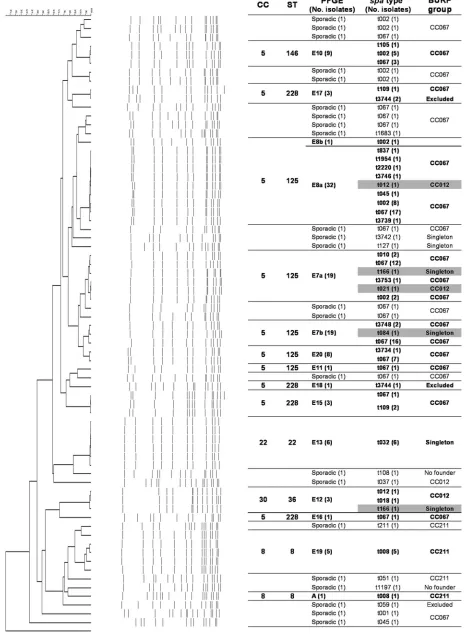
PFGE. Genotyping by PFGE of the 135 MRSA isolates grouped 112 into 13 genotypes (E7, E8, E10, E11, E12, E13, E15, E16, E17, E18, E19, E20, and A). Two genotypes (E19 and E20) were observed for the first time in Spain. Genotypes E7 (with subtypes E7a and E7b; 28.1%) and E8 (with subtypes E8a and E8b; 24.4%) predominated and together accounted for 52.5% of the isolates. The remaining 23 isolates belonged to 23 sporadic profiles that were each represented by a single isolate. Figure 1 shows the genetic relationships between the 36 PFGE patterns identified.
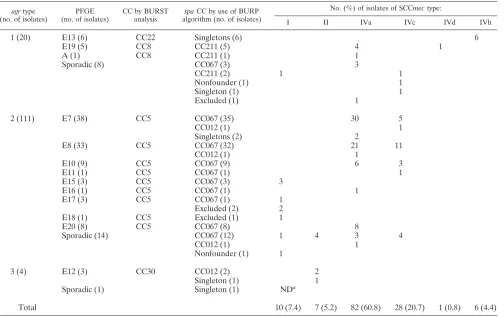
SCCmec types. The distribution of the different SCCmec
types among the different genotypes is shown in Table 2. SCCmectype IV accounted for 86.7% of the isolates (117), with 70.1% of these carrying SCCmec type IVa, 23.9% carrying SCCmectype IVc, 0.9% carrying SCCmectype IVd, and 5.1% carrying SCCmectype IVh. SCCmectype I was identified in 10 isolates (7.4%), and SCCmectype II was found in 7 isolates (5.2%). One isolate could not be typed by any of the methods of SCCmectyping used in this study.
SCCmectype IVa (present in 60.8% of all MRSA isolates) was included in seven major genotypes (E7, E8, E10, E16, E19, E20, and A) and eight sporadic isolates. SCCmectype IVc was present in four major genotypes (E7, E8, E10, and E11) and seven sporadic isolates. SCCmectype IVh was present in ge-notype E13 (ST22-MRSA-IV). SCCmectype I was present in genotypes E15, E17, and E18 (ST228-MRSA-I), and SCCmec
type II was present in genotype E12 (ST36-MRSA-II).
agrtypes.Table 2 shows the distribution of theagrtypes and their correlation with the genotypes observed by PFGE
TABLE 1. Resistance phenotypes of MRSA
Resistance profilea No. (%)
of isolates
Oxacillin only ... 7 (5.2)
ERY ... 1 (0.8) CIP ... 8 (5.9)
TOB⫹CIP...26 (19.2) ERY⫹CIP ... 7 (5.2) ERY⫹CLI ... 1 (0.7)
ERY⫹TOB⫹CIP...23 (17.0) ERY⫹CIP⫹CLI ...13 (9.6) GEN⫹TOB⫹CIP ... 4 (3.0)
ERY⫹CIP⫹CLI⫹TOB...22 (16.3) ERY⫹CIP⫹TOB⫹GEN... 6 (4.5)
ERY⫹CIP⫹TOB⫹GEN⫹CLI...17 (12.6)
aAbbreviations: CIP, ciprofloxacin; CLI, clindamycin; ERY, erythromycin;
GEN, gentamicin; TOB, tobramycin.
VOL. 47, 2009 MOLECULAR EPIDEMIOLOGY OF MRSA IN SPAIN 1621
on May 16, 2020 by guest
http://jcm.asm.org/
FIG. 1. Dendrogram showing the genetic relationships between the 135 MRSA isolates and correlations between the different typing methods. Group violations are marked in gray.
1622
on May 16, 2020 by guest
and SCCmec typing. The most frequent agrtype was type 2 (82.2%), which grouped strains belonging to nine major clones (E7, E8, E10, E11, E15, E16, E17, E18, and E20) and 14 sporadic MRSA strains.agrtype 1 was present in 14.8% of the strains belonging to three major clones (E13, E19, and A) and to eight sporadic MRSA strains. Only 3.0% of the MRSA strains harboredagrtype 3; these strains belonged to the E12 clone (three strains), andagrtype 3 was found in one sporadic MRSA isolate. None of the MRSA strains presented agr
type 4.
PVL genes. Only one isolate presented PVL. The MRSA strain showed PFGE genotype A (community acquired) and was also resistant to erythromycin (Table 2). The origin of the isolate was a wound infection from a child.
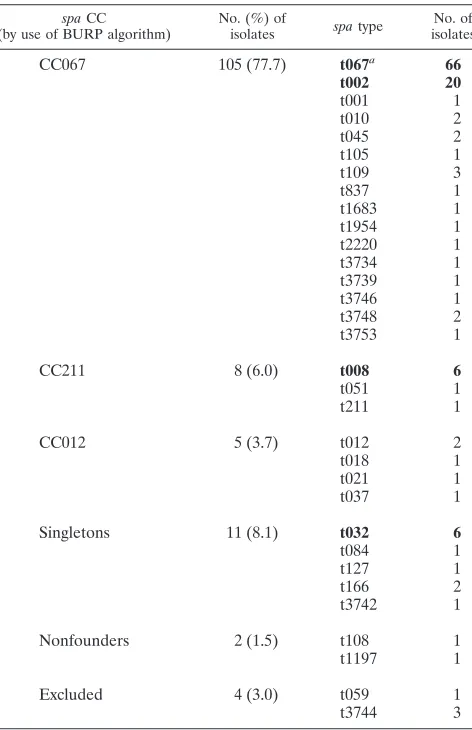
spa types. The different spa types observed are shown in Table 3. Among the 135 MRSA strains, 32 differentspatypes were identified: 21 were represented by a single strain, and 7 were newspatypes not described previously. spatype t067 was the most frequent (48.9% of the isolates), followed byspatype t002 (14.8%). By application of the BURP algorithm, the MRSA strains were clustered into three groups: clonal com-plex 067 (CC067; 77.7%), CC211 (6.0%), and CC012 (3.7%). The only PVL-positive isolate belonged tospatype t008 (spa
CC211). Two spa types were considered nonfounders, five were singletons (one of which, t032, grouped six MRSA strains), and two were excluded (3%).
Correlation between the different molecular typing methods. The correlations between the BURP group (spaCC),spatype, PFGE genotype,agrtype, and BURST group MLST type and the SCCmectype are shown in Table 2 and Fig. 1. Both PFGE andspatyping showed 100% typeability and excellent repro-ducibility, although PFGE showed more discriminatory power thanspatyping. MRSA strains belonging to different epidemic PFGE genotypes (E7, E8, E10, E11, E15, E16, and E20) pre-sented eitherspatype t067 (43.0%) orspatype t002 (11.9%), and both were grouped in CC067 and MLST CC5 (ST125 and ST228). The six isolates designated genotype E13 by PFGE belonged to spa type t032 and were grouped as singletons, corresponding to clone ST22-MRSA-IVh. On the other hand, 12 MRSA strains considered sporadic isolates on the basis of their PFGE patterns belonged to spa types t067 (8 strains; 5.9%) and t002 (4 strains; 2.9%). In addition, we observed discrepancies between the two methods in the classification of five MRSA isolates. Three isolates belonging to genotype E7, one isolate belonging to genotype E8, and another isolate belonging to genotype E12 presented different spa types, namely, types t012 and t021 (CC012, ST30-MRSA-IV) (Fig. 1). In general, we observed a high degree of concordance between the MLST clonal complexes and the BURP groups (Fig. 1). With the exception of the five isolates described above, isolates belonging to MLST CC5 (ST125 with PFGE genotypes E7, E8, E11, and E20; ST146 with PFGE geno-TABLE 2. Correlation between the different molecular typing methods
agrtype (no. of isolates)
PFGE (no. of isolates)
CC by BURST analysis
spaCC by use of BURP
algorithm (no. of isolates)
No. (%) of isolates of SCCmectype:
I II IVa IVc IVd IVh
1 (20) E13 (6) CC22 Singletons (6) 6
E19 (5) CC8 CC211 (5) 4 1
A (1) CC8 CC211 (1) 1
Sporadic (8) CC067 (3) 3
CC211 (2) 1 1
Nonfounder (1) 1
Singleton (1) 1
Excluded (1) 1
2 (111) E7 (38) CC5 CC067 (35) 30 5
CC012 (1) 1
Singletons (2) 2
E8 (33) CC5 CC067 (32) 21 11
CC012 (1) 1
E10 (9) CC5 CC067 (9) 6 3
E11 (1) CC5 CC067 (1) 1
E15 (3) CC5 CC067 (3) 3
E16 (1) CC5 CC067 (1) 1
E17 (3) CC5 CC067 (1) 1
Excluded (2) 2
E18 (1) CC5 Excluded (1) 1
E20 (8) CC5 CC067 (8) 8
Sporadic (14) CC067 (12) 1 4 3 4
CC012 (1) 1
Nonfounder (1) 1
3 (4) E12 (3) CC30 CC012 (2) 2
Singleton (1) 1
Sporadic (1) Singleton (1) NDa
Total 10 (7.4) 7 (5.2) 82 (60.8) 28 (20.7) 1 (0.8) 6 (4.4)
aND, not determined.
VOL. 47, 2009 MOLECULAR EPIDEMIOLOGY OF MRSA IN SPAIN 1623
on May 16, 2020 by guest
http://jcm.asm.org/
[image:4.585.44.548.80.397.2]type E10; and ST228 with PFGE genotypes E15, E16, E17, and E18) were grouped in BURP CC067. MLST CC8 (ST8 with PFGE genotypes E19 and A) presentedspatype t008, which belonged to BURP group CC211. CC22 (ST22 with genotype E13, which is related to clone EMRSA-15) pre-sented spa type t032, which appeared in this analysis as a singleton. Finally, MLST CC30 (ST36, genotype E12, which is related to clone EMRSA-16) presentedspatypes t012 and t018 and grouped in BURP CC012 andspa type t166 (sin-gleton).
DISCUSSION
MRSA is among the most frequently identified antimicro-bial drug-resistant pathogens worldwide and has evolved in a relatively few lineages. It has been demonstrated that some lineages are ecologically highly successful and that most iso-lates belong to pandemic clones (17). The present study re-vealed that⬎90% of the isolates were multiresistant and that ⬎30% were resistant to at least four antimicrobial agents. In 2002, the predominant (23.9%) pattern among MRSA isolates in Spain involved resistance to ciprofloxacin, erythromycin, clindamycin, gentamicin, and tobramycin (12). In the present
study, performed 4 years later by use of the same methodology, we observed a significant decrease in this multiresistance pat-tern (P⫽0.018), which was represented by only 12.6% of the isolates. In contrast, the rate of multiresistance to ciprofloxa-cin, erythromyciprofloxa-cin, and tobramycin increased significantly, from 8.2% in 2002 (12) to 17.0% in 2006 (P⫽0.042). These results indicate that strains are becoming more susceptible and that the M phenotype of resistance to macrolides and the presence of theant4⬘gene, which confers resistance to tobramycin but not to gentamicin, are becoming more prevalent. Of the 135 MRSA isolates, only one was community acquired and pre-sented the M phenotype of resistance to macrolides.
We characterized the MRSA isolates by using different mo-lecular typing tools. After analysis of the data, we found inter-esting clinical and epidemiological findings. First,spatype t067 (ST5-MRSA-IV) was dominant among the Spanish MRSA isolates, a situation not described in other countries. Second, we found a high degree of clonality of the MRSA isolates obtained in this nationwide prevalence study, which demon-strates that most isolates belong to pandemic clones; and third, we found that PFGE,spatyping, SCCmectyping, and MLST presented a good correlation for most MRSA strains.
The PFGE analysis revealed 36 different genotypes that in-cluded two predominant clones (E7 and E8) and one commu-nity-acquired clone (profile A). PFGE is known to be a highly discriminatory and valuable technique for the typing of S.
aureus(10) and has been used by the Spanish Reference
Lab-oratory for staphylococci for local investigations and national surveillance of MRSA since 1996 (53). It has been argued that the stability of PFGE may be insufficient for its application to long-term epidemiological studies due to the high degrees of genetic variation that have been observed among pandemic clones with a long evolutionary history (4). However, we have already reported that the predominant clones in Spain did not undergo significant changes from 1996 (53) to 2002 (12). Moreover, in the present study (conducted with strains col-lected in 2006), we identified the same predominant clones as well as two new clones, E19 (ST8) and E20 (ST125), with the latter clone being closely related to the predominant E7 and E8 clones. These genotypes belong to ST125, which continues to be responsible for more than half of the nosocomial MRSA infections in Spain (59.3%), although it is unusual in the rest of Europe (23, 42). Our results validate the use of PFGE for long-term nationwide epidemiological studies, although we consider that this technique presents difficulties in interlabo-ratory reliability. Nevertheless, multicenter studies by PFGE are now possible due to the standardization of the electro-phoresis conditions (8, 10) and the availability of normalization and analysis software (15).
The most frequent SCCmectype found was SCCmectype IV, which was present in 86.7% of the isolates. Its presence in the predominant clones, the majority clones, sporadic isolates, and the community-acquired clone suggests a great degree of promiscuity and successful persistence (43). Since SCCmec
[image:5.585.45.281.79.444.2]type IV is currently one of the most frequent nosocomial SCCmectypes found in several countries (1, 22, 33, 44, 47), the antimicrobial resistance patterns of isolates presenting this type varied considerably. In our study, 97.5% and 78.6% of MRSA isolates with multiresistance to three or four antimi-crobials, respectively, showed this type. The permanence of TABLE 3. Distribution ofspatypes and BURP groups (spaCC)
spaCC (by use of BURP algorithm)
No. (%) of
isolates spatype
No. of isolates
CC067 105 (77.7) t067a 66
t002 20
t001 1
t010 2
t045 2
t105 1
t109 3
t837 1
t1683 1
t1954 1
t2220 1
t3734 1
t3739 1
t3746 1
t3748 2
t3753 1
CC211 8 (6.0) t008 6
t051 1
t211 1
CC012 5 (3.7) t012 2
t018 1
t021 1
t037 1
Singletons 11 (8.1) t032 6
t084 1
t127 1
t166 2
t3742 1
Nonfounders 2 (1.5) t108 1
t1197 1
Excluded 4 (3.0) t059 1
t3744 3
a
The most frequentspatypes are marked in boldface.
on May 16, 2020 by guest
http://jcm.asm.org/
this type of SCCmecin hospitals over long periods of time has probably favored its multiresistance due to antibiotic pressure. In our study, most type IV strains belonged to subtype IVa (70.1%), followed by subtype IVc (23.9%). In one study per-formed in the United States (1), subtype IVa was identified in 87.1% of MRSA isolates and subtype IVd was identified in 5.7% of isolates. In a Japanese study, type IV SCCmecstrains were also the most frequent, comprising 53.6% of all strains, and the frequencies of type IVc and type IVd were 38.1% and 10.3%, respectively (33).
SCCmectypes I and II, which have historically been associ-ated with multiresistance (resistance to more than three anti-microbials), were very uncommon in this study and in certain cases were associated with sporadic isolates.
The characterization of SCCmecdid not allow 100% type-ability in our study and showed weak discriminatory power. Even when we used three different typing schemes, one isolate (a sporadic isolate) was nontypeable. In addition, the elevated number of isolates harboring SCCmec type IV limited the discriminatory power of this technique. Although this type can be differentiated into many subtypes, a second multiplex PCR is necessary, increasing the cost of type determinations (37). Since new alleles are frequently described, an ever increasing number of primers will be necessary in order to discriminate between different subtypes (7, 30).
Only 1 of the 135 MRSA isolates was PVL positive and was from a community-acquired wound infection in a child. This isolate presented the characteristics most frequently described among PVL-positive MRSA isolates in Spain, including PFGE profile A, ST8, andspatype t008 (CC008) (6). The finding of only one PVL-positive isolate could be due to the character-istics of our study: a point-prevalence study performed on a single day in 145 Spanish hospitals (13). However, we have previously described a higher prevalence of PVL-positive MRSA isolates (6), which is consistent with the increased prev-alence of PVL-positive MRSA isolates in Europe (52, 54).
Concerning theagrtypes, one previous study indicated that the genotypes determined by PFGE, MLST, and spaare so strongly correlated with theagrtypes that the former can be used to predict the latter indistinctly and that no MLST,spa, or PFGE pattern occurs in more than oneagrgroup (55). In our study, most isolates presentedagrtype 2 (82.2%), and strains belonging to BURP group CC012 presentedagrgroup 2 or 3 indistinctly. The same study cited above (55) also indicates that in certain cases, strains belonging to the same MLST type can present different agr groups. These observations need to be confirmed by additional data, although interstrain recombina-tion and intrastrain rearrangements would be important sources of variation that could explain these observations (43). In our study, in all cases there were unequivocal correlations between the MLST and theagrtypes. We have not found in the literature any studies analyzing theagrtypes of a large series of MRSA isolates.
Recently, a method based on the sequence of the protein A gene (spa typing) represents a marked improvement in the typing of MRSA. It is reproducible and easy to use, and the availability of a central database (http://spa.ridom.de) enables comparisons to be made with data obtained in different labo-ratories and countries. Several studies have demonstrated that it is applicable to both local and global epidemiological studies
(31, 35). The application of this method in Spain revealed that two spatypes (t067 and t002) were dominant (63.7% of all MRSA strains).
The high frequency of t067 (48.9%) in Spain contrasted with the relatively low frequency of t067 (0.97%) found in other European countries (Austria, Denmark, Finland, Germany, The Netherlands, Norway, Sweden, and Switzerland) (http: //spa.ridom.de).
In the case ofspatype t002, the global frequency was to be found 5.79% (Austria, Belgium, Canada, China, Croatia, Cy-prus, Denmark, Estonia, Finland, France, Germany, Hungary, Iceland, Israel, Italy, Japan, Lebanon, The Netherlands, Nor-way, Romania, Sweden, Switzerland, Taiwan, the United King-dom, and the United States), whereas the frequency of this type was higher in Spain (14.8%). The high frequency of t067 and t002 in Spanish hospitals limits the usefulness ofspatyping for local investigations and makes it necessary to differentiate these frequent strains by PFGE.
Concerning the correlation between the different typing methods used in our study, SCCmectypes encompassed mul-tiple MLST types,spatypes, MLST CCs, andspaCCs, a fact that has been observed elsewhere (41, 51).
When we compared the PFGE genotypes usingspatyping, the predominant clones (E7 and E8) presented a variety ofspa
types, although most belonged to the same BURP group (CC067). However, we observed discordant results (group vi-olations) between thespatype assignment and the profile ob-tained by PFGE, as described in other studies (26, 43). In addition, we encountered MRSA isolates that had different profiles—E7, E8 and E11 (ST125), and E10 (ST146)—but that shared the samespatype (t002 and t067). These discrepancies have also been described by Hallin et al. (26), suggesting that they could be due to intergenomic recombination. An elevated number of sporadic isolates, as defined by their PFGE profiles, harbored the samespatype as the predominant clones. This could be due to the high discriminatory power of PFGE. These different profiles could reflect the occurrence of genetic events (19). A recent report suggests that the combination of PFGE andspatyping for epidemiological surveillance studies makes it possible to maintain the discriminatory power and typeability needed in short-term and long-term studies (19).
The application of MLST is especially useful for long-term epidemiological studies due to the low mutation rate of the seven housekeeping genes analyzed by the method (16). How-ever, we considerspatyping and PFGE typing for epidemio-logical surveillance to be the most useful techniques for both long-term and short-term studies. In our study, this combina-tion of typing techniques predicted the MLST CCs, except for the five isolates included as group violations. Other studies have also suggested that this combination reasonably predicts the MLST CCs (19).
In summary, this study demonstrates that strains of MRSA in Spain have become significantly more susceptible to genta-micin and clindamycin than they were in previous years and that there is persistence of the ST125-MRSA-IV clone, which includes the previously described predominant clones E7 and E8 and the new closely related clone, E20. The use of spa
typing in this study allowed us to detect two predominant types (t067 and t002) in Spain that are very uncommon in other countries. In our experience, PFGE,spatyping, SCCmec
typ-VOL. 47, 2009 MOLECULAR EPIDEMIOLOGY OF MRSA IN SPAIN 1625
on May 16, 2020 by guest
http://jcm.asm.org/
ing, and MLST presented a good correlation for most MRSA strains. Due to the high percentage ofspatypes t067 and t002 (CC067 BURP), we consider thatspatyping should be com-bined with PFGE to provide the necessary discriminatory power and typeability for local and long-term epidemiological studies, as well as the possibility of interlaboratory compari-sons. The combination of PFGE and the assignment of BURP CC could predict the eBURST CC without the need to per-form MLST for a larger number of MRSA strains.
ACKNOWLEDGMENTS
This study was supported by the Ministerio de Sanidad y Consumo, Instituto de Salud Carlos III—FEDER, Spanish Network for the Re-search in Infectious Diseases (REIPI RD06/0008). We are grateful to Wyeth-Farma for financing the transport of samples and the laboratory material used in this study.
We thank T. Ito for theStaphylococcus aureuscontrol strains used for the subtyping of SCCmecIV. We thank Thomas O’Boyle for his help with the translation of the manuscript.
The members of the Spanish Group for the Study ofStaphylococcus and the staff of the microbiology services of all participating hospitals are presented in the supplemental material.
REFERENCES
1.Abdel-Haq, N., H. Al-Tatari, P. Chearskul, H. Salimnia, B. I. Asmar, M. R. Fairfax, and M. Amjad.20 November 2008. Methicillin-resistant Staphylo-coccus aureus(MRSA) in hospitalized children: correlation of molecular analysis with clinical presentation and antibiotic susceptibility testing (ABST) results. Eur. J. Clin. Microbiol. Infect. Dis. [Epub ahead of print.]. 2.Appelbaum, P. C. 2006. The emergence of vancomycin-intermediate
and vancomycin-resistantStaphylococcus aureus. Clin. Microbiol. Infect.
12(Suppl. 1):16–23.
3.Bell, J. M., and J. D. Turnidge.2002. High prevalence of oxacillin-resistant
Staphylococcus aureusisolates from hospitalized patients in Asia-Pacific and South Africa: results from SENTRY Antimicrobial Surveillance Program,
1998–1999. Antimicrob. Agents Chemother.46:879–881.
4.Blanc, D. S., P. Francioli, and P. M. Hauser.2002. Poor value of pulsed-field gel electrophoresis to investigate long-term scale epidemiology of
methicil-lin-resistantStaphylococcus aureus. Infect. Genet. Evol.2:145–148.
5.Boyce, J. M., B. Cookson, K. Christiansen, S. Hori, J. Vuopio-Varkila, S. Kocagoz, A. Y. Oztop, C. M. Vandenbroucke-Grauls, S. Harbarth, and D. Pittet.2005. Meticillin-resistantStaphylococcus aureus. Lancet Infect. Dis.
5:653–663.
6.Cercenado, E., O. Cuevas, M. Marin, E. Bouza, P. Trincado, T. Boquete, B. Padilla, and A. Vindel. 2008. Community-acquired methicillin-resistant
Staphylococcus aureusin Madrid, Spain: transcontinental importation and polyclonal emergence of Panton-Valentine leukocidin-positive isolates.
Di-agn. Microbiol. Infect. Dis.61:143–149.
7.Chongtrakool, P., T. Ito, X. X. Ma, Y. Kondo, S. Trakulsomboon, C. Tien-sasitorn, M. Jamklang, T. Chavalit, J. H. Song, and K. Hiramatsu.2006.
Staphylococcal cassette chromosomemec(SCCmec) typing of
methicillin-resistant Staphylococcus aureusstrains isolated in 11 Asian countries: a
proposal for a new nomenclature for SCCmecelements. Antimicrob. Agents
Chemother.50:1001–1012.
8.Chung, M., H. de Lencastre, P. Matthews, A. Tomasz, I. Adamsson, M. Aires de Sousa, T. Camou, C. Cocuzza, A. Corso, I. Couto, A. Dominguez, M. Gniadkowski, R. Goering, A. Gomes, K. Kikuchi, A. Marchese, R. Mato, O. Melter, D. Oliveira, R. Palacio, R. Sa-Leao, I. Santos Sanches, J. H. Song, P. T. Tassios, and P. Villari.2000. Molecular typing of methicillin-resistant
Staphylococcus aureus by pulsed-field gel electrophoresis: comparison of results obtained in a multilaboratory effort using identical protocols and
MRSA strains. Microb. Drug Resist.6:189–198.
9.Clinical and Laboratory Standards Institute.2007. Performance standards for antimicrobial susceptibility testing, 17th informational supplement. M100-S17, vol. 27, no. 1. Clinical and Laboratory Standards Institute, Wayne, PA.
10.Cookson, B. D., D. A. Robinson, A. B. Monk, S. Murchan, A. Deplano, R. de Ryck, M. J. Struelens, C. Scheel, V. Fussing, S. Salmenlinna, J. Vuopio-Varkila, C. Cuny, W. Witte, P. T. Tassios, N. J. Legakis, W. van Leeuwen, A. van Belkum, A. Vindel, J. Garaizar, S. Haeggman, B. Olsson-Liljequist, U. Ransjo, M. Muller-Premru, W. Hryniewicz, A. Rossney, B. O’Connell, B. D. Short, J. Thomas, S. O’Hanlon, and M. C. Enright.2007. Evaluation of molecular typing methods in characterizing a European collection of
epi-demic methicillin-resistantStaphylococcus aureusstrains: the HARMONY
collection. J. Clin. Microbiol.45:1830–1837.
11.Cox, R. A., C. Conquest, C. Mallaghan, and R. R. Marples.1995. A major
outbreak of methicillin-resistantStaphylococcus aureuscaused by a new
phage-type (EMRSA-16). J. Hosp. Infect.29:87–106.
12.Cuevas, O., E. Cercenado, E. Bouza, C. Castellares, P. Trincado, R. Cabrera, and A. Vindel.2007. Molecular epidemiology of methicillin-resistant Staph-ylococcus aureusin Spain: a multicentre prevalence study (2002). Clin.
Mi-crobiol. Infect.13:250–256.
13.Cuevas, O., E. Cercenado, M. Goyanes, A. Vindel, P. Trincado, T. Boquete, A. Marin, and E. Bouza.2008.Staphylococcusspp. in Spain: present situation and evolution of the resistance to antimicrobials (1986–2006). Enferm.
In-fecc. Microbiol. Clin.26:269–277. (In Spanish.)
14.Cuevas, O., E. Cercenado, A. Vindel, J. Guinea, M. Sanchez-Conde, M. Sanchez-Somolinos, and E. Bouza.2004. Evolution of the antimicrobial
resistance ofStaphylococcusspp. in Spain: five nationwide prevalence
stud-ies, 1986 to 2002. Antimicrob. Agents Chemother.48:4240–4245.
15.Duck, W. M., C. D. Steward, S. N. Banerjee, J. E. McGowan, Jr., and F. C. Tenover.2003. Optimization of computer software settings improves accu-racy of pulsed-field gel electrophoresis macrorestriction fragment pattern
analysis. J. Clin. Microbiol.41:3035–3042.
16.Enright, M. C., N. P. Day, C. E. Davies, S. J. Peacock, and B. G. Spratt.2000. Multilocus sequence typing for characterization of methicillin-resistant and
methicillin-susceptible clones ofStaphylococcus aureus. J. Clin. Microbiol.
38:1008–1015.
17.Enright, M. C., D. A. Robinson, G. Randle, E. J. Feil, H. Grundmann, and B. G. Spratt.2002. The evolutionary history of methicillin-resistant Staphy-lococcus aureus(MRSA). Proc. Natl. Acad. Sci. USA99:7687–7692. 18.European Antimicrobial Resistance Surveillance System.2006. EARSS
an-nual report 2006. European Antimicrobial Resistance Surveillance System, Bilthoven, The Netherlands.
19.Faria, N. A., J. A. Carrico, D. C. Oliveira, M. Ramirez, and H. de Lencastre.
2008. Analysis of typing methods for epidemiological surveillance of both
methicillin-resistant and methicillin-susceptible Staphylococcus aureus
strains. J. Clin. Microbiol.46:136–144.
20.Feil, E. J., and M. C. Enright.2004. Analyses of clonality and the evolution
of bacterial pathogens. Curr. Opin. Microbiol.7:308–313.
21.Feil, E. J., E. K. Nickerson, N. Chantratita, V. Wuthiekanun, P. Srisomang, R. Cousins, W. Pan, G. Zhang, B. Xu, N. P. Day, and S. J. Peacock.2008.
Rapid detection of the pandemic methicillin-resistantStaphylococcus aureus
clone ST 239, a dominant strain in Asian hospitals. J. Clin. Microbiol.
46:1520–1522.
22.Fey, P. D., B. Said-Salim, M. E. Rupp, S. H. Hinrichs, D. J. Boxrud, C. C. Davis, B. N. Kreiswirth, and P. M. Schlievert.2003. Comparative molecular
analysis of community- or hospital-acquired methicillin-resistant
Staphylo-coccus aureus. Antimicrob. Agents Chemother.47:196–203.
23.Fossum, A. E., and G. Bukholm.2006. Increased incidence of
methicillin-resistantStaphylococcus aureusST80, novel ST125 and SCCmecIV in the
south-eastern part of Norway during a 12-year period. Clin. Microbiol.
In-fect.12:627–633.
24.Geha, D. J., J. R. Uhl, C. A. Gustaferro, and D. H. Persing.1994. Multiplex PCR for identification of methicillin-resistant staphylococci in the clinical
laboratory. J. Clin. Microbiol.32:1768–1772.
25.Grundmann, H., M. Aires-de-Sousa, J. Boyce, and E. Tiemersma.2006.
Emergence and resurgence of meticillin-resistantStaphylococcus aureusas a
public-health threat. Lancet368:874–885.
26.Hallin, M., A. Deplano, O. Denis, R. De Mendonca, R. De Ryck, and M. J. Struelens.2007. Validation of pulsed-field gel electrophoresis andspatyping
for long-term, nationwide epidemiological surveillance studies of
Staphylo-coccus aureusinfections. J. Clin. Microbiol.45:127–133.
27.Harmsen, D., H. Claus, W. Witte, J. Rothganger, D. Turnwald, and U. Vogel.
2003. Typing of methicillin-resistantStaphylococcus aureusin a university
hospital setting by using novel software forsparepeat determination and
database management. J. Clin. Microbiol.41:5442–5448.
28.Hunter, P. R.1990. Reproducibility and indices of discriminatory power of
microbial typing methods. J. Clin. Microbiol.28:1903–1905.
29.Kluytmans-Vandenbergh, M. F., and J. A. Kluytmans.2006.
Community-acquired methicillin-resistantStaphylococcus aureus: current perspectives.
Clin. Microbiol. Infect.12(Suppl. 1):9–15.
30.Kondo, Y., T. Ito, X. X. Ma, S. Watanabe, B. N. Kreiswirth, J. Etienne, and K. Hiramatsu.2007. Combination of multiplex PCRs for staphylococcal
cassette chromosomemectype assignment: rapid identification system for
mec,ccr, and major differences in junkyard regions. Antimicrob. Agents
Chemother.51:264–274.
31.Koreen, L., S. V. Ramaswamy, E. A. Graviss, S. Naidich, J. M. Musser, and B. N. Kreiswirth.2004.spatyping method for discriminating among Staph-ylococcus aureusisolates: implications for use of a single marker to detect
genetic micro- and macrovariation. J. Clin. Microbiol.42:792–799.
32.Lina, G., Y. Piemont, F. Godail-Gamot, M. Bes, M. O. Peter, V. Gauduchon, F. Vandenesch, and J. Etienne.1999. Involvement of Panton-Valentine
leu-kocidin-producing Staphylococcus aureus in primary skin infections and
pneumonia. Clin. Infect. Dis.29:1128–1132.
33.Ma, X. X., T. Ito, P. Chongtrakool, and K. Hiramatsu.2006. Predominance of clones carrying Panton-Valentine leukocidin genes among
on May 16, 2020 by guest
http://jcm.asm.org/
resistantStaphylococcus aureusstrains isolated in Japanese hospitals from
1979 to 1985. J. Clin. Microbiol.44:4515–4527.
34.Maiden, M. C., J. A. Bygraves, E. Feil, G. Morelli, J. E. Russell, R. Urwin, Q. Zhang, J. Zhou, K. Zurth, D. A. Caugant, I. M. Feavers, M. Achtman, and B. G. Spratt.1998. Multilocus sequence typing: a portable approach to the identification of clones within populations of pathogenic microorganisms.
Proc. Natl. Acad. Sci. USA95:3140–3145.
35.Mellmann, A., T. Weniger, C. Berssenbrugge, U. Keckevoet, A. W. Friedrich, D. Harmsen, and H. Grundmann.2008. Characterization of clonal
related-ness among the natural population ofStaphylococcus aureusstrains by using
spasequence typing and the BURP (based upon repeat patterns) algorithm.
J. Clin. Microbiol.46:2805–2808.
36.Mellmann, A., T. Weniger, C. Berssenbrugge, J. Rothganger, M. Sammeth, J. Stoye, and D. Harmsen.2007. Based upon repeat pattern (BURP): an
algorithm to characterize the long-term evolution ofStaphylococcus aureus
populations based onspapolymorphisms. BMC Microbiol.7:98.
37.Milheirico, C., D. C. Oliveira, and H. de Lencastre.2007. Multiplex PCR
strategy for subtyping the staphylococcal cassette chromosomemectype IV
in methicillin-resistant Staphylococcus aureus: ‘SCCmecIV multiplex.’ J.
Antimicrob. Chemother.60:42–48.
38.Moore, P. C., and J. A. Lindsay. 2002. Molecular characterization of
the dominant UK methicillin-resistant Staphylococcus aureus strains,
EMRSA-15 and EMRSA-16. J. Med. Microbiol.51:516–521.
39.National Nosocomial Infections Surveillance (NNIS) System Report.2002. Data summary from January 1992 to June 2002, issued August 2002. Am. J.
Infect. Control30:458–475.
40.Oliveira, D. C., and H. de Lencastre.2002. Multiplex PCR strategy for rapid
identification of structural types and variants of themecelement in
methi-cillin-resistantStaphylococcus aureus. Antimicrob. Agents Chemother.46:
2155–2161.
41.Oliveira, D. C., A. Tomasz, and H. de Lencastre.2001. The evolution of
pandemic clones of methicillin-resistantStaphylococcus aureus: identification
of two ancestral genetic backgrounds and the associated mecelements.
Microb. Drug Resist.7:349–361.
42.Perez-Roth, E., F. Lorenzo-Diaz, N. Batista, A. Moreno, and S. Mendez-Alvarez.2004. Tracking methicillin-resistantStaphylococcus aureusclones during a 5-year period (1998 to 2002) in a Spanish hospital. J. Clin.
Micro-biol.42:4649–4656.
43.Robinson, D. A., and M. C. Enright. 2004. Evolution ofStaphylococcus aureusby large chromosomal replacements. J. Bacteriol.186:1060–1064. 44.Seybold, U., E. V. Kourbatova, J. G. Johnson, S. J. Halvosa, Y. F. Wang,
M. D. King, S. M. Ray, and H. M. Blumberg.2006. Emergence of
commu-nity-associated methicillin-resistantStaphylococcus aureusUSA300 genotype
as a major cause of health care-associated blood stream infections. Clin.
Infect. Dis.42:647–656.
45.Shopsin, B., B. Mathema, P. Alcabes, B. Said-Salim, G. Lina, A. Matsuka, J. Martinez, and B. N. Kreiswirth.2003. Prevalence ofagrspecificity groups
amongStaphylococcus aureusstrains colonizing children and their guardians.
J. Clin. Microbiol.41:456–459.
46.Strommenger, B., C. Braulke, D. Heuck, C. Schmidt, B. Pasemann, U. Nubel, and W. Witte.2008.spatyping ofStaphylococcus aureusas a frontline
tool in epidemiological typing. J. Clin. Microbiol.46:574–581.
47.Tenover, F. C.2006. Community-associated methicillin-resistant Staphylo-coccus aureus: it’s not just in communities anymore. Clin. Microbiol. Newsl.
28:33–36.
48.Tenover, F. C., R. D. Arbeit, R. V. Goering, P. A. Mickelsen, B. E. Murray, D. H. Persing, and B. Swaminathan.1995. Interpreting chromosomal DNA restriction patterns produced by pulsed-field gel electrophoresis: criteria for
bacterial strain typing. J. Clin. Microbiol.33:2233–2239.
49.Tenover, F. C., L. M. Weigel, P. C. Appelbaum, L. K. McDougal, J. Chait-ram, S. McAllister, N. Clark, G. Killgore, C. M. O’Hara, L. Jevitt, J. B. Patel, and B. Bozdogan.2004. Vancomycin-resistantStaphylococcus aureusisolate
from a patient in Pennsylvania. Antimicrob. Agents Chemother.48:275–280.
50.Tsiodras, S., H. S. Gold, G. Sakoulas, G. M. Eliopoulos, C. Wennersten, L. Venkataraman, R. C. Moellering, and M. J. Ferraro.2001. Linezolid
resis-tance in a clinical isolate ofStaphylococcus aureus. Lancet358:207–208.
51.Vainio, A., M. Karden-Lilja, S. Ibrahem, A. M. Kerttula, S. Salmenlinna, A. Virolainen, and J. Vuopio-Varkila.2008. Clonality of epidemic
methicillin-resistantStaphylococcus aureusstrains in Finland as defined by several
mo-lecular methods. Eur. J. Clin. Microbiol. Infect. Dis.27:545–555.
52.Vandenesch, F., T. Naimi, M. C. Enright, G. Lina, G. R. Nimmo, H. Haf-fernan, N. Liassine, M. Bes, T. Greenland, M. E. Reverdy, and J. Etienne.
2003. Community-acquired methicillin-resistantStaphylococcus aureus
car-rying Panton-Valentine leukocidin genes: worldwide emergence. Emerg.
In-fect. Dis.9:978–984.
53.Vindel, A., P. Trincado, E. Gomez, R. Cabrera, T. Boquete, C. Sola, S. Valdezate, and J. A. Saez-Nieto.2006. Prevalence and evolution of
methi-cillin-resistantStaphylococcus aureusin Spanish hospitals between 1996 and
2002. J. Clin. Microbiol.44:266–270.
54.Witte, W., C. Braulke, C. Cuny, B. Strommenger, G. Werner, D. Heuck, U. Jappe, C. Wendt, H. J. Linde, and D. Harmsen.2005. Emergence of
methi-cillin-resistant Staphylococcus aureus with Panton-Valentine leukocidin
genes in central Europe. Eur. J. Clin. Microbiol. Infect. Dis.24:1–5.
55.Wright, J. S., III, K. E. Traber, R. Corrigan, S. A. Benson, J. M. Musser, and R. P. Novick.2005. Theagrradiation: an early event in the evolution of
staphylococci. J. Bacteriol.187:5585–5594.
56.Zhang, K., J. A. McClure, S. Elsayed, T. Louie, and J. M. Conly.2005. Novel multiplex PCR assay for characterization and concomitant subtyping of
staphylococcal cassette chromosomemectypes I to V in methicillin-resistant
Staphylococcus aureus. J. Clin. Microbiol.43:5026–5033.
VOL. 47, 2009 MOLECULAR EPIDEMIOLOGY OF MRSA IN SPAIN 1627