© 2016, IRJET | Impact Factor value: 4.45 | ISO 9001:2008 Certified Journal | Page 2868
Simulation of integrating systems for direct synthesis approach using
PID controller techniques
Supriya A. Puri
1, Subhash S. Sankeswari
21
Lecturer, Electronics & Telecommunication Department, STMEI’s Sandipani Technical Campus, Faculty of
Engineering, Kolpa, Latur, Maharashtra
2
Head of the Department, Electrical, Electronics & Power Engineering, MBES’s College of Engineering, Ambajogai,
Maharashtra
---***---Abstract
-A PID controller is designed using directsynthesis method for various forms of integrating systems. In this method characteristic equation of the integrating system and PID controller with filter with the desired characteristic equation are compared. The desired characteristic equation consists of multiple poles which are placed at the same desired location. To achieve the desired robustness the tuning parameter of the PID controller is adjusted. Tuning rules for process parameter are given for various forms of integrating systems. By specifying Msvalue tuning parameter can be selected. The proposed controller design method is applied to the nonlinear model equations of jacketed CSTR and various transfer function models to show its effectiveness and applicability.
Key Words: Tuning, PID controller, Integrating systems, Time delay systems, Direct synthesis method
1.INTRODUCTION
The integrating process can be defined as: The process which consists of at least one pole at the origin. The integrating systems are classified as pure integrating process with time delay (PIPTD), double integrating process with time delay (DIPTD), stable/unstable first order plus time delay integrating process (FOPTDI), stable/unstable first order plus time delay integrating process with a positive/negative zero etc. Bioreactors , boiler steam drum, paper drum dryer cans, level control and composition control loop in distillation column, jacketed CSTR these are some examples of integrating processes.
Many more new methods are proposed in the literature to tune PID controllers for integrating systems. They are Empirical method [1], Internal model control method [2], Equating coefficient method [3], Stability analysis method [4], Two degree of freedom control scheme [5], frequency domain method [6]. It is to be observed that there are some advantages and disadvantages in tuning the PID controller by using these methods. Ajmeri and Ali [7] has considered parallel control structure that decouples servo problem
and regulatory problem for PIPTD, DIPTD and SFOPTDI systems. Shamsuzzoha [8] has reported analytical tuning rules for a PI/PID controller. Jin and Liu [9] have proposed 2DOF IMC with an extra set point filter for PIPTD, DIPTD AND FOPTDI. Viteckova and Vitecek [10] implemented conventional PID controller using multiple dominant pole placement method for FOPTD system with an integrator without time delay and pure integrator plus time delay system. Krishna et al. [11] applied the proposed method to nonlinear model of jacketed CSTR.
2. CONTROLLER DESIGN BY DIRECT SYNTHESIS
METHOD
Consider a general system given by open loop transfer function:
)
(
)
1
(
p
s
s
gs
Gp
k
e
Ls
p
(1)Case 1: If τ = 0, p = 1 and g = 0, the process is a pure integrating system.
Case 2: If τ = 1, p = 0 and g = 0, the process is a double integrating system.
Case 3: If p = 1 and g = 0, the process is a integrating stable first order plus time delay system.
Case 4: If p = −1 and g = 0, the process is a integrating unstable first order plus time delay system.
Case 5: If p = 1 the process is an integrating stable first order plus time delay system with a positive/negative zero. (P negative for positive zero and positive for negative zero).
Case 6: If p = -1 the process is an integrating unstable first order plus time delay system with a positive/negative zero. (P negative for positive zero and positive for negative zero).
The PID controller with a lead lag filter is given by:
1
1
1
1
s
s
s
s
Gc
DI c
k
© 2016, IRJET | Impact Factor value: 4.45 | ISO 9001:2008 Certified Journal | Page 2869
The characteristic equation is given by:1+GpGc=0 (3)
1+
)
(
)
1
(
p
s
s
gs
e
k
p Ls
1
0
1
1
1
s
s
s
s
D I ck
(4)
Use first orderPade’s approximation in the above equation:
0
)
1
)(
5
.
0
1
)(
(
)
1
)(
5
.
0
1
)(
1
)(
1
(
1
2 2
s
Ls
p
s
s
s
Ls
s
s
gs
k
k
I I I D c p
(5)On simplifying and rearranging Eq. (5), we obtain the following equation:
55
.
0
5
.
0
s
Lg
k
k
L
I D c pI
45
.
0
5
.
0
5
.
0
5
.
0
5
.
0
s
Lg
g
Lg
L
k
k
Lp
k
k
L
k
k
I I D I D I D c p I c p I c p I
+
35
.
0
5
.
0
5
.
0
5
.
0
5
.
0
s
Lg
g
Lg
g
L
L
k
k
Lp
k
k
p
k
k
I I I D I I D I D c p I c p I c p I
25
.
0
5
.
0
5
.
0
s
g
Lg
g
L
L
k
k
p
I I I I D c p I
I
0
.
5
L
g
s
1
0
(6)The desired characteristic equation is given by:
51
s
=0 (7)After expanding the Eq. (7) we get the following equation:
0
1
5
10
5
4 4 2 25
5
s
s
s
s
(8)On comparing the corresponding coeffcientsof
s
5,s
4,s
3,2
s
and s in Eq. (6) and Eq.(8), we get the following fiveequations:
0
5
.
0
5
.
0
-5
D Ic p I
Lg
k
k
L
(9)0
5
.
0
5
.
0
5
.
0
5
.
0
5
.
0
5
4
I I D I D I D c p I c p I c p ILg
g
Lg
L
k
k
Lp
k
k
L
k
k
(10)0
5
.
0
5
.
0
5
.
0
5
.
0
5
.
0
10
3
Lg
g
Lg
g
L
L
k
k
Lp
k
k
p
k
k
I I I D I I D I D c p I c p I c p I (11)0
5
.
0
5
.
0
5
.
0
10
2
g
Lg
g
L
L
k
k
p
I I I I D c p I
(12)
0
.
5
1
0
5
I
L
g
s
(13) The above five equations are solved by numerical methods using MATLAB to obtain the parametersk
c,
D,
I, α and β. It should be note that the parameters obtained by MATLAB solver may require iteration.The above procedure leads to very bad performanceascompared to the literature reported methods for pure integrating system with time delay. Hence, with third order characteristic equation conventional PID controller is tuned by using direct synthesis method.
The characteristic equation is given by:
1+
s
e
k
p Ls
s
s
D I ck
1
1
=0(14)The desired characteristic equation is given by:
31
s
© 2016, IRJET | Impact Factor value: 4.45 | ISO 9001:2008 Certified Journal | Page 2870
By comparing the corresponding coefficients of 3s
,s
2ands of Eqs. (14) and (15), after rearranging the following equations are obtained for PID parameters:
L
I
3
0
.
5
(16)
I I
D
L
L
20
.
25
32
3
(17)
1 2
5
.
0
3
DI p
c
k
L
k
(18)
Here, the tunning parameter λ is tuned in such a way to obtain the desired robustness of controller.
3
.
SIMULATION RESULTS
To show the effectiveness of controller, proposed method is tested on various transfer function models (linear and non-linear). The performance is compared in terms of input usage and (TV) and IAE for servo problem.
3.1 Example 1
An example of pure integrator plus time delay is considered.
s
e
G
s
P
5
05
.
0
(19)In this case study λ is tuned to 5.9962, so as to match the Msvalue of 2 as given by reported methods. The PID tuning parameters of proposed methodare
k
c
3
.
727
,94
.
18
I
,
D
1
.
89
.Thetunning parameter of Viteckova and Vitecek [1] methodarek
c
3
.
14
,66
.
18
I
,
D
1
.
32
and Ajmeri and Ali [7] are3209
.
3
c
k
,
I
20
.
5750
,
D
1
.
7705
. The servo response of PIPTD is shown in Figure 1. From servo response Integral Absolute Error (IAE), Input usage (TV) and overshoot (OS) is calculated and reported in Table 1.Fig-1: Servo response of the Example 1
Table-1: Performance comparision in terms of IAE,TV and OS
Method IAE TV OS
Proposed 13.8714 3.19 0.002
Viteckova
and Vitecek 14.60 1.81 0.027
Ajmeri and
Ali 14.92 2.61 0.002
The Table 1 and Figure 1 shows that the proposed method produces better result compared with reported methods in terms of less IAE, TV and OS for servo problem.
3.2 Example 2
An example of double integrator plus time delay is considered.
s
e
sGp
2
(20)In this case study λ is tuned to 2.1351 so as to match the Msvalue of 2 as given by reported methods. The PID tuning parameters of proposed method are
k
c
0
.
1378
,7264
.
9
I
,
D
3
.
8211
,
1
.
0392
. The tuningparameter of Jin and Liu [9] method are
k
c
0
.
016
,281
.
21
I
,
D
7
.
255
and Ajmeri and Ali are0414
.
0
c
© 2016, IRJET | Impact Factor value: 4.45 | ISO 9001:2008 Certified Journal | Page 2871
Fig-2: Servo response of the Example 2Table-2: Performance comparision in terms of IAE,TV and OS
Method IAE TV OS
Proposed 6.8560 0.2141 0.12
Jin and Liu 12 0.1344 0.05
Ajmeri and
Ali 12.92 0.1306 0.055
The Table 2 and Figure 2 shows that the proposed method produces better result compared with reported methods in terms of less IAE, TV and OS for servo problem.
3.3 Example 3
An example of stable first order plus time delay with an integrator is considered.
)
1
4
(
2
.
0
s
s
Gp
e
s
(21)
In this case study λ is tuned to 1.4191 so as to match the Msvalue of 2 as given by reported methods. The PID tuning parameters of proposed method are
7422
.
5
c
k
,
I
5
.
9046
,
D
1
.
9519
,
0
.
4915
.The tuning parameter of Jin and Liu [9] method are
686
.
3
c
k
,
I
10
.
392
,
D
2
.
43
and Ajmeri and Ali arek
c
3
.
67
,
I
10
.
4221
,
D
2
.
4769
[7]. The servo response of FOPTDI is shown in Figure 3. From servo response Integral Absolute Error (IAE), Input usage (TV) and overshoot (OS) is calculated and reported in Table 3.Fig-3: Servo response of the Example 3
Table-3: Performance comparision in terms of IAE, TV and OS
Method IAE TV OS
Proposed 5.65 5.8973 0.215
Jin and Liu 6.60 3.7072 0.061
Ajmeri and
Ali 6.61 3.6967 0.060
The Table 3 and Figure 3 shows that the proposed method produces better result compared with reported methods in terms of less IAE, TV and OS for servo problem.
3.4 Example 4
An example of stable first order plus time delay with an integrator with a negative zero is considered.
)
1
2
(
)
10
1
(
s
s
s
Gp
e
s
(22)
In this case study λ is tuned to 1.1992 so as to match the Msvalue of 2.35 as given by reported methods. The PID tuning parameters of proposed method are
k
c
1
.
1601
,1536
.
5
I
,
D
1
.
2458
. The tuning parameter of Shamsuzzoha[8] method arek
c
0
.
217
,
I
6
.
255
,359
.
0
D
© 2016, IRJET | Impact Factor value: 4.45 | ISO 9001:2008 Certified Journal | Page 2872
Fig-4: Servo response of the Example 4Table-4: Performance comparision in terms of IAE, TV and OS
Method IAE TV OS
Proposed 9.03 0.0086 0.51
Shamsuzzoha 7.14 0.22 0.076
The Table 4 and Figure 4 shows that the proposed method produces better result compared with reported methods in terms of less IAE, TV and OS for servo problem.
3.5 Example 5
An example of higher order system is considered.
)
1
5
.
0
)(
1
1
.
0
)(
1
4
.
0
(
)
5
.
0
1
(
5
.
0
0.7
s
s
s
s
s
Gp
e
s
(23)
In this case study λ is tuned to 1.1992 so as to match the Msvalue of 2.81 as given by reported methods. The PID tuning parameters of proposed method are
k
c
1
.
003
,3792
.
6
I
,
D
0
.
6573
. The tuning parameter of Jin and Liu [9] method arek
c
0
.
97
,
I
8
.
698
,
D
1
.
12
. The servo response of higher order system is shown in Figure 5. From servo response Integral Absolute Error (IAE), Input usage (TV) and overshoot (OS) is calculated and reported in Table 5.Fig-5: Servo response of the Example 5
Table-5: Performance comparision in terms of IAE, TV and OS
Method IAE TV OS
Proposed 4.8548 0.5942 0.004
Shamsuzzoha 5.9051 0.453 0.002
The Table 5 and Figure 5 shows that the proposed method produces better result compared with reported methods in terms of less IAE, TV and OS for servo problem.
3.6 Example 6
An example of non-linear jacketed CSTR, unstable FOPTDI with a zero is considered.
)
1
099
.
1112
(
)
0752
.
766
1
(
10
83
.
6
5
s
s
s
Gp
e
s
(24)
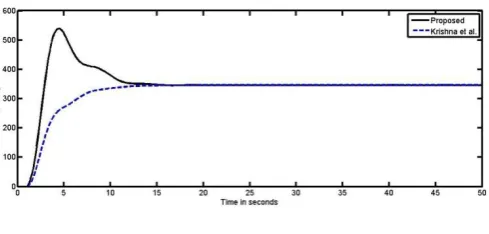
In this case study λ is tuned to 1.1992 so as to match the Msvalue of 3.52 as given by reported methods. The PID tuning parameters of proposed method are
5
10
954
.
6
c
k
,
I
5
.
1155
,
D
2
.
0962
. The tuning parameter of Krishna et. al [11] method are5
10
7102
.
3
c
[image:5.595.314.559.507.624.2]k
,
I
2221
.
4
,
D
3
.
7967
. The servo response of higher order system is shown in Figure 6. From servo response Integral Absolute Error (IAE), Input usage (TV) and overshoot (OS) is calculated and reported in Table 6.Fig-6: Servo response of the Example 6
Table-6: Performance comparision in terms of IAE, TV and OS
Method IAE TV OS
Proposed 161.17 14868 1.078
Shamsuzzoha 152.56 52074 0.006
© 2016, IRJET | Impact Factor value: 4.45 | ISO 9001:2008 Certified Journal | Page 2873
4. CONCLUSIONS
From all of the simulation results, the performance of the integrating systems with PID controller are obtained and discussed. The controller designed by the proposed method is robust even the parameters of the model changes. A single tuning parameter is selected to obtain desired robustness by specifying Msvalue. Furthermore performances of proposed method and recently reported method are compared in terms of IAE, input usage (TV) and overshoot (OS) and reported. The proposed method is proved to be effective both in terms of performance and input usage.
REFERENCES
[1] Ziegler JG,Nichols
NB.Optimumsettingforautomaticcontrollers.ASMETra ns 1942;64:759–68.
[2] Lee
Y,LeeJ,ParkS.PIDcontrollertuningforintegratinganduns
table processes
withtimedelay.ChemEngSci2000;55:3481–93.
[3] Chidambaram
M,PadmaSreeR.SimplemethodofdesigningPI/PIDcontr
ollers for
integrator/deadtimeprocesses.ComputChemEng2003; 27:211–5.
[4] Luyben
WL.Designofproportionalintegralandderivativecontrol lersfor
integratingdeadtimeprocesses.IndEngChemRes1996;3 9:973–6.
[5] MajhiS,MahantaC.Tuningofcontrollersforintegratingti
medelayprocesses. IEEE Trans2001;1:317–20 [catalogueno.01CH37239].
[6] Tyreus
BD,LuybenWL.TuningPIcontrollersforintegrator/dead time processes. IndEngChemRes1992;31:2625–8.
[7] Ajmeri M, Ali A. Direct synthesis based tuning of the
parallel control structure for integrating systems. Int J Syst Sci 2015.
[8] Shamsuzzoha
M.Closed-loopPI/PIDcontrollertuningforstableand integrating processwithtimedelay.IndEngChemRes2013;52:1297 3–92.
[9] Jin
QB,LiuQ.AnalyticalIMC-PIDdesignintermsofperformance/robustness trade
offforintegratingprocesses:from2-Dofto1-Dof.JProcessControl 2014;24:22–32.
[10] ViteckovaM,VitecekA.Twodegreeoffreedomcontrollert
uningforintegral plus
timedelayplants.ICICExpressLett2008;2(3):225–9.
[11] Krishna
D,SuryanarayanaK,AparnaG,PadmaSreeR.TuningofPID
controllers for