© 2016, IRJET | Impact Factor value: 4.45 | ISO 9001:2008 Certified Journal
| Page 2139
SEISMIC BEHAVIOUR OF RC FRAME WITH AND WITHOUT MASONRY
INFILL
K.Kalaipandian
1, R.Amuthaselvakumar
21
Assistant Professor, Civil Department, SVCET, Virudhinagar, TN, India
2
Assistant Professor, Civil Department, SVCET, Virudhinagar, TN, India
---***---ABSTRACT: In the building construction, framedstructures are frequently used due to ease of construction and rapid progress of work. Masonry infill panels have been widely used as interior and exterior partition walls for aesthetic reasons and functional needs. Generally designers neglect these infill walls in as ‘non-structural’ and treat the frames as conventional reinforced concrete frames. However, the presence of infill the frame alters the overall behavior, especially when the structure is subjected to later loads. The objective of this study was to investigate the behavior of one-fifth scale reinforced concrete frame with and without brick infill under quasi static loading. In this investigation the performance of M25 grade of concrete frame mix designed as per IS method with two types of masonry in filled frames such as reinforced concrete frames without masonry infill (Bare frame), reinforced concrete frames with brick masonry infill were cast and studied. The study discusses the strength of the frame under ultimate lateral loads till failure. Conclusions are made based on the experimental investigations.
KEYWORDS: Seismic behaviour of RC Frame, frame with and without masonry infill.
1. INTRODUCTION
Vibrations which disturb the earth’s surface caused by waves generated inside the earth are termed as earthquakes. It is said that earthquakes will not kill the life of human but structures which are not constructed in considering the earthquake forces do. At present a major
importance has given to earthquake resistant structures in India for human safety. India is a sub-continent which is having more than 60% area in earthquake prone zone. A majority of buildings constructed in India are designed based on consideration of permanent, semi-permanent, movable loads. But earthquake is an occasional load which leads to loss of human life but also disturbs social conditions of India.
2. NEED FOR SEISMIC EVALUATION
© 2016, IRJET | Impact Factor value: 4.45 | ISO 9001:2008 Certified Journal
| Page 2140
The vulnerability of thestructure can be assessed with a higher accuracy and better informed decisions can be made on the possible improvement of the seismic resistance of RC structures. For example, the critical components of the structure that are likely to sustain significant damages during future earthquake ground motions may be identified. Accordingly, the required immediate structural interventions may be designed to reduce the deformation demands on these components. Subsequently, the overall behavior of the structure may be improved to achieve a satisfactory overall seismic performance during a future earthquake.
3. PRESENT INVESTIGATION
3.1 DIMENSIONAL AND DETAIL OF R.C FRAME
MODEL
One fifth scale model of single concrete frames with a total height of 1.4m has been constructed. Each storey height is 0.6 m. Plan of the reinforced concrete frame model is shown in figure 1. Beams and columns are of size 100 X 100 mm and 150 X 100 mm respectively. The beam reinforcement consists of four numbers of 8 mm diameter bars. Columns are reinforced with four numbers of 10mm diameter bars. Lateral ties in the columns and beams are 6 mm diameter two legged stirrups at a spacing of 50 mm c/c at middle and 25 mm c/c at edge. The orientation and size of column is kept same throughout the height of the structure. The reinforcement has been fabricated conforming to the IS: 13920-1993. Material used are M 25 grade concrete and Fe 415 steel.
Fig-1: Reinforcement Details of the Frame
Fig-2
: Reinforcement Grill for the RC Frame
Fig-3
: Closer View of Beam-Column
© 2016, IRJET | Impact Factor value: 4.45 | ISO 9001:2008 Certified Journal
| Page 2141
4. TEST SETUP
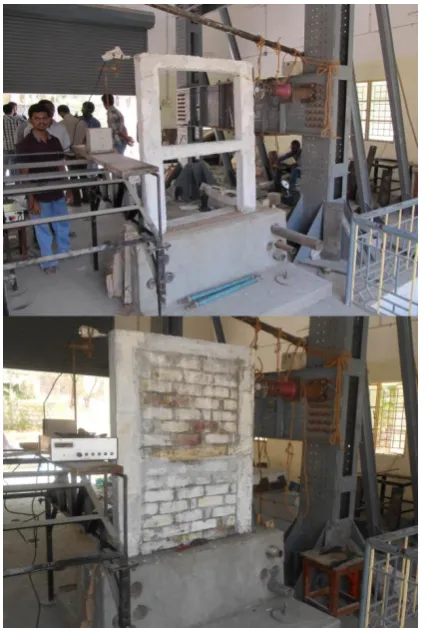
Figure 4 shows the test setup adopted for testing all the frame specimens. The effectiveness of instrumentation setup and the loading were checked in the beginning by loading and unloading the frame with small loads (of the order of 1.5 KN at the two load points) till all the readings was repeatable. The two frames were tested under uni-directional lateral loads in a quasi-static pattern simulating seismic action. In the experiments, the lateral load called base shear was applied at the beam levels using screw jack and the applied load was measured using proving ring. Since the main purpose of the experiment was to observe the frame’s behaviour under lateral loading, no vertical load was applied on the specimens except for the self-weight of frames and walls. Initially a base shear of 15 KN was applied and the loading was progressively increased by 10 KN base shears in successive cycles until the maximum load-carrying capacity of the specimen was reached.
[image:3.595.324.539.97.413.2]During the tests, storey displacements and the lateral loads were monitored. After each cycle, new initiated cracks and crack propagations were marked on the specimens and failure mechanisms were observed. The deflectometer readings for calculating the error due to rigid body rotation of foundation block were also recorded.
FIG – 5: Test setup for both frames
5. INVESTIGATION OF RC FRAME WITHOUT
INFILL
© 2016, IRJET | Impact Factor value: 4.45 | ISO 9001:2008 Certified Journal
| Page 2142
0 5 10 15 20 25 30 35 40
0 2 4 6
B
A
SE
SH
EA
R
k
N
LOAD CYCLE
Fig-6: Sequence of Loading for the bare Frame
Fig-7: Load-Displacement Response of Specimen
5.1. SPECIMEN BEHAVIOUR AND CRACK
PATTERN
The detailed behaviour of specimen is described in the following section. The terms front, centre, and back are used to identify the location of columns with respect to the loading end. The term front refers to the member nearest to the loading jack, while the term back refers to the member farthest from the loading end. In the control specimen, structural cracks began to form at a base shear of 22.5 kN. These cracks started from the tension side of the beam column joint in the front top-storey. The bottom-storey columns were made captive at 30 kN and cracks initiated in the front of bottom storey.
At a base shear of 39 kN, the cracks formed in the top and bottom of the column region adjacent to the beam widened to form plastic hinges and diagonal shear cracks started propagating between them.
The specimen reached a maximum lateral displacement of 28.5 mm, which corresponds to a base shear of 39 kN. Additionally, cracks developed in the back column of bottom-storey at the compression end because of diagonal strut action. No cracks were developed in the centre of columns and beams. Frame had failed only by plastic hinge failure.
6. INVESTIGATION OF RC FRAME WITH
MASONRY INFILL
The frame was subjected to lateral loads in a quasi-static pattern simulating seismic action. The history of sequence of loading for the masonry infilled frame is shown in Figure 8. The load carrying capacity of the specimen was named as ultimate load. The ultimate load of 63 kN was reached in the fifth cycle of loading. The load-displacement response of the masonry infilled frame was recorded as plotted in Figure 6.2. At the ultimate base shear, the top-storey deflection was found to be 38.51mm. The displacement due to rigid body rotation of the footing and the foundation block were incorporated in the calculation of net deflection
Fig-8
: Sequence of Loading for the masonry in filled
© 2016, IRJET | Impact Factor value: 4.45 | ISO 9001:2008 Certified Journal
| Page 2143
0 10 20 30 40 50 60 70
0 20 40 60 80 100 120
Fig-9:
Load-Displacement Response of Specimen
6.1 SPECIMEN BEHAVIOUR AND CRACK PATTERN
In the specimen, structural cracks began to form at a base shear of 42 kN. These cracks started from the tension side of the beam column joint in the front top-storey. The bottom-storey columns were made captive at 48 kN and cracks initiated in the front of bottom storey. At a base shear of 50 kN, the cracks formed in the top and bottom of the column region adjacent to the beam widened to form plastic hinges and diagonal shear cracks started propagating between them. Simultaneously separation of infill took place in the bottom-storey at the leeward end in each bay. At 52.5 kN, a shear crack appeared in the masonry infill exactly along the diagonal & the specimen reached a maximum lateral displacement of 38.51 mm, which corresponds to a base shear of 63 kN. Additionally, cracks developed in the back column of bottom-storey at the compression end because of diagonal strut action of the infill.7. RESULTS AND DISCUSSIONS
7.1 LATERAL DEFLECTION
The masonry infilled frame was subjected to 8 cycles of loading and the ultimate load is reached in the 8th cycle. After the 8th cycle there was a drastic reduction of load associated with large drift values. The observed ultimate load of frame was 63 kN and the corresponding maximum lateral displacement was 38.51 mm.
The bare frame was subjected to 5 cycles of loading and the ultimate load is reached in the 5th cycle. After the 5th cycle
there was a drastic reduction of load associated with large drift values. The observed ultimate load of frame was 39 kN and the corresponding maximum lateral displacement was 28.5 mm.
7.2 STIFFNESS
The stiffness was calculated as the amount of base shear required for causing unit deflection at the top-storey level. The initial stiffness of the masonry in filled frame was 8.85kN/mm. In Figure 5.8, the stiffness was found to decrease from 8.85 kN/mm during the second cycle to1.27 kN/mm during the eighth cycle of loading.
The initial stiffness of the bare frame was 6.375 kN/mm. The stiffness was found to decrease from 6.375 kN/mm during the second cycle to 2.58kN/mm during the fifth cycle of loading.
7.3 ENERGY DISSIPATION CAPACITY
The energy dissipation was determined by calculating the areas inside the hysteretic load-displacement loops for each cycle. The energy dissipation may be considered as a measure of material damage to the specimen. The cumulative energy dissipated was calculated as the sum of the energy dissipated in consecutive cycles throughout the test.
7.4 First Crack Load of with and without Infill
The first cracks observed in the experimental results of the bare frame model were compared with brick infill frame model results as shown in the figure© 2016, IRJET | Impact Factor value: 4.45 | ISO 9001:2008 Certified Journal
| Page 2144
7.5 Ultimate Load of with and without Infill
The ultimate load in the experimental results of the bare frame model was compared with brick infill frame model results as shown in the figure.11
Fig-11
: Ultimate Load of with and without Infill
8. CONCLUSIONS
In the present experimental investigation to understand the lateral load responses of two storied RC frame with and without masonry infill Structure; a carefully designed experimental setup was developed.
Based on the experiments, the following conclusions can be drawn;
i)
The ultimate failure pattern was by way of development of typical X – type plastic hinges at beam-column junctions and cracks are transferred through the masonry infill from one beam to another.ii)
The salient results are lateral deflection, stiffness degradation & Energy dissipation.iii)
It may also be concluded that this experimental setup could be utilized for further experimental parameters involving partial masonry in-fill.9. REFERENCES
[1] IS 456:2000 Code of practice for Reinforced Concrete
design, BIS, New Delhi, India.[2] IS: 1893(part1):2002, Criteria for earthquake resistant design of structures, BIS, New Delhi, India.