INTEGRATING SSSC WITH VARIABLE STRUCTURE OBSERVER
BASED OPTIMAL CONTROLLER FOR DAMPING FREQUENCY
OSCILLATIONS OF DEREGULATED POWER SYSTEM
A. Ganga Dinesh Kumar
1and N. V. Ramana
21Department of Electrical and Electronics Engineering, Sridevi Women’s Engineering College, Hyderabad, Telangana, India 2Department of Electrical and Electronics Engineering, JNTUH College of Engineering, Jagtiyal, Telangana, India
E-Mail: [email protected]
ABSTRACT
In this paper design of integrated static synchronous series capacitor (SSSC) and variable structure system observer (VSSO) based optimal controller for damping of frequency oscillations in Multi Area Power System (MAPS) under deregulated environment is presented. A Thermal-Thermal power system is considered for simulation study. SSSC is a series connecting device which is connected with tie line of the system. The low frequency oscillations of system are minimized by designing the gain of SSSC. The high frequency oscillations are minimized by designing observer based optimal controller. The design of VSSO matrix is a function of transformed System matrix obtained from optimal sliding mode control law. The performance of deregulated system with integrated control strategy (SSSC+ VSSO based Controller) is tested and simulation results are presented and compared to Neuro Fuzzy Sliding Mode Controller (NFSMC) and PI controller.
Keywords: deregulated power system, static synchronous series capacitor, Neuro fuzzy sliding mode controller, variable structure system observer.
INTRODUCTION
The change in load initiates tie line power flow results deviations in frequency. For proper trade of power in the Tie lines control of frequency [1-24] is a great challenge to a power system engineer particularly in a deregulated Environment. These days’ series FACT devices in tie line are commonly used for damping frequency oscillations [25, 26]. One kind of series controlled FACT device, Static Synchronous Series capacitor (SSSC) is used to suppress these power oscillations effectively and also controls the Tie-line power flow in specified limits [27-30].
Many authors studied these coordinated control strategies with different combinations. Few of them are, coordinated control of 𝐻∝ controller and SSPS [31]. A TCPS and PSO based fine turning PID controller, this method suppress frequency oscillations effectively [32]. The frequency response of each CA can be improved by adjusting parameters of SSSC and SMES using Probabilistic Methods Applied to Power Systems [33]. A dual mode control strategy with FABFM plus SSSC and TCPS is demonstrated for LFC [34]. Performance improvement by employing TCPS for AGC of a hydrothermal system under deregulation is presented in [35] and Redox Flow Batteries (RFB) with IPFC presented [36]. The authors earlier have proposed Neuro Fuzzy
the settling time, also to mitigate both the high frequency and low frequency oscillations. This is the main objective of this proposed control strategy. The name of the proposed control strategy is “Variable Structure Observer based Optimal Controller (VSSOC)”. The integral parts of VSSOC are an observer and an optimal controller. This strategy assumes a SSSC is cascaded with tie line. The feature of the designed sliding mode observer [39-46] is to estimate all the state variables by taking ∆f1 & ∆f2 as
inputs. Then system is converted in to state space model with observed states. These observer states are given as input to design control law using an optimal sliding mode controller. The desired response of the system with optimal controller is obtained by setting the gain through minimization of performance index.
The remaining paper presented the following. Section II discusses overview of the modeling of open access Thermal-Thermal system, SSSC and NFSMC. Algorithm of proposed VSSOC and flow chart were described in section III. Results of simulation were presented in section IV. Finally concluding remarks were presented in the last section.
Dynamic Model of Restructured Power System for AGC, SSSC and NFSMC
Figure-1. Dynamic model of MAPS with AC Tie-line.
The change in Tie-line power and frequency deviation has a combined effect on Area Control Error (ACE) [4, 5] and is given by
𝐸 = ∆𝑓𝑒𝑟𝑟 𝑟 + ∆ 𝑃𝑒𝑟𝑟 𝑟 𝑖 = , ,
In deregulated power system contract participation factor (cpf) [5] will affect the tie line power flow and these two are related by the following equation.
P − = ∑ ∑ cpf
=
= ∆PL
− ∑ ∑ cpf
=
= ∆PL
∆P − = ∆P − .− ∆P −a .
The transaction between the DISCOMs and GENCOs are related by DPM [4, 5]. The ACE is distributed among all the GENCOs and is called ACE participation factor, given by
∑ ∝
𝐺𝐸 𝐶 𝑗
=
= .
where, ∝ is the ACE participation factor of the G|ENCO No. “i” in the area No. “j”. Number of GENCOs in area
“j” is NGENCOj.
In open market environment a two control area power system having Thermal plants was shown in Figure-2.
Figure-2. MAPS integrated with SSSC for AGC in a Deregulated Environment.
Mathematical Modelling of SSSC
The mathematical model of SSSC is available in various publications. The reader can refer [27-30]. The basic equations can be referred in [27-30] and the power supplied by SSSC is given by:
∆P C= VX sinθV +VX sinθV
× V
√𝑉 + 𝑉 − 𝑉 𝑉 cos 𝜃 ∆V
The dynamic model of SSSC for LFC problem is shown in the Figure-3.
Figure-3. Dynamic model of SSSC for power oscillation damping.
Overview of NFSMC
Figure-4. Schematic diagram of NFSMC.
Design of proposed VSSOC with SSSC
Design and implementation of proposed VSSOC is discussed in this section. SSSC connected in series with tie for the purpose of minimizing low frequency oscillations. Using the deviations in frequencies in two areas the observer states are estimated. These states are used as inputs for sliding mode optimal controller. The control law is designed using optimal control theory by minimizing performance index which in turn adjusts the weight matrix Q and R matrices. Figure-5 describes the process of implementation VSSOC on a deregulated power system.
Figure-5. Implementation of proposed VSSOC.
1. Convert the system into state space model. 2. Let us consider observer gain matrix L= I n 3. The observer gain matrix is partitioned into
1 p p×(n-p)
2 (n-p)×p (n-p)
p p×(n-p)
L =[I
O
]
L =[O
I
]
M=[I
O
]
4. While designing observer system matrix these are he approximations made by Utkin [45]
5. M =L ;M =L ;F =A ;F =A ;F =A ;F =A1 1 2 2 11 11 12 12 21 21 22 22
11 (n-p)
1 1
p 12
A
I
G =
; G =
I
A
6. The observer system matrix N reduced to Utkin’s matrix
11 11 1 1 12 12 1 2
N =A - Z G ; N =A - Z G ;
21 21 2 1 22 22 2 2
N =A - Z G ; N =A - Z G ;
7. In VSSOC observer Z1 and Z2 approximated as
1 2 22
Z =0; Z =[0 Z ]
8. N matrix is minimized as11 12
21 22 22 12
A A
N=
A A - Z A
9. Sliding poles obtained from sliding mode control law by using pole placement method and Z22 is
obtained.
10. The other observer parameters J, E and H are reduced to
22
0 0
J=
0 Z
;
𝐸 = ;
𝐻 =
Figure-6. Flow chart for sliding mode observer based optimal controller.
Consider sliding mode observer
w (t)=Nw(t)+ Jy(t)+Hu(t)+ sgn(Me(t))
Start
Initialize the initial conditions for an LTI System described by
X (t)=AX(t)+Bu(t) y(t)=CX(t)
z(t)=LX(t)
Choose L= In to reduce to sliding mode observer
2
2 2
L A
CA CA
rank rank C
C
L L
Yes
N o
Partition
1 2 2
L= L GC
L L
1
2 2
L= L GC
L L
The Approxi atio s i desig of Utki ’s observer 1 1 2 2 11 11 12 12 21 21 22 22
M =L ;M =L ;F =A ;F =A ;F =A ;F =A
11 (n-p)
1 1
p 12
A I
G = ; G =
I A
1.
1
Stop
Plot the response of system dynamic parameters by usind LSIM command Convert observer matrix into observer transfer function and write the state equation using observer gain matrix Modified observer system matrix is given
by
11 12
21 22 22 12
A A
N=
A A - Z A
In Utkin’s observer
1 2 22
Z =0; Z =[0 Z ]
𝑍 is obtained via optimal sliding control law U = −𝑘
The observer system matrix is partitioned as 𝑁 , 𝑁 , 𝑁 , 𝑁
s
T (n×1) (n×n) 1
t
1
J = x Q x. dt ; x R ; Q R
2
To optimize J1 the problem is considered as quadratic regulator.
s
T
T T
1 11 12 22 12 1 22 1
t
1 T 2 22 12 1
1 T T
2 22 12 12 1
11 12
1 T 1
21 22
T T
2 21 1 1 12 2
1
J = [ x (Q Q Q Q ).x + v Q v ]dt ;
2
v = x + Q Q x ;
x = Q (A P + Q ).x ;
Q Q
Q = (M ) Q M = ;
Q Q
X Q X = X Q X
Step-4: Matrix Riccati equation is solved and P matrix evaluated.
1 T 1 T T
11 12 22 12 11 12 22 12
1 T T
12 22 12
P.(A A Q Q ) + (A A Q Q ) P
P.A Q Q P +D D = 0
Step-5: The surface is designed using optimal control law.
1 T T
12
22 12
H= Q (A P + Q I ×M
T 1 T
s s s s s s
PA + A P PB R B P + Q = 0
Where
1 T
s 11 12 22 12 s 12 s 22
A = A A Q Q ; B = A ; R = Q ;
Step-6: The control law for equivalent control
1 e
K = (SB) . S.A
Step-7: The corrective control law is given by
1 r
K = (SB) . S.
( - sliding margin)Step-8: the cumulative control law
e r
u = K X = (K + K ) X
Step-9: Eigen values of hyper plane H calculated by
( )
H eig A BK
area or other area. The contracted power will be dispatched to the DISCOs based on the following DPM.
It is considered that, each DISCO demands 0.1puMW power from the all other GENCOs. The GENCOs participates in AGC based on the following ACEpfs.
∝ = 0.6, ∝ = 1 - ∝ = 0.4
∝ =0.5, ∝ = 1 - ∝ = 0.5
In steady state there should not be any mismatch between the generation of a GENCO and the load requirement of a DISCO in contract with it. It is expressed as
mi j ij Lj
P cpf P
So, for this scenario we have
ΔP1= 0.2(0.1)+ 0.3(0.1)+0.5(0.1)+0.0(0.1)=0.1puMW
ΔP2= 0.12puMW;
ΔP3= 0.08puMW;
ΔP4= 0.1puMW;
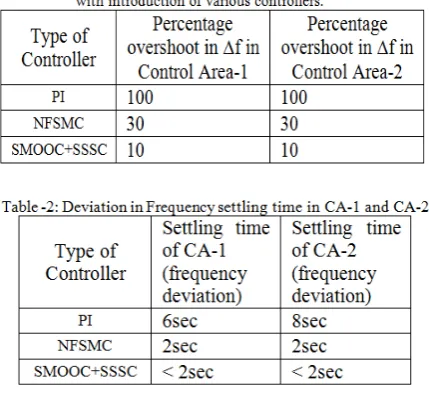
[image:6.595.320.542.96.269.2]The simulation results for the system under consideration i.e. Thermal - Thermal System were presented. Figure-8 represents deviation of frequency in control area-1, Figure-9 represents deviation of frequency in control area-2 and Figure-10 represents tie-line power exchange deviation.
[image:6.595.319.537.295.466.2]Figure-8. Deviation in frequency in control area 1.
[image:6.595.320.535.505.704.2]Figure-9. Deviation in frequency in control areas 2.
Figure-10. Tie - line power exchange deviation.
Appendix
[image:6.595.65.283.505.672.2]CONCLUSIONS
Variable structure observer based optimal controller is proposed to reduce tie-line power oscillations as well as to improve frequency response of two area thermal-thermal power system. The nonlinearities in power system model, unpredictable and uncertainty behavior of power system have overcome with this control strategy. The proven sliding mode control strategies are implemented. A Thermal-Thermal power system is considered for simulation study. SSSC is connected in series with tie line of the system. The low frequency oscillations of system are minimized by designing the gain of SSSC. The high frequency oscillations are minimized by designing observer based optimal controller. The performance of deregulated system with integrated control strategy (SSSC+ VSSO based Controller) is tested and simulation results are presented and compared to Neuro Fuzzy Sliding Mode Controller (NFSMC) and PI controller.
REFERENCES
[1] Hassan Bevrani. 2014. Robust Power System Frequency Control (Power Electronics and Power Systems Springer; 2nd ed. Edition.
[2] Elgerd OI. 1971. Electric energy system theory: an introduction. New York: McGraw-Hill.
[3] D. P. Kothari and I. J. Nagrath. 2009. Modern Power System Analysis. 3rd Edition, Tata McGraw-Hill Publishing Company Ltd.
[6] Gupta S.K., Arya Yogendra, Shukla Shivank and Chawla Pankaj. 2014. Two-area AGC in interconnected system under the restructured power system using BFO controller. 6th IEEE Power India International Conference (PIICON). pp. 1-6.
[7] O. Abedinia, N. Amjad, A. Ghasemi and H. Shayeghi. 2013. Multi-Stage Fuzzy Load Frequency Control Based on Multi objective Harmony Search Algorithm in Deregulated Environment. Journal of Operation and Automation in Power Engineering. 1(1): 63-73.
[8] Daneshfar F. 2013. Intelligent load-frequency control in a deregulated environment: Continuous-valued input, extended classifier system approach. Generation, Transmission & Distribution, IET, Year: 7(6): 5.
[9] Chandrashekar M. J. and Jayapal R. 2013. Design and comparison of I, PI, PID and Fuzzy logic controller on AGC deregulated power system with HVDC link. IEEE International conference on Circuits, Controls and Communications (CCUBE). pp. 1-6.
[10]G. Konar, K. K. Mandal and N. Chakraborty. 2014. Two Area Load Frequency Control Using GA Tuned PID Controller in Deregulated Environment. Proceedings of the International Multi Conference of Engineers and Computer Scientists, Vol II, IMECS 2014. pp. 1-6.
[11]Pal A.K.; Bera P.; Chakraborty K. 2014. AGC in two-area deregulated power system using reinforced learning neural network controller. Automation, Control, Energy and Systems (ACES), 2014 First International Conference on, Year. pp. 1-6.
[12]Hosseini Behrooz Tousi, Navid Razmjooy & Mohsen Khalilpour. 2014. Design Robust Controller for Automatic Generation Control in Restructured Power System by Imperialist Competitive Algorithm. IETE Journal of Research pp. 745-752.
[15]Demiroren A, Sengor NS, Zeynelgil HL. 2001. Automatic generation control by using ANN technique. Electrical Power Component System. 29(10): 883-96.
[16]A. Demiroren, H.L. Zeynelgil. 2007. GA application to optimization of AGC in three-area power system after deregulation” Electrical Power and Energy Systems. 29: 230-240.
[17]Tan Wen, Zhang H,Yu M. 2012. Decentralized load frequency control in deregulated environments. Electrical Power and Energy Systems. 41: 16-26.
[18]G.T. Chandra Sekhar a, Rabindra Kumar Sahu a, A.K. Baliarsingh b, Sidhartha Panda. 2016. Load frequency control of power system under deregulated environment using optimal firefly algorithm. Electrical Power and Energy Systems. 74: 195-211.
[19]Wen Tan a, Yuchun Hao C, Donghai Li b. 2015. Load frequency control in deregulated environments via active disturbance rejection. Electrical Power and Energy Systems. 66: 166-177.
[20]Lili Dong, Yao Zhang, Zhiqiang Gao. 2012. A robust decentralized load frequency controller for interconnected power systems. ISA Transactions. 51: 410-419.
[21]Praghnesh Bhatt, Ranjit Roy, S.P. Ghoshal. 2010. Optimized multi area AGC simulation in restructured power systems. Electrical Power and Energy Systems. 32: 311-322.
[22]I.A. Chidambaram, B. Paramasivam. 2013. Optimized load-frequency simulation in restructured power system with Redox Flow Batteries and Interline Power Flow Controller. Electrical Power and Energy Systems. 50: 9-24.
[23]Rabindra Kumar Sahu, G.T. Chandra Sekhar, Sidhartha Panda. 2015. DE optimized fuzzy PID controller with derivative filter for LFC of multi source power system in deregulated environment. Ain Shams Engineering Journal, Article in press.
[24]Feliachi A. 1987. Optimal decentralized load frequency control. IEEE Transactions on Power Systems. PWRS. 2(2): 379-85.
[25] N. G. Hingorani. 2000. Role of FACTS in a deregulated market. 2000 Power Engineering Society Summer Meeting, Year. 3: 1463-1467.
[26] S. K. Sinha; R. N. Patel; R. Prasad. 2011. Applications of Facts Devices with Fuzzy Controller for Oscillation Damping In AGC. 2011 International Conference on Recent Advancements in Electrical, Electronics and Control Engineering. pp. 314-318.
[27]Praghnesh Bhatt. 2014. Short Term Active Power Support from DFIG with Coordinated Control of SSSC and SMES in Restructured Power System. Power and Energy Engineering Conference (APPEEC), 2014 IEEE PES Asia-Pacific.
[28] I. Ngamroo. 2001. Application of static synchronous series compensator (SSSC) to stabilization of frequency oscillations in an interconnected power system. ISCAS 2001, the 2001 IEEE International Symposium on Circuits and Systems, Year: 3: 113 - 116.
[29]Praghnesh Bhatt; Ranjit Roy; S. P. Ghoshal. 2010. Coordinated control of SSSC and SMES in competitive electricity market for load frequency control. 2010 IEEE 11th International Conference on Probabilistic Methods Applied to Power Systems, Year: pp. 42-47.
[30]Praghnesh Bhatt; S. P. Ghoshal; Ranjit Roy. 2009. Optimized Automatic Generation Control by SSSC and TCPS in Coordination with SMES for Two-Area Hydro-hydro Power System. 2009 International Conference on Advances in Computing, Control, and Telecommunication Technologies. pp. 474-480.
[31]Ngamroo I., Mitani Y. and Tsuji K. 1999. Robust Load frequency control by solid-state phase shifter based on H∞ control design. Power Engineering
Society Winter Meeting, IEEE. 1: 725-730.
[32]Shayeghi H., Shayanfar H A., and Jalili A. 2009. LFC Design of a Deregulated Power System with TCPS Using PSO. World Academy of Science, Engineering and Technology. 3: 556-564.
[33]Bhatt P.; Roy R.; Ghoshal S.P. 2010. Coordinated control of SSSC and SMES in competitive electricity market for load frequency control. Probabilistic Methods Applied to Power Systems (PMAPS), 2010 IEEE 11th International Conference on. p. 42 - 47.
[35]K Kiran and C Muni Sekhar. 2013. Improvement of dynamic performance of automatic generation control of hydrothermal system employing TCPS under deregulation. International Journal of Conception on Electrical & Electronics Engineering. 1(2): 63-66.
[36]Tulasichandra Sekhar Gorripotu, Rabindra Kumar Sahu and Sidhartha Panda. 2015. AGC of a multi-area power system under deregulated environment using redox flow batteries and interline power flow controller. Engineering Science and Technology, an International Elsevier Journal. pp. 1-24.
[37]A.G. Dinesh Kumar and N.V. Ramana. 2016. A Neuro Fuzzy Sliding Mode Controller for Load Frequency Problem in Deregulated Environment for Multi Area Power System. 7th IEEE Power India International Conference.
[38]Venkata Ramana N. and Yadaiah N. 2006. SMO based Fuzzy Logic Controller for Multi-machine Power Systems. IEEE International Conference on Fuzzy Systems. pp. 2362-2368.
[39]Duy-Ky Nguyen. 1998. Sliding-Mode Control: Advanced design Techniques.
[40]C. Edwards and S.K. Spurgeon. 1998. Sliding Model Control: Theory and Applications, Taylor and Francis Ltd, U.K.
[41]Hidekazu K., Yuya S. and Shinichi I. 2009. A Load frequency control design using sliding mode controller theory with VSS observer.
[42]Elyas Rakhsani, Javad Sadeh, Simulation of Two Area AGC system in a competitive Environment using Reduced Order Observer Method. IEEE proceedings 2008.
[43]Wen-Chun Yu, Gou-Jen Wang. 2006. Discrete sliding mode controller design based on the LQR suboptimal approach with application on AC servomotor. Journal of the Chinese institute of engineers. 29(5): 873-882.
[46]T. Fernando; S. Alahakoon; N. Nikraz. 2008. Sliding Mode Functional Observers for Nonlinear Systems. 2008 IEEE Region 10 and the Third international Conference on Industrial and Information Systems, Year. pp. 1-6.