ISSN: 1992-8645 www.jatit.org E-ISSN: 1817-3195
EXPLORING THE NEEDS OF OLDER ADULT USERS FOR
SPIRITUAL MOBILE APPLICATIONS
1
Nahdatul Akma Ahmad, 2Azaliza Zainal, 3Saliyah Kahar, 4Mohammad Ashri Abu Hassan,
5
Roziyani Setik
1,2,3,4,5
Department of Computer Science, Faculty of Computer Science and Information Technology,
Universiti Selangor, MALAYSIA
E-mail: [email protected], [email protected],[email protected],
4
[email protected], [email protected]
ABSTRACT
The increasing number of aging populations worldwide versus the vast developments in mobile technology creates questions on how older adults adapt and apply mobile technology in their daily life. As older adults are said to be more spiritually inclined in the ageing process, thus, mobile spiritual applications can work as medium for serving the older adults spiritual needs. In this study, a series of workshop was conducted with fifteen volunteered older adults’ participants to give exposure and experiences of using mobile spiritual android application. After about a week, an interview session was then conducted with the participants to investigate the older adults’ design requirements for developing mobile spiritual application and also to investigate the older adults’ interests in using mobile spiritual applications. As a result, these older adults appreciated and agreed on the benefits of the application. However, several issues arise in the existing mobile spiritual applications such as improper design for older adults, lack of exposure and fear towards technology deter their interests. Participation in the workshop is seen as one of effective way to reduce technology anxiety among the participants hence increased enthusiasm in learning new mobile applications, particularly for spiritual applications. Feedbacks that were gathered from interview session with the interviewees were highlighted in this paper to be the input in developing mobile spiritual application for older adult users in future.
Keywords: Older people, elderly, spirituality, mobile phones, techno-spiritual, qualitative
1. INTRODUCTION
Older adults are those who saw a sharp increase by 2030 in which most countries in the world have a high percentage of older adults [1][2]. Although currently, there are many researchers and
institutions that producing guidelines for
developing mobile applications for older adults, however, older adults are yet seen as the neglected group in the design and mobile applications usage [3]. This unhealthy scenario would suppress the development of older adult’s successful aging where, according to [4] and [5], a country must ensure its citizens are experiencing successful ageing by ensuring that the older adults can afford independent living and healthy from the aspects of physical, mental, spiritual and also social well-being. Mobile applications on the other hand, are seen as possible tool in boosting older adults’ capability to live independently. Technology person especially academics and researchers should play role in reducing the gap between older people with technology. Therefore, this workshop is intent to
give technological awareness to older adults, besides, work as a medium of exposure for older adult’s to use mobile applications successfully. The aims of this paper are to achieve the following;
1. To gain feedback on the design requirement for
mobile spiritual application that tailored to older adults needs.
2. To investigate older adults’ interests and
experience in using mobile spiritual applications
2. RELATED WORK
ISSN: 1992-8645 www.jatit.org E-ISSN: 1817-3195 mobile technology make us doubt how older adults
adapt and apply new technology in their daily life. The technology design should fit to the end user physical impairments; the application interface must be sufficiently acceptable to the users to overcome any unfamiliarity felt; the benefit of using the applications must be significant, in order to gain plea for its use [6].
Several works related to provide guidelines for older adult users’ has been found. The field of this works as according to [7] ranging from three bio-psycho-social model area including cognitive functions, physical abilities and societal benefits. At the cognitive level, a lot of technology guidelines discussed especially on how to improve memory [8], attention and also monitoring capabilities. There are also a lot of system guidelines particularly on the improvement of physical abilities such as health monitoring, daily activities assistant etc. [7]. Furthermore, other studies focus on equipping older adult users with societal technology benefits such as smart home environment [9] and also internet technology especially the social network. [10], in his research suggested that improvements in today’s technology design were needed for older people as technology that tailored to older adults needs may alleviate many problems. It is important for the older people to get connected with mobile technology since it offers various services from connecting people, entertainment, information and also, spirituality that can enrich older adults’ life and knowledge.
Study among Malaysian older adults discovers that older adults practice religious and have spiritual intelligence as they aged [11]. Older adults often have a feeling of cosmic communion with God [12] whereas spirituality is also defines as one element for positive successful aging in Rowe and Kahn Model [13]. Therefore, mobile spiritual applications can work as a medium of serving the
older adults spiritual needs. Technology
practitioners and researchers should play a role in giving awareness and exposure towards spiritual applications usage by teaching and assisting older adults.
3. METHODS
3.1 Participants
This study was carried out in Shah Alam Senior
Citizen Complex, Selangor, Malaysia. The complex was chosen because it is located in Selangor which is one of the states with high population in Malaysia [14]. The complex is a community club
and act as platform for older adults to gather and run beneficial activities during leisure time. Member’s registration was open to people aged 56 years old and above as club members who will obtain various benefits when joining this club. This workshop involves fifteen older adults aged from 60 to 74 years old. The average age for all the participants is 66. Most of the older adults were retirees and housewives, and only one of them is still working. The workshop intention is to demonstrate and teach older adults on how mobile spiritual applications can be used to help older adults remain spiritually inclined, physically and mentally healthy.
3.2 Workshop Procedures
The following is the explanation on the workshop procedures starting from setting an appointment until the end of the workshop:
1. Set an appointment and asking for participant’s approval. The relationship between researcher and complex manager was good since researchers have conducted several community activities with older adults at the complex in the past. The researchers went to the complex two weeks before the workshop was held to make appointment. This shows that the complex manager was really pleased and looks forward to run the workshop. Researchers were also provided the attendance list of participants who are interested to participate in the workshops organized by the manager of the complex. One week before the workshop took place, the researchers went back to the complex to get the list, however the list of participants had yet to be given by the manager. The researchers at that time were participating in an ongoing religious class in the complex, hence made an announcement in the classroom about the workshop to get participants. At that time there were 15 participants who were interested to join the workshop and given their names.
2. Introductory and video demo. The agenda of the workshop started with a speech from the Program Director about the objectives of the workshop. After that, a montage and video demo on how to use the Quran Bahasa Melayu application as in Figure 1 was run. Upon completion of montage and video (10 minutes), participants were divided into few small groups with either 2 to 3 participants per group. Each group was conducted by facilitators who are lecturers and doctorate researchers from the
Universiti Selangor (UNISEL) and MARA
ISSN: 1992-8645 www.jatit.org E-ISSN: 1817-3195
Figure 1: Presentation of Montage and Application’s Demo Video
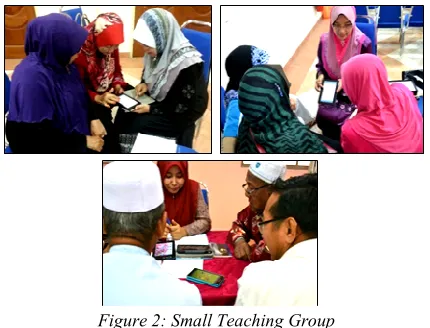
[image:3.612.88.303.296.460.2]3. Small teaching group. The training was carried out concurrently in all groups (refer Figure 2) where each group was provided with a set of the tablet PC. Firstly, the facilitator will demonstrate on how to use the tablet to the first participant which was selected randomly from the group.
Figure 2: Small Teaching Group
The following is the steps used in the application demo:
• Turn on the tablet
• Download the application into a tablet PC • Teach how to use Quran Bahasa Melayu
application and its features including listening to audio readings, making the page and select Verses in Quran
• Close the application and also the tablet
Secondly, after the first participant had understood how to use Quran application, he is then needed to teach the application to the second participant. The session occurs with close monitoring of the facilitator. Next, the second participant will teach the other participant until everybody in the group knows very well on how to use the application. This method is used to ensure the participants understand and successfully use the application in the future.
4. Lunch and dismiss. When the training session has ended, the participants were provided with tokens and food for lunch before leaving. Tokens were
given to appreciate the willingness of the participants to spend time and attend the workshop. Workshop started at 11.15 am and end at 12.40 pm.
5. Interview. A week after completing the training session, all participants were contacted back by the researchers to set for an appointment for an interview session. The participant consent was also asked in advance to ensure that only those who agreed will be interviewed. The purpose of this interview was to obtain feedback about the suitable design of mobile spiritual applications for older people. In addition, another purpose of the
interview was to obtain the participants’
background information in detail, participants’ experience in using mobile technologies as well as their experience in using any mobile spiritual
applications. This information is essential,
especially for designing a new mobile spiritual application that could tailored to their needs. There are two sections of the interview, section A consists demographic questions while section B consist of
question pertaining to the users’ spiritual
experience evaluation towards the mobile spiritual application usage.
4. RESULTS AND DISCUSSION
The results of the study were reported based on the following categories:
4.1 Participants’ Demographic Information These data were gathered from the participants’ attendance list. Once the older adult participants arrived, they were first asked to take their seat while being served with some refreshments. An in charge facilitator takes the responsibility to jot down each participants’ details and signature for the record. Table 1 summarizes the participant’s demographic information.
4.2 User’s Feedback on Interview Questions
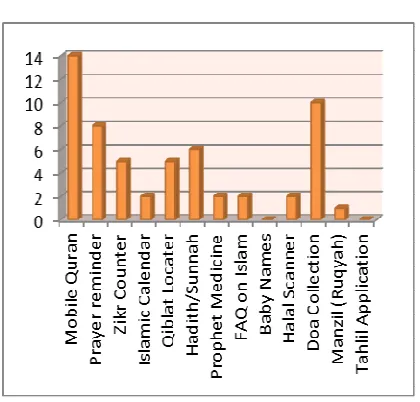
ISSN: 1992-8645 www.jatit.org E-ISSN: 1817-3195 categories of mobile spiritual apps which are
[image:4.612.89.304.126.632.2]Manzil (Ruqyah) and Tahlil applications in the list.
[image:4.612.84.299.128.415.2]Table 1: Participant’s Demographic Profile
Figure 3: Ranking of Spiritual Mobile Applications Available in Market by Older Adults
Next, since all participants have attended the
workshop on learning mobile spiritual application which were organize previously, each participants was asked a question regarding their experiences on using the application. They were also asked to
provide comments on the mobile spiritual application and give some input on their desired application in terms of application’s features including interaction, presentation, content and function. This is to make sure that the mobile spiritual application that is going to be developed in future can meet the criteria and requirements of older adult users. The following is the feedback that the researchers gained from all the interviewees.
Table 2: Older Adult Users Comments on Mobile Spiritual Application Design
ID Comments
P1,P2,P 3,P5,P6 ,P7, P9
Should have a function that can resize the font suitable for elderly that have
short-sighted and long-short-sighted
P3,P6,P 10,P15
Better use Bahasa Melayu compared to other languages, easier to understand P3,P4,P
9,P15
Use of color is important especially to highlight tajwid and look more attractive P2,P3,P
7
No need so many functions, it can make the elderly confuse
P10,P1 1
Tablet PC screen is big and the lights helps me to see the text clearly. Easy to bring
anywhere
P2,P8 I like applications that have audio, it helps me to gain more attention P9 For Quran applications, it is good to
provide video as I can see the reciter correct pronunciation
P15 It is good to have the image, I want to see the reciter face
P6 Translation makes me happy to use the application
P1 The Tablet PC screen is too sensitive P1 Virus notification is so irritating
P4 Put together all important applications in only one application. Easy for us, just one
single click
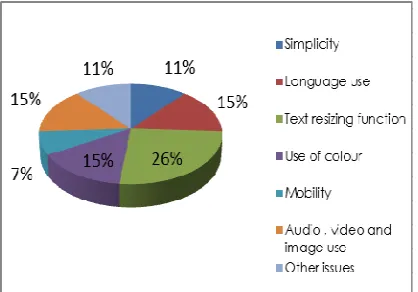
As far as our concern, there is a lot of mobile applications design guidelines being developed for other categories of mobile app’s except for mobile spiritual applications. Therefore, based on the feedback that the researchers gained from this study, the researchers had identify certain room of improvement for future mobile spiritual applications development as stated in Table 2. The researcher highlighted all the feedbacks into several categories including simplicity, language use, text resizing function, use of color, mobility, multimedia elements and other issues as depicted in Figure 4.
This study tried to answer the question about what are the design requirements for mobile
Id Age Gender Background
Technology background
P1 68 Male Retiree Smart phone
P2 61 Female Retiree Smart phone
P3 67 Female House wife Smart phone
P4 70 Female House wife Hand phone
P5 74 Male Retiree Hand phone
P6 61 Male Retiree Hand phone
P7 65 Male Working Smart phone
P8 68 Female Retiree Smart phone
P9 61 Female Retiree Smart phone
P10 63 Male Retiree Hand phone
P11 63 Female House wife Smart phone
P12 60 Female House wife Smart phone
P13 63 Female House wife Hand phone
P14 72 Male Retiree Hand phone
[image:4.612.89.299.437.638.2]ISSN: 1992-8645 www.jatit.org E-ISSN: 1817-3195 spiritual applications for older adult users. Based on
the findings from the evaluation of existing mobile spiritual application, the researchers believe that the spiritual application is among the required mobile applications for older adults instead of other type of
applications. Application designer ought to
consider the following elements while developing
mobileapplications to ensure high acceptance level
[image:5.612.90.299.206.352.2]among older adults.
Figure 4: Summary of Application’s Design based on User Feedback
Simplicity. Mobile spiritual applications for the older people should apply the concept of simplicity. Mobile application developers in general should
consider cognitive, behavior and physical
impairment faced by older adult generation in developing apps for them. Try to simplify the user interfaces including the number of button provided in the interface, minimize number of functions into the most usable functions and integrate several mobile spiritual application categories in only one application with only single click to open it.
Language use. The Malay older adults’ community
in the study is seen as proudly trying to keep the Malay language as their dominant language even in mobile applications. Majority of the participant urge the use of Malay language in all the mobile applications that were introduced to them for better understanding of the apps content. Despite of the overwhelming mobile spiritual applications in the market that uses English as the medium; the older adult users still prefers mobile applications that use their native language.
Text resizing function. According to literature review in gerontology study, it is stated that older adults are suffering from vision impairment especially when reading. In order to complement their sensory disability, the application designers have to consider of implementing text size increasing function. This function apparently helps to boost older adults’ confidence level when using
the mobile applications. On the other hand, it helps older users from suffering runny eyes when they looked at the mobile phone screen for too long.
Use of colour. Mobile application interfaces for the elderly should in general contain colored text or colored graphics especially to display relevant information. The use of color could in other hand guide older adults physical (eye) and cognitive motor to highlight the important information in the application. Besides, it could give an attraction to older adults to prolong their enthusiasm in using the mobile application. As stated by the participant in the study, colorful text makes them happy to use the application for quite a long time as it gives sense of aesthetic.
Mobility. Mobile technology is without a doubt, offers mobility aspects that attract older adult to use its applications. According to several interviewees, they kept mobile phones all day long with them for the purpose of communication with their children or friends and at the same time whenever they need to engage with spiritual activities they can just open the mobile phones and recite the Quran immediately. It is simple, fast and easy when using mobile applications as they do not need to follow certain procedures such as to perform ablution before reciting the Quran, hence, they can recite the Quran whenever on plane, in the car and everywhere.
Audio, video and image use. The “look and feel” of the applications helps to encourage older adults to experience the applications. Aesthetical and graphical aspects should be carefully considered when designing for spiritual applications. At a first glance, user interface of the applications do attract older users to use the applications, so, it is very important to consider how the interface can fulfill their sensorial abilities. For instance, the use of audio and video where applicable in the applications must be given a more comprehension on the subject matter. Simple image and not too embellished can also be used to avoid plainness of the applications.
ISSN: 1992-8645 www.jatit.org E-ISSN: 1817-3195 application causes the older people to feel stuffy
and disturbed. However, there are also older adult users who expressed their satisfaction in using mobile applications for instance the bright screen illumination which facilitates the older people to see clearly the applications content at any time.
5. CONCLUSIONS
In this paper, the researchers described the purpose of this study; which is to investigate the design elements and the older adult user’s experiences in using mobile spiritual applications. Obviously, older adults are often the neglected generation in many application developments, but they are the only increasing age group worldwide. Older adult users are actually do not possess much interest in the brand and the sophistication of the design like youngsters do, but rather interested in using mobile phones that can deliver real value services for them. In the Malaysian culture for instance, there was a clear consensus among the interviewees that older adults living in their old age will dedicate their old age with as many spiritual activities for the preparation of their afterlife. The uses of mobile phones equipped with applications that can assist them in daily spiritual activities are most-welcomed. From this study, the researchers have identified several issues that need to be taken into
account when designing mobile spiritual
applications for older adult users. Therefore, in the next project, the researcher planned to develop a mobile spiritual application for older adults considering all the design elements that have been discussed earlier. This application will work as mobile ibadah kit for older adult users in future.
ACKNOWLEDGEMENT
The work described in this paper has been fully supported by the Geran Penyelidikan Bestari UNISEL GPB-UNISEL15/ICT-003 project. Special thanks to Universiti Selangor (UNISEL) and also older adult participants from Kompleks Warga Emas, Seksyen 24, Shah Alam, Selangor, Malaysia for their willingness and cooperation in this study.
REFERENCES:
[1] H. Bouma, W. A. Rogers, and R. Schulz,
“Technology: A Means for Enhancing the Independence and Connectivity of Older People,” in CHI 2004, 2004, pp. 1580–1581.
[2] W. Ibrahim and W. Ahmad, “Population
Ageing and Religious Participation Among Rural Elderly in Terengganu, Malaysia,” J. US-China Public Adm., vol. 8, no. 9, pp. 968–977, 2011.
[3] S. Mallenius, M. Rossi, and V. Tuunainen,
“Factors affecting the adoption and use of mobile devices and services by elderly people–results from a pilot study,” 6th Annu. Glob. Mobil. …, 2007.
[4] N. Tohit, C. J. Browning, and H.
Radermacher, “‘We want a peaceful life here and hereafter’: healthy ageing perspectives of older Malays in Malaysia,” Ageing Soc., vol. 32, no. 03, pp. 405–424, May 2011.
[5] M. R. Crowther, M. W. Parker, W. a.
Achenbaum, W. L. Larimore, and H. G. Koenig, “Rowe and Kahn’s Model of
Successful Aging Revisited: Positive
Spirituality--The Forgotten Factor,”
Gerontologist, vol. 42, no. 5, pp. 613–620, Oct. 2002.
[6] A. Holzinger, G. Searle, and A.
Nischelwitzer, “On Some Aspects of Improving Mobile Applications for the Elderly,” in LNCS 4554, Springer-Verlag Berlin Heidelberg 2007, 2007, pp. 923–932.
[7] L. Frid, A. Garc, I. Laskibar, A. Etxaniz, and
M. F. Gonzalez, “What technology Can and Cannot Offer an Ageing Population: Current Situation and Future Approach,” in A
Multimodal End-End Approach to
Accessible Computing, P. Biswas, C. Duarte, P. Langdon, L. Almeida, and C. Jung, Eds. London: Springer London, 2013, p. 256.
[8] F. H. Abdul Razak, R. Sulo, and W. A. W.
Adnan, “Elderly User Mental Model of Reminder System,” in APCHI ’12, 2012, pp. 193–200.
[9] J. Shen, C. Zhang, and C. Jiang, “TV-Based
Caring Videophone System for the Elderly in the Smart Home Environment,” J. Electr. Comput. Eng., vol. 2013, pp. 1–8, 2013. [10] W. Olphert and L. Damodaran, “Older
people and digital disengagement: a fourth digital divide?,” Gerontology, vol. 59, no. 6, pp. 564–70, Jan. 2013.
[11] E. Baharuddin and Z. Ismail, “Hubungan Kecerdasan Rohaniah Warga Tua dengan Amalan Agama,” Islamiyyat, vol. 35, no. 1, pp. 19–28, 2013.
[12] L. Tornstam, “Gerotranscendence: The contemplative dimension of aging,” J. Aging Stud., vol. 11, no. 2, pp. 143–154, Jun. 1997. [13] R. Martha, W. Michael, L. Walter, and G.
Harold, “Rowe and Kahn’s Model of
Successful Aging Revisited: Positive
ISSN: 1992-8645 www.jatit.org E-ISSN: 1817-3195 [14] Jabatan Perangkaan Malaysia, Malaysia
2011- Statistics Yearbook, no. September. 2012.