ISSN: 1992-8645 www.jatit.org E-ISSN: 1817-3195
209
THE RESEARCH ON DATA STREAM CLUSTERING
ALGORITHM BASED ON ACTIVE GRID-DENSITY
1ZHONG ZHISHUI, 2WANG GANG
1Department of Mathematics and Computer Science, Tongling University, Tongling, China
ABSTRACT
The main work of this paper is to study and to achieve a time complexity of low and high precision of clustering data stream clustering algorithm. First is to analyze the data stream mining theory; to analyze and summarize several typical advantages and disadvantages of the traditional clustering algorithms, as well as the scope of application of clustering, which leads to data stream clustering algorithm and it’s elaborate; highlight a new data stream clustering algorithm: the data stream clustering algorithm is based on active mesh density. Firstly, the data space grid is divided into a grid structure formed by the small cube grid cell on the grounds, and then the data stream is mapped to this structure, the application of the concept is of density formation of the concept, and then feature vector to determine the density of the grid. The density attenuation of the dynamic is in the nature of the technology to capture data stream, and then extract the boundary point to remove it; introduce the concept of activity to determine the mesh density of active and inactive grid density to ignore the reserve of active grid density clustering, and in this article the algorithm CluStream algorithm for comparison. Finally, the algorithm is applied in this article to the network intrusion detection algorithm in the detection rate and false alarm rate analyzed to verify whether the algorithm is feasible or not.
Keywords: Data Stream, Clustering, Activity, Grid-Density
1. TRODUCTION
A continuous data stream, potentially unlimited, with high-speed mobility and other characteristics, which makes of the data stream mining algorithms, data can order one or more limited access. This feature of the data stream, the traditional mining method is difficult to meet their needs within a limited time. The result in depth study on the basis of the data stream clustering algorithm is given based on active mesh density data stream clustering algorithm (Data stream clustering algorithm is based on an active the grid density of AGD-Stream).
2. CLUSTREAM ALGORITHM BACKGROUND
Similarly, in the analysis of the data stream clustering algorithm, CluStream also played a huge role. Many stream clustering algorithm are CluStream clustering, thought them to the characteristics at the same time the Online / offline double the CluStream algorithm framework for data stream clustering algorithm to solve the contradiction between real-time requirements and quality of clustering in the data stream clustering problem through the framework of specific steps:
online micro-clustering process of the micro-cluster, offline clustering of macro macro-cluster process, and the framework structure of the pyramid. Micro-cluster summary information is stored up to use the macro clustering. CluStream algorithms involved in the pyramid time frame specific implementation process are as follows.
This framework snapshot saved in accordance with the data stream to reach the order, the order in accordance with the model of the pyramid is divided into different levels based on different information storage [3]:
1) Each layer can save up to
a
l+
1
snapshot; (2) Parti
layer a snapshot ofa
l , anda
l divisible by the time of the snapshot corresponding to after the start of the data streama
, an integer multiple of time is the level to save a snapshot of the moment;(3) Tier
i
ofa
or a divisible snapshot;(4) Any known user-defined time window of
h
,at least a snapshot of 2
h
in the distance the current time period.ISSN: 1992-8645 www.jatit.org E-ISSN: 1817-3195
210 a - as an integer, it determines the granularity of time
L - for the integer greater than 1, its size determines the arising
log
aT
- Pyramid maximum number of levels
This framework is to consider the storage requirements, taking into account the offline macro clustering in different time periods to restore the ability of the summary statistics [1-8].
Algorithm CluStream incremental clustering algorithm, STREAM algorithm is two less than any data stream arrives for processing, and can give any time to respond; faster by using the time frame of the pyramid according to treatment, can give different time granularity of the clustering results. However, CluStream algorithm has two shortcomings: (1) can only identify spherical clusters and clusters of arbitrary shape; (2) cannot handle the boundary points, the clustering accuracy is low. For each data point, the offline layer improved k-means algorithm is about all the initial data points for the kinds of division, and is able to identify the data points where a cluster is to calculate the data points with each distance between the centers. k-means algorithm the advantages is the ability to find the globular cluster, but the algorithm shortcomings - not the cluster of other shapes can be very efficient representation and mining, which determines the algorithm CluStream non-convex shape of the clusters relatively poor. In addition, because CluStream algorithm is based on k-means algorithm, which is determined by calculating the distance of data points and the center of its class affiliation, so it is not good at dealing with boundary points, largely affected the clustering effect, difficult to obtain accurate, high-quality clustering results, and the implementation of the algorithm is not efficient.
For the above CluStream algorithm cannot display any shape clustering, cannot effectively solve the boundary point two questions, this paper presents a data stream clustering algorithm based on active mesh density, which is able to identify the data of arbitrary shape and effectively address boundary issues. Firstly, the grid of data space is divided into a grid structure formed by a number of small cube grid cell, then the data stream is mapped to this structure, application of the concept of density is the formation of the concept of mesh density and density attenuation technology to capture the dynamic nature of the data stream, and then extract the boundary point to remove it; the
introduction of the concept of activity determines the mesh density of active and inactive grid density ignore retain active grid density of the final cluster . Experimental results show that, of AGD-Stream algorithms and CluStream algorithm compared to the arbitrary shape clusters that can be tapped to effectively solve the problem of boundary points, the time complexity of clustering accuracy have been improved.
3. AN IDEA OF THE DATA STREAM CLUSTERING ALGORITHM BASED ON ACTIVE MESH DENSITY
3.1The Basic Idea Of Algorithm
The basic idea is: the first grid of data space is divided into a grid structure formed by a number of small cube grid cell, then the data stream is mapped to this structure, the concept of the application of density mesh density concept, and then determine the density of the grid according to the feature vector. And use the density decay of the dynamic nature technology to capture the data stream.
3.2 Algorithm Description
AGD-Stream(X =
{
x1,L,xn}
,t
){
initialize(
grid
,g
); // Initialize the grid initialize(grid
_
list
,h
); // Initialize the grid listwhen there comes the data stream:
receive(X =
{
x1,L,xn}
,t
); Receiving data set(X =
{
x1,L,xn}
,t
) and recordthe mapping (
X
,g
) ;// data is mapped to the division of good space-intensive gridfor(
i
=
1
;i
<=
n
;i
+ +
)// Identify the boundary points in a certain time interval period, and remove it from the gridif ((
x
i is on the edge) and(t
mod
gap
<> 0))
for (
i
=
0
,i
<=
n
,i
+ +
)switch (
x
i){
ISSN: 1992-8645 www.jatit.org E-ISSN: 1817-3195
211 case ‘not on the edge’:
judge the active of grid density;
update(V);
break;
(// Determine whether the data points to meet another condition of the boundary pointscase ‘on the edge’:
inspect grid density ;
update(V);
break;
}
else
update (
grid
);// Otherwise, update the grid to meet the new distribution of the data streamif (density(
g
))// If the density of the grid is active mesh density, and add it to the grid listinsert
g
intohash
_
gridlist
;if(
t
mod
gap
= =0)// The cluster density-based approach to intensive gridcluster(
grid
); }3.3interval gap to Determine
The dynamic nature of the data stream can lead to the data density gradients over time. Some dense grid long time new data arrives, will lead to a very small amount of data in the grid, grid activity will reduce the attenuation of the transition grid or sparse grid. So we have to search for the density of each grid to a specified time interval, and then replace the original feature vector based on the results of the search, according to the dense nature of the grid to update the organizational structure of
each class. This time we require the value of
gap
should be appropriate. If value is too high, the test results cannot be timely performance of the fluctuations of the cluster; value too low will cause off-line processing be very complex, the calculated level rise, longer time, which cannot be consistent with the speed of data flow. Through the analysis mainly consider two aspects: (1) dense grid attenuation sparse grid, time-consuming the minimum (min); (2) sparse grid to update the minimum time-consuming for the dense grid. In order to guarantee sufficient time to detect the changes of the grid sparse, take (1), (2) theminimum value as the value of
gap
, this article refers to thegap
defined]:Theorem 1 for any a dense network in terms of
the grid
g
, the dense grid failure become sparse grid with minimum time required.
0 log
l m C C λ
σ
= (1)
Theorem 2 for any sparse grid
g
in terms of sparse grid upgrade to the minimum of the dense grid time required
1
log
m l
N
C
N
C
λ
σ
=
−
−
(2)Based on the above two theorems, select
σ σ
0,
1,the minimum value as the value of
gap
:2 2
2
min
log
, log
log (max
,
)
l m
m l
l m
m l
c
N
c
gap
c
N
c
c
N
c
c
N
c
−
=
−
−
=
−
(3)Where, N represents the number of grids.
3.4Handling Of Boundary Points
A grid density is less than
D
l, then there may betwo reasons: (1) real data points by a small number of boundary points constitute a small grid, grid boundaries sparse network; that a few boundary constitute a point; (2) even if a lot of data in the grid, the grid density gradually decay over time, resulting in less data, this grid is called the decay sparse network grid; only the first few data points in a real situation of a small number of boundary points of the grid.
ISSN: 1992-8645 www.jatit.org E-ISSN: 1817-3195
212 Definition 7 (density threshold) set the current
time
t
(t
>t
u),t
uthe gridt
ulast update data intime, then the density threshold is defined as
1 0
(1
)
( , )
(1
)
uu t t
t t i l l u i
C
C
fun t t
N
N
λ
λ
λ
− + − =−
=
=
−
∑
(4)Theorem 3 density threshold
fun t t
( , )
u has thefollowing properties:
( 1 )
t
1≤ ≤
t
2t
3 , Then3 2
1 2 2 1 3 1 3
( , )
(
, )
( , )
t t
fun t t
fun t
t
fun t t
λ
−+
+
=
(2)
t
1≤
t
2,Thenfun t t
( , )
1≥
fun t t
( , )
2 ,(
t
>
t t
1,
2)Proof: (1) from the known to have:
3 2
1 1
3 2 3 1 3 2 2 1
3 2
3 2 3 1
1 2 2 1 3
0 0 0
1 3 0
( , ) ( , )
( , )
t t t t
t t
t t t t
t t i i i i
l l l l
i i i t t i
t t i l
i
fun t t fun t t
C C C C
N N N N
C
fun t t N
λ
λ λ λ λ
λ − − − − − + − − − + = = = − = − = + = + = + = =
∑
∑
∑
∑
∑
This completes the proofProof: (2) Order,
∆ = −
t
t
2t
11 2 2 2
2 2
2
1
0 0 0 1
2 2
1 ( , )
( , ) ( , )
t t t t t t t t t t
i i i i
l l l l
i i i i t t
t t t i l
i t t
C C C C
fun t t
N N N N
C
fun t t fun t t N
λ λ λ λ
λ − − +∆ − − +∆ = = = = − + − +∆ = − + = = = + = + ≥
∑
∑
∑
∑
∑
This completes the proofHere,
fun t t
( , )
u as in B-time test gridg
is aboundary the standard sparse grid. If
( , )
( , )
uD g t
<
fun t t
, then
g
is a boundary sparse grid. Can be seen thatfun t t
( , )
u functionaccording to the formula can be used as a standard to distinguish the grid category, to determine what is "new" of the boundary point, which is the original stronghold of the majority. And can change over time to their adjustment, use the arrival time of the data points to analyze the size of the mesh density threshold.
If the moment of arrival of the nearest moment is longer, then the data points corresponding to the
density function value is smaller than
fun t t
( , )
u ;the contrary, if just a new data point arrives, then the data points corresponding to the density function
value is bigger than
fun t t
( , )
u . This is not becauseit is the newly arrived data points to determine the number of less error as a boundary point to remove.
4. SIMULATION EXPERIMENTS AND RESULTS ANALYSIS
AGD-Stream algorithm testing laboratoriesand the performance Clustream algorithm, the experimental environment is: Intel Pentium 4 CPU 3.00GHz Memory 1.00GB, the operating system for Windows XP. Algorithm is written in MATLAB. The experimental data [8] use real data sets KDDCUP99 Network Intrusion Detection stream data set collected by the MIT Lincoln Laboratory, the dataset object is divided into five major categories and 41 properties.
In this study, [7] 34 are continuous attributes. And to make the = 3.5, = 0.9, with practice in other literature, this paper also used the 34 continuous attributes; the other is artificial data set [8]. Clustering effect of the detection algorithm on the non-convex shape of the data set, generated as shown in Figure 1, two-dimensional non-convex shape of the artificial data set, the data set contains three classes, two attributes. In this experiment, each data set standardized in order to unify the data set of dimension values in [0, l], and divided equally to all data in a different dimension, set up each dimension to divide the length indicated.
Analysis of the clustering process and the effect of the algorithm
ISSN: 1992-8645 www.jatit.org E-ISSN: 1817-3195
213 In the experiment, each dimension by the length
of
len
= 0.05,λ
= 0.99. The experimental results show that, AGD-Stream algorithm can effectively remove a large number of boundary points which can be better found three classes. [image:5.612.331.503.127.461.2]To illustrate the class of AGD-Stream algorithm can dynamically change and timely remove the boundary point. This article specifically dealt with in the next experimental data, making the data stream start to appear three types of data, and then to observe the clustering results for each time period. The experimental results show that, AGD-Stream algorithm can generate the data stream and disappear in a timely manner to reflect the latest clustering information, and can effectively remove the boundary points.
Figure 1 30 000 Data Points Randomly Distributed
Artificial data sets used in this experiment, the distribution of their data as shown in Figure 4. This article is in order to generate a certain order, a total of randomly generated 90 000 data points, including 20 000 boundary points, the data flow rate of 1000, where inflow l000 data, 80 per unit time. 30 per unit
time
t
1, 60 per unit timet
2, timet
3 for 90 units ofAGD-Stream algorithm in time
t
1 clusteringevolution shown in Figure 5;
t
2 moment of clusterevolution shown in Figure 6; clustering in the
t
3time evolution shown in Figure 7.
Figure 5 indicates the class of AGD-Stream,
algorithms found in the beginning
t
1of time, whileexcluding the boundary points. Figure 6 show that
the class 1 at
t
2 time gradually disappeared, thealgorithm to find all the boundary points and delete at the same time to find a class 2, Figure 7 shows
that
t
3at the moment, the data flow all over theclustering results of the moment.
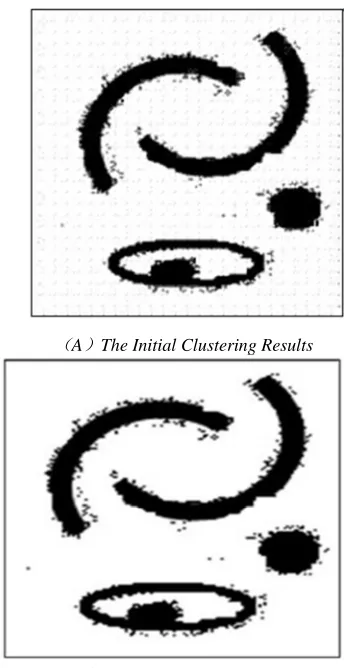
(A)The Initial Clustering Results
(B)The Final Clustering Results Figure 2 Representation Of Clustering Results
The class to identify the pieces of the chart and clear of AGD-Stream algorithm can be concentrated accurate data points, such as the above classes disappear and the process, but also ample evidence that the algorithm can effectively detect and remove the boundary points
5. SUMMARY
[image:5.612.116.273.292.450.2]ISSN: 1992-8645 www.jatit.org E-ISSN: 1817-3195
214 concept of activity to find the active grid density, the final cluster. The algorithm can be clusters of arbitrary shape and effectively deal with border issues. Reference time interval is a cluster period of time, reducing the computational load. Compared with CluStream algorithm, experiments show that of AGD-Stream, the algorithm's time complexity and accuracy of clustering have been improved.
ACKNOWLEDGEMENT
The paper is financed by Anhui University Provincial Natural Science Research Project(KJ2011B184),the Nature Science Foundation of Anhui Province(090416247) ,and
Collage Outstanding Young Talent
Fund(2009SQRZ175).
REFERENCES
[1] Han J, Kamber M. Data mining: concepts and technique. 2nd. Beijing China Machine Press, 2007: 306-307P
[2] Wang Xianpeng grid-based MST data stream clustering algorithm. Harbin Engineering University, a master's degree thesis .2009:4-35 [3]Yang Ning, jie, Wang Yue, Chen Yu, Zheng Jiao
Ling [7] based on the density of states tilt distribution of the data stream clustering algorithm. Journal of Software, 2009,21 (5) :1-11
[4] Jae Woo Lee, Nam Hun Park, Won Suk Lee. Efficiently tracing clusters over high-dimensional on-line data streams. Data and Knowledge Engineering. 2009, 68 (3) :362-379P
[5] Li W, Xuan H, PHILIP S Y. Density-based clustering of data streams at multiple resolutions. ACM Transactions on Knowledge Discovery from Data (TKDD). 2009,3 (3) :14-42P
[6] Zhu Wei Heng, seal, Xieyi Huang, arbitrary shape based on the data flow clustering algorithm, Journal of Software .2006,17 (3): 379-387
[7] Xue L, Qiu B. Density-reachable based clustering algorithm for multi-density. Computer Engineering. 2009, 35 (17) :66-68P
[8] Zhao L., Mao Y.X, GOBO: a Sub-Ontology API for Gene Ontology, IEIT Journal of Adaptive & Dynamic Computing, 2011(1), Jan 2011, pp:29-32.
DOI=10.5813/www.ieit-web.org/IJADC/2011.1 .5
[9] Zhu X.D, Block Correlations Directed Multi-copies Data Layout Technology, IEIT Journal of Adaptive & Dynamic Computing,
2011(1), Jan 2011, pp:33-38.