FUZZY RANDOM EUROPEAN CALL OPTION
PRICING MODEL
SHUXIA LIU, ENFENG LIU LIMING HUANG
School of Business Administration, Hebei Normal University of Science & Technology, QinHuangDao 066000,China
ABSTRACT
The valuation of an option is importance topic in finance. The classical option pricing models depend on the stochastic calculus to obtain some results. In practice, there are some fuzzy and imprecise factors in stock market. Fuzzy random theory may be an efficient tool to tackle with uncertainty. The paper presents the fuzzy random option pricing models, in which the prices of stocks are taken as fuzzy random variables. Moreover, in order to make decision better for the investor, the expected value of option price is derived. Finally, empirical analysis are given to demonstrate the idea how to calculate option value with fuzzy random stock price
Keywords: European Option, Option, Option Pricing,Fuzzy Variable, Fuzzy Random Variables
1. INTRODUCTION
Option pricing is one of the most exciting areas in modern financial researches. Conventionally, the payoff the contingent claim was only expressed as stochastic process and the volatility assumed to be a constant. The Black-Scholes formula had been celebrated as one of the major successes of the modern financial economics. But empirical analysis has pointed towards several systematic pricing errors. At the same time, the assumptions underlying the model have been widely criticized, and much work effort has been put into extending the valuation framework.
Some researchers have been looking long for efficient methods to valuate option. Fuzzy sets theory was used to option pricing theory by a few authors. Zmeskal[1]presented fuzzy-stochastic method, under these assumptions fuzzy number was proposed to appraise arm equity as a European call option, but the detailed computational procedure was not provided by Zmeskal. Yoshida [2-4] treated the stock price with applying fuzzy numbers and fuzzy stochastic process and mean values defined by fuzzy measures to evaluate option. Lee [5] adopted the fuzzy decision theory and Bayes rule as a base for measuring fuzziness in the practice of option analysis. This study also employed fuzzy decision space consisting of four dimensions. Wu [6] considered the fuzzy pattern of Black-Scholes formula, when the arithmetic in the classic Black-Scholes formula was replaced by the fuzzy arithmetic.
It is difficult to evaluate the practical stock price in future. Especially, the market is changing rapidly with the development of computer and Internet. When the financial model is applied actually, the actual price does not inconsistent with the theory price. In a world of uncertainty for stock price are not known exactly. Although we can get some information about the stock price, they are uncertain to some content. There are some random and vague, ambiguous factors in stock market. Sometimes it is more realistic and appropriate to characterize the stock price evolvement as a fuzzy random variable. In this paper, The European call option pricing model with fuzzy random stock price is presented by introducing fuzzy random theory [7-10] to the financial model, their valuation and properties are discussed respectively. Finally, the value of option can be evaluated by fuzzy random expected value.
2. FUZZY RANDOM OPTIONS PRICING
MODEL
The following notations formulate the fuzzy random option pricing model. European Options and American put option where there is no arbitrage opportunity.
( , , )
t
ξ θ ω
: Fuzzy random stock price at time tS t :stock price at time t
C: European call option K: strike price
ISSN: 1992-8645 www.jatit.org E-ISSN: 1817-3195
r: interest rate (c)+ : max {0, c}
Definition 1 Define stock price
ξ θ ω
( , , )
t
be a fuzzy random variable with membership function where( )
x
:
[ ] [ ]
0
,
1
→
0
,
1
L
is a monotonic increasing function andR
( )
x
:
[ ] [ ]
0
,
1
→
0
,
1
is a monotonic decreasing function as follows:( )
( ), ( ), 0, t t t t t t t x S Lif S m x S m
if x S
x
x S R
m if S x S m
otherwise
µ
−
− ≤ <
1, =
=
−
< ≤ +
(1)
For any givenω∈Ω, α∈ (0, 1],
ξ θ ω
( , , )
t
is fuzzy variable. It is easy to know thatα
-pessimistic values can be expressed by
(
)
{
( )
}
( )
{
}
{
( )}
( )
S
m
L
L
x
x
x
L
x
x
x
t
t L+
=
≥
=
≥
=
≥
=
− −α
α
α
α
µ
ω
θ
ξ
α 1 1inf
inf
inf
,
,
(2)For ω∈Ω, α∈ (0, 1],
α
-optimistic valuescan be expressed by
(
)
{
( )
}
( )
{
}
{
( )}
( )
S
m
R
R
x
x
x
R
x
x
x
t
t U+
=
≥
=
≥
=
≥
=
− −α
α
α
α
µ
ω
θ
ξ
α 1 1sup
sup
sup
,
,
(3)For the fuzzy European call options, fuzzy gain process
h
( ( , , ),
ξ
T
θ ω
T
−
t
)
is( ( , , ),
)
( ( , , )
)
h
ξ
T
θ ω
T
− =
t
ξ
T
θ ω
−
K
+(4) Theα
-pessimistic andα
-optimistic values of( ( , , ),
)
h
ξ
T
θ ω
T
−
t
are( ( , , ),
) (( ( , , )
) )
( ( , , )
)
( ( , , )
)
L L L U Lh
T
T t
T
K
T
K
T
K
α α
α α
α
ξ θ ω
ξ θ ω
ξ
θ ω
ξ
θ ω
+ + +
− =
−
=
−
=
−
(5)( ( , , ),
) (( ( , , )
) )
(
( , , )
)
(
( , , )
)
U U U L Uh
T
T t
T
K
T
K
T
K
α α
α α
α
ξ θ ω
ξ θ ω
ξ
θ ω
ξ
θ ω
+ + +
− =
−
=
−
=
−
(6)The fuzzy price processes of European call options are given as follows:
( )
( )
( , ( , , ))
[
( ( , , ),
)]
[
( ( , , )
) ]
Q r T t Q r T t
C t
t
E e
h T
T t
E e
T
K
ξ θ ω
ξ θ ω
ξ θ ω
−
− +
=
−
=
−
(7)E[.] denotes expectation with respect to the equivalent martingale measure Q and t ∈[0,T].
For ω∈Ω, α∈ (0, 1], the
α
-pessimistic values C(t, ξ(t, θ, ω)) is( ) ( ) ( )
( , ( , , ))
[
(( ( , , )
) ) ]
[
( ( , , )
) ]
[
( ( , , )
) ]
L Q r T t U
Q r T t L L
Q r T t L
C t
t
E e
T
K
E e
T
K
E e
T
K
α α
α α
α
ξ θ ω
ξ θ ω
ξ
θ ω
ξ
θ ω
− + − + − +
=
−
=
−
=
−
(8)For ω∈Ω, α∈ (0, 1], the
α
-optimistic valuesof C(t, ξ(t, θ, ω)) is
( ) ( ) ( )
( , ( , , ))
[
(( ( , , )
) ) ]
[
( ( , , )
) ]
[
( ( , , )
) ]
U Q r T t U
Q r T t U L
Q r T t U
C t t
E e
T
K
E e
T
K
E e
T
K
α α
α α
α
ξ θ ω
ξ θ ω
ξ θ ω
ξ θ ω
− + − + − +
=
−
=
−
=
−
(9)Where Q is equivalent martingale measure or risk-neutral measure. ( ) 1 2 2 1 2 1
( , ( , , ))
( , , ) ( )
( )
( , , )
ln
(
)(
)
2
,
L L r T t
L
C t
t
t
N d
Ke
N d
t
r
T t
K
d
T t
d
d
T t
α α
α
ξ θ ω ξ θ ω
ξ θ ω
σ
σ
σ
−=
−
+ +
−
=
−
= −
−
where
(10)With expiry date T and strike price K, N stands for the cumulative distribution function of standard normal random variable N(0,1).
( ) 1 2 2 1 ( , ( , , )) ( , , ) ( ) ( ) ( , , )
ln ( )( )
2
U U r T t
U
C t t t N d Ke N d
t
r T t
K d
T t
α α
α
ξ θ ω ξ θ ω
ξ θ ω
σ
σ
− = − + + − = − where (11)Remark 2 If
C t
( , ( , , ))
ξ θ ω
t
degenerates to a random variable, Equation (10) degenerates to classic B-S option pricing model, which is consistent with the result in stochastic case.To evaluate these fuzzy random processes by the expected value introduced in the reference
paper[10], 0 1 0 0 1 0
[ ( , ( , , ))]
{ ( , ( , , ))
} Pr(
)
1
{ ( , ( , , ))
}
Pr(
)
2
1
{ ( , ( , , ))
}Pr(
)
2
1
[ ( , ( , , )
( , ( , , ))]
2
L U
E C t
t
Cr C t
t
r dr
d
Cr C t
t
r d
d
Cr C t
t
r
d da
C t
αt
C t
αt
da
ξ θ ω
ξ θ ω
ω
ξ θ ω
α
ω
ξ θ ω
ω
ξ θ ω
ξ θ ω
+∞ Ω Ω +∞ Ω
=
≥
=
≥
=
≥
=
+
∫ ∫
∫ ∫
∫ ∫
∫
(12)3. FUZZY RANDOM WARRANT PRICEING
The total share capital of a company as N, M European style Warrants issued, warrants to subscribe for a ratio of I. Expiry of the warrants are exercised, the warrants holders K¥ per share price from companies to buy parts I stock available to listed companies cash MIK. Assume that the value of the company's total equity, η is the expiry of the warrants companies after the warrant exercise becomes η + MIK, the total share capital due to the
exercise of Warrants to expand η+MIK Therefore,
the exercise price per share becomes when the warrants expire, only if the stock price is greater than the exercise price, real-time, the warrants will be exercised, and therefore at time T, the proceeds of the warrant holders:
max(
I
MIK
K
), 0)
N
MI
η
+
−
+
(13)
Equation (13 ) slightly variant can be obtained
max( (
), 0)
NI
I
K
N
MI
N
η
−
+
(14)
For the fuzzy European call warrant,
( )
( )
( , ( , , ))
[
( ,
)]
[
(
) ]
Q r T t Q r T t
W t
t
E e
h
T t
E e
K
η θ ω
η
η
−
− +
=
−
=
−
(15)E[.] denotes expectation with respect to the equivalent martingale measure Q and t ∈[0,T].
For ω∈Ω, α∈ (0, 1], the
α
-pessimisticvalues
W t
( , )
η
is2 ( ) ( ) ( ) ( ) 1, 2, 2 1, 2, 1, 2
( , )
[
((
) ) ]
[
(
) ]
(
)
(
)
(
)
ln
(
)(
)
2
(
)
(
)
1
( )
,
1
2
L Q r T t L
Q r T t L
r T t L
L L r T t L
L L L L z i
NI
W t
E e
K
N MI
Nl
E e
K
N MI
NI
e
K dQ
N MI
Nl
N d
Ke
N d
N MI
r
T t
K
d
T t
d
d
T t
N d
e dz i
α α
α
α
α α α
α α α α
η
η
η
η
η
η
σ
σ
σ
π
− + − + −∞ − + −∞ − −=
−
+
=
−
+
=
−
+
=
−
+
+ +
−
=
−
=
−
−
=
=
∫
where
,2,
i d −∞∫
(16)With expiry date T and strike price K, N stands for the cumulative distribution function of standard normal random variable N(0,1).
For ω∈Ω, α∈ (0, 1], the
α
-pessimistic values( , ( , , ))
W t
ξ θ ω
t
is( ) ( ) ( ) ( ) 1, 2, 2 1, 2, 1,
( , )
[
((
) ) ]
[
(
) ]
(
)
(
)
(
)
ln
(
)(
)
2
(
)
(
)
U Q r T t U
Q r T t U
r T t U
L U r T t U
U
U
U U
W
t
E e
K
E e
K
e
K dQ
N d
Ke
N d
where
r
T
t
K
d
T
t
d
d
T
t
α α
α
α
α α α
ISSN: 1992-8645 www.jatit.org E-ISSN: 1817-3195
Evaluating E [W(t, η)] the expected value of W(t, η) by the following equation:
1 0
( ) ( )
[image:4.612.312.522.71.231.2] [image:4.612.309.527.343.687.2] [image:4.612.95.286.383.542.2]1, 2, 1, 2,
[ ( , )] 1
[ ( , ) ( , )] 2
( ) ( ) ( ) ( )
L U
L L r T t L U U r T t U E W t
W t W t d
N d Ke N d N d Ke N d
α α
α α α α α α
η
η η α
η − η −
= +
= − + −
∫
(
18)4. EMPIRICAL ANALYSIS
Taking April 28, 2008 as the current point, the closing price of the shares of the underlying assets of the days 12.141 ¥ , calculated based on
historical data for the previous three months, the stock daily fluctuations of the yield was 68.97%. Risk-free interest rate is 3.106 percent, based on the call option price so fuzz random environment as shown in Figure 1. In fact, the day the closing price of the call option is 7.024 ¥ in Figure 1 dotted line, then it can be estimated that the α values of the day of about 0.4.
Figure 1: Fuzzy Price And The Market Price
Compared in Figure 2 will be optimistic value and pessimistic value and the actual market price, we can see a lot of the actual price of the Warrants fall fuzzy price range. And the most pessimistic value is closer to the actual price; optimism is slightly higher than the actual price. Model assumptions more need for further in-depth research, in order to more accurately for the warrants pricing, provide investors with a better, more reliable reference.
Figure 2: The Market Price And Fuzzy Price
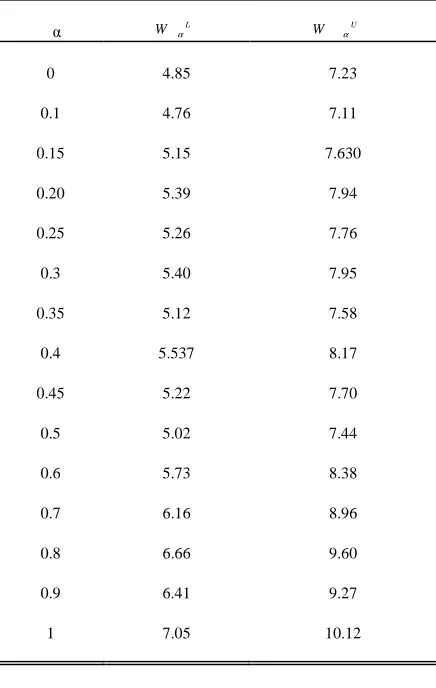
Select a different confidence α∈ [0, 1] from the table. In the process of α is gradually increased, the fuzzy price range has been gradually reduced. For α
= 1, the fuzzy price range becomes a constant, fuzzy price equal to the classic BS price, by fuzzy random model, the decision maker can choose the confidence price range.
Table 1 : Warrants Analysis
α W αL W αU
0
0.1
0.15
0.20
0.25
0.3
0.35
0.4
0.45
0.5
0.6
0.7
0.8
0.9
1
4.85
4.76
5.15
5.39
5.26
5.40
5.12
5.537
5.22
5.02
5.73
6.16
6.66
6.41
7.05
7.23
7.11
7.630
7.94
7.76
7.95
7.58
8.17
7.70
7.44
8.38
8.96
9.60
9.27
10.12
5. CONCLUSION
vague in the stock market, then stock price is characterized as the fuzzy random variable. Basic mathematical models of option pricing with fuzziness and randomness are established. The fundamental calculation formulas of European call options with fuzzy random theory are proposed. We derive the fuzzy random expected value of option. Fuzzy random option pricing model is a reasonable and natural extension of the classic stochastic process. The degenerated cases show the consistence with classical Black-Scholes model. Finally, the validity of this fuzzy approach to option pricing methodology has been highlighted with empirical analysis. Our methods are general in the sense that they can be applied also to more general equations. We are able to show that the new model fits actual prices better and performs better. Further research could use the similar approach to other exotic option models, such as Asian option and look-back option.
ACKNOWLEDGEMENTS
This work was supported by Doctoral Foundation of Hebei Normal University of Science & Technology No.YB2012001.
REFERENCES:
[1] Z. Zmeskal, “Application of the fuzzy-stochastic methodology to appraising the European call option”. European Journal of Operation Research, Vol.135, No.5, 2001, pp.303-310.
[2] Y. Yoshida, M. Yasuda, “A new evaluation of mean value for fuzzy numbers and its application to American put option under uncertainty”. Fuzzy Sets and Systems, Vol.157, No.19, 2006, pp.2614-2626.
[3] Y. Yoshida, “The valuation of European options in uncertain environment”. European Journal of Operational Research, Vol.145,No.1,2003, pp.221-229.
[4] Y. Yoshida, “Optimal stopping models in a stochastic and fuzzy environment”. Information Sciences,Vol.142, No.1-2,2002, pp. 89-101.
[5] Ch. Lee, G. Tzeng, “A new application of fuzzy set theory to the Black-Scholes option pricing model”.Expert Systems with Applications,Vol. 29,No.2, 2005, pp.330-342. [6] H. Wu, “Pricing European options based on the
fuzzy pattern of Black-Scholes formula”. Computers & Operations Research, Vol.31,No.7,2004, pp.1069-1081.
[7] B. Liu, “Fuzzy random chance-constrained programming”. IEEE Transactions on Fuzzy Systems, Vol.9, No.5,2001, pp.713-720. [8] B. Liu, “Fuzzy random dependent-chance
programming”. IEEE Transactions on Fuzzy Systems, Vol.9,No.5,2001, pp.721-726. [9] B. Liu, and Y. Liu, “Expected value of fuzzy
variable and fuzzy expected value models”. IEEE Transactions on Fuzzy Systems, Vol.10,No.4, 2002, pp.445-450.