SPEECH AUTHENTICATION
BASED ON PERCEPTUAL
FINGERPRINT HASHING
1
HONGXIA WANG, 2JINFENG LI, 3YONG QIU
1
Prof., School of Information Science and Technology, Southwest Jiaotong University, Chengdu, 610031, P.R.China
2
Ph.D. candidate, School of Information Science and Technology, Southwest Jiaotong University, Chengdu, 610031, P.R.China
3
Master, School of Information Science and Technology, Southwest Jiaotong University, Chengdu, 610031, P.R.China
E-mail: [email protected], [email protected]
,
3ABSTRACT
A perceptual fingerprint hashing method is proposed for audio authentication in this paper. First, the biologic fingerprint image is divided into overlapping rectangle blocks by randomly using a chaotic sequence, and then the gravity center of each block is calculated. Finally, the perceptual Hashing value is generated based on the gravity center of each block. To authenticate the speech identity source, the perceptual fingerprint hashing that represents speaker’s identity information and speech signal must be connected closely. So the perceptual fingerprint hashing value is embedded into the speech signal as a watermark. At the authentication stage, first, the perceptual fingerprint hashing value is extracted from the speech for authentication, and then it matches another perceptual fingerprint hashing value which is restructured by the suspicious fingerprint image. Finally, the authentication result can be decided by the matching result. The experimental results indicate that the proposed algorithm is not only robust against fingerprint rotation processing and noise attack, but also has high security and uniqueness.
Keywords: Speech Authentication, Speaker Verification, Perceptual Hashing, Biologic Fingerprint, Digital Watermarking
1. INTRODUCTION
Nowadays, the existing authentication protocol using PKI/CA technology, smart card, digital signature and USB key means to solve the network identity authentication, but the password is easy to be forgotten, vulnerable, leaked, while the smart card and USB certificate token are easily stolen, lost, or spurious. The basic principle of traditional speaker verification technology creates a personality description model for every speaker. The speaker authentication is implemented by comparing the suspicious speech with the saved speaker model. If the similarity is smaller than a specified threshold, the speaker's identity will be confirmed. Otherwise, the authentication doesn’t pass. Therefore, the existing speaker verification algorithm mainly consists of three parts: (1) Speech signal processing and feature extraction; (2) Speaker verification model establishing and training; (3) Calculating the matching distance between the
suspicious speech and the model. The traditional speaker authentication process is shown in Figure 1.
Speech
Preprocess Feature extraction
Train
Match
Template database
[image:1.612.315.519.523.575.2]Judge Result
Figure 1: Principle of Traditional Speaker Verification
The main traditional speaker verification methods are presented as follows: (1) Template model method [1]; (2) Probability model method [2]; (3) Artificial neural network method and support vector machine (SVM) [3]; (4) Fusion method [4]. In general, these methods are based on the speech features.
more accurate to reflect the different speaker is an urgent problem to be solved. Meanwhile, the speech is easy to be imitated. With the development of high capability digital recorder, the attacker can achieve sound features of the speaker with a very low cost. Therefore, the identity reliability is reduced by means of using the voice feature only.
Limited to speech signal itself, simple features extracted from the voice signal to speaker recognition cannot solve the problem commendably. So other aided features for speaker verification are expected to solve these problems such as speaker lip changes [5] or other biologic features. The fingerprint features possess high recognition accuracy, low equipment cost, small data storage and other advantages, so it can be used for speech recognition technology. However, the same individual’s fingerprint images data maybe have a certain difference due to two times input angle minor differences, the fingers’ pressing strength, and wet / dry degrees. Considering the notable difference between the perceptual hashing and the traditional hashing algorithm that even two perceived similar fingerprint images have numerically different Hashing representations, the perceptual Hashing function enables them to produce the same or similar hashing value [6] [7]. Gravity center, geometric invariant to translation and rotation, can tolerate small geometric distortion. Because the gravity center of fingerprint image is calculated based on image content, the perceptual hashing values generated by the gravity center of different fingerprint images are different. Even if two fingerprint images’ perceptual elements are the same, they will also generate different perceptual hashing values due to different keys.
Therefore, in this paper, we propose a speech authentication algorithm by the perceptual hashing model based on the gravity center of biometric fingerprint image. To connect the identity information with the speech signal for the purpose of speaker verification, the perceptual fingerprint Hashing value as a watermark is embedded into the speech signal. The remainder of this paper is organized as follows. In Section 2, the proposed algorithm is described. Experimental results and capability analysis are given in Section 3. Finally, the conclusions are given in Section 4.
2. PROPOSED ALGORITHM
2.1. Basic idea
First of all, the fingerprint image is collected to the computer through the fingerprint scanner, and then gravity center of the fingerprint image is
calculated. A perceptual hashing model based on the gravity center of the fingerprint image is created under the control of the key. In order to connect the speaker identity information with the speech signal, the generated perceptual hashing sequence, as a watermark, will be embedded into the speech signal. When we identify the speech identity source, first, we extract the perceptual hashing sequence from the speech signal to be authenticated. Then, we scan the fingerprint image into the computer according to the same processing as before and the same key to generate another perceptual hashing sequence, and then calculate the normalized distance of two perceptual hashing sequences. Set a threshold, if the distance is less than the threshold, the authentication will pass. Otherwise, the candidate person is not the speaker of the speech to be authenticated.
2.2. Perceptual Hashing Generation
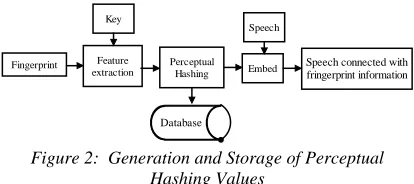
The perceptual hashing value is generated and stored as shown in Figure 2.
Perceptual Hashing Feature
extraction
Speech
Embed
Database
Speech connected with fringerprint information
[image:2.612.314.521.359.451.2]Fingerprint Key
Figure 2: Generation and Storage of Perceptual Hashing Values
The main processes are as follows:
Step 1. Fingerprint image random blocking: In
order to enhance the security of the perceptual hashing algorithm, we use a secrete key to generate a pseudo-random sequence Qp. The pseudo-random sequence will randomly divided the fingerprint image into C overlapping rectangles, and the key controls the number of rectangles and the pseudo-random sequence. The fingerprint image blocking can also makes up the disadvantage that the gravity center can only describe global characteristics of an image.
The pseudo-random sequence xi is generated by Logistic map as follows:
1(1 1) 3.5699 4
i i i
x =
µ
x− −x− < <µ
(1)Then, we obtain the binary pseudo-random sequence according to the following quantification method:
0 <0 1 0
i i
i
x B
x
= ≥
According to the image size, we adaptively select proper bits as the coordinate of x-axis and y-axis, length and width of the random region to prevent boundary, denoted by a quaternion C (mx, my, length,
width). So, the fingerprint image is divided into C
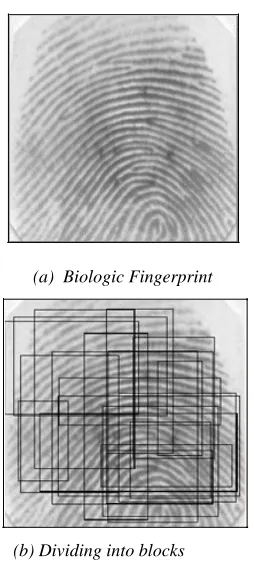
overlapping rectangular regions, which is shown in Figure 3. Because the quaternion is randomly generated, the rectangular areas are random.
(a) Biologic Fingerprint
[image:3.612.133.260.190.472.2](b) Dividing into blocks
Figure 3: Fingerprint Divided Randomly into Overlapping Blocks
Step 2. Calculate the gravity center of the
rectangular blocks: The original gray fingerprint image is denoted by f i j( , ),1≤ ≤i M,1≤ ≤j N. The coordinate ofthe gravity center G m m( x, y)
1 1 1 1
1 1 1 1
( , ) / ( , )
( , ) / ( , )
M N M N
x
i j i j
M N M N
y
i j i j
m i f i j f i j
m j f i j f i j
= = = =
= = = =
= ⋅
= ⋅
∑∑
∑∑
∑∑
∑∑
(3)According to step 1, the gravity center coordinates of the pseudo-random rectangular blocks are denoted by G = {G1, G2, … , GC}, and C is the number of rectangular blocks. Through the calculation of each block’s gravity center, the local information of the fingerprint image can be obtained, which improves the ability to distinguish different fingerprint images.
Step 3. Gravity center quantification:Note d be a
quantification step, and the gravity center coordinates G are quantified as follows:
/
C C
S =G d×d (4)
Obviously, if the quantification step d is too large, the change of gravity center will not be sensitive, and the false acceptance rate will increase.
Step 4. Perceptual hashing value generation: Let
S = {S1, S2, … , SC} denote the quantized values by Step 3. Convert S to binary bits, denoted by
1,1 1,2 1, 2,1 2,2 1, ,1 ,2 , 2 (b b b j,b b b j,b bC C bC j) ,
, {0,1}
C j
b ∈ . Finally, the generated perceptual Hashing sequence H is
1,1 1,2 1, 2 2,1 2,2 1, 2 ,1 ,2 , 2
( j ) || ( j ) || || (C C C j )
H= b b b b b b b b b .
2.3. Perceptual Hashing Value Storage
[image:3.612.106.250.565.622.2]The watermarking algorithm using robust audio watermarking algorithm based on zero-crossing rate against time-scale modification [8], which is robust enough to many attacks, such as the conventional speech signal processing, MP3 lossy compression, low-pass filtering, and the time scale modification. It is proved that the perceptual Hashing sequence can be extracted correctly, so the accuracy of speaker identification can be guaranteed.
2.4. Speech Identity Source Authentication
When we identify the speaker, firstly, the perceptual hashing sequence is extracted from the speech signal, and is matched the perceptual hashing sequence generated by the dubitable fingerprint image. If the distance between two perceptual hashing sequences is less than the specified threshold, the speech will pass the authentication. Otherwise, the authentication is failed.
Perceptual Hash valueH2 Feature
extraction
Match Fingerprint
Key
Speech to be
Authenticated Extract Hash valuePerceptualH
1
[image:4.612.321.507.310.474.2]Authentication result
Figure 4: Principle of Proposed Speaker Verification
The identification framework is as shown in Figure 4. The steps are as follows:
Step 1. The perceptual Hashing sequence H1 is
extracted from the speech signal which contains biometric feature trough digital audio watermarking extracting algorithm.
Step 2. The dubitable fingerprint image is
partitioned into C random rectangular blocks by the same secret key as perceptual Hashing generation process, and the gravity center coordinates of the blocks are calculated and quantized. Finally, another fingerprint perceptual hashing sequence H2
is generated.
Step 3. Set a threshold T, T >0, the normalized
Hamming distance is calculated
1 2 1 2
1
1
( , ) | ( ) ( ) |
L
k
D H H H k H k
L =
=
∑
− (5)where L is the length of perceptual hashing sequence. If D H H( 1, 2)≤T , the speakers are the
same person, otherwise, D H H( 1, 2)>T, the speakers
are different. Ideally, the normalized Hamming distance of two similar fingerprints is close to 0, while the normalized Hamming distance of two different fingerprints is close to 0.5.
3. EXPERIMENTAL RESULTS AND
CAPABILITY ANALYSIS
In the experiment, 100 fingerprint images of size 304×256 are randomly selected, and the format is BMP. The parameters are set as follows: the chaotic initial value is 0.23, the quantization step is 1, and the number of random rectangle blocks is 150.
3.1. Collision Test
Collision represents two different fingerprint images that generate approximate perceptual Hashing values. We calculate the 100 perceptual hashing values of 100 fingerprint images, and the distance between two perceptual hashing values D
(H1, H2). Finally, we obtain 4950 matching values.
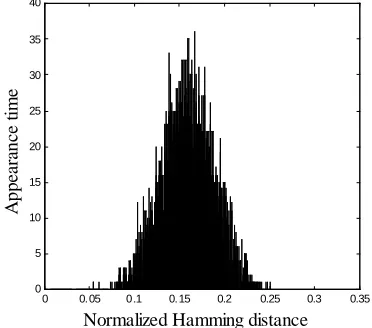
The frequency distribution histogram is shown in Figure 5.
0 0.05 0.1 0.15 0.2 0.25 0.3 0.35
0 5 10 15 20 25 30 35 40
Normalized Hamming distance
A
p
p
ea
ra
n
ce
t
im
e
Figure 5: Collision Test
Figure 5 shows the results can be approximate to
the Gaussian distribution with the
expectation µ=0.1591 and standard
deviationσ=0.0293. Set the thresholdT=0.1, the conflict probability will be
2
2
( )
6 2
0 1
7.6603 10 2
x T
p e dx
µ σ
πσ
− −
−
=
∫
= ×As a result, the conflict probability is very small. Hence, the proposed method can ensure the uniqueness of perceptual Hashing values of the fingerprint image.
3.2. Perceptual Robustness A. Robustness to Rotation Attack
Rotate the fingerprint image with different degrees, and calculate the perceptual Hashing values H′2 . Compare H2′ with the original
[image:4.612.91.299.327.398.2]normalized Hamming distance is shown in Figure 6. When the rotation angle of the fingerprint image is limited to ± °3 , the normalized Hamming distance
1, 2)
D H H( ′ ′ is less than the threshold T=0.1, so the proposed algorithm can tolerate the rotation attack within ± °3 .
-5 -4 -3 -2 -1 0 1 2 3 4 5
0 0.02 0.04 0.06 0.08 0.1 0.12 0.14
Rotation angle
N
o
rm
al
iz
ed
H
am
m
in
g
d
is
ta
n
ce
Figure 6: Robustness to Fingerprint Rotation
0 0.05 0.1 0.15 0.2 0.25 0.3 0.35 0.4 0.45 0
0.02 0.04 0.06 0.08 0.1 0.12
???????
? ? ? ? Variance
N
o
rm
al
iz
ed
H
am
m
in
g
d
is
ta
n
[image:5.612.98.283.185.341.2]ce
Figure 7: Robustness to Gaussian White Noise
B.Robustness to Noise Attack
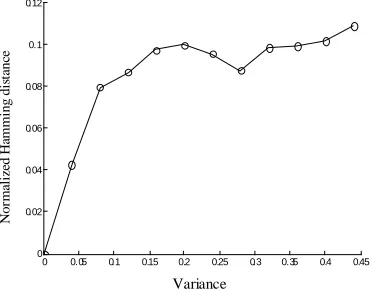
The fingerprint image is added to different degrees Gaussian white noise with variance 0~0.44. We calculate the perceptual Hashing value ''
2
H , and
extract the perceptual Hashing value H′′1. Then the normalized Hamming distance D(H1'',H2'') is obtained. The robustness to Gaussian white noise is shown in Figure 7. From Figure 7, when the variance is less than 0.36, the normalized Hamming distance D(H1'',H2'') is less than the threshold value
0.1
T= .Namely, the proposed algorithm is robust enough to resist noise attack that caused by the condition of fingerprint image acquisition, i.e. clean
or not, dry or wet, which is equal to the distortion of adding noise with different variances.
3.3. Security
[image:5.612.109.298.378.523.2]Because the chaotic sequence is non-periodic and sensitive to the initial value, the Logistic map is used to generate a pseudo-random sequence in this paper. The fingerprint image is partitioned into random blocks. The chaotic initial values, as the key, are set 0.23 and 0.38, respectively. The segment of perceptual Hashing value generated by the different keys is listed in Table 1.
Table 1: Segment of Perceptual Hashing Value Generated by Different Keys
… 137 103 177 113 110 206 …
… 193 183 148 92 92 125 …
By calculation, the normalized Hamming distance is 0.4511, which is far greater than the threshold T=0.1 , so the security meets the application requirement. Therefore, without knowing the key that the initial value of the chaotic map, even if the watermark extraction algorithm is known, the correct perceptual Hashing value generated by fingerprint image cannot be leaked.
3.4. Authentication capability discussion
The existing traditional speaker authentication method is based on large amount of speech analysis, feature extraction, training speech and modeling [8]. The amount of data to be processed is very large, and features extraction costs a lot of time. This paper introduces the gravity center of fingerprint image as well as perceptual Hashing technology, effectively reducing the consumption of time. Assume the size of fingerprint image is304 256× , and then the image has 77824 pixels with 8 bits. If the image is stored in binary, the storage space needs 622592 bits. But if we store the perceptual hashing sequence of the fingerprint image, the storage space requirement will greatly reduce. Assume the fingerprint image is randomly partitioned into 100 rectangular blocks, and then 100 gravity centers are generated and quantified. If we convert the decimal gravity centers coordinate to the binary, the storage space requires only 1600 bits. This means, the algorithm can greatly reduce the storage cost, at the same time, greatly increase the running efficiency.
introduces the speaker’s fingerprint biological characteristic, which is embedded into the speech to be protected. In fact, our method is that a stable phase is added into the speech, so it can avoid the environmental impact. Moreover, the accuracy of speaker identification depends on the accuracy of speaker’s fingerprint authentication. If the fingerprint feature can be nicely extracted, the accuracy of speech identification can reach 100% in some cases according to the performance of fingerprint perceptual Hashing technique.
4. CONCLUSIONS
In this paper, we present a speech identity source authentication scheme based on the perceptual fingerprint Hashing technique. The experimental results show that the proposed algorithm can resist rotation attack within the rotation angle ± °3 , Gaussian white noise attack with variance 0.36, and has strong robustness and high security. If the key is not known, the perceptual hashing values will not be matched, even if the fingerprint image is copied. Furthermore, the experimental results prove that the fingerprint perceptual hashing sequence is unique. The proposed algorithm combines the speaker’s biologic fingerprint feature with the speech signal, equivalently adding the speech with a stable phase, which is good at avoiding the environmental impact, such as age, health and other factors, which causes the probability of failure in identifying the speaker. Hence, the ability of the resistance of environmental impact is improved. Further work is needed to reduce the amount of the perceptual hashing values by coding, such as huffman coding and arithmetic compression coding.
ACKNOWLEDGMENT
This research was supported by the National Natural Science Foundation of China (NSFC) under the grant No. 61170226, the Fundamental Research Funds for the Central Universities under the grant Nos.SWJTU11CX047, SWJTU12ZT02, and the Young Innovative Research Team of Sichuan Province under the grant No.2011JTD0007.
REFRENCES:
[1] A. Brew and P. Cunningham, “Vector
Quantization Mappings for Speaker
Verification”, 20thInternational Conference on
Pattern Recognition(ICPR), Istanbul, Turkey,
August 23-26, 2010, pp. 560-564.
[2] M.S. Sinith, K.S. Gowri, K.V.N. Sandeep, and A. Soman, “A Novel Method for
Text-Independent Speaker Identification Using MFCC and GMM”, International Conference on Audio Language and Image Processing
(ICALIP), Shanghai, China, November 23-25,
2010, pp. 292-296.
[3] W.M. Campbell, J.P. Campbell, T.P. Gleason, D.A. Reynolds, and W. Shen, “Speaker Verification Using Support Vector Machines and High-Level Features”, IEEE Transactions
on Audio, Speech, and Language Processing,
Vol. 15, No. 7, 2007, pp. 2085-2094.
[4] W.M. Campbell, D.E. Sturim, and D.A
ReynoldS, “Support Vector Machines Using GMM Supervectors for Speaker Verification”,
IEEE Signal Processing Letters, Vol. 13, No. 5,
2006, pp. 308-311.
[5] V.R. Aravabhumi, R.R. Chenna, and K.U. Reddy, “Robust Method to Identify the Speaker Using Lip Motion Features”, 2nd International Conference on Mechanical and
Electrical Technology (ICMET), Singapore,
September 10-12, 2010, pp. 125-129.
[6] X.D. Lv and Z.J. Wang, “Perceptual Image Hashing Based on Shape Contexts and Local
Feature Points”, IEEE Transactions on
Information Forensics and Security, Vol. 7,
No. 3, 2012, pp. 1081-1093.
[7] J.T. Zhou and Q.C. Au, “Security Evaluation of a Perceptual Image Hashing Scheme Based on
Virtual Watermark Detection”, IEEE
International Conference on Multimedia and
Expo (ICME), Barcelona, Spain, July 11-15,
2011, pp. 1-6.
[8] H.X. Wang and M.Q. Fan, “Time-Scale Invariant Audio Watermarking based on Zero-Crossing Rate”, Chinese Invention Patent No.
ZL 200910058797.X, 2011, pp. 1-10.
[9] V. Varshney, D.J. Malakar, and P.K. Das,
“Analysis of Patterns in Speaker
Authentication Using Discrete Probability
HMMs”, Proceedings of the Third
International Conference on Machine
Learning and Cybernetics, Shanghai, China,