D E C E M B E R 1 9 9 4
WRL
Technical Note TN-43
Ramonamap
-An Example of
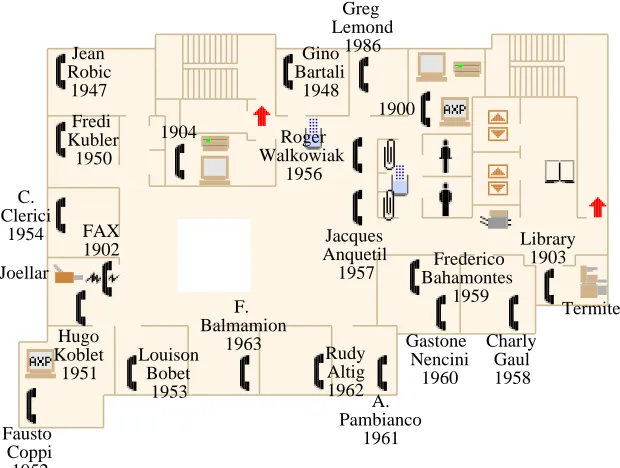
Graphical Groupware
Joel F. Bartlett
The Western Research Laboratory (WRL) is a computer systems research group that was founded by Digital Equipment Corporation in 1982. Our focus is computer science research relevant to the design and application of high performance scientific computers. We test our ideas by designing, building, and using real systems. The systems we build are research prototypes; they are not intended to become products.
There are two other research laboratories located in Palo Alto, the Network Systems Lab (NSL) and the Systems Research Center (SRC). Another Digital research group is located in Cambridge, Massachusetts (CRL).
Our research is directed towards mainstream high-performance computer systems. Our prototypes are intended to foreshadow the future computing environments used by many Digital customers. The long-term goal of WRL is to aid and accelerate the development of high-performance uni- and multi-processors. The research projects within WRL will address various aspects of high-performance computing.
We believe that significant advances in computer systems do not come from any single technological advance. Technologies, both hardware and software, do not all advance at the same pace. System design is the art of composing systems which use each level of technology in an appropriate balance. A major advance in overall system performance will require reexamination of all aspects of the system.
We do work in the design, fabrication and packaging of hardware; language processing and scaling issues in system software design; and the exploration of new applications areas that are opening up with the advent of higher performance systems. Researchers at WRL cooperate closely and move freely among the various levels of system design. This allows us to explore a wide range of tradeoffs to meet system goals.
We publish the results of our work in a variety of journals, conferences, research reports, and technical notes. This document is a technical note. We use this form for rapid distribution of technical material. Usually this represents research in progress. Research reports are normally accounts of completed research and may include material from earlier technical notes.
Research reports and technical notes may be ordered from us. You may mail your order to:
Technical Report Distribution
DEC Western Research Laboratory, WRL-2 250 University Avenue
Palo Alto, California 94301 USA
Reports and technical notes may also be ordered by electronic mail. Use one of the fol-lowing addresses:
Digital E-net: JOVE::WRL-TECHREPORTS
Internet: [email protected]
UUCP: decpa!wrl-techreports
To obtain more details on ordering by electronic mail, send a message to one of these addresses with the word ‘‘help’’ in the Subject line; you will receive detailed instruc-tions.
Reports and technical notes may also be accessed via the World Wide Web:
Ramonamap - An Example of Graphical Groupware
Joel F. Bartlett
December, 1994
Abstract
Ramonamap is an interactive map for database and communication services
within our workgroup. Resources are represented as icons on the map, which
preserves their actual (or implied) physical location and capitalizes on a user’s
understanding of maps. The map is interactive, giving the user control over the
level of detail visible, allowing more information and services to appear than
could be placed on a static map. The interactivity also allows users to change
the map and add icon annotations. Since the map is continuously derived from
an on-line database, changes and annotations are immediately shared by all
users. As the database contains a wealth of information about the group, it also
serves as a source for static maps for other purposes.
This technical note is a copy of a paper presented at UIST’94, The Seventh Annual
Sym-posium on User Interface Software and Technology, November 2-4, 1994, Marina del Rey,
Cali-fornia.
Permission to copy without fee all or part of this material is granted provided that the copies
are not made or distributed for direct commercial advantage, the ACM copyright notice and the
title of the publication and its date appear, and notice is given that copying is by permission of
the Association for Computing Machinery. To copy otherwise, or to republish, requires a fee
and/or specific permission.
Copyright
1994
Association for Computing Machinery
Table of Contents
1. Introduction
1
2. Browsing and Annotating
1
3. Communication
2
4. Constructing an Interactive Map
2
5. Producing Static Maps
2
6. Ramonamap in Action
2
7. Extending This Work
3
8. Conclusion
3
9. Acknowledgments
4
1. Introduction
A tremendous amount of information of varying permanence flows within a workgroup.
Ex-amples include "out of office" messages, printer up and down notices, conference room
schedules, and the latest telephone directory and equipment locations. Before e-mail, this sort of
information was conveyed by leaving notes taped to phones or posted on bulletin boards located
in that functional area. With e-mail, each user must filter and file this information, resisting the
urge to delete information that might not be immediately relevant. A shared text database is an
improvement over e-mail, but both have lost an important key to organizing the information: the
physical location associated with it.
[image:5.612.103.552.276.590.2]By representing resources as icons in a building map or floor plan, ramonamap preserves the
physical location associated with the resource. Icons also provide a dense representation as a
3"x5" area may contain 60 icons, yet still appear uncluttered.
Figure 1: This partial screen image is the result of clicking on Luis Ocana’s
telephone icon to expose the associated note pad and then moving the cursor to
Bernard Hinault’s telephone icon to show its label.
2. Browsing and Annotating
Each icon on an interactive map can provide additional information when the user so chooses.
As the mouse enters an area or icon, its label is displayed (see Figure 1). Clicking on an icon
RAMONAMAP - AN EXAMPLE OF GRAPHICAL GROUPWARE DECEMBER 1994
exposes more detail in the form of a note pad. The note pad’s header in Figure 1 contains
in-structions on how to page a member of the operations staff. Where appropriate, the header also
contains controls to interact with the resource represented by the icon. For example, printer icons
have controls to examine the job queue and the printer log, and to delete jobs.
Annotations are made to the map by typing them into the lower portion of the note pad.
Recording a printer’s current status on its icon’s note pad is far less intrusive than broadcasting it
via e-mail.
3. Communication
Keeping the map up-to-date is as important as making it interactive. The data displayed by the
map is stored in a shared, on-line database. As users make changes, they immediately become
visible to other users. In Figure 1, the third telephone icon to the left of the cursor has a yellow
rectangular flag indicating that the icon’s note has changed since the user last looked at it. Once
the user examines the new note, the flag is removed from their map.
4. Constructing an Interactive Map
A simple way to construct the underlying map is to copy another map. Each floor plan in
ramonamap was constructed by scanning an existing drawing, scaling it to the desired size, and
then defining lines and areas over it. While automatic methods for area finding [5] show
promise, manual design input is still required to add emphasis and delete undesired detail as
typical building plans are far too detailed for this use. Color schemes and design styles for
con-ventional maps [6] strongly influenced this system’s appearance.
Once the underlying map has been constructed, users add the appropriate icons by dragging
them into position and labeling them. As each icon is added or changed, the changes are
im-mediately visible to all users.
5. Producing Static Maps
The system is a rich source of information for producing static maps. While the user can
easily select the icons they wish to be displayed, placing their labels so that they do not overlap
other labels or icons is a difficult problem. Ramonamap used the simulated annealing algorithm
described in [2] to produce Figure 2.
6. Ramonamap in Action
The printed page does a poor job of capturing the tool’s color and action. It is better
demonstrated in the video tape, ramonamap: Graphical Groupware in Action, that is available
from the author.
RAMONAMAP - AN EXAMPLE OF GRAPHICAL GROUPWARE DECEMBER 1994 Jean Robic 1947 Fredi Kubler 1950 C. Clerici 1954 Hugo Koblet 1951 Gino Bartali 1948 1900 Fausto Coppi 1952 Louison Bobet 1953 Library 1903 Charly Gaul 1958 Gastone Nencini 1960 Frederico Bahamontes 1959 A. Pambianco 1961 Rudy Altig 1962 F. Balmamion 1963 FAX 1902 Roger Walkowiak 1956 Jacques Anquetil 1957 1904 Joellar Termite Greg Lemond 1986
Figure 2: Icon labels placed using simulated annealing to minimize the objective
function: U+3*L, where U is the number of overlapped, unlabeled icons
and L is the number of overlapped, labeled icons. The vertical spacing of
multi-line labels was also compressed to 80% of normal to reduce their size and
improve legibility.
7. Extending This Work
While locating items by browsing with the mouse seems to work for us, users in larger
or-ganizations might want to explicitly search the map for all icons meeting certain criteria. In
addition, they might want more kinds of notes, control over who can access and update the icons,
and automatic entry of information from other sources. It is a distinct disadvantage for us that
ramonamap is not connected to our group’s on-line calendar. These extensions suggest the use of
TM TM
a groupware framework like Digital’s LinkWorks
or Lotus Notes
in place of the existing
TMsimple database that uses ULTRIX
files and directories. Replacing the existing 2-D
struc-tured graphics system, ezd [1], with a system like Pad [3] could allow automatic generalization
with the user’s zooming controlling the amount of detail displayed. Finally, the map could
represent a business process such as purchase order processing instead of an area or building.
8. Conclusion
Maps encourage users to ask questions like "What’s next to...?" or "Where’s the nearest...?" A
number of systems, including [4], have taken advantage of this to inform users via maps. Fewer
TM
systems, like this one and General Magic’s MagicCap
have taken the next step of making the
map itself the interactive system. Using the simple notions of browsing and annotating maps,
we’ve tried to make ramonamap a workgroup database and communications tool.
RAMONAMAP - AN EXAMPLE OF GRAPHICAL GROUPWARE DECEMBER 1994
9. Acknowledgments
The author wishes to thank Joe Marks and John Ousterhout for their valuable comments
during the construction of this system and Wendy Bartlett for her editorial assistance.
10. References
[1]
Joel F. Bartlett.
Don’t Fidget with Widgets, Draw!
In Proceedings 6th Annual X Technical Conference, pages 117-131. January, 1992.
[2]
Jon Christensen, Joe Marks, Stuart Shieber.
Algorithms for Cartographic Label Placement.
In Proceedings of the American Congress on Surveying and Mapping, pages 75-89.
February, 1993.
[3]
Ken Perlin, David Fox.
Pad - An Alternative Approach to the Computer Interface.
In Proceedings of SIGGRAPH 93, pages 57-64. ACM, August, 1993.
[4]
George G. Robertson, Stuart K. Card, Jock D. Mackinlay.
Information Visualization Using 3D Interactive Animation.
Communications of the ACM 36(4):57-71, April, 1993.
[5]
Kathy Ryall, Joe Marks, Murray Mazer, Stuart Shieber.
Annotating Floorplans Using Deformable Templates.
1993.
[6]
Edward R. Tufte.
Envisioning Information.
Graphics Press, 1990.
RAMONAMAP - AN EXAMPLE OF GRAPHICAL GROUPWARE DECEMBER 1994
WRL Research Reports
‘‘Titan System Manual.’’ ‘‘The USENET Cookbook: an Experiment in
Michael J. K. Nielsen. Electronic Publication.’’
WRL Research Report 86/1, September 1986. Brian K. Reid.
WRL Research Report 87/7, December 1987. ‘‘Global Register Allocation at Link Time.’’
David W. Wall. ‘‘MultiTitan: Four Architecture Papers.’’
WRL Research Report 86/3, October 1986. Norman P. Jouppi, Jeremy Dion, David Boggs, Mich-ael J. K. Nielsen.
‘‘Optimal Finned Heat Sinks.’’ WRL Research Report 87/8, April 1988. William R. Hamburgen.
WRL Research Report 86/4, October 1986. ‘‘Fast Printed Circuit Board Routing.’’ Jeremy Dion.
‘‘The Mahler Experience: Using an Intermediate WRL Research Report 88/1, March 1988. Language as the Machine Description.’’
David W. Wall and Michael L. Powell. ‘‘Compacting Garbage Collection with Ambiguous WRL Research Report 87/1, August 1987. Roots.’’
Joel F. Bartlett.
‘‘The Packet Filter: An Efficient Mechanism for WRL Research Report 88/2, February 1988. User-level Network Code.’’
Jeffrey C. Mogul, Richard F. Rashid, Michael ‘‘The Experimental Literature of The Internet: An
J. Accetta. Annotated Bibliography.’’
WRL Research Report 87/2, November 1987. Jeffrey C. Mogul.
WRL Research Report 88/3, August 1988. ‘‘Fragmentation Considered Harmful.’’
Christopher A. Kent, Jeffrey C. Mogul. ‘‘Measured Capacity of an Ethernet: Myths and WRL Research Report 87/3, December 1987. Reality.’’
David R. Boggs, Jeffrey C. Mogul, Christopher ‘‘Cache Coherence in Distributed Systems.’’ A. Kent.
Christopher A. Kent. WRL Research Report 88/4, September 1988.
WRL Research Report 87/4, December 1987.
‘‘Visa Protocols for Controlling Inter-Organizational ‘‘Register Windows vs. Register Allocation.’’ Datagram Flow: Extended Description.’’
David W. Wall. Deborah Estrin, Jeffrey C. Mogul, Gene Tsudik,
WRL Research Report 87/5, December 1987. Kamaljit Anand.
WRL Research Report 88/5, December 1988. ‘‘Editing Graphical Objects Using Procedural
Representations.’’ ‘‘SCHEME->C A Portable Scheme-to-C Compiler.’’
Paul J. Asente. Joel F. Bartlett.
WRL Research Report 87/6, November 1987. WRL Research Report 89/1, January 1989.
RAMONAMAP - AN EXAMPLE OF GRAPHICAL GROUPWARE DECEMBER 1994
‘‘Optimal Group Distribution in Carry-Skip Ad- ‘‘The Distribution of Instruction-Level and Machine
ders.’’ Parallelism and Its Effect on Performance.’’
Silvio Turrini. Norman P. Jouppi.
WRL Research Report 89/2, February 1989. WRL Research Report 89/13, July 1989.
‘‘Precise Robotic Paste Dot Dispensing.’’ ‘‘Long Address Traces from RISC Machines:
William R. Hamburgen. Generation and Analysis.’’
WRL Research Report 89/3, February 1989. Anita Borg, R.E.Kessler, Georgia Lazana, and David W. Wall.
‘‘Simple and Flexible Datagram Access Controls for WRL Research Report 89/14, September 1989. Unix-based Gateways.’’
Jeffrey C. Mogul. ‘‘Link-Time Code Modification.’’
WRL Research Report 89/4, March 1989. David W. Wall.
WRL Research Report 89/17, September 1989. ‘‘Spritely NFS: Implementation and Performance of
Cache-Consistency Protocols.’’ ‘‘Noise Issues in the ECL Circuit Family.’’ V. Srinivasan and Jeffrey C. Mogul. Jeffrey Y.F. Tang and J. Leon Yang. WRL Research Report 89/5, May 1989. WRL Research Report 90/1, January 1990.
‘‘Available Instruction-Level Parallelism for Super- ‘‘Efficient Generation of Test Patterns Using scalar and Superpipelined Machines.’’ Boolean Satisfiablilty.’’
Norman P. Jouppi and David W. Wall. Tracy Larrabee.
WRL Research Report 89/7, July 1989. WRL Research Report 90/2, February 1990. ‘‘A Unified Vector/Scalar Floating-Point Architec- ‘‘Two Papers on Test Pattern Generation.’’
ture.’’ Tracy Larrabee.
Norman P. Jouppi, Jonathan Bertoni, and David WRL Research Report 90/3, March 1990. W. Wall.
‘‘Virtual Memory vs. The File System.’’ WRL Research Report 89/8, July 1989.
Michael N. Nelson.
‘‘Architectural and Organizational Tradeoffs in the WRL Research Report 90/4, March 1990. Design of the MultiTitan CPU.’’
‘‘Efficient Use of Workstations for Passive Monitor-Norman P. Jouppi.
ing of Local Area Networks.’’ WRL Research Report 89/9, July 1989.
Jeffrey C. Mogul.
‘‘Integration and Packaging Plateaus of Processor WRL Research Report 90/5, July 1990. Performance.’’
‘‘A One-Dimensional Thermal Model for the VAX Norman P. Jouppi.
9000 Multi Chip Units.’’ WRL Research Report 89/10, July 1989.
John S. Fitch.
‘‘A 20-MIPS Sustained 32-bit CMOS Microproces- WRL Research Report 90/6, July 1990. sor with High Ratio of Sustained to Peak
Perfor-‘‘1990 DECWRL/Livermore Magic Release.’’ mance.’’
Robert N. Mayo, Michael H. Arnold, Walter S. Scott, Norman P. Jouppi and Jeffrey Y. F. Tang.
Don Stark, Gordon T. Hamachi. WRL Research Report 89/11, July 1989.
WRL Research Report 90/7, September 1990.
RAMONAMAP - AN EXAMPLE OF GRAPHICAL GROUPWARE DECEMBER 1994
‘‘Pool Boiling Enhancement Techniques for Water at ‘‘Interleaved Fin Thermal Connectors for Multichip
Low Pressure.’’ Modules.’’
Wade R. McGillis, John S. Fitch, William William R. Hamburgen.
R. Hamburgen, Van P. Carey. WRL Research Report 91/9, August 1991. WRL Research Report 90/9, December 1990.
‘‘Experience with a Software-defined Machine Ar-‘‘Writing Fast X Servers for Dumb Color Frame Buf- chitecture.’’
fers.’’ David W. Wall.
Joel McCormack. WRL Research Report 91/10, August 1991.
WRL Research Report 91/1, February 1991.
‘‘Network Locality at the Scale of Processes.’’ ‘‘A Simulation Based Study of TLB Performance.’’ Jeffrey C. Mogul.
J. Bradley Chen, Anita Borg, Norman P. Jouppi. WRL Research Report 91/11, November 1991. WRL Research Report 91/2, November 1991.
‘‘Cache Write Policies and Performance.’’ ‘‘Analysis of Power Supply Networks in VLSI Cir- Norman P. Jouppi.
cuits.’’ WRL Research Report 91/12, December 1991.
Don Stark.
‘‘Packaging a 150 W Bipolar ECL Microprocessor.’’ WRL Research Report 91/3, April 1991.
William R. Hamburgen, John S. Fitch. ‘‘TurboChannel T1 Adapter.’’ WRL Research Report 92/1, March 1992. David Boggs.
‘‘Observing TCP Dynamics in Real Networks.’’ WRL Research Report 91/4, April 1991.
Jeffrey C. Mogul.
‘‘Procedure Merging with Instruction Caches.’’ WRL Research Report 92/2, April 1992. Scott McFarling.
‘‘Systems for Late Code Modification.’’ WRL Research Report 91/5, March 1991.
David W. Wall.
‘‘Don’t Fidget with Widgets, Draw!.’’ WRL Research Report 92/3, May 1992. Joel Bartlett.
‘‘Piecewise Linear Models for Switch-Level Simula-WRL Research Report 91/6, May 1991.
tion.’’ ‘‘Pool Boiling on Small Heat Dissipating Elements in Russell Kao.
Water at Subatmospheric Pressure.’’ WRL Research Report 92/5, September 1992. Wade R. McGillis, John S. Fitch, William
‘‘A Practical System for Intermodule Code Optimiza-R. Hamburgen, Van P. Carey.
tion at Link-Time.’’ WRL Research Report 91/7, June 1991.
Amitabh Srivastava and David W. Wall. ‘‘Incremental, Generational Mostly-Copying Gar- WRL Research Report 92/6, December 1992.
bage Collection in Uncooperative
Environ-‘‘A Smart Frame Buffer.’’ ments.’’
Joel McCormack & Bob McNamara. G. May Yip.
WRL Research Report 93/1, January 1993. WRL Research Report 91/8, June 1991.
‘‘Recovery in Spritely NFS.’’ Jeffrey C. Mogul.
WRL Research Report 93/2, June 1993.
RAMONAMAP - AN EXAMPLE OF GRAPHICAL GROUPWARE DECEMBER 1994
‘‘Tradeoffs in Two-Level On-Chip Caching.’’ ‘‘Complexity/Performance Tradeoffs with Non-Norman P. Jouppi & Steven J.E. Wilton. Blocking Loads.’’
WRL Research Report 93/3, October 1993. Keith I. Farkas, Norman P. Jouppi. WRL Research Report 94/3, March 1994. ‘‘Unreachable Procedures in Object-oriented
Programing.’’ ‘‘A Better Update Policy.’’
Amitabh Srivastava. Jeffrey C. Mogul.
WRL Research Report 93/4, August 1993. WRL Research Report 94/4, April 1994.
‘‘An Enhanced Access and Cycle Time Model for ‘‘Boolean Matching for Full-Custom ECL Gates.’’
On-Chip Caches.’’ Robert N. Mayo, Herve Touati.
Steven J.E. Wilton and Norman P. Jouppi. WRL Research Report 94/5, April 1994. WRL Research Report 93/5, July 1994.
‘‘Software Methods for System Address Tracing: ‘‘Limits of Instruction-Level Parallelism.’’ Implementation and Validation.’’
David W. Wall. J. Bradley Chen, David W. Wall, and Anita Borg.
WRL Research Report 93/6, November 1993. WRL Research Report 94/6, September 1994. ‘‘Fluoroelastomer Pressure Pad Design for ‘‘Performance Implications of Multiple Pointer
Microelectronic Applications.’’ Sizes.’’
Alberto Makino, William R. Hamburgen, John Jeffrey C. Mogul, Joel F. Bartlett, Robert N. Mayo,
S. Fitch. and Amitabh Srivastava.
WRL Research Report 93/7, November 1993. WRL Research Report 94/7, December 1994. ‘‘A 300MHz 115W 32b Bipolar ECL Microproces- ‘‘How Useful Are Non-blocking Loads, Stream
Buf-sor.’’ fers, and Speculative Execution in Multiple Issue
Norman P. Jouppi, Patrick Boyle, Jeremy Dion, Mary Processors?.’’
Jo Doherty, Alan Eustace, Ramsey Haddad, Keith I. Farkas, Norman P. Jouppi, and Paul Chow. Robert Mayo, Suresh Menon, Louis Monier, Don WRL Research Report 94/8, December 1994. Stark, Silvio Turrini, Leon Yang, John Fitch,
Wil-liam Hamburgen, Russell Kao, and Richard Swan. WRL Research Report 93/8, December 1993. ‘‘Link-Time Optimization of Address Calculation on
a 64-bit Architecture.’’
Amitabh Srivastava, David W. Wall. WRL Research Report 94/1, February 1994.
‘‘ATOM: A System for Building Customized Program Analysis Tools.’’
Amitabh Srivastava, Alan Eustace. WRL Research Report 94/2, March 1994.
RAMONAMAP - AN EXAMPLE OF GRAPHICAL GROUPWARE DECEMBER 1994
WRL Technical Notes
‘‘TCP/IP PrintServer: Print Server Protocol.’’ ‘‘Boiling Binary Mixtures at Subatmospheric Pres-Brian K. Reid and Christopher A. Kent. sures’’
WRL Technical Note TN-4, September 1988. Wade R. McGillis, John S. Fitch, William R. Hamburgen, Van P. Carey.
‘‘TCP/IP PrintServer: Server Architecture and Im- WRL Technical Note TN-23, January 1992. plementation.’’
Christopher A. Kent. ‘‘A Comparison of Acoustic and Infrared Inspection WRL Technical Note TN-7, November 1988. Techniques for Die Attach’’
John S. Fitch.
‘‘Smart Code, Stupid Memory: A Fast X Server for a WRL Technical Note TN-24, January 1992. Dumb Color Frame Buffer.’’
Joel McCormack. ‘‘TurboChannel Versatec Adapter’’
WRL Technical Note TN-9, September 1989. David Boggs.
WRL Technical Note TN-26, January 1992. ‘‘Why Aren’t Operating Systems Getting Faster As
Fast As Hardware?’’ ‘‘A Recovery Protocol For Spritely NFS’’
John Ousterhout. Jeffrey C. Mogul.
WRL Technical Note TN-11, October 1989. WRL Technical Note TN-27, April 1992. ‘‘Mostly-Copying Garbage Collection Picks Up ‘‘Electrical Evaluation Of The BIPS-0 Package’’
Generations and C++.’’ Patrick D. Boyle.
Joel F. Bartlett. WRL Technical Note TN-29, July 1992.
WRL Technical Note TN-12, October 1989.
‘‘Transparent Controls for Interactive Graphics’’ ‘‘The Effect of Context Switches on Cache Perfor- Joel F. Bartlett.
mance.’’ WRL Technical Note TN-30, July 1992.
Jeffrey C. Mogul and Anita Borg.
‘‘Design Tools for BIPS-0’’ WRL Technical Note TN-16, December 1990.
Jeremy Dion & Louis Monier.
‘‘MTOOL: A Method For Detecting Memory Bot- WRL Technical Note TN-32, December 1992. tlenecks.’’
‘‘Link-Time Optimization of Address Calculation on Aaron Goldberg and John Hennessy.
a 64-Bit Architecture’’ WRL Technical Note TN-17, December 1990.
Amitabh Srivastava and David W. Wall. ‘‘Predicting Program Behavior Using Real or Es- WRL Technical Note TN-35, June 1993.
timated Profiles.’’
‘‘Combining Branch Predictors’’ David W. Wall.
Scott McFarling. WRL Technical Note TN-18, December 1990.
WRL Technical Note TN-36, June 1993. ‘‘Cache Replacement with Dynamic Exclusion’’
‘‘Boolean Matching for Full-Custom ECL Gates’’ Scott McFarling.
Robert N. Mayo and Herve Touati. WRL Technical Note TN-22, November 1991.
WRL Technical Note TN-37, June 1993.
RAMONAMAP - AN EXAMPLE OF GRAPHICAL GROUPWARE DECEMBER 1994
‘‘Ramonamap - An Example of Graphical Group-ware’’
Joel F. Bartlett.
WRL Technical Note TN-43, December 1994. ‘‘Circuit and Process Directions for Low-Voltage
Swing Submicron BiCMOS’’
Norman P. Jouppi, Suresh Menon, and Stefanos Sidiropoulos.
WRL Technical Note TN-45, March 1994.
‘‘Experience with a Wireless World Wide Web Client’’
Joel F. Bartlett.
WRL Technical Note TN-46, March 1995.