SPRINGBACK EFFECT PREDICTION IN WIPE BENDING
PROCESS OF SHEET METAL: A GA-ANN APPROACH
1S.PRAKASAM 2P.THANGAVEL
1Assistant Professor, Department of Mechanical Engineering
Shree Venkateshwara Hi-Tech Engineering College, Gobi, Erode - 638455, Tamilnadu, India
2Principal, Shree Venkateshwara Hi-Tech Engineering College, Gobi, Erode-638455, Tamilnadu, India
E-mail: [email protected] , [email protected]
ABSTRACT
Sheet metal is one of the most important semi-finished products used in automobiles, domestic appliances, aircraft and other familiar products. Therefore sheet metal forming technology is an important engineering discipline in the area of mechanical engineering. In sheet metal forming, wipe bending process plays a major role in which the sheet metal tries to return to its original shape after release of the load by a punch, due to the elastic stresses. This phenomenon is called as springback and the angle between the target bend and the original after elastic release is called sprinback angle. Springback angle prediction is essential while engaging with such wipe bending processes. State of the art methods use Artificial Neural Network with conventional configuration for the prediction of springback angle. To improve the prediction efficacy, this paper exploits Genetic Algorithm to provide appropriate training to Artificial Neural Network. The experimental investigations show that the proposed ANN approach predicts more precisely compared to the conventional ANN approach.
Keywords: Springback, Wipe Bending Process, Artificial Neural Network (ANN), Genetic Algorithm (GA),
Prediction
1. INTRODUCTION
Materials engineering encompasses the science and art involved in the conceptualisation, specification, design, analysis, fabrication and evaluation of generic materials in their various forms and in different operating conditions with the aim of developing materials for an application [16]. Among them, sheet-metal working processes have been related with mankind since the Iron Age, when human beings first discovered that metals, especially gold and silver, can be shaped in the cold state by repetitive hammering to form thin sheets for making bowls, plates, containers, decorative items, etc [2]. Sheet-metal forming is one of the most widely used manufacturing processes for the fabrication of a broad range of sheet metal products in many industries such as automotive appliances, aerospace, and others [1] [3] [5] [6] [10] [11]. The sheet metal forming has gained a lot of attention in modern technology because of ease with which metal may be formed into useful shapes by plastic deformation processes in which the volume and mass of the metal are preserved and metal is displaced from one place to another [3]. Sheet
metal can be easily produced by rolling mills at low cost and the parts that are formed from sheet metal have the advantage that the material has a high elastic modulus and high yield strength, so that they can be both stiff and have a good strength-to-weight ratio [7].
Sheet metal forming simulation plays an indispensable role in integrating manufacturing necessities into the product design process at an early stage. In conjunction with concurrent engineering, sheet metal forming simulation is proving to be an important tool in linking design and manufacturing [4]. The numerical simulation of sheet metal forming processes is particularly attractive to reduce the waste of time and cost because of the process modelling for computer simulation by a virtual trial and error process [8]. As a result, rapid tooling technologies have made inroads into conventional die fabrication methods with the aim of reducing the lead time and investment costs of tooling development. One category of rapid tooling technology involves the application of advanced polymers and composite materials to fabricate sheet metal forming dies [6]. However, there are many variables which are unknown but which can control the forming processes in order to be able to solve the industrial problems [8]. Optimization theory provides an effective way for further studying the relations among the sheet metal forming quality influence factors and scientifically controlling them [9].
2. RELATED WORKS
Some of the recent literary works that deal with the optimization of sheet metal formation are discussed in this section.
In 2009, G.M. Kakandikar et al., [2] have discussed the application of evolutionary strategies to optimize the geometry parameters such as die design and punch design, process parameters such as forming load, blank holder pressure and coefficient of friction, the spring back, hammering sequence etc. Evolutionary algorithms offered many advantages over traditional methods. Those are widely used now days for sheet metal industry.
In 2009, Recep Kazan et al., [13] have discussed the prediction model of spring back in wipe-bending process of sheet metal was developed using artificial neural network (ANN) approach. In their work, several numerical simulations using finite element method (FEM) were performed to obtain the teaching data of neural network. The learned neural network was numerically tested and can be easily implemented spring back prediction for new cases.
In 2010, Mehmet Firat et al., [14] have proposed an approach based on numerical simulation of stamping processes by using explicit–incremental and implicit–iterative finite element techniques.
The influence of the numeric model parameters were investigated with factor analysis and described with response surfaces obtained by multi-linear regression. A forming process lead to spring back-critic channel geometry was selected for the application of the proposed methodology. The effects of modelling parameters were determined by evaluating influences of the punch velocity and the element size, in order to obtain a numerically calibrated simulation model. Then the sensitivity of the spring back deformations to the contact interface friction and the blank holder force was predicted, and a set of response surfaces was generated. Comparisons with the experimental data have indicated the suitability of the proposed approach in spring back predictions. The proposed technique was employed in the stamping analysis of an engine suspension bracket made of high-strength steel. The process conditions were investigated in terms of draw bead penetration and blank holder force setting, and the predicted part shapes were compared with CMM measurements of the manufactured parts. An evaluation of computed spring back distortions have shown good correlation with experiment results and confirms the use of process parameters estimated with the proposed design.
In 2011, Mihael Volk et al., [12] have discussed about the FEM which was needed for reliable product development and stable production process. One of the most significant parameters in the sheet metal forming process was the blank holding force. In their work, the optimisation of the blank holding force was performed with the help of FEM analysis. For the optimisation the geometry and the structure of the blank holder was optimised. The best results were obtained with flexible, segmented blank holders, which enables wider technological window for good parts.
and accuracy of optimizing sheet-metal formability without wrinkle and fracture.
The literary works have dealt with the bending process of sheet metal forming process by focusing on the modelling of bending process. For instance, kazan et al [13], have focussed on deriving prediction model for springback angle in wipe-bending process. They have proposed an ANN approach for prediction model and compared the results with FEM method. In their method, they have exploited the basic configuration of ANN training algorithm that is not effectual in search of global solutions. As the work is suffering due to the problem, we focus on developing an ANN approach with effective error minimization process. The paper is organized as follows. Section 3 gives a brief introduction about the springback wipe bending process, Section 4 details the proposed ANN approach with required illustrations and mathematical formulations and Section 5 explains the error minimization procedure using GA. Section 6 discusses the results and Section 7 concludes the paper.
3. SPRINGBACK WIPE BENDING PROCESS
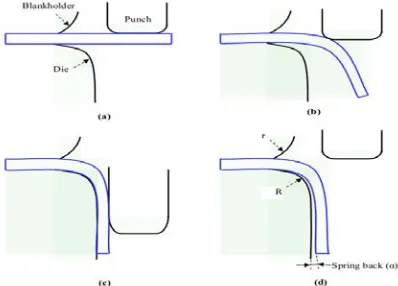
[image:3.612.94.293.564.707.2]The wipe-bending process plays a major role in sheet metal forming industry [29]. In the bending process, after release of the load by withdrawal of the punch, the metal tries to return to its original shape because of the elastic stresses [30] [31] [32].Springback after proclamation is one of the problems of such bending process [19] [20]. Springback refers to the elastic recovery of deformed parts. Springback occurs because of the elastic relief from the bending moment imparted to the sheet metal during forming. The sheet metal bending is a composite elasto-plastic deformation process involving small to moderate deformation and large rotation [21].
Figure 1: Springback Effect Of Wipe Bending In Sheet Metal Forming Process
In the past two decades, several mathematical models have been proposed to describe and predict springback for meek geometry. None of these have found wide acceptance, although some common characteristics are prominent [17]. For pure bending, springback has been reported to be approximately proportional to the bend ratio, the yield stress and contrariwise proportional to the elastic modulus [18]. The accuracy of the spring back prediction depends on the accuracy of constitutive equation and their equivalent material parameters [22]. It is also sensitive to range of materials and process parameters such as strain acclimatization evaluation of elastic properties elastic and plastic anisotropy and the presence of Bauschinger effect [23] [24]. On the other hand, curl occurs when the walls of a part away from the locally bent region, which ideally should remain straight, become curved [25] [26]. It is a complex corporal phenomenon which is mainly oversaw by the stress state obtained at the end of a deformation. Depending on the product geometry and deformation regime, there are several types of springback in sheet metal forming: bending, membrane, twisting and combined bending and membrane [27] [28].A general illustration of springback effect in a wipe bending process is depicted in Figure 1.
4. PROPOSED SPRINGBACKPREDICTION IN WIPE BENDING PROCESS
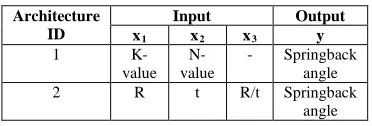
ANN is a generalized mathematical model of human brain structure and neural biology. Here, the neurons and its associated weights are modelled to ANN structure, which can be two layered (with input and output layers) or multi-layered (with input, output and hidden layers). In our method, we exploit multi-layered feed forward neural network for developing the prediction model for springback in wipe-bending process of sheet metal. The architectural view of the ANN model is given in Figure 2.
(b)
Figure 2: Proposed ANN Architecture For Springback Angle Prediction
Table I: Input And Output Parameters Of The Proposed ANN Architecture For Prediction Of Sprinback Angle In
Wipe Bending Process
Architecture ID
Input Output x1 x2 x3 y
1
K-value N-value
- Springback angle 2 R t R/t Springback
angle
In Figure 2, two architectures are presented in which the first architecture takes two inputs (
K
-value andn
-value) and the second takes three inputs (R
,t
andR
/
t
) that are mentioned in Table I. This represents that the first ANN architecture is for prediction of FE simulation data given in TableII [13]. Both the architecture has NH number of
hidden neurons and an output neuron.
4.1. Derived Prediction Model
It is well known that the ANN is a mathematical model, which is comprised of a function of the input variables and the operation of input, hidden
and output layers. Letxi :1≤i≤ N be the
generalized input variables and
y
be output of the model to be derived. The generalized model output can be) ,
( hy
y hw
f
Y = (1)
) ,
( ih
h xw
f
H = (2) where, fy(⋅): (y=1) is the output layer output,
which is the model output and fh(⋅):1≤h≤NHis the hidden layer output that are given in Eq. (1) and
(2), respectively,
w
ih andw
hy are the weights ofedges of input-hidden layer and edges of hidden-output layer, respectively.
− + =
∑
= N i ih i h h w x w x f 1 exp 1 1 ) ,( (3)
) , ( ) , ( 1 h N h h hy y
y h w w f xw
f
∑
H=
= (4)
5. ERROR MINIMIZATION USING GA
The previous Section describes the architecture and the mathematical model of ANN. In the model, it is essential to optimize the weights in such a way that the error between the model output and the actual output sought to be extreme minimum. Traditionally, Back propagation algorithm has been used in the literature in which the weights are optimized by propagating in the backwards direction. As the weights optimization is gradual in this method, achieving the objective of minimizing the error consumes more time and hence the computational complexity become more. Moreover, literature has asserted that back propagation algorithm can easily stick in local optima and hence the error minimization process gets saturated without accomplishing sought figure. Hence, our method exploits GA to minimize the error. The GA process optimizes all the weights at every instant of operation based on the obtained error, instead of gradual operation (propagating in backward direction in BP algorithm). The steps that covered in the GA-based error minimization is as follows
Step 1: Generate a population pool with the following attributes 1 0 , 1 0
: ≤ ≤ − ≤ ≤ w−
pq p Np q N
x
such that,
) (
)
(N N N Ny
Nw = × H + H × (5)
where,
Np
→
population
pool
size
Step 2: Determine fitness as follows
2 ) ( 2 / 1 1 T p y y f −
= (6)
Step 3: Select the
N
p/
2best chromosomes which have maximum fitnessStep 4: Perform single point crossover at a
crossover rate of Cr and hence obtain
2
/ p N
[image:4.612.102.288.330.393.2]r
wC
N
genes are exchanged between the corresponding parents.
Step 5: Perform random mutation operation to
obtain new Np/2offspring
new
x
at a mutationrate of Mr. In random mutation, the genes in arbitrary mutation points are replaced by randomly generated numbers within the limits.
Step 6: Replace the population pool chromosomes
by the Np/2selected chromosomes and new
2
/ p N
offspring chromosomes
Step 7: Repeat the process until the termination criterionis met. Once the termination criterion is met, terminate the process and select the best of the chromosomes in the population pool.
The best optimized weights are determined from the aforesaid process and updated in the ANN model further evaluation phase.
5.1. Evaluation phase
In the evaluation phase of the method, the
unknownR,
t
andR/t, and K-values and n-values is given to the learned ANN model. As the ANN model is already trained because of a huge training samples and the error gets minimized between the actual springback angle and the model springback angle. The ANN model is made correlated with the training data by updating the weights obtained at the end of every iterative process. At the end of the complete GA process, updating the optimal weights leads the ANN model to cope up closely with the training data with minimum error rate. This in turn, theoretically asserts that such trained ANN model is able to determine or estimate the output of any unknown data provided the data has to be in correlation with the training data.6. SIMULATION RESULTS
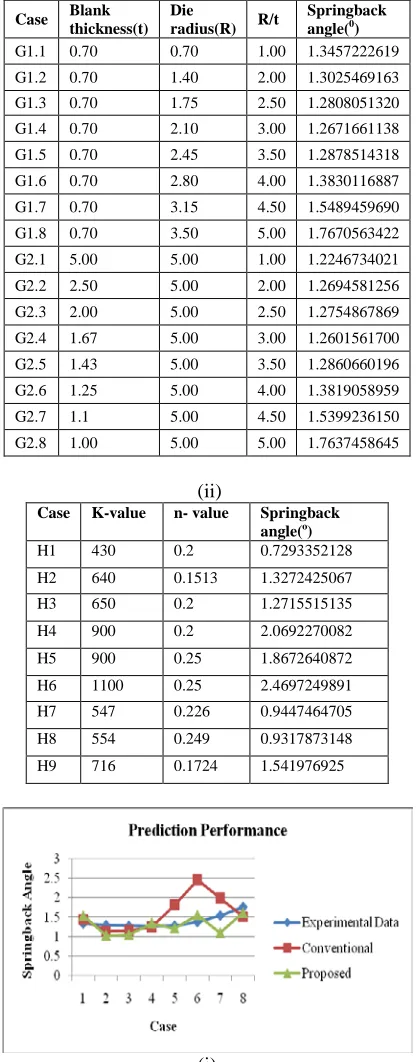
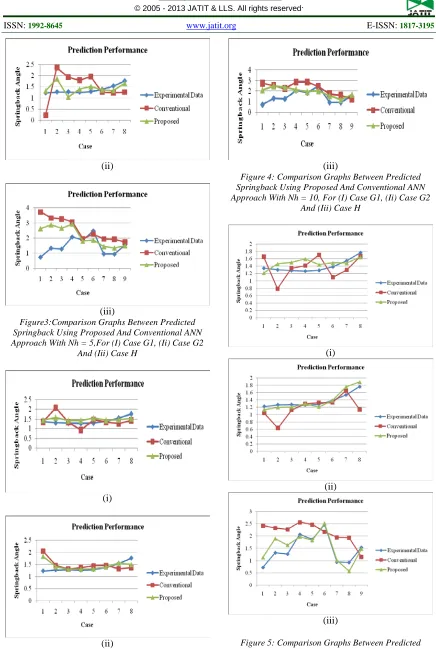
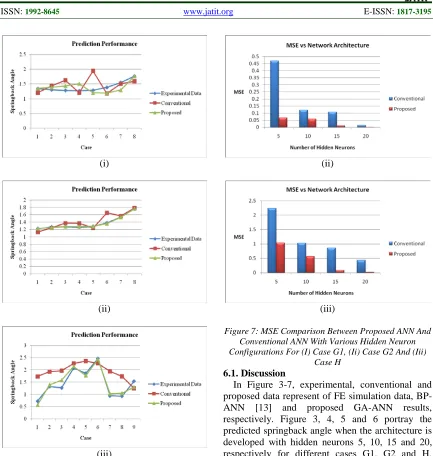
The proposed ANN approach for prediction of springback in wipe-bending process is implemented in MATLAB (version 7.12) and the performance is evaluated for the FE simulation data given in Table II.K-fold cross validation method is used for reliable experimentation of the method performance. An extensive analysis is made on the impact of number of hidden neurons on the training performance. The experimental results are illustrated in Figure 3-7 in comparison with the
[image:5.612.314.522.186.717.2]conventional BP-ANN model [13] and the FEM data [13].
Table II: Springback Values Determined With FE Simulation With Various (I) Blank Thickness And Die
Radius, And (Ii) K-Value And N-Value
(i)
Case Blank thickness(t)
Die
radius(R) R/t
Springback angle(0)
G1.1 0.70 0.70 1.00 1.3457222619 G1.2 0.70 1.40 2.00 1.3025469163 G1.3 0.70 1.75 2.50 1.2808051320 G1.4 0.70 2.10 3.00 1.2671661138 G1.5 0.70 2.45 3.50 1.2878514318 G1.6 0.70 2.80 4.00 1.3830116887 G1.7 0.70 3.15 4.50 1.5489459690 G1.8 0.70 3.50 5.00 1.7670563422 G2.1 5.00 5.00 1.00 1.2246734021 G2.2 2.50 5.00 2.00 1.2694581256 G2.3 2.00 5.00 2.50 1.2754867869 G2.4 1.67 5.00 3.00 1.2601561700 G2.5 1.43 5.00 3.50 1.2860660196 G2.6 1.25 5.00 4.00 1.3819058959 G2.7 1.1 5.00 4.50 1.5399236150 G2.8 1.00 5.00 5.00 1.7637458645
(ii)
Case K-value n- value Springback angle(o)
H1 430 0.2 0.7293352128
H2 640 0.1513 1.3272425067 H3 650 0.2 1.2715515135
H4 900 0.2 2.0692270082 H5 900 0.25 1.8672640872
H6 1100 0.25 2.4697249891 H7 547 0.226 0.9447464705
H8 554 0.249 0.9317873148 H9 716 0.1724 1.541976925
(ii)
(iii)
Figure3:Comparison Graphs Between Predicted Springback Using Proposed And Conventional ANN Approach With Nh = 5,For (I) Case G1, (Ii) Case G2
And (Iii) Case H
(i)
(ii)
(iii)
Figure 4: Comparison Graphs Between Predicted Springback Using Proposed And Conventional ANN Approach With Nh = 10, For (I) Case G1, (Ii) Case G2
And (Iii) Case H
(i)
(ii)
[image:6.612.87.523.56.705.2](iii)
Figure 5: Comparison Graphs Between Predicted Springback Using Proposed And Conventional ANN Approach With Nh = 5, For (I) Case G1, (Ii) Case G2
(i)
(ii)
(iii)
Figure 6: Comparison Graphs Between Predicted Springback Using Proposed And Conventional ANN Approach With Nh = 5, For (I) Case G1, (Ii) Case G2
And (Iii) Case H
(i)
(ii)
[image:7.612.90.523.70.526.2](iii)
Figure 7: MSE Comparison Between Proposed ANN And Conventional ANN With Various Hidden Neuron Configurations For (I) Case G1, (Ii) Case G2 And (Iii)
Case H
6.1. Discussion
case 5 and 9 of Figure 3 (iii), case 3, 6 and 8 of Figure 4 (i), etc., however in an overview the proposed ANN approach more closely copes up with FE data when compared to the conventional ANN approach. This can be observed from Figure 7 using the illustration of Mean Squared Error (MSE). MSE of conventional approach represent the deviation between the predicted data using conventional ANN approach and the FE data. Similarly, MSE of the proposed approach represent the mean squared deviation between the predicted data using the proposed ANN approach and the FE data. It can be seen from Figure 7 that MSEs of proposed ANN approach are considerably lesser that the MSEs of conventional ANN approach. Moreover, the graphical illustrations show that increasing the number of hidden neurons leads to reduce the MSE, which in turn can be interpreted that the prediction is more likely to be precise while comparing with the FE simulation data.
7. CONCLUSION
This paper proposed an effective ANN approach to predict the springback angle of wipe bending in sheet metal forming process. The proposed approach exploited two ANN architectures, one with K-value and n-value as inputs (for case H) and the other with R, t and R/t as inputs (for case G). The architectural views were used for deriving the prediction model and prediction error was minimized by optimizing the weights using GA. The intention of using GA is to overcome the problems in conventional BP algorithm in such a way that the error was reduced to the minima compared to the conventional BP algorithm. Cross validation is conducted for the three different cases and the MSE if determined to determine the precision of the prediction. The validations results have showed that the proposed ANN approach outperformed the conventional ANN approach at remarkable. This in turn directs that the proposed ANN approach is more suitable for predicting the springback angle of wipe bending process.
REFERENCES
[1] Guangyong Sun, Guangyao Li, Shiwei Zhou, Wei Xu, Xujing Yang and Qing Li, “Multi-fidelity optimization for sheet metal forming process”, Structural and Multidisciplinary
Optimization Journal, Vol. 44, No.1,
pp.111-124, 2011.
[2] Kakandikar G.M., Darade P.D. and Nandedkar V.M., “Applications of evolutionary algorithms to sheet metal forming processes: A review”,
International Journal of Machine Intelligence,
Vol. 1, No.2, pp. 47-49, 2009.
[3] AmitGoel, “Blank optimization in sheet metal forming using finite element simulation” Technical report on mechanical engineering,
Texas A&M International University, 2004.
[4] Hakim S. Sultan Aljibori and Abdel MagidHamouda, “Finite Element Analysis of Sheet Metal Forming Process”, European
Journal of Scientific Research, Vol.33, No.1,
pp.57-69, 2009.
[5] Thaweepat Buranathiti , Jian Cao, Z. Cedric Xia and Wei Chen, “Probabilistic Design in a Sheet Metal Stamping Process under Failure Analysis”, Proceedings of the 6th International Conference and Workshop on Numerical Simulation of 3D Sheet Metal Forming Process,
AIP Conference Proceedings, Vol. 778, pp.
867-872, 2005.
[6] Y. Park and J. S. Colton, “Sheet Metal Forming Using Polymer Composite Rapid Prototype Tooling”, ASME Journal of Engineering
Materials and Technology, Vol. 125, pp.
247-255, 2003.
[7]Wang Hao and Stephen Duncan, “Optimization of Tool Trajectory for Incremental Sheet Forming Using Closed Loop Control”,2011
IEEE International Conference onAutomation
Science and Engineering,Trieste, Italy - August
24-27, 2011.
[8] Winn WahWah Aye and Li Xiao Xing, “Optimization of Forming Process for Transiting Part of Combustion Chamber”, 2010
International Conference on Mechanical and Electrical Technology (ICMET 2010).
[9] Qihan Li, Mingzhe Li and Qihan Li, Ye Tian, “Optimization Technology of Sheet Metal Deep Drawing with Variable Blank Holder Force”, 2010 International Conference on Computer, Mechatronics, Control and Electronic Engineering (CMCE).
[10] YanminXie, Shiren Yin and zhengzhiLuo, “Robust Optimization for Deep-Drawing Process of Sheet Metal Based on CAE with Grey Relational Analysis Method”, Fifth International Conference on Fuzzy Systems and
Knowledge Discovery, Vol.4, pp. 345-349,
[11] Juhua Huang, JinjunRao and Xuefeng Li, “Study on process parameters optimization of sheet metal forming based on PFEA/ANN/GA”,
Journal of material science and technology,
Vol.19, No.1, 2003.
[12] Volk, M. Nardin, B and Dolsak, B., “Application of Numerical Simulations in the Deep-Drawing Process and the Holding System with Segments’ Inserts”, Journal of Mechanical
Engineering, Vol. 57, No. 9, pp. 697-703, 2011.
[13] Recep Kazan, Mehmet Fırat and AysunEgrisogutTiryaki, “Prediction of springback in wipe-bending process of sheet metal using neural network”,Journal of
Materials and Design, Vol.30, No.2, pp.418–
423, 2009.
[14] Mehmet Firat , OsmanH.Mete, UmitKocabicak and Murat Ozsoy, “Stamping process design using FEA in conjunction with orthogonal regression”, Journal of Finite Elements in
Analysis and Design, Vol. 46, No.11, pp.
992-1000, 2010.
[15] S. V. Mohammadi, M. H. Parsa and A. JalaliAghchai, “Effect of the thickness distribution and setting condition on springback in multi-layer sheet bending”, International Journal of Engineering, Science and
Technology, Vol. 3, No. 4, pp. 225-235, 2011.
[16] Odetunji A. Odejobi and Lasisi E. Umoru, “Applications of soft computing techniques in materials engineering: A review”, African Journal of Mathematics and Computer Science
Research, Vol. 2, No.7, pp. 104-131, 2009.
[17] LuminGeng, R.H. Wagoner, “Role of plastic anisotropy and its evolution on springback”,
International Journal of Mechanical Sciences,
Vol. 44, No. 1, pp. 123–148, 2002.
[18] K.K. Pathak, Sanjay Panthi, N. Ramakrishnan “Application of Neural Network in Sheet Metal Bending Process”, Defence Science Journal, Vol. 55, No. 2, pp. 125-131, April 2005.
[19] Mohammad Ali Farsi and BehroozArezoo, “The Determination of Spring-Back In L Bending Operation Using Neural Networks”, In
preceding of 5th International Advanced
Technologies Symposium, Karabuk, Turkey,
2009.
[20] M. Sasso, M. Callegari and D. Amodio, “Incremental forming: an integrated robotized cell for production and quality control”,
Meccanica, Vol. 43, No. 2, pp. 153-163, April
2008.
[21] BadisHaddag, Tudor Balan, and Farid Abed-Meraim, “Investigation of advanced strain-path dependent material models for sheet metal forming simulations”, International Journal of
Plasticity, Vol. 23, No. 6, pp. 951–979, 2007.
[22] S. Bouvier, J.L. Alves, M.C. Oliveira, L.F. Menezes, “Modelling of anisotropic work-hardening behaviour of metallic materials subjected to strain-path changes”,
Computational Materials Science, Vol. 32, No.
3-4, pp. 301–315, 2005.
[23] K.P. Li, W.P. Carden, R.H. Wagoner, “Simulation of springback”, International
Journal of Mechanical Sciences, Vol. 44, No. 1,
pp. 103–122, 2002.
[24] M.C. Oliveira, J.L. Alves, B.M. Chaparro, L.F. Menezes, “Study on the influence of work-hardening modeling in springback prediction”,
International Journal of Plasticity, Vol. 23, No.
3, pp. 516–543, 2007.
[25] BadisHaddag, Tudor Balan and Farid Abed-Meraim, “Investigation of advanced strain-path dependent material models for sheet metal forming simulations”, International Journal of
Plasticity, Vol. 23, No. 6, pp. 951–979, 2007.
[26] “Deformation analysis of springback in
L-bending of sheet metal”, journal of
Achievements in Materials and Manufacturing
Engineering, Vol. 18, No.1-2, pp. 339-342,
2006.
[27] Marko Vrh, MiroslavHalilovic, Martin Misic and Boris Stok “Strain path dependent stiffness degradation of a loaded sheet”, International
Journal of Material Forming, Vol. 1, No. 1, pp.
297-300, April 2008.
[28] H K Yi, D W Kim, C J Van Tyne, And Y H Moon, “Analytical prediction of springback based on residual differential strain during sheet metal bending”, In Proceedings of the Institution of Mechanical Engineers, Part C:
Journal of Mechanical Engineering Science,
Vol. 222, No. 2, pp. 117-129, 2008.
[29] De-hua HE, Dong-sheng LI, Xiao-qiang LI and Chao-hai JIN, “Optimization on springback reduction in cold stretch forming of titanium-alloy aircraft skin”, Transactions of Nonferrous
Metals Society of China, Vol. 20, No. 12, pp.
2350–2357, 2010.
[31] YuanxinLuo and Kai He, Ruxu Du, “A new sheet metal forming system based on incremental punching, part 2: machine building and experiment results”, The International Journal of Advanced Manufacturing
Technology, Vol. 51, No. 5-8, pp. 493-506,
November 2010.
[32] S.K. Panthi and N. Ramakrishnan “Semi analytical modeling of springback in arc bending and effect of forming load”,
Transactions of Nonferrous Metals Society of
China, Vol. 21, No. 10, pp. 2276–2284, October