http://dx.doi.org/10.4236/am.2014.53033
The Differential Quadrature Solution of
Reaction-Diffusion Equation Using Explicit and Implicit
Numerical Schemes
Mohamed Salah, R. M. Amer, M. S. Matbuly
Department of Engineering Mathematics and Physics, Faculty of Engineering, Zagazig University, Zagazig, Egypt Email: [email protected]
Received November 2, 2013; revised December 2, 2013; accepted December 9,2013
Copyright © 2014 Mohamed Salah et al. This is an open access article distributed under the Creative Commons Attribution License, which permits unrestricted use, distribution, and reproduction in any medium, provided the original work is properly cited. In accor-dance of the Creative Commons Attribution License all Copyrights © 2014 are reserved for SCIRP and the owner of the intellectual property Mohamed Salah et al. All Copyright © 2014 are guarded by law and by SCIRP as a guardian.
ABSTRACT
In this paper, two different numerical schemes, namely the Runge-Kutta fourth order method and the implicit Euler method with perturbation method of the second degree, are applied to solve the nonlinear thermal wave in one and two dimensions using the differential quadrature method. The aim of this paper is to make comparison between previous numerical schemes and detect which is more efficient and more accurate by comparing the obtained results with the available analytical ones and computing the computational time.
KEYWORDS
Reaction-Diffusion; Implicit Euler; Runge-Kutta; Differential Quadrature; Perturbation
1. Introduction
Thermal wave is reaction-diffusion equation that plays an ever-increasing role in the study of material parame-ters. It has been employed in optical investigations of solids, liquids and gases with photo-acoustic and thermal lens spectroscopy. Thermal waves have also been used to analyze the thermal and thermodynamic properties of materials and image thermal and material features within a solid sample [1].
solution using very small step size due to the limitation of stability condition that leads to more computational cost and lower efficiency. Therefore, Meral applied differential quadrature method and implicit Euler method with Newton method to solve one dimensional density dependent nonlinear reaction-diffusion equation [15]. Meral obtained stable solutions, and larger time steps could be used.
In this research, the thermal wave propagation model is solved by using two numerical methods to make comparison between them. In the first method, we used the hybrid technique method of Runge-Kutta fourth or-der method (RK4) and differential quadrature method (DQM). In the second method, we used the combined al-gorithm of DQM, Perturbation method of second degree and implicit Euler method. Perturbation method is used to avoid the nonlinear term. The obtained results are compared with the previous analytical ones to complete the comparison between previous different numerical schemes.
2. Numerical Procedure of Thermal Wave
Propagation of thermal waves through a rectangular plate, is governed by [14]:
(
)
( ) ( ) ( )
2 2
2 max
2 2 , 0, 0, 0 , ,
U U U
U U U t x y a b
t α x β y γ
∂ = ∂ + ∂ + − > < <
∂ ∂ ∂ (1)
where: U is a temperature,
α and β are diffusion parameters in direction of x and y, respectively, γ is reaction parameter,
a and b are plate dimensions in direction of x and y, respectively, Umax is a maximum temperature of the system.
Along the external boundaries, the temperatures can be described as:
(
)
(
)
( )
1 , , 1 1 ,
0, , U
a U o y t b f y t
y t x ∂
+ =
∂ (2-a)
(
)
(
)
( )
2 , , 2 2 ,
, , U
a U a y t b f y t
a y t x ∂
+ =
∂ (2-b)
(
)
(
)
( )
3 , 0, 3 3 ,
, 0, U
a U x t b f x t
x t y ∂
+ =
∂ (2-c)
(
)
(
)
( )
4 , , 4 4 ,
, , U
a U x b t b f x t
x b t y ∂
+ =
∂ (2-d)
where a bi, i and ,fi
(
i=1, 4 ,)
are known functions. Then initial temperature may be described as:(
, , 0)
(
,)
U x y =g x y (3)
where g x y
(
,)
is a known function.2.1. Numerical Procedure Using First Method (RK4)
The main strategy is to employ DQM to reduce the problem to a system of ordinary differential equations then to apply RK4 to solve the reduced system as follows:
1) Discretize the spatial domain using Chebyshev-Gauss-Lobatto grid points [12], such as:
(
1)
π1 cos , 1, 2, ,
2 1
i
i a
x i N
N −
= − =
−
(4-a)
(
1)
π1 cos , 1, 2, ,
2 1
j
j b
y j M
M −
= − =
−
2) Apply the method of differential quadrature in terms of nodal temperature, such that:
(
)
1(
)
, ,
, ,
N x
ik k j k
i j
U
A U x y t x y t
x =
∂ =
∂
∑
(5-a)(
)
1(
)
, ,
, ,
M y jl i l l
i j
U
A U x y t x y t
y =
∂ =
∂
∑
(5-b)(
)
(
)
2 2 1 , , , , N xik k j k
i j
U
B U x y t x y t
x =
∂
=
∂
∑
(5-c)(
)
(
)
2 2 1 , , , , M y jl i l li j
U
B U x y t x y t
y =
∂
=
∂
∑
(5-d)where Aijp and p ij
B ,
(
p=x y,)
are the first and second order weighting coefficients with respect to p [12]. 3) On sustainable substitution from Equations (5) into (1), one can reduce the problem to the following system of ordinary differential equations as:(
)
(
1 1) (
2 1)
(
)
d
, , , , , , , , , ,
, ,
d i j ij N M
U
q U x y t U x y t U x y t
x y t
t =
or simply
(
)
(
11 21)
d
, , , , , 1, and 1, .
, ,
d i j ij NM
U
q U U U t i N j M
x y t
t = = = (6)
where
(
)
(
)
(
)
20 2
1 1
, , , , ,
1, and 1, .
N M
x y
ij ik k j jl i l ij ij
k l
q B U x y t B U x y t U U U
i N j M
γ α β δ = = = + + − = =
∑
∑
(7)4) Update the temperature using RK4 such that [16]
(
0) (
0)
1 2 3 41
, , , , 2 2 ,
6
ij ij ij ij
i j i j
U x y t + ∆ =t U x y t + H + H + H +H (8) where
(
)
1 11, 21, , , 0
ij
ij NM
H = ∆tq U U U t , (9-a)
11 21
1 1 1
2 11 , 21 , , , 0
2 2 2 2
NM ij
ij NM
H H H t
H = ∆tq U + U + U + t +∆
(9-b)
11 21
2 2 2
3 11 , 21 , , ,0
2 2 2 2
NM ij
ij NM
H H H t
H = ∆tq U + U + U + t +∆
(9-c)
(
11 21)
4 11 3 , 21 3 , , 3 ,0
ij NM
ij NM
H = ∆tq U +H U +H U +H t + ∆t , (9-d) where ∆ = − = − =t t1 t0 t2 t1 = −tP tP−1
2.2. Numerical Procedure Using Second Method (Implicit Euler)
trans-form the previous system to a system of linear algebraic equations as follows: 1) We can solve
(
)
2 2
2 max
2 2 ,
U U U
U U U
t α x β y εγ
∂ = ∂ + ∂ + −
∂ ∂ ∂ (10)
subjected to the prescribed to boundary and initial conditions in Equations (2) and (3), assuming 2
1 2
n
o n
U=U +εU +ε U +ε U (11) where U U U0, 1, 2 are unknowns functions and ε is a perturbation parameter.
The following condition is tested to ensure the convergence condition [19] in previous series in Equation (11).
1
1 where 0,1, , 1 i
i U
i n
U
+ < = −
(12)
2) On sustainable substitution from Equation (11) into (10), one can reduce the problem to the following equ-ation.
(
)
(
)
(
)
(
)
(
)
(
)
2 2
2 2 2
1 2 2 1 2 2 1 2
2
2 2
max 1 2 1 2 ,
o o o
o o
U U U U U U U U U
t x y
U U U U U U U
ε ε α ε ε β ε ε
εγ ε ε ε ε
∂ + + = ∂ + + + ∂ + +
∂ ∂ ∂
+ − + + + +
(13)
3) Applying zero order perturbation method such that,
2 2
0 0 0
2 2
U U U
t α x β y
∂ ∂ ∂
= +
∂ ∂ ∂ (14)
Subjected to boundary and initial conditions in Equations (2) and (3), where differential quadrature method and implicit method are used to reduce Equation (14) to a system of linear algebraic equations such that,
By substitution of Equation (5) into (14) result that,
(
)
1(
)
1(
)
d , , , , , , d N M x y o
ik o k j l jk o i k l
k k
i j
U
B U x y t B U x y t
x y t
t α = β =
=
∑
+∑
(15)(
)
(
11 21)
0
0 0 0
d
, , , , , 1, and 1, .
, ,
d i j ij NM
U
q U U U t i N j M
x y t
t = = = (16)
(
)
(
)
(
11 21)
0 i, j, 0 0 i, j,0 ij 0 , 0 , , 0NM, 0 ,
U x y t + ∆ =t U x y t + ∆ ×t q U U U t + ∆t (17)
4) First order perturbation method is applied such that,
(
)
2 2
2
1 1 1
max
2 2 o o
U U U
U U U
t α x β y γ
∂ = ∂ + ∂ + −
∂ ∂ ∂ (18)
Subjected to the same boundary and initial conditions in Equations (2) and (3), reduced to the following alge-braic system in equations
(
)
(
)
(
)
(
)
21
1 1 max , , , ,
1 1 d , , , , , , d N M x y
ik k j l jk i k l oi j l oi j l
k k
i j
U
B U x y t B U x y t U U U
x y t
t α = β = γ
=
∑
+∑
+ − (20)(
)
(
)
(
11 21)
1 i, j,0 1 i, j, 0 ij 1 , 1 , , 1NM, 0 ,
U x y t + ∆ =t U x y t + ∆ ×t q U U U t + ∆t (21)
(
)
2 2
2
1 1 1
max 0 1 0 1
2 2 2 3
U U U
U U U U U
t α x β y γ
∂ = ∂ + ∂ + −
∂ ∂ ∂ (22)
Subjected to the same boundary and initial conditions in Equations (2) and (3), reduced to the following alge-braic system
(
)
(
)
(
)
(
2)
2
1 1 max 0 , , 1 , , 0 , , 1 , ,
1 1
d
, , , , 2 3
, ,
d
N M
x y
ik k j l jk i k l i j l i j l i j l i j l
k k
i j
U
B U x y t B U x y t U U U U U
x y t
t α = β = γ
=
∑
+∑
+ − (23)(
)
(
)
(
11 21)
2 i, j, 0 2 i, j, 0 ij 2 , 2 , , 2NM, 0 ,
U x y t + ∆ =t U x y t + ∆ ×t q U U U t + ∆t (24)
Finally, the series solution can be written as
numerical 1 2
1
lim o
U U U U U
ε →
= = + + (25)
We carry on previous procedure until the specified time is reached.
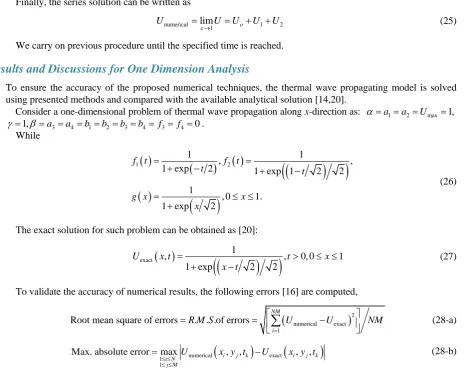
3. Results and Discussions for One Dimension Analysis
To ensure the accuracy of the proposed numerical techniques, the thermal wave propagating model is solved using presented methods and compared with the available analytical solution [14,20].
Consider a one-dimensional problem of thermal wave propagation along x-direction as: α = =a1 a2 =Umax =1,
3 4 1 2 3 4 3 4
1, a a b b b b f f 0
γ = β= = = = = = = = = .
While
( )
(
) ( )
(
)
(
)
( )
(
)
1 2
1 1
, ,
1 exp 2 1 exp 1 2 2
1
, 0 1.
1 exp 2
f t f t
t t
g x x
x
= =
+ − + −
= ≤ ≤
+
(26)
The exact solution for such problem can be obtained as [20]:
( )
(
)
(
)
exact
1
, , 0, 0 1
1 exp 2 2
U x t t x
x t
= > ≤ ≤
+ − (27)
To validate the accuracy of numerical results, the following errors [16] are computed,
(
)
2numerical exact 1
Root mean square of errors . . .of errors NM
i
R M S U U NM
=
= = −
∑
(28-a)(
)
(
)
numerical exact 1
1
Max. absolute error max i, j, k i, j, k
i N j M
U x y t U x y t
≤ ≤ ≤ ≤
= − (28-b)
3.1. Numerical Results of First Method (RK4)
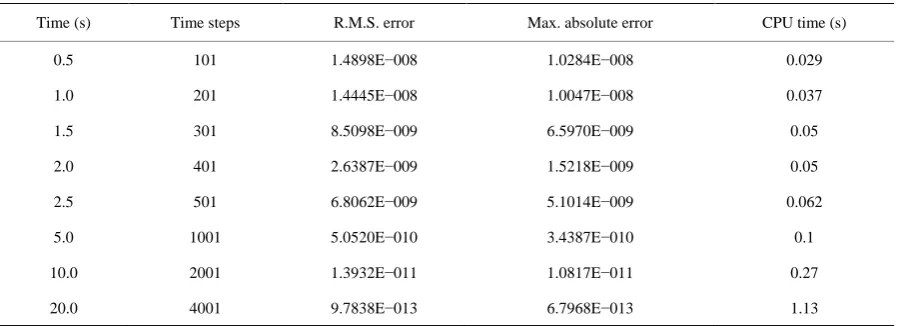
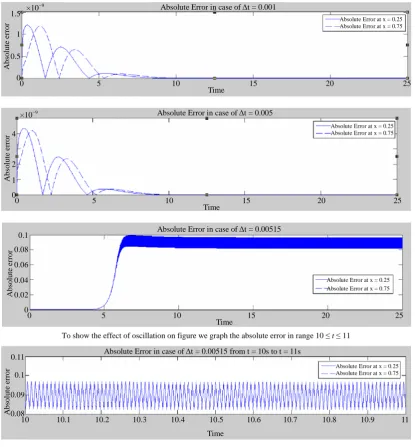
For the numerical computation, the time domain is limited to 0≤ ≤t 20 and N = 7. The efficiency of presented techniques is tested by CPU time required when the computation reaches to t = 20 s. Two time step sizes of 0.001 and 0.005 are used for layer marching in the time direction. The numerical results of these two cases are listed respectively in Tables 1 and 2. From these two tables, it can be seen that RK4 method can achieve high accuracy at very small step size at Δt = 0.001 with R M S. . . of errors< ×4 10 , Max. absolute error−9 < ×3 10−9 and at Δt = 0.005 with R M S. . . of errors<1.4 10 , Max. absolute error× −8 <1.0 10× −8
[image:5.595.81.547.226.606.2]Table 1. R.M.S., absolute errors, time steps and CPU times given by 4-stage Runge-Kutta at Δt = 0.001.
Time (s) Time steps R.M.S. error Max. absolute error CPU time (s)
0.5 501 4.8171E−009 3.4276E−009 0.06
1.0 1001 4.6699E−009 3.3448E−09 0.1
1.5 1501 2.7909E−009 2.1988E−009 0.17
2.0 2001 9.8607E−010 5.5920E−010 0.27
2.5 2501 2.2172E−009 1.7006E−009 0.42
5.0 5001 1.8723E−010 1.1556E−010 2
10.0 10001 4.9678E−012 3.5828E−012 11.2
20.0 20001 3.1625E−013 2.2571E−013 77.6
Table 2. R.M.S., absolute errors, time steps and CPU times given by 4-stage Runge-Kutta at Δt = 0.005.
Time (s) Time steps R.M.S. error Max. absolute error CPU time (s)
0.5 101 1.4898E−008 1.0284E−008 0.029
1.0 201 1.4445E−008 1.0047E−008 0.037
1.5 301 8.5098E−009 6.5970E−009 0.05
2.0 401 2.6387E−009 1.5218E−009 0.05
2.5 501 6.8062E−009 5.1014E−009 0.062
5.0 1001 5.0520E−010 3.4387E−010 0.1
10.0 2001 1.3932E−011 1.0817E−011 0.27
20.0 4001 9.7838E−013 6.7968E−013 1.13
3.2. Numerical Results of Second Method (Implicit Euler)
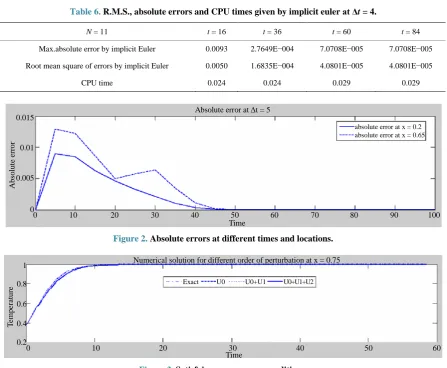
In the obtained results the advantage of using an implicit scheme has been observed. Stability problems are not encountered due to the use of implicit time integration step and larger time increments can be used, e.g. for t = 30, ∆ =t 3.0 can be taken.Table 3shows the maximum absolute errors and root mean square of errors for a fixed time (t = 30.0) for various numbers of grid points. The accuracies by using N = 8, 11 are almost the same and there is a drop for N = 15. From the table, DQM is observed to give very good accuracy with a small num-ber of grid points. For N = 15, the drop of accuracy is due to the ill-conditioned Vandermonde-system obtained after the DQM discretization, which is the known nature of DQM for large N [15]. Tables 4-6 give the compar-ison of the DQM solution with the exact solution in terms of maximum absolute error and root mean square of errors for small time levels and for the times tending to steady-state, respectively. The computations are carried out with N = 11 and it is seen to be enough to obtain the solution with five digits accuracy at steady-state. Moreover, Figure 2 shows the absolute error at different times and locations. Also convergence condition in Equation (12) is tested achieving higher accuracy at second order perturbation method as shown in Figure 3.
4. Results and Discussions for Two Dimensions Analysis
Consider also a simple two dimensional problem with
1 2 3 4 1,
a a a a
α β= = = = = =
1 2 3 4 1 2 3 4 0
b b b b f f f f
γ = = = = = = = = = ,
[image:6.595.88.537.294.457.2]A
b
sol
u
te
e
rro
r
10 20 25
Time 0
Absolute Error in case of Δt = 0.001
0 0.5
1 1.5
Absolute Error at x = 0.25 Absolute Error at x = 0.75
15 5
×10−9
A
b
sol
u
te
e
rro
r
10 20 25
Time 0
Absolute Error in case of Δt = 0.005
0 4
Absolute Error at x = 0.25 Absolute Error at x = 0.75
15 5
×10−9
1 2
A
b
sol
u
te
e
rro
r
10 20 25
Time 0
Absolute Error in case of Δt = 0.00515
0
Absolute Error at x = 0.25 Absolute Error at x = 0.75
15 5
0.02 0.04 0.06 0.08 0.1
To show the effect of oscillation on figure we graph the absolute error in range 10 ≤ t ≤ 11
A
b
sol
u
te
e
rro
r
10
Time
Absolute Error in case of Δt = 0.00515 from t = 10s to t = 11s
0.08
Absolute Error at x = 0.25 Absolute Error at x = 0.75
0.09 0.1 0.11
[image:7.595.106.522.83.531.2]10.1 10.2 10.3 10.4 10.5 10.6 10.7 10.8 10.9 11
[image:7.595.85.538.600.734.2]Figure 1. Absolute errors at different times and locations.
Table 3. R.M.S., absolute errors and CPU times given by implicit euler at Δt = 3.
t = 30.0 N = 5 N = 8 N = 11 N = 15
Max.absolute error by implicit Euler 0.0025 6.9707E−004 2.4820E−004 0.0045
Root mean square of errors by implicit Euler 0.0015 4.0116E−004 1.3981E−004 0.0023
[image:7.595.89.537.666.737.2]CPU time 0.018 0.018 0.02 0.042
Table 4. R.M.S., absolute errors and CPU times given by implicit euler at Δt = t.
N = 11 t = 0.01 t = 0.1 t = 0.5 t = 1.0
Max. absolute error by implicit Euler 0.1320 0.0654 0.0129 1.0898E−004
Root mean square of errors by implicit Euler 0.0871 0.0391 0.0076 5.6590E−005
Table 5. R.M.S., absolute errors and CPU times given implicit euler at Δt = 2.
N = 11 t = 6.0 t = 12 t = 22 t = 34
Max.absolute error by implicit Euler 0.0220 0.0176 0.0012 0.0012
Root mean square of errors by implicit Euler 0.0134 0.0089 6.8117E−004 6.8188E−004
[image:8.595.89.537.176.544.2]CPU time 0.021 0.017 0.024 0.038
Table 6. R.M.S., absolute errors and CPU times given by implicit euler at Δt = 4.
N = 11 t = 16 t = 36 t = 60 t = 84
Max.absolute error by implicit Euler 0.0093 2.7649E−004 7.0708E−005 7.0708E−005
Root mean square of errors by implicit Euler 0.0050 1.6835E−004 4.0801E−005 4.0801E−005
CPU time 0.024 0.024 0.029 0.029
A
b
sol
u
te
e
rro
r
10 20 30 40 50 60
Time 0
Absolute error at Δt = 5
0 70 80 90 100
0.005 0.01 0.015
absolute error at x = 0.2 absolute error at x = 0.65
Figure 2. Absolute errors at different times and locations.
0
Numerical solution for different order of perturbation at x = 0.75
T
em
p
er
at
u
re
10 20 30 40 50 60
Time 0.2
0.4 0.6 0.8 1
Exact U0 U0+U1 U0+U1+U2
Figure 3. Satisfying convergence conditions.
(
,)
sinπ sin π ,0 , 1g x y = x y ≤x y≤
which can be solved exactly as [21]: U x y t
(
, ,)
=e−2π2tsinπ sin πx y. The design of the numerical scheme is ex-tended to two dimensions.Table 7 shows that for ∆ =t 0.01,N=5,M=4, the obtained results agree with the analytical ones [21] in both methods. Also Figure 4shows that absolute error for the hybrid method absolute error <0.01, and for im-plicit Euler, the absolute error 3
0.6 10× − .
5. Conclusion
Table 7. Root mean square of errors for two dimensional thermal wave propagation at Δt = 0.01, N = 5, M = 4.
TIME 0.01 0.04 0.08 0.16 0.4 1.00
Root mean square of errors by hybrid method 0.0027 0.0060 0.0054 0.0021 3.9994E-005 5.1513E-010
Root mean square of errors by implicit Euler 0.0369 0.0143 0.0025 0.0013 7.4271E-005 2.9596E-009
3.5 3
2 1.5
1 1 4
y x
0
Absolute error at t = 0.1s using hybrid method
A
b
sol
u
te
E
rr
o
r
2.5
1.5 2 2.5 3 3.5
4 4.5 5
0.005 0.01 0.015
5 4
3
2
1 1 2 3 4
5 6 7 8
9 6
y x
0 0.5 1
Absolute Error at t = 0.1 using Implict Euler ×10−3
A
b
sol
u
te
E
rr
o
r
Figure 4. Absolute error at t = 0.1 s and different locations of x, y.
to make comparison between two methods and detect which of them is better. The numerical results obtained in this paper ensure that the problems have small desired time to reach it. Thus they have very small step size which is preferred and use RK4 to solve the system of ordinary differential equations in order to decrease the computational time. On the other hand, the problems which have high desired time to reach it, thus have large incremental time (stiff problems) which are preferred and use implicit Euler with perturbation method to solve the system of ordinary differential equations.
REFERENCES
[1] J. Opsal, A. Rosencwaig and D. L. Willenborg, “Thermal-Wave Detection and Thin-Film Thickness Measurements with Laser Beam Deflection,” Applied Optics, Vol. 22, No. 20, 1983, pp. 3169-3176. http://dx.doi.org/10.1364/AO.22.003169
[2] Z. Y. Yan, “Generalized Method and Its Application in the Higher-Order Nonlinear Schrodinger Equation in Nonlinear Optical Fibres,” Chaos Solitons and Fractals, Vol. 16, No. 5, 2003, pp. 759-766. http://dx.doi.org/10.1016/S0960-0779(02)00435-6 [3] J. Mei, H. Zhang and D. Jiang, “New Exact Solutions for a Reaction-Diffusion Equation and a Quasi-Camassa Holm Equation,”
Applied Mathematics E-Notes, Vol. 4, 2004, pp. 85-91.
[4] E. S. Fahmy and H. A. Abdusalam, “Exact Solutions for Some Reaction Diffusion Systems with Nonlinear Reaction Poly-nomial Terms,” Applied Mathematical Sciences, Vol. 3, No. 11, 2009, pp. 533-540.
[5] M. S. H. Chowdhury and I. Hashim, “Analytical Solution for Cauchy Reaction-Diffusion Problems by Homotopy Perturbation Method,” Sains Malaysiana, Vol. 39, No. 3, 2010, pp. 495-504.
[6] S. Puri and K. Wiese, “Perturbative Linearization of Reaction-Diffusion Equations,” Journal of Physics A: Mathematical and General, Vol. 36, No. 8, 2003, pp. 2043-2054. http://dx.doi.org/10.1088/0305-4470/36/8/303
[8] R. G. Marcus, “Finite-Difference Schemes for Reaction-Diffusion Equations Modeling Predator-Prey Interactions in MATLAB,” Bulletin of Mathematical Biology, Vol. 69, No. 3, 2007, pp. 931-956. http://dx.doi.org/10.1007/s11538-006-9062-3
[9] B. Liu, M. B. Allen, H. Kojouharov, B. Chen, et al., “Finite-Element Solution of Reaction-Diffusion Equations with Advection,” Computational Mechanics, 1996, pp. 3-12.
[10] X. Christos and L. Oberbroeckling, “On the Finite Element Approximation of Systems of Reaction-Diffusion Equations by p/hp Methods,” Global Science, Vol. 28, No. 3, 2010, pp. 386-400.
[11] G. Meral and M. S. Tezer, “Solution of Nonlinear Reaction-Diffusion Equation by Using Dual Reciprocity Boundary Element Method with Finite Difference or Least Squares Method,” Advances in Boundary Element Techniques, Vol. 3, 2008, pp. 317- 322.
[12] C. Shu, “Differential Quadrature and Its Application in Engineering,” Springer Verlag, London, 2000. http://dx.doi.org/10.1007/978-1-4471-0407-0
[13] T. Y. Wu and G. R. Liu, “A Differential Quadrature as a Numerical Method to Solve Differential Equations,” Computational Mechanics, Vol. 24, No. 3, 1999, pp. 197-205. http://dx.doi.org/10.1007/s004660050452
[14] V. Kajal, “Numerical Solutions of Some Reaction-Diffusion Equations by Differential Quadrature Method,” International Journal of Applied Mathematics and Mechanics, Vol. 6, No. 14, 2010, pp. 68-80.
[15] G. Meral, “Solution of Density Dependent Nonlinear Reaction-Diffusion Equation Using Differential Quadrature Method,” World Academy of Science, Engineering and Technology, Vol. 41, 2010, pp. 1178-1183.
[16] W. Y. Yang, W. Cao, T. Chung, J. Morris, et al., “Applied Numerical Methods Using Matlab,” John Wiley & Sons, Hoboken, 2005. http://dx.doi.org/10.1002/0471705195
[17] J. S. Nadjafi and A. Ghorbani, “He’s Homotopy Perturbation Method: An Effective Tool for Solving Nonlinear Integral and Integro-Differential Equations,” Computers and Mathematics with Applications, Vol. 58, No. 11-12, 2009, pp. 2379-2390. http://dx.doi.org/10.1016/j.camwa.2009.03.032
[18] H. S. Prasad and Y. N. Reddy, “Numerical Solution of Singularly Perturbed Differential-Difference Equations with Small Shifts of Mixed Type by Differential Quadrature Method,” American Journal of Computational and Applied Mathematics, Vol. 2, No. 1, 2012, pp. 46-52. http://dx.doi.org/10.5923/j.ajcam.20120201.09
[19] J. P. Hambleton and S. W. Sloan, “A Perturbation Method for Optimization of Rigid Block Mechanisms in the Kinematic Me- thod of Limit Analysis,” Computers and Geotechnics, Vol. 48, 2013, pp. 260-271.
http://dx.doi.org/10.1016/j.compgeo.2012.07.012
[20] M. Bastani and D. K. Salkuyeh, “A Highly Accurate Method to Solve Fisher’s Equation,” Indian Academy of Sciences, Vol. 78, No. 3, 2012, pp. 335-346.