http://dx.doi.org/10.4236/ajps.2014.53033
Effect of Planting Methods on the Yield and Yield
Attributes of Short Duration Aman Rice
Md. Masud Rana1*, Md. Abdullah Al Mamun1, Afruz Zahan2, Md. Nayeem Ahmed3, Md. Abdul Jalil Mridha1
1
Agronomy Division, Bangladesh Rice Research Institute, Gazipur, Bangladesh; 2Adaptive Research Division, Bangladesh Rice Research Institute, Gazipur, Bangladesh; 3Soil Science Division, Bangladesh Rice Research Institute, Gazipur, Bangladesh.
Email: *[email protected]
Received November 19th, 2013; revised December 23rd, 2013; accepted January 11th, 2014
Copyright © 2014 Md. Masud Rana et al. This is an open access article distributed under the Creative Commons Attribution License, which permits unrestricted use, distribution, and reproduction in any medium, provided the original work is properly cited. In accor-dance of the Creative Commons Attribution License all Copyrights © 2014 are reserved for SCIRP and the owner of the intellectual property Md. Masud Rana et al. All Copyright © 2014 are guarded by law and by SCIRP as a guardian.
ABSTRACT
To find out the effect of planting methods on the yield and yield attributes of short duration Aman rice varieties, a field trial was conducted at the farm of Bangladesh Rice Research Institute, Gazipur, during July to November 2012. The treatments comprised of three BRRI released high yielding varieties viz., BRRI dhan39, BRRI dhan49 and BRRI dhan57 and three planting methods viz., direct seeding of dry seed, direct seeding of sprouted seed and transplanting. It was a factorial experiment conducted in a Randomized Complete Block Design with three replications. Planting methods had a significant effect on the growth duration of rice. The rice crop established with direct seeding of the dry and sprouted seed matured 7 days earlier than transplanting. The variety BRRI dhan39 gave the highest yield (4.964 t∙ha−1
) when grown with direct seeding of sprouted seed compared to other varieties. The highest net return (23362.00 BDT ha−1) and cost benefit ratio (1:1.49) were observed in direct seeding of the sprouted seed method. So, direct seeding of sprouted seed might be the best planting method be-cause about 19.94% production cost is reduced due to the omission of seedling raising and transplanting opera-tions as well as the reduction in the length of the crop cultivation period.
KEYWORDS
Direct Seeding of Dry and Sprouted Seed; Growth Duration; Short Duration Aman Rice
1. Introduction
The people in Bangladesh depend on rice as staple food which has a tremendous influence on agrarian economy of Bangladesh. It has been feeding the region’s popula- tion for well over 4000 years and is the staple food of about 557 million people [1]. Rice is grown in 11.53 mil- lion hectares of land with a production of 33.54 million tons where Aman rice covers the area of 5.64 million hectares with a production of 12.79 million tons of rice [2]. At present, rice cultivation is done in different ways in the world. The most important cultivation ways are direct seeding and transplanting methods. Rice cultiva- tion in Bangladesh is predominantly practiced in trans- planting method that involves raising, uprooting and
transplanting of seedlings. Transplanting is a resource and cost intensive method since the preparation of seedbed, the raising of seedling and the transplanting are labor- and time-intensive operations. Labor involvement for these operations consists of nearly one third of the total cost of the production in Bangladesh. To solve the prob- lem of the labour shortage, alternate methods of rice stand establishmentare inevitable. Direct seeding of rice is a potential alternate, which, is a successful method in various rice-growing countries of the world [3]. The final rice cultivation system in the world is affected by the water deficiency, the low suitable land, and shortages of worker [4]. Direct seeding of rice is the water- and la- bor-saving technique of cultivation [5]. It eliminates the need of seedling rising, maintaining and subsequent transplanting. In addition to higher economic returns,
directly seeded crops are faster and easier to plant, less labor intensive and consume less water [6]. Directly seeded rice has received much attention all over the word by the agronomist because of its low-input demand. Therefore, the present study was designed to evaluate the effect of planting methods on the yield and yield attri- butes of short duration Aman rice varieties.
2. Material and Methods
The experiment was conducted at the farm of Bangladesh Rice Research Institute, Gazipur (90˚33'E longitude and 23˚77'N latitude), during July to November 2012 to find out the effect of planting methods on the yield and yield attributes of short duration Aman rice varieties. Soil of the experimental field belongs to the Shallow Red Brown Terrace Soils. The region belongs to sub-tropical humid climate. The experiential soil characters are shown in Ta-ble 1. The treatments comprised of three BRRI released high yielding varieties viz., BRRI dhan39, BRRI dhan49 and BRRI dhan57 and three planting methods viz.; direct seeding of dry seed, direct seeding of sprouted seed and transplanting. It was a factorial experiment conducted in a Randomized Complete Block Design with three repli- cations. Layout of the experiment was done on 23 July 2012 with inter plot spacing of 1.0 m and inter block spacing of 1.0 m. The size of each unit plot was 5.0 m × 4.0 m. Continuous line sowing of dry seed at 40 kg·ha−1 was done manually on 26 July 2012 with a line to line distance of 20 cm in the assigned plots when soil mois- ture was at field capacity. Seeds were immersed into wa- ter in a bucket on the same date of direct seeding of dry seed for 24 hours. These were then taken out of water and kept tightly in gunny bags. The seeds started sprouting after 48 hours which were suitable for sowing. The sprouted seeds were sown in line (line to line distance 20 cm) in the assigned plots by manually on July 29 July 2012 and also sown in the nursery bed for raising seedling which was pre-pared previously. 25-day-old seedlings were transplanted (2 - 3 seedlings hill−1) on 23 August 2012 with a spacing of 20 cm × 15 cm. Light irrigation was applied 4 - 5 days after seeding to facilitate germination and plant establishment, depending upon soil moisture in dry seeded plots. The expe- riment was conducted in rainfed condition but sup-
plemental irrigation was applied as per necessary. The field was fertilized with urea, triple super phosphate, muriate of potash, gypsum and zinc sulphate at 127, 52, 82, 60 and 7 kg·ha−1, respectively. Except urea, whole amounts of other fertilizers were applied during final land preparation. Urea was top-dressed in three equal in- stallments i.e., during sowing/transplanting, tillering stage and 7 days before panicle initiation. All agronomic practices were performed uniformly for all the treatments. Maturity of rice occurred at different times irrespective of planting method and variety. Harvesting was done from 25 October 2012 to 22 November 2012 depending upon the maturity of the three varieties. The harvested rice was then dried, threshed and cleaned and necessary data were collected. The collected data were compiled and tabulated for statistical analysis. Data were analyzed statistically for analysis of variance (ANOVA) following the method described by Gomez and Gomez [7]. MSTAT C computer software was used to carry out statistical analysis [8]. Partial economic analysis was done based on the prevailing market price.
3. Results and Discussion
3.1. Tiller Production
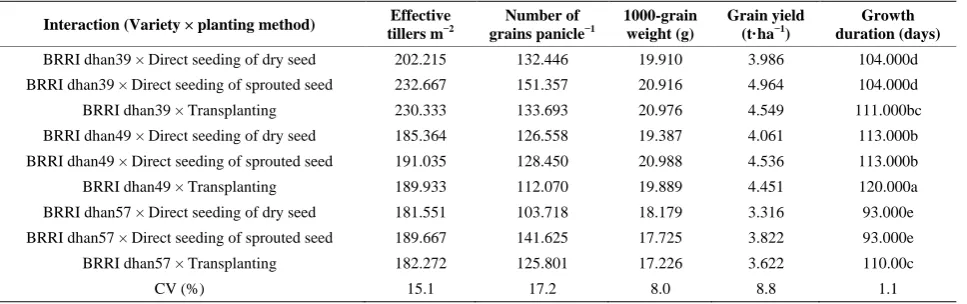
[image:2.595.58.545.637.723.2]In this study, result showed that the number of effective tillers at harvest was not significant in different cultivars and cultivation methods (Table 2). The maximum num- ber of effective tillers m−2 (232.667) was obtained from the direct seeding of sprouted seeds followed by the transplanting (230.333) and direct seeding of dry seed (202.215), respectively for BRRI dhan39 (Table 3). This might be due to the closer spacing of sprouted seeds which increased number of plants m−2. The result is sup- ported by Ali [9] and Xiang et al., [10] who observed maximum number of effective tillers m−2 in the sprouted seeds than the seedlings transplanting method.
Table 1. Soil characters of the experimental site.
Soil texture
Organic matter
Sand
(%) Silt (%) Clay (%) pH
Loamy 1.3 46 36 18 6.2
Table 2. Effect of variety on the yield and yield attributes of short duration Aman rice.
Variety Effective tillers m−2 Number of grains panicle−1 1000-grain weight (g) Grain yield (t·ha−1) Growth duration (days)
BRRI dhan39 221.738 139.172 20.601a 4.500a 106.333b
BRRI dhan49 188.777 122.357 20.088a 4.349a 115.333a
BRRI dhan57 184.496 123.715 17.710b 3.587b 98.666c
CV (%) 15.1 17.2 8.0 8.8 1.1
Table 3. Effect of interaction of variety and planting methods on the yield and yield attributes of short duration Aman rice.
Interaction (Variety × planting method) tillers mEffective −2 grains panicleNumber of −1 1000-grain weight (g) Grain yield (t·ha−1) duration (days) Growth
BRRI dhan39 × Direct seeding of dry seed 202.215 132.446 19.910 3.986 104.000d
BRRI dhan39 × Direct seeding of sprouted seed 232.667 151.357 20.916 4.964 104.000d
BRRI dhan39 × Transplanting 230.333 133.693 20.976 4.549 111.000bc
BRRI dhan49 × Direct seeding of dry seed 185.364 126.558 19.387 4.061 113.000b
BRRI dhan49 × Direct seeding of sprouted seed 191.035 128.450 20.988 4.536 113.000b
BRRI dhan49 × Transplanting 189.933 112.070 19.889 4.451 120.000a
BRRI dhan57 × Direct seeding of dry seed 181.551 103.718 18.179 3.316 93.000e
BRRI dhan57 × Direct seeding of sprouted seed 189.667 141.625 17.725 3.822 93.000e
BRRI dhan57 × Transplanting 182.272 125.801 17.226 3.622 110.00c
CV (%) 15.1 17.2 8.0 8.8 1.1
Values of a column followed by same letter are statistically similar at 5% probability.
3.2. Number of Grains Panicle−1
Investigation of grain number panicle−1 revealed that there was no significant difference between all forms of planting methods (Table 4). The direct seeding of sprouted seed produces the highest number of total grains panicle−1 (151.357) and the lowest number of grains panicle−1 (132.446) was recorded from the direct seeding of dry seed method for the variety BRRI dhan39. This might be attributed to better root devel- opment in direct seeding of sprouted seed which pro- duced healthy panicles with higher number of grains. Nourbakhshian [11] and Yang et al., [12] found higher number of grains in sprouted seeds compared to that transplanting seedling.
3.3. Thousand Grain Weight
The thousand grain weight was not significantly affected by various planting methods. However, the thousand grain weight attained by the crop established through direct seeding of sprouted seed method was highest fol- lowed by transplanting and direct seeding of dry seed method (Table 4). The lowest grain weight was recorded from the crop established with direct seeding of dry seed. Awan et al., [13] reported lower grain weight in direct seeding of dry seed on flat soil than other planting me- thods of rice.
3.4. Grain Yield
There was significant difference in producing grain yield (Table 4). Direct seeding of sprouted seed method pro- duced higher grain yield as compared to all other me- thods. The highest grain yield (4.964 t·ha−1 for BRRI dhan39) was recorded from direct seeding of sprouted seed (Table 3). Gupta et al., [14] reported 10% higher yields in direct seeded rice than flooded transplanting. Higher yield in direct seeding of sprouted seed treat- ments are attributed to good crop conditions, more
availability of nutrient which resulted higher tiller num- ber, number of grains panicle−1 and 1000-grain weight.
3.5. Growth Duration
Various cultivation methods significantly affected growth duration of the three rice varieties (Table 2). Establish- ment of rice with transplanting method needed the long- est duration for maturity (120 days for BRRI dhan49). The rice crop grown with direct seeding of dry seed and sprouted seed matured 7 days earlier (113 days for BRRI dhan49) than that of the transplanting method (Table 4), agreeing with IRRI [15] study reports that depending on a cultivar, direct seeded rice matures seven to ten days earlier than transplanted rice. Growth duration of the crop was considerably reduced in direct seeded rice might be due to the absence of transplanting shock. The longer days to flowering and maturity in seedling trans- planting could be due to longer period required for crop establishments compared to other methods.
3.6. Economic Analysis
3.6.1. Total Variable Cost
Variable cost varied due to the variation of crop estab- lishment methods (Table 5). The highest variable cost was incurred by the transplanting method (59294.00 BDT ha−1) while the lowest variable cost was incurred by the direct seeding of dry seed method (46794.00 BDT ha−1). This was similar to the results of Kabir etal., [16] who found lowest variable cost in direct seeded rice due to the omission of seedling raising, uprooting and trans- planting.
3.6.2. Cost Benefit Ratio
Table 4. Effect of planting methods on the yield and yield attributes of short duration Aman rice.
Planting method Effective
tillers m−2
Number of grains panicle−1
1000-grain weight (g)
Grain yield (t·ha−1)
Growth duration (days)
Direct seeding of dry seed 193.789 120.914 19.158 3.788b 103.000b
Direct seeding of sprouted seed 204.456 140.477 19.876 4.441a 103.000b
Transplanting 200.846 123.855 19.364 4.207a 113.667a
CV (%) 15.1 17.2 8.0 8.8 1.1
[image:4.595.55.540.223.297.2]Values of a column followed by same letter are statistically similar at 5% probability.
Table 5. Total variable cost of rice under different planting methods.
Planting Method Land preparation (BDT ha−1)
Irrigation (BDT ha−1)
Seed (BDT ha−1)
Fertilizer (BDT ha−1)
Labor (BDT ha−1)
Pesticide (BDT ha−1)
Total (BDT ha−1)
DS by dry seed 4000 2000 1400 6894 31500 1000 46794
DS by sprouted
seed 4000 2000 1400 6894 32400 1000 47694
Transplanting 5000 3000 1400 6894 42000 1000 59294
DS = Direct seeding; Seed: 40 kg·ha−1 at 35 BDT kg−1; Urea: 127 kg·ha−1 at BDT 20 kg−1; TSP: 52 kg·ha−1 at BDT 22 kg−1; MoP: 82 kg·ha−1 at BDT 15 kg−1; Gypsum: 60 kg·ha−1 at BDT 12 kg−1; ZnSO4: 7 kg·ha−1 at BDT 180 kg−1; Labor wage: 300 BDT day−1; BDT = Bangladeshi currency.
Table 6. Cost benefit ratio as affected by different planting methods.
Planting method Grain yield
(t·ha−1)
Total variable cost (BDT ha−1)
Gross return (BDT ha−1)
Net return
(BDT ha−1) Cost benefit ratio
a b (b − a) (b − a )
DS by dry seed 3.78 46794.00 60608.00 13814.00 1.30
DS by sprouted seed 4.44 47694.00 71056.00 23362.00 1.49
Transplanting 4.21 59294.00 67433.00 8139.00 1.14
DS = Direct seeding; Price: Rice grain = BDT 16 kg−1.
The highest cost benefit ratio in direct seeding of sprouted seed method may be due to high yield, saving of irrigation water for puddling and labour charges beared for seedling raising and transplanting in the field. Sanji- tha Rani and Jayakiran [17] had found higher net return in his experiment due to saving of labour cost and irriga- tion water in direct seeded rice.
4. Conclusion
It can be concluded from the results that variety BRRI dhan39 performed better than other varieties when grown with direct seeding of spouted seed method. Therefore, the cultivation of BRRI dhan39 with direct seeding of spouted seed method is recommended for better yield.
REFERENCES
[1] D. O. Manzanilla, T. R. Paris, G. V. Vergara, A. M. Is- mail, S. Pandey, R. V. Labios, G. T. Tatlonghari, R. D. Acda and T. T. N. Chi, “Submergence Risks and Farmers’ Preferences: Implications for Breeding Sub1 Rice in South- east Asia,” Agricultural Systems, Vol. 104, 2011, pp. 335- 347. http://dx.doi.org/10.1016/j.agsy.2010.12.005
[2] BBS (Yearbook of Agricultural Statistics of Bangladesh),
Bangladesh Bureau of Statistics, Statistics Division, Min-istry of Planning, Government of Bangladesh, Bangla-desh, 2011, pp. 124-128.
[3] C. R. Adair, H. M. Beachell, N. E. Jodon, L. L. David and J. W. Jones, “Comparative Yields of Transplanted and Direct Sown Rice,” Journal of the American Society of Agronomy, Vol. 34, No. 2, 1992, pp. 129-127.
http://dx.doi.org/10.2134/agronj1942.0002196200340002 0004x
[4] N. V. Nguyen and A. Ferrero, “Meeting the Challenges of Global Rice Production,” Paddy and Water Environment, Vol. 4, No. 1, 2006, pp. 1-9.
[5] G. Mahajan, V. Sardana, A. S. Brar and M. S. Gill, “Ef- fect of Seed Rate, Irrigation Intervals and Weed Pressure on Productivity of Direct Seeded Rice (Oryza sativa L.),”
Indian Journal of Agricultural Science, Vol. 76, No. 12, 2006, pp. 756-759.
[6] W. A. Jehangir, I. Masih, S. Ahmed, M. A. Gill, M. Ah- mad, R. A. Mann, M. R. Chaudhary and H. Turral, “Sus- taining Crop Water Productivity in Rice-Wheat Systems of South Asia: A Case Study from Punjab Pakistan,” Draft Working Paper, International Water Management, Ins. Lahore, Pakistan, 2005.
[image:4.595.56.542.346.426.2]1994, pp. 1-340.
[8] B, Bricker, “MSTATC: A Micro-Computer Program for the Design, Management and Analysis of Agronomic Research Experimentation,” Department of Crop and Soil Sciences, Michigan State University, East Lansing, 1991. [9] M. A. Ali, “Productivity and Resource-Use Efficiency of
Rice as Affected by Crop Establishment and Nitrogen Management,” Ph.D. Thesis, University of Los Banos, Los Banos, 2005.
[10] D. H. Xiang, F. R. Ying, L. Fang, X. H. Ding, R. Y. Fu and L. Fang, “A Study on Tiller Ear Bearing of Direct Seeded Rice for Yield up to 8.25 tha−1,” China Rice, Vol. 2, 1999, pp. 18-19.
[11] S. J. Nourbakhshian, “Function Comparison of Rice Va- rieties in Direct Seeded and Transplanting Methods,” Iran Agricultural Science Journal, Vol. 2, No. 4, 2000, pp. 25- 32.
[12] S. U. Yang, Y. Sang, T. P. Sung, T. C. Byong, Y. Son, U. S. Yeo, S. T. Park and B. T. Chun, “Physiological and Yield Responses of Rice Cultivars in Direct Seeded and Transplanted Rice Cultivation,” RDA Journal of Crop Science I, Vol. 40, No. 2, 1998, pp. 109-111.
[13] T. H. Awan, I. Ali, M. E. Safder, M. M. Ashraf and M.
Yaqub, “Economic Effect of Different Plant Establish- ment Techniques on Rice, Oryza sativa Production,” Jour- nal of Agricultural Research, Vol. 45, No. 1, 2007, pp. 73-80.
[14] R. K. Gupta, R. K. Naresh, P. R. Hobbs, Z. Jiaguo and J. K. Ladha, “Sustainability of Post-Green Revolution Agri- culture. The Rice-Wheat Cropping Systems of the Indo- Gangetic Plains and China,” In: Improving the Productiv-ity and SustainabilProductiv-ity of Rice-Wheat Systems: Issues and Impacts, ASA Special Publication 65, Washington DC, 2003, pp. 1-26.
[15] International Rice Research Institute (IRRI), “Rice Pro- duction Training Module: Method of Planting Rice,” IR-RI, Los Barios, 2008, pp.1-13.
[16] M. H. Kabir, M. S. U. Bhuiya, A. Saha, M. A. H. Khan and Nur-E-Elahi, “Effect of Crop Establishment Method and Time of Nitrogen Application on the Productivity of Boro Rice in Lowland Ecosystem,” Bangladesh Rice Journal, Vol. 14, No. 1-2, 2009, pp. 1-6.