Positioning to Authenticate Devices for
Spontaneous Interaction
Rene Mayrhofer, Hans Gellersen, and Mike Hazas
Lancaster University, Computing Department, South Drive, Lancaster LA1 4WA, UK {rene,hwg,hazas}@comp.lancs.ac.uk
Abstract
Spontaneous interaction is a desirable characteristic associated with mobile and ubiquitous computing. The aim is to enable users to connect their personal devices with devices encountered in their environment in order to take advantage of interaction opportunities in accordance with their situation. However, it is dicult to secure spontaneous interaction as this requires authentication of the encountered device, in the absence of any prior knowledge of the device. In this paper we present a method for establishing and securing spontaneous interactions on the basis of spatial references that capture the spatial relationship of the involved devices. Spatial references are obtained by accurate sensing of relative device positions, presented to the user for initiation of interactions, and used in a peer authentication protocol that exploits a novel mechanism for message transfer over ultrasound to ensures spatial authenticity of the sender.
1 Introduction
Spontaneous networking is of potentially great value to mobile users as it can enable them to associate their personal devices with devices encountered in their environment, and thereby to take advantage of serendipitous interaction oppor-tunities. Spontaneous interaction in ubiquitous computing has for example been studied for applications such as social interaction and game-playing in mobile user communities. However, the potential of such interactions extends into areas that may involve more sensitive data and transactions, such as use of a vending machine over a wireless link, or direct payment transactions between two mo-bile devices. For such applications to be acceptable in a spontaneous network setting, a user must be able to authenticate the interaction of their personal device with the intended target device. They must be able to ascertain that the network entity their device connects to is identical with the physical device `in front of them'. Furthermore, given the inherent vulnerability of a wireless com-munication channel, they must be able to rule out the presence of a third party established as `man-in-the-middle' between their device and the target.
in spontaneous networks neither can be assumed to be available. Instead it is necessary to provide an out-of-band mechanism alongside the wireless channel, for secure key exchange or verication of keys that have been `speculatively' exchanged over the wireless channel. A wide range of mechanisms have been discussed in the literature, from user entry of PIN codes [1] and direct electrical contact [2] to use of communication channels with inherent physical limitations, such as infrared, audio and ultrasound [3,4].
In this paper we present a novel approach for device-to-device authentication in spontaneous networks. The main contribution is a method that uses spatial references to establish and authenticate interaction between a pair of devices. Spatial references capture the spatial relationship with a target device in terms of bearing and distance, and are used in an authentication protocol that couples key verication with verication of the relative position of the sender. The method and protocol are a general contribution in the sense that they can be implemented with any peer-to-peer sensing approach capable of providing accurate relative bearing and distance. However, we also contribute a concrete implementation, using a combination of radio frequency (RF) and ultrasonic (US) communication for measurement of spatial relationships.
As ultrasonic ranging is susceptible to certain attack scenarios (as we will ex-plain in the course of the paper), we further contribute a novel coding technique for spatially-dependent message transfer over an ultrasonic channel. This tech-nique allows a sender to transmit a message such that it can only be successfully decoded if it is received at a particular range. The technique is a key component in the protocol implementation we present, but can have wider application in ultrasonic systems independent of the particular problem we consider here.
In the subsequent section we will position our research with respect to related work, and then proceed to a description of the overall design of our method, the underlying sensing approach and the proposed user interface. This will be followed by a threat analysis, the description of a peer device authentication protocol as our core contribution, and an analysis of security and performance.
2 Related Work
Peer device authentication was rst highlighted as a distinct security challenge emerging in ubiquitous computing by Stajano and Anderson, who proposed the `Resurrecting Duckling' model for secure transient device association, boot-strapped from direct electrical contact [2]. Others have proposed channels for authentication that do not require direct contact but are `location-limited' [3] or `physically constrained' [4], including infrared beams [3], laser beams [5], and ultrasound [6]. Our method of spatial references eectively expands on the idea of location-limitation, using spatial measurements in addition to channel limita-tions, in order to further limit the position from which a device can successfully authenticate.
com-parison with wirelessly received material [7] and verication of spoken messages generated by devices [8]. Our approach also has the user in the loop, however does not involve any user interaction solely targeted at security. Instead, we provide the user with a spatial technique for initiating interaction with another device; the spatial relationship is captured in this process and is then used for securing the interaction without need for further intervention of the user.
Our concrete implementation is based on the use of US as out-of-band chan-nel. Kindberg et al. have before us proposed the use of US alongside an RF wireless channel in a protocol for validation and securing of spontaneous inter-action [6]. The idea of the protocol is for devices to rst exchange keys, and then to verify that the intended device is in possession of the correct key, by having the device send a nonce in plaintext over ultrasound and over RF. However, the protocol design does not consider potential attacks on the ultrasonic channel. A specic problem is the reliance on ultrasonic time-of-ight measurements for verication of device authenticity, as these involve synchronisation over the RF channel and are open to attack scenarios in which an attacker may appear nearer or further than they are [9]. As the protocol has not been implemented it is also not clear how precisely the nonce would be transmitted and what the security implications of this would be. In its general design, our protocol is similar to that of Kindberg et al., but we attend specically to the issue of trustworthiness of ultrasonic ranging, and provide a complete implementation with security and performance analysis.
Other related work includes spatial interaction techniques. Hazas et al. [10], while not considering security, have presented an approach that uses ultrasonic peer-to-peer sensing for spatial discovery of other devices within interaction range, and work expanding on this has considered visualisation of the devices' positions in the user interface in order to ease interaction across devices (e.g. enabling transfer of a document to another device by a simple drag-and-drop operation) [11,12]. We employ the same principle in our method to let users ini-tiate spontaneous interactions by means of spatial discovery and selection of the target device, but extend the approach by adding security in a seamless manner.
3 Security by Spatial Reference
3.1 Design of the method
In our method for establishing and securing spontaneous interactions, spatial references are used for discovery of devices, for selection of a target devices, and for verication that interaction is secured between the `right' devices. This involves the following steps:
1. The user's device uses a combination of network discovery and spatial sensing for spatially-bounded discovery of devices.
2. The spatially discovered devices perform spatial measurements to compute their relative positions.
3. Users are provided with a visualisation of available devices, integrated in the user interface of their personal device and laid out in correspondence with computed positions relative to the user's device.
4. Users initiate interaction and communication with a device by selection of the corresponding visual object, using direct manipulation techniques available in their user interface.
5. Selection of a device for spontaneous interaction triggers a protocol for key exchange with the target device and verication that no other devices can be present as `man-in-the-middle' between the user's device and the target. 6. Once it has been asserted that exchanged keys are authentic, they are used for securing the communication channel between user device and target, and the initiated interaction can take place.
3.2 Spatial discovery and sensing
For a concrete implementation of spatial discovery and sensing we base our method on the Relate system for relative positioning introduced by Hazas et al. [10]. The Relate system provides wireless sensors implemented as USB don-gles that can be readily used to extend host devices (such as laptops or PDAs) with spatial sensing. The Relate sensors contain three ultrasonic transducers (to cover space in front, left and right of the device) and they operate their own ad hoc network over combined radio frequency (RF) and ultrasound (US) channels (note this sensor network is separate from the wireless network that connects their host devices). Protocol functions implemented over the sensor network in-clude network discovery and management, collaborative ultrasonic sensing, col-lection of measurements, and exchange of host information. The Relate sensors specically support spatial discovery of their host devices by exchanging the hosts' network addresses over the sensor network.
Fig. 1. Integration of spatial references to near-by devices in the mobile user interface; left: extension of Guinard et al.'s Gateways [12]; right: Kortuem et al.'s map view [11].
to share and collect sensor data, and each sensor provides the collected data to its host device. This then enables the host devices to compute their relative positions very accurately. Hazas et al. report a 90% precision around 8 cm in position and 25◦ in orientation [10]: these gures and our practical experience suggest sucient accuracy for reliable disambiguation of devices. By collabora-tively sharing US measurements over RF, partial obstruction can be dealt with in principle. However, for spatial authentication we rely on direct line of sight between the authenticating devices.
3.3 User interface design
4 Threat Analysis
The key idea underlying our method is to use spatial references for verication of device authenticity. In this section we consider threats in the context of the ultrasonic sensing approach we introduced above, as well as threat scenarios that arise on application level.
4.1 Attacker capabilities
There are three channels of concern: the communication network between de-vices, e.g. wireless LAN with a TCP/IP stack, the radio frequency channel used for communication between spatial sensing devices (RF ), and the ultrasound channel used for sending and receiving ultrasonic pulses (US). We assume an attacker (`Eve') to be capable of gaining complete control over the wireless com-munication channels. This allows Eve to perform a 'man-in-the-middle' (MITM) attack on the wireless channels. Assuming to devices A and B, the attacker E can pretend to A that it is B, and to B that it is A, and thus agree to a cryptographic key with A and separately with B. A and B will be unaware of this and believe to communicate securely with each other when in fact they are communicating via E (who might be partially or completely relaying their messages).
The aim of our method is to prevent that a man-in-the-middle can succeed. To this end, spatial references are used during the authentication process, and are therefore subject to potential attack. We can distinguish between three dierent attacker capabilities with regards to tampering with spatial references, in order of increasing complexity:
1. RF-only: Attacks on any of the wireless channels (RF) are the most danger-ous, because they can be carried out inconspicuously (see e.g. [13]). With directed antennas, the possible range of an attacker can signicantly exceed the normal range of the RF channel, as has been demonstrated by an attack on mobile phones via Bluetooth over a distance of over 1.7 km.
2. US in room: Control over the US channel, on the other hand, is assumed to be limited. First, for attacks on this channel, an attacker needs to be physi-cally present in the same room (US is eectively blocked by solid materials such as walls, doors, and windows). Second, although eavesdropping is easily possible, injecting US pulses is more dicult. We assume an attacker to be capable of injecting US pulses at any time with arbitrary strength. Injection in this sense means to insert completely new messages into the US chan-nel, while modifying, replacing, or removing other messages is not possible without detection.
possible). However, an attacker could be placed in line with A and B, and thus not be required to fake the angle.
4.2 Sensing-level threats
Attacking the RF channels creates three threats specic to our spatial sensing system:
(a) by removing all RF messages sent from or to a single device, an attacker Eve can prevent the device from entering the sensor network, and thus make a specic device disappear for all other devices however, this can be detected by the device in question.
(b) by changing RF messages, Eve can tamper with shared measurements, i.e. those that are taken by remote sensors and exchanged between Relate sensors. Additionally, US ranging depends on trigger packets sent via RF.
(c) by controlling these trigger packets, Eve can manipulate distance measure-ments.
If Eve is spatially aligned line with A and B, she could also send US messages delayed or ahead of schedule to the eect that her position, from Alice's point of view, appears to be where Bob is. This creates a fourth specic threat, namely (d) to fake the perceived distance.
Note that, in contrast to ranging measurements, angle of arrival measure-ments are trustworthy in our sensing system, as they are derived from signal peak values measured on with sensors oriented in dierent directions, and not from time-of-ight as proposed in [6].
4.3 Application-level threats
The possibility to tamper with spatial references leads to three specic attack scenarios on the application level.
1. Replacement: The rst possibility for attack is to virtually replace another device. This requires two steps: First, the original communication partner, in this case B, needs to be `silenced' so that it will no longer be visible in terms of wireless communication and measurements. Second, Eve needs to fake her position to appear at the same place where the user (`Alice') expects B to be. In this attack, interaction happens only between Alice and Eve, and no interaction happens with B. Scenarios for this threat are thus limited to asymmetric settings where B is an infrastructure device not monitored by users.
try to avoid detection by forwarding to B and thus completing the high-level interaction. This scenario requires that B does not verify the origin of the messages, i.e. that only Alice authenticates B, but not the other way around. 3. Synchronous MITM : For live interaction, like a chat or voice communica-tion between two users (Alice and Bob) over the secure channel, even the slight delay of an asynchronous MITM attack would be noticeable. The most dangerous threat, because it is hard to detect when the attack is being per-formed, is that of a synchronous MITM. For a synchronous MITM, Eve rst attacks the wireless channel as in the previous threat scenarios. But then she remains passive during spatial discovery and mutual positioning of Alice and Bob. Only during spatial authentication she tampers with the spatial measurements. Thus, she remains virtually undetectable for both Alice and Bob, while still having full access to their communication. This requires Eve to be physically between Alice and Bob, because both verify angle of arrival of spatial relationships.
5 Key Agreement and Peer Authentication
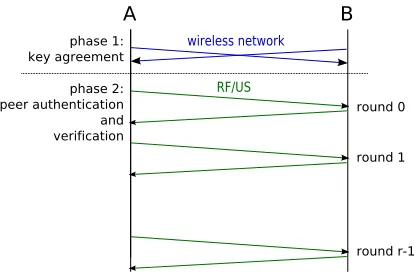
We secure spontaneous interaction between two devices A and B in two phases, key agreement and peer authentication, as shown in Fig. 2. In the rst phase, we let A and B establish a shared key using a standard, unauthenticated key agree-ment protocol, such as Die-Hellman (DH) [14]. If this is successful, then A and B can use the agreed key to protect their communication against eavesdropping and tampering, with E being unable to gain sucient knowledge of that shared key. To protect A and B against MITM attacks, we use a second phase for peer authentication (A establishing that it is really talking to B, and vice versa), and for verication that A and B are in possession of the same key (which would rule out the presence of a MITM due to the unique-key property of a protocol such as DH).
5.1 Peer authentication
The peer authentication process is designed to be symmetric, which means that the two devices A and B authenticate each other. Even though the interaction is initiated by A in response to Alice's selection of B as target, it will often be appropriate that B can also verify the sending device and its relative position, for example to provide its user Bob with a veried visual indication in his user interface of where a received document has been sent from (and thus prevent replacement or asynchronous MITM attacks). As a starting point for authenti-cation, A has a spatial reference to B as derived from the user's selection of B as her target, and B can base authentication on a corresponding spatial reference to A.
Fig. 2. Devices A and B secure their interaction by key agreement over a wireless network channel, followed by peer authentication over the RF and US channels of their spatial sensors.
to the same key, and (ii) they are A and B as mutually veriable by spatial reference. The devices approach this by generating a nonce (a random number used only once) and by transmitting the nonce encrypted over the RF channel. They also transmit the plaintext nonce over the US channel in a series of smaller parts that are coded within the actual distance measurements. When the devices receive these transmissions, they decrypt the RF message, verify that the content matches the nonce received via US, and thus establish whether their keys match. For this approach to be secure, the encoding and the transmission of these nonces need to be coordinated. In the following, we discuss these two issues and how they interact with each other.
5.2 A spatial coding technique for trustworthy ultrasonic ranging When a device receives an ultrasonic pulse, it computes a distance measurement based on the time-of-ight. As explained above in section 4.2, these distances can be tampered with. We therefore introduce a method to embed information in ultrasound pulses, which (i) allows to use US as an out-of-band channel for message exchange, and (ii) makes the distances trustworthy.
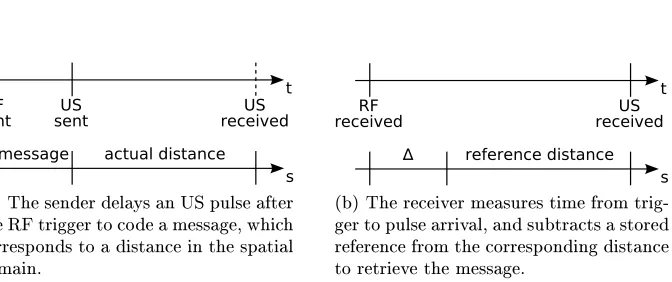
(a) The sender delays an US pulse after the RF trigger to code a message, which corresponds to a distance in the spatial domain.
[image:10.612.146.482.90.231.2](b) The receiver measures time from trig-ger to pulse arrival, and subtracts a stored reference from the corresponding distance to retrieve the message.
Fig. 3. Message transmission embedded with ultrasonic ranging: The receiver will only be able to retrieve the message if the sender's distance matches the stored reference.
equal to the reference measurement, and therefore constitutes and implicit check of spatial integrity. Figure 3 illustrates this mechanism for message transmission over ultrasound with implicit verication of sending range. In addition to this implicit distance check, A can verify that the pulse was received from a direction corresponding with the reference held for B, thus eectively eliminating the possibility that the US transmission originates from another device but B.
5.3 Preventing MITM relaying
5.4 Protocol specication
An overview of the protocol phases is shown in Fig. 2. Key agreement takes place over a wireless network channel, and subsequent key verication and peer authentication over the RF/US channels of their spatial sensors. The second phase involves turn-taking of the parties in an interlock protocol over a number of roundsr. This number will be agreed between devices, in consideration of the
security level, protocol duration, and US channel capacity. The US channel ca-pacitybuis the number of bits that can be reliably transmitted as distance oset
in each round, and will depend on the characteristics of the sensors used and sensing protocol details. Assuming a nonce of 128 bits, we would needd128/bue
rounds for transmission of the nonce over US. However, a smaller number of rounds may be agreed to complete the protocol faster, compromising on how many bits of the nonce are eventually compared for key verication. With r
agreed, we then set the number of bits that will transmitted over the RF chan-nel in each round to bm := d128/re, splitting the encrypted nonce into equal
message parts.
We will now describe our protocol more formally using the following notation:
c:=E(K, m)describes the encryption of plaintextmunder key Kwith a
sym-metric block cipher,m:=D(K, c)the corresponding decryption,H(m)describes
the hashing of the messagemwith a secure hash algorithm, andm||ndescribes
the concatenation of stringsmandn. Additionally, the notationM[a:b]is used
to describe the substring of a message M starting at bitaand ending at bitb.
Messages that are transmitted to the other party are printed in bold. 1. Key agreement, using the Die-Hellman key establishment protocol:
(a) A chooses a random numbera∈ {1, ..., q−1}and transmitsX:=ga,
B chooses a random numberb∈ {1, ..., q−1}and transmitsY:=gb
(b) A computes KSess
a := H(Ya) and KaAuth := H(Ya||P AD) with some
secure hash algorithm, B generatesKSess
b andKbAuth correspondingly fromXb
The numbersg,q and the stringP AD are assumed to be publicly known.
Although we envisage the use of ephemeral keys, i.e. new values foraandb
for each protocol run, it might be advantageous to use long-term values for performance reasons. We useKAuth(=KaAuth=KbAuth) for key verication
in the peer authentication phase, andKSess (=KaSess =KbSess) for
subse-quent channel security if the verication succeeds. The additional hashing to compute two dierent shared keys provides forward secrecy in the case of leaked authentication key material (cf. [16, section 15.8.4]), for example by a known plaintext attack onE(KAuth
x , Nx)after the respectiveNxis revealed
in the following steps. 2. Peer authentication:
(a) A chooses a nonceNa∈ {1, ...,2128−1}and computesMa:=E(KaAuth, Na),
B choosesNb and computesMb correspondingly withKbAuth
(b) For each roundi:= 0. . . r−1:
A transmits a RF packetMi
a:=Ma[i·bm: (i+ 1)·bm−1]and an
US pulseUSPi
B receives message partMi
aand US pulseUSPia, derives a distance measurementdi
b,a, and uses the stored reference measurementdb,ato
reconstruct the distance-coded message∆i
a :=dib,a−db,a. B also
veri-es the angle of arrivalαi
b,aand compares it with the stored reference
measurementαb,a. If the dierence exceeds the typical measurement
error, B aborts the authentication protocol with an error message. B transmits Mi
b:=Mb[i·bm: (i+ 1)·bm−1]and USPibdelayed byNb[i·bu : (i+ 1)·bu−1]units, and acknowledges receipt of A's
RF and US messages for roundi,
A receives Mi
b and USPib, veries angle of arrival, computes dia,b,
uses the reference measurementda,bto reconstruct∆ib:=d i
a,b−da,b,
and acknowledges B's messages for roundi
(c) A reassembles all received RF packetsMb0 :=M0
b||. . .||M r−1
b , decrypts the messageNb0 :=D(KAuth
a , Mb0), reassembles the nonce from the
dis-tance osets Nb00:=∆0
b||. . .||∆ r−1
b , veries thatN
00
b =Nb0[0 :r·bu−1],
and setsK:=KSess
a on match or K:=nullotherwise,
B reassembles Ma0 := M0
a||. . .||Mar−1, decrypts Na0 := D(KbAuth, Ma0),
reassembles Na00 :=∆0a||. . .||∆ra−1, veries thatNa00=Na0[0 :r·bu−1],
and setsK:=KbSesson match or K:=nullotherwise
Note, ifbu< bm(i.e. if fewer bits are transmitted via US than via RF) then
step 2c) only comparesr·bu bits of the nonce.
If key agreement and peer authentication are completed successfully, then A and B can use the session key K to establish a secure channel. The key can be
used as a shared secret for one of the standard protocols such as IPSec with PSK authentication, or one of the recently specied TLS-PSK cipher suites [17]. Other options are WPA2-PSK or EAP-FAST.Kcan be used directly as key material,
rendering additional asymmetric cryptographical operations in the secure chan-nel implementation unnecessary and thus speeding up chanchan-nel establishment.
5.5 Implementation
We have implemented the key agreement phase of our protocol over TCP/IP. As a secure hash we use SHADBL-256, which is a double execution of the
stan-dardSHA-256message digest to safeguard against length extension and
partial-message collision attacks [16]:SHADBL-256 = SHA-256 ((SHA-256 (m))|m). The peer authentication phase of the protocol has been implemented over the RF/US channel of the Relate sensors, using AES (Rijndael) with a key size of 256 bits as secure block cipher for the interlock protocol. The protocol is tightly integrated with the Relate spatial sensing protocol. RF packets transmitted for authentication serve simultaneously as trigger packets for ultrasonic time-of-ight measurement. Pulses emitted on the US channel serve simultaneously for ranging and for transmission of nonce message parts.
Derived from the characteristics of the Relate sensors, we have set the number of bits transmitted in each round over US to bu := 3. In each round, the 3 bit
receiver-perceived distance by delaying the US pulse. At the receiver end, this allows for +/-12.8 cm of measurement inaccuracy to retrieve the 3 bits correctly (note the reported precision of Relate sensors for this level of accuracy is over 95%). The duration of a round is about 200 ms (longer if other devices present are allowed to `interrupt' the authenticating peers for spatial sensing and exchange of measurements). Transmission of the complete nonce would require 43 rounds but the number of rounds has been kept variable in our implementation to allow users to dene their required level of security.
6 Security Analysis
6.1 Message channels
In our case, information is transmitted both via RF and via US. To safeguard against eavesdropping all RF packets are encrypted with an authentication key, but over US the nonce will become gradually revealed as the protocol proceeds. The interlock protocol ensures that this will be of no use to an attacker, as the protocol forces commitment of encrypted nonce message parts over RF before the entire nonce can be intercepted on the US channel. The nonce is also strictly used only once which rules out replay attacks. Complete or selective denial-of-service attacks can not be protected against under our assumption of completely insecure RF channels.
As described above, the main motivation for using the interlock protocol is to protect against man-in-the-middle attacks during authentication. An RF-only MITM attack would be noticed, and we therefore need to analyse the possibilities for a concurrent attack on the US channel.
6.2 Ultrasonic sensing and message transmission
devices would be obvious to the user. Note that this MITM device can not be arbitrarily small due to a physical limits on the minimum size of ultrasound transducers.
One remaining risk is that E is positioned in line with A and B, but farther away instead of in between. If E performs a selective denial-of-service attack on B and forges distance measurements before authentication is started, it will be able to fake its perceived and subsequently visualised position as seen by A. Although for security purposes one does usually not trust other devices's measurements (they might be collaborating for an attack), we note that these measurements, shared by benign devices over the Relate RF network, may serve to reveal ongoing attacks such as this one. The shared measurements are not used for increasing trust in an authentication protocol run or providing proof of authentication, but they may still be used for decreasing trust in a protocol run, when shared measurements do not match local ones. Attacking networks of multiple Relate devices should therefore be considered signicantly harder than attacking just two devices.
We should also note that attacks on the sensing level become harder in sce-narios involving mobility of devices. Positioning an attacker unsuspiciously and directly in line between A and B is not trivial even in static settings. When at least one of the interacting devices is mobile, an attacker would need to be constantly re-positioned (or virtualized by sound forming, which is considered infeasible with the current state of the art in ultrasonic systems).
6.3 Applications
The application-level threats described in section 4.3 are specic to our method. With the protections of the sensing level described above, the remaining threat is the misrepresentation of E at the position of B as seen by A. Replacement of infrastructure devices is hard to detect, and therefore dicult to protect against. One possibility is to create an explicit application-level feedback from B that can be veried by Alice, for example to lighting an LED for a few seconds whenever authentication has succeeded. If Eve replaces B, then B will not light its LED and Alice can subsequently abort the interaction. The same protection can be used against asynchronous MITM, which eectively transforms these two scenarios into a synchronous MITM setting. However, this adds an additional step in the interaction process that may not be desirable for many applications. A more pragmatic protection against these remaining replacement and asynchronous MITM threats is to protect against E being in line with A and B by physical means, e.g. simply placing B directly in front of a wall and thus making it impossible for E to be hiding `behind' it.
6.4 User interaction
The overall security of our method depends on the correct selection of the target device, and the correct association of the target with a spatial reference. We need to consider two possible sources of error or incorrect association. One is that the network communication in the initial steps of our method is not secure. A user can trust the relative position information it has of other devices as this is measured with on-board sensors but any additional information exchanged may be interfered with by an attacker. For example, the Gateway interface shown in Fig. 1 is based on locally measured spatial information but in addition visualises type of discovered device based on information received over the wireless net-work. An attacker might tamper with this to the eect that a dierent device type is indicated, which might mislead the user.
The second risk at the level of user interaction is that the user selects the `wrong' device in their user interface, in the worst case an attacker positioned near the actual target. i.e. E instead of B, in their user interface. The visual design of the UI and the accuracy of the spatial layout in correspondence with the `real world' arrangement of devices will be key factors in reducing the risk of faulty selection, which of course will also be dependent on number and arrangement of devices discovered and visualised.
7 Performance Evaluation
The authentication protocol involves evaluation of sensor data with inherent limitations in accuracy and precision. It is therefore critical to assess impact of sensor limitations on practical performance.
7.1 Robustness against `false negatives'
Sensors are inherently imprecise. Our authentication protocol is designed to ac-count for the resulting variance in sensor readings, but only within limits that are consistent with secure authentication of devices by spatial reference (i.e. there must be no possibility that devices become confused due to allowances made for sensor error). As a consequence, the protocol can fail to authenticate legitimate peers when sensor errors occur that exceed built-in tolerance.
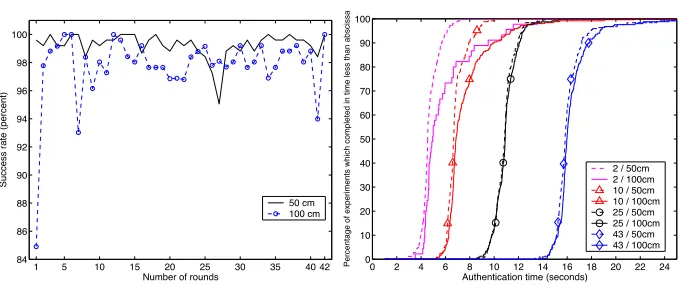
Figure 4 shows the success rate of authenticating legitimate peers dependent on the number of rounds of the interlock protocol and the distance between the devices. For this experiment, two devices were positioned facing each other in direct line of sight at distances of 50cm and 100cm. For each number of rounds, 250 protocol runs were performed. As shown in Fig. 4, success rates are at least 85% and typically above 95%.
1 5 10 15 20 25 30 35 40 42 84 86 88 90 92 94 96 98 100
Number of rounds
Success rate (percent)
50 cm 100 cm
0 2 4 6 8 10 12 14 16 18 20 22 24 0 10 20 30 40 50 60 70 80 90 100
Authentication time (seconds)
Percentage of experiments which completed in time less than abscissa
[image:16.612.139.479.112.255.2]2 / 50cm 2 / 100cm 10 / 50cm 10 / 100cm 25 / 50cm 25 / 100cm 43 / 50cm 43 / 100cm
Fig. 4. Authentication success rate depending on the security level and distance (left); Authentication speed depending on the security level and distance (right).
a more notable decrease might be expected, as the probability of an erroneous measurement increases with the number of rounds. Note that the impact of distance on success rate is not very pronounced and appears to be within error of measurement (success rates for the larger distance are on average lower, but not consistently).
7.2 Speed versus security
There is an inherent trade-o in our protocol between speed and security. The resistance against attacks increases with the number of rounds used for the interlock protocol, because each round transmits 3 bits of entropy for verifying the nonce. Therefore, an attacker's chance of guessing a nonce equals1/23r. To
put this into perspective, after only 5 rounds a nonce would already be harder to guess than a randomly generated 4-digit PIN number. Also note that our protocol is symmetric, which means that an attacker would need to guess two nonces correctly in order to deceive the authenticating devices as MITM.
Figure 4 (right) shows this trade-o with measurements taken for 2, 10, 25, and 43 rounds, obtained with the same experimental setup of devices as described above. The variations in the time necessary for authentication over a certain number of rounds stem from the specics of the underlying RF/US sensing protocol which can require message retransmits. The dependency on the distance between the devices is again marginal. As can be seen, a complete authentication takes around 12 s for 25 rounds.
attacker can not repeatedly attack the authentication protocol with an online attack, because it is only triggered by an explicit user action. Therefore, there is only a one-o chance for an attack, and any computational attacks are therefore matched with a security level of 128 bits. Nonetheless, our protocol allows the user or application to choose the best compromise between speed and security and scales up to a 128 bit level even for the single attack possibility.
8 Conclusion
We have contributed and discussed a method for establishing secure spontaneous interaction on the basis of spatial references. Spatial references are a type of context that allows users to match what they see with what their device sees. At the core of our method is a peer authentication protocol that uses relative bearing and distance between devices. We have presented an implementation using ultrasound for spatial measurements; however, the method can also be realised with other sensors. For example, one could consider use of cameras (which are becoming ubiquitous in mobile phones and handhelds) and vision techniques to obtain spatial references between devices.
The concrete implementation we have presented uses ultrasound, for peer-to-peer spatial sensing, and for out-of-band message transfer as part of a key verication protocol. We have provided a comprehensive threat analysis for ul-trasonic ranging and contributed a novel coding technique that allows a sender to guarantee that a message was sent from a particular range. This technique can thus be used to to construct a spatially-authentic channel from sender to receiver.
Our protocol implementation is embedded in a spatial sensing scheme that more generally provides devices with accurate relative positions of peers discov-ered within interaction range. The method further involves a user interaction model based on visualisation of relative device positions, integrated in the user interface for direct manipulation. The method as presented relies on spatial sen-sors, however, the sensors are not specic to the purpose of providing security but have broader use for support of spatial interaction and services. Cameras and various other sensors are already ubiquitous in mobile devices, and given the general utility of ultrasonic transducers for ranging tasks it is easily perceivable that these will become commonplace as well.
As a nal note it has to be stressed that the presented approach fundamen-tally diers from proximity-based methods such as near-eld communication (NFC). Any proximity-based method that relies on a quantitative property of the out-of-band channel such as radio signal strength is open to attack from further aeld for example to attack NFC by increasing communication range with more powerful senders and/or more sensitive receivers. In contrast, our method exploits the qualitative out-of-band properties of ultrasound: that it is blocked by solid materials and that angle of arrival can not be faked.
Acknowledgements
We acknowledge support for the presented research by the Commission of the European Union under contracts 013790 "RELATE" and the FP6 Marie Curie Intra-European Fellowship program contract MEIF-CT-2006-042194 CAPER, and by the Engineering and Physical Sciences Research Council in the UK under grant GR/S77097/01.
References
1. Gehrmann, C., Mitchell, C.J., Nyberg, K.: Manual authentication for wireless devices. RSA Cryptobytes 7(1) (2004) 2937
2. Stajano, F., Anderson, R.: The resurrecting duckling: Security issues for ad-hoc wireless networks. In: Proc. 7th Int. Workshop on Security Protocols, Springer-Verlag (April 1999) 172194
3. Balfanz, D., Smetters, D.K., Stewart, P., Wong, H.C.: Talking to strangers: Au-thentication in ad-hoc wireless networks. In: Proc. NDSS'02, The Internet Society (February 2002)
4. Kindberg, T., Zhang, K., Shankar, N.: Context authentication using constrained channels. In: Proc. WMCSA 2002, IEEE CS Press (June 2002) 1421
5. Kindberg, T., Zhang, K.: Secure spontaneous devices association. In: Proc. Ubi-Comp 2003, Springer-Verlag (October 2003) 124131
6. Kindberg, T., Zhang, K.: Validating and securing spontaneous associations be-tween wireless devices. In: Proc. ISC'03, Springer-Verlag (October 2003) 4453 7. McCune, J.M., Perrig, A., Reiter, M.K.: Seeing-is-believing: Using camera phones
for human-veriable authentication. In: Proc. IEEE Symp. on Security and Privacy, IEEE CS Press (May 2005) 110124
8. Goodrich, M.T., Sirivianos, M., Solis, J., Tsudik, G., Uzun, E.: Loud and clear: Human veriable authentication based on audio. In: Proc. ICDCS 2006, IEEE CS Press (July 2006) 10
9. Clulow, J., Hancke, G.P., Kuhn, M.G., Moore, T.: So near and yet so far: Distance-bounding attacks in wireless networks. In: Proc. ESAS 2006, Springer-Verlag (2006) 8397
10. Hazas, M., Kray, C., Gellersen, H., Agbota, H., Kortuem, G., Krohn, A.: A relative positioning system for co-located mobile devices. In: Proc. MobiSys 2005, ACM Press (June 2005) 177190
11. Kortuem, G., Kray, C., Gellersen, H.: Sensing and visualizing spatial relations of mobile devices. In: Proc. UIST 2005, ACM Press (October 2005) 93102
12. Guinard, D., Streng, S., Gellersen, H.: Relategateways: A user interface for spon-taneous mobile interaction with pervasive services. In: CHI 2007 Workshop on Mobile Spatial Interaction. (2007)
13. Shaked, Y., Wool, A.: Cracking the Bluetooth PIN. In: Proc. MobiSys 2005, ACM Press (June 2005) 3950
14. Die, W., Hellman, M.E.: New directions in cryptography. IEEE Trans. on Infor-mation Theory IT-22(6) (1976) 644654
15. Rivest, R.L., Shamir, A.: How to expose an eavesdropper. Commununications of ACM 27(4) (1984) 393394
16. Ferguson, N., Schneier, B.: Practical Cryptography. Wiley Publishing (2003) 17. Eronen, P., Tschofenig, H.: RFC4279: Pre-shared key ciphersuites for transport
![Fig. 1. Integration of spatial references to near-by devices in the mobile user interface;left: extension of Guinard et al.'s Gateways [12]; right: Kortuem et al.'s map view [11].](https://thumb-us.123doks.com/thumbv2/123dok_us/7981495.756847/5.612.143.477.147.259/integration-spatial-references-interface-extension-guinard-gateways-kortuem.webp)