A Hybridized Robust Watermarking Scheme based on
Fast Walsh-Hadamard Transform and Singular Value
Decomposition using Genetic Algorithm
K.Meenakshi
PhD Scholar Department of E.C.E, JNTU
Kakinada, Andhra Pradesh
Ch.Srinivasa Rao
Professor
Department of E.C.E, JNTU college of Engineering Vizianagaram, Andhra Pradesh
K.Satya Prasad
Professor Department of E.C.E, JNTU
Kakinada, Andhra Pradesh
ABSTRACT
In this paper a robust Hybridized Watermarking scheme based on Fast Walsh Hadamard transform (FWHT) and Singular Value De-composition (SVD) using Genetic algorithm (GA) is presented. The host image is subjected to FWHT and SVD . The singular values of SVD of host image are modified with singular values of watermark. Multiple scaling factors are used in watermark em-bedding. The GA searches for optimized multiple scaling factors from a random population using a fitness function. When the opti-mized multiple scaling factors are applied dramatically lot of im-provement is seen in robustness without losing the transparency.
General Terms:
Image processing, Watermarking, Network Security
Keywords:
Genetic Algorithm, Walsh-Hadamard Transform, Singular Value Decomposition, Multiple Scaling factors, Fitness function
1. INTRODUCTION
In recent years the tremendous growth in digital technology and wide spread use of high speed Internet has facilitated the ease with which the multimedia files such as image, audio and video are pi-rated and reproduced[23]. Consequently, the owners of multimedia document are facing with the problem of protecting their digital property against copyright violation, illegal distribution and unau-thorized tampering . Therefore Digital Watermarking emerged as a potential solution to protect multimedia documents from ille-gal and malicious copying . Digital watermarking is a method to hide some auxiliary information that is integrated with a multime-dia object[29] . The watermark is usually a pseudo random num-ber sequence, copyright messages and ownership logo. The two common methods used in watermarking are spatial and spectral do-main.Algorithms in first category embed a watermark by modify-ing the pixel values of image and algorithms in the second category embed watermark in spectrum coefficients after the image has been transformed to spectrum domain such as Discrete Cosine Trans-form (DCT) [17, 7, 16, 24] , Singular Value Decomposition(SVD) [18, 31, 4, 5] Discrete Fourier Transform (DFT)[27, 34, 19, 8], and
(SF)in achieving more robustness to attacks. Besides [14] utilized the GA in an embedded technique that was based on Quantization Index Modulation (QIM) technique. In Ref. [33] amelioration of Peak Signal to noise ratio and Bit Correct Rate is obtained using a watermarking scheme based on parametric Slant Transform and GA.
2. PRELIMINARIES
This paper is a research work on robust hybrid watermarking based on Fast Walsh-Hadamard Transform and SVD using Genetic Algo-rithm. A Preliminary introduction of WHT, SVD and GA is given in subsection. 2.1 , 2.2 and . 2.3.
2.1 Walsh-Hadamard transform
Walsh-Hadamard transform [25]is a square array of plus and minus ones whose rows and columns are orthogonal to one another. The transform has the advantage of [13] less computational complexity and nearly identical forward and inverse kernels and it is computed by a fast successive doubling method. The algorithm shows robust-ness against compression at low quality factor[26]. The orthogo-nal rows and columns in Walsh transform are independent. So it is robust for image modification than other popular transforms be-cause in latter the values of pixels in block are changed by different amount due to the multi valued kernels. So it is better suited for real time implementation of watermarking in hardware.It is the lowest computational transform among all the existing orthogonal trans-forms and is derived from functionally identical kernels. Forward Walsh-Hadamard transform kernel is given in [13]
g(x, y, u, v) = 1
N(−1)
n−1 P
i=0
[bi(x)bi(u)+bi(y)bi(v)]
(1)
Inverse Walsh-Hadamard transform kernel is given in [13]
h(x, y, u, v) = 1
N(−1)
n−1 P
i=0
[bi(x)bi(u)+bi(y)bi(v)]
(2)
wherebk(z) is thekth bit of z in binary representation.The
se-quency is the number of zero crossings or sign changes in rows or columns of kernel of Walsh-Hadamard transform is analogous to frequency in Fourier transform .
The forward2D Walsh-Hadamard transform is given by
H(u, v) = 1
N
N−1
X
x=0
N−1
X
y=0
f(x, y)(−1)
n−1 P
i=0
[bi(x)bi(u)+bi(y)bi(v)]
(3)
for u,v=0,1,2,· · ·, N-1. The inverse 2D Walsh-Hadamard transform is given by
f(x, y) = 1
N
N−1
X
u=0
N−1
X
v=0
H(u, v)(−1)
n−1 P
i=0
[bi(x)bi(u)+bi(y)bi(v)]
(4)
for x,y=0,1,2,· · ·, N-1.
The Hadamard based watermarking schemes already found in literature.In Ref. [6]the watermarking is done based on Multi-resolution Walsh-Hadamard transform and SVD. The authors point that as LL band is resistant to attacks and HH band preserves transparency so middle singular values are chosen for watermark embedding to prevent the hacker to decrypt the watermark.They used the middle singular values of HH band to embed the wa-termark.The technique is imperceptible and robust to number of attacks. In Ref.[28] a Hadamard transform based watermarking
scheme is used for visible and invisible watermarking.The scaling factors chosen based on sigmoid function. The two algorithms are compared with the proposed one in Section. 5
2.2 Singular Value Decomposition
SVD is a matrix factorization technique widely used in image com-pression, retrieval and watermarking.The transform can be applied to square and rectangular matrices of real and complex values. Ac-cording to it, every real matrix A can be decomposed into a product of three matrices, U, S, V whereU UT = I,V VT =Iand S is
a diagonal matrix containing largest singular values. The singular values above rank r of matrix is zero.
A=U SVT (5)
In SVD singular values represent the strong edges and singular vec-tors represent weak edges and texture region.e[3]. The main advan-tage of the SVD is the largest singular values packs most of the energy and are robust to small modifications and there by immune to most of the signal processing and image compression operations [21].
In watermarking, the watermark is scaled by a scaling factor and added to host image for obtaining watermarked image. When the scaling factor is large the transparency suffers and the robust-ness is improved. Contrary is true if the scaling factor is made smaller.Different transform coefficients may exhibit different toler-ances to the modification , So single scaling factor is inefficient.So multiple scaling factors are used in watermark embedding and ex-traction to reduce visible artifacts [5].
2.3 Genetic Algorithm
Genetic Algorithm is a heuristic method to obtain useful solutions by trial and error. GA search for a solution to optimization prob-lems using techniques mimicking natural biological evolution, such as hereditary, mutation, selection and cross over. The GA then eval-uates each candidate according to the fitness function.Finally GA tries to maximize or minimize the value obtained by fitness func-tion. The GA is initiated by generating random populafunc-tion.Suppose the solution is of size n variables. A population M of size n variables is taken as initial population and each variable is applied to fitness function. In M iterations the whole population is evaluated.Later out of M , the strongest fitness individuals are stochastically se-lected and become parents to next generation. After the selection, GA applies operators such as cross over and mutation on the se-lected parents to alter the features of succeeding generations. The algorithm terminates when the algorithm produces maximum num-ber of generations, or a satisfactory fitness level has been reached for the population.The main components used in Genetic algorithm are
(1) Selection: It is based on Darwinian principle of survival of the fittest. According to it , only the strong population survive in the next generation and weak ones are perished. Similarly in selection process, low fitness individuals are discarded and out of population of size N,Ngoodindividuals survive for mating
and the left overN−Ngoodare discarded to make room for
offspring in the next generation.
(2) Cross over: In cross over two parents are selected fromNgood
(3) Mutation: It introduces new traits in the offspring completely different from their predecessors.So mutation introduces ge-netic diversity in population.
3. WATERMARK EMBEDDING ALGORITHM USING FWHT2D AND SVD
The watermarking scheme used a hybridization of FWHT2D and SVD. The algorithmic steps for watermark embedding is shown in Figure 1
[image:3.595.68.270.206.495.2]3.1 Watermark Embedding
Fig. 1. Embedding Algorithm using FWHT2D and SVD
(1) Let A be the host image of size N×N. Apply Fast 2D Walsh transform to the whole cover image as given in [6]
B=F W HT2D(A) (6) (2) Apply SVD to the Walsh-Hadamard transformed Image
[Uc, Sc, Vc] =SV D(B) (7)
(3) Apply SVD to the watermark Image W.
[Uw, Sw, Vw] =SV D(W) (8)
(4) Singular values of watermarked image is obtained by singular values ofSc and singular values of watermarkSw using the
equation below
Swa=Sc+α×Sw×
K Kmax
(9)
whereKmaxis the largest coefficient in multiple scaling
fac-tors andαis set equal to 0.001. (5) Apply inverse SVD
Bnew=UcSwaVcT (10)
(6) Apply inverse Walsh-Hadamard transform to obtain the water-marked image.
AW =IF W HT2D(Bnew) (11)
3.2 Watermark Extraction Algorithm using FWHT2D and SVD
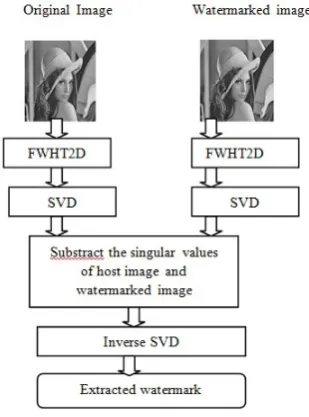
[image:3.595.359.514.233.442.2]Watermark is extracted using the algorithm given in Figure 2. The proposed algorithm is non-blind and requires host image for extrac-tion.
Fig. 2. Extraction Algorithm using FWHT2D and SVD
(1) The multiple scaling factor used in embedding is also utilized in extraction.
(2) Apply Fast Walsh-Hadamard transform to Watermarked image denoted byA0.
B0=F W HT2D(A0) (12) (3) Apply SVD to the Walsh-Hadamard transformed watermarked
image.
[Uwa, Swa, Vwa] =SV D(B
0
) (13)
(4) Obtain singular values of watermark from singular values of watermarked image from singular values of original image.
Swnew= (Swa−Sc)
kmax
k×α (14)
(5) Apply inverse SVD to obtain extracted watermark.
Wext=UwSwnewVwT (15)
Fig. 3. Block diagram of FWHT2D-SVD based GA
4. WATERMARK EMBEDDING IN HYBRIDIZED FWHT2D-SVD WITH GA
The proposed scheme uses hybridized FWHT2D-SVD with GA .The steps used for computation of multiple scaling factors is given below:
(1) As the watermark size is 64×64, the size of scaling factor to be optimized is taken 64. The 64 values of scaling factor is taken as chromosome.
(2) In GA, each chromosome in the population represents a possi-ble solution . The strings are enciphered using a doupossi-ble vector.
(3) For initial population, the values of scaling factors(SF)s are randomly produced. If the size of population is M and the num-ber of variables used is n, then the initial population consists of
M×n. So it is a matrix of random values ofM×n. In this paper M=100 and n=64 is used.
(4) The watermarks are extracted from the distorted using the ex-traction procedure discussed earlier. The fitness function is computed based on Structural similarity (S.S.I.M) between original and watermarked image as given in Equ. 18 and Nor-malized cross correlation between original and extracted
wa-termarks as given in Equ.??.
fi= t P
i=1
(N CC(w, wext)
t −S.S.I.M(I, Iw) (16)
where t is number of attacks employed.wis the watermark used in embedding.wextis the retrieved watermark under each
attack.Iis the host imageIwis the distorted or watermarked
image. In order to calculate fitness value, the expression is given as
f itnessi= 1
fi
(17)
Having evaluated all chromosomes in a generation, the chro-mosomes that produced the maximum fitness values are se-lected for the next generation. The population of the next gen-eration is then produced from these chromosomes by using ge-netic operators such as crossover and mutation operators. The processes explained above are iterated until a termination cri-teria is met, for example the maximum number of generations. (5) Evaluate the fitness of each chromosome by passing it to
ob-jective function.
Roulette-wheel , Boltzmann , tournament , Rank and steady-state selection.
(7) Apply crossover operator for producing population enriched with better individuals. The cross over operators can be used in GA are single point , two-point , multi-point and uniform cross over.
(8) Apply operator mutation such as flipping bits or by using shift left or right operators.
(9) Define cross over rate that define the number of pairs to be cross over for a fixed population.
(10) Define mutation rate that define the number of bits to be mu-tated.
(11) Define elitism, the population that is retained in next genera-tion.
[image:5.595.339.538.65.319.2](12) repeat the steps till termination criteria that is the population have attained a degree of homogeneity.
Fig. 4. a) Original image b) Watermarked image.
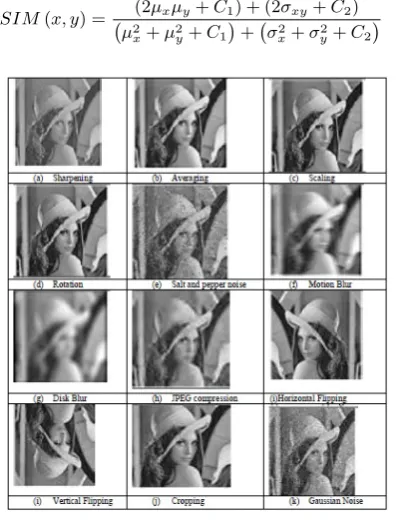
The Structural Similarity Index is defined in [32]
SSIM(x, y) = (2µxµy+C1) + (2σxy+C2)
µ2
x+µ2y+C1
+ σ2
x+σ2y+C2
[image:5.595.89.259.263.344.2](18)
[image:5.595.73.278.403.665.2]Fig. 5. Signal processing and compressional attacks applied to Lena
Fig. 6. Extracted watermarks after Lena image is subjected to Signal pro-cessing and Compressional attacks
Table 1. Normalized Cross Correlation between original and extracted watermark for different attacks without and
with GA
Attack type N.C.C without GA N.C.C with GA
Sharpening 0.1186 0.9637
Averaging 0.1195 0.9736
Scaling 0.1192 0.9732
Rotation 0.1097 0.9420
Salt and Pepper noise 0.1194 0.9540 Gaussian noise 0.1186 0.9611 Motion Blur 0.1209 0.9500
Disk Blur 0.1215 0.9288
Horizontal flip 0.1191 0.9732 Vertical flip 0.1191 0.9732
Cropping 0.1177 0.9756
Jpeg Compression 0.1192 0.9679
where
µx−Averageof x
µy−Averageof y
σ2
x-Variance of x.
σ2
y-Variance of y.
σxy-CoVariance of xy.
C1=K1L2-constant to avoid instability whenµ2x+µ2yis close to
zero.k1= 0.01, L=255.
C2=K2L2-constant to avoid instability when σ2x +σy2 is close
[image:5.595.329.545.405.544.2]fac-Table 2. P.S.N.R and Cross correlation obtained with GA for test images under no attack
Test Image P.S.N.R C.C Lena 54.776 0.99 F.16 55.676 1 House 53.55 1 Boat 53. 25 1
tor is used in proposed watermarking scheme without GA and from Table 1 low values of cross correlation reveal that the Walsh-Hadamard transform-SVD are not suited for robust watermarking. But with the multiple scaling factor obtained from GA using the fitness function given in Equ. 16is applied there is dramatic im-provement is seen in robustness.
5. RESULTS AND DISCUSSION
The numerical simulation of our algorithm is implemented using an Intel 5 processor of 2.5 GHz and 4 GB RAM using Microsoft Windows 7 and Matlab 8.1. We used the 512×512 gray scale Lena image , 64×64 gray scale GRIET emblem as host image and logo. The choice of attacks used for evaluating the proposed watermarking scheme are sharpening, averaging, rotation, scaling, salt and pepper noise, Gaussian noise, motion blur, disk blur, Jpeg compression, vertical flipping, horizontal flipping and cropping as shown in Figure 5. The extracted watermarks under different at-tacks are shown in Figure 6. The watermarking scheme is evalu-ated through Peak Signal to Noise Ratio (PSNR), [1], Normalized Correlation Coefficient (NCC) [1]. Normally, in image processing, the quality of watermark is judged based on P.S.N.R. The P.S.N.R between watermarked and the original image is defined in equ 19
P SN R= 10log10(
2552
M.S.E) (19)
Where and the MSE is the mean squared error between host and watermarked image. and Normalized cross correlation is taken as
N.C.C= PM−1
i=0
PN−1
j=0 w(i, j)wext(i, j) PM−1
i=0
PN−1
j=0 w(i, j)2
(20)
N.C.C is a measure of similarity between the original and extracted watermark. It lies between 0 to 1. If it is nearly 1 then the original and extracted watermark are identical.The more the normalized cross correlation the robust the design is.The GA is initialized with different initial population.For each initial population the range of scaling factor must be given. It is a diagonal matrix with 64 variables. The size of population is 100. So a random matrix comprised of64×100is the initial population.Each 64 variables constitute a chromosome.So initially 100 chromosomes are taken and fed to fitness function and 100 fitness values are obtained. Out of them, the chromosomes having the highest fitness value are retained using selection process. Roulette selection process is used in proposed algorithm. The scaling function used is Rank. The cross over method used is single point. The cross over fraction and mutation rate is taken as 0.8 and 0.04. The elite count is taken as 5.The number of Generations used is 400.
The 64 best scaling factor obtained with GA.
[image:6.595.316.561.99.217.2]328.5014 951.6928 655.8299 729.8926 694.2096 689.4976 605.0334 375.9066 764.0373 603.0104 365.1091 959.9923
Table 3. Comparision of Normalized cross correlation between original and extracted watermark for different attacks between
proposed algorithm and santhi et. al
Attack type N.C.C of [28] N.C.C of proposed Algorithm
Scaling 0.8441 0.9732
Rotation 0.8793 0.9420
Salt and Pepper noise 0.9540
Gaussian noise 0.9611
Motion Blur 0.9500
Disk Blur 0.9288
Horizontal flip 0.9732
Vertical flip 0.9732
Cropping 0.8562 0.9756
[image:6.595.122.229.101.154.2]Jpeg Compression 0.8436 0.9679
Table 4. Comparision of Normalized cross correlation between original and extracted watermark for different attacks between
proposed algorithm and bhatnagar et al.
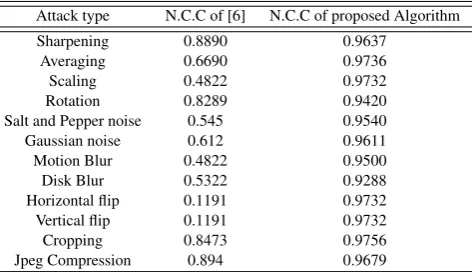
Attack type N.C.C of [6] N.C.C of proposed Algorithm
Sharpening 0.8890 0.9637
Averaging 0.6690 0.9736
Scaling 0.4822 0.9732
Rotation 0.8289 0.9420
Salt and Pepper noise 0.545 0.9540 Gaussian noise 0.612 0.9611 Motion Blur 0.4822 0.9500
Disk Blur 0.5322 0.9288
Horizontal flip 0.1191 0.9732 Vertical flip 0.1191 0.9732
Cropping 0.8473 0.9756
Jpeg Compression 0.894 0.9679
934.2089 858.6199 653.9487 962.2642 840.3048 957.1775 840.3048 957.1775 683.5209 601.4993 964.7182 558.1196 803.6664 804.3353 668.7058 540.7351 745.5223 655.3275 799.7824 505.8513 424.9317 875.3336 696.5437 860.1560 411.3766 679.1339 708.9430 716.8215 900.8159 948.6748 723.8566 493.8747 793.2786 762.7139 881.4497 857.5746 319.9588 703.5539 770.0906 871.4000 834.3152 819.6665 865.1642 974.2767 378.0016 741.8255 618.5433 901.0897 904.9481 675.9644 948.4349 968.0743 481.2220 384.9168
The proposed algorithm is compared with the works on Hadamard transfrom already present in literature Ref.[28], and Ref.[6] . The peak signal to noise ratio of Ref.[6] is around 45 dB. The Peak signal to noise ratio of proposed algorithm is greater than 54 dB. References Ref. [6] and Ref.[28] are used for comparing the pro-posed algorithm in Table. 5 and Table 3 and the high N.C.C value of proposed algorithm indicate that it is more robust to attacks. The host and watermarked images are shown in Figure. 7 and 8. The various attacks used in watermarking are
(1) Sharpening: The watermarked image is subjected to 3×3 mask of high pass filter . The extracted watermark is95%similar to original watermark.
(2) averaging: The watermarked image is subjected to 3×3 mask of low pass filter. The extracted watermark is97%is similar to original watermark.
[image:6.595.321.559.264.400.2]in-Fig. 7. Host images
Fig. 8. Watermarked images
creased. so in order to restore original shape some of the useful information is lost. The retrieved watermark is95%similar to original watermark.
(4) Scaling is a major attack in image watermarking. It removes high frequency components.So useful information may be lost. In the proposed watermarking the image is scaled to one fourth of the original and restored back to its normal size before ex-traction . The retrieved watermark is98%similar to original watermark.
(5) Gaussian noise : Gaussian noise with zero mean and normal-ized variance 0.01 are added to distorted image.The retrieved watermark is95%similar to original watermark.
(6) Salt and pepper noise: It adds this noise to the watermarked image, with specified noise density. The default value of noise density taken is 0.05.The retrieved watermark is97%similar to original watermark.
(7) Motion blur: Apply motion blur to the watermarked image. The retrieved watermark is90%similar to original watermark. (8) Circular blur: Apply circular blur to watermarked image.The
retrieved watermark is95%similar to original watermark. (9) Vertical flip: It returns watermarked image with rows flipped
in the up-down direction, that is, about a horizontal axis.The retrieved watermark is98%similar to original watermark. (10) Horizontal flip: It returns watermarked image with columns
flipped in the left-right direction, that is, about a vertical axis. (11) JPEG compression: It compresses the watermarked image to
the specified jpeg quality factor of 60 %.The retrieved water-mark is98%similar to original watermark.
(12) Cropping: It crops the watermarked image in specified loca-tion up to a height and width.The retrieved watermark is98%
similar to original watermark.
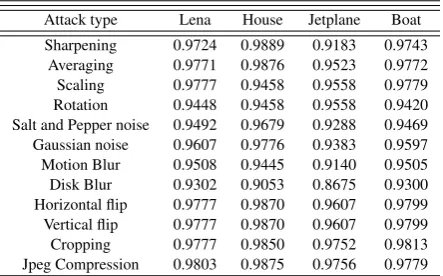
[image:7.595.53.310.66.162.2]The algorithm is trained with different host images -Lena, Boat, Jet plane and House as shown in Figure. 7 with G.R.I.E.T logo. Each image have different histograms. Though the images are dif-ferent with the proposed scaling factors obtained with GA using the
Table 5. Comparision of Normalized cross correlation between original and extracted watermark for different cover
images in proposed algorithm
Attack type Lena House Jetplane Boat
Sharpening 0.9724 0.9889 0.9183 0.9743 Averaging 0.9771 0.9876 0.9523 0.9772 Scaling 0.9777 0.9458 0.9558 0.9779 Rotation 0.9448 0.9458 0.9558 0.9420 Salt and Pepper noise 0.9492 0.9679 0.9288 0.9469 Gaussian noise 0.9607 0.9776 0.9383 0.9597 Motion Blur 0.9508 0.9445 0.9140 0.9505 Disk Blur 0.9302 0.9053 0.8675 0.9300 Horizontal flip 0.9777 0.9870 0.9607 0.9799 Vertical flip 0.9777 0.9870 0.9607 0.9799 Cropping 0.9777 0.9850 0.9752 0.9813 Jpeg Compression 0.9803 0.9875 0.9756 0.9779
trained host images the N.C.C is found to be more than 95%. The corresponding watermarked images are shown in Fig. 8
6. CONCLUSION
Inherently Walsh-Hadamard transform is suffered with the prob-lem of robustness. In watermarking optimizing transparency and robustness is a challenge. By using multiple scaling factors de-rived from GA, an amelioration of transparency and robustness is achieved in the proposed algorithm.But GA suffers from high computational complexity. So in future the work can be extended with Differential Evolution that has the advantages of fast conver-gence,minimum parameters to control and parallel processing.
7. REFERENCES
[1] Emad E Abdallah, A Ben Hamza, and Prabir Bhattacharya. Mpeg video watermarking using tensor singular value decom-position. InImage Analysis and Recognition, pages 772–783. Springer, 2007.
[2] Charu Agarwal, Anurag Mishra, and Arpita Sharma. Gray-scale image watermarking using gabpn hybrid network. Jour-nal of Visual Communication and Image Representation, 24(7):1135–1146, 2013.
[3] Harry C Andrews and C Patterson III. Singular value decom-position (svd) image coding.Communications, IEEE Trans-actions on, 24(4):425–432, 1976.
[4] Veysel Aslantas. A singular value decomposition-based image watermarking using genetic algorithm. AEU-International Journal of Electronics and Communications, 62(5):386–394, 2008.
[5] Veysel Aslantas. An optimal robust digital image watermark-ing based on svd uswatermark-ing differential evolution algorithm. Op-tics Communications, 282(5):769–777, 2009.
[6] Gaurav Bhatnagar and Balasubramanian Raman. Robust wa-termarking in multiresolution walsh-hadamard transform. In Advance Computing Conference, 2009. IACC 2009. IEEE In-ternational, pages 894–899. IEEE, 2009.
[7] Alexia Briassouli and Michael G Strintzis. Locally optimum nonlinearities for dct watermark detection.Image Processing, IEEE Transactions on, 13(12):1604–1617, 2004.
[image:7.595.327.549.99.237.2]amplitude boost and low amplitude block selection.Pattern Recognition, 38(4):587–598, 2005.
[9] BJ Falkowski and Lip-San Lim. Image watermarking us-ing hadamard transforms.Electronics Letters, 36(3):211–213, 2000.
[10] BJ Falkowski and S Rahardja. Walsh-like functions and their relations. InVision, Image and Signal Processing, IEE Proceedings-, volume 143, pages 279–284. IET, 1996. [11] Bogdan J Falkowski. Properties and ways of calculation
of multi-polarity generalized walsh transforms.Circuits and Systems II: Analog and Digital Signal Processing, IEEE Transactions on, 41(6):380–391, 1994.
[12] Emir Ganic and Ahmet M Eskicioglu. Robust embedding of visual watermarks using discrete wavelet transform and sin-gular value decomposition.Journal of Electronic Imaging, 14(4):043004–043004, 2005.
[13] Rafael C Gonzalez and E Richard. Woods, digital image pro-cessing.ed: Prentice Hall Press, ISBN 0-201-18075-8, 2002. [14] Prayoth Kumsawat, Kitti Attakitmongcol, and Arthit Srikaew. A new approach for optimization in image watermarking by using genetic algorithms.Signal Processing, IEEE Transac-tions on, 53(12):4707–4719, 2005.
[15] Martin Kutter, Sviatoslav V Voloshynovskiy, and Alexan-der Herrigel. Watermark copy attack. InElectronic Imaging, pages 371–380. International Society for Optics and Photon-ics, 2000.
[16] Shinfeng D Lin, Shih-Chieh Shie, and Jim Yi Guo. Improving the robustness of dct-based image watermarking against jpeg compression. Computer Standards & Interfaces, 32(1):54– 60, 2010.
[17] Jian-Chyn Liu and Shu-Yuan Chen. Fast two-layer image termarking without referring to the original image and wa-termark. Image and Vision Computing, 19(14):1083–1097, 2001.
[18] Ruizhen Liu and Tieniu Tan. An svd-based watermarking scheme for protecting rightful ownership.Multimedia, IEEE Transactions on, 4(1):121–128, 2002.
[19] Yan Liu and Jiying Zhao. A new video watermarking algo-rithm based on 1d dft and radon transform.Signal Processing, 90(2):626–639, 2010.
[20] Santi P Maity and Claude Delpha. Optimization in digital watermarking techniques.Advanced Techniques in Multime-dia Watermarking: Image, Video and Audio Application, IGI Global Pub., USA, pages 369–406, 2010.
[21] K Meenakshi, Ch Srinivasa Rao, and K Satya Prasad. A fast and robust hybrid watermaking scheme based on schur and svd transform.International Journal of Research in Engineer-ing and Technology, 3(4):7–11, 2014.
[22] K Meenakshi, Ch Srinivasa Rao, K Satya Prasad, et al. Robust video watermarking schemes in phase domain using binary phase shift keying.arXiv preprint arXiv:1404.1314, 2014. [23] K Meenakshi, Ch Srinivasa Rao, and K Satya Prasad. A scene
based video watermarking using slant transform.IETE Jour-nal of Research, (ahead-of-print):1–12, 2014.
[24] Jagdish C Patra, Jiliang E Phua, and Cedric Bornand. A novel dct domain crt-based watermarking scheme for image authen-tication surviving jpeg compression.Digital Signal Process-ing, 20(6):1597–1611, 2010.
[25] William Pratt, Julius Kane, and Harry C Andrews. Hadamard transform image coding.Proceedings of the IEEE, 57(1):58– 68, 1969.
[26] Mahalingam Ramkumar and Ali N Akansu. Capacity esti-mates for data hiding in compressed images.Image Process-ing, IEEE Transactions on, 10(8):1252–1263, 2001. [27] JJK ´O Ruanaidh, WJ Dowling, and FM Boland.
Watermark-ing digital images for copyright protection.IEE Proceedings-Vision, Image and Signal Processing, 143(4):250–256, 1996. [28] V Santhi and P Arulmozhivarman. Hadamard transform based adaptive visible/invisible watermarking scheme for digital images.Information Security Technical Report, 2013. [29] Adrian Sequeira and Deepa Kundur. Communication and
in-formation theory in watermarking: A survey. InITCom 2001: International Symposium on the Convergence of IT and Com-munications, pages 216–227. International Society for Optics and Photonics, 2001.
[30] Chin-Shiuh Shieh, Hsiang-Cheh Huang, Feng-Hsing Wang, and Jeng-Shyang Pan. Genetic watermarking based on transform-domain techniques. Pattern recognition, 37(3):555–565, 2004.
[31] Jieh-Ming Shieh, Der-Chyuan Lou, and Ming-Chang Chang. A semi-blind digital watermarking scheme based on singu-lar value decomposition.Computer Standards & Interfaces, 28(4):428–440, 2006.
[32] Zhou Wang, Alan C Bovik, Hamid R Sheikh, and Eero P Simoncelli. Image quality assessment: from error visibility to structural similarity.Image Processing, IEEE Transactions on, 13(4):600–612, 2004.
[33] Iran Yazd. Digital image watermarking based on parameters amelioration of parametric slant-hadamard transform using genetic algorithm. 2012.