2018 International Conference on Computer, Communications and Mechatronics Engineering (CCME 2018) ISBN: 978-1-60595-611-4
RFID-based Intelligent Warehouse Management
Yu GAO and Chun LIN
Centre of Information Technology, CGN Power Co., Ltd., Shenzhen City, China
Keywords: RFID technology, Warehouse management, Applied research.
Abstract. RFID technology is a non-contact automatic identification technology that is being gradually applied to warehouse management. Based on the development and application status of RFID technology at home and abroad, this paper gives an overview of the concept, working principle, advantages and typical applications of RFID. The hardware composition, system flow and system functions of the warehouse management system using RFID technology are elaborated. Analyzed the advantages of the system.
Introduction
RFID is a new type of information technology that enables fast contact between data and information. RFID is widely used in manufacturing, product anti-counterfeiting, animal identification, bus card, logistics and supply chain management. RFID technology is a wireless tag that transmits data wirelessly, automatically identifies target objects and acquires relevant data through RF signals. There is no need for a straight line of sight between the reader and the identified target, and it is a readable and writable technology. The slow mode of information transfer has become less and less applicable to the development of the modern warehousing industry, and there is an urgent need for a new information technology to replace this traditional warehousing mode.
Research Status and Purpose
Research Status at Home and Abroad
In 2003, Wal-Mart asked the top 100 suppliers to adopt RFID in 2 years and required their manufacturers to complete the RFID supporting measures within 3 years. At the same time, Gillette Corporation of the United States also carried out application tests of RFID technology. In 2004, BIM and Philips provided an RFID-based logistics system for verification tests conducted by Tesoc in the UK and Metor in Germany, respectively, and built a demonstration shopping supermarket accordingly. In China, the first application of RFID technology to warehousing is Shenzhen Bai Sha Logistics. Bai Sha Logistics was invested by Bai Sha Group in 1992 with a total investment of 250 million and a registered capital of 60 million. A few years later, Bai Sha Logistics has become a well-known third-party logistics company. At present, the application of Bai Sha Logistics System is to add RFID and bar code to the pallet and bar code management. Through this application, the utilization rate of Bai Sha Logistics is 30. The % is increased by 80%, and since the pallet is reused, the electronic label is reused accordingly, so that the hardware cost is effectively controlled.
Research Purposes and Significance
track items and exchange data. Because RFID technology eliminates the manual intervention in the tracking process, it can greatly improve work efficiency while saving a lot of manpower, so it has great appeal to logistics and supply chain management.
Introduction to RFID Technology
Concept of RFID Technology
RFID is the abbreviation of Radio Frequency Identification, which is commonly known as inductive electronic chip or proximity card, proximity card, contactless card, electronic tag, electronic bar code, commonly known as radio frequency tag. RFID technology is a non-contact automatic identification technology. Simply put, RFID technology is a radio frequency tag that transmits data wirelessly, and automatically identifies the target object and acquires relevant data through the RF signal, between the reader and the identified target. It does not require a straight line of sight and is a readable and writable technology.
How RFID Technology Works
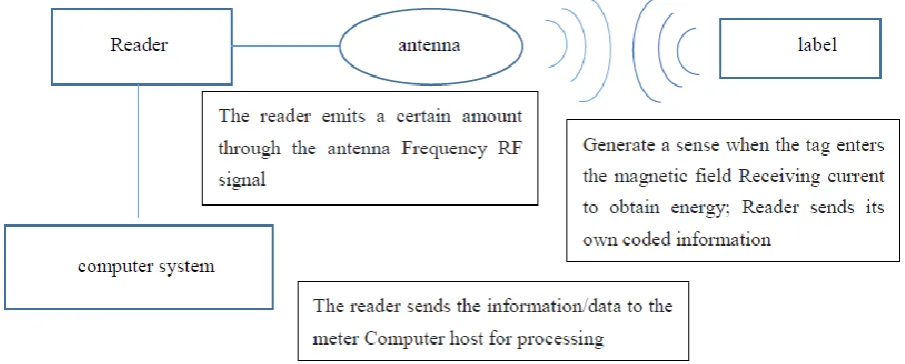
[image:2.595.75.528.412.594.2]The working principle of RFID technology is that the reader emits a special RF signal through a reader antenna in a certain range of magnetic fields. If the RF signal is received by a passive RF tag or a passive RF tag, the RF tag can be obtained by the induced current. The micro-energy sends out the electronic information stored in the chip, or the active radio frequency tag or the active radio frequency tag actively transmits the signal of a certain frequency, and the reader receives the electronic information of the radio frequency tag and decodes it, and sends it to the computer network system for reading. The RF tag performs data processing. Figure 1 shows the working principle of RFID technology:
Figure 1. Working principle of RFID technology.
Advantages of RFID Technology
Application of RFID Technology in Warehouse Management System
System Hardware Components
Main control system: Including the main control computer, network controller, the reader of the in/out door and the corresponding identification antenna, wireless network connector, location navigation indicator and so on. The main control computer is connected to the network controller, and is connected through a data line to a wireless network connector, an access/access door reader, and an identification antenna and a location navigation indicator.
Vehicle unit: Including car control computer, display, wireless network connector, reader and identification antenna, standard tray with electronic label, car electronic tag with electronic code for truck identification. The vehicle unit is connected to the main control system via a wireless network connector.
Handheld unit: Includes integrated mobile handsets and handheld electronic tags with handheld device identification electronics. The handheld unit accesses the host computer over a wireless network.
Warehouse facilities: The warehouse will be divided into different locations with corresponding identification electronic codes, including the warehouse, cargo area, shelves and each individual goods storage area. The manager writes the electronic code of the location into the location identification electronic tag and encapsulates the location identification electronic tag in the navigation indicator of the corresponding location. The entire warehouse and the vicinity of each warehouse door will be covered by an infinite LAN to achieve information sharing.
The Main Business Process of the System
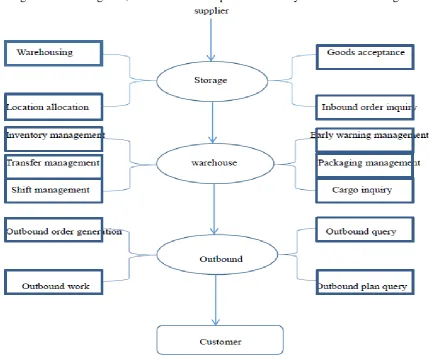
[image:3.595.81.511.396.751.2]According to the flow of goods, the main business process of the system is shown in Figure 2.
System Functions
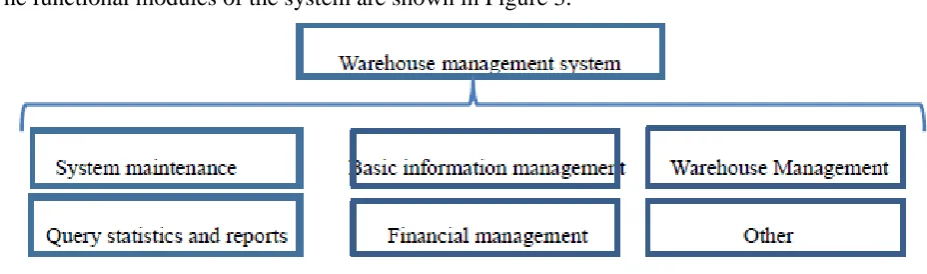
[image:4.595.62.526.99.236.2]The functional modules of the system are shown in Figure 3.
Figure 3. System main function module.
System Maintenance. Includes user rights management, password settings, operation logs, data backup, and print settings.
Basic Information Management. It mainly realizes the management of the basic information of the system and the setting of initial data. Includes warehouse definitions, regional information, product information, supplier information, customer information, employee information, inbound and outbound information, and category information.
Warehouse Management. Mainly to achieve the management of the basic business of warehousing, is the core of the entire warehousing management. Including goods into the warehouse, goods out of the warehouse, warehouse management system, system maintenance, basic information management, warehouse management, query statistics, financial management, other location management, inventory management, shift management, transfer management, early warning management, packaging management Quality management.
Query Statistics and Reports. Including warehousing, outbound, assembly, disassembly, loss reporting, shifting, inventory, etc. query statistics, outbound planning, transfer orders, transfer applications, customer orders, contracts, etc. and various report output.
Financial Management. Mainly used for simple bookkeeping, it can manage the income and expenditure in the warehouse logistics. Including account setting, accounting entry, accounting management, accounting inquiry, statistical summary table and certificate printing.
Other auxiliary projects and terminal program interfaces.
Advantages of the System
The RFID-based warehouse management system uses electronic tags to tag each object that needs to be managed during its management cycle. Managers can use this system to know the nature, status, location, historical changes and other information of each managed object (goods) in real time, and take corresponding management countermeasures and measures according to this information to improve the operation level and management quality of the enterprise. purpose. The warehousing management system can achieve better results after applying RFID technology, mainly in:
Full-featured: The system closely integrates the characteristics of the warehousing industry, making the system closely integrated with the actual business.
Flexible and convenient operation: The system is humanized from the interface and function organization, so that the operator can grasp the use of the system in the shortest time, and greatly improve the work efficiency through quick operation.
object-oriented design method, realizes componentization and makes the system have good scalability. If the user's business changes, only need to add or modify some business components in the business logic layer.
Conclusion
RFID technology brings great technological innovation to the field of logistics and warehousing, which greatly improves the collection speed of logistics information and the efficiency of logistics operations. This course focuses on the application of RFID technology in warehouse management and optimizes the existing warehouse management system. As discussed in the previous article, the application of RFID technology in warehousing will certainly drive the rapid development of the warehousing industry, and bring a rich return on investment for strategic investment partners; it will also have the ability to mobilize and coordinate social logistics warehousing resources, and reduce society. At the same time of the total cost of logistics and warehousing, improve the overall efficiency and efficiency of social logistics warehousing.
References
[1] R. Want, An Introduction to RFID Technology, 2006, 21(3):25-33.
[2] J. Kabachinski, An introduction to RFID, Biomedical Instrumentation & Technology, 2005, 39 (2):131.
[3] J. Landt, The history of RFID, Potentials IEEE, 2005, 24 (4):8-11.
[4] SE Sarma, SA Weis, DW Engels: RFID Systems and Security and Privacy Implications Revised Papers from the International Workshop, 2002, 25(23):454-469.