https://dx.doi.org/10.22161/ijels.4.3.40 ISSN: 2456-7620
Upgrading of Intelligent Warehouse
Management System Based on RFID
Technology- Taking Company as an Example
Zhang Tongliang, Wang Xinxin, Yang Xue
School of Economics , Shandong University of Technology, Zibo 255000,China
Abstract— With the continuous development of e-commerce in China, more and more attention has been paid to modern logistics. The competition in the new era is not only in the fields of technology, cost and management, but also in the comprehensive competition of supply chain. The traditional warehouse management system is mainly completed by human resources, which consumes a lot of manpower and material resources and has low efficiency. It can no longer meet the needs of the development of modern e-commerce logistics. New retail industry is changing. New logistics has become the core of new retail form. Developing intelligent warehousing has become a solution to advance intelligent logistics. Radio Frequency Identification (RFID) technology has the advantages of large data storage, fast information reading and storage, and can effectively solve the problems of low efficiency, low accuracy and easy interference in information transmission of traditional warehouse management system. Based on the analysis of the existing problems of company A in warehouse management, this paper proposes to use RFID technology to optimize and upgrade it.
Keywords— RFID technology, intelligent , warehousing,
logistics, digitalization.
With the close integration of network technology with various real industries and financial economy, China's agriculture, industry and commodity service industry have achieved new development. At the same time, they are facing new opportunities and challenges. Logistics, as an important part of commodity trade, plays an increasingly important role. However, our t raditional logistics network has been insufficient to meet the increasingly vigorous transportation needs. The warehouse management system also needs to be upgraded urgently.
At present, the intelligent wa rehouse management system is integrated with wire less communication technology and RFID rad io frequency technology. These new technologies enable the existing warehouse manage ment system to be reconstructed and intellectualized,
and use the flexibility of wire less network wiring to meet the special needs of data close-range and low-speed in intelligent wa rehouse management. At the sa me t ime, along with the development of RFID radio frequency technology, the whole process of goods fro m inbound to outbound has also undergone innovative changes and leaps and bounds. Because of the non-contact and fast reading and writing characteristics of RFID, the goods can basically be intellectualized and mechanized in wa rehousing, discharging and picking. Intelligent warehouse management means changing the tradit ional way o f warehouse manage ment, rea lizing a more thorough sense and measure ment of business, and interconnecting each other more co mprehensively. On this basis , we can get a deeper understanding.
I. ENTERPRIS E AN OVERVIEW
Enterprise A is located in the northern cities of China, ma inly engaged in the acquisition and sale of agricultural products. Because of the higher require ments of agricultural products for logistics transportation and warehousing, the traditional logistics wa rehousing mode of enterprise A fro m origin to warehouse to sales point has higher cost, and the effic iency of logistics warehousing mode ma inly rely ing on human partic ipation is low, and the error rate needs to be reduced. In the period of enterprise transformat ion to meet the needs of contemporary society, the application of new technology is particularly important.
II. OVERVIEW OF RFID TECHNOLOGY
https://dx.doi.org/10.22161/ijels.4.3.40 ISSN: 2456-7620
radio waves to read and store information. The storage informat ion in the RFID tag is read by the rad io wave emitted by the sensor, which is main ly used to identify the object, while the distance of the sensor is from several centimeters to several meters. A perfect industrial chain of RFID technology should include chips, reading and writing devices, antennas, application software, label packag ing, system integration and many other co mponents, among which ch ips are the most important design focus in the overall industrial chain. This technology has the functions of fast speed, large capacity, sma ll vo lu me, strong penetration, long service life and high reusability. At the same time, this technology can also track and locate the target object for a long time , so it can be applied to many fie lds such as supply chain manage ment, intelligent transportation, quality manage ment in manufacturing industry. RFID has become the ma in technical means of logistics manage ment in developed countries. In Japan and Korea, electronic tags have become the standard configuration of most logistics distribution centers. In recent years, many enterprises in Ch ina have introduced electronic tags to upgrade the management system, and achieved some results. Mainly used in the following three aspects: first, within the enterprise ,the p lace ment of rad io frequency tags on the pallets of automated warehouses can significantly improve the manage ment of refine ment, Haie r, Shenzhen Baisha Group and other cases; second, the use of a supply chain can reduce management costs, improve product quality and improve inventory scheduling level, such as Hong Kong Yida Group. Radio frequency label is used in Xinjiang cotton purchasing process. Third, it is applied in a wide range of networks. The typical case is the vehicle manage ment and dispatching system of the Ministry of Railways.
III. THE FRAMEWORK OF CURRENT WAREHOUS ING MANAGEMENT AND ITS
PROBLEMS
Fro m suppliers supplying commod ities, sorting commodit ies into warehouses, informat ion registration, and then determining the location of commodity storage for storage, to commodit ies into production workshop for production, and finally to new commod ities out of warehouses, this step-by-step process is more complex.
1. Framework of warehousing management:
⑴.Storage of goods. Suppliers supply commodities
toproducers. Warehousing centers grasp relevant informat ion of commodit ies from suppliers (such as the name, quantity, specifications of co mmodit ies), and determine the storage location of commodit ies. Warehousing centers arrange inspection and storage of
commodities when they receive commodities.
(2) Manage ment of goods in warehouse. The manage ment of goods in warehouse must also follow certain standards. For exa mple , some goods consume fast, some goods consume slowly, and some goods must be stored under special conditions, so their storage location needs to be strictly controlled. Moreover, there are certain require ments for the storage of similar but different specifications of co mmodit ies. These proble ms make it necessary to confirm that the goods are in accordance with the location when they are stored.
(3) Goods out of warehouse. In the warehouse manage ment procedure, if the customer has issued an order to the sales department, the sales department will send the customer's order require ments to the warehouse manage ment depart ment, and the warehouse management system will confirm the goods location.
2.Problems in warehousing management:
(1) Hu man factors have great influence and lack of decision-ma king ability. If the management mode is basically manual management, a large nu mber of staff need to be arranged in warehousing operations, such as warehousing, inventory and warehousing, which increases the cost of manage ment and also affects the efficiency of work. Once proble ms arise in the intermediate work, the situation can not be transmitted to the higher level in t ime, and some staff's mishandling will lead to the inaccuracy of the inventory work, the upper leadership can not make correct decisions, and can not accurately understand the storage, in-storage and out-of-storage operations of the inventory, which will cause losses.
(2) The use of bar code technology. Nowadays, barcode is often used in warehouse manage ment system to improve the speed of collecting goods informat ion. Co mpared with tradit ional manual paper records, it does improve the effic iency. However, in the face of increasingly frequent logistics warehousing needs, the drawbacks of barcode technology are beco ming more and more prominent, such as slow identification speed, inaccurate reading of information and less information.
(3) Visualization operation can not be realized. More and more users hope to see the goods informat ion and dynamic transportation status in real time, instead of the static logistics informat ion on the client side. This will require enterprises to further imple ment intelligent logistics strategy to meet the needs of users, while rea lizing the dynamic feedback of cargo transportation status. Intelligent logistics can be more conducive to enterprises for targeted analysis and decision-ma king, and imp rove a ll aspects of enterprises. Save work efficiency.
https://dx.doi.org/10.22161/ijels.4.3.40 ISSN: 2456-7620
inevitably e xposed to the risk of brea kage. Simila rly, in warehouse management, some co mmod ities are o f the same kind and have very low diffe rentiation, wh ich makes warehousing management more difficult. Similar commodit ies may lead to staff negligence and make two different commodities mixed together.
IV. OPTIMIZING AND UPGRADING MEASURES OF INTELLIGENT WAREHOUS E MANAGEMENT SYSTEM BASED ON RFID
TECHNOLOGY
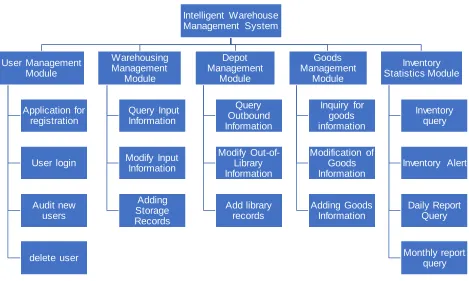
The warehouse management system based on RFID can effectively realize the visual management of commodity inventory information through the application of RFID technology and wire less network technology, thus greatly imp roving the efficiency of wa rehousing operations. Based on these require ments, we can get several ma in modules of the system: user management module , stock manage ment module, warehousing manage ment module, as well as goods management, inventory statistics management module.
Fig. 1 Performance structure of warehouse management system based on RFID Technology
In the software structure design of digital logistics warehouse manage ment system based on radio frequency identification technology, the functional module flow of the system is designed separately, the control structure of the system is optimized, and the operation effic iency of the system is improved. The warehouse is composed of warehousing temporary storage area, storage area and out of storage temporary storage area. RFID access control devices are installed at storage and storage outlet. The warehouse is designed as an automatic three-dimensional warehouse, equipped with three-d imensional shelves and
roadway stackers. The quantity depends on the size of the warehouse. In order to monitor the warehouse environment in rea l t ime and install a suitable number of te mperature, illu mination intensity and humidity sensors, the sensor transmits the environmental information to the monitoring system through the network. When the environmental informat ion of the warehouse exceeds the set value, the system sends out alarm instructions and displays the reasons for the a larm. The a larm is sent out by the warehouse admin istrator. The wa rehouse administrator processes and records the alarm in t ime . The reason of the Intelligent Warehouse
Management System
User Management Module
Application for registration
User login
Audit new users
delete user
Warehousing Management
Module
Query Input Information
Modify Input Information
Adding Storage Records
Depot Management
Module
Query Outbound Information
Modify Out-of-Library Information
Add library records
Goods Management
Module
Inquiry for goods information
Modification of Goods Information
Adding Goods Information
Inventory Statistics Module
Inventory query
Inventory Alert
Daily Report Query
https://dx.doi.org/10.22161/ijels.4.3.40 ISSN: 2456-7620
alarm is summarized and analy zed regularly and the
suggestions for improvement are put forward. In the goods management module, the ma in functions
include inventory management, inventory, inventory early warning. Detailed function design: add, modify and delete warehouse informat ion; add, modify and delete and disable goods allocation; vie w inventory information and inventory situation of each warehouse location; adjust the warehouse location on the visual interface, regard the whole backstage as the warehouse location adjustment component, so as to reduce energy consumption and save running time of the system. In the user management module, it ma inly includes user login control and user management. In the user's login control, the load driver is used to obtain the connection object, and the state statement is created to generate the processing result data set and release the connection. When the user enters the username and password and clic ks on the login, the data input by the user will be processed in the background, matching the account and password in the database. If the match is successful, the login will succeed, otherwise the prompt will fail, and the ma in page will be returned. For the purpose of ensuring the confidentiality and reliability of the system, the storage management system uses the management form of mu lti-level users. Users are d ivided into several levels: supervisors, system managers, purchasing personnel and warehouse managers. Different levels of authority, mult i-pronged, clear d ivision of labor, conducive to the smooth operation of the system.
In order to rationalize inventory and reduce inventory cost, statistical software can be used to invoke information such as commodity category, quantity, date of entry and exit, e xisting inventory, goods damage and order satisfaction rate, so as to calculate the period of entry and e xit, monthly demand and average level, off-peak season analysis, annual total demand, roughness analysis, overstocked commodity varieties and quantity, and goods loss rate and so on, assist managers to ma ke scientific de mand forecasting, and provide data reference for improving warehousing conditions and commodity production plan.
RFID technology combined with co mputer technology and pallet management can optimize the business process of distribution center. When wa rehousing, the goods are scanned on the conveyor belt, then directly stacked on the pallet. The pallet is automatically sent to the corresponding floor by the hoist under the control of the system. Fina lly, the forklift t ruck sends the pallet to the a llocated storage space of the system. When discharging fro m the warehouse, the forklift truck sends the target tray to the hoist according to the system instruction and the first-in-first-out principle, and then sends it to the sorting center for sorting. Through the effective manage ment and applicat ion of the tray, the number of cargo handling and the probability of da mage are
reduced, and the operation efficiency is imp roved. The application of RFID technology improves the speed of goods searching, reduces the occurrence of commodity out-of-sale, shortens the time of supply and marketing planning, thus reduces the stock occupation funds, reduces fre ight, and makes the retaile r's co mmodity sales meet in time.
V. CONCLUSIONS AND SUGGES TIONS
Co mbin ing RFID technology with warehouse manage ment to improve the accuracy of warehouse manage ment data can not only overcome the shortcomings of traditional manual manage ment, but also reduce labor costs with the improve ment of automation level of warehouse system. In recent years, the technology of RFID has become a hot spot in log istics informationizat ion, especially in the promotion of foreign powerful enterprises, which ma kes the application prospect of this technology in China receive much attention. As far as the whole country is concerned, the application cost of RFID is too high, the technical standards are not uniform, and the government has not played a leading ro le in the process of its application and promotion, which ma kes enterprises show cautious attitude in the face of RFID, so the promotion and application of RFID in China is still in a very slow starting stage. In order to pro mote the development of RFID in China's logistics fie ld, we should actively participate in the formulat ion of international standards and establish a unified RFID system; the government should drive enterprises to promote the exchange and research of RFID. Through the establishment of an industrial a lliance for the application and promotion of RFID, and under the leadership of the relevant departments of the state, we will work with relevant manufacturers, research institutes and user departments to launch products and technologies with distinctive features, and actively pro mote e xtensive international e xchanges between domestic enterprises and relevant units in the fields of RFID hardwa re, software and applications.
REFERENCES
[1] Application of Wang Minyu. RFID in Storage Material Management of Ma ll [J]. Education and Teaching Forum, 2018, (21): 103-104.
[2] Yu Shixin, Li Yong. Warehousing Management System Based on RFID [J]. Information Technology, 2016 (05): 81-83
[3] Li Qi. Application of RFID in Logistics Warehousing [J]. Management and Technology of Sma ll and Medium-sized Enterprises (Prev ious Periodica ls), 2013 (04): 298.
https://dx.doi.org/10.22161/ijels.4.3.40 ISSN: 2456-7620
Warehousing System Based on Internet of Things RFID Technology [J]. Manufacturing Automation, 2012, 34 (4): 139-141.
[5] Ouyang Ping, Wu Yunze, Sun Wenwen. Dig ital warehouse management system based on radio frequency identificat ion technology [J]. Aviat ion standardization and quality, 2015, 10(5): 48-52. [6] Liu Bingbing, Sun Libo, Yu Yugang. Recent advances
in warehousing, logistics and supply chain manage ment [J]. Journal of Ch ina University of Science and Technology, 2017, 47 (2): 176-187 [7] Liu He. Logistics Storage Management System for
Frozen and Refrigerated Food Based on Radio Frequency Identification Technology [J]. Food and Machinery, 2016 (1): 121-124
[8] Wang Xiu xing. Application of Intelligent Warehousing System in Electronic Co mme rce Environ ment [J]. Information Technology and Informat ization, 2015, 4 (8): 73-74
[9] Kongxing. Discussion on the Application Mode of RFID Technology in Intelligent Warehouse Management [J]. China Market, 2013 (34): 19-20. [10] Xiang Daodong. Optimization and design of