Study of Logistics Warehouse Management System Based on RFID
Jin Yingli
1,a, Gong Ailing
1,b, Liu Shaopeng
2,c1
School of Mechanical Engineering, Shenyang University of Technology, Shenyang, 110178, China
2
Storage and Logistics Automation Department, SIASUN Robot & Automation Co.Ltd,110168, China
a
[email protected], [email protected], [email protected]
Keywords: RFID, WMS, logistic, system utility
Abstract. According to Modern Warehouse Management System (WMS) for needs of high informationization, high efficiency, high utilization rate and low costs, RFID technology will be combined with WMS in this paper. After that, the structure and working principle of RFID are introduced, and then the advantages of RFID technology are analyzed. Finally, combining with concrete example, the business process about Logistics Warehouse Management System is showed. 1 Introduction
WMS, which is a part of the logistics System, has the function of storing including raw materials, products and finished products, and providing the relevant information of the storage items state, condition and treatment for managers. With the rapid development of modern logistics technology and demands for more storage business and customers, WMS which has become an important component part of the supply chain management, needs more and higher informationization level. It becomes the research for many scholars about how to reduce the storage management cost, improve the utilization rate of warehouse staff and equipment, shorten the work flow and fill library time [1-3].
RFID, as an automatic identification technology, is characterized by the large storage capacity, batch identification, high fault tolerance, anti-jamming, corrosion resistance, safe and reliable etc [4]. Compared with another widely used technology-bar code technology, the use of RFID technology can not only collect basic data quickly, accurately and comprehensively but also help managers to track the goods location and handling. In foreign, RFID has developed more mature and is widely applicated in industrial automation, commercial automation, transportation control management and many other fields [5-6]. In China, RFID is mainly used in highway, subway charges, fees, entrance guard system, etc.
2 RFID Technology Overview
RFID. RFID(Radio Frequency Identification), commonly known as the electronic tag, is a recognition technology which uses radio-frequency signal to achieve the purpose of information transfer no contact through the space coupling (alternating magnetic field or electromagnetic fields).
The Composition of the RFID System. The basic RFID system consists of four parts.
Electronic Tag: It is the core part of RFID technology and includes the coupling components and chip. Each electronic label has global identity number(ID) and cannot be modified and counterfeit. ElectronicTag which can save the various attributes information of identify commodity, such as type, production factory,quantity and so on is regarded as data information carrier.
Antenna: It can transfer radio frequency signal between tag and antenna. Reader: It is also called scanner and can read the label information.
The Computer System: It takes charge processing datas from RFID reader and providing datas to application.
The Working Principle of RFID System. First, the antenna of reader device broadcasts electromagnetic waves that form electromagnetic field area. When electronic Tag which is attached to the surface or internal of goods entry into the magnetic field area, it is activated to receive the radio frequency pulse from Reader.Then the antenna regulator demodulates the related order and data and
All rights reserved. No part of contents of this paper may be reproduced or transmitted in any form or by any means without the written permission of TTP, www.ttp.net. (ID: 130.203.136.75, Pennsylvania State University, University Park, USA-26/02/15,19:31:50)
sends that to control logic that accepts instructions and sends out the product information stored in chip (Passive Tag), or send a Tag Active frequency signal (Active Tag). Finally, the Reader reads information and decodes them, after that the central information system will process all datas [7-8]. 3 The WMS Based on RFID
Frame of the WMS Based on RFID. The system is mainly applied in these key business process of outbound and inbound, inventory warehouse management system. It includes mobile Reader, fixed Reader that is used for incoming or outgoing and wireless router that is used in inventory process and other equipments. The difference between WMS based on RFID and the original system lies in warehouse management, outbound management and chambers management. Structure as shown in Figure 2. The WMS modules need to use RFID middleware.
The basic information of a productability Automated Storage/Retrieval System(AS/RS) is as follows: reservoir area (long×width×high m) 53.9×15.3×8.08, the production time 320 days, every 3 class run 24 hours, conventional 2 class, 17 hours operation. There are two roadway which has a roadway stacker each. There average 300 pieces of outbound or inventory palle a day. The peak value of every day is up to 900. Using RFID can meet needs of collecting goods information real-time and accurately, quickily by automation means, realizing the goods scientific management, speeding up the loading and unloading goods and increasing the efficiency of inventory. Survey data are shown in Table 1,The following procedure is designed based on the above needs
Table 1: Bar Code and RFID Processing Speed Comparison Task number Bar code scanner RFID recognition
1 2 s 0.1 s
10 20 s 1 s
100 200 s 10 s 1000 33 min 1min 40 s
The Process of Warehousing Operation. It needs to clear whether the goods being preserved have stickup RFID tags before using RFID technology or not. In this paper the research object is productive three-dimensional storehouse, so each goods is added electronic tag before storing. Accordingly the fixed RFID Readers have been installed in the entrances of warehouse doors or imports and exports of conveyors. When the goods go through the detection Reader, goods and the tray electronic label will be read. So all processes of the automatic recognition, testing, transportation, taking out or laying down, outbound from the moment of storage will be managed well.
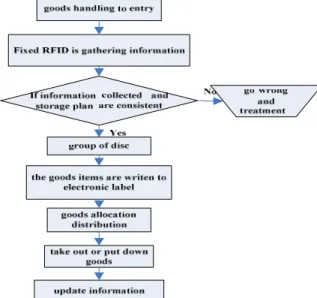
The key problem in warehouse management is whether the cargo messages are properly collected and the goods are stored in the correct position.Specific operation process as shown in Figure 1.
Fig. 1. Warehousing Processes
Step 1: Storage administrator will direct introduction including the name of goods, quantity of goods, storage time, delivery truck and other messages after receiving the godown entry notice from workshop or customers, then get prepare for warehousing.
Step 2: When the goods are to be shipped to the waiting area, fixed Reader located at the entrance of the gate read by batch goods RFID information which will be sent to processing system for judging. When colleted information and system information are matched, allowing goods go through or the error will be sent to the relevant system handling.
Step 3: Firstly, the goods are to be placed at the entrance of the conveyor and be set in dish. Secondly fixed Reader read the goods information which are written to pallet electronic tag, and then system release storage tasks and distribute goods positions according to the relevant rules in advance. Step 4: Lane stacker get at the entrance of the laneway according to the automatic optimal path, take out the goods from the transfer and put down it on the specified goods allocation.
Step 5: Lane stacker will report information to the database system after the task has been completed. At the same time warehousing information will be updated for inventory information. Incoming data table will create to check, recording of the incoming name, type, production date, storage time, inventory batches, quality status, inventory quantity, warehousing agent and warehouse code and other information.
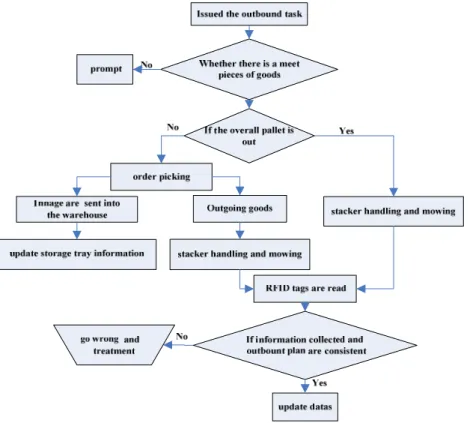
The Process of Outbound Operation. The outbound management mainly solve the correct choice for outbound products and datas collection. Specific operation process as shown in Figure 2.
Fig. 2. Outboud Processes
Step 1: WMS administrator receive outbound homework instructions and know the relevant work details such as the outbound time, the goods vehicles nameplate, goods list etc, then make outbound plan and prepare outbound order.
Step 2: The system obtain information of goods which meet the outbound conditions and the earliest time of storage afterinquiring. Stacking machine will along the optimal path from the current position to designated position and then carry the goods on the conveyor belt.
Step 3: If the whole disk is to be outbound, the fixed RFID Reader above the outbound conveyor would gather information directly, or pallet which contain goods will be sent to sorting equipment for order picking. The rest will be back into Chambers. The sorted goods will be send to the destination through the reader gathering information. If collected information and outbound plan are consistent, allowing it go through or the error will be sent to the relevant system handling.
Step 4: the stored data information will be updated after the outbound confirmation, and at the same time the outbound product data table will be generated.
The Process of Inventory Opertation. The role of the inventory is to ensure the consistency between physical stock quantity and the system logical record. Using RFID technology to inventory, first of all, according to system inventory plan the inventory warehouse has be choosen, then the inventory list should be also maken. Warehouse managers with handheld unit entry into the reservoir and the system will record inventory starting. RFID Reader work all rack in turn to traverse. When the hand-held devices is out, the system will logo inventory task is over. At the same time inventory data will transfer to information system which deal with the difference by wireless networks. Inventory management is mainly complete inventory homework and it also can adjust the inventory management, inventory browse, inquiring stock goods distribution and alysising storing goods etc. 4 Conclusions
Logistics Warehousing Management System based on RFID are analyzed in this paper. Firstly, the composition and working principle about RFID are introduced. Secondly, advantages of the RFID application in the logistics WMS are summarized. Finally, the actual example on storage business process is given. RFID applicated in Storage Management System can not only speed up the goods for entry or out and improve the accuracy of goods information, but also simplify the warehouse operation process, so as to improve the storage efficiency and save storage management cost. Hope that the study results can be a reference for RFID technology introduction and the storage management costs reducing.
References
[1] Liu Shifeng, Shang Mincong. The Study of RFID Technology Application in Storage Management . Logistics Technology, Vol. 26 (2007), p. 99-100
[2] Wu Zhixia. Storage Data Processing Based on RFID Technology . Logistics Engineering and Management,Vol.33( 2011), p.55-52
[3] Ding Jun. RFID Technology and its Application. Industrial Instruments and Automation Devices, Vol. 5(2006) ,p.74-75
[4] Qiu Xiaoyong, Liu Kai, Feng Chun. Discussion of RFID in Modern Logistics Development. Logistics Technology, (2005)
[5] Naves, D. RFID Tracks Huge Rolls of Paper in Warehouse. Supply Chain Systems, Vol.10-23 (2003), p.20-26.
[6] TAN H. The Application of RFID Technology in the Warehouse Management. Information System[C]. //Proc. Of the 2008 Int. Symposium on Electronic Commerce and Security [S. l.], SECS, 2008: 1063-1067
[7] Lang Weimin. The principle and application of Radio Frequency Identification. Beijing: Mechanical Industry Press, (2006).
[8] Li Shizhao. The Application of RFID Technology in the Warehouse Management. Tianjin: Tianjin University,(2007).
Study of Logistics Warehouse Management System Based on RFID 10.4028/www.scientific.net/AMR.748.1281