arXiv:astro-ph/0409417v1 16 Sep 2004
A WIND ANALYSIS OF AN EVOLVED GIANT - FUSE ANDHST/STIS OBSERVATIONS OF
AN ECLIPSING SYMBIOTIC BINARY
C. Crowley1
, B. R. Espey1
, and S. R. McCandliss2 1
Physics Department, Trinity College Dublin , Dublin 2, Ireland
2
Department of Physics and Astronomy, Johns Hopkins University, Baltimore, MD 21218, USA
Abstract
A major outstanding problem in stellar astrophysics lies in understanding the wind generation mechanism by which evolved giants lose mass. Phase-resolved observa-tions of eclipsing symbiotic binary systems, containing a mass-losing giant and a hot white dwarf, are ideal for studying the wind generation mechanisms in evolved stars. For such systems we use the orbital motion of the dwarf through the giant’s wind to provide a pencil-beam view through the circumstellar gas. FUV observations can probe different layers of the wind in absorption, permitting the derivation of the velocity profile and providing valuable, spatially-resolved diagnostics of the cool wind.
We present a series ofFUSE andHST/STIS observa-tions of two such systems and discuss our findings. The ve-locity profiles, and by implication, wind generation mech-anisms for these giants are found to differ from those pre-dicted by commonly used parametrisations. The phasing of our observations allow us to examine the density, tem-perature and velocity structure in the wind acceleration region, as well as the composition of the outflowing mate-rial.
Key words: Mass loss – Evolved stars – EG And – Ultra-violet Spectroscopy – Eclipsing binaries – Stellar winds
1. Introduction
Stellar winds and the rate of mass lost to the interstellar medium play a central role in stellar and galactic evolu-tion. For hot stars the observed winds are quantitatively explained by line-driven wind generation theory. However for cooler, more evolved stars there is no complete the-ory of mass-loss and understanding the mechanism(s) of mass-loss in late-type giants, in particular, remains a ma-jor problem in stellar astrophysics.
For intermediate and low mass stars, mass-loss be-comes significant when they approach the end of their lives and enter the red giant (RG) phase (Schaller et al. 1992). Since the wind generation mechanisms are not understood, it follows that the processes that contribute a large frac-tion of processed material back to the ISM remain uniden-tified. For cool giants with strong winds it is thought
that they lose mass in a two step process. At stellar dis-tances greater than 5 RG radii (RRG) where dust can
form, radiation pressure on dust and subsequent dust-gas collisions can explain the observed wind properties (Danchi et al. 1994 ). At smaller distances where the wind temperatures are too high to allow dust to form, no con-vincing models of wind acceleration exist for the case of non-pulsating stars. What is required, therefore, are obser-vational constraints to pin-down the wind conditions and velocity laws in the range 1 - 4 RRG for non-dusty and
non-pulsating objects. In general, observations of solitary giants can provide only disk-averaged information on the wind, with only the mass-loss rates and terminal velocities being estimated. However it is possible to probe sightlines through the circumstellar material and spatially examine the wind forming region in some detail by taking advan-tage of:
– the UV spectroscopic capabilities of satellite observa-tories
– the rich diagnostic qualities of the UV bandpass (possi-ble to diagnose the cool gas typically observed in chro-mospheres as well as much hotter gas seen in coronae) – and well-timed observations of eclipsing binary sys-tems containing a mass-losing giant and a UV con-tinuum source
1.1. Symbiotic Stars
Symbiotic binary systems are the closest separation, non-interacting binaries. They typically consist of a late type giant primary and a hot dwarf or sub-dwarf companion, with line emission originating in a photoionised portion of the RG wind superimposed on the combination spectrum. The use of these systems to probe giant winds holds many advantages over other classes of binary stars:
1) The two components do not directly interact which minimises the effect of interactions on the RG wind itself.
2) Unlike massive binaries, the two components in symbiotic systems have entirely different spectral char-acteristics - for example, the hot wind is thin and fast, whereas the cool wind is slow and weakly ionised - per-mitting the two winds and components to be isolated spec-troscopically.
3) The WD provides a bright UV continuum source
upon which varying absorption from the cool circumstel-lar gas is superimposed. The FUV and UV is especially rich in resonance and diagnostically informative atomic and molecular transitions which would not be available without the presence of the UV continuum.
4) These objects have been studied using wave-lengths from the radio to x-rays, and the orbital elements and geometrical parameters of many of these stars are well known.
It is therefore possible to use high resolution UV ob-servations of symbiotic stars, taken at well-chosen orbital phases, to tomographically map the structure and condi-tions in the gas surrounding an evolved giant.
1.2. EG Andromadae
[image:2.612.329.576.255.471.2]EG And is the nearest and brightest symbiotic system and consists of a hot, low luminosity white dwarf with an M3 giant primary. The UV continuum is known to un-dergo periodic variations although the system has never been observed to undergo outburst. This variation is at-tributed to the dwarf being eclipsed by the atmosphere of the primary component and has been observed extensively over several orbital epochs byIUE. The low luminosity of the dwarf means that the giant’s atmosphere is less af-fected by the ionising radiation of its companion than in some similar systems. Shown in Figure 1 is an uneclipsed spectrum of EG And combining FUSE, HST/STIS,HST G430L and ground-based echelle data. The binary nature of the object is apparent from the two distinct continuum sources - the WD dominates the ultraviolet and the gi-ant dominates the optical region. The averaged spectra of a number of M3 giant spectral standards is overplot-ted and is almost identical to the optical spectrum of EG And, graphically showing the similarity of the giant in the binary to isolated giants, despite the presence of its companion.
Table 1. System parameters for EG And
EG And Parameters
RG temperature ∼3,700 K
WD temperature ∼75,000 K
RG Luminosity ∼950⊙
WD Luminosity ∼30⊙
Period ∼481 days
Separation ∼4.5 RRG
RG Radius ∼75⊙
Inclination >700
Vmag ∼7.3
The object is well documented in the literature (Fekel et al. 2000, Vogel 1993, Vogel et al. 1992, Stencel 1984) and is
consid-ered a prototype for stable, non-dusty symbiotics. The at-tenuation of the UV continuum (due to Rayleigh scat-tering by neutral scatscat-tering hydrogen in the atmosphere of the giant) around eclipse is readily apparent from the IUE observations. However, the low resolution and sig-nal to noise of the data preclude a more in-depth asig-nalysis such as a radial velocity and phase dependent absorption analysis. The higher resolution ofFUSE and the E140M setting on STIS, combined with the brightness and low extinction (EB−V ∼0.05) of the target, make it an ideal
[image:2.612.113.269.572.702.2]object to study the wind acceleration region of the giant.
Figure 1. A spectrum of EG And, a typical symbiotic sys-tem, stretching from the FUSE wavelength region into the optical. The optical region is dominated by the spectrum of the late-type giant. The overplotted data (light grey) is an averaged spectrum composed from observations of a number M3 III spectral standards. The close match to the symbiotic giant spectrum suggests that the giant compo-nent is relatively undisturbed by the presence of the WD. Note the rising continuum of the WD in the FUV and also the strong emission lines originating in the photoionised region of the wind.
1.3. Observations
and Sahnow et al.(2000). See also ’FUSESpectroscopy of Cool Stars’ (Harper) in these proceedings.
The 7 HST observations were carried out with the medium resolution (λ/∆λ∼30,000 - 45,000) echelle
grat-ings of the Space Telescope Imaging Spectrograph (STIS) through the 0.2“
x0.06“
aperture at the 1425, 1978 and 2707 settings.
This therefore provides extensive wavelength coverage stretching from 905˚A - 3100˚A. This bandpass encompasses the transitions of many important atomic and molecular species including neutral and low-ionisation states of H, C, N, O, Si, P, Fe, Ni, Mg, Mn as well as CO and H2O. Transitions probing high temperature gas such as OVI, PV, CIV, SiIV, N V, SIV and HeII are also present along with a range of forbidden and semi-forbidden lines.
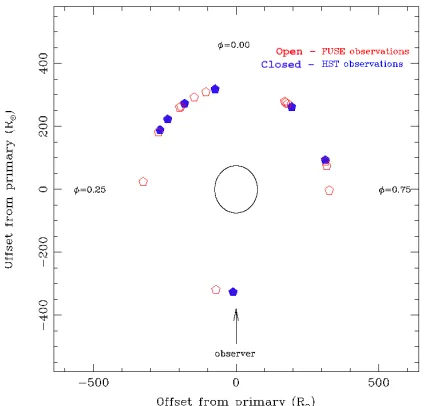
[image:3.612.76.290.397.600.2]The observing programmes were designed to cover or-bital phases both in and out of eclipse. The uneclipsed spectra only show absorption that is either interstellar or else originating in the hot gas associated with the dwarf. These reference spectra can then be compared to observa-tions taken at various degrees of eclipse in order to map and diagnose the circumstellar gas. See Figure 2 and ap-pendix A for a diagram and log of the ultraviolet obser-vations respectively.
Figure 2. View of EG And perpendicular to the orbital plane. Points correspond to the dwarf position for the FUSE and HST observations. Observer’s view is from the bottom and the scale is in units of solar radii.
2. The Wind in Absorption
The spectra are observed to undergo periodic variations with orbital phase due to Rayleigh scattering of ultravi-olet photons out of the line of sight during the eclipse of
the dwarf. The shape of the ultraviolet continuum dur-ing eclipse is defined by the broad dampdur-ing wdur-ings of the hydrogen Lyman series. Superimposed on this continuum during ingress and egress are a host of narrow absorp-tion lines from a range of different low-ionisaabsorp-tion species present in the wind. See some sample FUSE and STIS spectra in Figure 3 and Figure 4 for an example of the spectral variations around eclipse. The small diameter of the dwarf relative to the giant provides a pencil-beam view through the circumstellar material, while the systemic ra-dial velocity (-95 km s−1
) means that the wind absorption can easily be distinguished from interstellar absorption. Identifying wind features and continuum placement is also facilitated by comparison with unabsorbed spectra taken out of eclipse.
2.1. Low ionisation atomic species
Identified absorption features in the wind include HI, CI, CII, NI, NII, OI, OII, MgII, AlII, SiII, PII, ArI, MnII, FeII and NiII. The damped profile of H Lymanαprovides an accurate measure of the neutral hydrogen column in the line. We use a profile fitting technique to fit the damped wings of Lyman α λ1216 ˚A in the STIS spectra, and of Lymanβ λ1025 ˚A and the blue wing of Lyman α λ1216 ˚
A in theFUSEspectra.
To determine the column densities of other species whose lines are not on the damped region of the curve of growth we use a combination of profile fitting and the ap-parent optical depth technique (Savage & Sembach 1991). Although there are problems involving line saturation, blending and atomic data uncertainties in the ultraviolet it is possible to constrain the columns for many species quite accurately.
2.1.1. Temperature and Ionisation
In the case of species such as FeII and NiII, which have a large amount of lines, it is apparent that there are ab-sorption features arising from transitions from lower levels ranging from ground to levels∼5eV above ground. This
therefore makes it possible to calculate the level popu-lations and examine the excitation structure. In all the absorbed spectra the FeII level populations can be ex-plained by a simple collisional excitation model. By com-paring the excitation diagrams with model ions populated collisionally it is possible to derive a temperature and to-tal column density. We find that for the range of impact parameters observed (∼2.2 - 3.7 RRG) the wind
temper-ature is consistently located within the range ∼ 6,000
-8,000 K throughout eclipse (see Figure 6).
Figure 3. Series of FUSE spectra of EG And going from quadrature, into eclipse, and back out again (top to bottom). Note the varying continuum shapes due to Rayleigh scattering by neutral hydrogen. Its is also possible to see the narrow absorption lines originating in the wind (mostly FeII, NiII and PII in the FUSE bandpass).
[image:4.612.96.549.432.713.2]Figure 5. The top panel shows two FUSE spectra of EG And. The uneclipsed spectrum was taken at quadrature and is an unobscured view of the dwarf where the absorption lines are all interstellar (flux is offset by +3x10¹³
for clarity). The absorbed spectrum was taken part-way during eclipse (phi=0.10) and a fit is overplotted (light). The fit was generated by placing absorbing material in the line of sight to the uneclipsed spectrum. The second panel shows the FeII contribution to the fit while the bottom panel shows the HI contribution along with a number of other species (in this wavelength region mostly NI, PII and NiII). Note that the blue wing of Lyman αdefines the continuum shape. The FeII model was generated using atomic data from Raassen & Uylings
is swift onset of ionisation due to the radiation from the dwarf. This is most obvious for hydrogen where the large columns disappear rapidly. The variations in the columns of other species in the wind are observed to track that of hydrogen.
2.1.2. Atomic Data
Atomic data in the ultraviolet region of the spectrum (es-pecially in the FUSE region) is notoriously uncertain for many transitions. Lines from lower levels with excited states up to ∼5 eV above ground are generally not
ob-served in FUSE or STIS targets. The lines in this data originating from lower levels above ground can be used to check theoretical atomic oscillator strengths. For
ex-ample the FeII lines in the FUSE data were fit using atomic data published by Kurucz & Bell(1995) and also data from Raassen & Uylings(1998) and it was found that the Raassen & Uylings data provided a better match to the observed spectrum.
2.2. Molecular Lines
[image:5.612.67.584.87.454.2]Figure 6. By measuring the apparent absorbing column for a range of lines coming from different lower levels it is possible to examine the excitation structure in the gas. Here is an excitation diagram of FeII derived from one of the STIS spectra. The solid line corresponds to a total FeII column of 7x10¹⁶
cm−2
and a temperature of 7,500 K. The lower and higher dashed lines correspond to the same column but a temperature of 6,500 K and 8,500 K respectively.
setting tight constraints on the molecular content of the wind at these distances above the limb. The upper limit of molecular hydrogen is found to be H2/H<10−
8 .
3. Wind Acceleration
By tracking the varying absorption profiles of neutral hy-drogen at different phases it is possible to map the spatial extent and density of the wind. However, finding the run of the velocity profile using the HI column densities is a
mathematically complicated inverse problem. Knill, Dgani, & Vogel(1993) discuss this particular problem of reconstructing the
den-sity profile of a stellar wind in a binary system and have developed a technique for doing so. The equation to be inverted is:
NH(b) =a
Z ∞
b
dr
√
r2
−b2r v(r)
(1)
where b is the impact parameter of the two compo-nents,ais a constant defined by the mass loss parameters of the system,ris the distance from the giant andv(r) is the velocity - ie. the variable we wish to determine.
As outlined by Knill, Dgani, & Vogel(1993) the con-tinuity equation (1) is an integral equation of Fredholm’s type but it can be brought to Abel’s type by means of suit-able transformations. Using this method it is then possible to invert the equation by an explicit diagonalization of the Abel’s operator. The analysis assumes a neutral, spheri-cal wind and a circular orbit. In practice the observed HI
columns are parametrised by a polynomial and the veloc-ity field is then obtained from the inverted Abel’s oper-ator. See Knill, Dgani, & Vogel(1993) for a thorough dis-cussion. This work implements the technique using some IUEEG And data and found that the wind acceleration region region lies at∼2.5 RRG from the limb of the giant.
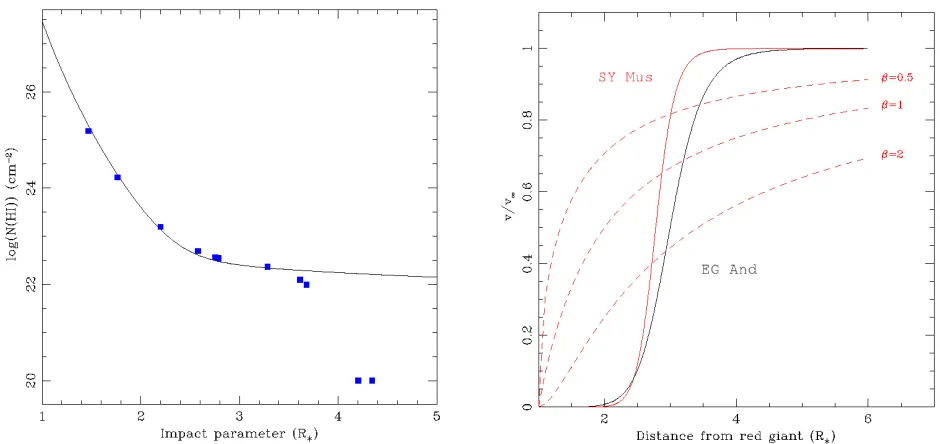
Plotted in Figure 7 (left panel) are the HI column den-sity datapoints measured on egress from the FUSE and STIS data plotted against impact parameter. Overplotted is a parametrised fit. The sudden drop in HI column at b∼3.5RRGcorresponds to the distance above the limb of
the giant where its wind becomes ionised and the major-ity of hydrogen in the line of sight is no longer visible in the HI lines. It is apparent that the ionisation boundary is well-defined and the onset is swift.
Plotted in black in Figure 7 (right panel) is the wind velocity profile obtained by inverting the model using the technique described above. Also shown are theβ-laws which are commonly used to describe velocity profiles. These laws match observations for hot stars very well, however giant winds are known not to be radiatively driven and there is no good reason why the beta laws should success-fully model these winds. The disagreement with the wind in the cool giant is clear to see.
Also plotted (in grey) is the velocity law derived for a similar systems, SY Mus by Dumm et al. (1999) where they obtained similar results usingIUEdata.
4. Extending the Wind Analysis
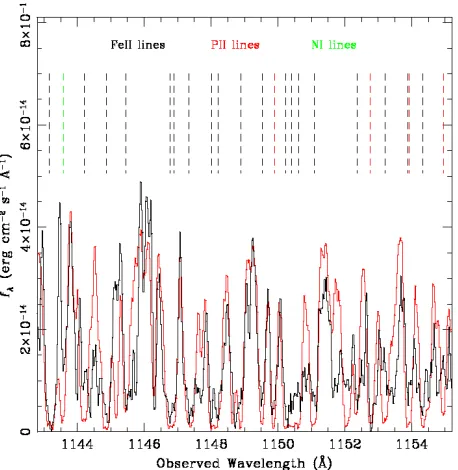
Our complete ultraviolet phase coverage of EG And (com-bined with our ground-based optical spectra and photo-metric monitoring) has allowed us to study the object in some detail. We have also been awarded FUSE cycle 4 and cycle 5 time to obtain ephemeris observations of the similar eclipsing symbiotics, BF Cyg and RW Hya (see Appendix A for aFUSEobservation log of BF Cyg). Our BF Cyg programme has recently finished we and are cur-rently obtaining our RW Hya observations. Although in both cases the phase coverage is not as complete as it is for EG And, it is possible to use our understanding of the data to examine the similarities/differences in the winds in each system. For example a highly absorbedFUSE spec-trum BF Cyg would be extremely difficult to interpret and model without the in-depth analysis of EG And. A simple comparison with a similarly attenuated EG And FUSE spectrum immediately shows that the ionisation level and composition of both winds are very similar (see Figure 8). Line identification and absorption line modelling has al-ready been carried out for EG And allowing us to model the wind and velocity profile of BF Cyg quite successfully even allowing for the sparser coverage.
Figure 7. Left:Model of the HI column density falloff as a function of distance from the giant primary in EG And. Overplotted are the HI columns derived from FUSE and STIS data. Note the deviation of the model from the datapoints at b ≈3.5RRG corresponding to the point where hydrogen is ionised by the WD.Right:Plot of derived wind laws for
the giants in EG And (black and SY Mus (grey) using the Abel inversion method. Note the deviation of the velocity profiles from the β laws, commonly used to parameterise the wind profile in late giants.
5. Discussion
Symbiotic systems can be used as laboratories in which to perform detailed studies on giant winds in ways which would not be possible for isolated stars. Effects due to the presence of an ionising source close to the giants can be minimised by a careful target selection. In the case of EG And the dwarf is a factor∼30 less luminous than the giant
and the ionising effects closer to the giant appear minimal. In addition to wind analyses, much can be learned about the interaction of cool and hot gas in such systems, as well as providing constraints on atomic data in the far ultraviolet.
5.1. Implications for Wind Driving Mechanisms
Van Buren et al. (1994) present evidence for the lack of dust opacity in the wind of EG And - an argument based on extinction constraints fromIUE data and far infrared fluxes fromIRAS. OurFUSEandHSTobservations tighten the extinction constraints furthering the evidence that the wind cannot be dust driven. The authors proceed to dis-cuss radiation pressure on molecular lines as a possible driver to accelerate the the material in the wind out to
dust forming distances (also see Elitzur, Brown, & Johnson(1989)). However, our FUSE data provides tight upper limits on
the presence of molecular hydrogen throughout the wind acceleration region thus ruling out any molecular line opac-ity at these impact parameters.
Polarisation measurements have been carried out on EG And to determine whether a magnetic field is present (Schulte-Ladbeck et al.(1990)). The results however, are inconclusive, and the small observed polarisation (∼
0.2%-0.4%) could be due to either scattering, a magnetic field or some other effect. As Van Buren et al. (1994) discuss, al-though high mass-loss rates and a large magnetic field are required for Alfven waves to be an effective wind driver, the observations don’t rule this out and it is possible that magnetic fields play an important role.
The composition and velocity profiles of the giant winds in SY Mus and BF Cyg are consistent with what is ob-served for EG And. The giants in these systems all have different mass-loss rates and spectral types which would suggest a wind driving mechanism that can be applied to non-dusty, late type giants generally. Further analysis of our BF Cyg and RW HyaFUSEdata will provide further clues.
5.2. Future Work
Figure 8. FUSE spectrum of BF Cyg (black) plotted against an eclipsed spectrum of EG And (grey). Even though the phases are different it is apparent that the ionisation struc-ture and composition of both winds are very similar.
Preliminary results are consistent those derived from the Abel inversion method.
Acknowledgements
This work is supported by Enterprise Ireland Basic Research grant SC/2002/370 from EU funded NDP
References
Danchi, W. C., Bester, M., Degiacomi, C. G., Greenhill, L. J., & Townes, C. H. 1994, AJ, 107, 1469
Dumm, T., Schmutz, W., Schild, H., & Nussbaumer, H. 1999, AAP, 349, 169
Elitzur, M., Brown, J. A., & Johnson, H. R. 1989, ApJL, 341, L95
Fekel, F. C., Joyce, R. R., Hinkle, K. H., & Skrutskie, M. F. 2000, aj, 119, 1375
Knill, O., Dgani, R., & Vogel, M. 1993, AAP, 274, 1002 Kurucz, R. L. & Bell, B. 1995, Kurucz CD-ROM, Cambridge,
MA: Smithsonian Astrophysical Observatory, c1995, April 15, 1995,
Moos, H. W., et al. 2000, ApJL, 538, L1
Raassen, A. J. J. & Uylings, P. H. M. 1998, Journal of Physics B Atomic Molecular Physics, 31, 3137
Sahnow, D. J., et al. 2000, procSPIE, 4139, 131 Savage, B. D. & Sembach, K. R. 1991, ApJ, 379, 245
Schaller, G., Schaerer, D., Meynet, G., & Maeder, A. 1992, AAPS, 96, 269
Schulte-Ladbeck, R. E., Aspin, C., Magalhaes, A. M., & Schwarz, H. E. 1990, AAPS, 86, 227
Stencel, R. E. 1984, ApJL, 281, L75
van Buren, D., Dgani, R., & Noriega-Crespo, A. 1994, AJ, 108, 1112
Vogel, M. 1993, AAP, 274, L21
Vogel, M., Nussbaumer, H., & Monier, R. 1992, AAP, 260, 156
[image:8.612.334.570.210.377.2]Appendix A: UV Observations
Table A1. EG And FUSE observations
Obs. no. Date UV Phase Reduced Phase
1 5 Jan 2000 1.7937 -0.2063
2 6 Aug 2000 2.2383 0.2383
3 24 Nov 2000 2.4655 0.4655
4 3 Sep 2001 3.0523 0.0523
5 14 Sep 2001 3.0741 0.0741
6 28 Sep 2001 3.1037 0.1037
7 23 Oct 2001 3.1566 0.1566
8 23 Aug 2002 3.7861 -0.2139
9 20 Oct 2002 3.9062 -0.0938
10 22 Oct 2002 3.9103 -0.0897
11 23 Oct 2002 3.9128 -0.0872
12 22 Jan 2003 4.1007 0.1007
13 01 Dec 2003 4.7484 -0.2516
Table A2. EG And STIS observations
Obs. no. Date UV Phase Reduced Phase
1 28 Aug 2002 3.796 -0.204
2 16 Oct 2002 3.898 -0.102
3 22 Dec 2002 4.036 0.036
4 18 Jan 2003 4.093 0.093
5 06 Feb 2003 4.131 0.131
6 16 Feb 2003 4.152 0.152
7 31 Jul 2003 4.495 0.495
Table A3. BF Cyg FUSE Observations
Obs. no. Date UV Phase Reduced Phase
1 9 Aug 2000 0.4895 0.4895
2 6 May 2003 1.8102 -0.1898
3 21 May 2003 1.8296 -0.1704
4 4 Jun 2003 3.8489 -0.1511
5 17 Jul 2003 1.9053 -0.0947
6 30 Sep 2003 2.0047 0.0047
[image:8.612.333.571.458.558.2] [image:8.612.334.571.640.741.2]