Time, Flies, and Why We Can’t Control the Past
Alison Fernandes
[Forthcoming in Barry Loewer, Eric Winsberg and Brad Weslake (eds.) Time’s Arrows and the Probability Structure of the World, Cambridge, Mass.: Harvard University Press.]
David Albert explains why we can typically influence the future but not the past by appealing to an initial low-entropy state of the universe. And he argues that in the rare cases where we can influence the past, we cannot use this influence to knowingly gain future rewards: so it does not constitute control. I will introduce an important new case in which Albert's account implies we can not only influence the past but control it: a case where our actions in the present are reliably correlated with several events in the present and past. To deal with such cases, we need to appeal to epistemic conditions on
deliberation: being agents requires our decisions being epistemically undetermined at the time we make them. In a world with the past-hypothesis, this implies that deliberation will typically come prior to decision. Once deliberation in this direction is established, correlations towards the past cannot then be exploited for control. To explain why we cannot effectively control the past, we need to appeal to deliberation, whether as part of a defence of Albert's account, or used independently to explain the asymmetry of control.
1. Introduction
rewards. So it does not constitute control. But there is an important case Albert fails to consider: a case where our action in the present is reliably correlated with several events in the past, and can knowingly be used to gain future rewards.1 To deal with this case, we
need to appeal to epistemic conditions on deliberation: being agents requires our decisions being epistemically undetermined at the time we make them. In a world with the Past Hypothesis, this implies that deliberation will typically come prior to decision. Once deliberation in this direction is established, correlations towards the past cannot then be exploited for control.Deliberation is required to explain why we cannot effectively control the past, whether as part of a defence of Albert's account, or used independently to explain the asymmetry of control.
I begin with Albert’s explanation of the asymmetry of influence—why the future depends on what we do now in a way the past does not (§2). I then argue against his treatment of exceptional cases. His response to a case presented by Mathias Frisch fails, because it introduces an unexplained asymmetry of rewards (§3). Moreover, he cannot deal with a new importantly different case by appealing to conditions on rewards (§4−5). In this new case, it seems we can knowingly influence the past to gain future rewards. To deal with this case, we need to appeal to evidential undermining and epistemic conditions on deliberation that explain why agents deliberate before they decide (§6). By appealing to deliberation, we can once again explain the asymmetry of control.
If we can recover Albert's explanation, we revive his more general project of unifying and explaining a range of asymmetric phenomena. This follows a tradition, beginning with Boltzmann's work in of statistical mechanics, of explaining apparently fundamental
1 My target here is Albert, but related problems arise for the entropy-based accounts of Loewer (2007,
phenomena in scientific terms: why ice cubes in glasses of water tend to melt (a thermodynamic asymmetry), why our knowledge of the past is so different from our knowledge of the future (an epistemic asymmetry), why we can influence the past but not the future, and why causes come before their effects. What typifies this program is attempting to account for these asymmetries by appealing merely to time-symmetric dynamical laws, assumptions and methods, and the Past Hypothesis.2 The program uses
a form of explanation that is already well-accepted in scientific explanations of the second law of thermodynamics. And by tracing a range of asymmetric phenomena back to a single boundary condition, we can understand at a deep level how these phenomena relate. So this kind of explanation is worth preserving.
2. The Asymmetry of Influence
Albert's explanation of the asymmetry of control proceeds in two parts.3 In the first,
Albert appeals to the Past Hypothesis to explain why the present contains many more means of influencing (‘causal handles’) on macroscopic aspects of the future than the past. In the second part (considered in the next section), Albert argues that any causal handles there are on the past cannot be used effectively—we cannot know about them or use them to gain rewards. So even if we can influence the past, we can't control it.
The first thing to note is that talk of causal handles as ‘ways of influencing the future’ should be compatible with the deterministic character of the dynamical laws. Here I take the laws to be Newtonian laws of motion. Although such laws are not exceptionless or fundamental, whatever laws replace them will have to recover Newtonian laws on
2 For an overview of foundational work in statistical mechanics, see Sklar (1993). For work broadly in this
program, see Reichenbach (1956), Horwich (1987), Price (2002), Callendar (2004), Greene (2004), Penrose (2005), Loewer (2007, 2012), Carroll (2010) and references therein, and for recent criticism, Winsberg (2004), Earman (2006), Price and Weslake (2009) and Frisch (2007, 2010).
3 Albert sometimes refers to a merely apparent asymmetry. I take it the asymmetry is real, for any reasonable
everyday length and energy scales, leaving the explanation largely intact. When we claim that manipulating a local feature of the present is a way of influencing the future, we are not claiming, contrary to fact, that two different futures are compatible with the present state and the laws. What we are claiming is that, counterfactually, if the present were otherwise than it is, then the future would be different. This in turn means we need some way of evaluating counterfactuals.
Albert proposes the following method.4 Start with phase space, a continuous space
containing six dimensions for every particle in the system, one for each dimension of position and momentum. Points in phase space represent possible microstates of the system at a time. Volumes of phase space represent possible macrostates. Given deterministic laws, some of these microstates are compatible with the Past Hypothesis: with the universe beginning in ‘whatever particular low-entropy highly condensed big-bang sort of macrocondition it is that the normal inferential procedures of cosmology will eventually present to us’ (2000, 96). The Past Hypothesis claims the universe began in a particular low-entropy macrostate.5 To evaluate a counterfactual, take the location of
the actual world in phase space at the present time, and consider the closest world (as measured in phase space at that time) that satisfies the following:
1) The antecedent of the conditional is satisfied, 2) The Past Hypothesis is true,
3) The world’s macrohistory, given its macrostate and the Past Hypotheses, is assigned a reasonable probability by the statistical postulate.
4 Albert claims that any reasonable time-symmetric method of evaluating counterfactuals yields the same
asymmetry (2000, 125). Loewer's account (2007) is broadly compatible. Lewis' account (1979) is symmetric, but beset by further problems (see Elga 2001).
5 We will need to amend this claim if the concept of entropy does not apply at the start of the universe
The statistical postulate in the third condition takes probabilities of volumes of phase-space at a time to be uniform over the standard Lebesgue measure. This implies, roughly, that for any two volumes of the same size, the system is as likely to be in one as the other. The third condition excludes cases where the closest world is an anomalous one— in an improbable microstate, i.e. with an unusual macrohistory, given its current
macrostate and the Past Hypothesis. We will see some of the interesting results of this condition below. Once the world has been selected, we evolve it in time according to the dynamical laws, and see whether the consequent is satisfied. The counterfactual is true if and only if the consequent is satisfied.
Note that any change to the present microcondition of a world will necessarily change its past as well as future microhistory. Any counterfactual change to the present is
necessarily a change to the past and future. This means that if we are to succeed in explaining the asymmetry of influence, we need to restrict the changes to the past, present and future being considered, by restricting the possible antecedents and
consequents of the counterfactuals. Albert restricts the consequents to localised areas of the world that can be characterised macroscopically in relatively simple everyday
Given these restrictions, counterfactuals determine what aspects of the present, past and future we influence. Albert claims that if the antecedents are features that are under our direct control and the consequents are readily characterisable macroscopic features, the present contains many more 'causal handles' on the future than the past. The turning motion of my hands on the steering wheel, for example, is a causal handle on my car beginning to turn left in the next moment. But it is not a causal handle on the car's previous motion. This reasoning is based on the claim that the Past Hypothesis accounts for the asymmetry of records: it explains why we can reliably read local macroscopic features of the present and our memories as reliable indicators of the macroscopic past, but not the future (2000, Chapter 6). Assuming this, and that the same inferential procedure are used for reading records and evaluating counterfactuals, we get the
asymmetry of influence. The method for evaluating counterfactuals requires leaving most of the actual present as it is, including records. If these records are reliable, when we evolve the system backwards in time, the past inferred to will be very much like the actual one. But in regards to the future there is no such guarantee. If the present contains no records of the future, a small change in one part of the present may well bring about large changes in the future—the present state of the world does not constrain these changes to the same degree.
significant about the past? The nearest counterfactual world in which the antecedent is satisfied in the present has me not waving my arm. But it is likely to have lots of records of the sawing having begun—my memories, wood chips lying on the ground, birds flying startled in the air. If evaluating counterfactuals involves the same inferential procedures as reading records, these reliable records keep the past as it was. Given the restriction imposed by the Past Hypothesis, it is likely that my cousin has still been sawing away at the tree.
This same type of reasoning works for any macroscopic event in the past for which there are records in the present. So it seems that if there are records in the present that are not under our direct control, we cannot influence these aspects of the past, and so our influence of the past is severely restricted in a way our influence of the future is not. By explaining the asymmetry of records, the Past Hypothesis thus explains the asymmetry of influence.
3. Dealing with Exceptional Cases
However, cases presented by Adam Elga (2001), Douglas Kutach (2002) and Mathias Frisch (2010) suggest that Albert's account entails that we can influence the past. So Albert can't explain the asymmetry of influence. Albert responds by moving to consider control of the past, rather than influence, and introducing further conditions. While some
Elga and Kutach introduce the following case.6 There is a large-scale event in the past,
such as the sinking of Atlantis, for which there are no records in the present. This means that small changes in the present, such as the movement of my finger, may be correlated whether Atlantis exists. Given we control such small changes in the present, Albert's account implies we control past macroscopic events.
Albert (forthcoming) and Loewer (2012, 128) respond by arguing that while there may be counterfactual dependence of the past even on the present, this does not constitute control. This is because there are no macroscopic correlations we could become aware of
between what we control in the present and the past macrostate. If there were, there would be records in the present, and this case relies on the absence of records.
This response succeeds, but only by conceding that an asymmetry of counterfactual dependence is not enough to explain the asymmetry of control. Instead, we need further epistemic conditions on what counts as effective control: it is control we can know about. But such epistemic conditions are plausible. We don't have control of an event merely because it is correlated with our action. For example, I do not control what a detective records merely because he has decided to write down my shopping choices (to take a case from Anscombe). I need to at least know about this correlation in order to effectively use it to bring about my ends, and so for it to constitute control. With this added condition, Albert's account survives Elga and Kutach's challenge.
Frisch (2010) raises a separate challenge to Albert's account. He introduces a case where the unique record of an event is under an agent's direct control. Say I am playing a piano piece, and come to a point in the music where I can decide whether to play the first or
second ending—the decision being under my direct control. Stipulate that I have no conscious memory of what music I have played and there are no external records present. But I am a reliable pianist. Therefore, whatever decision I make counts as a record of where I am up to and what music I have played. So by having control of my decision in the present and my decision being a unique record, I have control over what music I have played in the past. So we have a counterexample, and Albert's account does not deliver the asymmetry of influence.
Albert (forthcoming) responds to Frisch's case by adding another condition on effective control. He argues that even if the agent knows he can influence the past, he cannot use this influence for any further benefit, beyond what he secures through influencing the present. If the pianist wants to finish his playing sooner, for example, he could influence the past so that he began the piece earlier. But he could just as easily decide to play the second ending and finish playing. The past event only influences the future via a feature the agent already has direct control over. It gives the agent no additional benefits. So this is not a case of effective control, even if it's a case of influence.
Before we move on to the new case, we should note that there is a better response to Frisch available. To effectively control the past, it is not enough to know that in some cases, my decision is correlated with a past event. To know I control the past, I must have some way of checking whether I have controlled it, on occasions when I attempt to do so. I cannot do this in the Frisch case. There is no time at which I know both my decision and my past playing by independent means. Because my decision in the present is the only record of the event, I cannot determine whether I have controlled the past. And so this is not control I can know about. So Frisch's attacks fails. Albert's explanation of the asymmetry of control survives. But there is a new case that evades even this response.
4. The Fly Case
The Elga-Kutach and Frisch cases can be dealt with. But there is another case that threatens Albert's explanation of the asymmetry of control. Here it is: in the actual world, a fly flies in front of my face at t1, and at t2 I swat it away. Then consider the
counterfactual: if I had not swatted at t2, the fly would have been somewhere else at t1. If
this counterfactual is true, and I can knowingly exploit this counterfactual dependence, I have control of the past. And so Albert's account does not deliver the asymmetry of control. In this section I will argue the counterfactual is true, and in the next, that I can knowingly exploit this counterfactual dependence.
To evaluate the counterfactual, we consider nearby worlds in which I do not swat, the Past Hypothesis is true, and the macrohistory of the world is statistically normal. Perhaps I don't swat because a stray thought or itch distracts me. But say I am not the type to get distracted by stray thoughts or itches—since I was a young child, many varied
away whenever they appear. Moreover, there are lots of records of these harrowing experiences, and my reliability at swatting. Given that these records are reliable and kept intact, my swatting will itself count as a record of the fly's location in the past. If I hadn't swatted at t2 it would be because the fly was out of range or sight at t1. Our
counterfactual looks true, set to give me influence on the past.
The counterfactual would be false if the present contained many large-scale records of the fly’s actual position at t1. Keeping these records intact and reliable would prevent the
location in the past from changing—as we saw in the tree-sawing case above. But no entomologists are videoing the fly's activities. The fly's location at t1 is a small event,
perhaps only recorded in its location at t2, the location of some air molecules and my
memory. These records are small enough to be changed in a nearby world where I don't swat. And these changes are required if my tendency to swat and these records are to remain reliable.
This is the important difference between the fly case and the Frisch case. In the Frisch case, there are no macroscopic changes beyond those explicitly specified in the
antecedent. The agent's influence in the present is limited to what he controls directly. Not so in the fly case. By directly controlling a record of the fly's location, the agent influences other records in the present. And this allows him more wide-ranging control of the past and future, as we will see in the next section.
What is doing the work in making the counterfactual true is the third condition: that the world’s macrohistory, given its macrostate and the Past Hypothesis, is assigned a
with the location of the fly in the past. But these are all unusual worlds, assigned a low probability by the statistical postulate, not compared to each other, but compared to a given standard. We should not infer to such worlds. Similarly there are worlds in which the fly's location at t1 changes, but not its location at t2: the fly flies incredibly fast. But
again, these are unusual worlds. We should not infer to them.
There is a nearby world in which all these records remain reliable. It is a world in which I do not swat and the fly's location at t1 and at t2 change. This is the world I should infer
to. These changes are required to satisfy the antecedent, and make the world's history sufficiently probable, given its macrostate. My swatting remains a reliable record of the fly's location. And so by directly controlling my swatting, a record of the fly's location, I influence the fly's location in the present and past. Albert's account does not yet deliver the asymmetry of control. I will now defend this counterexample from a number of preliminary objections.
Objection 1: The relevant counterfactual is false. The third condition only requires us to
pick a microstate that is probable with respect to other microstates in the same macrostate. Given Frisch's interpretation (2007, 2010), no macrostates are ruled out by this condition. In the nearest world, nothing macroscopic outside the antecedent changes. So the fly's location in the past does not change.
Response: Albert's account is consistent with this reading of the third condition, but it
favours my own. My reading is more in keeping with Albert's appeal to 'normal
news of yesterday as well as the contents of your newspaper today. If counterfactuals are to capture such inferences, those like the following should come out true: if my paper had been different, yours would have been. If this counterfactual is to come out true, we can't rule out making changes in the macroscopic state outside the antecedent. In
addition, Albert (forthcoming) more explicitly requires us to: 'Find the possible world which is closest to the actual one, as measured by distance in phase-space, at the time of the antecedent…'. If there are to be no macroscopic changes outside the antecedent, this requirement is difficult to make sense of. Why should closeness within the same
macrostate matter? The condition makes better sense if its work is to minimise such macroscopic changes, not rule them out altogether.
Objection 2: Albert's intentions aside, we should follow Loewer (2007) and Kutach (2002)
and not allow macroscopic changes outside the antecedent when evaluating counterfactuals. So the counterfactual is false.
Response: Satisfying antecedents nearly always involve making changes elsewhere in the
system, under any method of evaluating counterfactuals. For example, if my hand is to be located in region x instead of y, air molecules will have to be moved out of x and into y. This is not an unusual feature of Albert's method. Moreover, the method gives us a
useful guide to what other changes are required to satisfy the antecedent. Because worlds with vacuum pockets around me are very unusual, we should not infer that were my hand at x, there would be a vacuum pocket at y.
reasoning, it must allow for changes in the antecedent to be correlated with macroscopic changes outside the antecedent. While ultimately we may want a method that doesn't allow for changes outside the antecedent, the more informative project is to consider how we get to such a method without first simply stipulating against such changes. Price and Weslake make a similar point (2009, 426).
Objection 3: Condition 3 can only rule out exceedingly unlikely worlds. A world where I
swat and the fly does not move is not sufficiently unlikely.
Response: If condition 3 is to ensure good inferential reasoning, it should not be too weak.
We should not infer that measuring devices always break down when we consider changes to their records. While unusual events do happen in our world, and reliable devices do break down, we should assume they always do, if there are other nearby worlds available, in which recording devices remain reliable. Otherwise the method for evaluating counterfactuals will often lead to unhelpful results.
Objection 4: If we're requiring records remaining reliable, why should the size of the
record matter? Why not also consider large macroscopic changes outside the antecedent?
Response: While such a method is appealing, my target is Albert. Albert follows Lewis
(1979) in thinking that changes from the actual world should be minimised. What's important is that even with this requirement, counterexamples can be generated.
Objection 5: The fly's location is a small event. The influence on the past is only minimal,
Response: While the fly's location is a small event, a small change in the near past can be
parlayed into a much larger change in the more distant past. If the small event I control is a unique record of a larger more distant event, say the last remaining newspaper record of a 19th century fire, I control the larger event as well. Nothing in the framework itself
rules out such large-scale changes—or us training ourselves and others to develop responses that can be exploited in this way.
Objection 6: The setup for the case itself is too fragile—add some large records in the
present, and the influence on the past is destroyed. These cases are not sufficiently common and robust to challenge Albert's explanation.
Response: While the case is fragile, this is not enough to dismiss it. We should consider
why we can't make our influence on the past more robust, as we can our influence on the future. The response I recommend below can account for this fact.
Objection 7: Agents aren’t reliable responders. Their neurological makeup is fragile and
easily changes in counterfactual worlds. Their decisions and actions aren't records, and so don't allow for influence of the past under Albert's set up.
Response: It is essential for the fly case that records of the agent’s reliability are recorded in
large-scale macrofeatures of the world, such as in eyewitness reports and my four-volume treatise detailing my dedication to fly swatting. These macrofeatures don't easily change and are reliable evidence for the behaviour and neurology of agents.
Objection 8: Agents aren't reliable responders unless they observe the events they respond
Response: My swatting may be an unconscious, instinctive action and yet reliable. But
more importantly, we should ask why this is true of our reliable correlations to the past, but not the future—why we don't need to observe a future states in order for them to be correlated with our decisions now. Calling correlations with the past 'responses' hides this asymmetry. Once this asymmetry is explained, the response suggested is compatible with my own (§6).
5. Can the Fly Case Be Used for Effective Control?
Having considered some preliminary objections, how else might we respond to the fly case? Albert responded to the Elga-Kutach and Frisch by invoking conditions on effective control. While these cases involve counterfactual dependence and influencing the past, I cannot knowingly use this influence to gain rewards. So they do not threaten an asymmetry of control. But I will show how it seems we can knowingly gain rewards in the fly case, and it remains a threat to Albert's account.
To show this, we can enrich the fly case by adding a sensor that records the location of the fly at t1 and displays this location on a screen at t2. By stipulation, the screen is the
only record of the fly’s location from the sensor that remains at t2—the rest of the device
resets. Stipulate this record is small in size and changes in the counterfactual world. This means both the record and my hand swatting are reliably correlated with the presence of the fly in an area at t1. Say I am offered a reward (anytime before t2) for having this area
free of flies at t1. I will attempt this at t2, the sensor will tell whether I have succeeded and
I will be rewarded when the screen is checked after t2. From what has been said so far, I
My response to the Frisch case will not work here. In the Frisch case, there is no independent means of checking whether I have controlled the past. The only record of the past event is a record I control directly, and there is no way to confirm that this record remains reliable. What is importantly different about the fly case is that there are records of the consequent outside the direct control of the agent—the fly's location in the present, and the record on the screen. This means there is an independent means of checking whether I have controlled the past.
Albert's response to the Frisch case will not work here either. His objection to the Frisch case was that any rewards the agent gains in the future are due only to his direct control of the present, not his influence on the past. Not so in the fly case. Here my mere ability not to swat, uncorrelated with the absence of the fly, is not enough to secure the reward. I have to influence the fly's location in the past. Otherwise the sensor's record in the present will not be changed, and I will not receive the reward. Again, this is because there are records of the consequent outside the direct control of the agent. The agent can influence these records, but only by influencing the past.
Nor is Albert's response to the Elga-Kutach case effective here. In the Elga-Kutach case, there are no records of the past event in the present, and so no macroscopic correlations between my action and the event I could become aware of. But in the fly case, there are such records. There are macroscopic correlations between my swatting now and the fly's location in the past, correlations I can know. So it seems I can control the past to gain the reward.
I commit myself to gaining the reward and therefore decide not to swat my hand, the stillness of my hand is no longer a reliable record of the fly’s absence. Instead, it is a reliable record of my desire for or reason to gain the reward. In the nearest
counterfactual world, the macrohistory will then not be one in which the fly is
somewhere else, but merely one in which I wish or have reason to make this so. More generally, if the antecedent is brought about in order to bring about the consequent, the antecedent is no longer a reliable record of the consequent, but only of a desire or reason to bring it about. So the counterfactual is false and I do not control the past. I call this 'evidential undermining'.
Evidential undermining works equally well against the Frisch case. If I decide to play the second ending in order that I started playing earlier, and so will finish sooner, my playing the second ending is no longer a reliable record of my having begun earlier—just of my desire that this is so. While Frisch is right to claim that we can learn inductively of correlations between our decisions and past events (2010, 31), this is not the same as learning of correlations we can make use of; these need to be correlations which are robust when we attempt to use them to control the past.
is that evidence for a correlation between the fly's presence and my swatting, is not evidence for a correlation between a fly's presence and my swatting in cases where I decide not to swat in order to exploit this correlation.
This response is largely correct—here I agree with Price and Weslake (2009). But it is inadequate in its current form. It relies on an asymmetry—that agents in our world deliberate before they decide. It is because deliberative reasoning comes temporally prior to decision that it can disrupt correlations between decision and past states, but not correlations between decision and future states. This may be due to general features of influence: that influence propagates through time. Or it may be due to features peculiar to deliberation. But it is straightforwardly true. If an agent's deliberative structure were reversed, such that she acted, then decided, then deliberated, correlations between her decision and past states would be preserved under counterfactual changes.
6. Deliberative Agency
I will now explain why deliberation comes temporally prior to decision. I will argue for two epistemic conditions on deliberation (ignorance and efficacy) that allow us to explain a key feature of deliberation: its seriality. Seriality, combined with an epistemic asymmetry, explains this deliberative asymmetry and so the asymmetry of control.
Ignorance
I take it to be a condition of deliberation that an agent cannot be certain of her decision at the time she is deliberating and as she decides.7 If an agent is deliberating whether to
A, she cannot be certain that her deliberation issues in her deciding to A: decisions are
epistemically undetermined. Why think that decisions satisfy this requirement?While many theorists simply note the condition as necessary, a promising response appeals to the function of deliberation: there is no point deliberating if an agent is already certain of her decision. Holton, for example, argues that choice scenarios arise in cases where we are unsure of what to do—if we were sure, there would be no need for the decision (2006). Ginet makes similar points (1962).
Accepting this requirement places an ignorance condition on decision. There cannot be connections between and agent's decisions and states of the world (including her beliefs and desires), which allow her to infer her decision while deliberating and deciding. In particular, if she is certain of other states of the world, she can’t also be certain of the correlations between these states and her decision. Ignorance can be satisfied if the correlations between states of the world and decisions are complicated and difficult to track. This will be the case if our internal make up is complex, constantly changing and
7 Defenders of this condition include Hampshire and Hart (1958), Ginet (1962), Taylor (1964), Schick
hidden from view. Think of a fireman, and whether he can take the heat of the floor as evidence he will decide to leave a burning building (Holton 2006). In order to make an accurate inference, he must take into account the nature of his values and desires, the way he balances the risks involved against the possibility of saving the building, and the significance of all this evidence. In addition, his inference must take into account what effect the inference will have on his decision—making a prediction can change his evidence about what he will decide to do. Because of this, his decision is very unlikely to be susceptible to simple modelling. Ignorance can be satisfied by these kind of epistemic limitations.
Efficacy
There is a second epistemic condition on decision: agents must take their decisions to be efficacious in producing their results. An agent, while deliberating whether to A, must
believe that her decision to A will result in her A-ing: her decision must be good evidence for her A-ing. This does not imply a causal connection between the decision and result. It is a minimal epistemic condition only, which many defend (see footnote 7).
Seriality
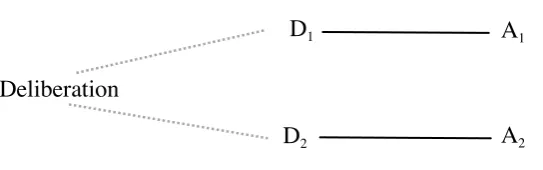
These two conditions on decision explain a key feature of deliberation: its seriality. This is its ordering in terms of deliberation, decision, action, as schematized in figure 1 below. Note that this is not yet an asymmetric temporal ordering—we're not presuming that decision falls before action in time. Decision might come after. But seriality does imply that decision falls temporally between action and deliberation.
Figure 1: The seriality of agency. While deliberating, the agent is uncertain of her decisions (shown by a dotted line). Decisions are epistemic possibilities (D1 or D2). But
she takes there to be a correlation between her decisions and her actions (A1 and A2),
represented by a solid line.
It does not yet follow that agency is oriented in a particular temporal direction—only that decision comes between deliberation and action. However, given the epistemic asymmetry Albert explains (or even a more limited epistemic asymmetry), seriality implies agency will typically lie in a temporal direction that runs past−future. Ignorance and efficacy can be satisfied in a forward temporal direction. Our decision-making is sufficiently complex to satisfy ignorance, as we saw in the fireman case. And records in the form of memories allow agents to pick up on general correlations between their decisions and actions, allowing efficacy to be satisfied. Not so in the backward temporal direction. Here, the reliability of records prevents ignorance being satisfied. If our macroscopic acts occur in the recent past, we will typically have records of them in the present in the form of memories. Given ignorance this prevents us deliberating about these acts: the decisions are not epistemically undetermined. An agent could still take the mental state to be
epistemically undetermined, by ignoring or forgetting the correlation with action. But then it would not satisfy efficacy and would longer count as a decision. And note that if the
Deliberation
A1
D1
A2
D2
temporal distance between the decision and the action becomes too great, the reliability of their connection is likely to be lost and so efficacy will not be satisfied.
It is because there are readily available records of macroscopic events in the recent past, but not the future, that deliberation is typically directed towards the future and we deliberate before we decide. Records of the past prevent decision being directed towards the past. But they don't prevent decision from being directed towards the future, and they allow agents to track correlations between decision and action. This argument does require an epistemic asymmetry. But we have independent grounds to accept such an asymmetry, whether it is a general asymmetry of records (Albert 2000) or something limited to records like memories. However, if a suitable epistemic asymmetry can be explained in terms of the Past Hypothesis, as Albert attempts, we also have an argument for why the Past Hypothesis is relevant to the direction of deliberation. It is relevant because it explains features of our epistemic access to the world (contra Price and Weslake 2009).
(mentioned Frisch 2007, 365). Both these conceptions of agency can explain what seems odd about the fly and Frisch cases and why we take influence of the past to be impossible.
But we need not go so far. We can combine the deliberative asymmetry with our previous response to the fly case to finally explain the asymmetry of control. In §5, I argued that agents who deliberate prior to decision will be unable to exploit correlations between their decisions and states further in the past. If they attempt to use such correlations to control the past, they will undermine them. Their decisions will only be evidence for their desires or reasons, rather than for the past states they hope to control. So as far as an agent's evidential map encodes correlations she can use, no correlations between decisions and previous states will appear. While she can believe there are evidential correlations between her decision and previous states, they are not ones she can exploit to achieve her ends.
So agents cannot freely establish correlations between their decision and past events and use these to control the past. In the fly case, for example, if I decide to develop a reliable correlation between the state of the fly and my swatting, by swatting when I observe the fly, I cannot exploit this correlation to influence the past. Deciding to swat on observing the fly already assumes that deliberation comes prior to decision. Given this, I will undermine any correlations to the past I attempt to exploit.
7. Conclusion
and so effectively control the past. And there may be unusual circumstances (such as traditional Newcomb cases) in which we do control the past—cases in which
correlations towards the past are not undermined by our deliberating on the basis of them. But in ordinary circumstances agents like us, able to form stable memories of past macroscopic events like actions, won't be able to deliberate towards the past. We can't pick up on correlations between past actions and present decisions in a way that allows decisions to be epistemically undetermined. And given we deliberate before we decide, we cannot in ordinary cases exploit past directed correlations without undermining them.
References
Albert, David Z. 2000. Time and Chance. Cambridge, Mass.: Harvard University Press. ———. Forthcoming. "The Sharpness of the Distinction between Past and Future." In
Asymmetries of Chance and Time, ed. Alistair Wilson. Oxford: Oxford University
Press.
Carroll, Sean. 2010. From Eternity to Here. New York: Dutton.
Callender, Craig. 2004. "Measures, Explanation and the Past: Should ‘Special’ Initial Conditions Be Explained?" British Journal for the Philosophy of Science 55:195−217. Dummett, Michael. 1964. "Bringing about the Past." The Philosophical Review 73 (3):
338−359.
Earman, John. 2006. "The ‘‘Past Hypothesis’’: Not Even False." Studies in History and Philosophy of Modern Physics 37:399–430.
Elga, Adam. 2001. "Statistical Mechanics and the Asymmetry of Counterfactual Dependence." Philosophy of Science 68 (3): S313-S324.
Frisch, Mathias. 2007. "Causation, Counterfactuals, and the Past-Hypothesis." In Causation, Physics, and the Constitution of Reality, ed. Huw Price and Richard Corry,
293−326. Oxford: Oxford University Press.
———. 2010. "Does a Low-Entropy Constraint Prevent Us from Influencing the Past?" In Time, Chance and Reduction, ed. Gerhard Ernst and Andreas Hüttemann, 13−33. Cambridge: Cambridge University Press.
Ginet, Carl. 1962. "Can The Will be Caused?" The Philosophical Review 71 (1): 49−55. Greene, Brian. 2004. The Fabric of the Cosmos. New York: Alfred A. Knopf.
Hampshire, Stuart, and H. L. A. Hart. 1958. "Decision, Intention and Certainty." Mind 67 (265): 1-12.
Horwich, Paul. 1987. Asymmetries in Time. Cambridge, Mass.: Massachusetts Institute of Technology Press.
Ismael, Jenann. 2007. "Freedom, Compulsion and Causation." Psyche 13 (1): 1−11. ———. 2012. "Decision and the Open Future." In The Future of the Philosophy of Time, ed.
Adrian Bardon, 149−68. London: Routledge.
Kutach, Douglas. 2002. "The Entropy Theory of Counterfactuals." Philosophy of Science 69 (1): 82–104.
Levi, Isaac. 1986. Hard choices. Cambridge: Cambridge University Press.
Lewis, David. 1979. "Counterfactual Dependence and Time's Arrow." Nous 13: 455−76. Loewer, Barry. 2007. "Counterfactuals and the Second Law." In Causation, Physics, and the
Constitution of Reality, ed. Huw Price and Richard Corry, 293−326. Oxford:
Oxford University Press.
———. 2012. "Two accounts of laws and time." Philosophical Studies 160 (1): 115-137. Penrose, Roger. 2005. The Road to Reality. New York: Alfred A. Knopf.
Price, Huw. 1986. "Against Causal Decision Theory." Synthese 67:195−212.
———.1991. "Agency and Probabilistic Causality." British Journal for the Philosophy of Science 42 (2): 157–176.
———. 2002. "Boltzmann's Time Bomb." British Journal for the Philosophy of Science 53:83−119.
Price, Huw and Weslake, Brad. 2009. "The Time-Asymmetry of Causation." In The Oxford Handbook of Causation, ed. Helen Beebee, Christopher Hitchcock and
Peter Menzies, 414–43. Oxford: Oxford University Press.
Reichenbach, Hans. 1956. The Direction of Time. Mineola: Dover Publications.
Schick, Frederic. 1979. "Self-knowledge, Uncertainty, and Choice." British Journal for the Philosophy of Science 30:235−52.
Taylor, Richard. 1964. "Deliberation and Foreknowledge." American Philosophical Quarterly 1:73−80.