Volume 95
Issue 3
Spring
Article 10
Spring 2005
More than Zero: Accounting for Error in Latent
Fingerprint Identification
Simon A. Cole
Follow this and additional works at:
https://scholarlycommons.law.northwestern.edu/jclc
Part of the
Criminal Law Commons
,
Criminology Commons
, and the
Criminology and Criminal
Justice Commons
This Criminology is brought to you for free and open access by Northwestern University School of Law Scholarly Commons. It has been accepted for inclusion in Journal of Criminal Law and Criminology by an authorized editor of Northwestern University School of Law Scholarly Commons.
Recommended Citation
0091-4169/05/9503-0985
THE JOURNAL OF CRIMINAL LAW & CRIMINOLOGY Vol. 95, No. 3 Copyright 0 2005 by Northwestern University, School of Law Printedin US.A.
MORE THAN ZERO: ACCOUNTING FOR
ERROR IN LATENT FINGERPRINT
IDENTIFICATION
SIMON A. COLE*
LOUISE: I never would have guessed that he was selling fake insurance.
CANEWELL: That's what the whole idea was.., he didn't want you to guess it. If you could have guessed, then he couldn't have sold nobody no insurance.
- August Wilson, Seven Guitars (1996)
INTRODUCTION
The year 2004 witnessed what was probably the most highly publicized fingerprint error ever exposed: the case of Brandon Mayfield, an Oregon attorney and Muslim convert who was held for two weeks as a material witness in the Madrid bombing of March 11, 2004, a terrorist attack in which 191 people were killed. Mayfield, who claimed not to have left the United States in ten years and did not have a passport, was implicated in this attack almost solely on the basis of a latent fingerprint
found on a bag in Madrid containing detonators and explosives in the aftermath of the bombing. Unable to identify the source of the print, the Spanish National Police emailed it to other police agencies. Federal Bureau of Investigation (FBI) Senior Fingerprint Examiner Terry Green identified Mayfield as the source of the latent print.' Mayfield's print was in the database because of a 1984 arrest for burglary and because of his military service. The government's affidavit stated that Green "considers the match to be a 100% identification" of Mayfield.2 Green's identification was "verified" by Supervisory Fingerprint Specialist Michael Wieners, Unit Chief, Latent Print Unit and fingerprint examiner John T. Massey, a retired FBI fingerprint examiner with over thirty years of experience.
Kenneth Moses, a well-known independent fingerprint examiner widely considered a leader in the profession, subsequently testified in a closed hearing that, although the comparison was "quite difficult," the Madrid print "is the left index finger of Mr. Mayfield.' '3 A few weeks later the FBI retracted the identification altogether and issued a rare apology to Mayfield.4 The Spanish National Police had attributed the latent print to
Ouhnane Daoud, an Algerian national living in Spain.
The error occurred at a time when the accuracy of latent print identification has been subject to intense debate. Because the Mayfield case is the first publicly exposed case of an error committed by an FBI latent print examiner and the examiners were highly qualified, it was particularly
sensational.
But the Mayfield case was not the first high-profile fingerprint misattribution to be exposed in 2004.5 In January, Stephan Cowans was
1 Application for Material Witness Order and Warrant Regarding Witness: Brandon Bieri Mayfield, In re Federal Grand Jury Proceedings 03-01, 337 F. Supp. 2d 1218 (D. Or. 2004) (No. 04-MC-9071).
2 Id.
3 Les Zaitz, Transcripts Detail Objections, Early Signs of Flaws, OREGONIAN, May 26,
2004, at Al; Noelle Crombie & Les Zaitz, FBIApologizes to Mayfield, OREGONIAN, May 25, 2004, at 1; Andrew Kramer, Fingerprint Science Not Exact, Experts Say, ASSOCIATED PRESS,
May 21, 2004, available at http://www.msnbc.msn.com/id/5032168; see also Steven T. Wax & Christopher J. Schatz, A Multitude of Errors: The Brandon Mayfield Case, 28 CHAMPION 6 (2004). There is some ambiguity as to whether Moses was retained by Mayfield or by the court. Moses's retention was apparently proposed by Mayfield, but Moses was then appointed by the court so that his report would go directly to the court. Electronic communication from Les Zaitz, Reporter, The Oregonian, to author (Sept. 7, 2004) (on file with the author). In any case, it is clear that Moses's role was to provide an independent assessment of the evidence.
4 Press Release, Federal Bureau of Investigation, Statement on Brandon Mayfield Case,
(May 24, 2004) [hereinafter FBI Press Release].
5 See Jonathan Saltzman & Mac Daniel, Man Freed in 1997 Shooting of Officer: Judge
2005] ERROR IN LATENT FINGERPRINT IDENTIFICATION 987
freed after serving six and a half years of a 30- to 45-year sentence for shooting and wounding a police officer.6 Cowans had been convicted solely on fingerprint and eyewitness evidence, but post-conviction DNA testing showed that Cowans was not the perpetrator.7 The Boston Police Department then admitted that the fingerprint evidence was erroneous,8 making Cowans the first person to be convicted by fingerprint evidence and exonerated by DNA evidence.9 As with the Mayfield case, the Cowans misattribution involved multiple experts, including defense experts.10
Latent print examiners have long claimed that fingerprint identification is "infallible."1' The claim is widely believed by the general public, as evidenced by the publicity generated by the Mayfield and Cowans cases, with newspaper headlines like "Despite Its Reputation, Fingerprint Evidence Isn't Really Infallible.'12 Curiously, the claim even appears to survive exposed cases of error, which would seem to puncture the claim of infallibility.'" Such cases have been known since as early as 1920 and have not disturbed the myth of infallibility.'4 Today, latent print examiners continue to defend the claim of infallibility, even in the wake of the Mayfield case.'5 For example, Agent Massey commented in a story on the Mayfield case, "I'll preach fingerprints till I die. They're infallible.16 Another examiner declared, in a discussion of the Mayfield case, "Fingerprints are absolute and infallible."'17
6 Id
7 Id.
8Id.
9 The Innocence Project, at http://www.innocenceproject.org/ (last visited May 8, 2005). 10 David Weber & Kevin Rothstein, Man Freed After 6 Years: Evidence Was Flawed,
BOSTON HERALD, Jan. 24, 2004, at 4.
11 See, e.g., FEDERAL BUREAU OF INVESTIGATION, THE SCIENCE OF FINGERPRINTS:
CLASSIFICATION AND USES, at iv (1985) ("Of all the methods of identification, fingerprinting alone has proved to be both infallible and feasible.").
12 Sharon Begley, Despite Its Reputation, Fingerprint Evidence Isn't Really Infallible, WALL STREET JOURNAL, June 4, 2004 at B 1; Simon A. Cole, Fingerprints Not Infallible, 26 NAT'L L.J. 22 (Feb. 23, 2004); Kramer, supra note 3.
13 See, e.g., Commonwealth v. Loomis, 113 A. 428, 430 (Pa. 1921).
14 Id; Commonwealth v. Loomis, 110 A. 257 (Pa. 1920); Albert S. Osborn, Proof of
Finger-Prints, 26 AM. INST. CRAM. L. & CRIMINOLOGY 587, 587 (1935).
15 See, e.g., Flynn McRoberts et al., Forensics Under the Microscope, CHI. TaM., Oct. 17,2004, at 1.
16 Id.
17 Steve Scarborough, They Keep Putting Fingerprints in Print, WEEKLY DETAIL, Dec.
The question of the "error rate" of forensic fingerprint identification has become a topic of considerable legal debate in recent years. "Error rate" has been enshrined as one of the non-definitive criteria for admissible scientific evidence under the United States Supreme Court's decision
Daubert v. Merrell Dow Pharmaceuticals. 18 In discussing how trial judges should exercise their "gatekeeping" responsibility to ensure that "any and all scientific testimony or evidence admitted is not only relevant, but reliable,"19 the Court noted that "in, the case of a particular scientific technique, the court ordinarily should consider the known or potential rate of error.,20 In Kumho Tire v. Carmichael,21 the Court decided that the
" 509 U.S. 579, 593 (1993).
'9 Id. at 589.
20 Id. at 594. The Court's phrasing of its "error rate" requirement was admittedly rather
vague. Part of the confusion probably stems from its use by the Daubert Court to demarcate reliable from unreliable science. Id. at 589. In most scientific pursuits, the term "error" usually refers to measurement error, the expected discrepancy between measured values and true values. This is something quite different from an error rate. Since Daubert is commonly read as an effort to describe what is distinctive about science, see, e.g., David S. Caudill & Richard E. Redding, Junk Philosophy of Science?: The Paradox of Expertise and
Interdisciplinarity in Federal Courts, 57 WASH. & LEE L. REv. 685, 735-41 (2000), it might
have made more sense for the Court to have referred to measurement error than to "error rate."
An error rate would tend to be more commonly associated with a process or technique. A litmus test is an obvious example. Litmus paper turns red when exposed to an acid. One might imagine calculating an error rate for different kinds of litmus paper by measuring how often they fail to turn red when exposed to an acid and how often they turn red when exposed to a substance that is not an acid. A pregnancy test might also be imagined to have an error rate. And birth control devices often have "failure rates" associated with them, although these are obviously highly sensitive to conditions of use.
There is, therefore, some potential confusion in the Court's use of "error rate" as one of its criteria for defining legitimate scientific knowledge. Some knowledge claims produced by areas of inquiry that most people would certainly consider "science," such as physics, would be hard-pressed to provide an "error rate" for their findings, or even to understand what would be meant by such a request. They would, on the other hand, readily understand what was meant by a request for their "measurement error." On the other hand, there are technical processes, like the production of "reliable" litmus paper (as opposed to the chemical principle underlying litmus paper), that could readily comply with a request for an "error rate," but would appear to most observers to be industrial production processes, rather than "science."
2005] ERROR IN LATENT FINGERPRINT IDENTIFICATION 989
"gatekeeping" responsibility extended to non-scientific expert evidence and reiterated the same non-definitive checklist it enumerated in Daubert.22 Though courts have found that latent print identification is non-scientific expert evidence, Kumho prevents such a determination from becoming a loophole through which latent print identification could evade Daubert's requirement that judges ensure its reliability. Indeed, the Court specifically noted that even the case of "experience-based" testimony-which, presumably, is what latent print identification is, if it is not science-it is relevant to know the error rate.2 3 Although the Supreme Court was careful
to note that its proposed checklist was merely illustrative, courts frequently treat it as a defacto litmus test for admissibility. Since criminal defendants began challenging the admissibility of forensic fingerprint evidence in 1999,24 the error rate of fingerprint evidence has been extensively discussed and litigated.
2' 526 U.S. 137 (1999). 22 Id. at 141-42. 23 Id. at 151.
At the same time, and contrary to the Court of Appeals' view, some of Daubert's questions can help to evaluate the reliability even of experience-based testimony. In certain cases, it will be appropriate for the trial judge to ask, for example, how often an engineering expert's experience-based methodology has produced erroneous results ....
Id.
Professors Denbeaux and Risinger have pointed out that discussions of "error rate" in debates over applying the Daubert/Kumho standard to forensic science tend to ignore the requirement in Kumho Tire that the discussion be calibrated to the task at hand. Mark Denbeaux & D. Michael Risinger, Kumho Tire and Expert Reliability: How the Question
You Ask Gives the Answer You Get, 34 SETON HALL L. REv. 15 (2003). While forensic
document examination (Denbeaux and Risinger's principal example) involves a greater range of tasks than latent print identification, the tasks involved in latent print identification do vary greatly. The principal axis of variation for latent print identification concerns the difficulty of the comparison, and the principal component of this is the quality and quantity of information available in the unknown print. Common sense indicates that the "error rate" for very high quality latent prints (or very "easy" comparisons) should be quite different from the "error rate" for marginal latent prints (or very "difficult" comparisons). A rational attempt to assess the error rate of latent print identification should therefore yield not a single "error rate," but many error rates, or, rather, an "error curve" showing the estimated rate of error for different levels of latent print quality and quantity (or comparison difficulty). One key hindrance to generating this sort of information is the lack of an accepted metric for measuring either latent print quality and/or quantity or the difficulty of a comparison. So far, the only possible metric is the number of ridge characteristics in a print, which has been, with some justification, rejected as a metric by the latent print community, as being inconsistent and not derived from empirical research. Christophe Champod, Edmond Locard
-Numerical Standards and 'Probable' Identifications, 45 J. FORENSIC IDENTIFICATION 136 (1995).
Curiously, it would appear that the Court's inclusion of error rate in
Daubert/Kumho, rather than having the palliative effect of encouraging
latent print examiners to measure their error rate, has had the unintended consequence of tempting them to make even less sustainable claims. Thus, in response to a challenge to the admissibility of latent print evidence under Daubert/Kumho, the government and latent print examiners advanced the "breathtaking' 26 claim that the error rate of forensic fingerprint identification is zero.27
As with infallibility, latent print examiners defend the claim of a zero error rate even when confronted with known cases of misattribution in real cases. In a 60 Minutes interview about the Jackson case, Agent Meagher demonstrated an identification to reporter Leslie Stahl:
MEAGHER: The latent print is, in fact, identical with the known exemplar.
STAHL: It's identical?
MEAGHER: Yes.
STAHL: You can tell that?
MEAGHER: Yes.
STAHL: What are the chances that it's still not the right person?
MEAGHER: Zero.
STAHL: Zero.
S25
MEAGHER: It's a positive identification.
How can a process commit errors and yet be considered infallible? How can the "error rate" of any technique, let alone one that has been known to commit errors, be considered zero? In this article, I will argue
25 1 am grateful to an anonymous reviewer for making this point.
26 United States v. Haward, 117 F. Supp. 2d 848, 854 (S.D. Ind. Oct. 5, 2000).
Professor Starrs has suggested that "preposterous" or "unsupportable" would have made better word choices here. Online posting (Nov. 4, 2000), at http://onin.com/ bums/messages/3/ 21.html?SaturdayMarch2320020950am.
27 Government's Combined Report to the Court and Motions in Limine Concerning Fingerprint Evidence at 22, United States v. Mitchell, 199 F. Supp. 2d 262 (E.D. Pa. 2002) (No. 96-407), available at http://www.clpex.com/Information/USvMitchell/lPreDaubert HearingMotions/US v MitchellGovtResponse.pdf ("By following the scientific method-ology of analysis, comparison, evaluation and verification, the error rate remains zero.").
2005] ERROR IN LATENT FINGERPRINT IDENTIFICATION 991
that the coexistence of these two contradictory notions is not merely a product of simple "doublethink."29 Rather, I will show that it the product of a rhetorical strategy to isolate, minimize, and otherwise dismiss all exposed cases of error as "special cases," or "one-offs, 30
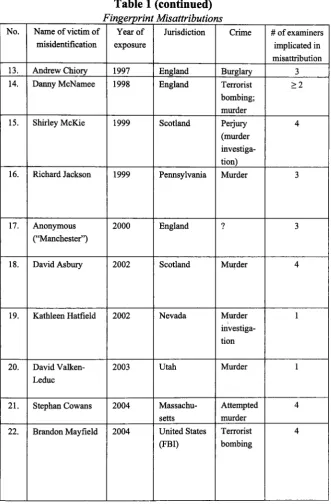
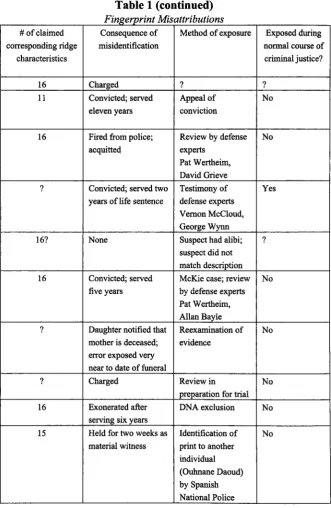
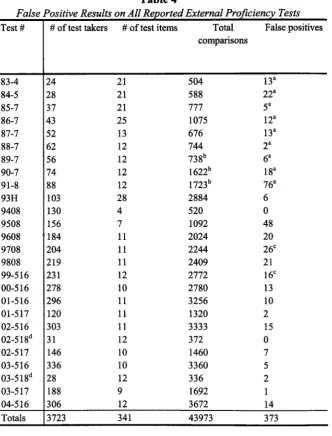
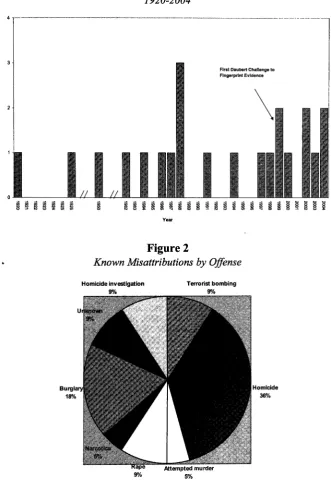
and therefore as irrelevant. After a brief legal and technical background discussion in Part I, Part II of this paper discusses what we do know about the error rate of latent print identification. Part II.A catalogs twenty-two cases of fingerprint misattribution that have been reported in the public record. An analysis of these cases shows that they are most likely only the tip of the proverbial iceberg of actual cases of fingerprint misattribution. Part II.B discusses the results of proficiency testing of latent print examiners. These tests also show a non-zero error rate. In Part III, I discuss what might be called "the rhetoric of error." This Part analyzes rhetorical efforts by fingerprint advocates and courts to minimize, dismiss, and explain away the evidence of error revealed in Part II. Fingerprint practitioners seek to create an error-free aura around fingerprint identification that has the potential to dangerously mislead finders of fact. At the end of Part III, I discuss some more defensible ways of conceptualizing fingerprint error. Far from being "one-offs," I suggest that the cases of error are more likely the product of routine practice. Whatever special circumstances exist in the misattribution cases are more likely to account for the exposure of the misattribution than the misattribution itself. I conclude by arguing that it is necessary to confront, analyze, and understand error if we ever hope to reduce it.
I. BACKGROUND
A. LATENT PRINT IDENTIFICATION
Latent print identification is a process of source attribution.3
' Latent print examiners compare "latent" prints taken from crime scenes to prints of known origin. Although prints taken from suspects using ink or scanners are typically of good quality-and can be re-taken if they are not-latent prints are typically partial, smudged, or otherwise distorted. It is the poor quality of many latent prints that makes latent print identification problematic. The most valuable aspect of the latent print testimony in criminal justice proceedings is the attribution of the latent print to the
29 GEORGE ORWELL, 1984, at 214 (1949) ("Doublethink means the power of holding two contradictory beliefs in one's mind simultaneously, and accepting both of them.").
30 Pat A. Wertheim, The Connection: Faulty Forensics (NPR radio broadcast, June 10,
2004), available at http://www.theconnection.org/shows/2004/06/20040610b-main.asp.
31 KEITH INMAN & NORAH RUDiN, PRINCIPLES AND PRACTICE OF CRIMINALISTICS: THE
defendant. Although latent print testimony is often phrased as claiming that the latent print and the known print of the defendant are "identical," this is not strictly true; all fingerprint impressions, including those taken from the same finger, are in some way unique.32 The true import of latent print testimony is not that the unknown print and the known print are "identical" but rather that they derive from a common source.33 Since the source of the known print is known to be the defendant (because someone in the chain of custody took them from the defendant), the unknown print is then attributed to the defendant. The defendant is said to be the source of the latent print.
1. Conclusions
In the above respects, latent print identification is similar to many other areas of forensic analysis. But latent print evidence differs crucially from most other types of forensic evidence in the manner in which source attributions are phrased. In forensic DNA analysis, for example, the analyst typically testifies that the defendant may be the source of a DNA sample. This statement is then accompanied by a random match probability which indicates the frequency with which randomly chosen individuals with the same racial or ethnic background would also be consistent with the unknown DNA sample. When latent print examiners make a "match," however, they always testify that the defendant is the source of the latent print to the exclusion of all other possible sources in the universe. Latent print examiners are, in fact, ethically bound to only testify to source attributions; they are banned from offering probabilistic opinions in court.3' Latent print examiners are the only forensic expert witnesses who are so restricted. Latent print examiners are permitted by the (largely unenforceable) rules of their profession to offer only three possible conclusions35 from any comparison of a known and unknown set of prints:
32 Id. at 133; CHRISTOPHE CHAMPOD ET AL., FINGERPRINTS AND OTHER RIDGE SKIN
IMPRESSIONS 24 (2004).
33 INMAN& RDIN, supra note 31, at 141.
34 Int'l Ass'n for Identification, Resolution VII, 29 IDENTIFICATION NEws 1 (Aug. 1979)
("[A]ny member, officer or certified latent print examiner who provides oral or written reports, or gives testimony of possible, probable, or likely friction ridge identification shall be deemed to be engaged in conduct unbecoming such member, officer, or certified latent print examiner."); Int'l Ass'n for Identification, Resolution V, 30 IDENTIFICATION NEWS 3 (Aug. 1980) (amending the resolution to allow for such testimony, with qualifications, under threat of court sanction).
35 Scientific Working Group for Friction Ridge Analysis, Study and Technology
[hereinafter SWGFAST], Friction Ridge Examination Methodology for Latent Print
Examiners § 3.3 (Aug. 22, 2002), version 1.01, available at http://www.swgfast.org/
2005] ERROR INLATENT FINGERPRINT IDENTIFICATION 993
1. Individualization
2. Inconclusive
3. Exclusion
3 6
Many of the press reports about the Mayfield case reported with apparent surprise the FBI's characterization of an attribution that would turn out to be erroneous as "a 100 percent positive identification. 3 7 These reports were apparently unaware of the fact that all latent print attributions are supposed to be characterized with such an inflated degree of certainty.38
2. Individualization
Latent print examiners reach conclusions of "individualization' 39 by finding corresponding "ridge characteristics"'40 between the unknown and known prints. Any "unexplainable dissimilarity" results in a conclusion of exclusion.41 Insufficient correspondences result in a conclusion of "inconclusive."4 2 "Sufficient" correspondences result in a conclusion of
"individualization," or source attribution.43 A crucial question is, of course, where the boundary lies between insufficient and sufficient correspondences. The latent print community has been unable to answer this question with any precision or consistency other than to posit a circular answer, which simply rests upon the analyst's subjective measure of "sufficiency," such as the following: "Sufficiency is the examiner's
36 Id.
37 Sarah Kershaw & Eric Lichtblau, Spain Had Doubts Before U.S. Held Lawyer in
Madrid Blasts, N.Y. TIMEs, May 26, 2004, at Al; David Feige, Printing Problems: The
Inexact Science of Fingerprint Analysis, SLATE (May 27, 2004), available at
http://slate.msn.conid/2101379; see also Application for Material Witness Order and Warrant Regarding Witness: Brandon Bieri Mayfield at 3, In re Federal Grand Jury Proceedings 03-01,337 F. Supp. 2d 1218 (D. Or. 2004) (No. 04-MC-9071).
38 See supra note 32 and accompanying text. People v. Ballard, No. 225560, 2003 Mich.
App. LEXIS 547 (Mich. Ct. App. 2003), is a case in point. The court found that the latent print examiner's "testimony that she was '99 percent' certain that defendant's fingerprint was found in the stolen car.., had no demonstrated basis in an established scientific discipline . " I. Id. at *9. The irony is that the examiner's undoing probably lay in naming a figure smaller than 100%.
39 SWGFAST, Methodology, supra note 35, § 3.3.1.
' DAVID R. ASHBAUGH, QUANTITATIVE-QUALITATIVE FRICTION RIDGE ANALYSIS: AN INTRODUCTION TO BASIC AND ADVANCED RIDGEOLOGY 22 (1999).
41 Willam F. Leo, Distortion Versus Dissimilarity in Friction Skin Identification, 48 J.
FORENSIC IDENTIFICATION 125-26 (1998).
42 SWGFAST, Methodology, supra note 35, at §3.3.3.
determination that adequate unique details of the friction skin source area are revealed in the impression."44
3. Methodology
Recently, latent print examiners have taken to describing their "methodology" as "ACE-V" (Analyze, Compare, Evaluate - Verify).45 For our purposes, the important thing to note is the "verification" component in which a second examiner "ratifies" the conclusions of the initial examiner. The latent print community has until recently resisted any pressure to conduct "blind" verification-that is, to prevent the "verifier" from knowing what conclusion the initial examiner has reached, or even whether the initial examiner has reached a conclusion.46 An FBI report on the
Mayfield case, however, has now endorsed blind verification in "designated" cases.47
4. Qualifications
There are no qualifications necessary to render an individual a "latent print expert"; whether to let an individual testify as such is entirely up to the court.4 8 There is, however, a certification program, administered by a professional organization, the International Association for Identification (IAI).49 Upon creating the certification program, the IAI specifically stated that lack of certification should not be construed as rendering a purported expert unqualified to testify as an expert witness.50
B. FINGERPRINT ERROR RATES
Although I will criticize below the parsing of error into different "types," there are some legitimate distinctions to be made when talking about forensic error. First is the distinction between false positives and
44 SWGFAST, Methodology, supra note 35.
45 ASHBAUGH, supra note 40.
46 CHAMPOD ET AL., supra note 32, at 200 (recommending that verification should be
blind only for especially difficult latent prints).
47 Robert B. Stacey, A Report on the Erroneous Fingerprint Individualization in the
Madrid Train Bombing Case, 54 J. FORENSIC IDENTIFICATION 706, 715 (2004).
48 Pat A. Wertheim, re: Certification (To Be or Not to Be), 42 J. FORENSIC
IDENTIFICATION 279, 280 (1992) [hereinafter Wertheim, re: Certification].
49 Int'l Ass'n for Identification, Latent Fingerprint Certification, at
2005] ERROR IN LATENT FINGERPRINT IDENTIFICATION 995
false negatives. These are also sometimes called Type I and Type II errors. (This distinction, unlike some of those discussed below, is well recognized in numerous fields of science.) In the context of fingerprint identification, a false positive would consist of reporting that an individual is the source of an impression when in fact she is not. A false negative would consist of reporting that an individual is not the source of an impression when in fact she is. These errors can be of differing importance depending on the context. For example, in criminal law the classic formulation of this is "Blackstone's maxim," which states that it is better to let ten guilty people go free than to falsely convict one innocent person.51 This would suggest
that false positives are ten times more catastrophic than false negatives. 2 In addition, there are some distinctions that may be made among false positives based on the stage of the criminal justice process at which the error is detected. Presumably, some false positives are detected and corrected within the crime laboratory itself. An analyst may take a second look at the evidence and change her mind. Alternatively, another analyst may disagree with the initial analyst's conclusion. In current fingerprint parlance, this process is known as "verification." The dispute would be resolved within the laboratory and reported as "inconclusive" or an exclusion. No one outside the laboratory would know that there had been an "error." We know very little about these types of errors. They are unlikely to generate media attention, officially published reports, or legal records, our primary sources for learning about fingerprint errors. In all likelihood the disagreement is resolved quietly within the laboratory.
There is legitimate reason to distinguish between errors that are detected in the laboratory and errors that are not detected until after a laboratory has in some way input its conclusions into the criminal justice system, leading to arrest, indictment, trial, or conviction. In the former case, it may reasonably be argued that whatever safeguards the laboratory has in place (such as "verification") functioned correctly, detected the error, and prevented false information from being offered into evidence. It might reasonably be said, "the system worked." In the latter case, whether the error is ultimately detected before conviction or after conviction, the error is nonetheless far more serious. Once the laboratory inputs a conclusion into the criminal justice, it has effectively terminated whatever processes it has
51 See generally Alexander Volokh, n Guilty Men, 146 U. PA. L. REv. 173, 174 (1997).
in place to detect errors. At this point, responsibility for exposure of the error rests with other actors, such as the prosecutor, judge, jury, or, mont important, the defense expert, if there is one.
Thus, it would be oversimplified to speak of "an error rate" of a forensic fingerprint identification. Are we interested in the rate of false positives, false negatives, or the sum of the two? How expansive is our definition of an "error"? Are we interested in errors exposed within the laboratory, errors exposed after they leave the laboratory, or are we interested in estimating the prevalence of all actual errors, whether or not they are exposed? In this article, my focus will be on false positives that leave the laboratory. I will not discuss false negatives or errors that are detected within the laboratory. Estimating the number of errors that are detected within laboratories would be a nearly impossible task for a laboratory outsider. The latent print community itself could, if it wanted, produce data about the occurrence of errors within the laboratory. So, for example, the two false positives committed by Agent Massey back in the 1970s that were detected within the FBI laboratory are not included in my data set.3 I omit discussing false negatives because no one disputes that false negatives occur. The rate and occurrence of false positives, however, is more controversial.
II. WHAT Do WE KNOW ABOUT ERROR RATES IN LATENT PRINT
IDENTIFICATION?
There are two basic ways of going about calculating an error rate, neither of which is entirely satisfactory. The ideal method would be to divide the number of actual cases of error by the number cases in which fingerprint evidence was used, thus yielding an error rate (or rates-false positives and false negatives). This approach has a fundamental problem: we do not know the "ground truth." In casework we do not know whether the suspect is or is not, in fact, the source of the unknown print. Therefore, any error rate calculated from casework is inherently untrustworthy. A second approach would be to run a simulation. In a simulation, the researcher can control the materials that are submitted to the process or technique and thus know the ground truth. The drawback to simulations is that they usually differ in significant ways from the real-world practice to which their error rates will be extrapolated. Therefore, the extrapolation of an error rate from simulation to the real world can always potentially be contested. Indeed, in scientific controversies, the extrapolation from a
2005] ERROR IN LATENT FINGERPRINT IDENTIFICATION 997
simulation to the "real world" will almost inevitably be contested.4 Therefore, we should expect that any declared error rate for latent print identification will be contested by one party or the other (or perhaps both). An accepted error rate will not simply emerge from some academic study.
That is, however, no reason not to try to assess the likelihood of error.
A. FINGERPRINT MISATTRIBUTIONS
1. Case selection
In this section, I use archival analysis of reported cases of misattribution to attempt to estimate the error rate of latent print identification. Any effort to calculate the false positive rate of forensic fingerprint identification from known cases of misattribution is hampered by the fact that there is no central repository of knowledge about such cases. No mechanism for recording, compiling, reviewing, or analyzing cases of fingerprint misattribution exists. Some latent print examiners and legal scholars have compiled mistattibution cases on various web sites." I have compiled below those cases known to me through my historical fingerprint research. Overwhelmingly, these are cases that were reported either in the media or in published court decisions. Since I have occasionally seen reference in the fingerprint literature to cases of misattribution that were not publicized,56 I believe that the number of known cases of misidentification
54 H. M. CoLLINs, CHANGING ORDER: REPLICATION AND INDUCTION IN SCIENTIFIC PRACTICE (1985).
55 Dusty Clark, Latent Prints: A Forensic Fingerprint Impression Evidence Discussion Site, at http://www.latent-prints.com (last visited May 8, 2005); Craig Cooley, Law-Forensic.com, at http://www.law-forensic.com (last visited May 8, 2005); Ed German,
Problem Idents, at http://onin.com/fp/problemidents.html (last visited May 8, 2005);
Michele Triplett, Erroneous Identification, known cases of', in MICHELE TRIPLETT'S
FINGERPRINT DICTIONARY, at http://www.nwlean.net/fprints/e.htm (last visited May 8, 2005).
56 For example, in 1984 Lambourne wrote, "Due to the frank and open policies of our
American counterparts we do know that since early 1981 five members of the International Association for Identification have had their certification revoked because of erroneous identifications .... " G. T. C. Lambourne, Fingerprint Standards, 24 MED. Sci. & L. 227, 229 (1984). Three of these probably derived from the Caldwell case, infra Part II.A.3.d. Depending on when Lambourne actually wrote that statement, one of the examiners referred to may have been the one implicated in Midwestern, infra Part II.A.3.e The fifth was probably Margaret Matthers, formerly with the Florida Department of Criminal Law Enforcement of Sanford, Florida, whose certification was revoked in August 1980 "for having furnished testimony to an erroneous identification." Certification Revoked, 31
IDENTIFICATION NEWS 2 (Feb. 1981) [hereinafter Certification Revoked, Feb.]. No further information on this erroneous identification was available, and it is unlikely to be among the cases reported here.
listed here is probably significantly less than the number known to the "collective mind" of the fingerprint profession.
A second problem concerns case selection. Case selection for any such exercise raises difficult methodological problems. Criteria for case selection that are too liberal may overstate the potential for latent print error, whereas criteria that are too conservative may understate it. Moreover, how do we determine that a latent print attribution was erroneous? Even in cases that are widely treated within the fingerprint community itself as clear errors, there is rarely definitive scientific proof that the attribution was erroneous. 7 Only in two of the cases listed below, Hatfield, infra Part II.A.3.o, and Cowans, infra Part II.A.3.q, is there definitive proof that that attribution was erroneous. In Hatfield, a forensic technician used fingerprint impressions to identify a corpse.58 The individual identified as the corpse turned out to be alive.59 Cowans was excluded as the source of DNA evidence which was taken from the same object as the latent print.6 ° In most of the other cases, the "evidence" that the match was erroneous consists of the consensus of the fingerprint community itself. This creates difficulty because it demands using the very technique that is being questioned to establish the ground truth.61
[in which] an expert or consultant on fingerprint for the defense has been instrumental in seriously undermining the state's case by demonstrating faulty procedures used by the state's witnesses or by simply showing human errors in the use of fingerprint evidence." ANDRt
MOENSSENS ET AL., SCIENTIFIC EVIDENCE IN CIVIL AND CRIMINAL CASES 516 (4th ed. 1995). It seems unlikely that all of Moenssens's "great number" of cases are represented in my study. In addition, Dr. David Stoney reports having discovered three erroneous attributions in "around 500" fingerprint cases that he has reviewed. David A. Stoney, Challenges to
Fingerprint Comparisons, Address at Fingerprints: Forensic Applications, DePaul
University Center for Law and Science (April 15, 2002). It is unlikely that all of Stoney's cases are represented in my study.
57 Professor Gary Edmond points out that our treatment of supposed miscarriages of
justice is "asymmetric." That is, once we have decided that the defendant was innocent, we interpret all the evidence in that light, just as the evidence was originally interpreted in light of the theory that the defendant was guilty. Gary Edmond, Constructing Miscarriages of
Justice: Misunderstanding Scientific Evidence in High Profile Criminal Appeals, 22 OXFORD
J. LEGAL STUD. 53 (2002).
58 Michael Coit, Santa Rosa Woman Identified as Vegas Slaying Victim Turns Up Alive,
SANTA ROSA PREss DEMOCRAT, Sept. 13, 2002, at Al.
59 Id.
60 Saltzman & Daniel, supra note 5.
61 In addition, there is some ambiguity between cases in which the consensus of latent
2005] ERROR INLATENT FINGERPRINT IDENTIFICATION 999
In most cases, there is no way of proving that the attribution was erroneous without assuming the very infallibility of latent print examiners'
consensus judgments that these cases undermine. For example, McKie, one of the best-known cases of "error," (infra Part III.A.3.1), is generally viewed within the latent print community as an erroneous attribution.62 But, in fact, we have no way of knowing that Shirley McKie did not make the print in question, other than through the consensus judgment of latent print examiners. In McKie (unusually), there is not even a complete consensus. Some latent print examiners continue to stake their professional reputations on the claim that McKie was indeed the source of the disputed print.63
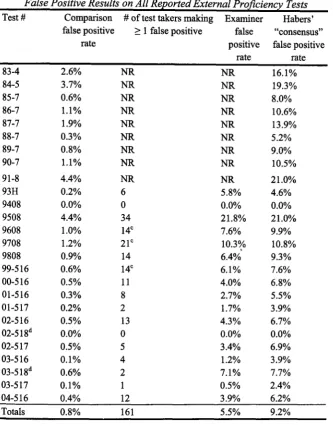
In Table 1 and Part II.A.3, I list and discuss twenty-two cases of latent print "misattributions." These are cases where the consensus of opinion in the latent print community itself holds that attribution is erroneous. The conservative nature of my case selection has led me to exclude from my sample several cases of "disputed attributions.,64 These are cases in which reputable latent print examiners have either declined to corroborate an attribution (claimed the correct conclusion should have been "inconclusive") or disagreed about the attribution of a latent print (claimed the correct conclusion should have been "exclusion"), but there is no
65
consensus judgment that the attribution was erroneous.
both scientifically and legally, but in many cases it is impossible to determine from the sources available which type of error has occurred.
62 David L. Grieve, Built By Many Hands, 49 J. FORENSIC IDENTIFICATION 565, 574-75
(1999); David L. Grieve, Forest and Trees, 50 J. FORENSIC IDENTIFICATION 538 (2000);
David L. Grieve, Getting Things Right, 50 J. FORENSIC IDENTIFICATION 229, 238 (2000);
David L. Grieve, No Free Lunch, 50 J. FORENSIC IDENTIFICATION 426,432 (2000).
63 Kasey Wertheim, 2002-2003 Report from the Science and Practice Committee, 53 J.
FORENSIC IDENTIFICATION 603, 604 (2003); Malcolm Graham, Your Comments on Fingerprints on Trial, BBC NEWS, May 19, 2002, available at http://news.bbc.co.uk/l/hi/ programmes/panorama!1997258.stm, Letter from David A. Russell, Solicitor, Towells Solicitors, to the Lord Advocate, Crown Office (Apr. 28, 2005) (available at http://shirleymckie.com/documents/LetterRussellversion.pdf).
64 These cases include: United States v. Alteme, No. 99-8131-CR-FERGUSON (S.D. Fla. 2000) (Hilerdieu Alteme); Commonwealth v. Siehl, 657 A.2d 490 (Pa. 1995) (Kevin Siehl) (Mr. Siehl is currently serving a sentence of life without parole for murder, based in part on fingerprint attribution which two experts have now declared was erroneous); Associated Press, Defendant Is Linked to 2 Prints, MIAMI HERALD, May 1, 1985, at 2D
(Michael Lanier); Associated Press, Teen Cleared in Flute Death, MIAMI HERALD, May 5, 1985, at 6D (Michael Lanier); Email communication with Ralph Haber, June 22, 2004 (on file with author) (Jos6 Arelleno); Ralph Haber & Lyn Haber, Two Latent Prints Matched to Defendant with Absolute Certainty, to the Exclusion of all Others; and an Acquittal in Federal Court (Oct. 8, 2003) (unpublished manuscript) (on file with author) (Thomas Cooley).
2. Intentional Misattribution (Fraud)
Finally, I have also excluded here any discussion of cases of alleged fraud, forgery, or fabrications. Again, distinguishing between fraudulent intent and honest error poses problems. Typically, an examiner involved in a misattribution is well advised not to talk to the authorities. Even if the examiner were willing to talk, any effort to divine the examiner's state of mind during the error is inherently difficult and unreliable. Some of the cases discussed here (e.g., MeKie/Asbury, Cowans) have been alleged to have been caused by fraud.66 Ultimately, to assign one of these cases to
print evidence for virtually every other type of expert evidence: Latent print examiners are not supposed to disagree about attributions. Simon A. Cole, Witnessing Identification:
Latent Fingerprint Evidence and Expert Knowledge, 28 Soc. STUD. OF Sci. 687, 700 (1998) [hereinafter Cole, Witnessing Identification]. They are only supposed to go forward with attributions that all other qualified peers would corroborate. David R. Ashbaugh, The
Premise of Friction Ridge Identification, Clarity, and the Identification Process, 44 J.
FORENSIC IDENTIFICATION 499 (1994) ("Others with equal knowledge and ability must be able to see what you see."); Robert D. Olsen, Sr. & Henry C. Lee, Identification of Latent
Prints, in ADvANCEs IN FINGERPRINT TECHNOLOGY 41 (Lee and Gaensslen eds., 2001) ("Above all, the experienced examiner knows that the validity of the identification can be demonstrated to the satisfaction of other qualified examiners."). If there is any doubt about whether peers would corroborate an attribution, latent print examiners are supposed to classify the comparison as "inconclusive." This is admittedly a curious practice, one that, if strictly adhered to, would result in the ruthless discarding of potentially probative evidence, but it is, of course, a necessary practice for latent print examiners to sustain their myth of infallibility. Cole, Witnessing Identification, supra, at 702; Simon Cole, What Counts for
Identity? The Historical Origins of the Methodology of Latent Fingerprint Identification, 12
SCIENCE IN CONTEXT 139 (1999) [hereinafter Cole, What Counts for Identity?]. In any case, it is a principle to which latent print examiners claim to adhere. This suggests that the latter category of cases are "errors" in that the examiners ought not to have gone forward with them because other qualified examiners declined to corroborate them. Although the prints in question may, in fact, belong to the individual to whom they were attributed, the evidence was not strong enough to constitute an "identification." To draw an analogy with studies of miscarriages of justice, my "misattributions" might be likened to cases of "actual innocence," and my "disputed identifications" might be likened to reversals, in which the defendant may or may not be, in fact, guilty of the crime, but, in either case, ought not to have been convicted.
For this reason, even the "disputed identifications" may properly be considered "errors" of some kind in that it was presumably poor judgment, or perhaps even poor ethics, for the examiner to go forward with the identification if it was so marginal that it would invite dispute. This is true even if the ground truth is that the print does, in fact, belong to the individual to whom it was attributed. Were such cases included, the misattributions data set that I present below would, of course, be significantly larger. Nonetheless, when I discuss errors in this paper, I will limit myself to the cases I have listed as "misattributions."
66 Pat A. Wertheim, Problem Identifications, Latent Print Examination (June 4, 2000), at http://onin.com/bums/messages/3/16.html?ThursdayAugust320000441pm (describing the
McKie case: "the 'identification' is so obviously erroneous that I must believe the four
2005] ERROR IN LATENT FINGERPRINT IDENTIFICATION
fraud would require knowing the state of mind of the latent print examiner at the time of the misattribution, which, in most cases, will be an impossible task.
Certainly, there are numerous cases in which fraudulent intent has been fairly clearly documented.67 I do not discuss those cases here. My interest here is primarily in unintentional misattributions, which constitute a more difficult problem than fraud. That fraud occurs in the fingerprint field is to be expected and not generally disputed. That unintentional misattributions can occur is a far more controversial matter. In addition, unintentional misattributions are probably more difficult to detect. The cases of fingerprint fraud, and forensic fraud in general, demonstrate that vigilante forensic scientists often leave ample paper trails that make their misdeeds easily traceable and documentable, once the analyst has been exposed as fraudulent.68 Far more difficult to detect are cases in which the analyst honestly believes in an erroneous conclusion.
3. Known cases offingerprint misattribution
a. Loomis
Robert Loomis was convicted in 1920 for the murder of Bertha Myers during a burglary in 1918 in Easton, Pennsylvania.69 Two latent print experts testified for the government that a latent print found on a jewelry box could be identified to Loomis.70 Loomis won a new trial on the basis of
faulty jury instructions.71 At Loomis's second trial, the government
admitted that Loomis was not the source of the latent print and declined to
questionable, though, given that other experts, external to the case, have agreed with the four experts' conclusion. See supra sources cited note 63 and accompanying text.
67 NELSON E. ROTH, THE NEW YORK STATE POLICE EVIDENCE TAMPERING
INVESTIGATION, REPORT TO THE HONORABLE GEORGE PATAKI, GOVERNOR OF THE STATE OF
NEW YORK (1997); Boris Geller et al., A Chronological Review of Fingerprint Forgery, 44 J.
FORENSIC Sci. 963 (1999); Boris Geller et al., Fingerprint Forgery-A Survey, 46 J. FORENSIC SCI. 731 (2001); Pat A. Wertheim, Detection of Forged and Fabricated Latent
Prints: Historical Review and Ethical Implications of the Falsification of Latent Fingerprint Evidence, 44 J. FORENSIC IDENTIFICATION 652 (1994).
68 See BARRY SCHECK ET AL., ACTUAL INNOCENCE: WHEN JUSTICE GOES WRONG AND
How TO MAKE IT RIGHT 160-62 (2003).
69 Commonwealth v. Loomis, 113 A. 428 (Pa. 1921); Commonwealth v. Loomis, 110 A.
257 (Pa. 1920). For a more complete discussion, see SIMON A. COLE, SUSPECT IDENTITIES: A HISTORY OF FINGERPRINTING AND CRIMINAL IDENTIFICATION 192 (2001) [hereinafter COLE, SUSPECT IDENTITIES].
70 Loomis, 110 A. at 258. 71 Id.
offer it into evidence.72 The record does not show what led the government to this conclusion. Loomis then sought to enter the print into evidence, claiming it belonged to the true perpetrator.73
b. Stevens
A latent print found on a calling card at the scene of the notorious Hall-Mills murders in New Brunswick, New Jersey in 1926 was attributed to William Stevens by three latent print examiners.74 Interestingly, one of the examiners was Joseph Faurot, who had been one of the first examiners to offer testimony in court in the United States.75 Two latent print examiners testified for the defense and claimed the attribution was erroneous, but they also contended, inconsistently, that the print might have been forged. Stevens was acquitted; the jury reportedly disregarded the latent print evidence.76
c. Stoppelli
John "The Bug" Stoppelli was convicted in 1948 for the sale of narcotics in Oakland.77 After a drug raid, in which four other suspects were arrested, a latent print was recovered from an envelope containing heroin.78 The print did not match any of the four arrested.79 After an extensive database search, Internal Revenue Agent W. Harold "Bucky" Greene attributed the latent to Stoppelli, a parolee in New York City.80 Greene found fourteen matching ridge characteristics.81 No other evidence linked Stoppelli to the crime.82
Stoppelli was convicted.83 Eventually, his attorney, Jake Ehrlich, convinced the arresting officer, Colonel White, to talk to Stoppelli.8 4 White became convinced of Stoppelli's innocence and had the print reviewed by
72 Loomis, 113 A. at 431.
73 id.
74 GERALD TOMLiNSON, FATAL TRYST (1999); Triplett, supra note 55.
75 COLE, SUSPECT IDENTITIES, supra note 69, at 181-85. 76 Triplett, supra note 55.
77 JOHN WESLEY NOBLE & BERNARD AVERBUCH, NEVER PLEAD GUILTY: TIE STORY OF
JAKE EHRLICH 295 (1955); R. M. Vollmer, Report of Science and Practice Committee, 6
IDENTIFICATION NEWS 1 (1956).
78 NOBLE & AVERBUCH, supra note 77, at 295.
79 Id. at 296.
80 Id.
81 Id; Vollmer, supra note 77, at 1.
82 NOBLE & AVERBUCH, supra note 77, at 296. 83 id.
2005] ERROR IN LATENT FINGERPRINT IDENTIFICATION
the FBI laboratory.85 The FBI excluded Stoppelli as the source of the print, and President Truman commuted his sentence.86 He had served two years.87
d. Caldwell
Roger Caldwell was convicted of the murder of Elisabeth Congdon in Minnesota in 1978.88 Three latent print examiners attributed a latent print found on an envelope to Roger Caldwell. The envelope was addressed to Caldwell and contained a gold coin believed to have been stolen from the victim's home.89 The examiners were: Steven Sedlacek, who testified for the government at trial, Claude Cook, who "verified" Sedlacek's identification, and Ronald Welbaum, who was retained by Caldwell and
also corroborated the match.90 All three were IAI-Certified Latent Print Examiners.91 Sedlacek testified that "the latent print partial... I found to be identical with the inked impression on the fingerprint card bearing the name Roger Caldwell.'92 This conclusion was based on eleven matching
ridge characteristics and no unexplainable dissimilarities.9 3
The original negative of the latent print was reexamined for the trial of Caldwell's wife and supposed co-conspirator, Marjorie Caldwell. The forensic scientist Herbert MacDonell and the latent print examiners George Bonebrake and Walter Rhodes testified that Roger Caldwell could not have been the source of the latent print. Marjorie Caldwell was acquitted, and Roger won a new trial. That the fingerprint evidence was erroneous does not necessarily exonerate the Caldwells, and Roger Caldwell eventually pled guilty to time served rather than submitting to a new trial. On the other hand, a guilty plea to time served is a difficult offer for even an innocent person to refuse and is, therefore, not particularly convincing
85 Id.
86 Id at 298.
87 Id.
88 State v. Caldwell, 322 N.W.2d 574 (Minn. 1982); James E. Starrs, A Miscue in
Fingerprint Identification: Causes and Concern, 12 J. POLICE SCI. & ADMrN. 287 (1984);
Certification Revoked, Feb., supra note 56; Certification Revoked, 31 IDENTIFICATION NEWS
2 (Sept. 1981) [hereinafter Certification Revoked, Sept.]. 89 Stars, supra note 88, at 288.
90 Id. at 288, 292; Certification Revoked, Feb., supra note 56; Certification Revoked,
Sept., supra note 88.
91 Starts, supra note 88, at 292; Certification Revoked, Feb., supra note 56; Certification
Revoked, Sept., supra note 88. 92 Starrs, supra note 88, at 288.
93 id.
evidence of Caldwell's guilt.94 Sedlacek, Cook, and Welbaum had their certifications revoked by the IAI.
e. "Midwestern"
Special Agent German reports a case of erroneous identification reported by an examiner from "a small American police department in the Midwest" in 1984.95 The nature of the crime is not reported. The defendant was a parolee.96 Testimony implicating the defendant based on latent print
evidence was given at a preliminary hearing and parole revocation hearing. The latent print examiner was IAI-certified97 and was decertified upon exposure of the error. The defendant was released upon exposure of the misidentification.98 German reports that "[t]he Latent Print Examiner, being relatively new in the business, had not previously caused anyone's incarceration based upon fingerprint evidence and the Prosecutor decided that no future warrants would be issued based on just the local examiner's work."99 After decertification, the examiner continued to work as a police officer, crime scene technician, and, apparently, latent print examiner, since German reports that the examiner "to my knowledge has since always submitted fingerprint identifications to outside agencies for verification.' 10 0 German withholds the identifying details "because I am proud of his (and his department's) integrity and professionalism."'0'1
f. Cooper
Michael Cooper was arrested for being the "Prime Time Rapist," a serial rapist, in Tucson, Arizona in 1988.102 Two latent prints from two
14 Id. at 295.
95 Ed German, Latent Print Examination: Fingerprints, PaImprints and Footprints, at http://onin.com/fp/problemidents.html (last visited May 9, 2005).
96 id.
97 According to German, id., the examiner had passed the IAI certification examination.
He was not one of those who was "grandfathered" into the certification program. 98 id.
99 Id. German's language is ambiguous. If he literally means that the examiner "had not previously caused anyone's incarceration based upon fingerprint evidence," this would be rather surprising for a certified examiner. If, however, he means that the examiner "had not previously erroneously caused anyone's incarceration based upon fingerprint evidence," one would hope not!
100 Id.
101 Id.
102 Cooper v. Dupnik, 963 F.2d 1220 (9th Cir. 1992); James E. Stars, More
Saltimbancos on the Loose? Fingerprint Experts Caught in a World of Error, 12 Sci.
2005] ERROR INLA TENT FINGERPRINT IDENTIFICATION
different crime scenes were attributed to Cooper by two law enforcement personnel: Timothy O'Sullivan and Gene P. Scott.10 3 While O'Sullivan apparently had minimal latent print experience, Scott was a Supervisor.10 4 The examiners claimed to have found "eleven or twelve" corresponding ridge characteristics between a crime scene print and an inked print taken from Cooper,10 5 and Scott called the match a positive comparison.06 On the basis of the fingerprint evidence, Cooper was subjected to an illegal interrogation, which the Ninth Circuit later decided violated his civil rights. 07 During the interrogation, one investigator, Weaver Barkman, began to harbor doubts about Cooper's guilt, which he expressed outside the interrogation room.1 0 8 According to Barkman, his supervisor, Tom
Taylor, "said something very close to fingerprints do not lie. Get your ass back in there, Weaver."'0 9 Identification technician Mary McCall also participated in the interrogation, telling Cooper that he had been positively identified by fingerprint evidence.1 0 The record does not show whether or not McCall had yet examined the evidence herself. Upon double-checking her work, however, McCall began to doubt the match."' O'Sullivan and Scott initially "ignored her and declined to reexamine the exemplars."" 2 Eventually, however, the examiners changed their conclusion to one of exclusion. At the time, they maintained that there were twelve corresponding ridge characteristics but also some unexplainable dissimilarities, which rendered the comparison an exclusion."3 Scott and O'Sullivan were demoted, and McCall was suspended for two days without pay.114
103 Cooper, 963 F.2d at 1228; Starrs, supra note 102, at 6.
104 Starrs, supra note 102, at 6.
105 Cooper, 963 F.2d at 1233.
106 Id. at 1228.
107 Id. at 1220.
108 Id. at 1232.
109 Id.
0 Id. Although the Supreme Court has ruled that it is permissible for police
interrogators to use such tactics as falsely telling a suspect that they have incriminating fingerprint evidence, the significant thing in this case was that McCall's statements were sincerely believed, not deliberate lies. Frazier v. Cupp, 394 U.S. 731 (1969).
111 Cooper, 963 F.2d at 1232.
112 id. 11' Id.
114 Starrs, supra note 102, at 6.
g. Trogden Cases
Bruce Basden was arrested in 1985 for the murders of Remus and Blanche Adams in Fayetteville, North Carolina.115 A latent print found in the Adams' home was attributed to Basden by latent print examiner John Trogden.16 Upon reexamining and enlarging the evidence in response to a
discovery request by the defense, Trogden withdrew his conclusion of identification.17 The charges were dismissed. Basden had been jailed for thirteen months. 18
The FBI and the North Carolina State Bureau of Identification reviewed the work of Trogden and another latent print examiner named Sue George.1 9 Their review found three erroneous identifications. 20 A latent print in a burglary case was attributed to Maurice Gaining, who had been convicted of burglary and sentenced to ten years.12 1 The print apparently
belonged to Gaining's co-defendant James Hammock.122 Other latent print evidence, reportedly correctly attributed, remained against Gaining in other pending burglary cases.123 Coincidentally, one of the other misattributed prints was attributed to Hammock in another burglary case for which he was sentenced to ten years. 24 Again, there was additional print evidence, apparently correctly attributed, against Hammock.125 The third error was
the attribution of a palm print to Darian Carter.126 Carter had been convicted of larceny and sentenced to ten years.127 Again, there were also two
fingerprints, which had apparently been correctly attributed to Carter.128 Identification Bureau officials noted that the errors occurred "early in the identification careers" of Trogden and George, that the examiners "did not have [the] luxury" of "leam[ing] from more experienced people," and that
... Id. at 1.
116 Id. at 5.
17 Id.
118 Id. 119 Id. 120 Id.
121 Id.; Barry Bowden, Judge Throws Out Theft Sentence, FAYETEVILLE OBSERVER (N.C.), Feb. 5, 1988.
122 Bowden, supra note 121.
123 Id.
124 id. 125 Id.
126 Barry Bowden, Law Officials Find Error in Hand Print Matching, FAYETTEVELLE
OBSERVER (N.C.), Mar. 31, 1988.
127 Id.
2005] ERROR INLA TENT FINGERPRINT IDENTIFICATION
they "had identified a record 118 fingerprints in 1987.7129 Trogden and George remained on the job. Their supervisor commented, "I'm not going to throw them out because of a mistake. I think with additional experience and training, our print examiners will be the finest in the state."3'
h. Lee
Neville Lee was arrested in 1991 in Nottinghamshire, England, for the rape of an eleven-year-old girl on the basis of a supposed fingerprint match.13' It is not known how many corresponding ridge characteristics
were identified, but at that time a minimum requirement of sixteen matching ridge characteristics was in force in the United Kingdom.132 Lee's home was wrecked by vigilantes, and he was assaulted in jail.133 Another individual subsequently confessed to the crime, and Lee was released.134 The authorities admitted that the fingerprint match was
erroneous.135
i. Blake
Martin Blake136 was arrested and interrogated for three days in 1994 for the murder of seven people during a robbery in Palatine, Illinois.137 A Chicago Police Department latent print examiner matched a print from the crime scene, a Brown's Chicken & Pasta, to Blake.138 Upon review by the Illinois State Police and the FBI, the match was determined to be erroneous. 139
129 Barry Bowden & Mike Barrett, Fingerprint Errors Raise Questions on Local
Convictions, FAYETTEVILLE OBSERVER (N.C.), Jan, 15, 1988.
130 id.
131 Stephen Grey, Yard in Fingerprint Blunder, LONDON SUNDAY TIMEs, Apr. 6, 1997, at
4.
132 id.
133 Id.
134 id.
135 id.
136 The newspaper account of this case does not give the victim of erroneous
identification's name. He is identified as Martin Blake by Craig Cooley in Forgettable
Science or Forensic Science: Wrongful Convictions and Accusations Attributable to Forensic Science, at http://www.law-forensic.com/cfr-sciencemyth.htm (last visited May 8,
2005).
137 Michael Higgins, Fingerprint Evidence Put on Trial, CI-n. TRIB., Feb. 25, 2002, at 1.
138 Id. 139 id.
j. Chiory
Andrew Chiory was charged in 1996 for the burglary of the home of Miriam Stoppard, a writer and broadcaster who also happened to be the ex-wife of the well-known playwright Tom Stoppard, in London, England.14
0
Two separate latent prints from the crime scene were attributed to Chiory.14 1 Both matches were "allegedly triple-checked," and both were
conducted under the requirement for sixteen corresponding ridge characteristics in force in the United Kingdom at that time.142 Chiory served two months in prison before the match was exposed as erroneous.143 Despite an extensive external investigation of this miscarriage of justice,144 no explanation for the misidentification has ever been made public.
k. McNamee
Danny McNamee was convicted in England in 1987 of conspiracy to cause explosions. 45 He was dubbed the "Hyde Park Bomber" for his alleged role in a 1982 Irish Republican Army bombing that killed four soldiers and seven horses.146 McNamee was implicated in the crime by
three latent prints: two from tape found with explosive-making equipment, and one from a battery recovered from debris after a controlled explosion in London.147 The latent print from the battery was the most incriminating. At McNamee's trial, Metropolitan Police latent print examiners offered evidence that McNamee was the source of the latent print on the battery.148
As McNamee appealed his conviction, controversy emerged over the battery print. At least fourteen different examiners analyzed the evidence.149 Two Glasgow examiners found eleven corresponding characteristics between the latent print and McNamee's inked prints, but they were not the same eleven characteristics. 50 At least two Dorset examiners also attributed the print to McNamee, but did not agree with some of the corresponding ridge characteristics identified by the original
140 Grey, supra note 131. 141 Id.
142 Id.
143 Id.
144 Id.
145 Bob Woffmden, Thumbs Down, GuARDIAN, Jan. 12, 1999, at 17.
146 Bob Woffinden, The Case of the Missing Thumbprint, 12 NEW STATEsMAN 28 (Jan. 8,
1999).
147 id.
148 Id.
149 id