http://dx.doi.org/10.4236/ojbm.2014.24032
Top 10 Key Risk Factors of GZA Project
Implementation Are Analyzed with
Interpretative Structural Model
Jiangping Wan, Guangwei Pan
School of Business Administration, South China University of Technology, Guangzhou Email: [email protected], [email protected]
Received 20 June 2014; revised 25 July 2014; accepted 9 August 2014
Copyright © 2014 by authors and Scientific Research Publishing Inc.
This work is licensed under the Creative Commons Attribution International License (CC BY).
http://creativecommons.org/licenses/by/4.0/
Abstract
The top 10 risk factors of GZA project implementation are analyzed with interpretative structural model. There is scientific decision-making, policy supporting, design quality, supervisory mechan-ism, drawing accuracy, costing, budget control, organization structure, personnel quality, demo-cratic participation, and its interpretative structural model is established. The result illustrates that the relationship among the top 10 risk factors of GZA project implementation is like a pagoda: the root risks are risk of scientific decision-making and risk of drawing accuracy, and risk of or-ganization structure is on the top floor. Those three risks are the most critical factors which affect GZA project implementation’s success or failure. The study attempts to facilitate designing of the specific strategy to avoid risk in order to enhance the success rate of GZA project implementation.
Keywords
GZA Project, Key Risk Factors, Interpretative Structural Model (ISM)
1. Introduction
Due to the characteristics and mode of operation of government investment projects, there are a lot of problems in the government project. Risk management of government investment project has attracted the close attention from society. We urgently need to study risk factors from theory to practice in the process of government in-vestment projects in order to prevent and control risks.
hierarchy process, and the top 10 key risk factors are as follows: scientific decision-making, policy supporting, design quality, supervisory mechanism, drawing accuracy, costing, budget control, organization structure, per-sonnel quality, democratic participation [1]. This paper studies the hierarchy relationship among the top 10 risk factors of GZA project implementation with Interpretative Structural Model (ISM), and tries to find the root risk and the influence relationship among risk factors, so as to provide better risk management.
This paper is organized as follows: introduction and literature review are in the first section, then the hierar-chical structure relationship among the top 10 risk factors of GZA project implementation is analyzed with ISM in order to find the root risk factors and their influence relationship. Finally they are conclusion, acknowledge-ments and references.
2. Literature Review
2.1. Project Risk Management
Since the mid-1980s, various foreign risk management theories were applied to project management, especially the large civil engineering projects with the continuous development of our economy. For example, the Shang-hai subway project in the implementation process was successfully applied in project risk management method [2]. Z.Y. Zhao, Y.S. Liu, H.C. Yang introduced the fault tree analysis method of the engineering reliability theory to the risk management of construction projects. The diagram deductive method was proposed to create the project risk fault tree. The project risk made identification and the risk factor quantification was approached. The minimal cut set method for detecting project’s weakness was provided. Based on the binary system and the probability theory, the project successful degree was calculated and the minimizing of the costs to reduce the project sick was studied [3]. P. Guo, P.G. Shi proposed the grey clustering theory which could be used to obtain the index grey statistics and structure the project risk fuzzy subjection matrix and establish the comprehensive risk evaluation method of combing grey evaluation with fuzzy evaluation [4]. Reasonable risk allocation (RA) was attributed to project success among the core participants of project. H. Zhao, Y. L. Yin on the basis of lite-rature review, nine influencing factors are proposed. Then, the hierarchical structure model of influencing fac-tors of reasonable risk allocation (RA) is constructed based on ISM. Finally, the hierarchical relationship of RA influencing factors is obtained and further analyzed the RA strategies selection of project owner. The result pro-vides the theoretical basis for identifying influencing factors of RA and allocating project risks reasonably [5].
2.2. Interpretative Structural Model
and the root key success factors of mobile Internet were figured out [10].
3. Building the Top 10 Risk Factors Interpretative Structure Model of
GZA Project Implementation
3.1. Establishing the Interpretative Structural Model Group
ISM work program can be divided into the following steps: 1) implement the ISM group, including technical experts, coordinators and participants; 2) set the key issues; 3) select the factors have influence on the key issues of the system; 4) list the correlation of the factors; 5) establish the adjacency matrix and accessible matrix, ac-cording to the correlation; 6) breakdown the accessible matrix and build the structure model; 7) establish the in-terpretative structure model based on the structure model [5].
8 experts who engaged in the field of government investment projects, including management experts, gov-ernment leaders, and managers of design firms, construction companies, supervision companies and consulting firms, are invited to join the ISM group, these experts have rich experiments in government investment project implementation, and are willing to provide sincere help.
The discussion and communication in ISM group were going with e-mail. Setting the general problem of modeling is whether factor A affect factor B, we distributed the problems to each members of ISM group in the form of the questionnaire, after collecting and collating the questionnaire, we gave feedback to each member, let them modify the conclusion. It was repeated until all the ISM group members on the formation of a consensus opinion.
3.2. Discussion about the Relationship among the Top 10 Risk Factors of GZA
Project Implementation
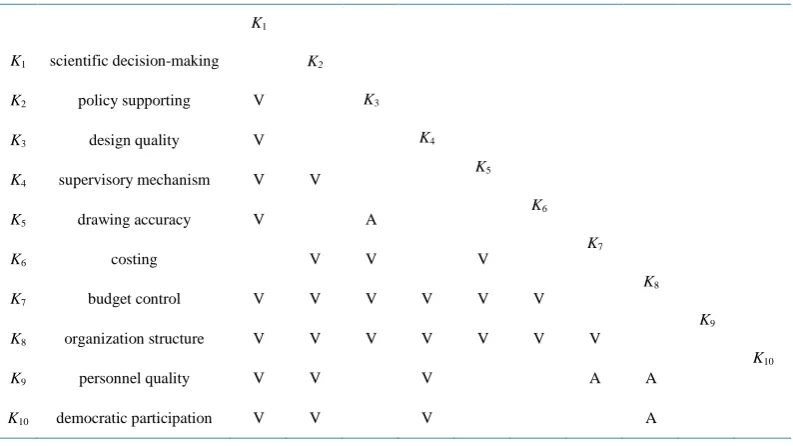
The ISM group had unified views on the result of the discussion and formed the causal relationship between risk factors after analysis of multiple iterations through iterative analysis repeatedly. In order to express conveniently and uniformly, “X” in the cell is used to illustrate the row factor and the column factor influence each other, “V” means the row factor has influence to the column factor, while “A” has the opposite meaning, and the cell in space means there is no relationship between row factor and column factor (Table 1).
According to the results above, an adjacent matrix can be built. For the top 10 risk factors of e-business
(
1, 2, ,10)
i
[image:3.595.100.497.493.716.2]K i= , “1” means Ki is influential to Kj, otherwise, “0” is used. So the relationship in Table 1 can be expressed as the adjacency Matrix (1) as follows:
Table 1. The relationship among the top 10 risk factors of GZA project implementation.
K1
K2
K3
K4
K5
K6
K7
K8
K9
K10
K1 scientific decision-making
K2 policy supporting V
K3 design quality V
K4 supervisory mechanism V V
K5 drawing accuracy V A
K6 costing V V V
K7 budget control V V V V V V
K8 organization structure V V V V V V V
K9 personnel quality V V V A A
1 2 3 4 5 6 7 8 9 10 1 2 3 4 5 6 7 8 9 10
0 1 1 1 0 1 1 1 0 1
0 0 0 1 0 1 1 1 0 1
0 0 0 0 1 1 1 0 0 0
1 0 0 0 0 0 1 0 1 1
0 0 1 0 0 1 1 0 0 0
0 0 1 0 1 0 1 0 0 0
0 0 0 0 0 1 0 1 0 0
0 0 0 1 0 0 0 0 0 0
0 0 0 0 0 0 1 1 0 0
1 0 0 1 0 0 0 1 0 0
K K K K K K K K K K
K K K K K A K K K K K = (1)
According to the formula
(
A+I)
k−1 ≠(
A+I) (
k = A+I)
k+1 =R (I is referred to the unit matrix), the reacha-ble Matrix (2) is acquired as follows with the ISM WIN 1.1 software:1 2 3 4 5 6 7 8 9 10
1 2 3 4 5 6 7 8 9 10
1 1 1 1 0 1 1 1 1 1
0 1 0 1 0 1 1 1 1 1
0 0 1 0 0 1 1 1 0 0
0 0 0 1 0 0 1 1 1 1
0 0 1 0 1 1 1 1 0 0
0 0 0 0 0 1 1 1 0 0
0 0 0 0 0 0 1 1 0 0
0 0 0 0 0 0 0 1 0 0
0 0 0 0 0 0 1 1 1 0
0 0 0 0 0 0 0 1 0 1
K K K K K K K K K K
K K K K K R K K K K K = (2)
The set for each factor Ki is obtained with the reachable matrix R:
( )
i{
j ij 1}
P K = K m = (3)
( )
i{
j ji 1}
Q R = K m = (4)
( )
i( )
i( )
iP K Q K =T K (5)
( )
iP K is called to reachable set, namely the set of all the reachable factors from factor K Q Ki⋅
( )
i , called advanced set, refers to the set of all the factors can reach K Q Ri⋅( )
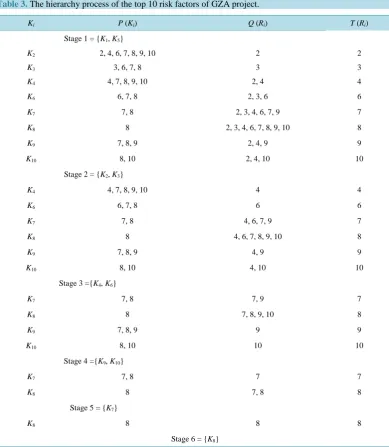
i means the universal set, which is the set of all the factors both belong to the reachable set and the advanced set (Table 2).The relationship description of the top 10 risk factors above is not intuitive enough. To express the relation-ship more clearly, the hierarchy is further analyzed (Table 3).
3.3. Building the Hierarchical Interpretative Structural Model of Risk Factors of
GZA Project Implementation
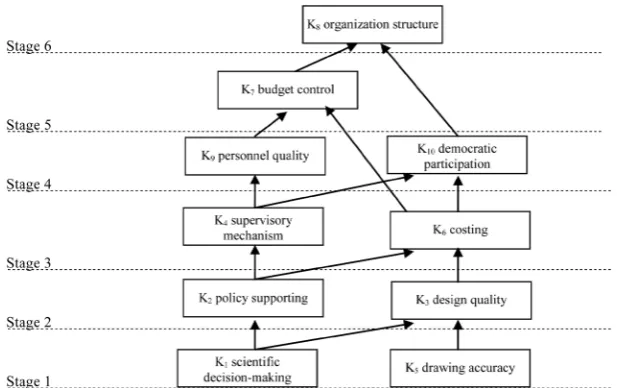
According to the hierarchy of the top 10 risk factors of GZA project implementation, the ISM model of the top 10 risk factors of GZA project implementation is established (Figure 1).
Table 2. The reachable set, advanced set and universal set of the top 10 risk factors of GZA project.
Ki P (Ki) Q (Ri) T (Ri)
K1 1, 2, 3, 4, 6, 7, 8, 9, 10 1 1
K2 2, 4, 6, 7, 8, 9, 10 1, 2 2
K3 3, 6, 7, 8 1, 3, 5 3
K4 4, 7, 8, 9, 10 1, 2, 4 4
K5 3, 5, 6, 7, 8 5 5
K6 6, 7, 8 1, 2, 3, 5, 6 6
K7 7, 8 1, 2, 3, 4, 5, 6, 7, 9 7
K8 8 1, 2, 3, 4, 5, 6, 7, 8, 9, 10 8
K9 7, 8, 9 1, 2, 4, 9 9
K10 8, 10 1, 2, 4, 10 10
Table 3. The hierarchy process of the top 10 risk factors of GZA project.
Ki P (Ki) Q (Ri) T (Ri)
Stage 1 = {K1, K5}
K2 2, 4, 6, 7, 8, 9, 10 2 2
K3 3, 6, 7, 8 3 3
K4 4, 7, 8, 9, 10 2, 4 4
K6 6, 7, 8 2, 3, 6 6
K7 7, 8 2, 3, 4, 6, 7, 9 7
K8 8 2, 3, 4, 6, 7, 8, 9, 10 8
K9 7, 8, 9 2, 4, 9 9
K10 8, 10 2, 4, 10 10
Stage 2 = {K2, K3}
K4 4, 7, 8, 9, 10 4 4
K6 6, 7, 8 6 6
K7 7, 8 4, 6, 7, 9 7
K8 8 4, 6, 7, 8, 9, 10 8
K9 7, 8, 9 4, 9 9
K10 8, 10 4, 10 10
Stage 3 ={K4, K6}
K7 7, 8 7, 9 7
K8 8 7, 8, 9, 10 8
K9 7, 8, 9 9 9
K10 8, 10 10 10
Stage 4 ={K9, K10}
K7 7, 8 7 7
K8 8 7, 8 8
Stage 5 = {K7}
K8 8 8 8
[image:5.595.102.492.271.719.2]Figure 1. The hierarchical structure model of the top 10 risk factors of GZA project.
4. Conclusion
The key risk factor of interpretative structural model to analyze the top 10 risk factors of GZA project imple-mentation was established. The result illustrated that the relationship among the risk factors of GZA project im-plementation is the complex network of relationships which is like a pagoda: the root risks are risk of scientific decision-making and risk of drawing accuracy, and risk of organization structure is on the top floor. Those three risks are the most critical factors which affect GZA project implementation’s success or failure. We hope that the research will be enlightenment for GZA project implementation.
Acknowledgements
Thanks for helpful discussion with Mr. Jing Xia, and Mr. Guoping Zhang etc.
References
[1] Wan, J.P. and Pan, G.W. (2014) Top 10 Key Risk Factors of GZA Project Implementation are Identified with Analytic Hierarchy Process. Open Journal of Business and Management, 2, 172-179.
http://dx.doi.org/10.4236/ojbm.2014.23021
[2] 233 Network School (2008) The Classification and Characteristics of Engineering Project Risk Management and Countermeasures. http://www.233.com/jzs1/xmgl/fudao/20080922/085417974.html
[3] Zhao, Z.Y., Liu, Y.S. and Yang, H.C. (2002) Application of Fault Tree Analyzing Method to Risk Management of a Construction Project. Modern Electric Power, 19, 95-99.
[4] Guo, P. and Shi, P.G. (2005) Research on Fuzzy-Grey Comprehensive Evaluation Method of Project Risk. Journal of
Xi’an University of Technology, 21, 106-109.
[5] Zhao, H. and Yin, Y.L. (2011) An Analysis of Influencing Factors of Reasonable Risk Allocation in Construction Project Based on Interpretative Structural Modeling, Journal of Beijing Institute of Technology (Social Sciences Edi-tion), 13,15-19.
[6] Warfield, J.N. (1976) Societal Systems: Planning, Policy, and Complexity, Wiley Interscience, New York, 208-366.
[7] Cheng, B. (2010) Empirical Analysis on the Capability of Our Entrepreneures Factors Based on ISM. Mathematics in
Practice and Theory, 40, 71-79.
[8] Wan, J.P. and Hou, J.J. (2012) Research on SAP Business One Implementation Risk Factors with Interpretive Struc-tural Model. Journal of Software Engineering and Applications, 5, 147-155.
http://dx.doi.org/10.4236/jsea.2012.53022
[9] Wan, J.P., Cao, Y.H. and Hou, J.J. (2013) Case Study on H Corp. Software Project Risk Management with ISM.
Technology and Investment, 4, 145-152. http://dx.doi.org/10.4236/ti.2013.43017