Robust Image Watermarking based on
DCT-DWT-SVD Method
Sneha Jose
Department of Electronics and communication
Federal Institute of Science and Technology (FISAT)
Rajesh Cherian Roy,
PhD. Department of Electronics andcommunication
Federal Institute of Science and Technology (FISAT)
Sreenesh Shashidharan
Department of Electronics and communication
Federal Institute of Science and Technology (FISAT)
ABSTRACT
Hybrid Image watermarking scheme proposed based on Discrete Cosine Transform (DCT)-Discrete Wavelet Transform (DWT)-Singular Value Decomposition (SVD). The cover image is reordered before DCT is applied. The DCT coefficients of the reordered image are decomposed into sub bands using DWT. The singular values of the middle sub bands are found and watermark is embedded. Simulation results shows that this method can survive attacks like rotation, cropping, JPEG compression and noising attacks and also can be used for copyright protection of multimedia objects.
Keywords
Discrete Wavelet transforms, Singular Value Decomposition, Discrete cosine transform.
1.
INTRODUCTION
Digital Watermarking is a technique to embed an imperceptible data called “watermark” into multimedia objects so as to discourage unauthorized copying or attesting the origin of the images. The invisible watermark is embedded in such a way that the modification made to the pixel value is perceptually not noticed, and it can be recovered only with an appropriate extraction mechanism. The embedding of the watermark into the cover image must be done in such a way to achieve efficient tradeoffs among the three conflicting objectives of maximizing the strength of watermark to be inserted, minimizing distortion between the cover image and watermarked image, and maximizing the resilience to attacks. The effectiveness of a digital watermarking algorithm is indicated by the robustness of watermarked signal against degradations. These degradations may result from processing and transmission or from deliberate/intentional attacks. Deliberate attacks are performed to destroy the watermark. Watermarking can be categorized according to their processing domain, signal type of the watermark, and hiding location. Watermark embedding is performed in either spatial domain or frequency domain. There are different types of attacks: geometrical attacks, noising attack, de-noising attack, compression attack and image processing attack. Geometrical attack causes synchronization errors during the extraction process of the watermark due to which the quality of the extracted watermark is affected. Watermark has to be embedded in the invariant transform domain to counteract the synchronization errors
.
Commonly used metrics to evaluate image quality are peak-signal-to-noise ratio (PSNR), weighted PSNR (wPSNR), and the Watson just noticeable difference (JND) [1], structural
similarity index measure (SSIM). These metrics can help in achieving the tradeoff between the desired quality and the strength of watermark to be embedded.
More recently, different watermarking techniques and strategies have been proposed in order to solve a number of problems ranging from the detection of content manipulations, to information hiding (steganography), to document usage tracing. The watermarking scheme proposed in this paper is a non-blind watermarking scheme, since it requires the original image to extract the watermark image, is for copyright protection.
This paper focuses on possible attacks against a image watermarking techniques, and work out an effective robust method based on DCT-DWT-SVD that must satisfy the requirements of watermarking scheme [2]. Watermark insertion is done by reordering the cover image and then applying the transforms. The watermark is embedded in the to the middle frequency bands of the DWT of an image. The proposed approach has the following advantages:1) The extracted watermark is visually recognizable to claim one’s ownership; 2) The scheme has multiresolution characteristics; 3) The embedded watermark is hard to detect by human visual perceptivity; 4) The scheme is very robust against attacks. The transforms used are briefly described in section II. The proposed hybrid non-blind watermarking scheme is presented in the section III. The simulation results are illustrated in section IV, and the concluding remarks are drawn in section V.
2.
BASICS OF TRANSFORMS USED
FOR WATERMARKING
2.1
Discrete Cosine transform (DCT)
DCT is used to linearly transform image to frequency domain. The energy of the image is concentrated in only a few low frequency components of DCT depending on the correlation in the data.
2.2
Discrete Wavelet Transform (DWT)
the sub-band coding, is repeated for further decomposition in order to make a multiresolution analysis.
2.3
Singular Value decomposition (SVD)
Singular Value Decomposition is an optimal method for matrix decomposition. SVD is known for its stability, proportion invariance and rotation invariance properties. SVD is a general linear algebra technique which is used for packing the maximum signal energy into a few coefficients as possible.
The SVD theorem decomposes a digital image A of size M× N, as:
= , (1) Where U and V are of size M×M, and N ×N respectively. S is
a diagonal matrix containing the singular values. In watermarking trial, SVD is applied to the image matrix; then watermark resides by altering singular values (SVs).The properties of SVD [2].
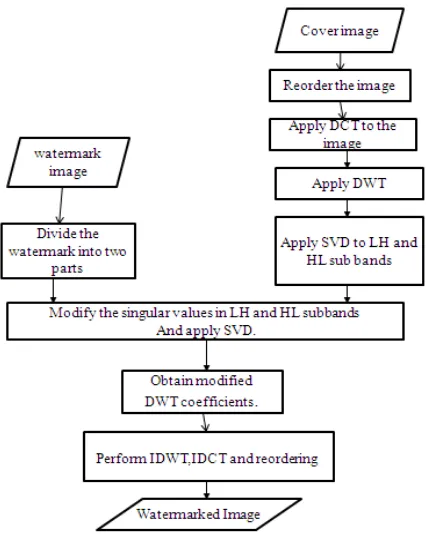
Fig. 1 shows the flowchart of watermark embedding process.
3.
PROPOSED METHOD
The main steps in the proposed hybrid method for non-blind watermarking are summarized below.
3.1
Proposed Method Algorithm
3.1.1
Watermark Insertion
1. The cover image matrix is reordered in a zigzag manner.
Fig. 2. Shows the zigzag reordering of the image matrix.
2. Apply Discrete Cosine transform (DCT) to the reordered cover image matrix.
3. Apply one-level Haar DWT to the DCT coefficients of the reordered image into four subbands. 4. Apply SVD to LH and HL subbands.
Ak=UkSkVkT k=1,2 (2)
5. Watermark is divided into two parts W=W1+W2 where Wk denotes half of the watermark.
6. Change the singular values in HL and LH subbands with half of the watermark image and then apply SVD to them, respectively, i.e.;
Sk+αWk = Uwk Swk VwkT (3)
whereα denotes the scale factor. The scaling factor . is for varying the strength of the watermark to be
inserted.
7. Obtain the two sets of modified DWT coefficients. i.e.,
A*k= UkSwkVkT (4)
8. Perform the inverse DWT using two sets of modified DWT coefficients and two sets of non modified DWT coefficients.
9. Perform inverse DCT of the above obtained image matrix.
10. Obtain the watermarked image Aw by reordering the
image matrix in a zigzag manner.
3.1.2
Watermark Extraction
[image:2.595.363.536.81.158.2] [image:2.595.64.277.284.551.2]1. The watermarked image I*W is reordered in a zigzag
manner.
Fig. 4. Shows the zigzag reordering of the image matrix.
2. Apply DCT to the reordered watermarked image and find the DCT coefficients.
3. Use one-level Haar DWT to decompose DCT coefficients into four subbands.
4. Apply SVD to the LH, HL subbands A*kW=U
*k
S*kWV
*kT
(5) 5. Compute
B*k =UkW (S*kW )VWkT , k=1,2 (6)
6. Extract each half of the watermark image from the LH and HL subbands.
W*k=(B*k- Sk) /α ,k=1,2 (7) 7. Add the results in step 6 to obtain the watermark
image.
W=W*1+W*2 (8)
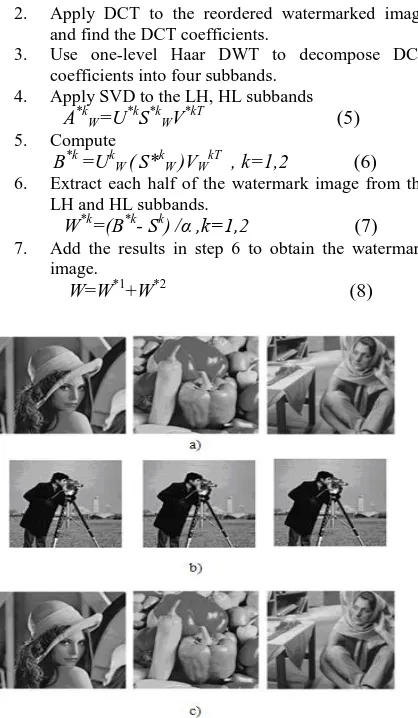
Fig. 5.a) Shows the cover images used Lena, peppers and Barbara of size 256 x 256.b) Shows the watermark image used cameraman of size 128x128. c) Shows the
watermarked images.
a) b) c) d) e) f)
Fig. 6.a)-c) Shows the extracted watermark after JPEG compression. d)-f) Shows the extracted watermark after noising attack.
4.
SIMULATION RESULTS
We have tested the proposed watermarking scheme on the popular gray scale test images Lena, Barbara, and Peppers of size 256 x 256 as our cover image and cameraman 128 x 128 as the watermark image.
4.1
Imperceptibility test:
[image:3.595.78.277.69.213.2]Imperceptibility property must be preserved by watermarking scheme. In order to compare the cover image and watermarked image peak signal to noise ratio (PSNR) is used. The comparison of the PSNR values obtained by implementing the proposed and DWT-SVD method [3] is shown in the table below.
Table 1. Comparison of Peak Signal to Noise Ratio
Cover image Proposed
method
DWT-SVD Method
Lena 51.5564 50.2894
Peppers 51.7925 50.4406
Barbara 51.7341 50.9311
4.2
Robustness test:
The robustness against various attacks is test. The attacks are performed on the watermarked image and watermark is extracted from this watermarked image using the extraction algorithm described in section III. Pearson’s correlation coefficient is used to compare the correlation between the original watermark image and the extracted watermark images.
4.2.1
JPEG compression
:
This scheme can resist JPEG compression up to a quality factor of 30. Fig. 6(a) –(c) illustrates the simulation results after JPEG compression.
Table 2. Pearson’s Correlation Coefficient Values of Watermark extracted from JPEG Compressed Watermarked Image.
Compression factor
Proposed method DWT-SVD
Method
Best Average Best Average
10 0.9844 0.9661 0.9318 0.9083
20 0.9515 0.9286 0.8799 0.8545 30 0.9192 0.8993 0.8487 0.8170
4.2.2
Noising Attack:
[image:3.595.65.274.229.588.2]The Gaussian noise is added to the watermarked image. The Fig. 6(d)-(f) shows the watermarks detected.
Table 3. Pearson’s Correlation Coefficient Values of Watermark extracted from Gaussian Noise added Watermarked Image.
Mean Value Proposed method DWT-SVD
Method
0.8 0.9998 0.9994 0.9998 0.9995
[image:3.595.59.275.645.712.2]4.2.3
Signal Processing:
[image:4.595.307.540.101.269.2]The watermark can be detected after the watermarked image suffered common signal processing. Fig. 7(a)-(c) shows the simulation results for average filtering or blurring.
Table 3. Pearson’s Correlation Coefficient Values of Watermark extracted from Average Filtered Watermarked Image.
Mean Value Proposed
method
DWT-SVD Method
0.8 0.9998 0.9994 0.9355 0.9120 1.2 0.9994 0.9968 0.9078 0.9001 1.6 0.9992 0.9543 0.8422 0.7912
4.2.4
Cropping
:
[image:4.595.44.274.152.260.2]From the simulation results (given in Table 4), it can be seen that the proposed scheme is robust to cropping. As shown in Fig. 7(d)-(f), the watermarks can be detected even after the watermarked image suffer the cropping 50% off.
Table 4. Pearson’s Correlation Coefficient Values of Watermark extracted from Cropped Watermarked Image. Cropping Proposed method DWT-SVD Method
Best Average Best Average
¼ columns from left
0.9920 0.9776
0.8678 0.8316
¼ rows from right
0.9886 0.9533
0.8440 0.8316
½ columns from left
0.9156 0.8979
0.8168 0.7846
4.2.5
Rotation:
[image:4.595.319.536.314.383.2]The simulation results given in Table 5 illustrate the fact that the proposed scheme is more robust to rotation than DWT-SVD scheme [3] .Fig. 8(a)-(c) shows the simulation results for different angles of rotation.
Table 5. Pearson’s Correlation Coefficient Values of Watermark extracted from Cropped Watermarked Image. Rotated By Proposed method DWT-SVD Method
Best Average Best Average
450 0.9055 0.8376
0.9003 0.6691 600 0.9734 0.9319
0.9545 0.8556 900 0.9909 0.9778
0.9897 0.9144
4.2.6
Contrast adjustment:
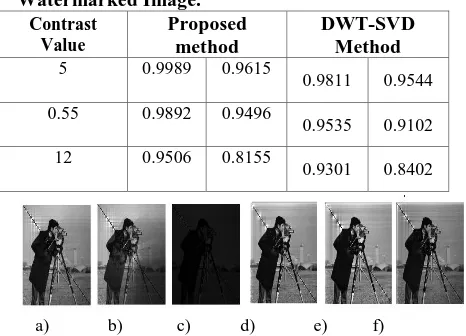
The simulation results in table 6 shows that this scheme is more resilient to contrast adjustment than DWT-SVD scheme [3].Fig 8(d)-(f) shows the simulation results for contrast adjustment for different values.
Table 6. Pearson’s Correlation Coefficient Values of Watermark extracted from Contrast Adjusted Watermarked Image. Contrast Value Proposed method DWT-SVD Method
5 0.9989 0.9615
0.9811 0.9544 0.55 0.9892 0.9496
0.9535 0.9102 12 0.9506 0.8155
0.9301 0.8402
a) b) c) d) e) f)
Fig. 7.a)-c) Shows the extracted watermark after average filtering attack. d)-f) Shows the extracted watermark after cropping attack.
a) b) c) d) e) f)
Fig. 8.a)-c) Shows the extracted watermark after Rotation Attack. d)-f) Shows the extracted watermark after Contrast Adjustment Attack.
5.
CONCLUSION
A novel hybrid watermarking scheme based on DCT-DWT-SVD is proposed in this paper. In this method, the watermark is embedded very deep into the cover image since three transform (DCT, DWT, SVD) are taken before embedding the watermark which help in resilience the attacks. This method can be used for copyright protection, tamper detection, fingerprinting, authentication and secure communication. The proposed scheme is robust to JPEG compression, noise adding attacks, contrast adjustment attack, cropping attack, rotation attack and other signal proceeding attacks. Better robustness is obtained at the expense of increased computation time. Experimental results are presented to claim the robustness and correctness of the proposed watermarking process
.
6.
REFERENCES
[1] Q. Li, C. Yuan, and Y.-Z. Zhong, “Adaptive DWT-SVD Domain Image Watermarking Using Human Visual Model”. In proceedings of 9th International Conference on Advanced Communication Technology.Gangwon-Do,South Korea, pp. 1947-1951.
[2] R. Liu and T. Tan, “An SVD-based watermarking scheme for protecting rightful ownership”.IEEE Trans. Multimedia,vol. 4, no. 1, pp. 121–128, March 2002. [3] Chih-Chin Lai and Cheng-Chih Tsai.” Digital image
watermarking using discrete wavelet transform and singular value decomposition”. IEEE Transactions on instrumentation and measurement, Vol. 59.No. 11.2010. [4] F. Ahmed and I. S.Moskowitz.”Correlation-based
[image:4.595.47.274.573.692.2]Applications”. Opt. Engineering. Vol 43, No. 8,pp. 1833-1835.Aug 2004.
[5] H.T. Wu and Y.M. Cheung,”Reversible watermarking by modulation and security enhancement,” IEEE transactions on Instrumentation and measurement, Vol.59, No.1, pp.221-228 , Jan 2010.
[6] V. Aslantas, L. A. Dog˘an, and S. Ozturk. “DWT-SVD based Image watermarking using particle swarm optimizer”. In proceedings of IEEE International Conference on Multimedia Expo. Hannover, Germany, 2008,pp. 241-244.
[7] S.G. Mallat,”A Theory for Multiresolution signal decomposition: The wavelet representation,” IEEE transactions on Pattern Analysis Machine Intell., Vol.11, no.7, pp.654-693, Jul.1989.
[8] A. Nikolaidis and I. Pitas, “Asymptotically optimal detection for additive watermarking in the DCT and DWT domains,” IEEE transactions on Image Processing ,Vol. 12,no. 5,pp.563-571,May 2003.